
淘宝

Search documents
比音勒芬,净利润下滑丨消费参考
2 1 Shi Ji Jing Ji Bao Dao· 2025-11-07 01:45
Group 1 - The core viewpoint of the article highlights that despite a fashion show showcasing its brand, Biyinlefen is experiencing a decline in profits, with a 27.4% drop in net profit for Q3 compared to the previous year [1] - In Q3, Biyinlefen's revenue increased by 3.2% year-on-year to 1.1 billion yuan, while net profit fell to 210 million yuan [1] - For the first three quarters, the company's revenue grew by 6.7% to 3.2 billion yuan, but net profit decreased by 18.7% to 620 million yuan [1] - The increase in sales expenses by 27.8% is attributed to investments in brand rejuvenation, new brand launches, and e-commerce initiatives [1] - Biyinlefen has acquired two international brands, CERRUTI1881 and KENT&CURWEN, which are currently in the investment phase, leading to projected losses for the operating subsidiary [1] - The inventory turnover period increased by 55 days, likely due to new brand incubation and early preparations for e-commerce peak seasons [1] Group 2 - A founder of a leading men's clothing brand noted that domestic high-end brands are gaining opportunities as overseas luxury goods lose their allure, although growth is becoming increasingly challenging [2] - Biyinlefen's willingness to increase market investment indicates the company's optimism about future prospects [2]


美股盘前要点 | 苹果或将联手谷歌推出新版Siri!马斯克万亿薪酬方案投票在即
Ge Long Hui· 2025-11-06 12:33
Market Overview - US stock index futures showed slight increases, with Nasdaq futures up 0.09%, S&P 500 futures up 0.13%, and Dow futures up 0.06% [1] - Major European indices collectively declined, with Germany's DAX down 0.33%, UK's FTSE 100 down 0.2%, France's CAC down 0.68%, and the Euro Stoxx 50 down 0.26% [1] Company Developments - The US Supreme Court debated the legality of Trump's large-scale tariffs, with a majority of justices expressing skepticism [2] - Apple plans to pay approximately $1 billion annually to Google, with the new Siri integrating the Gemini large model set to launch next year [2] - Tesla will hold its annual shareholder meeting on November 6, where shareholders will vote on Musk's $1 trillion compensation plan [2] - Tesla has reportedly restarted the development of the Roadster electric supercar, with production expected to take at least two to three more years [2] - As of November 5, Taobao's flash sales have generated over 100 million e-commerce orders during the Double 11 shopping festival [2] - Xpeng unveiled a new generation humanoid robot designed with a female appearance, with plans for mass production in April next year [2] - SoftBank reportedly considered a $100 billion acquisition of Mellanox Technologies, potentially merging it with its Arm subsidiary [2] - Starbucks employees at US locations plan to strike next week, targeting the holiday sales peak known as "Red Cup Day" [2] - EchoStar and SpaceX reached a revised final agreement, increasing the total transaction price to $19.6 billion [2] Financial Performance - Qualcomm's Q4 revenue reached $11.27 billion, exceeding expectations, despite a net loss of $3.12 billion due to tax expenses [2] - Arm's Q2 revenue was $1.14 billion, with net profit soaring 122% year-over-year to $238 million, both surpassing expectations [2] - AstraZeneca reported a 12% year-over-year increase in Q3 revenue to $15.191 billion, with core earnings per share at $2.38 [2] - AppLovin's Q3 revenue grew 68.9% year-over-year to $1.41 billion, with a significant $3.2 billion allocated for share buybacks [2] - Lyft's Q3 revenue was $1.69 billion, slightly below expectations, while total bookings reached a record $4.8 billion [2] - Duolingo's Q3 performance exceeded expectations, but Q4 booking guidance fell short, indicating a potential slowdown in daily active user growth [2] - Lucid's Q3 revenue increased 68% year-over-year to $340 million, though it still fell short of expectations, with a net loss of approximately $980 million [2] - Snap's Q3 results surpassed expectations, and the company entered a $400 million partnership with AI startup Perplexity [2]
QuestMobile2025 中国移动互联网秋季大报告: 互联网广告规模接近2000亿
Sou Hu Cai Jing· 2025-11-05 11:07
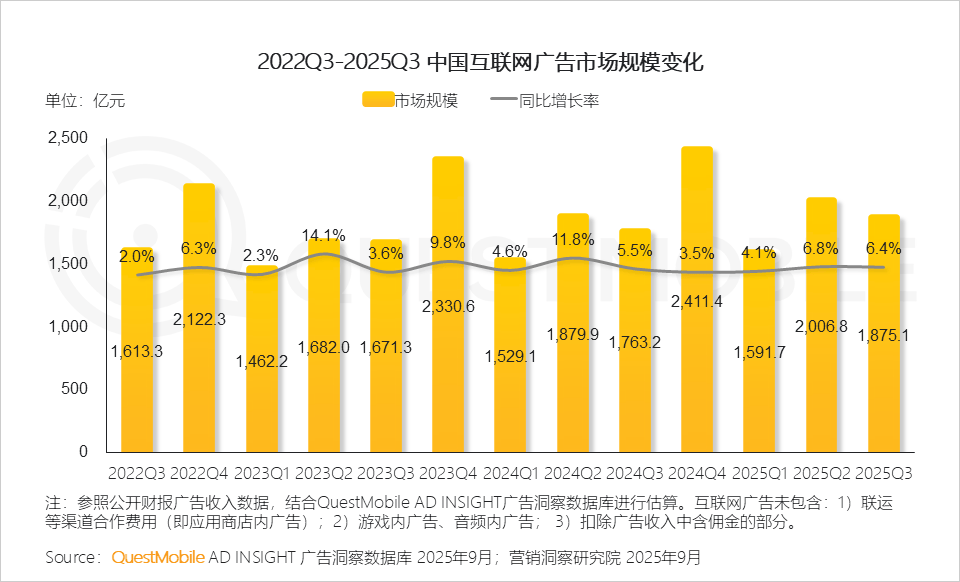
Core Insights - The report by QuestMobile indicates that as of September 2025, the total number of internet users in China reached 1.269 billion, marking a 2% year-on-year increase, with average monthly usage time per user at 178.2 hours, up 8.2%, the highest growth rate in nearly a year [1] - The mobile internet industry is entering a phase of high-quality development, reflected in the rapid growth of the internet advertising market, which reached 187.51 billion yuan in Q3 2025, a 6.4% year-on-year increase [1] Group 1: User Demographics and Trends - The user structure of China's mobile internet is evolving towards a healthier demographic, with first-tier city users accounting for 11.2% of the total, a 0.8% increase year-on-year [3] - Users with online consumption capabilities between 1,000 to 2,999 yuan represent 63% of the total, up 0.9% year-on-year, while users aged 46 and above make up 37.7%, an increase of 1.1% [3][5] Group 2: Advertising Market Dynamics - The soft advertising market is becoming a battleground for various industries, driven by lower costs and more direct conversion effects, aligning with the current shift towards a "trust economy" [3][5] - Marketing strategies are focusing on quickly attracting traffic and achieving conversion loops, with brands leveraging IP collaborations and celebrity endorsements to enhance conversion rates [5] Group 3: Seasonal Marketing Trends - Marketing activities are increasingly aligned with seasonal events, with significant peaks during occasions like Qixi Festival and Mid-Autumn Festival, which serve as key marketing opportunities [7] Group 4: Hard Advertising Strategies - Hard advertising is stabilizing but is becoming more precise and aggressive in response to intensified competition and innovation within the industry [8] - Key players in hard advertising include beauty, personal care, luxury goods, and healthcare sectors, with basic consumer goods also showing strong growth [9] Group 5: E-commerce and Competitive Landscape - The competition among e-commerce platforms is intensifying, with advertising strategies closely tied to business layouts and subsidy plans, emphasizing precision and aggressiveness [11] - Major platforms like Taobao and Douyin are seeing significant budget allocations due to their high transaction proximity and user engagement [13]

放过双十一 刘强东才能讲出新故事
Sou Hu Cai Jing· 2025-11-04 19:37
Core Viewpoint - The recent promotional strategies of JD.com, particularly the "million cash reward" for price comparison, reflect a reliance on outdated marketing tactics that may not resonate with today's consumers [1][3][4]. Group 1: Marketing Strategies - JD.com is attempting to revive old promotional tactics, such as cash rewards for price comparisons, reminiscent of strategies used over a decade ago [3][4]. - The current price comparison campaign is limited to the home appliance category, neglecting other significant categories like clothing and beauty products, which may not effectively enhance JD.com's low-price perception [4]. - The marketing approach appears to lack innovation, as evidenced by the repetitive nature of campaigns and the recent replacement of JD.com's retail marketing head [3][4]. Group 2: Competitive Landscape - JD.com faces increasing competition from platforms like Pinduoduo and Douyin, which are gaining market share without relying heavily on traditional promotional tactics [9]. - The company's efforts to expand into new areas, such as food delivery and local services, have shown initial promise but face challenges in sustaining momentum against competitors [6][9]. - JD.com's ambition to surpass Alibaba's Tmall has been complicated by the emergence of Pinduoduo, shifting the focus from leading the market to merely competing for second place [8][9]. Group 3: Leadership and Strategy - Liu Qiangdong's personal involvement in various initiatives, such as the food delivery business, reflects a hands-on leadership style but raises questions about the long-term strategic direction of JD.com [6][8]. - The company's historical successes in marketing, such as the 618 shopping festival, contrast sharply with its current reliance on outdated methods, indicating a potential strategic blind spot [8]. - There is a need for JD.com to adopt more effective and innovative business practices rather than relying on traditional marketing strategies to drive growth [9].


“饿了么”将更名为“淘宝闪购” 骑手已同步更换为淘宝橙工服
Xin Lang Cai Jing· 2025-11-04 13:13
Core Viewpoint - The company "Ele.me" has been rebranded as "Taobao Flash Purchase," with the app currently undergoing a gray testing phase for select users [2] Group 1: Name Change and Testing Phase - The "Ele.me" app icon now displays "Double 11 Taobao Flash Purchase," indicating the rebranding [2] - "Taobao Flash Purchase" is in a gray testing phase, allowing a limited number of users to experience food delivery and daily necessities instant delivery services [2] Group 2: Operational Continuity - Ele.me's delivery capacity is fully supporting Taobao Flash Purchase orders, covering a wider range of product categories [2] - Customer service representatives confirmed that the name change does not affect user rights, data privacy policies, or delivery operations, which remain normal [2]
“双11”短剧带货火了!淘宝、京东、拼多多纷纷入局!
Zheng Quan Shi Bao Wang· 2025-11-04 04:42
Core Insights - Short dramas have emerged as a new entry point for user attention amidst the peak of traditional e-commerce traffic and high customer acquisition costs, becoming a focal point for e-commerce and content platforms during this year's "Double 11" shopping festival [1][5] Group 1: Short Drama and E-commerce Integration - ByteDance's free short drama app, Hongguo Short Drama, is testing a new e-commerce feature that allows users to purchase items related to the content, focusing on categories like clothing and accessories [2][3] - Hongguo Short Drama has seen rapid user growth, with monthly active users reaching 210 million in June, a 179% year-on-year increase, surpassing long video platform Youku [2][3] - The integration of short dramas with e-commerce is seen as a way to enhance user engagement and create new consumption scenarios, with platforms competing for user attention and viewing time [6][7] Group 2: Industry Challenges and Perspectives - The short drama e-commerce model faces challenges, including balancing content quality with commercialization, increasing content homogenization leading to user fatigue, and ensuring supply chain and fulfillment capabilities [3][6] - Some industry experts argue that the short format and high information density of short dramas may not align well with e-commerce, potentially disrupting user experience [3] Group 3: E-commerce Platforms' Strategies - Major e-commerce platforms like Taobao, JD.com, and Pinduoduo are actively investing in short dramas, utilizing various models to enhance their presence in this space [4][6] - JD.com has launched customized dramas featuring brands, while Taobao has integrated shopping links within short dramas, indicating a strategic shift to leverage short-form content for sales [4][6] Group 4: Market Growth and Future Prospects - The short drama market in China is projected to grow significantly, with estimates suggesting it will reach 67.79 billion yuan by 2025, a 34.4% year-on-year increase, and exceed 150 billion yuan by 2030 [7][8] - The industry is evolving with increased investment and policy support aimed at promoting high-quality short dramas, moving away from low-quality content towards more refined productions [7][8]
“赛事流量”转为“消费增量” 全市重点商圈街区3天交易额26.2亿元
Nan Jing Ri Bao· 2025-11-04 03:34
Core Insights - The event themed "Super League Final Night, City Carnival" in Nanjing successfully integrated commerce, culture, tourism, and sports, converting event traffic into consumer spending [1][2] - From October 31 to November 2, Nanjing's key commercial areas recorded a transaction amount of 26.2 billion yuan, a year-on-year increase of 20.1% [1] - On the day of the match, e-commerce platform Taobao Flash Sale in the Nanjing region saw a transaction volume increase of 92% and order volume increase of 155% compared to the previous year [1] Commercial and Tourism Impact - The influx of fans and tourists significantly boosted the restaurant and accommodation sectors, with a reported average occupancy rate of 85.9% for 35 monitored hotels from October 31 to November 1, up 4.9% year-on-year [2] - During the same period, foot traffic in monitored department stores and accommodation and dining businesses increased by 9.2% and 15.9% respectively [2] - The "second viewing site" expanded to over 100 locations, creating a multi-dimensional layout that connected core venues, commercial districts, and scenic spots, enhancing consumer engagement [2] Event-Driven Activities - Various themed activities were organized in key "second viewing site" areas, such as the "Follow 'Super League' to 'Read the City'" event, which attracted over 30,000 visitors and increased street area revenue by 40% [2] - The "Nanjing Literature Night" event at Jinling STYLE saw nearly 30,000 visitors, a 78% increase compared to the previous week [2] Online Consumption Growth - The city's commerce bureau collaborated with platforms like Meituan, Taobao, Didi, and Gaode to expand the issuance of digital consumption vouchers, with Taobao Flash Sale investing 50 million yuan in vouchers over three days [3] - On the day of the event, Meituan's overall transaction scale in Nanjing increased by 9.2%, with 20.7% of transactions coming from users outside the region, marking a 27.7% year-on-year growth [3]
饿了么将正式更名为淘宝闪购
Ge Long Hui· 2025-11-04 01:50
(责任编辑:宋政 HN002) 【免责声明】本文仅代表作者本人观点,与和讯网无关。和讯网站对文中陈述、观点判断保持中立,不对所包含内容 的准确性、可靠性或完整性提供任何明示或暗示的保证。请读者仅作参考,并请自行承担全部责任。邮箱: news_center@staff.hexun.com 格隆汇11月4日|综合市场消息,11月3日,不少用户发现,饿了么App完成版本号更新至12. 0.1后,已 正式更名为"淘宝闪购"。据悉,目前"淘宝闪购"正处于灰度测试阶段,仅对部分用户开放体验。此次更 新的"淘宝闪购"标语为"外卖放心点,美食准时达"。灰度测试期间,部分用户可通过"淘宝闪购"体验餐 饮外卖及日用百货等即时配送服务。目前,饿了么的配送运力已全面承接淘宝闪购订单,覆盖更多品 类。 ...
赢了世界却败在中国:全球首富携6万亿资产,黯然撤出中国市场
Sou Hu Cai Jing· 2025-11-03 13:08
Core Insights - Amazon, once a dominant player in global e-commerce and cloud computing, faced significant challenges in the Chinese market, ultimately leading to its exit in 2019 [1][11][17] - The company's failure in China highlights the importance of local adaptation and understanding consumer behavior in a rapidly changing market [15][17][18] Group 1: Market Entry and Initial Performance - Amazon entered the Chinese market in 2004 by acquiring Joyo.com for $75 million, positioning itself ahead of local competitors like Taobao and JD.com [3] - At its peak, Amazon held approximately 15% of the Chinese e-commerce market share, but by 2018, this had plummeted to just 0.6% [3] Group 2: Reasons for Failure - Amazon's standardized business model, which worked well in the U.S., failed to resonate with Chinese consumers who preferred a more interactive and social shopping experience [5][9] - The company's website design was overly simplistic compared to local platforms, which offered more engaging and detailed product pages [5] - Amazon's customer service and logistics were not competitive, with slower delivery times and outdated payment methods compared to local players [5][7] Group 3: Management and Operational Challenges - Amazon's lack of local management authority hindered its ability to respond quickly to market changes, as decisions had to be approved by headquarters [7][9] - The company's reliance on foreign executives led to a disconnect with the local market, resulting in ineffective strategies [7][15] Group 4: Strategic Shift Post-Exit - Following its exit from the Chinese e-commerce market, Amazon refocused on its strengths in cloud computing, with AWS projected to generate over $90 billion in revenue by 2024 [11][13] - Amazon's "Global Selling" initiative has become a key strategy, allowing Chinese sellers to reach international markets instead of competing directly with local e-commerce giants [13] Group 5: Lessons Learned - Amazon's experience in China serves as a cautionary tale for multinational companies, emphasizing the need for local understanding and adaptability in diverse markets [15][17][18] - The company's failure illustrates that success in global markets requires more than just replicating successful models; it necessitates a deep understanding of local consumer behavior and market dynamics [15][17]


小红书入局“生活服务”,互联网巨头争抢6万亿线下服务市场
Tai Mei Ti A P P· 2025-11-03 05:25
Core Insights - Xiaohongshu is expanding its commercialization efforts into the offline lifestyle services sector, which includes various industries such as tourism, education, and healthcare [2][4] - The search trends for lifestyle services on Xiaohongshu have seen significant growth, with a 37% increase in searches and a 39% increase in note publications since 2025 [2] - The overall growth rate of the offline service industry remains healthy, exceeding 5%, indicating strong consumer interest in experiential services [2] Industry Overview - The local lifestyle service market in China is projected to reach a scale of 38,881 billion yuan in 2025, with a year-on-year growth of 17.6%, and is expected to approach 60,000 billion yuan by 2028 [3] - The lifestyle service industry is characterized by a low online penetration rate, presenting significant growth opportunities [3] Xiaohongshu's Strategy - Xiaohongshu initially focused on the restaurant sector before expanding into a broader range of offline services [4][6] - The platform has introduced features such as store POI, hotel bookings, and a "Xiaohong Card" for users to enjoy discounts and exclusive offers [5] - Xiaohongshu's lifestyle services are primarily focused on advertising revenue, with some merchants establishing in-platform stores for transactions [6] Market Dynamics - The lifestyle service sector is undergoing a transition from non-standardized to standardized services, with a significant portion of consumer demand still unmet [8] - Major competitors like Meituan and JD.com are aggressively pursuing the online transformation of lifestyle services, with Meituan reporting a 77% year-on-year increase in order volume [9][10] - Xiaohongshu faces challenges in balancing its community-driven platform with commercial demands, as it seeks to optimize content relevance and improve conversion rates [12] Future Outlook - Xiaohongshu aims to enhance user experience by leveraging real user feedback and content presentation, which aligns with the experiential nature of service consumption [12] - The company is exploring new strategies, such as "lead live streaming," to improve post-engagement conversion efficiency [12]
