Momenta

Search documents
“十四五”答卷·创新驱动产业蝶变|技术创新助推中国新能源汽车驶向全球
Ke Ji Ri Bao· 2025-10-23 09:15
Core Insights - The 2025 Intelligent Connected Vehicle Conference showcased advancements in China's smart vehicle industry, highlighting innovations in autonomous driving and vehicle operation systems [1] - China's new energy vehicle (NEV) industry has achieved significant breakthroughs in production scale, core technologies, and supply chain ecosystems during the 14th Five-Year Plan, leading to a rise in global exports [1][3] Group 1: Industry Developments - The conference featured a fully autonomous Robotaxi operation model and a new generation of autonomous vehicles equipped with 33 high-precision sensors for comprehensive environmental recognition [1] - The integration of domestic chips in vehicles is emphasized, showcasing a model that incorporates products from ten leading Chinese chip manufacturers [1] - The Ministry of Industry and Information Technology noted the establishment of a complete industrial system encompassing smart cockpits, autonomous driving, and connected cloud control [1] Group 2: Technological Innovations - A new material developed by the Chinese Academy of Sciences enables a flexible battery that can withstand 20,000 cycles, improving energy density by 86% when used in composite cathodes [2] - Over the past five years, the charging efficiency of power batteries in China has increased by more than four times, with a domestic vehicle localization rate exceeding 95% [3] Group 3: Smart Mobility Transformation - The definition of "automobile" is evolving into a smart mobility terminal, integrating advanced voice interaction systems and real-time monitoring technologies for driver safety and comfort [3] - The automotive industry is entering an era of deep exploration in artificial intelligence, with innovations leading to five major transformations in new vehicles [3] Group 4: Collaborative Innovation - The "vehicle-road-cloud integration" system addresses challenges in signal recognition for autonomous driving, enhancing safety through real-time traffic information sharing [4] - The demand for over 2,000 chips per vehicle is accelerating the growth of the electronic information manufacturing sector [4] - The NEV sector is projected to exceed 2 trillion yuan in consumption by 2024, driving rapid development across the supply chain and related industries [5] Group 5: Global Market Impact - In the first nine months of the year, China's NEV exports reached 1.758 million units, marking a year-on-year increase of 89.4%, with over 5,000 vehicles exported daily [5] - Chinese brands are progressively establishing a presence in the global market, contributing significantly to the electrification transformation of the automotive industry [5]

宝马集团董事长齐普策出席清华经管顾问委员会2025年会议
Sou Hu Cai Jing· 2025-10-23 04:12
Core Viewpoint - BMW Group's Chairman, Zipser, emphasizes the importance of international cooperation and dialogue in the evolving global landscape, highlighting the company's commitment to long-term investment and innovation in China [3][4]. Group 1: International Cooperation and Market Dynamics - Zipser calls for enhanced international collaboration to promote green and low-carbon development while maintaining fair market competition [3]. - BMW Group opposes the European Commission's anti-subsidy tariffs on Chinese electric vehicles and has filed a lawsuit in the EU court, advocating for free trade and open markets [3][4]. - The company believes that open markets and clear rules are more beneficial for shared prosperity than trade barriers [3]. Group 2: Commitment to China and Innovation - BMW Group has established the largest R&D network outside Germany in China, investing over 116 billion RMB in its Shenyang production base since 2010 [4]. - The company is focused on a dual strategy of "independent innovation and open cooperation," enhancing product digitalization and intelligent driving systems through partnerships with Chinese firms like Alibaba and Huawei [4]. Group 3: Green Development and Sustainability Goals - Zipser highlights that green development is a common goal for both Europe and China, advocating for a comprehensive assessment of carbon emissions across the entire value chain in the automotive industry [6]. - BMW aims to reduce carbon emissions by at least 40 million tons by 2030 compared to 2019 levels and achieve carbon neutrality across its value chain by the end of 2050 [8]. - The new generation BMW iX3, set to be produced in Shenyang in 2026, will be the most localized model and contribute to green and intelligent mobility [8]. Group 4: Competitive Environment in China - Zipser notes that constructive competition should reward quality, safety, and innovation, while destructive competition based solely on price is detrimental to the industry's long-term health [8]. - The company supports the Chinese government's initiatives to establish clear rules for fair and orderly competition, which will protect consumer rights and enhance supplier confidence [8].


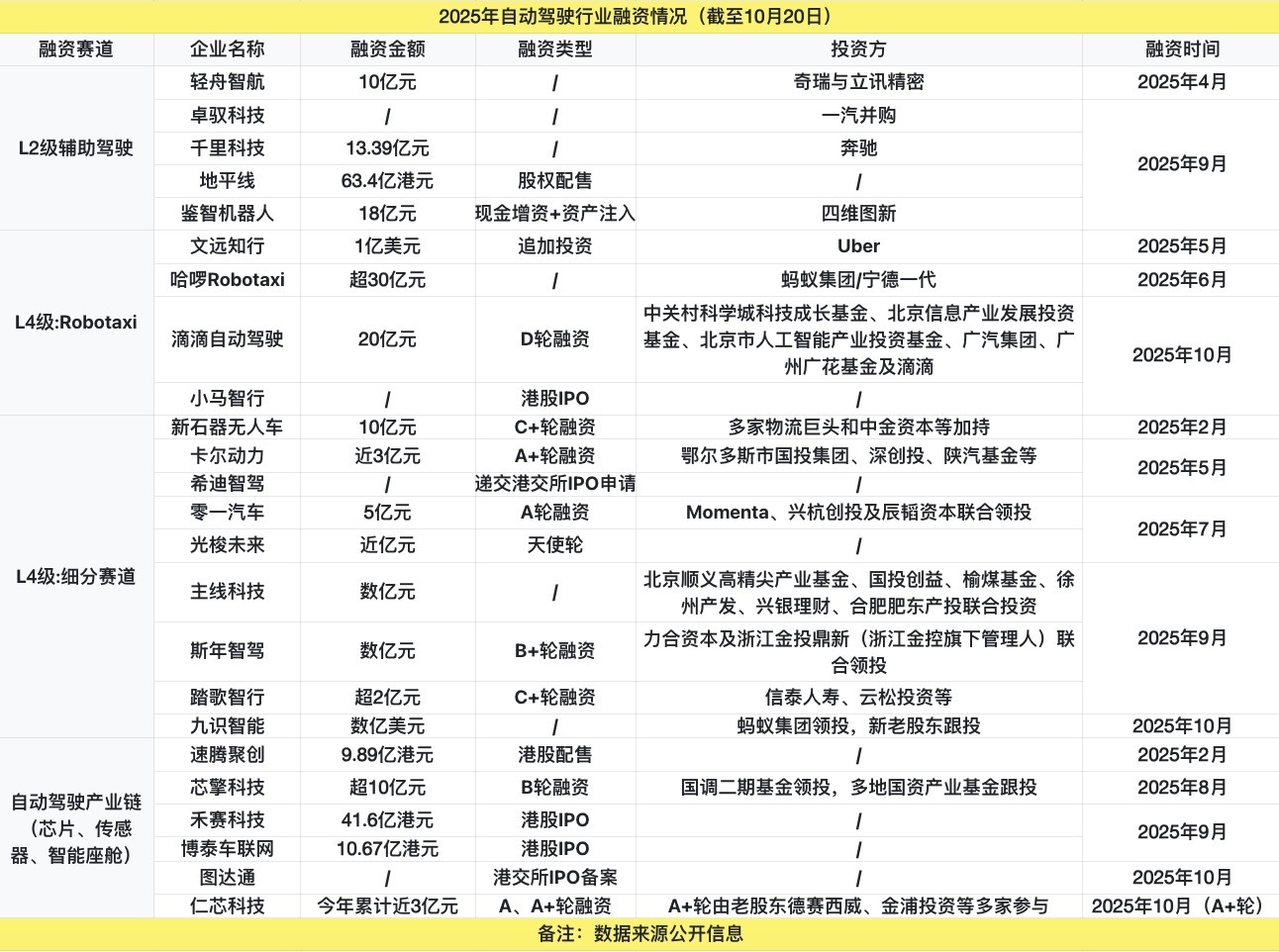
自动驾驶赛道“回暖”24起融资吸金超350亿元
Mei Ri Jing Ji Xin Wen· 2025-10-21 12:59
Core Insights - The autonomous driving industry is experiencing a significant resurgence in investment, with over 100 billion RMB raised in 11 financing events in the past month alone, and a total of 24 financing events exceeding 350 billion RMB since the beginning of 2025, indicating a strong recovery from previous years' downturns [1][2][6] Financing Trends - The 24 financing events in 2025 cover four main areas: L2-level assisted driving, L4-level niche markets, Robotaxi, and the autonomous driving supply chain, with 10 events raising over 10 billion RMB each, accounting for 50% of the total financing [2][3] - L2-level assisted driving saw 5 financing events, with the largest being Horizon Robotics raising approximately 58.12 billion RMB, while significant investments were also made in Robotaxi, with Didi Autonomous Driving completing a 20 billion RMB round [2][3] Market Dynamics - L4-level autonomous driving is advancing in specific applications like mining and logistics, with 9 companies raising over 30 billion RMB in total [3] - The supply chain for autonomous driving, particularly in chips and LiDAR, is also attracting substantial investments, with notable rounds from companies like Chipone Technology and Hesai Technology [3] Policy and Capital Influence - The financing landscape is characterized by a shift towards state-owned and industrial capital, which is replacing traditional financial investors, indicating a new dynamic in the industry [6][7] - The period from 2024 to 2025 has seen a significant increase in policy support, with over 71 new policies introduced in the first half of 2025 alone, laying a legal and institutional foundation for the commercialization of autonomous driving [7][8] Technological Advancements - The penetration rate of L2-level assisted driving in China has surpassed 50%, leading globally, with emerging technologies becoming standard in mid-to-high-end vehicles [8] - The cost of hardware has halved over the past two years, and the driving experience has improved tenfold, indicating rapid technological advancement [8] Profitability Challenges - Despite the influx of capital, many companies in the autonomous driving sector are still in the investment phase and have not yet achieved profitability, with significant losses reported by leading firms [9][10] - Companies like Horizon Robotics and Pony.ai are facing challenges in achieving stable profits, highlighting the ongoing need for financing to support R&D and market expansion [9][10] Future Outlook - The market for intelligent connected vehicles in China is projected to grow from 161.1 billion RMB in 2023 to 222.3 billion RMB by 2025, with expectations that China will become the largest market for autonomous driving by 2030 [11][12] - Industry leaders emphasize the importance of safety in the deployment of AI technologies in driving, suggesting a cautious yet optimistic approach to the future of autonomous driving [12]
齐普策今年四访中国:宝马锚定创新与绿色机遇,笃定长期合作
Bei Ke Cai Jing· 2025-10-21 02:12
Core Insights - BMW Group's Chairman, Zipser, emphasizes the company's strong commitment to the Chinese market, highlighting the importance of deepening cooperation and innovation in the region [1][3][11] Group 1: Strategic Commitment - Zipser's frequent visits to China reflect BMW's high regard for the market and its determination to enhance collaboration [1] - The concept of "home in China" signifies a deep partnership beyond manufacturing and sales, focusing on mutual growth and cooperation [3] - BMW's 30-year localization story demonstrates the viability of multilateral cooperation amidst rising protectionism and trade barriers [3] Group 2: Investment and Innovation - Since 2010, BMW has invested approximately 116 billion RMB in its Shenyang production base, significantly boosting local employment and economic development [6] - The Shenyang facility has become a global leader in manufacturing and innovation, utilizing AI and digital technologies to enhance production efficiency and product quality [6][7] - BMW has established the largest and most comprehensive R&D network outside Germany in China, with over 3,000 team members focused on various automotive technologies [6] Group 3: Digitalization and Sustainability - BMW's collaboration with Chinese partners has entered a 2.0 phase, focusing on digitalization and green development as dual drivers of innovation [7][9] - The company has implemented a comprehensive AI strategy in China, with over 200 AI applications enhancing production processes [7] - BMW is a pioneer in battery lifecycle management in China, achieving 100% recycling of retired batteries and recovering over 2,100 tons of raw materials in 2024 [9] Group 4: Competitive Landscape - Zipser advocates for healthy competition that rewards quality, safety, and innovation, contrasting it with destructive price-based competition [9] - The company supports government initiatives that ensure fair and orderly competition, benefiting consumer rights and supply chain resilience [9] Group 5: Future Outlook - BMW remains committed to growing alongside the Chinese market, aiming to deliver high-quality products and services while contributing to the sustainable development of the automotive industry [11]

技术创新助推中国新能源汽车驶向全球
Ke Ji Ri Bao· 2025-10-20 23:28
Core Insights - The 2025 Intelligent Connected Vehicle Conference showcased advancements in China's electric vehicle industry, highlighting innovations in autonomous driving and smart technology [1] - China's automotive industry has achieved significant breakthroughs during the 14th Five-Year Plan, with electric vehicle production and sales reaching new heights, making China the world's largest exporter of automobiles [1][5] - Continuous innovation in battery technology and smart systems is transforming vehicles into intelligent mobility platforms, enhancing user experience and safety [3][4] Group 1: Industry Developments - The conference featured a fully autonomous Robotaxi operation model and a new generation of self-driving cars equipped with 33 high-precision sensors for comprehensive environmental recognition [1] - The integration of domestic chips in electric vehicles is a testament to the growth of China's semiconductor industry, with a full-scale model demonstrating products from ten major domestic chip companies [1] - The automotive industry has seen a fourfold increase in battery charging efficiency over the past five years, with a domestic vehicle localization rate exceeding 95% [3] Group 2: Technological Innovations - A new flexible battery material developed by the Chinese Academy of Sciences can withstand 20,000 cycles of bending, improving energy density by 86% when used in composite cathodes [2] - The "vehicle-road-cloud integration" system enhances driving safety by providing real-time traffic signal and road condition information to vehicles, addressing challenges in autonomous driving [4] - AI applications in Chinese automotive companies are rapidly advancing, with significant growth in electric vehicle exports, which reached 1.758 million units in the first nine months of the year, a 89.4% increase year-on-year [5]
锦秋基金领投企业Manifold AI流形空间连获两轮共亿元融资,打造下一代具身智能世界模型|Jinqiu Spotlight
锦秋集· 2025-10-20 12:18
Core Insights - Jinqiu Fund has completed an investment in Manifold AI, focusing on world models and embodied intelligence, with a total of over 100 million yuan raised in two funding rounds [2][4] - Jinqiu Fund emphasizes a long-term investment philosophy, seeking groundbreaking technologies and innovative business models in the field of general artificial intelligence [3][16] Investment Overview - The recent angel round of financing for Manifold AI was led by Jinqiu Fund, with participation from co-investors including Chuangweiye and existing shareholder Inno Angel Fund [4] - The seed round was led by Inno Angel Fund, with follow-on investment from the Waterwood Tsinghua Alumni Seed Fund [4] Technological Focus - Manifold AI's original embodied world model technology aims to drive the large-scale deployment of robotic brains, addressing the challenges of diverse bodies, limited data, and fragmented applications in general robotics [6][16] - The company utilizes a World Model Action (WMA) approach, leveraging vast amounts of ego-centric video data for pre-training, which is expected to enhance physical space intelligence emergence [10][16] Industry Context - The rapid evolution of robotics and the need for autonomous operational capabilities are critical for large-scale implementation [6] - The shift in technology strategies by companies like Tesla and Figure AI towards using extensive ego-centric video data for training reflects a broader trend in the industry [6][7] Team and Leadership - Manifold AI's core team is based in Beijing, with members having backgrounds in robotics and large models, and experience in developing AI products with millions of users [12] - The founder and CEO, Dr. Wu Wei, has extensive management experience and previously led the development of the world model at SenseTime [13][16] Future Outlook - Jinqiu Fund anticipates exploring the next generation of embodied intelligent world models in collaboration with Manifold AI, as the industry moves towards a deeper understanding of machine interaction with the world [17]

自动驾驶再现融资热,24起融资超350亿元,但行业尚未进入盈利期
Mei Ri Jing Ji Xin Wen· 2025-10-20 11:30
Core Insights - The autonomous driving industry is experiencing a significant resurgence in investment, with over 100 billion RMB raised in 11 financing events in the past month alone, totaling 350 billion RMB for the year as of October 20, 2025, indicating a strong recovery from the previous three years of capital winter [1][2][6] - The financing landscape is characterized by a preference for companies with clear application scenarios, with state-owned and industrial capital increasingly replacing traditional financial investors as key drivers of industry development [6][7] Financing Overview - As of October 20, 2025, there have been 24 financing events in the autonomous driving sector, with a total amount exceeding 350 billion RMB, including 10 events with disclosed amounts of 10 million RMB or more, accounting for 50% of the total financing [2][3] - The L2 level assisted driving segment has seen five financing events, with the largest being Horizon Robotics raising approximately 58.12 billion RMB through a share placement [2][3] - The Robotaxi segment has attracted significant investment, with notable financing events including Didi's 20 billion RMB Series D round and Hello's over 30 billion RMB funding [3][4] Market Dynamics - The L4 level autonomous driving sector is entering a phase of accelerated commercialization, particularly in specific scenarios such as mining and logistics, with nine companies raising over 30 billion RMB [4][6] - The supply chain for autonomous driving, particularly in chips and lidar technology, has also seen substantial financing, with companies like Hesai Technology raising approximately 38 billion RMB through an IPO [4][6] Policy and Technological Support - The autonomous driving industry is supported by a surge in relevant policies, with over 71 policies released in the first half of 2025, including national-level approvals for L3 vehicle production [7][8] - Technological advancements and increased market acceptance are crucial for commercial viability, with L2 level assisted driving penetration exceeding 50% in China, the highest globally [7][8] Financial Performance and Challenges - Despite the financing boom, many companies in the autonomous driving sector remain unprofitable, with significant losses reported alongside revenue growth, indicating ongoing challenges in achieving stable profitability [8][10] - Companies like Horizon Robotics reported a revenue of 1.567 billion RMB in the first half of 2025, a 67.6% increase, but also faced a loss of 5.233 billion RMB, highlighting the financial strain in the industry [8][10] Future Outlook - The market for intelligent connected vehicles in China is projected to grow from 161.1 billion RMB in 2023 to 222.3 billion RMB by 2025, with expectations that China will become the largest autonomous driving market globally by 2030 [10][11] - The emphasis on safety and the gradual expansion of application scenarios for autonomous driving technologies are critical for the industry's future development [11]
淘汰赛进入倒计时!Momenta曹旭东:明年中国城市辅助驾驶仅存两三家玩家,全球可能就三四家【附自动驾驶行业市场分析】
Qian Zhan Wang· 2025-10-20 10:26
Core Viewpoint - The CEO of Momenta, Cao Xudong, predicts that the landscape of urban assisted driving will stabilize next year, with only two to three players remaining in China and three to four globally [2]. Group 1: Autonomous Driving Levels - Autonomous driving is categorized into six levels according to the SAE standards, with Level 0 being fully human-driven and Level 5 representing complete automation without human intervention [2][3]. - Level 4 is considered "unmanned driving" in specified scenarios, while Level 5 is the ultimate goal of full automation across all environments [2]. Group 2: Industry Approaches - Traditional automakers adopt a "gradual" approach, starting with lower levels of assisted driving (L1/L2) and progressively enhancing their capabilities [6]. - In contrast, tech companies like Baidu and Huawei pursue a "leapfrog" strategy, aiming directly for higher levels (L4 and L5) due to their strengths in technology and data processing [6]. Group 3: Challenges in Development - The development of L4 and L5 faces significant challenges, including the need for substantial funding, high-tech talent, and a long-term focus on R&D [7]. - Automakers often collaborate with tech companies to leverage mutual strengths in developing autonomous driving technologies [7]. Group 4: Current Industry Landscape - Various companies are at different levels of autonomous driving capabilities, with traditional manufacturers like BYD at L2 and tech firms like Baidu and Huawei at L4/L5 [8]. - New entrants in the automotive sector, such as NIO and Xpeng, are targeting L3 development, while startups like Zhixing and Pony.ai are also focusing on L4/L5 [8]. Group 5: Future Predictions - The transition to fully autonomous driving (L5) is expected to take 8-10 years, with significant barriers in regulations, data, computing power, and liability recognition [10]. - The current phase of assisted driving is viewed as a long-term transitional solution until L5 becomes a reality, which may lead to a significant reduction in private car ownership [10].
中国智能网联汽车加速驶来
Huan Qiu Shi Bao· 2025-10-20 08:13
Core Insights - The 2025 World Intelligent Connected Vehicle Conference in Beijing highlighted China's significant achievements in the automotive industry during the "14th Five-Year Plan" and its future prospects in smart vehicle development [1] - China is establishing a "decisive leading position" in the global smart automotive industry, achieving rapid advancements that foreign companies aspire to replicate [1] Industry Developments - The Chinese automotive industry has developed a comprehensive ecosystem encompassing smart cockpits, autonomous driving, and connected cloud control, with over 60% of new passenger cars sold featuring advanced driver assistance systems [1][2] - The market for new energy vehicle exports has surged from approximately 1 million units in 2019 to over 5.8 million units by 2024, with new energy vehicle exports increasing from about 250,000 to around 1.28 million in the same period [2] Technological Advancements - The rapid development of smart driving technology in China is attributed to the integration of artificial intelligence across domestic and joint venture automotive companies, enhancing user experience and brand recognition [3][4] - Approximately half of the new cars sold in China are equipped with L2-level intelligent driving systems, with projections indicating that by 2030, China will dominate the global L2+ intelligent driving market [4][5] Regulatory Environment - China's regulatory framework has evolved to support extensive testing of autonomous driving technologies, with over 30,000 kilometers of roads approved for testing, fostering innovation through local policy initiatives [5][6] - Recent regulatory tightening aims to enhance quality standards in the industry, requiring manufacturers to undergo stricter technical testing and approval processes [6] International Collaboration - European automotive companies are increasingly collaborating with Chinese smart driving technology firms, with partnerships emerging for the development of advanced driver assistance systems [7] - Chinese smart driving companies are expanding their market presence in the Middle East and Europe, indicating a competitive landscape with U.S. firms in these regions [8]
儿童能避开的纸箱,难倒了天价开发的AI司机
第一财经· 2025-10-20 04:12
Core Viewpoint - The article emphasizes the importance of clarifying the boundaries of assisted driving capabilities in the automotive industry to enhance safety and consumer understanding [3][4]. Group 1: Misunderstanding of Assisted Driving - The CEO of Momenta, Cao Xudong, highlights that there is a significant misunderstanding among consumers regarding the capabilities of assisted driving technology, which can lead to unrealistic expectations [5][6]. - A recent incident involving a Haobo GT vehicle crashing into a stationary construction vehicle while using adaptive cruise control has raised concerns about the technology's ability to recognize static objects [6][9]. - The complexity of recognizing common obstacles, such as a 50 cm cardboard box, poses significant challenges for assisted driving systems, which often rely on high-performance sensors [6][10]. Group 2: Technical Challenges - The article discusses the technical logic behind the "counterintuitive" nature of assisted driving systems, where simple tasks for humans can be complex for machines due to their reliance on data and probability [10][11]. - The difficulty in recognizing stationary objects is attributed to the fact that many static items on the road do not require avoidance, leading to a cautious approach by assisted driving systems to prevent unnecessary braking [11][12]. - The industry is working on improving technology through multi-sensor fusion and collecting extreme case data to address these challenges and enhance the recognition capabilities of assisted driving systems [12][13]. Group 3: Industry Responsibility and Training - The industry leaders stress the need for a strong sense of responsibility in the development of assisted driving technologies, contrasting it with the more flexible nature of software products [12][13]. - Companies like Momenta are actively engaging in training sales personnel to better communicate the capabilities and limitations of assisted driving systems to consumers [13].