
中信建投证券

Search documents
20cm速递|创业板人工智能ETF国泰(159388)涨超1.2%,关注AI板块春季行情
Mei Ri Jing Ji Xin Wen· 2026-01-26 06:51
Core Viewpoint - The current macroeconomic environment is characterized by "production stronger than demand, external demand better than internal demand," with a loose monetary policy leading to interbank interest rates at their lowest level since 2020 [1] Group 1: Macroeconomic Environment - The combination of weak macro demand and loose liquidity favors investments in structurally prosperous sectors [1] - The focus remains on technology, particularly AI and new energy, which are currently the core areas of prosperity [1] Group 2: Investment Opportunities - Emerging hotspots continue to catalyze prosperity, with AI applications receiving strong policy support and accelerating commercialization [1] - The strategy is to adhere to a "technology + resource products" dual mainline approach [1] Group 3: Specific Investment Products - The Guotai AI ETF (159388) tracks the ChiNext AI Index (970070), which has a daily price fluctuation limit of 20% [1] - This index selects listed companies in the AI sector from the ChiNext market to reflect the overall performance of AI-related securities [1] - The index focuses on the development trends of the AI industry, covering subfields such as machine learning, smart hardware, and data processing, characterized by high growth and innovation [1]

坚守“科技 + 资源品”双主线,石化ETF(159731)连续13日合计“吸金”6.1亿元
Sou Hu Cai Jing· 2026-01-26 04:12
Core Viewpoint - The petrochemical ETF (159731) is experiencing a significant increase, with a net inflow of 610 million yuan over the past 13 days, indicating strong investor interest in the sector [1] Group 1: ETF Performance - The petrochemical ETF has reached a new high with a total share of 887 million and a total scale of 910 million yuan [1] - Major stocks such as China National Offshore Oil Corporation, China Petroleum, and Yanchang Petroleum are leading the gains within the ETF [1] Group 2: Market Environment - The current macroeconomic environment is characterized by stronger production than demand, with external demand outperforming internal demand, and a loose monetary policy similar to the investment peak period of 2020-2021 [1] - In the last two weeks, stock ETFs have seen an outflow of approximately 450 billion yuan, while broad-based ETFs have experienced an outflow of over 570 billion yuan, contrasting with an inflow of about 110 billion yuan into thematic industry ETFs [1] Group 3: Investment Strategy - The current bull market is supported by a positive policy tone, with a focus on "technology + resource products" as the main investment themes [1] - The technology sector should focus on AI and semiconductors, while the resource sector should pay attention to non-ferrous metals, with potential benefits expected to extend to energy and machinery sectors [1] Group 4: Index Composition - The petrochemical ETF closely tracks the CSI Petrochemical Industry Index, which is primarily composed of basic chemicals and petroleum and petrochemical industries, accounting for over 91% of the index [1] - The top ten holdings include the "Big Three" oil companies—China Petroleum, China Petrochemical, and China National Offshore Oil Corporation—collectively representing over 20% of the index weight [1]
刚刚!A股,突变!两大变量,集中来袭!
券商中国· 2026-01-26 03:11
Market Overview - A-shares experienced a sudden shift in style and risk preference, with major indices turning from gains to losses, particularly the ChiNext index which fell nearly 1% [1] - The number of rising stocks decreased to less than 2000, indicating a market trend towards defense [1] Risk Preference Changes - Two significant variables affecting risk appetite emerged: escalating geopolitical risks and a sharp decline in the US dollar index, leading to a surge in gold and silver futures [1][4] - Popular stocks collectively plummeted, with satellite ETFs dropping nearly 5%, signaling a retreat from speculative trading [1] Sector Performance - A notable increase in the number of declining stocks was observed, particularly in sectors like semiconductor chips, commercial aerospace, robotics, and AI applications, with nearly 4000 stocks declining and 17 hitting the daily limit down [3] - Precious metals surged, with silver futures reaching a limit up with a 17% increase, and gold prices exceeding $5088.39 per ounce, marking a rise of over 2% [3] Capital Flow Dynamics - Recent data indicated a significant outflow of approximately 450 billion yuan from stock ETFs over the past two weeks, with broad-based ETFs seeing outflows exceeding 570 billion yuan [6] - In contrast, thematic ETFs related to TMT and cyclical resources saw inflows of around 50 billion yuan and 40 billion yuan respectively, highlighting structural differentiation in capital flows [6] Market Sentiment and Future Outlook - The market is experiencing increased volatility, with external factors weakening the narrative logic in capital markets and stock valuations appearing less attractive [6] - Analysts suggest that sectors at relatively low valuations with strong narratives may see recovery, particularly in consumer chains and real estate, as the market anticipates upcoming events [6][7] - The current market environment is characterized by a slow bull trend, with a focus on "technology + resource" as the dual mainline for investment strategies [7]


景气投资占优 坚守“科技+资源品”双主线 | 券商晨会
Sou Hu Cai Jing· 2026-01-26 02:34
|2026年1月26日 星期一| NO.1中信建投:景气投资占优 坚守"科技+资源品"双主线 中信建投证券研报认为,经济数据显示,工业生产延续韧性,与此同时出口保持较快增长,但消费、投 资等内需指标仍显疲软。从宏观背景来看,当前宏观环境与2020~2021年赛道投资高峰期有颇多相似之 处。宏观需求偏弱+流动性宽松的组合,具备结构性景气的赛道投资占优。科技方面,AI半导体/新能源 仍是当前的景气核心,与此同时新兴热点景气催化不断,AI应用政策强力支持、商业化落地加速,太 空光伏全球产能规划超预期、技术突破打开万亿市场,创新药BD交易、临床突破与新药获批推动价值 兑现。资源品方面,目前有色金属行业2025年报业绩预告向好率最高。 NO.2华泰证券:A股市场逐步切换向绩优方向 光大证券研报认为,春节前市场将会保持震荡,难以保持稳定的趋势,这主要与春节之前投资者交易热 度有所下行,以及微观流动性短期趋紧有关。从历史情况来看,春节前20个交易日,主要指数上涨概率 不足50%。预计春节之后市场将会迎来新一轮上行动力,春节后20个交易日主要指数上行概率与平均涨 幅均较高。因此建议投资者近期以稳为主,但仍应持股过节。行业方面 ...
十大券商一周策略:慢牛未改!科技 + 资源品成共识配置,警惕赚钱效应收敛
Jin Rong Jie· 2026-01-25 23:50
Core Viewpoint - The A-share market is characterized by "structural differentiation and simultaneous repair," with various institutions noting that despite ongoing redemption pressure on broad-based ETFs, sectors such as consumer chains, real estate chains, and resource products are entering a repair window [1][2]. Group 1: Market Trends - The broad-based ETF redemption pressure continues to grow, with significant differences in the承接力 (support capacity) among different industries and stocks [2]. - The consumer chain is expected to see an increase in allocation leading up to the Two Sessions, with the real estate chain also likely to experience noticeable recovery during this period [2]. - The spring market is supported by ample liquidity and policy backing, which may sustain the ongoing spring rally, although caution is advised regarding the marginal contraction of profit effects at high levels [1][3]. Group 2: Investment Focus - The consensus among institutions is to focus on technology (AI, semiconductors) and resource products (non-ferrous metals, chemicals) as key investment directions [1][7]. - There is growing attention on cyclical sectors showing signs of bottom reversal, such as power grid equipment and lithium batteries, as well as non-bank sectors [1][3]. - The current market environment is conducive to exploring basic combinations centered around chemicals, non-ferrous metals, new energy, and power equipment, while also considering low allocation in non-bank sectors like securities and insurance [2][4]. Group 3: Performance and Earnings - As the annual report forecast disclosure period peaks, the impact of earnings on market structure is expected to become more pronounced, with a focus on sectors with earnings highlights [4][11]. - The performance of sectors such as AI hardware, batteries, pharmaceuticals, steel, and non-bank financials is anticipated to improve, given their relatively low price increases [4][12]. - The market is likely to experience a rotation among sectors, with a focus on high-growth areas and those benefiting from price increases [12][14]. Group 4: Future Outlook - The market is expected to continue its slow bull trend, with the potential for a correction after reaching a phase high between 4200 and 4300 points [6][10]. - The spring market is seen as an extension of the structural bull market, with a likelihood of a consolidation phase following the current rally [3][5]. - The focus for 2026 includes a clearer dual mainline of asset allocation towards physical assets and Chinese assets, with thematic investments becoming essential [9][10].




周末!突然停牌了!
中国基金报· 2026-01-25 14:52
Weekend Major Events - The China Securities Regulatory Commission (CSRC) released guidelines for the performance comparison benchmarks of publicly offered securities investment funds, effective from March 1, 2026, to enhance investor protection and fund management practices [3] - A natural person named Yu Han was penalized by the CSRC for manipulating the stock of "Doctor Glasses" using 67 accounts, resulting in a total fine and confiscation of over 1 billion yuan [4] - The CSRC imposed significant penalties on Zhejiang Ruifengda Asset Management Co., totaling over 28 million yuan, with the actual controller facing a lifetime ban from the securities market [5] - The CSRC expanded the range of futures market open varieties, adding 14 new futures and options products [6] Silver Market Update - Silver prices surged to a historic high of over 100 USD, with year-to-date increases exceeding 40%, indicating a significant shift in global resource asset pricing mechanisms [7][17] Commercial Aerospace Encouragement - Beijing's government issued measures to promote mergers and acquisitions in satellite data-related enterprises, signaling support for the commercial aerospace sector [8][9] Broker Insights - CITIC Securities emphasized the importance of strong market support and suggested focusing on sectors with logical narratives and low valuations, particularly in consumer and real estate chains [14] - Shenwan Hongyuan noted that the spring market is progressing along a predetermined path, with a focus on cyclical investments and the potential for profit expansion [15] - China Merchants Strategy highlighted the need for a stable A-share market in response to rising silver prices and suggested focusing on high-growth sectors [16][17] - Guotai Junan pointed out the resilience of the A-share market amid external risks and emphasized the importance of physical assets and Chinese assets in 2026 [18] - CITIC Construction Investment recommended a dual focus on technology and resource products, with particular attention to sectors like AI, semiconductors, and new energy [19] - Cinda Strategy observed a shift in market dynamics, with a focus on sectors with strong performance and potential for price increases [20] - Dongfang Caifu Strategy identified commercial aerospace and AI applications as key investment themes, alongside sectors benefiting from supply-demand mismatches [21] - GF Securities noted a high certainty of deposit migration among high-net-worth individuals, with a significant inflow of funds into the market [22] - Zhongtai Strategy discussed the current market's significant divergence, supported by high-risk appetite and favorable liquidity conditions [24] - Everbright Strategy recommended a cautious approach leading up to the Spring Festival, with expectations of a market rebound post-holiday [25]



【十大券商一周策略】春季行情仍在途,注意总体赚钱效应已逼近高位
券商中国· 2026-01-25 14:11
Group 1 - The core viewpoint of the article emphasizes the ongoing recovery of market confidence, with potential for sector and stock recovery, particularly in consumer and real estate chains before the Two Sessions [2] - The article highlights the significant outflow of funds from broad-based ETFs, with a notable impact on sectors and stocks that are underweight by institutions [2] - It suggests that sectors with strong fundamentals and logical narratives, particularly those not heavily weighted in broad-based indices, are likely to see recovery [2] Group 2 - The spring market is characterized by a transition towards a more stable phase, with the potential for a perfect spring market driven by increased profitability [3] - The article notes that the overall profitability effect is nearing a high point, indicating that the market may face limitations in time and space for further growth [3] - It anticipates a correction phase following the spring market, where the focus will shift to clearer industrial trends and performance digestion [3] Group 3 - The article discusses the supportive role of abundant liquidity in driving the current spring market, stemming from various factors including insurance capital and foreign fund inflows [4] - It emphasizes the importance of focusing on fundamental performance as companies begin to disclose annual reports, with particular attention to sectors like AI hardware, batteries, and pharmaceuticals [5] Group 4 - The article identifies the current market phase as a structural bull market, transitioning from the second consolidation phase to the third upward phase [6] - It suggests that the market may face a correction after reaching a temporary high between 4200 and 4300 points, with a focus on the support levels and core sectors [6] Group 5 - The article advocates for a dual focus on technology and resource sectors, highlighting the importance of macroeconomic conditions and liquidity in shaping investment strategies [7] - It identifies key sectors such as semiconductors, AI, and new energy as central to current market trends, with a positive outlook for resource industries [7] Group 6 - The article suggests that the market's optimism is necessary, particularly in light of the recent volatility and the need to consider the relationship between market optimism and regulatory cooling [8] - It emphasizes the importance of focusing on physical assets and Chinese assets in investment strategies, with a recommendation for sectors like equipment exports and consumer recovery [9] Group 7 - The article indicates that the current market is entering a phase of high volatility and differentiation, with expectations for policy-driven demand expansion [10] - It highlights the potential for the non-ferrous metals sector to benefit from both industrial trends and financial attributes, particularly in light of geopolitical factors [11] Group 8 - The article notes that the A-share market is returning to a slow bull trend, with an increasing importance of sector rotation and fundamental performance [12] - It emphasizes the need to focus on structural investment opportunities, particularly in technology innovation and manufacturing sectors [12] Group 9 - The article suggests that the current market may be entering the latter half of the spring market, with a focus on sectors with strong performance and clear industrial trends [13] - It highlights the potential for price increases in sectors like basic chemicals and new energy materials, as well as opportunities in export-driven sectors [13] Group 10 - The article maintains that the slow bull trend is likely to continue, with a focus on technology, resource sectors, and industries with high growth potential [14] - It suggests that the current market conditions provide ample opportunities for investment, particularly in sectors with strong earnings forecasts [14]
业绩兑现+AI赋能,资金单周爆买金融科技!百亿ETF吸金超9亿元!
Xin Lang Cai Jing· 2026-01-25 11:22
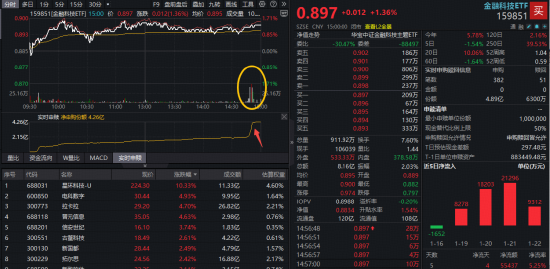
Core Viewpoint - The A-share market experienced a significant increase, particularly in the fintech sector, with the CSI Fintech Theme Index rebounding over 1% on January 23. Notable stocks such as Xinghuan Technology surged over 10%, while several others rose more than 2% [1][5]. Market Performance - The fintech ETF (159851) closed up 1.36%, with a total trading volume of 816 million yuan. Notably, there was a substantial net inflow of funds towards the end of the trading day, with net subscriptions increasing to 426 million shares, approximately 381 million yuan based on the average price for the day. Over the week, net inflows exceeded 900 million yuan [5][6]. Catalysts for Growth - Positive earnings forecasts are driving the fintech sector, with A-shares recording over 20 trillion yuan in trading volume for 19 consecutive trading days. Leading internet brokerage Tonghuashun projected a net profit growth of 50% to 80% for 2025, amounting to 2.735 billion to 3.282 billion yuan, benefiting from AI investments and market recovery [5][6]. - Market expectations are shifting towards a slow bull market, with the securities sector expected to participate in this trend. The activity level in the stock market is a key indicator of the valuation and performance of the securities industry, with internet brokerages being particularly sensitive to trading volumes [6][7]. AI Impact on Financial Technology - AI is identified as a driving force for upgrading the fintech industry, enhancing the efficiency and experience of financial services. This presents new investment opportunities in fintech, with a focus on core companies benefiting from various sub-sectors [6][7]. ETF Insights - The fintech ETF (159851) has a current scale exceeding 10.5 billion yuan, with an average daily trading volume of 800 million yuan over the past six months, leading among eight ETFs tracking the same index in terms of scale and liquidity [6][7].

年终奖都不要了,分析师转会再起小高潮
财联社· 2026-01-24 12:43
华源证券研究所在本周迎来了自己的新宏观团队,来自中信建投孙苏雨。作为近年来的黑马研 究所之一,华源的案例只是一个。 刚步入2026年,不到1个月就超过10家券商有分析师转会,不 少新财富明星分析师连年终奖都没等,就敲定了新下家。在不少分析师看来,这是大势所趋。 "2025年的年终奖,要到2026年下半年才可能拿到,不仅周期长,金额也不确定。"不少分析师 心里,即便年末换所意味着要放弃年终奖,生存优先成了近期转会的核心原因。 多数研究所采用利润导向考核机制,收缩态势明显,降薪成为不少分析师的常态。相较于模糊 的短期收益,更稳定的发展平台显然更值得取舍,当然,为了赶上新一届分析师评选的执业变 更窗口期也是一个动因,毕竟结果关系到后续派点资源、话语权,这是长期生存发展的关键。 "在好平台,付出能有更合理的回报。"一位刚跟着首席跳槽的分析师坦言,但他也强调,跳槽 的还有一个原因是"热爱卖方研究、勤奋认真"。一些研究所管理层也认为,卖方研究"高强 度、快节奏、重结果"的行业特性,是筛选长期适配人才的关键指标。 像孙苏雨一样从头部跳到特色券商的分析师还有很多,理由自然并非仅是薪酬。北京一分析师 说, 过去看重头部券商的跨 ...

2026保险业前瞻:“报行合一”有望带动行业费用率改善
2 1 Shi Ji Jing Ji Bao Dao· 2026-01-23 14:37
Core Viewpoint - The 2026 regulatory work meeting of the National Financial Regulatory Administration established the financial regulatory tone for the "14th Five-Year Plan" period, emphasizing the continuous promotion of "reporting and operation integration" in the insurance industry and the adjustment of predetermined interest rates [1] Group 1: Trends in the Insurance Industry - The insurance industry is expected to exhibit three core trends in 2026: low upper limits on predetermined interest rates for traditional insurance, the rise of dividend insurance as a market mainstream due to its "fixed income + floating" characteristics, and the strategic position of insurance funds as "patient capital" [1] - Dividend insurance is gaining popularity as it effectively balances the risk of interest margin losses for insurance companies and the inflation resistance needs of customers, with a current predetermined interest rate research value of 1.89% [2][3] - The sales of dividend insurance are closely linked to investment yield rates and competing product yields, with the decline in bank deposit rates making dividend insurance more attractive to residents [4] Group 2: Reporting and Operation Integration - The "reporting and operation integration" initiative has been implemented in the auto insurance sector and is now being extended to non-auto insurance areas, which is expected to fundamentally change the industry's cost competition model [5][6] - This integration is anticipated to improve industry expense ratios, reduce overall operating costs, and enhance insurance companies' ability to price risks accurately [7] - The competition in the bancassurance channel is expected to shift from a focus on fees and products to a competition based on professional capabilities and comprehensive services [8] Group 3: Strategic Investment Directions - The meeting highlighted the importance of cultivating "patient capital" to support the development of new productive forces, with insurance funds being well-suited for long-term, stable funding support [9] - Infrastructure and real estate, along with private equity, are expected to become key areas for alternative investments by insurance funds, aligning with their investment characteristics [10] - Insurance companies are encouraged to increase their equity investment in strategic emerging industries, focusing on sectors like 5G, artificial intelligence, healthcare, and new consumption, which are seen as having significant growth potential [11]