谷歌

Search documents
三星电子HBM4正式打入英伟达链,2月量产开启AI存储新格局
Zhi Tong Cai Jing· 2026-02-09 03:00
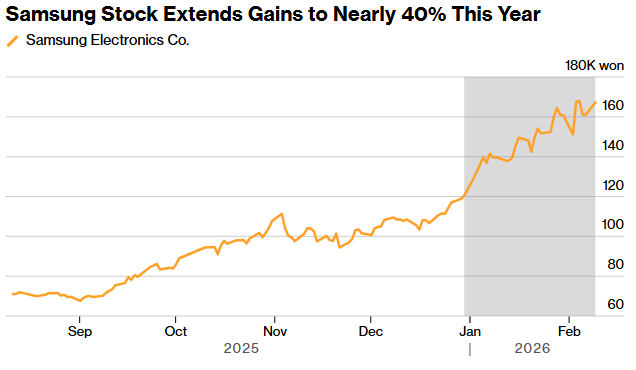
三星电子股价于周一在首尔证券交易所迎来强劲反弹,盘中涨幅一度突破6%。此次市场情绪的集体爆 发,主要源于业界流传三星已正式获准启动全球首款第六代高带宽内存(HBM4)芯片的量产计划,并预 计最快于2月底开启规模化出货。 据报道,这家韩国科技巨头计划最早将于2月第三周向英伟达(NVDA.US)——人工智能加速器领域的领 军企业——出货这些芯片。据知情人士透露,三星电子此次量产的HBM4芯片已顺利通过英伟达极为严 苛的质量认证,成功切入其下一代Vera Rubin架构AI加速器的供应链。 三星当前正处于非同寻常的战略追赶期——正全力缩小与SK海力士的差距。作为英伟达内存芯片的核 心供应商,SK海力士已凭借技术优势占据先发地位,而三星在高带宽内存(HBM)开发领域的突破性进 展,正逐步消解其与国内竞争对手的技术鸿沟。 从资本市场的视角来看,三星市值的回升反映了投资者对其AI业务盈利前景的重新评估。随着全球数 据中心对大模型训练需求的持续扩张,存储市场已进入新一轮景气周期,行业预测2026年第一季度内存 合约价格可能因供应偏紧而出现超过50%的涨幅。 三星通过抢占HBM4的量产先机,不仅有望显著增厚其存储业务部的利润 ...


千问App又崩了,千问发文:热度太高有点堵,求放过;山姆会员店多地现退卡潮;OpenClaw突然大火,美团元老王慧文再发创业英雄帖丨邦早报
创业邦· 2026-02-09 00:08
完整早报音频,请点击标题下方小耳机收听 【千问 App 又崩了,官方发文回应:求放过】 2 月 8 日有网友反馈,千问 App 再次出现宕机,"发放奶茶免单 卡"活动无法下单。对此,千问官微发文回应称,"球球大家放过,知道很多朋友急着参与免单活动,但热度太高有 点堵…免单卡有效期至 2 月 28 日,大家慢慢来,保证一定能用掉。"(福建日报) 【加密货币交易网站创始人 7000 万美元收购" AI.com ",将提供个人" AI 智能体"服务】 加密货币交易网站 Crypto.com 的创始人以 7000 万美元收购了互联网域名" AI.com "。据悉,这是迄今披露的域名交易中价格最高 的一笔。 Crypto.com 的联合创始人兼首席执行官克里斯·马萨莱克计划在本周末的超级碗广告中正式推出" AI.com ",该网站将提供个人" AI 智能体"服务,用户将可用它发送消息、使用应用程序并进行股票交易。(财联 社) 【 OpenClaw 突然大火,美团元老王慧文再发创业英雄帖】 近日, OpenClaw 突然大火,投资人、创业者相继涌 入。 2 月 7 日凌晨,美团元老王慧文大模型创业后,再发英雄帖,称"哪个 ...

盘前必读丨央行已连续15个月增持黄金;23.14亿天价索赔案和解
Di Yi Cai Jing· 2026-02-09 00:01
机构认为,当前A股市场趋势下,"轻仓持股过节"是一种审慎且符合历史规律的合理策略。 【财经日历】 澜起科技在港交所挂牌上市 新股申购:通宝光电 ►►2月6日,国务院总理李强主持召开国务院常务会议。会议指出,促进有效投资对于稳定经济增长、增强发展后劲具有重要作用。要创新完善政策措施, 加力提效用好中央预算内投资、超长期特别国债、地方政府专项债券等资金和新型政策性金融工具。要结合制定实施"十五五"规划,着眼于长远发展需要和 构筑未来竞争优势,在基础设施、城市更新、公共服务、新兴产业和未来产业等重点领域,深入谋划推动一批重大项目、重大工程。要更好发挥央国企扩投 资作用,加大力度支持民间投资发展,形成促进有效投资的合力。 ►►央行公告,中国2026年1月末黄金储备报7419万盎司,2025年12月末为7415万盎司,为连续第15个月增持黄金。 ►►中国人民银行等八部门发布关于进一步防范和处置虚拟货币等相关风险的通知。《通知》重申境内对虚拟货币坚持禁止性政策,明确虚拟货币不具有法 定货币地位,相关业务活动属于非法金融活动。同时,重申境内对于虚拟货币"挖矿"的禁止性政策等。《通知》还强调,未经相关部门依法依规同意,境内 ...

海外宏观及大类资产周度报告-20260208
Guo Tai Jun An Qi Huo· 2026-02-08 14:10
国泰君安期货研究所· 海 外 研 究 联系人 杨藤 F03151619 国泰君安期货·君研海外 海外宏观及大类资产周度报告 戴璐 Z0021475 刘雨萱 Z0020476 日期:2026年2月8日 Guotai Junan Futures all rights reserved, please do not reprint Special report on Guotai Junan Futures CONTENTS 01 02 03 大类资产周度表现及市场高频数据 • 固定收益 – 海外固收周度表现 • 固定收益 – 美债收益率曲线和信用利差 • 固定收益 – 不同评级信用债相对强弱及欧元区利差 • 固定收益 – 美国国债发行量及一二级市场供需 • 汇率市场 – 主要汇率周度表现 • 汇率市场 – 主要国家国债收益率与美债利差走势 • 汇率市场 – 中国货币政策框架演进 • 汇率市场 – 人民币汇率月频指标 • 汇率市场 – 人民币汇率高频指标 • 大宗商品 – 主要大宗商品周度表现 • 大宗商品 – 主要大宗商品比价及产业链相对强弱 • 海外权益 – 全球主要指数及美股各行业周度表现 • 海外权益 – ...
电子行业研究:谷歌/亚马逊26年CAPEX指引超预期,AI硬件需求强劲
SINOLINK SECURITIES· 2026-02-08 12:24
Investment Rating - The industry is rated positively, with expectations for significant growth in capital expenditures from major companies like Amazon and Google, indicating a bullish outlook for the sector [1][26]. Core Insights - Amazon raised its 2026 capital expenditure forecast to $200 billion, a more than 50% increase from $131 billion in 2025, driven by strong demand signals in AI hardware and cloud services [1]. - Google's parent company, Alphabet, expects its 2026 capital expenditure to be between $175 billion and $185 billion, nearly double its 2025 spending, reflecting robust growth in its cloud business [1]. - The demand for AI infrastructure is expected to lead to a significant increase in ASIC (Application-Specific Integrated Circuit) production from companies like Google, Amazon, Meta, OpenAI, and Microsoft, with a projected explosive growth in 2026-2027 [1][4][26]. Summary by Sections 1. Capital Expenditure and Demand - Amazon's AWS cloud division saw a 24% year-over-year growth, with a backlog of $244 billion, indicating strong enterprise investment in AI and core cloud services [1]. - Google's cloud revenue reached $17.7 billion in Q4, a 48% year-over-year increase, driven by strong demand for enterprise-level AI products [1]. 2. AI Hardware and ASIC Demand - The report highlights the strong demand for AI-related hardware, with Amazon's self-developed Trainium chip showing a 30%-40% cost advantage over similar GPUs, leading to significant revenue potential [1]. - Companies are expected to ramp up production of new generation ASIC chips, with Amazon and Google entering a phase of increased demand and production [1][4]. 3. PCB and Semiconductor Industry Outlook - The PCB industry is experiencing high demand, with companies expanding production capacity due to strong orders driven by AI applications [4][26]. - The semiconductor equipment sector is also expected to benefit from increased capital expenditures, with a focus on domestic production capabilities in light of global supply chain challenges [23][25]. 4. Specific Company Insights - Companies like North Huachuang and Zhongwei are positioned to benefit from the growing demand for semiconductor equipment and materials, with a focus on domestic production and technological advancements [28][25]. - The report emphasizes the growth potential for companies involved in AI-related PCB manufacturing, with expectations for sustained high growth in performance and revenue [4][26].

ClaudeOpus4.6开启多Agent协作模式
Soochow Securities· 2026-02-08 10:26
证券研究报告·策略报告·策略周评 策略周评 20260208 Claude Opus 4.6 开启多 Agent 协作模式 2026 年 02 月 08 日 [Table_Tag] [Table_Summary] 本周 AI 要闻 (信息来源:第一财经、财联社、AI daily 等) 周度观点 ◼ Claude Opus 4.6 开启多 Agent 协作模式,AI 向生活场景渗透 (1)本周全球 AI 产业延续算力、模型与应用协同推进的演进趋势,基础 设施加码与应用场景扩展两条主线持续延展。算力端,头部云厂商持续加 大资本开支并通过融资扩容云基础设施,国内中科曙光万卡超集群上线试 运行,显示算力资源正加速向具备资金与技术优势的主体集中,行业门槛 持续抬升。模型端,随着大模型能力向复杂任务拆解与现实执行延伸,海 外厂商通过多 Agent 协作与企业级工作流,推动 AI 向"AI 员工"形态演 进,国内厂商则通过开源完善具身智能技术体系,推动模型能力向物理世 界延伸。应用端,AI 一方面通过人形机器人加速进入现实执行场景,另一 方面借助消费与开发等高频数字场景培育用户使用习惯。整体来看,AI 产 业正在算力集中与 ...

光模块逻辑的背离与收敛
GOLDEN SUN SECURITIES· 2026-02-08 08:01
证券研究报告|行业周报 gszqdatemark 2026 02 08 年 月 日 通信 光模块逻辑的背离与收敛 市场近期关于 CPO(共封装光学)技术将快速取代可插拔光模块的过 度担忧,背离了产业发展的基本面,在未来两至三年,乃至更长时间 内,可插拔光模块仍将是数据中心光互连的主流解决方案。市场担忧 和筹码结构集中需时间消化,长期来看市场终将回归业绩基本面主导 的共识。 【预期差纠偏:市场"焦虑"的起源与误读】 英伟达宣布将于今年规模部署 CPO 技术,市场普遍担忧 CPO 技术将 快速全面地取代可插拔光模块。这种过度担忧脱离了行业发展的基本 面,是对 CPO 技术的误读,导致市场估值出现非理性分化。 【筹码结构:过度集中与结构优化】 当前光模块板块筹码结构过于集中,需要时间进行结构优化与自我修 正。 增持(维持) 行业走势 -20% 4% 28% 52% 76% 100% 2025-02 2025-06 2025-10 2026-02 通信 沪深300 作者 分析师 宋嘉吉 执业证书编号:S0680519010002 邮箱:songjiaji@gszq.com 分析师 黄瀚 执业证书编号:S0680519 ...
大手笔AI投资之后:亚马逊、谷歌、Meta要花光现金流了?
硬AI· 2026-02-08 06:18
Core Viewpoint - The article highlights a looming cash flow crisis for major tech companies, with a projected capital expenditure of $645 billion by 2026, raising concerns about their ability to convert investments into tangible revenue growth [2][34]. Group 1: Capital Expenditure Projections - The total capital expenditure for the four major U.S. cloud giants—Amazon, Google, Meta, and Microsoft—is expected to reach $645 billion by 2026, a 56% year-over-year increase, with an additional $230 billion in new spending [3]. - Google's capital expenditure guidance has been raised to between $175 billion and $185 billion for 2026, reflecting a staggering 97% year-over-year growth [5]. - Amazon's capital expenditure is projected at approximately $200 billion for 2026, a 52% increase, but its operating cash flow is estimated to be only $178 billion, leading to a significant cash outflow [10]. Group 2: Financial Health and Cash Flow - Meta's capital expenditure is expected to grow by 75% to between $115 billion and $135 billion, which will nearly eliminate its free cash flow, straining its previously strong financial position [15]. - Microsoft is projected to have a capital expenditure exceeding $103 billion, a growth of over 60%, but is expected to generate around $66 billion in free cash flow, allowing it to cover its substantial spending [23]. - Oracle's net debt has surged to $88 billion, more than double its EBITDA, serving as a cautionary example of excessive leverage [29][30]. Group 3: Shareholder Returns and Financial Strategies - The ability of tech giants to return capital to shareholders through stock buybacks is under pressure, with Meta likely to reduce its buyback efforts due to shrinking free cash flow [21]. - Google and Meta paid approximately $10 billion and $5 billion in dividends, respectively, which may further strain their cash flow in the coming year [22]. - Amazon has not engaged in stock buybacks since 2022 and has never paid dividends, making it less vulnerable to cash flow pressures in this regard [22]. Group 4: Debt Management and Future Outlook - Google maintains a "zero net debt" status, with cash reserves of $127 billion exceeding its $47 billion debt, indicating a strong financial position despite increased spending [32]. - Amazon holds $123 billion in cash and has issued $15 billion in bonds, preparing for potential large-scale debt issuance to manage its cash flow challenges [32].



聚焦AI 2C入口重构与B端高价值场景:2026年第5周计算机行业周报-20260208
Changjiang Securities· 2026-02-07 23:31
Investment Rating - The report maintains a "Positive" investment rating for the software and services industry [9] Core Insights - The computer sector experienced a significant pullback, with an overall decline of 4.31%, ranking 28th among primary industries in the Yangtze River region, and accounting for 7.03% of total market turnover. AI infrastructure-related stocks were notably active [2][6][17] - The report highlights the inflation of computing infrastructure, the emergence of space computing, and advancements in brain-computer interface technology as key trends [7][22] - The launch of the AI Agent social platform, MoltBook, marks a significant development in the 2C entry and high-value scenarios, indicating a potential acceleration in the commercialization of AI agents [8][50] Summary by Sections Market Performance - The computer sector saw a substantial decline of 4.31% last week, with the Shanghai Composite Index also experiencing a slight pullback of 0.44% [6][17] - AI infrastructure-related stocks showed notable activity, with specific companies like Wangsu Technology and Hongjing Technology seeing significant gains [19][20] Key Trends - The report identifies three main trends: inflation in computing infrastructure, the development of space computing, and advancements in brain-computer interface technology [7][22][31] - The "Star Computing·Intelligent Connection" seminar held in Beijing emphasizes collaborative efforts to advance space computing technology [31][34] Investment Opportunities - The report suggests focusing on high-value scenarios in both 2C and 2B sectors, including healthcare, taxation, legal services, coding, office applications, advertising, and e-commerce [8][30] - The introduction of personal assistants like Clawdbot is expected to drive localized deployment demand in households [8][30] Brain-Computer Interface Developments - The National Medical Products Administration approved two projects for revising standards related to brain-computer interface medical devices, indicating a favorable policy environment for the industry [38][41] - The rapid approval of these standards reflects the urgent need for regulatory frameworks to support the high-quality development of brain-computer interface technologies [41][42] AI Agent Commercialization - The report anticipates 2026 to be a pivotal year for AI agents, with significant advancements in their capabilities and potential applications across various sectors [50][54] - The emergence of platforms like MoltBook demonstrates the evolving role of AI agents from mere tools to autonomous entities capable of social interaction and collaboration [50][54]
巨头砸钱6500亿加剧担忧,黄仁勋发声“灭火”
华尔街见闻· 2026-02-07 12:35
Core Viewpoint - The surge in AI infrastructure capital expenditure in the tech industry is deemed reasonable, appropriate, and sustainable, driven by extremely high demand for computing power, as stated by Jensen Huang [1][5]. Group 1: AI Infrastructure Investment - Huang indicated that the capital expenditure from key clients like Meta, Amazon, Google, and Microsoft is projected to reach approximately $650 billion by 2026, representing a 60% increase from 2025 [3][7]. - This spending level significantly exceeds the GDP of many medium-sized economies, with most funds allocated for purchasing NVIDIA chips [3][7]. - The anticipated capital expenditures for these companies will be close to or exceed their total spending over the past three years, setting records for individual company annual capital expenditures [7]. Group 2: Market Reactions and Concerns - Recent financial reports and guidance have led to severe sell-offs in tech stocks, with a cumulative market value loss of about $1.35 trillion among major tech firms [3][10]. - Despite some companies like Meta and Alphabet seeing stock price increases, others like Amazon and Microsoft faced significant declines, resulting in a total market value drop exceeding $950 billion since the latest earnings reports [10]. - Concerns about investment efficiency and potential overcapacity have created a negative sentiment in the market, with analysts highlighting the structural issues surrounding the massive capital expenditures required for AI development [11][12]. Group 3: Profitability and Future Outlook - Huang emphasized that as long as companies continue to pay for AI, they will generate profits, leading to exponential growth in revenue [6][5]. - AI companies are already becoming profitable, with NVIDIA's clients leveraging AI to enhance their operations, such as Meta transitioning its recommendation systems to generative AI [6][5]. - The ongoing demand for AI computing power is reflected in the rental of all previously sold GPUs, indicating a robust and sustained need for AI infrastructure [6][5].