圣邦股份

Search documents
376家首店,264场首发活动!2025西安首发经济活力拉满
3 6 Ke· 2026-01-29 02:22
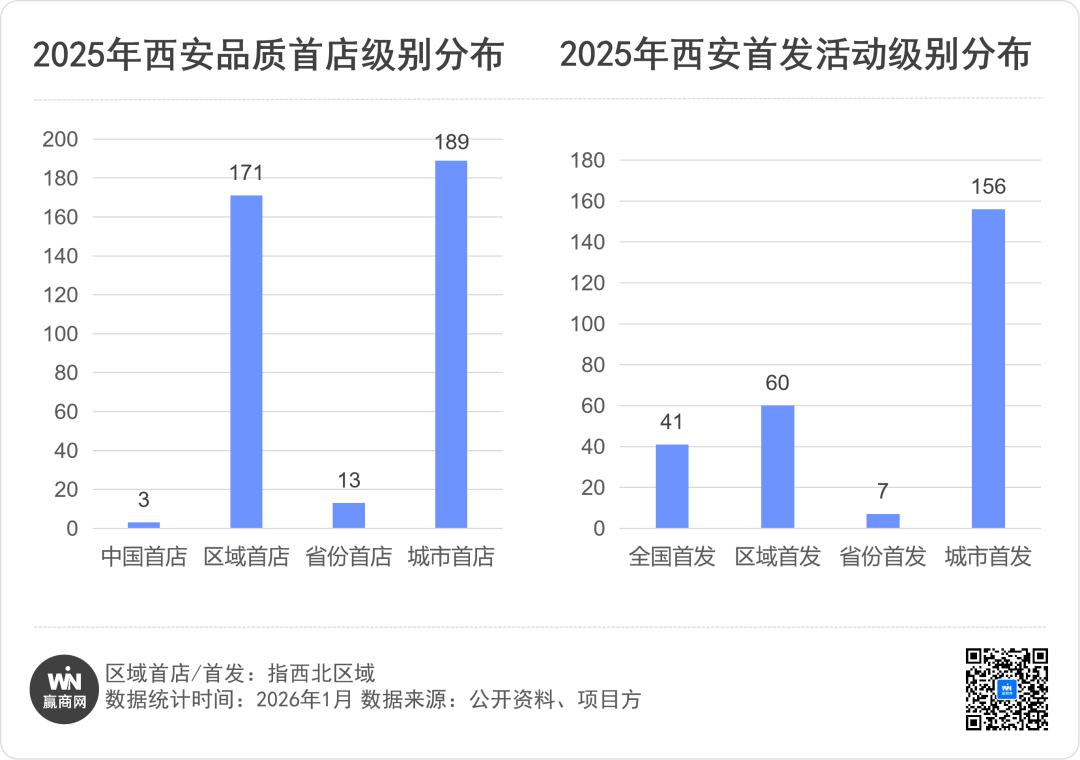
Core Insights - Xi'an has introduced a total of 376 new brand stores in 2025, including 3 national first stores, 171 regional first stores, 13 provincial first stores, and 189 city first stores, indicating a strong market presence and strategic positioning in the Northwest region of China [1][4] - The city has hosted 264 launch events, with 41 being national launches, showcasing a vibrant commercial atmosphere and a shift towards experience-driven retail [1][15] Group 1: Store Introduction and Brand Strategy - The proportion of regional first stores is 45.5%, while city first stores account for 50.3%, indicating a preference for Xi'an as a strategic base for brands in the Northwest market [4][6] - Notable national first stores include MINISO's WAKUKU theme store, which features over 6,000 products in an immersive shopping environment, reflecting the city's growing commercial influence [4][6] - The distribution of store grades shows that C-grade stores dominate at 52.9%, while S and A-grade stores combined account for only 9.9%, suggesting room for improvement in brand quality [6][7] Group 2: Regional Distribution and Market Dynamics - Yanta District leads with 138 first stores, representing 37% of the total, followed by Qujiang New District with 62 stores, highlighting a concentration of commercial activity in mature urban areas [8] - Emerging areas like Chanba Ecological District and Chang'an District are beginning to attract new stores, indicating a shift in commercial development from traditional centers to peripheral regions [8] Group 3: Commercial Projects and Performance - The Xi'an Seg International Shopping Center stands out with 59 first stores, showcasing a diverse range of categories and a strong market position [9][10] - Other significant projects like Xi'an Joy City and Xi'an MixC have also introduced over 20 first stores each, enhancing their competitive edge in the market [9] Group 4: Industry Trends and Consumer Preferences - The restaurant sector dominates with 54.79% of new stores, reflecting a growing trend towards experiential dining and lifestyle consumption [11][14] - Bakery and beverage categories are particularly popular, with 38 and 33 new stores respectively, indicating a shift towards a "light enjoyment economy" [11][13] - Innovative dining concepts, such as self-service hot pot and seafood buffets, are emerging, showcasing a trend towards unique and high-quality dining experiences [14] Group 5: Launch Events and Marketing Activities - A total of 264 launch events were held, with 59% being city-level events, indicating a robust local commercial activity [15][19] - Xi'an Joy City hosted the most events at 47, featuring high-profile activities that attract a younger demographic [15][17] - The structure of events shows a shift towards experiential and engaging formats, with exhibitions and performances becoming key drivers of consumer engagement [19]


AI存算分离突破催化DRAM需求,数字经济ETF(560800)盘中涨1.27%
Xin Lang Cai Jing· 2026-01-28 02:44
Group 1 - The semiconductor and chip sectors are experiencing a strong rally, with the China Securities Digital Economy Theme Index rising by 1.23% as of January 28, 2026, and key stocks like Shengbang Co., Ltd. and Zhaoyi Innovation seeing increases of 6.71% and 6.11% respectively [1] - The Digital Economy ETF (560800) also saw a rise of 1.27%, with a trading volume of 539.51 million yuan and a turnover rate of 0.95% [1] - The DeepSeek and Peking University collaboration introduced the Engram model, which separates static knowledge retrieval from complex calculations, enhancing AI infrastructure and providing a scalable technical path for large models in China [1] Group 2 - The AI wave is reshaping the semiconductor supply chain, with significant supply constraints in upstream core components, as noted by Datong Securities [2] - AI-driven chips are prioritizing advanced process capacities at companies like TSMC and Samsung, impacting traditional server CPU production [2] - The Digital Economy ETF closely tracks the China Securities Digital Economy Theme Index, selecting companies with high digital infrastructure and application levels [2] Group 3 - As of December 31, 2025, the top ten weighted stocks in the China Securities Digital Economy Theme Index accounted for 52.63% of the index, including companies like Dongfang Wealth and Cambricon [3] - The Digital Economy ETF has various connection options, including the Pengyang China Securities Digital Economy Theme ETF [3]
未知机构:1用玉米大豆模型把AI需求如何外溢到非AI芯片讲清楚-20260128
未知机构· 2026-01-28 02:00
Summary of Conference Call Transcript Industry Overview - The discussion revolves around the semiconductor industry, particularly the impact of AI demand on traditional chip production and supply dynamics [1][3]. Core Insights and Arguments 1. **Agricultural Analogy**: The author uses a "corn-soybean" model to explain how AI demand diverts resources from traditional chips (corn) to advanced chips (soybeans) like HBM and 3/4 nm processes [1][3]. 2. **Supply Shortage Evidence**: By 2026, three key indicators suggest a shortage of traditional chips: - **NAND**: Companies like Kioxia and SK Hynix report that their 2026 production capacity was sold out by January, with SSD spot prices increasing by 15-20% [2][6]. - **CPU**: Intel prioritizes 14/10 nm capacity for server CPUs, leading to a widening supply gap for PC CPUs, with Raptor Lake prices rising by 8-12% in January [2][6]. - **Packaging**: Major players like ASE and Tongfu report a 5-8% increase in lead frame and substrate prices due to rising costs of copper, gold, and BT resin, alongside tight 8-inch capacity [2][6]. 3. **Comparison of 2021 and 2026**: - **2021**: Supply constraints due to events like the Renesas fire and Texas freeze, with 8-inch utilization dropping to 75%. Demand surged due to pandemic-driven PC and electric vehicle sales [6]. - **2026**: Supply constraints persist, with AI demand causing negative capital expenditure for 8-inch lines for three consecutive years, and global capacity down 7% from 2021 levels. Demand remains weak, with mobile shipments expected to grow only 3% and automotive chip inventories at 2.2 months [6]. 4. **Potential Catalysts for Demand Recovery**: - **Macro Factors**: A global inventory replenishment cycle in the second half of 2026 could boost utilization rates from 85% to 95% [6]. - **Events**: A significant disruption at a major 8-inch wafer or packaging facility could lead to rapid price increases [6]. - **Policy Initiatives**: New government policies promoting domestic MCU and analog IC demand could significantly impact the market [6]. Additional Important Insights 1. **MCU Price Trends**: In January, 32-bit MCU prices showed a 5% increase for STMicroelectronics and a 7% increase for GigaDevice, indicating early signs of price recovery, although actual demand remains subdued [7]. 2. **Risk Factors**: If demand does not improve by Q2 2026, channel inventories may flood the market again, potentially driving prices back to 2022 lows [7]. 3. **Investment Strategy**: Recommended stocks include leading packaging firms (Changdian, Tongfu, Huada), specialized 8-inch wafer manufacturers (Huahong, China Resources Micro), and domestic MCU/analog design companies (GigaDevice, Silead, Systech) as a balanced investment approach [7].
本轮半导体周期的同与不同
2026-01-26 02:49
本轮半导体周期的同与不同 20260125 摘要 半导体行业正经历由 AI 结构性需求驱动的新一轮高景气周期,与上一轮 新能源需求挤压产能不同,AI 需求创造了对半导体的新需求,并挤压现 有产能,存储市场开启史上最强周期,短期内没有减弱迹象。 全球封测行业发生变化,台积电将部分先进封装外包,台湾厂商转移传 统产能至大陆,大陆封测设备和材料紧张并涨价,为国内封测厂商带来 机遇,行业格局优化,供需关系趋于紧张。 国产算力发展拉动国内晶圆厂,但尚未成为主要业绩贡献,研发和折旧 成本压力下,大厂对成熟制程提价诉求增加,需关注国产算力带来的新 进制程增长及成熟制程提价压力。 半导体分测试环节值得关注,上市公司普遍对四季度及明年持乐观态度, 多家公司新项目投产,产业段需求变化显著,AI 相关订单外溢至大陆, 整体供需关系趋紧。 LED 驱动行业竞争格局显著改善,非上市公司和小厂退出,随着市场需 求增长和竞争环境优化,该行业有望迎来更大的发展机遇。 Q&A 当前半导体行业的周期性特征是什么?与上一轮周期相比有何异同? 当前半导体行业的周期性特征可以从产品周期、产能周期和库存周期三个方面 来理解。首先,产品周期是电子半导体领 ...
徕卡又要出售了,中资买下百年可乐标?
Xin Lang Ke Ji· 2026-01-26 01:20
Core Viewpoint - Leica Camera, a century-old iconic brand, is considering a sale of its controlling stake, with an estimated valuation of approximately €10-12 billion ($12-15 billion) [1] Group 1: Company Background - Leica's origins trace back to 1849 when Carl Kellner founded the "Optical Institute" in Germany, which later evolved into the Leica brand [3] - The brand has become synonymous with documentary photography, having been used by renowned photographers throughout the 20th century [5] - Leica has undergone significant transformations, including a near bankruptcy in the digital age, before being rescued by Andreas Kaufmann in 2004 [8] Group 2: Ownership and Financials - The current ownership structure consists of ACM holding 55% and Blackstone holding 45% of Leica [8] - Blackstone's investment in 2011 valued Leica at approximately €278 million, and the firm has since helped elevate Leica into a luxury brand [9][12] - Leica's revenue has seen consistent growth, increasing from €450 million to €596 million over the past four fiscal years, despite a slowdown in growth rate [11][12] Group 3: Strategic Partnerships - Leica has established significant partnerships with Chinese tech giants Huawei and Xiaomi, which have contributed to its revenue growth in the mobile imaging sector [10][18] - The collaboration with Huawei, which began in 2016, significantly boosted Leica's brand exposure and revenue, although it ended in 2022 due to Huawei's market challenges [16][18] - The partnership with Xiaomi, initiated in 2022, aims to enhance Xiaomi's brand positioning in the high-end market, providing Leica with stable returns [19][20] Group 4: Potential Buyers and Market Implications - Potential buyers for Leica include Chinese private equity firm HSG, Nordic private equity fund Altor Equity, and German optics giant Zeiss [1][20] - A successful acquisition by HSG could further enhance Leica's growth in the Chinese market, which has seen a 25% increase in sales [20] - The sale process is being managed by Morgan Stanley, and the outcome will depend on both the bidding price and regulatory considerations [10][21]

圣邦股份:截至2025年9月30日股东数量为110773户
Zheng Quan Ri Bao· 2026-01-22 08:35
Group 1 - The core viewpoint of the article is that Shengbang Co., Ltd. will disclose the number of shareholders in its periodic reports, with the current number of shareholders reported as 110,773 as of September 30, 2025 [2]

圣邦股份股价涨5.05%,尚正基金旗下1只基金重仓,持有1.46万股浮盈赚取5.3万元
Xin Lang Cai Jing· 2026-01-21 06:15
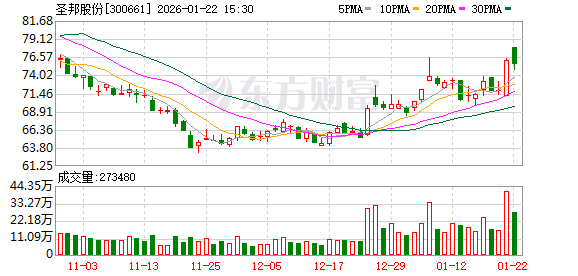
Group 1 - The core point of the news is that Shengbang Microelectronics (Beijing) Co., Ltd. has seen a stock price increase of 5.05%, reaching 75.56 yuan per share, with a total market capitalization of 467 billion yuan [1] - The company specializes in high-performance and high-quality analog integrated circuits, with its main business revenue composition being 61.75% from power management products and 38.04% from signal chain products [1] - The company was established on January 26, 2007, and went public on June 6, 2017 [1] Group 2 - According to data from the top ten heavy stocks of funds, Shangzheng Fund has one fund heavily invested in Shengbang shares, specifically the Shangzheng Research Selected Mixed Fund A (023397), which increased its holdings by 4,200 shares in the third quarter [2] - The fund currently holds 14,600 shares, accounting for 6.73% of the fund's net value, ranking as the ninth largest heavy stock [2] - The fund has achieved a return of 16.09% this year, ranking 207 out of 8,844 in its category, and a cumulative return of 52.22% since its inception [2] Group 3 - The fund manager of Shangzheng Research Selected Mixed Fund A is Zhang Zhimei, who has a tenure of 8 years and 48 days, with the fund's total asset size at 253 million yuan [3] - During Zhang's tenure, the best fund return was 121.21%, while the worst was -29.86% [3] - Co-manager Li Rui has a tenure of 338 days, with a fund asset size of 18.07 million yuan, achieving a best return of 52.26% and a worst return of 7.12% during his tenure [3]
今日61只股长线走稳 站上年线
Zheng Quan Shi Bao Wang· 2026-01-21 05:18
Market Overview - The Shanghai Composite Index closed at 4120.10 points, above the annual line, with a change of 0.16% [1] - The total trading volume of A-shares reached 1,645.83 billion yuan [1] Stocks Above Annual Line - A total of 61 A-shares have surpassed the annual line today, with notable stocks showing significant deviation rates [1] - The stocks with the highest deviation rates include: - Huawi Design (华维设计) with a deviation rate of 24.42% - Hualing Co. (华岭股份) at 5.51% - Huilong Piston (汇隆活塞) at 4.81% [1] Detailed Stock Performance - The following table summarizes the performance of selected stocks that have crossed the annual line: - Huawi Design (华维设计): Today's change of 29.96%, turnover rate of 26.39%, annual line at 14.64 yuan, latest price at 18.22 yuan [1] - Hualing Co. (华岭股份): Today's change of 12.70%, turnover rate of 9.21%, annual line at 24.90 yuan, latest price at 26.27 yuan [1] - Huilong Piston (汇隆活塞): Today's change of 18.06%, turnover rate of 13.30%, annual line at 9.86 yuan, latest price at 10.33 yuan [1] - Other notable stocks include: - Wuhan Fangu (武汉凡谷) with a deviation rate of 4.17% - Meirui New Materials (美瑞新材) with a deviation rate of 3.81% [1] Additional Stocks with Minor Deviations - Stocks with smaller deviation rates that have just crossed the annual line include: - Gongdong Medical (拱东医疗) and Chongqing Gas (重庆燃气) [1] - The performance of these stocks indicates a cautious upward trend in the market [1]




光通信蓝海拾珠-模拟芯片与液冷大有可为
2026-01-19 02:29
Summary of Conference Call on Optical Communication Industry Industry Overview - The optical communication industry is experiencing significant growth, particularly in the optical module segment, which is expected to maintain high demand in 2026 and 2027. The focus is not only on optical modules but also on related components such as optical chips, lasers, CW light sources, and DSPs [2][9]. Key Components and Market Dynamics - **Power Management**: Power supply is critical in optical modules, requiring high-density power to support components like DSPs. Typical supply voltage is 3.3V, which needs to be stepped down to 1V using DC-DC converters, with each line potentially requiring over 10A [1][3]. - **Analog Front-End (AFE)**: AFE is essential for bias control, with increasing channel counts as speeds rise. Major market players include TI and ADI, with prices exceeding $4 per unit. Domestic company Sanhui Electronics is gaining market share in this area [1][3][4]. - **Laser Driver Chips (LDD) and Transimpedance Amplifiers (TIA)**: These components are crucial for high-speed optical modules, primarily supplied by foreign manufacturers. However, domestic firms are expected to make breakthroughs in this sector [1][3]. - **Temperature Control Chips (TEC)**: TECs are vital for precise temperature control to prevent signal crosstalk, especially in long-distance communication. Shengbang Co. has a strong track record in TEC controllers [1][6]. Market Opportunities - The market for analog chips and related components is projected to exceed $10 billion, with each 800G module valued at nearly $10. This presents a significant opportunity for domestic manufacturers [1][3]. - The internal liquid cooling technology in optical modules is primarily passive, with companies like Zhongshi making significant advancements and entering mass production. Future developments may include more advanced 3D VC forms [2][6][9]. - External liquid cooling solutions are also evolving, with NVIDIA showcasing a fully liquid-cooled system. This requires careful design to accommodate size variations during installation [6][7]. Competitive Landscape - Several domestic companies are positioned well in these segments: - **Shengbang Co.**: Strong in TEC controllers and AFE. - **Sanhui Electronics**: Notable for AFE with increasing core customer share. - **Youxun Co.**: Focused on LDD and TIA, covering major global operators and equipment manufacturers [4][5][9]. - **Creeper and Shenbang**: Potential to break into the DAC chip market, which is currently dominated by ADI's high-priced products [8][10]. Conclusion - The optical communication sector, particularly in optical modules and OCS switches, presents substantial growth opportunities. Domestic manufacturers are well-positioned to capitalize on these trends through customized development and innovation, potentially leading to significant market share expansion [2][10].
2026年,要想清楚该如何面对牛市
雪球· 2026-01-17 03:46
Group 1 - The article discusses the potential bullish trend in the A-share market by 2026, supported by factors such as low interest rates and the attractiveness of stock dividends compared to government bonds [5][6][10] - It highlights the concept of "asset scarcity," where capital is expected to flow into higher-yielding investments as traditional options like real estate and bank deposits lose their appeal [7][8] - The article emphasizes the importance of strategic focus on stimulating consumption and internal demand through asset appreciation rather than direct cash distribution [9][10] Group 2 - The article outlines four key investment strategies for navigating a bull market, applicable to both institutional and retail investors [11] - The first strategy is to embrace index ETFs, particularly the CSI 500, which represents a diversified selection of leading companies [12][13] - The second strategy stresses the importance of balanced asset allocation to mitigate risks associated with heavy concentration in specific stocks or sectors [14] - The third strategy advises investors to adopt a long-term perspective and avoid short-term trading, as retail investors typically lack advantages in quick market movements [15][16] - The fourth strategy suggests waiting for price corrections to find good entry points for investments, emphasizing the need for a positive mindset [17][19] Group 3 - The article identifies three key criteria for selecting high-quality companies in the high-end manufacturing sector: price increases, overseas expansion, and innovation [22][23] - It discusses the importance of evaluating both relative and absolute price metrics, including PE/PB ratios and historical performance, to determine good pricing [25][26] - The article categorizes leading manufacturing companies into five groups based on their fundamentals and valuation metrics, providing a framework for investment decisions [28]