
瑞幸

Search documents
为什么都在抢购"洋品牌"的中国资产?
3 6 Ke· 2025-12-04 04:17
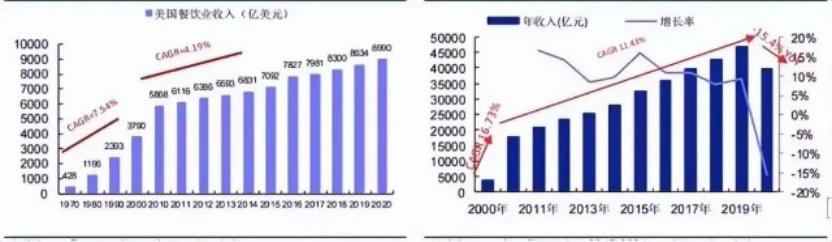
Core Insights - The recent ownership battle for Starbucks' China operations has concluded, highlighting a trend where foreign brands are being acquired by local capital in China [1][2] - This trend is not isolated, as seen with McDonald's China operations, which have thrived under local management after being acquired [3][10] Group 1: Market Dynamics - The competition between foreign brands' "slow operations" and local capital's "fast strategies" is evident in the Chinese market, leading to a clash of business logics [2][4] - The Chinese coffee market is growing at an annual rate of approximately 15%, with the industry scale expected to exceed 300 billion yuan by 2024, making it an attractive target for investment [3][10] Group 2: Case Studies - McDonald's China, after being acquired, increased its store count from 2,400 to over 7,100, becoming one of the fastest-growing markets globally [3][10] - Starbucks is viewed as a valuable asset due to its potential for operational improvement, particularly in its "third space" model, which lags behind competitors like Luckin Coffee [3][10] Group 3: Strategic Approaches - Local capital's "fast strategy" is characterized by rapid market adaptation and efficiency, contrasting with the slower, more methodical approach of foreign brands [4][5] - The difference in market growth rates—4.19% for the U.S. restaurant market from 2001 to 2020 versus 11.43% for China's restaurant market from 2010 to 2019—illustrates the need for different operational strategies [5][8] Group 4: Consumer Behavior and Market Potential - The saturation of high-tier cities in the coffee market contrasts with the growth potential in lower-tier cities, where local brands are increasingly focusing their efforts [10][12] - The rise of digital platforms and changing consumer perceptions in lower-tier cities have made them ripe for expansion, with local brands effectively targeting price-sensitive consumers [10][12] Group 5: Long-term Considerations - The rapid expansion of local brands, while beneficial in the short term, poses risks of brand dilution and profitability challenges in the long run [13][14] - The balance between maintaining brand integrity and adapting to local market dynamics is crucial for sustained success [15][16]


蜜雪冰城杀进早餐界
Guo Ji Jin Rong Bao· 2025-12-01 13:04
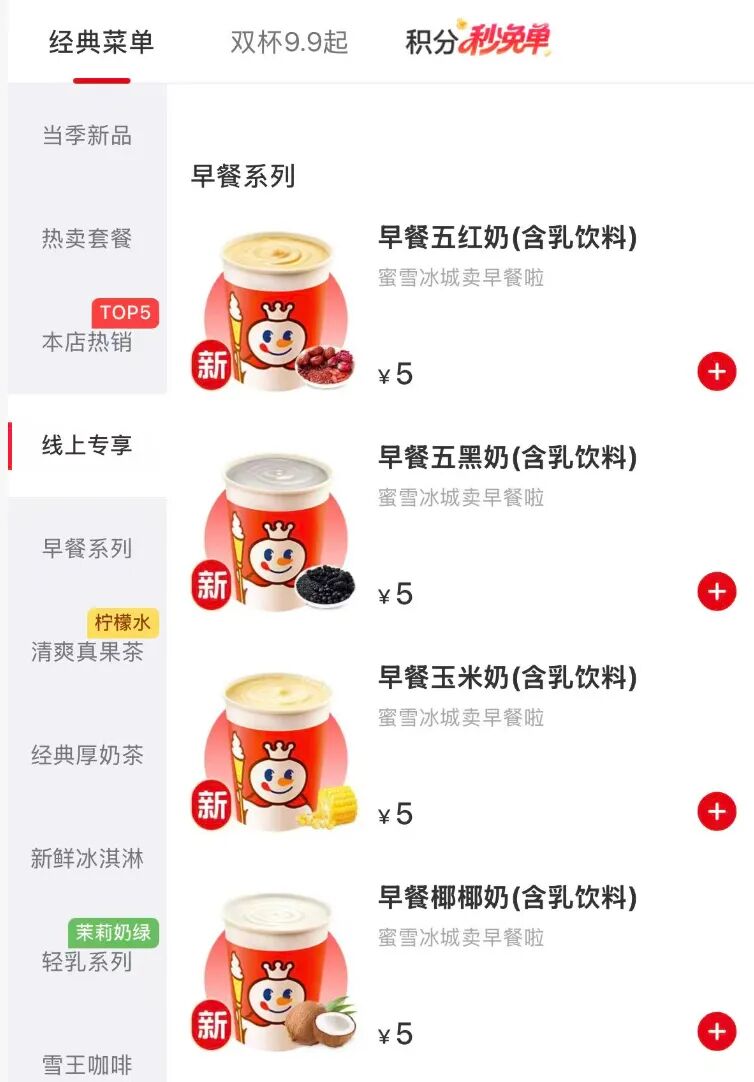
Core Insights - Mixue Ice City has launched a new breakfast product line, including four milk-based drinks priced at 5 yuan each, and is conducting consumer surveys to gather data for future product adjustments [1][2][6] Company Developments - The breakfast initiative is currently in a trial phase in cities like Dalian, Xi'an, Nanning, and Hangzhou, with no plans for large-scale rollout yet [2] - Mixue Ice City has a strong presence with nearly 42,000 operating stores in China, which allows for rapid consumer reach for new products [7] - The company has recently expanded its business scope by acquiring a majority stake in the parent company of "Fresh Beer Fu Lu Jia," diversifying its offerings beyond tea and coffee [9] Industry Trends - The breakfast market in China is projected to reach 1.35 trillion yuan by 2025, with an annual growth rate of 7%-8% [4] - The breakfast sector is currently fragmented, with the top five brands holding only 23.5% market share, indicating significant opportunities for new entrants [4] - Competitors like Tims and Starbucks have already established breakfast offerings, and other brands are also looking to enter this space to drive growth [5]
退市5年还敢杀回美股?瑞幸CEO放话,门店超星巴克,底气在哪?
Sou Hu Cai Jing· 2025-11-29 10:06
Core Viewpoint - Luckin Coffee aims to return to the US stock market after being delisted due to a $310 million fraud scandal five years ago, despite the challenges posed by its historical issues and the need for compliance [1][10]. Group 1: Company Background - Luckin Coffee was delisted from NASDAQ in June 2020 after a fraud scandal that emerged shortly after its IPO in May 2019, resulting in a $180 million fine [4]. - The company has shown remarkable recovery, with Q2 2025 financial results reporting total net revenue of 12.359 billion yuan, a year-on-year increase of 47.1%, and operating profit of 1.7 billion yuan, up 61.8% [4]. Group 2: Business Strategy - The company underwent significant operational changes post-scandal, including a strategic reduction of underperforming stores while opening new locations in high-demand areas, leading to improved store density and profitability [6][8]. - A new management team was established, emphasizing transparency and employee engagement through stock incentives, which has enhanced operational efficiency [8]. Group 3: Challenges to Return - Returning to the US market is complicated by stringent regulations from the SEC regarding companies with a history of fraud, requiring Luckin to demonstrate compliance and present clean financial reports for at least three years [10]. - The company faces ongoing challenges related to US-China audit regulations, which could impact its ability to regain investor trust [10]. Group 4: Future Prospects - Luckin Coffee's motivation to return to the US market is driven by the need for capital to support expansion into lower-tier cities and global initiatives, as US markets offer higher financing efficiency and valuations [10].
奶茶品牌跨界,为何赖上电商?
3 6 Ke· 2025-11-28 08:03
Core Viewpoint - The tea beverage industry is witnessing a shift as brands like Cha Yan Yue Se (茶颜悦色) are diversifying their product offerings beyond traditional tea drinks to include snacks and other items, adapting to the competitive landscape and changing consumer preferences [1][2][22]. Group 1: Company Strategies - Cha Yan Yue Se is transitioning from being solely reliant on fresh tea drinks to incorporating snacks as a new mainstay, responding to the intense competition in the beverage sector [2][22]. - The brand is leveraging online platforms to expand its reach, as its physical store locations limit consumer access, particularly in rural areas [4][12]. - Online sales of snacks and tea products have shown significant traction, with items like sea salt caramel bread cubes and instant tea powders achieving high sales volumes on platforms like Taobao and JD [4][7][20]. Group 2: Industry Trends - The trend of tea brands moving online is becoming prevalent, with competitors like Mi Xue Bing Cheng (蜜雪冰城) also engaging in e-commerce to enhance consumer interaction and brand visibility [10][21]. - The online marketplace is seen as a new battleground for tea brands, with various strategies being employed, such as selling ready-to-drink beverages or instant mixes, to cater to different consumer needs [20][22]. - The success of online initiatives by brands like Cha Yan Yue Se and Mi Xue Bing Cheng indicates that online marketing can positively impact brand awareness and sales without cannibalizing physical store revenue [21][22].

中国最好的一批消费品牌是怎么诞生的?
36氪· 2025-11-26 09:27
Core Viewpoint - Luckin Coffee has demonstrated a remarkable turnaround, with its store count reaching 2,921, six times the number at the time of its delisting in 2020, and achieving a stable profit of 1.2 yuan per cup, contrasting with a loss of 5.6 yuan per cup five years ago [5][6]. Group 1: Company Recovery and Market Dynamics - The case of Luckin Coffee represents one of the most significant "turnaround" stories in Chinese business history, challenging the notion that delisting equates to failure and showcasing the resilience of the Chinese consumer market [8][9]. - Institutional investors, such as Snow Lake Capital and IDG Capital, have played a crucial role in supporting Luckin Coffee post-delisting, with significant investments and strategic changes that revitalized the brand [9][11]. - The market's response to Luckin's delisting was calm, indicating a strong underlying demand for its products, which remained unaffected by the delisting crisis [13][19]. Group 2: Shift in Consumer Investment Paradigms - The narrative surrounding Luckin Coffee reflects a broader shift in the Chinese consumer landscape, moving away from a model focused on aggressive spending and rapid growth towards one emphasizing product quality and sustainable profitability [16][19]. - The success of Luckin Coffee and other brands illustrates the emergence of a new generation of consumer entrepreneurs who prioritize product excellence and consumer insights over mere market share [25][26]. - The investment landscape is evolving, with a focus on long-term value creation and the importance of identifying companies with strong product capabilities and brand strength [30][31]. Group 3: Market Potential and Global Influence - China's consumer market is increasingly recognized as a significant source of global innovation, with a vast population allowing for extensive validation and iteration of niche products [34][44]. - The competitive environment in China is characterized by both high risks and high rewards, necessitating that local companies and their investors adapt to rapidly changing market conditions [35][39]. - Investment institutions are now more involved in the global expansion of Chinese brands, reflecting a shift from merely bringing foreign brands to China to actively participating in the global market [41][43].
蜜雪幸运咖全球门店破万!食品饮料ETF天弘(159736)昨日成交额超7000万元,机构:2026消费大年看好大众品需求
2 1 Shi Ji Jing Ji Bao Dao· 2025-11-26 01:32
Group 1 - The A-share market experienced a rebound on November 25, with all three major indices closing in the green [1] - The Tianhong Food and Beverage ETF (159736) recorded a trading volume exceeding 70 million yuan, with leading stocks including Jinzi Ham, Angel Yeast, and Bailong Chuangyuan showing significant gains [1] - The Tianhong Agriculture ETF (512620) was actively traded, achieving a turnover rate of 5.27% and a trading volume over 20 million yuan, with top-performing stocks including Biological Shares, Roniu Mountain, and Cangge Mining [1] Group 2 - The Tianhong Food and Beverage ETF (159736) tracks the CSI Food and Beverage Index, focusing on leading high-end and mid-range liquor stocks, as well as key players in beverages, dairy, and condiments, with top ten weighted stocks including "Moutai, Wuliangye, Luzhou Laojiao, and Yanghe" [1] - As of November 24, the Tianhong Food and Beverage ETF (159736) had a scale of 5.627 billion yuan, ranking first among food and beverage ETFs in Shenzhen [1] - The Tianhong Agriculture ETF (512620) closely follows the CSI Agriculture Index, covering sectors such as breeding and agricultural chemicals, with leading stocks including Muyuan Foods, Wens Foodstuff Group, and Haida Group [1] Group 3 - The Huashu Network announced a public auction for 6,500 tons of domestic frozen pork on November 20, 2025 [2] - Structural opportunities in the food and beverage industry are expected to continue, with new consumption trends and a recovery in traditional consumption [2] - According to Citic Securities, the demand for most consumer goods has experienced a decline over the past two years, but inventory levels are stabilizing, and demand is expected to improve, particularly in dairy and frozen food sectors [2]

幸运咖门店数破万家:咖啡价格战会加剧吗?
2 1 Shi Ji Jing Ji Bao Dao· 2025-11-25 03:28
21世纪经济报道记者贺泓源、实习生韦怡琦 比库迪更便宜的幸运咖门店数破万家了。 亦要看到,随着外卖补贴退潮,咖啡价格战可能会进入更稳定的新阶段。 大概方向是,产品价格稳定在某个区间。比如,库迪曾靠着一己之力把咖啡市场拖入9.9元价格战,现 在库迪正坚守在这一区间。可从产品价格上,应该不会再出现2.9元的超低价。 幸运咖会把市场带到6-8元区间吗?客观上,咖啡茶饮赛道,是典型高频消费赛道,产品补贴价格降低 后能催生出大量需求。若瑞幸、库迪们不跟,同行将会迅速占领市场,所以只能迎战。 2025年11月24日,幸运咖宣布,其全球门店数量正式突破10000家。幸运咖是蜜雪集团旗下现磨咖啡品 牌,主要产品定价在6-8元。作为对比,库迪正在实施全场9.9元。 从门店规模来看,截至三季度末,瑞幸门店数为29214家。库迪最新数据是1.8万家。 另据幸运咖披露,截至目前,幸运咖门店已覆盖全国超300座城市,包括一线、二三线城市及广大下沉 市场。其中,一线市场的门店数已超千家,北京地区门店数达到100家。 需要注意的是,幸运咖的爆发,有着外卖大战推动。在今年二季度,幸运咖新签门店同比增长164%。7 月以来,加盟咨询量环比增长 ...
幸运咖门店数破万家:咖啡价格战会加剧吗?丨消费参考
2 1 Shi Ji Jing Ji Bao Dao· 2025-11-25 03:03
Group 1 - Luckin Coffee has surpassed 10,000 stores globally as of November 24, 2025, with pricing primarily between 6-8 yuan, making it cheaper than its competitor, Kudi, which has a flat price of 9.9 yuan [1][2] - As of the end of Q3, Luckin Coffee operates 29,214 stores, while Kudi has 18,000 stores. Luckin Coffee has expanded to over 300 cities, including more than 1,000 stores in first-tier cities [2] - The rapid growth of Luckin Coffee is attributed to the competitive landscape driven by delivery service wars, with a 164% year-on-year increase in new store openings in Q2 [2] Group 2 - The reduction of delivery subsidies is impacting the coffee market, with Luckin Coffee's same-store sales growth facing short-term pressure as noted by its executives [3][4] - The coffee price war may stabilize as delivery subsidies decrease, with expectations that prices will settle in a certain range, potentially around 6-8 yuan for Luckin Coffee [6][9] - Luckin Coffee's growth trajectory positions it as a strategic competitor to established players like Luckin and Kudi, especially as it reaches a significant scale [8][9]
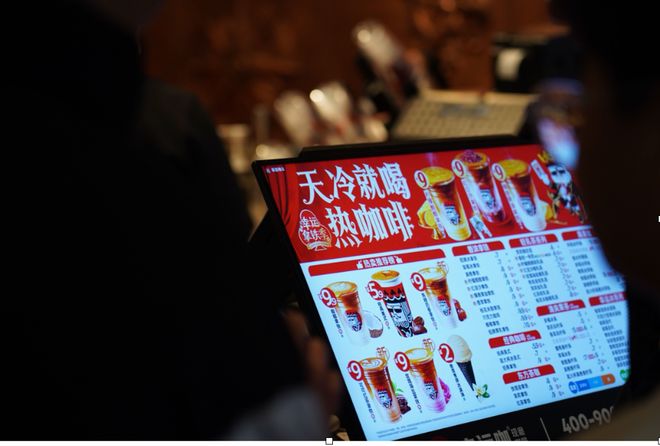
中国最好的一批消费品牌是怎么诞生的?
3 6 Ke· 2025-11-24 01:18
刚刚过去的一个季度里,瑞幸的门店总数达到29214 家,这个数字是 2020 年退市时的6倍。五年时间里,它从每卖一杯亏 掉5.6 元,到如今单杯稳定获利1.2 元[1]。粉单市场上,它的股价从最低不到 1 美元一路反弹,不断逼近退市前 129 亿美元 的总市值峰点。 这些标志性的数字,构成了瑞幸重生的叙事。 这是近十年来中国商业史上最具代表性的"困境反转"案例。它修正了资本市场对于"中概股退市必死"的刻板印象,演绎了 一段投资机构逆势支持企业的佳话,更用一场起死回生告诉人们: 中国消费市场是一个庞大的存在,只要持续做好自己的产品,就可以活得比所有人以为的更有韧性。 2021年,生椰拿铁的上市宣布了瑞幸的"卷土重来"——单月销量突破 2000 万杯,相当于每秒钟卖出 7 杯,券后价格常年 9.9 元就能实现盈利。瑞幸又回到了最朴素的商业常识里:好产品是前面的1,其他能力是后面的0。规模只是产品的结果, 份额只是品牌的具象。 事实上,IDG资本从一开始就非常看好瑞幸,但一直没有找到合适的入局机会。公司投资团队判断瑞幸本身的品牌、门店 网络、数字化系统等都是良性健康的,只是在前期试图用大量补贴,在短期急速培养消费 ...

中国最好的一批消费品牌是怎么诞生的?
远川研究所· 2025-11-23 12:38
Core Viewpoint - Luckin Coffee's remarkable recovery illustrates the resilience of the Chinese consumer market, challenging the stereotype that Chinese concept stocks must fail after delisting, and highlighting the importance of product quality in driving business success [5][8]. Group 1: Company Performance - In the past quarter, Luckin Coffee's total number of stores reached 2,914, which is six times the number at the time of its delisting in 2020 [2]. - The company transitioned from losing 5.6 yuan per cup to a stable profit of 1.2 yuan per cup [2]. - Luckin's stock price rebounded from below 1 USD to approach its pre-delisting market cap of 12.9 billion USD [2]. Group 2: Investment and Market Dynamics - The delisting was initially seen as a fatal blow, but institutional investors remained focused on Luckin, with Snow Lake Capital raising its target price and major investments from firms like Dazhong Capital and IDG Capital totaling over 400 million USD [6][8]. - The shift in management and business model, driven by new investors, emphasized product innovation and data-driven strategies, leading to the successful launch of products like the coconut latte, which sold over 20 million cups in a month [8][9]. Group 3: Industry Trends - The current market environment has shifted from a focus on aggressive pricing and heavy spending to a model prioritizing product quality, high repurchase rates, and stable profits [11][13]. - The Chinese consumer market is characterized by its vast size and rapid feedback mechanisms, allowing even niche demands to be validated and turned into significant business opportunities [21][26]. - The investment landscape is evolving, with a focus on long-term value creation and the importance of identifying companies with strong product and brand capabilities [22][23]. Group 4: Case Studies of Success - Companies like Ying Shi and Pop Mart exemplify the new generation of consumer brands that have thrived by focusing on product excellence and innovation, leading to significant market impact [14][16]. - The success of these brands demonstrates that a deep understanding of consumer needs and a commitment to quality can lead to global recognition and market leadership [17][18]. Group 5: Future Outlook - The narrative of Chinese consumer entrepreneurship is shifting towards a focus on sustainable growth and the development of high-quality products that can compete globally [22][27]. - Investment institutions are increasingly playing a crucial role in supporting these brands, helping them navigate the complexities of both domestic and international markets [23][26].
