
雅克科技

Search documents
中银晨会聚焦-20260212-20260212
Bank of China Securities· 2026-02-12 01:01
Group 1: Macro Insights - January CPI growth rate year-on-year was lower than expected, while PPI growth rate was slightly higher than expected, influenced by the Spring Festival timing and base period rotation [4][5] - The average impact of the base period rotation on CPI and PPI year-on-year indices is estimated to be approximately 0.06 and 0.08 percentage points, respectively, which is relatively small [4][5] - CPI in January increased by 0.2% month-on-month and year-on-year, with core CPI rising by 0.8%, indicating a mixed inflationary environment influenced by seasonal factors and external inputs [5] Group 2: Real Estate Sector - The traditional residential development sector is contracting, while commercial real estate is entering a policy-driven growth phase, with a focus on creating new consumption scenarios to meet diverse consumer needs [12][13] - The shift from traditional commercial spaces to new consumption scenarios emphasizes emotional engagement and immersive experiences, moving beyond mere transactional spaces [14][20] - The rise of non-standard commercial projects, characterized by innovative space and operational models, is gaining traction, particularly in major cities like Shanghai and Beijing [16][17] Group 3: Chemical Industry - The dye industry is experiencing price increases due to rising costs of intermediate products, with significant price hikes observed in January, benefiting integrated companies with stable market shares [24][25] - The concentration of supply in the dye industry is improving due to stringent safety and environmental regulations, which may lead to a more favorable market environment for leading companies [26][27] Group 4: Electronics Sector - The demand for AI computing materials is expected to rise significantly as cloud service providers increase capital expenditures, leading to a supply-demand mismatch in the electronic fabric market [29][30] - Traditional electronic fabric production is transitioning to low-dielectric materials, with price increases anticipated across both traditional and low-dielectric electronic fabrics due to supply constraints [32][33]
中银晨会聚焦-20260210-20260210
Bank of China Securities· 2026-02-09 23:30
Group 1: AI Applications and Seedance 2.0 - The launch of Seedance 2.0 by ByteDance is expected to catalyze a rebound in AI applications, as market sentiment is currently at a low point [6][7] - Seedance 2.0 significantly enhances video generation capabilities, addressing key pain points in controllability, coherence, expressiveness, and production thresholds in the AI video generation field [7][10] - The model allows users to provide multiple inputs (up to 9 images, 3 videos, and 3 audio segments) to specify video generation effects, which can maintain consistency across multiple shots and enable complete narrative segments [10][11] - The improved usability rate of videos generated by Seedance 2.0 is projected to reach 90%, a significant increase from the previous industry average of about 20%, which could drastically lower production costs [10][11] Group 2: Animation Industry Development - The advancements brought by Seedance 2.0 are anticipated to accelerate the development of the AI animation market, with production costs and technical barriers significantly reduced [9][11] - The user base for domestic animation dramas is expected to grow from approximately 120 million in 2025 to 280 million in 2026, indicating a robust market potential [11] - The release of Seedance 2.0 is likely to enhance the production quality and efficiency of animation dramas, leading to a rapid industry expansion [11] Group 3: Computer Industry Breakthroughs - Significant breakthroughs in the technology sector include the launch of the world's first brain-machine acupuncture rehabilitation equipment, marking a substantial advancement in medical applications of brain-machine interfaces [13][14] - Shanghai has prioritized brain-machine interfaces and semiconductors in its future industrial planning, providing policy support for technological commercialization [15] - The University of Science and Technology of China has achieved major breakthroughs in quantum networking, laying the groundwork for long-distance quantum communication [16] Group 4: Autonomous Driving Developments - Waymo has completed a $16 billion financing round, becoming the largest single financing in the autonomous driving sector in recent years, with plans to expand services to over 20 cities [17] - The company reported a more than twofold increase in order volume year-on-year, with cumulative orders exceeding 20 million [17] - The financing is expected to propel the autonomous driving industry from testing to large-scale commercial applications [17] Group 5: Social Services Sector Insights - The social services sector experienced a decline of 3.44% in the first two trading weeks of 2026, ranking 24th among 31 industries [20][21] - The upcoming Spring Festival holiday, lasting 9 days, is expected to boost travel demand significantly, with an estimated 9.5 billion people expected to travel, setting a historical record [22][23] - Companies in the travel and tourism sector are anticipated to benefit from the concentrated release of travel demand during the holiday period [23]
行业聚焦:全球球形二氧化硅行业头部生产商市场份额及排名调查(附核心企业名单)
QYResearch· 2026-02-09 06:59
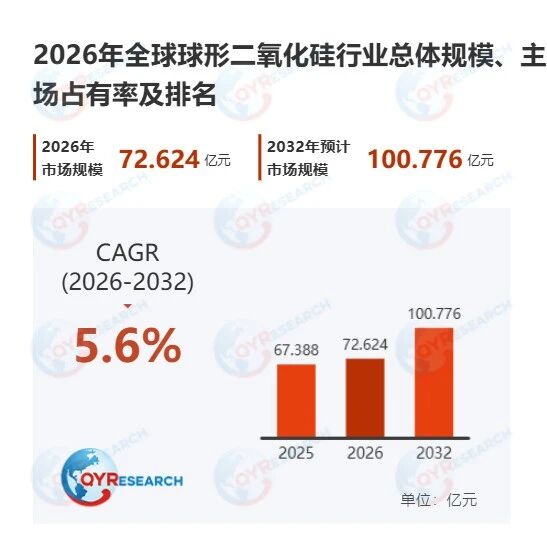
Core Insights - The global spherical silica market is projected to reach $1.48 billion by 2032, with a compound annual growth rate (CAGR) of 5.6% over the coming years [3] - The production of spherical silica is aimed at achieving higher packing density and more stable rheological properties compared to irregularly shaped silica [2] Market Overview - The estimated global production of silica is approximately 239,000 tons, with an average market price of $4,154 per ton [2] - The leading manufacturers in the spherical silica market include Denka, Admatechs, NIPPON STEEL Chemical & Material, and others, with the top ten companies holding about 61.0% market share by 2025 [5] - The primary product type in the market is 10 μm-20 μm, accounting for approximately 53.6% of the market share [7] Application Segmentation - The main demand source for spherical silica is epoxy molding compounds, which represent about 55.1% of the market [10] - Spherical silica is predominantly used in applications related to electronic materials, particularly in epoxy encapsulation [16] Industry Drivers - Significant investments in the semiconductor ecosystem in Asia, such as China's $150 billion chip initiative, are driving local material supply and increasing demand for electromagnetic compatibility (EMC) materials [17] - The rise of advanced packaging technologies is increasing the demand for fillers, with a projected CAGR of 8-10% [18] - The explosive demand for high-performance computing and 5G devices is a major driver for the need for high-quality packaging materials [19] Challenges - Rising compliance and operational costs due to stringent regulations on crystalline silica are impacting production costs [20] - The high concentration of raw material supply, particularly high-purity quartz, poses a risk of supply disruptions [20] - Long certification cycles in the semiconductor industry slow down the adoption of new filler technologies [21] Opportunities - The adoption of silane coupling agents for surface treatment of silica particles is enhancing resin adhesion and moisture resistance, which is becoming a standard process in advanced EMC fillers [22] - There is a growing demand for low-alpha fillers, particularly in memory and aerospace applications, which is opening new market opportunities [22] - The increasing need for thermal management and dimensional stability in automotive and industrial electronics is accelerating the application of silica fillers in composite laminates [24]

“无锡板块”焕新扩容 耐心资本壮大科创力量
Xin Hua She· 2026-02-08 12:06
Core Insights - Wuxi is undergoing a significant transformation, leveraging its strong manufacturing base to create a vibrant cluster of listed companies known as the "Wuxi Sector" [1] Group 1: Market Performance - By 2025, Wuxi aims to add 8 new listed companies, including 5 on the A-share market, ranking fifth nationwide [2] - Currently, Wuxi has 172 listed companies, with a total market capitalization of nearly 2.5 trillion yuan, contributing approximately 30% of the city's tax revenue and over 40% of its total imports and exports [2] - The "Wuxi Sector" is characterized by a strong focus on technology, with over 37% of listed companies on the Sci-Tech Innovation Board and Growth Enterprise Market [2] Group 2: Industry Development - Wuxi has over 50 semiconductor companies, forming a leading domestic industry chain, with notable success stories like MicroNano, which went public on the Sci-Tech Innovation Board within 7 years [2] - Traditional industries are also evolving through digital transformation, exemplified by Hai Lan Yunfu's smart factory, which utilizes AI and IoT for rapid production and inventory efficiency [3] Group 3: Government Support - Wuxi has established a comprehensive support system for companies throughout their lifecycle, including a database of approximately 400 potential listed companies [4] - The government has implemented policies to facilitate mergers and acquisitions, providing financial support and incentives for companies to achieve high-quality growth [4][5] Group 4: Capital Investment - Wuxi's investment landscape is characterized by "patient capital" and strategic investments, with state-owned capital playing a key role [6] - The total fund size managed by Wuxi Innovation Investment Group exceeds 290 billion yuan, supporting over 120 listed companies [6] - The establishment of the Shangxianhu Fund Park has attracted over 370 institutions, with a total private equity fund management scale surpassing 260 billion yuan [7]
化工行业周报20260208:国际油价回调,己内酰胺、维生素E价格上涨-20260208
Bank of China Securities· 2026-02-08 05:58
基础化工 | 证券研究报告 — 行业周报 2026 年 2 月 8 日 强于大市 化工行业周报 20260208 国际油价回调,己内酰胺、维生素 E 价格上涨 二月份建议关注:1、低估值行业龙头公司;2、"反内卷"对相关子行业供给端影响;3、下游需求旺 盛,自主可控日益关键背景下的电子材料公司。 行业动态 投资建议 ◼ 截至 2 月 8 日,SW 基础化工市盈率(TTM 剔除负值)为 28.57 倍,处在历史(2002 年至今) 82.89%分位数;市净率为 2.58 倍,处在历史 73.42%分位数。SW 石油石化市盈率(TTM 剔除负 值)为 15.16 倍,处在历史(2002 年至今)46.10%分位数;市净率为 1.47 倍,处在历史 50.93% 分位数。展望 2026 年,本轮行业扩产已近尾声,"反内卷"等措施有望催化行业盈利底部修复, 同时新材料受益于下游需求的快速发展,有望开启新一轮高成长,二月份建议关注:1、低估值行 业龙头公司;2、"反内卷"对相关子行业供给端影响;3、下游需求旺盛,自主可控日益关键背 景下的电子材料公司。中长期推荐投资主线:1、传统化工龙头经营韧性凸显,布局新材料等领域, ...


中银晨会聚焦-20260206-20260206
Bank of China Securities· 2026-02-06 01:32
Core Insights - The report highlights the contradiction faced during the "14th Five-Year Plan" period, where carbon reduction pressures are increasing while the growth rate of new energy installations is slowing down. The introduction of a national capacity price policy is expected to open up space for new energy installations and support high-yield investment options for power companies during the "14th Five-Year Plan" investment intensity [5][6][9]. Group 1: Energy Storage Industry - The national capacity price policy, issued on January 30, 2026, aims to establish a mechanism that balances power supply stability, green energy transformation, and efficient resource allocation. This policy is expected to support the development of adjustable power sources and enhance the installation of new energy [7][9]. - The report estimates that the demand for energy storage will show a high growth trend, with new energy storage installations expected to reach 66.43 GW and 189.48 GWh in 2025, representing year-on-year increases of 52% and 73% respectively [8][9]. - The capacity price policy is seen as the final piece needed for energy storage development, potentially increasing project returns from approximately 6.5% to over 8% under current subsidy conditions. This is expected to stimulate investment interest from state-owned enterprises in new energy storage projects [8][9]. Group 2: Investment Recommendations - The report suggests prioritizing investments in leading companies involved in energy storage integration and upstream battery cells, recommending firms such as Sungrow Power Supply, Trina Solar, LONGi Green Energy, JinkoSolar, CATL, and Eve Energy. It also advises monitoring companies like Haisum, Sungrow Electric, Canadian Solar, and Penghui Energy [9].




2026年中国四氟化碳行业理化性质、市场规模、重点企业及发展趋势分析:高纯替代与新兴领域需求双轮驱动,行业进入国产替代关键窗口期[图]
Chan Ye Xin Xi Wang· 2026-02-04 01:30
Industry Overview - The Chinese tetrafluoromethane (CF₄) industry is currently undergoing a phase of technological upgrades and market expansion, with a projected market size of approximately 2.079 billion yuan in 2024, representing a year-on-year growth of 7.44% [1][7] - The domestic low-temperature distillation-adsorption coupling process is maturing, improving the first-pass yield of 6N-grade products and narrowing the technology gap with international giants to a single purity level, laying a solid foundation for domestic substitution [1][7] - The demand for high-purity CF₄ is rapidly increasing due to the continuous expansion of downstream emerging industries such as semiconductors, photovoltaics, and panels [1][7] Industry Chain - The upstream of the CF₄ industry chain includes raw materials such as hydrofluoric acid, methanol, fluorine gas, carbon sources, and electricity, as well as production equipment like fluorocarbon reactors and distillation towers [4] - The midstream involves the production and manufacturing of CF₄, while the downstream applications are primarily in semiconductor, flat panel display, photovoltaic, and optical fiber manufacturing processes [4] Market Dynamics - The price of hydrofluoric acid, a core raw material for CF₄ production, is expected to reach 11,873 yuan per ton by the end of 2025, reflecting an increase of 8.87% year-on-year, driven by tightening supply and mining policies [5] - The production capacity of integrated circuits in China is projected to reach approximately 484.3 billion pieces by 2025, with a year-on-year growth of 7.28%, which will drive the demand for electronic-grade CF₄ in etching and wafer cleaning processes [7] Key Enterprises - The competitive landscape of the CF₄ industry is characterized by a concentration of leading firms driven by technology, with companies like Kemet, Fujian Del Technology, and Huate Gas rapidly emerging [8] - Huate Gas, established in 1999, has achieved high-purity CF₄ mass production and has been certified by major semiconductor clients, covering top global semiconductor companies [9] - Fujian Yongjing Technology, founded in 2007, focuses on fluorochemical production and has a capacity of 600 tons/year, utilizing advanced purification technologies [10] Future Trends - The growth of the CF₄ industry is primarily driven by the semiconductor and photovoltaic sectors, with increasing purity requirements pushing CF₄ products from mainstream 5N (99.999%) to 6N and beyond [12] - The competition in the industry is shifting towards a concentration of leading firms, with a focus on technological and capital advantages, as smaller firms face significant survival challenges [13] - Environmental regulations are expected to drive technological innovations in the industry, with a focus on green production processes and the development of efficient end-of-pipe treatment and recycling technologies [14]


中银晨会聚焦-20260204-20260204
Bank of China Securities· 2026-02-03 23:30
Group 1: Computer Industry Insights - The merger of SpaceX and xAI aims to integrate space and AI businesses, with plans for an IPO before June 2026 [8] - Meta plans to significantly increase its capital expenditure to $115-135 billion in 2026, nearly doubling its 2025 spending, to support AI infrastructure and core business growth [9][10] - Nvidia, Amazon, and Microsoft are negotiating to invest up to $60 billion in OpenAI, with SoftBank considering an additional $30 billion investment [10] Group 2: Real Estate Industry Insights - New home transaction area saw a significant increase, with a 15.9% month-on-month rise and a 240.1% year-on-year increase, attributed to the previous year's Spring Festival [14] - Second-hand home transaction area decreased by 5.6% month-on-month but increased by 793.2% year-on-year, indicating a shift in market dynamics [14] - The inventory of new homes increased by 0.2% month-on-month but decreased by 5.9% year-on-year, with a de-stocking cycle of 17.6 months [15] Group 3: Investment Recommendations - The report suggests focusing on companies related to space computing, such as Jiayuan Technology and Shanghai Huanxun, due to the anticipated growth from the SpaceX and xAI merger [11] - In the real estate sector, it is recommended to pay attention to firms with stable fundamentals in core cities, such as China Resources Land and China Merchants Shekou, as well as smaller firms that have shown significant breakthroughs in sales and land acquisition [18]
中银晨会聚焦-20260203-20260203
Bank of China Securities· 2026-02-03 00:55
Core Insights - The public REITs market in China is expanding from infrastructure to commercial real estate, marking a new phase of development as per the announcement by the China Securities Regulatory Commission (CSRC) on December 31, 2025 [5][6][18] - The announcement defines commercial real estate REITs and outlines requirements for fund registration, management, and regulatory responsibilities, while still adhering to previous guidelines for infrastructure securities [5][6] - The first batch of commercial real estate REITs is expected to raise a total of 31.47 billion yuan, covering various commercial formats such as hotels, office buildings, and shopping centers [7][18] Summary by Sections Commercial Real Estate REITs Overview - The CSRC's announcement on December 31, 2025, signifies the dual development of commercial real estate and infrastructure REITs in China [5] - Commercial real estate REITs are defined as closed-end public funds that invest in commercial real estate asset-backed securities to acquire ownership or operational rights, generating stable cash flows from rents and fees [5][6] Regulatory Framework - The new business guidelines include the expansion of applicable scope to include commercial real estate REITs, with specific requirements for operational and financial disclosures [6] - Funds raised through public REITs can be used for acquiring existing assets, new investments, debt repayment, and working capital, but not for purchasing residential land [6] Initial Batch of REITs - Eight commercial real estate REITs have been submitted for approval, with expected fundraising ranging from 1.703 billion yuan to 7.47 billion yuan [7][8] - The underlying assets for these REITs are primarily located in core urban areas, with operational performance generally strong [7] Specific REITs Details - **Hua'an Jinjiang REIT**: Expected to raise 1.703 billion yuan, focusing on 21 hotels across 18 cities, with an average occupancy rate of 61.58% [8] - **Huitianfu Shanghai Real Estate REIT**: Expected to raise 4.002 billion yuan, with two office buildings in Shanghai showing a 100% occupancy rate [9] - **CICC Vipshop REIT**: Expected to raise 7.47 billion yuan, focusing on two outlet projects with high operational performance [10] - **Hua'an Lujiazui REIT**: Expected to raise 2.810 billion yuan, with assets including office and commercial projects in Shanghai [11] - **Hua'an Poly Development REIT**: Expected to raise 2.093 billion yuan, with assets in Guangzhou and Foshan [12] - **Hua'an Yintai REIT**: Expected to raise 4.2785 billion yuan, focusing on a shopping center in Hefei [13] - **Hua'an CapitaLand REIT**: Expected to raise 4.054 billion yuan, with assets in Shenzhen and Mianyang [14] - **Guotai Haitong Sasseur REIT**: Expected to raise 5.064 billion yuan, focusing on an outlet project in Xi'an [15] Market Potential - The commercial real estate sector in China has a substantial existing asset base, with over 9,000 retail properties and a total area exceeding 667 million square meters [18] - The introduction of commercial real estate REITs is expected to enhance asset liquidity and broaden financing channels for companies [18] Investment Recommendations - Companies that have proactively assessed and prepared for REIT issuance, such as Poly Development and Maoye Commercial, are likely to have a competitive advantage [19] - Focus on firms with stable and mature assets, such as China Resources Land and China Overseas Development, for potential investment opportunities [19]
电子气体行业深度报告:电子气体:半导体需求有望加速扩张,国产替代或重塑供给格局
NORTHEAST SECURITIES· 2026-02-02 09:17
Investment Rating - The report rates the industry as "Outperforming the Market" [6] Core Insights - The electronic gas industry is crucial for semiconductor manufacturing, with high product certification barriers. It is divided into bulk gases and specialty gases, with the latter being more technically intensive and having over 110 types used in semiconductor processes [1][3] - Demand for electronic gases is expected to accelerate due to the expansion of wafer manufacturing capacity and technological iterations, particularly driven by the increasing need for AI chips in data centers and edge devices. The Chinese electronic specialty gas market is projected to reach 42 billion yuan by 2030, while the bulk gas market is expected to reach 28.8 billion yuan [2][3] - The supply chain is being reshaped by domestic substitution, with local manufacturers currently covering only 20%-30% of the required types for integrated circuit manufacturing. The domestic production rate for electronic specialty gases is expected to reach 25% by 2025 [3] Summary by Sections 1. Electronic Gases: Key Materials in Wafer Manufacturing - The electronic gas industry has significant entry barriers due to the high purity requirements and complex production processes. The industry is categorized into bulk gases and specialty gases, with specialty gases being high-value and requiring stringent purity controls [1][15] - The purity standards for electronic gases start at 5N (99.999%) and can go up to 6N (99.9999%) or higher, with strict control over impurities [17][46] 2. Demand Side: Capacity Expansion and Technological Iteration - The Chinese semiconductor materials market is projected to grow, with electronic specialty gases accounting for approximately 13% of the wafer manufacturing materials. The market size is expected to increase from 9.2 billion yuan in 2016 to 19.5 billion yuan in 2024 [48][54] - The global wafer manufacturing equipment spending is expected to reach 374 billion USD from 2026 to 2028, with China leading in investment [62][68] 3. Supply Side: Domestic Substitution Reshaping Supply Chain - The global electronic gas market is dominated by a few major players, with local manufacturers still in the early stages of achieving self-sufficiency. The potential for domestic suppliers to accelerate their validation processes is increasing due to external supply chain pressures [3][4] - The report emphasizes the long-term value of the electronic gas sector, driven by demand-side growth and supply-side restructuring [3] 4. Investment Recommendations - The report suggests focusing on leading companies in the electronic bulk gas and specialty gas sectors that have core competitive advantages [3][4]