
南钢股份

Search documents
南钢股份:“钢铁侠”荣膺“领航级”智能工厂
Shang Hai Zheng Quan Bao· 2025-11-27 00:33
Core Insights - Nanjing Steel Co., Ltd. (南钢股份) is transforming into a smart manufacturing enterprise through the implementation of JIT+C2M technology, enhancing production efficiency and customization capabilities [4][5][7] - The company has established a Smart Operations Center that integrates manufacturing, operations, and ecology, leading to a 10% improvement in production stability, a 2% increase in output, and a 10% reduction in costs [5][6] - Nanjing Steel is recognized as a leading smart factory in China, reflecting its successful transition from traditional manufacturing to a more intelligent and data-driven approach [8][9] Digital Transformation - The company has adopted a digital governance framework that utilizes over 138 intelligent models for operational efficiency, resulting in a 20% reduction in quality costs and a 20% increase in labor efficiency [6][9] - Nanjing Steel's digital research institute successfully produced customized steel parts using advanced technologies like digital twins and 3D printing, showcasing its innovative capabilities [5][7] Market Positioning - By restructuring its sales, research, manufacturing, and service processes, Nanjing Steel has shifted from a product manufacturer to a materials solution provider, allowing it to better meet customer demands for small-batch and personalized orders [7] - The company aims to enhance market prediction accuracy for key materials from 70% to over 80% through the development of a comprehensive data-driven forecasting model [9][10] Future Outlook - Nanjing Steel is collaborating with Huawei to advance its AI capabilities and has launched the "Yuan Ye·Steel Big Model" framework to further enhance its smart manufacturing and digital operations [9][10] - The company is committed to driving innovation and technological advancements in the steel industry, positioning itself for high-quality growth in the future [10]


好的要约收购本质是价值发现
Zheng Quan Shi Bao· 2025-11-26 18:29
Core Viewpoint - The article discusses the rarity and challenges of tender offers in China's A-share market, highlighting the factors that influence their success and failure, as well as their potential benefits for target companies [1][2]. Group 1: Tender Offer Overview - Since the first tender offer case in 2003, there have been fewer than 300 cases in total, averaging less than 15 per year [1]. - The scarcity of tender offers is attributed to lengthy and uncertain transaction processes, with parties often opting for alternative acquisition methods to avoid tender obligations [1]. - Tender offers can provide multiple benefits for target companies, including stock price boosts, governance improvements, and operational enhancements [1]. Group 2: Factors Influencing Success - Successful tender offers depend on several variables, including timing, pricing, the target company's equity structure, strategies of major shareholders, and the acquirer's capital strength [2]. - Common reasons for failed tender offers include unattractive offer prices, disclosure violations, insufficient acceptance of shares, and expired or unapproved audit reports [2]. - Market conditions and concerns about the target company's quality can also lead to withdrawal from offers [2]. Group 3: Market Dynamics and Investor Considerations - The outcomes of tender offers can lead to polarized stock price movements, with failed cases having a lower probability of outperforming the market compared to successful ones [3]. - Investors are advised to closely monitor tender offer developments and assess various factors such as offer pricing, acquirer strength, and target company quality to make informed investment decisions [3].
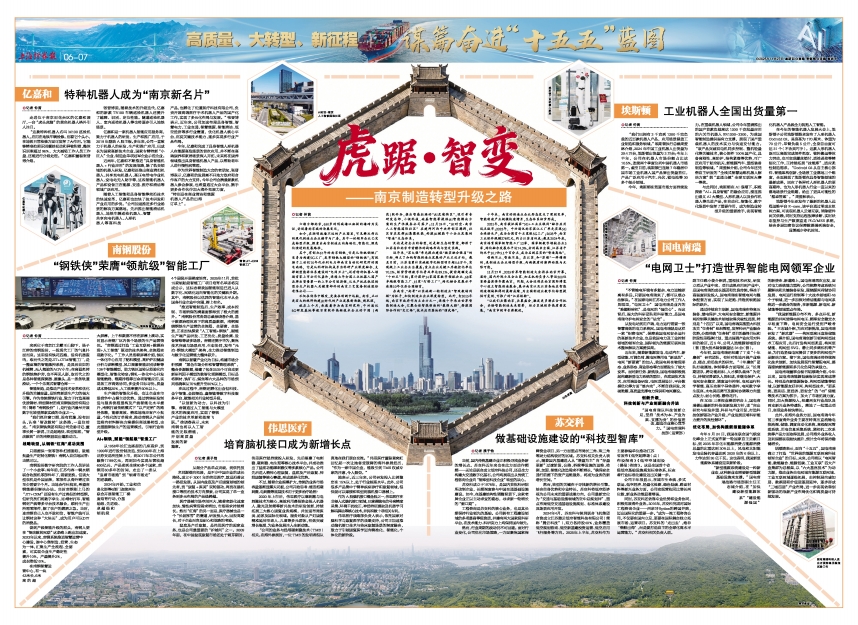
虎踞·智变——南京制造转型升级之路
Shang Hai Zheng Quan Bao· 2025-11-26 18:26
Group 1 - Nanjing is transforming its manufacturing industry towards high-end, intelligent, and green development, with leading companies like Nanjing Steel and Guodian NARI leading the way in digital transformation and innovation [11][12][14] - Jiangsu Province has implemented over 56,000 digital transformation projects, achieving a digitalization rate of 70.1% in manufacturing and 89.1% in management [13] - Nanjing has been recognized as a national pilot city for "5G + Industrial Internet" and is set to host the World Intelligent Manufacturing Conference, showcasing advancements in smart manufacturing [14][18] Group 2 - Yijiahe, a leading company in special robots, has developed various intelligent robots for applications in energy, transportation, and healthcare, and aims to expand its international presence [15][16][17] - Nanjing Steel has successfully transformed into a "smart factory" with a focus on digitalization and intelligent manufacturing, achieving significant improvements in production efficiency and cost reduction [18][19][20] - Nanjing Steel's smart operations center has integrated over 138 intelligent models, enhancing production stability by 10% and reducing costs by 10% [20][22] Group 3 - Estun has maintained its position as the top domestic brand in industrial robot shipments for seven consecutive years, with a market share of 10.5% in the first half of the year [29][30] - Estun is actively integrating AI with robotics, launching advanced products such as humanoid robots and remote operation platforms, enhancing automation and digitalization in manufacturing [31][32] - Estun's new heavy-duty robot, capable of handling loads up to 1200 kg, demonstrates significant technological advancements in the field [30][31] Group 4 - Guodian NARI is recognized as a leader in smart grid technology, focusing on innovative solutions for the evolving energy landscape, including renewable energy integration and smart grid development [33][34] - The company emphasizes technological innovation and has established research teams to tackle industry challenges, achieving breakthroughs in key technology areas [35][36] - Guodian NARI aims to become a world-class energy internet high-tech enterprise, expanding its business into energy internet and industrial internet domains [38]




地方政府与城投企业债务风险研究报告:南京市
Lian He Zi Xin· 2025-11-26 11:26
Report Industry Investment Rating No relevant content provided. Core Views of the Report - Nanjing, an important central city in eastern China, has obvious regional advantages, convenient transportation, a high - level of urbanization, a reasonable industrial structure, and clear industrial planning. In 2024, its economic aggregate and general public budget revenue ranked second in Jiangsu Province. The general public budget revenue has good quality and strong fiscal self - sufficiency, while government - funded revenue decreased year - on - year. The government debt burden is at a medium level among prefecture - level cities in Jiangsu [4]. - Among Nanjing's districts, Jiangning District has the strongest overall economic strength, and core areas such as Jianye and Xuanwu Districts have prominent per - capita GDP levels. There are differences in fiscal strength among districts. Affected by the real - estate market adjustment, the government - funded revenues of Jiangning, Lishui, and Liuhe Districts are under significant pressure. Most areas have a relatively heavy overall debt burden [4]. - Nanjing has a large number of existing bond - issuing urban investment enterprises, with the main body ratings being AA and AA+. In 2024, the net financing of urban investment bonds turned from net inflow to net outflow. In the first three quarters of 2025, the net financing continued to show a large - scale net outflow. The debt scale of bond - issuing urban investment enterprises continued to grow, and some district - level platforms have heavy debt burdens and weak short - term solvency indicators [4]. Summary by Relevant Catalogs I. Nanjing's Economic and Fiscal Strength (1) Regional Characteristics and Economic Development in Nanjing - Regional advantages and transportation: Nanjing is the capital of Jiangsu Province, with obvious regional advantages and a well - developed transportation network including railways, highways, waterways, and aviation. In 2024, it opened new international train lines, and its subway, airport, and port all had good development [5][7]. - Urbanization level: By the end of 2024, Nanjing's permanent population was 9.577 million, ranking second in Jiangsu, with an urbanization rate of 87.3%, higher than the provincial average [6]. - Economic aggregate: In 2024, Nanjing's GDP was 1.850081 trillion yuan, ranking second in Jiangsu, with a growth rate of 4.5%. In the first half of 2025, it was 917.918 billion yuan, with a year - on - year growth of 5.3% [8]. - Industrial structure: Nanjing has a reasonable industrial structure and a clear "2 + 6+6" industrial plan. In 2024, investment in advanced manufacturing and related product output increased [9]. - Policies and support: Since 2024, Nanjing has introduced various economic guidance policies and received support from the superior government in terms of fiscal transfer payments [12]. (2) Nanjing's Fiscal Strength and Debt Situation - Fiscal revenue: In 2024, Nanjing's general public budget revenue ranked second in Jiangsu, with good quality and strong fiscal self - sufficiency. Government - funded revenue decreased year - on - year, and superior subsidies contributed to the comprehensive fiscal resources [14]. - Debt burden: By the end of 2024, Nanjing's local government debt ratio and debt - to - GDP ratio ranked eighth among prefecture - level cities in Jiangsu, at a medium level [16]. II. Economic and Fiscal Conditions of Nanjing's Districts (Counties, Cities) (1) Economic Strength of Nanjing's Districts - Regional planning: Nanjing will build a spatial structure of "rural areas in the north and south, a metropolis in the middle, development along the Yangtze River, and urban - rural integration" [18]. - Industrial development: Each district forms characteristic industrial clusters based on its own resource endowments, such as integrated circuits and biomedicine in Jiangbei New Area, and advanced manufacturing in Jiangning District [21]. - Economic development: In 2024, there were significant differences in the economic aggregates of Nanjing's districts. The economic growth rates of 11 districts were relatively balanced, and there were large differences in per - capita GDP levels [22]. (2) Fiscal Strength and Debt Situation of Each District - Fiscal revenue: In 2024, there were differences in fiscal strength among districts. Most areas had stable general public budget revenues. Tax revenues accounted for a high proportion, and the government - funded revenues of Jiangning, Lishui, and Liuhe Districts were under pressure. The comprehensive fiscal resources of Jiangning and Jiangbei New Areas were in the first echelon [28][34]. - Debt situation: Except for Jianye District, the government debt balances of other districts increased. Most areas had a relatively heavy overall debt burden, with Jiangning District having the largest debt scale and Gaochun District having the heaviest debt burden [36]. - Debt management: Nanjing and its districts have strengthened debt monitoring and management, and each district has formulated differentiated debt management plans [39][41]. III. Debt - Repayment Ability of Nanjing's Urban Investment Enterprises (1) Overview of Urban Investment Enterprises - As of September 30, 2025, there were 67 urban investment enterprises with existing bonds in Nanjing. The main body ratings were mainly AA and AA+. Since 2024, the ratings of 2 urban investment enterprises have been upgraded [44][45]. (2) Bond - Issuing Situation of Urban Investment Enterprises - In 2024, the bond - issuing scale of Nanjing's urban investment enterprises increased slightly year - on - year, and the net financing of urban investment bonds turned from net inflow to net outflow. In the first three quarters of 2025, the net financing continued to show a large - scale net outflow [46]. (3) Analysis of Debt - Repayment Ability - As of the end of 2024, the debt scale of Nanjing's bond - issuing urban investment enterprises continued to grow, concentrated in the city - level, Jiangning, and Jiangbei New Areas. Some district - level platforms had heavy debt burdens and weak short - term solvency indicators. In 2024 and the first half of 2025, the financing efforts of urban investment enterprises increased [51][59]. (4) Support and Guarantee Ability of Fiscal Revenue for the Debt of Bond - Issuing Urban Investment Enterprises - The ratio of "total debt of bond - issuing urban investment enterprises + local government debt" to "comprehensive fiscal resources" in Nanjing's districts ranges from 1321.72% to 127.20%, showing serious differentiation [61].
江苏南京:相约十年,让制造更聪明
Nan Jing Ri Bao· 2025-11-26 02:24
Core Insights - The 2025 World Intelligent Manufacturing Conference will be held from November 27 to 29, marking its tenth anniversary and showcasing the achievements of Nanjing's intelligent manufacturing industry [3][4] - The conference has evolved into a global "barometer" for intelligent manufacturing, reflecting China's deep involvement in global collaboration and the high-quality development of Jiangsu's manufacturing sector [4][6] - Nanjing aims to transition from a "manufacturing city" to a "smart manufacturing powerhouse," leveraging the conference to highlight its urban transformation and development [3][19] Event Highlights - The upcoming conference will feature a record exhibition area of 55,000 square meters, with participation from 456 companies across 21 countries, including major international players like Phoenix, Honeywell, and Dassault [7][8] - The event will introduce an international invited exhibition area in collaboration with the Stuttgart Exhibition Group, enhancing its global engagement [6][8] - Over the past decade, the conference has attracted more than 10,000 industry elites and facilitated over 100 high-level exchange platforms, significantly contributing to technological innovation and industrial upgrades in intelligent manufacturing [8][19] Industry Developments - The conference will focus on themes such as "Digital Intelligence Driving New Quality Leadership," emphasizing international collaboration and market-oriented approaches [8][10] - Nanjing has established a comprehensive industrial ecosystem in intelligent manufacturing, with nearly 200 related enterprises and a significant increase in robot production capacity, positioning itself as a leader in the sector [10][12] - The city has implemented a three-year action plan for the digital transformation of manufacturing, achieving a digital integration development level of 74.3, surpassing national and provincial averages [16][18] Technological Innovations - The conference will showcase cutting-edge technologies, including a humanoid robot designed for intelligent manufacturing scenarios, which integrates advanced AI and reinforcement learning [10][11] - Nanjing's intelligent manufacturing sector has seen substantial growth, with local companies like Estun Robotics leading the market with a 10.5% share and a production capacity of 120,000 industrial robots annually [10][12] - The city is also focusing on AI-driven solutions to enhance manufacturing efficiency, with significant cost reductions reported in various industrial applications [12][18] Future Outlook - Nanjing is committed to building a global intelligent manufacturing hub, continuously improving its industrial foundation and ecosystem to support high-quality development [19] - The city aims to integrate advanced technologies and foster collaboration among government, enterprises, and academia to address challenges and opportunities in digital transformation [11][14] - The upcoming conference is expected to further solidify Nanjing's position in the global intelligent manufacturing landscape, paving the way for the next decade of growth and innovation [19]
世界市长点赞南京滨水城市治理经验
Ren Min Ri Bao· 2025-11-25 22:56
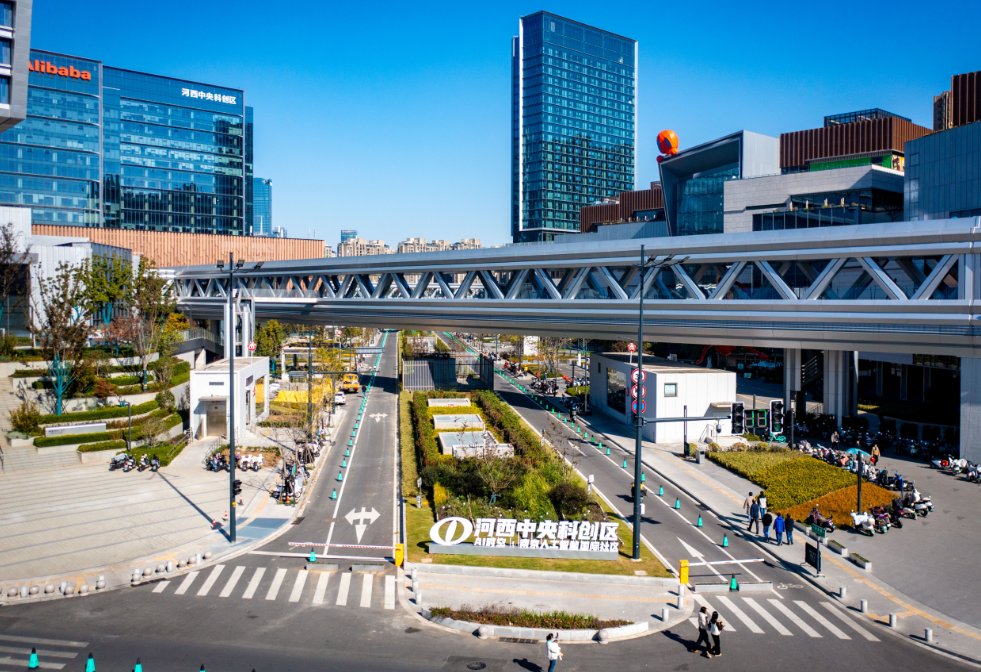
Group 1: Event Overview - The "2025 World Mayors Dialogue" event opened in Nanjing, focusing on sustainable urban development and sharing governance experiences among cities from various countries [1] - The event is guided by the State Council Information Office and aims to enhance international cooperation and mutual learning among cities [1] Group 2: Cultural Heritage and Urban Vitality - Nanjing's Ming City Wall, a UNESCO-recognized heritage site, is a key example of cultural preservation, with 25.1 kilometers well-preserved and over 600,000 bricks recycled since 2016 [3] - The "micro-renewal" approach in historical districts like Xiaoxihu and Laomendong has successfully retained cultural characteristics while revitalizing the area, earning awards for innovative design [3][4] Group 3: Green Development Initiatives - Nanjing is the only city in the Yangtze River basin where wild Yangtze River dolphins can be observed, with their population nearly doubling to about 65 over the past decade due to conservation efforts [7][8] - The city has restored approximately 1.7 million square meters of green space and 11 kilometers of ecological shoreline, promoting biodiversity and environmental health [8] Group 4: Smart City Governance - Nanjing's "One Network Management" platform enhances urban governance through digital integration, enabling real-time monitoring and decision-making across various sectors [10][11] - The city aims to create a digital governance model that supports sustainable urban development and efficient resource management [11] Group 5: International Collaboration and Consensus - The "Nanjing Consensus on River City Development" was established, emphasizing cooperation to address global challenges such as climate change and cultural heritage preservation [13] - The consensus advocates for sustainable practices, cultural diversity, and equitable urban development, fostering international dialogue and collaboration among river cities [13][14]
哑铃型配置强化,红利资产再获资金青睐,国企红利ETF(159515)盘中上涨0.26%
Sou Hu Cai Jing· 2025-11-25 02:43
Core Insights - The China Securities State-Owned Enterprises Dividend Index has shown a slight increase of 0.15% as of November 25, 2025, with notable gains in constituent stocks such as Fujian Expressway, which rose by 9.97% [1] - The National Enterprise Dividend ETF (159515) has also increased by 0.26%, indicating a positive trend in dividend-focused investments [1] - Market sentiment is under pressure due to a lack of performance policies and fluctuating expectations regarding the Federal Reserve's interest rate decisions, leading to a focus on dividend assets [1] Market Performance - The National Enterprise Dividend ETF recorded a turnover rate of 0.06% with a transaction volume of 27,200 yuan, and an average daily transaction volume of 3.54 million yuan over the past week [1] - The overall industry prosperity index continued to decline in October, but at a slower rate, with essential consumption, midstream manufacturing, and large financial sectors showing the most improvement [1] Investment Strategy - The dividend strategy is highlighted as a foundational investment approach, focusing on high dividend yields and stable cash flows from quality enterprises, which can provide continuous cash flow and long-term compounding potential [1] - A balanced investment approach is recommended, incorporating growth, cyclical, and dividend assets to identify opportunities with improving industry conditions and relatively low valuations [1] Index Composition - The China Securities State-Owned Enterprises Dividend Index comprises 100 listed companies selected for their high and stable cash dividend yields, reflecting the overall performance of high-dividend securities among state-owned enterprises [2] - As of October 31, 2025, the top ten weighted stocks in the index accounted for 17.08% of the total index weight, including companies like COSCO Shipping Holdings and Agricultural Bank of China [2]



大越期货锰硅周报-20251125
Da Yue Qi Huo· 2025-11-25 02:32
Report Summary 1. Report Industry Investment Rating No investment rating information is provided in the report. 2. Core Viewpoint of the Report The current silicon - manganese market presents a stalemate and game pattern of "strong cost - end and weak demand - end". Affected by the strong cost and downstream price - pressing, the adjustment of the spot market is limited. It is expected that the market will continue to fluctuate in the short term [2]. 3. Summary According to Related Catalogs Manganese Silicon Supply - **Capacity**: The report shows the monthly capacity of Chinese silicon - manganese enterprises [6][7]. - **Annual Output**: It presents the annual output of silicon - manganese in Guangxi, Guizhou, Inner Mongolia, Ningxia, Yunnan, other regions, and China as a whole [8][9]. - **Weekly, Monthly Output and开工率**: The weekly and monthly output of Chinese silicon - manganese and the weekly开工率 of Chinese silicon - manganese enterprises are provided [10][11]. - **Regional Output**: It includes the monthly output of Inner Mongolia, Ningxia, and Guizhou, and the daily average output of Inner Mongolia, Ningxia, Guizhou, and Guangxi [12][13]. Manganese Silicon Demand - **Steel Tendering Purchase Price**: The monthly purchase prices of silicon - manganese 6517 by Baoshan Iron & Steel Co., Ltd., Baowu E'gang, Chengde Jianlong, and other steel enterprises are shown [15][16]. - **Daily Average Hot Metal and Profit**: The weekly daily average output of hot metal and the weekly profitability of 247 steel enterprises in China are presented [17][18]. Manganese Silicon Import and Export The monthly import and export quantities of silicon - manganese in China are provided [19][20]. Manganese Silicon Inventory The weekly inventory of 63 sample silicon - manganese enterprises in China, the monthly average available days of silicon - manganese inventory in China, the northern region, and the eastern region are shown [21][22]. Manganese Silicon Cost - **Manganese Ore Import Volume**: The monthly import volume of manganese ore by trade method, from Gabon, southern Africa, and Australia to China is presented [23][24]. - **Manganese Ore Port Inventory and Available Days**: The weekly port inventory of manganese ore in China, Qinzhou Port, and Tianjin Port, and the weekly average available days of manganese ore inventory in China are shown [25][26]. - **High - Grade Manganese Ore Port Inventory**: The weekly port inventory of high - grade manganese ore from Australia, Gabon, and Brazil in Qinzhou Port and Tianjin Port is presented [27][28]. - **Tianjin Port Manganese Ore Price**: The daily summary prices of South African semi - carbonate manganese ore, Australian manganese ore, and Gabonese manganese ore in Tianjin Port are provided [29]. - **Regional Cost**: The daily costs of silicon - manganese in Inner Mongolia, the northern region, Ningxia, the southern region, and Guangxi are shown [30][31]. Manganese Silicon Profit The daily profits of silicon - manganese in the northern region, the southern region, Inner Mongolia, Ningxia, and Guangxi are presented [32][33].
普钢板块11月24日跌0%,三钢闽光领跌,主力资金净流入1.2亿元
Zheng Xing Xing Ye Ri Bao· 2025-11-24 09:02
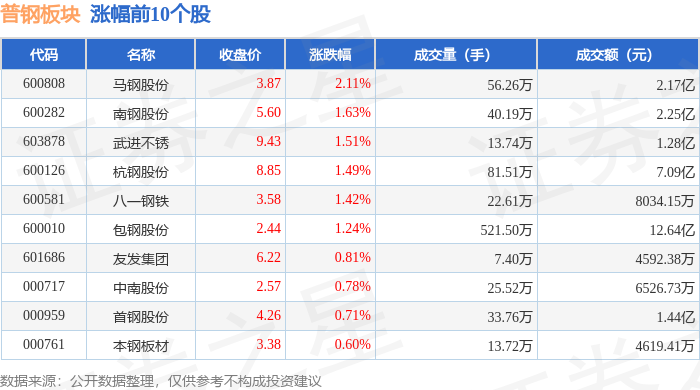
Core Insights - The steel sector experienced a slight decline of 0.0% on November 24, with Sansteel Mingguang leading the losses [1] - The Shanghai Composite Index closed at 3836.77, up 0.05%, while the Shenzhen Component Index closed at 12585.08, up 0.37% [1] Steel Sector Performance - Major steel stocks showed mixed performance, with notable gainers including: - Maanshan Iron & Steel (600808) at 3.87, up 2.11% with a trading volume of 562,600 shares and a turnover of 217 million yuan - Nanjing Steel (600282) at 5.60, up 1.63% with a trading volume of 401,900 shares and a turnover of 225 million yuan - Wujin Stainless Steel (603878) at 9.43, up 1.51% with a trading volume of 137,400 shares and a turnover of 128 million yuan [1] - Conversely, Sansteel Mingguang (002110) fell to 4.21, down 2.09% with a trading volume of 242,500 shares and a turnover of 103 million yuan [2] Capital Flow Analysis - The steel sector saw a net inflow of 120 million yuan from institutional investors, while retail investors experienced a net outflow of 131 million yuan [2] - Specific stock capital flows included: - Baogang Group (600010) with a net outflow of 57.72 million yuan from institutional investors - Chongqing Steel (601005) with a net inflow of 29.54 million yuan from institutional investors [3] - Retail investors showed a net inflow of 11.73 million yuan overall, indicating a mixed sentiment in the market [2]


东吴证券:钢铁行业反内卷趋势不改 铁矿成本下行盈利有望维稳
智通财经网· 2025-11-24 08:08
Core Viewpoint - The steel industry in China is expected to face a supply surplus, with total apparent steel consumption projected to reach 930 million tons by October 2025, reflecting a year-on-year increase of 5% [1][2]. Group 1: Supply and Demand Dynamics - By November 2025, the average daily pig iron output is expected to be 2.38 million tons, a year-on-year increase of 3.7% [2]. - The total crude steel output in China is projected to be 820 million tons by October 2025, showing a year-on-year decrease of 4% [2]. - The demand for steel is primarily affected by the real estate sector, while shipbuilding, automotive, manufacturing, and exports are expected to provide some compensation [1][2]. Group 2: Price Trends - Steel prices are anticipated to exhibit a downward trend in 2025, fluctuating between 3,000 to 3,500 RMB per ton, with Q3 expected to be the lowest point of the year due to weak downstream demand [4]. - The decline in coking coal prices is expected to contribute to the decrease in steel prices, with iron ore prices also projected to have room for further decline in 2026 [5]. Group 3: Profitability Outlook - The steel industry's gross profit margins are expected to remain at a high level during July to September 2025, with the average profitability for the year being the best from 2021 to 2025 [6]. - The anticipated supply-side reform 2.0 may constrain crude steel production by 5% to 10%, focusing on environmental and carbon emission standards [7]. Group 4: Investment Strategy - The investment strategy for 2026 suggests focusing on companies with stable performance in the top-tier steel sector and those benefiting from growth in downstream niche markets [8]. - Recommended companies include Baosteel (600019.SH), Hualing Steel (000932.SZ), Nanjing Steel (600282.SH), and CITIC Special Steel (000708.SZ) for their quality product structures [8].
