
康方生物

Search documents
中金:披沙剖璞,公募基金港股投资策略解构
中金点睛· 2025-12-18 23:58
Core Viewpoint - The Hong Kong stock market is increasingly favored by mainland public funds due to its deep value opportunities, potential for future growth, and global diversification, leading to a rise in public fund participation in Hong Kong stocks [2][10]. Market Overview - As of Q3 2025, the number of equity funds including Hong Kong stocks reached 2,689, with a total scale of 2.63 trillion yuan. Active management funds dominate in both quantity and proportion, indicating a strong willingness from public institutions to flexibly allocate to the Hong Kong market [2][22]. - Active products show a steady increase in Hong Kong thematic funds, while balanced allocation funds have expanded significantly, with thematic and balanced funds numbering 92 and 872 respectively by Q3 2025 [2][31]. - Passive products are led by thematic funds, which have seen rapid growth, reaching 108 funds by Q3 2025, driven by the accelerated return of Chinese concept stocks and structural market trends [2][32]. Institutional Landscape - The concentration of management scale among different types of Hong Kong equity funds is gradually dispersing. As of Q3 2025, the CR5 for thematic, balanced, and minor participation funds stands at 60.3%, 35.8%, and 30.2% respectively [3][33]. - Passive products exhibit higher concentration due to scale effects and first-mover advantages, with CR5 for thematic, balanced, and minor participation funds at 67.0%, 67.9%, and 81.0% respectively [3][33]. Performance Analysis - Active management products show significant internal differentiation, indicating varying levels of management capability. Thematic funds have better upward momentum, while the advantages of active management are not prominently displayed [3][37]. - The median returns for passive and active thematic funds this year are 28.2% and 25.5%, respectively, suggesting that thematic focus may yield better market performance [3][37]. Strategy Characteristics - Thematic funds maintain a high Hong Kong stock position of around 90%, focusing on long-term trends rather than short-term fluctuations. They prefer H-shares with a balanced sector distribution [4]. - Minor participation funds view the Hong Kong market as a tactical allocation, focusing on short-term trading and flexible adjustments, with a preference for new economy sectors like technology and consumption [5]. - Balanced allocation funds maintain a Hong Kong stock position of 30-40%, frequently adjusting their allocations to capture excess returns through active cross-market timing [6]. Investment Value - The Hong Kong stock market has reversed its previous weak performance, with the Hang Seng Index rising 28.9% this year and 51.7% over the past two years, leading global major market indices [10]. - The market's flexible trading mechanisms and diverse funding structures position it uniquely to attract both domestic and international capital, enhancing its long-term investment value [10][15]. - As of November 30, 2025, the Hang Seng Index's PE ratio is 11.9, indicating a valuation advantage compared to other global markets, alongside a dividend yield of 3.0%, making it an attractive investment option [16][17].


医药行业周报:年末国产创新药出海交易密集落地,2026年向上趋势中价值回归可期-20251218
BOCOM International· 2025-12-18 11:48
Industry Rating - The report rates the pharmaceutical industry as "Leading" [1] Core Insights - The report highlights a concentrated trend of domestic innovative drug collaborations and transactions as the year ends, with expectations for value recovery in 2026 [1][4] - The overall market performance shows a decline, with the Hang Seng Index down 0.8% and the Hang Seng Healthcare Index down 4.3% during the week [4][7] - The report emphasizes the importance of stock selection logic returning to fundamentals and valuations, focusing on stocks that are currently undervalued with expected fundamental improvements [4] Valuation Summary - The report provides a detailed valuation overview of various companies, indicating target prices and earnings per share estimates for FY25E and FY26E, along with their respective price-to-earnings ratios [3] - Notable companies with "Buy" ratings include AstraZeneca, BeiGene, and Hansoh Pharmaceutical, with target prices significantly above current trading prices [3] Market Trends - The report notes a slight decrease in domestic institutional holdings through the Hong Kong Stock Connect, while foreign holdings remain stable [33] - The report identifies a trend of increasing positions in leading innovative pharmaceutical companies by domestic investors, particularly in companies like Heng Rui Medicine and Rongchang Bio [36] Investment Insights - The report mentions several significant business development (BD) transactions exceeding $1 billion, indicating a robust pipeline for innovative drugs [4][5] - It recommends focusing on specific segments such as innovative drugs and CXO companies that are expected to benefit from downstream recovery and high market demand [4]
年内港股配售融资规模超3100亿港元,科技与生物医药行业占据主导
Zheng Quan Shi Bao· 2025-12-18 11:37
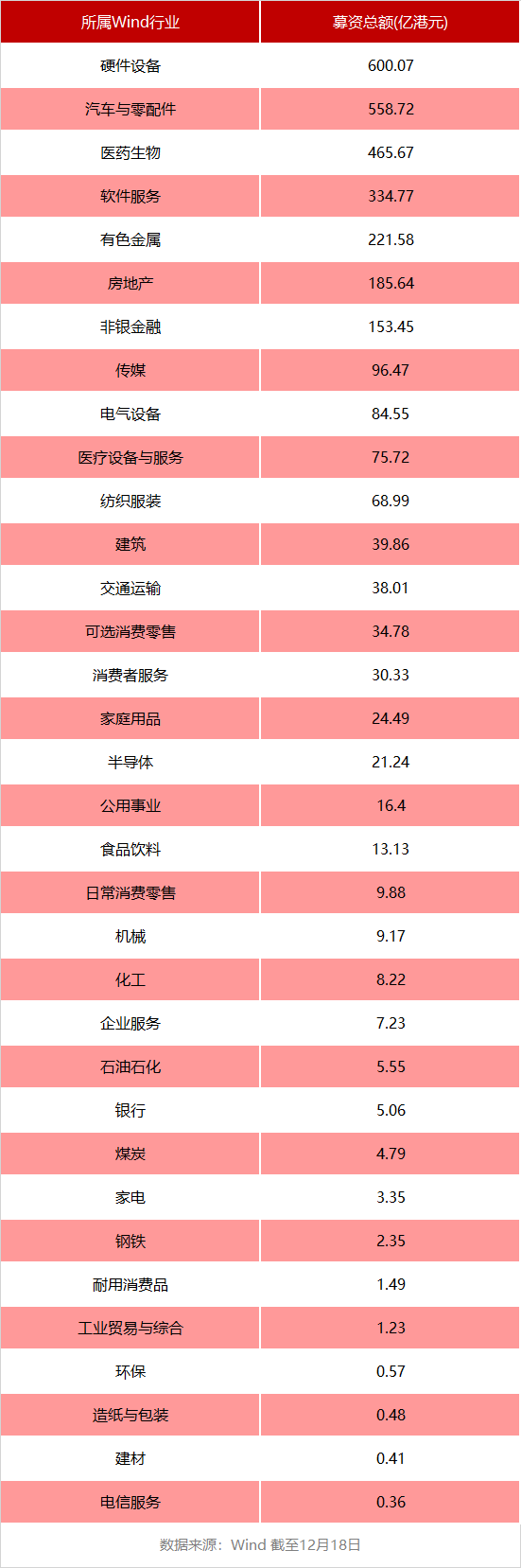
Core Viewpoint - The Hong Kong stock market has seen a surge in refinancing activities this year, with placements becoming the preferred method for companies due to their efficiency, flexibility, and cost advantages [1][3]. Group 1: Market Activity - Hong Kong listed companies have raised nearly 350 billion HKD through placements, rights issues, and consideration issues this year, with placements accounting for almost 90% of the total [1][3]. - The total amount raised through placements alone reached approximately 312.4 billion HKD, representing 89.61% of the total refinancing [3][7]. Group 2: Industry Insights - Key industries leading the placements include hardware equipment, automotive and parts, biomedicine, and software services, with hardware equipment raising 600.07 billion HKD [4][5]. - Notable contributions from specific companies include Xiaomi Group raising 426 billion HKD in the hardware sector and BYD raising 435.09 billion HKD in the automotive sector [4][7]. Group 3: Fund Utilization - The funds raised through placements are primarily allocated for research and development, business expansion, international market development, and optimizing capital structure [9]. - Companies like SenseTime and BYD have specified that their raised funds will support core business development, AI infrastructure, and overseas market expansion [9]. Group 4: Market Conditions - The active refinancing in the Hong Kong market is attributed to increased market activity, rising trading volumes, and valuation recovery, providing an excellent window for companies to refinance [10]. - Analysts predict that the liquidity in the Hong Kong market will continue to improve, driven by the "wealth effect" and increasing participation from mainland investors [10].



年内港股配售融资规模超3100亿港元 科技与生物医药行业占据主导
Zheng Quan Shi Bao· 2025-12-18 11:31
Group 1 - The Hong Kong stock market has seen active refinancing this year, with placements becoming a key method due to their efficiency, flexibility, and cost advantages [1][2] - As of this year, Hong Kong listed companies have raised nearly 350 billion HKD through placements, rights issues, and consideration issues, with placements accounting for nearly 90% of the total [1][2] - Discounted placements have become the mainstream method, with most companies adopting this strategy to attract investors [1][2] Group 2 - The technology and biopharmaceutical sectors dominate the placement market, with hardware, automotive, and software services also being significant contributors [3] - Notable placements include Xiaomi Group raising 426 billion HKD in the hardware sector and BYD raising 435 billion HKD in the automotive sector [3] - Approximately 40% of the total refinancing this year has come from technology companies, reflecting strong investor confidence in the tech sector [3] Group 3 - The funds raised through placements are primarily allocated for research and development, business expansion, international market development, and operational capital [4][5] - Companies like SenseTime plan to use 30% of their placement proceeds for core business development and AI infrastructure, while BYD aims to enhance its technological capabilities and expand overseas [4][5] - The active refinancing environment is supported by increased market activity, rising transaction volumes, and valuation recovery, providing an excellent window for listed companies [5]
从跟跑到超车,广州黄埔重塑全球生物医药创新产业链
Xin Lang Cai Jing· 2025-12-18 07:30
Core Insights - The biopharmaceutical sector in Guangzhou, particularly in the Huangpu District, is rapidly developing, with a focus on innovation in areas such as gene therapy, diagnostics, and medical devices [1][5][21] - Guangzhou has established itself as a hub for unicorn companies, with 210 enterprises listed, 60 of which are in Huangpu, representing 29% of the city's total [1][5] - The "Strategic Entrepreneur Cultivation Plan" initiated by the Guangzhou Development Zone aims to enhance the competitiveness of biopharmaceutical companies through resource integration and systematic training [1][5] Biopharmaceutical Industry Development - Huangpu District has over 4,800 biopharmaceutical companies, including 528 high-tech firms and 21 listed companies, accounting for 72% of the city's total [7][21] - The district's industrial output value reached 35.1 billion yuan, positioning it among the top tiers of China's biopharmaceutical industry [7] - The area has seen a significant increase in clinical trial approvals, with 115 new approvals in 2024, including 99 for innovative drugs [7][21] Key Companies and Innovations - Yunzhou Biotech has become the world's largest CRO service provider for research-grade gene vectors, delivering over one million gene vectors globally by 2024 [2][17] - The company has achieved a compound annual growth rate of over 20% in revenue over the past three years, with a valuation exceeding 70 billion yuan, making it the first biopharmaceutical unicorn in Guangzhou [17] - Other notable companies in the region include Akeso, BeiGene, and Hengrui Medicine, contributing to a diverse and innovative biopharmaceutical landscape [5][18] Strategic Initiatives and Collaborations - The Guangzhou International Bio-Island initiative aims to create a comprehensive biopharmaceutical ecosystem through the establishment of pilot parks that enhance collaboration among companies [9][10] - The Huangpu District has implemented multiple policies to support the biopharmaceutical industry, including the "Biopharmaceutical 3.0" policy, which focuses on technology innovation, product commercialization, and talent support [25][30] - Recent investments from global healthcare giants, such as the establishment of a production base by Medtronic, highlight the area's attractiveness for foreign investment [28][30]





港股止跌,整个早盘都维持在中轴附近窄幅盘整




Ge Long Hui· 2025-12-18 04:56
Group 1 - The Hong Kong stock market has stabilized, maintaining a narrow range around the mid-axis during the morning session, with slight gains in consumer and technology sectors, while the internet and healthcare sectors experienced a downturn [1] - The consumer sector showed signs of recovery, with a slight increase of 0.32% by midday, driven by stocks such as Li Ning up 4.37%, Shenzhou International up 2.26%, and several others like Stone Pharmaceutical, Lao Pu Gold, WuXi Biologics, and Pop Mart all rising over 1% [3] - The technology sector also saw a minor increase of 0.14% by midday, with Meituan up 1.21%, while major players like JD Group, Alibaba, Tencent Holdings, and SMIC posted slight gains; however, BYD and NetEase faced minor declines [3] Group 2 - The healthcare sector had a lackluster performance, with Stone Pharmaceutical up 1.9% and WuXi Biologics up 1.68%, while other stocks like BeiGene, Innovent Biologics, and 3SBio saw slight increases; in contrast, companies like CanSino Biologics, China Biologic Products, JD Health, and Hansoh Pharmaceutical experienced minor declines [3]

ETF盘中资讯 | AH医药逆市表现!美年健康两连板,全市场最大医疗ETF突破年线!港股通创新药继续回暖,520880直线拉升
Sou Hu Cai Jing· 2025-12-18 03:02
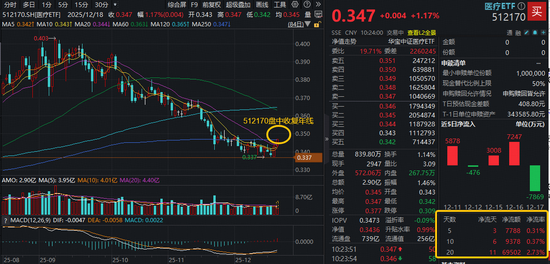
Core Viewpoint - The pharmaceutical sector is showing resilience in the current market, with significant activity in both A-shares and Hong Kong stocks, particularly in the medical and innovative drug segments, indicating a potential opportunity for investment in medical assets [1][3][4]. Group 1: A-share Market Insights - The medical sector in the A-share market continues to rebound strongly, with the largest medical ETF (512170) rising over 1% and surpassing the annual line [1]. - Private hospitals and AI medical-related stocks are leading the gains, with Meinian Health achieving two consecutive trading limits and Weining Health rising over 7% [1]. - The pharmaceutical sector shows mixed performance, with traditional Chinese medicine leader Pian Zai Huang increasing over 1%, while innovative drug stocks such as Gan Li Pharmaceutical and Hai Si Ke fell by 1% [1]. - The medical ETF (512170) has seen a significant inflow of over 93 million yuan in the last 10 days, indicating strong buying interest [1]. Group 2: Hong Kong Market Insights - The Hong Kong pharmaceutical market is performing well, with the Hang Seng Index and Hang Seng Tech Index both in the red, while leading innovative drug stocks like BeiGene and CSPC Pharmaceutical are up by over 1% and 3%, respectively [3]. - The Hong Kong Innovation Drug ETF (520880) has experienced continuous net subscriptions for eight days, with its fund size reaching a record high of 4.176 billion shares [3]. - The medical theme sector in Hong Kong is also seeing significant gains, particularly in AI medical and medical device stocks, with MicroPort Medical rising by 8% [3]. Group 3: Industry Trends and Opportunities - Recent developments in the innovative drug sector include significant overseas collaborations, such as Heng Rui Pharmaceutical's partnership with Kailera for clinical research and a $90 million upfront payment deal between Heptares Therapeutics and BMS [4][5]. - The CXO (Contract Research Organization) sector is showing clear upward momentum, with increasing orders and performance indicators suggesting a positive trend [4]. - The innovative medical device sector is gaining attention from major global companies, indicating a potential for growth and value realization similar to the previous year's innovative drug sector [5]. Group 4: Investment Strategies - Various ETFs are available for investment in the pharmaceutical sector, including the Hong Kong Innovation Drug ETF (520880) and the A-share medical ETF (512170), which are positioned to capture growth in innovative drugs and medical services [6]. - The Hong Kong medical ETF (159137) is currently being launched, providing additional investment options in the medical theme sector [3][6].


AH医药逆市表现!美年健康两连板,全市场最大医疗ETF突破年线!港股通创新药继续回暖,520880直线拉升
Xin Lang Cai Jing· 2025-12-18 02:44
Core Viewpoint - The pharmaceutical sector in both A-shares and Hong Kong stocks is showing resilience amid market fluctuations, with significant activity in medical assets indicating defensive strength [1][9]. Group 1: A-share Market Performance - The medical sector in the A-share market continues to rebound strongly, with the largest medical ETF (512170) rising over 1% and surpassing the annual line [1][9]. - Private hospitals and AI medical-related stocks are leading the gains, with Meinian Health achieving two consecutive trading limits and Weining Health rising over 7% [1][9]. - The pharmaceutical sector shows mixed performance, with traditional Chinese medicine leader Pian Zai Huang increasing over 1%, while innovative drug stocks like Gan Li Pharmaceutical and Hai Si Ke fell by 1% [1][9]. - The medical ETF (512170) displayed a "one bullish engulfing two bearish" pattern, signaling a potential trend reversal if it closes above the annual line [1][9]. - Recent capital inflow into the medical ETF has exceeded 93 million yuan over the past 10 days, indicating investor interest [1][9]. Group 2: Hong Kong Market Performance - The Hong Kong pharmaceutical sector is performing well, with the Hang Seng Index and Hang Seng Tech Index both in the red, while leading innovative drug stocks like BeiGene and CSPC Pharmaceutical are up by over 1% and 3%, respectively [3][11]. - The Hong Kong Stock Connect innovative drug ETF (520880) has seen continuous net subscriptions for eight consecutive days, with the latest fund size reaching 4.176 billion shares, a record high since its launch [3][11]. - The medical theme index in Hong Kong is showing broad gains, particularly in AI medical and medical device-related stocks, with MicroPort Medical rising by 8% and other related stocks also seeing significant increases [3][11]. Group 3: Investment Opportunities - Analysts suggest that the current environment presents a favorable opportunity for allocating to pharmaceutical assets, with positive developments across various fields [4][12]. - In the innovative drug sector, there are ongoing advancements, such as Heng Rui Pharmaceutical's overseas collaborations and significant transactions involving new drug acquisitions [4][12]. - The CXO sector is experiencing upward momentum, with increasing orders and performance indicators suggesting a positive trend [5][13]. - Recent partnerships in innovative medical devices, such as the collaboration between Xian Rui Da Medical and Boston Scientific, highlight growing interest from international pharmaceutical companies in Chinese innovations [5][13]. Group 4: ETF Investment Options - For investors looking to enter the pharmaceutical sector, various ETFs are available, including the Hong Kong Stock Connect Innovative Drug ETF (520880) and the A-share Medical ETF (562050) [6][14]. - The Hong Kong medical ETF (159137) is currently being launched, providing additional options for investors [6][14]. - The investment strategies differ, with some ETFs focusing solely on innovative drugs while others include a mix of traditional and innovative pharmaceutical assets [6][14].
生物医药2026年度策略:十年创新,踏出海征程
2025-12-17 15:50
Summary of Key Points from the Conference Call Industry Overview - The biopharmaceutical industry is experiencing significant growth, particularly in the CXO and chemical pharmaceutical sectors, with a notable increase in fund concentration in these areas [1][2] - The demand in the diagnostic and treatment sectors remains stable, and the medical insurance fund balance has significantly improved, indicating effective cost control measures [2][5] - The release of the first commercial insurance innovative drug directory in December 2025 has introduced new payment increments for the pharmaceutical industry [2][5] Financial Performance - In the first three quarters of 2025, the license-out transaction amount reached $92 billion, more than doubling year-on-year, indicating strong international recognition of domestic innovative drugs [2][6] - The IPO market in Hong Kong has rebounded, leading to increased investment activity in the primary market, with multiple pharmaceutical companies going public [2][6] Key Focus Areas for 2026 - The industry is expected to focus on innovative therapies, particularly IO (immune-oncology) bispecific antibodies and GLP-1 (glucagon-like peptide-1) drugs [1][4] - Notable advancements in the IO bispecific antibody field include the rapid development of Kangfang Biotech's PD-1/VEGF bispecific antibody AK112, with several key clinical data updates anticipated in 2026 [1][4][8] - Emerging technologies such as small nucleic acids and in vivo CAR-T are expected to show initial progress [4] GLP-1 Drug Market - The GLP-1 drug market shows immense potential, with Semaglutide leading in sales and Tirzepatide expected to become a new "blockbuster" [3][13] - There is a focus on new directions such as oral long-acting formulations and weight loss/muscle gain applications, with new targets like Amylin being explored [3][13][14] Investment Opportunities - The trend of innovative drugs going overseas is beneficial for industry chain enterprises, including major players like WuXi AppTec and WuXi Biologics, as well as CRO companies like InnoStar and Mediso [3][16] - The life sciences sector, including companies like BPS and Haoyuan, is also worth attention due to strong demand and performance certainty [16] Future Trends - The combination of IO and ADC (antibody-drug conjugates) is seen as a necessary direction for future development, with several companies already initiating clinical trials in this area [10][12] - The dual antibody drugs in the colorectal cancer field are becoming important assets for global pharmaceutical companies, indicating strong competitive potential for domestic products [9] Conclusion - The biopharmaceutical industry is poised for growth driven by innovation, with significant opportunities in both domestic and international markets. The focus on emerging technologies and the successful launch of innovative drugs will likely shape the industry's future landscape [1][4][16]
康方生物-B(9926.HK):AK112展现下一代核心IO基石药物潜力
Ge Long Hui· 2025-12-17 08:36
Core Viewpoint - The company reported a significant increase in product revenue but also faced a substantial loss in net profit due to various factors, including investment losses and rising expenses [1][2]. Financial Performance - In the first half of 2025, the company's product revenue increased by 49.2% year-on-year to 1.4 billion yuan, with total revenue reaching 1.41 billion yuan, and a gross margin of 79.4% [1]. - Research and development expenses rose by 23.0% to 730 million yuan, contributing to a net profit loss of 570 million yuan, which is an increase of 139% compared to the previous period [1]. Capital Raising - In late August 2025, the company raised 3.493 billion HKD by placing 2.355 billion shares at a price of 149.54 HKD per share, resulting in a net cash position of 5.8 billion yuan post-placement [1]. Product Pipeline Progress - The company has made significant advancements in its product pipeline, including approvals for various cancer treatments, with AK104 and AK112 being notable products that have received regulatory approvals and are included in medical insurance [2]. - AK104 has been approved for multiple cancer indications, while AK112 has shown promising results in clinical trials, with plans for further submissions and analyses in the coming years [2]. Valuation and Target Price - The target price has been raised to 144.9 HKD based on a DCF valuation method, assuming a WACC of 10.0% and a perpetual growth rate of 3.0%, indicating a potential upside of 23.4% from the current price [3].