
迈瑞医疗

Search documents
迈瑞医疗在济南成立新公司,注册资本2000万
Zhong Guo Neng Yuan Wang· 2026-01-04 06:40
天眼查工商信息显示,近日,济南迈瑞科技有限公司成立,法定代表人为席彬,注册资本2000万人民 币,经营范围含仪器仪表制造、第一类医疗器械生产、仪器仪表销售、货物进出口、技术进出口、进出 口代理等。股东信息显示,该公司由迈瑞医疗(300760)全资持股。 ...

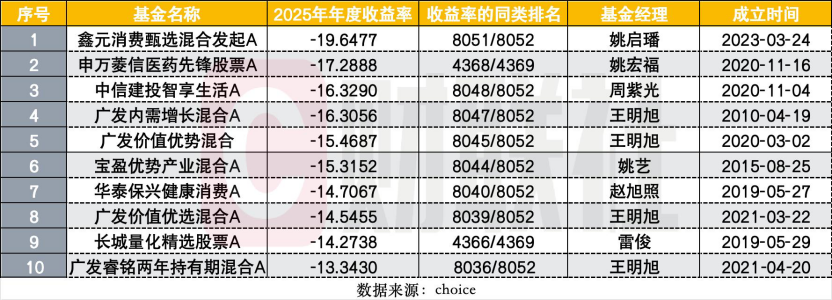
2025年谁流落亏损榜?“亏损王”爱调仓折腾,多位知名老将在列
Feng Huang Wang· 2026-01-03 23:21
Core Viewpoint - The A-share market in 2025 exhibited a clear structural bull market, with significant performance disparities among active equity funds, highlighted by the top-performing fund achieving a record annual return of 233.29% while others faced substantial losses, including the worst performer with a -19.65% return [1][4]. Group 1: Market Performance - The Shanghai Composite Index, Shenzhen Component Index, ChiNext Index, and Sci-Tech Innovation 50 Index rose by 18.41%, 29.87%, 49.57%, and 35.92% respectively in 2025 [1]. - A total of 4888 active equity products from 160 public fund institutions reported positive returns, while 144 products from 68 institutions experienced losses [1][9]. Group 2: Fund Performance Disparities - The top-performing fund, Yongying Technology Smart Selection, achieved a record annual return of 233.29%, surpassing the previous record set by Wang Yawei in 2007 [1]. - The worst-performing fund, Xinyuan Consumption Selection, recorded a -19.65% return, marking a significant gap of 252.94% from the top performer [2][4]. Group 3: Xinyuan Consumption Selection Analysis - Xinyuan Consumption Selection's poor performance is attributed to aggressive trading strategies, frequent personnel changes, and scale challenges, leading to a lack of coherent investment logic [3][5]. - The fund's industry allocation showed erratic shifts, moving from heavy investments in pharmaceuticals to technology and later to media, missing key market trends [5][6]. Group 4: Fund Manager Insights - Notable fund managers, including Wang Mingxu and Han Weijun, saw their products listed among the worst performers, with their total managed assets shrinking by over 70% compared to previous peaks [3][9][12]. - Xinyuan Consumption Selection faced a critical challenge to meet its scale assessment, needing to grow from 0.29 billion to 2 billion within three months [7][8]. Group 5: Institutional Investment Trends - Institutional ownership in Xinyuan Consumption Selection dropped from over 95% to 42.94% by mid-2025, indicating a significant withdrawal of institutional funds [7]. - The trend of multiple products from the same fund manager appearing on the loss list highlights a broader issue within the industry, affecting even previously successful managers [9][10].

2025年度创业板排行榜
Wind万得· 2026-01-01 22:38
1.2 总市值变动 2025年 度 末, 创业板总市值为17.83万亿元,较2024年末增长43.0%,增幅高于沪深证主板。 1.3 成交额对比 2 025年 度 创业板总成交额达114.22万亿元,单只个股平均成交额819.97亿元,高于上证主板、科创板和北证A股。 | | | 各板块平均成交额对比 | | | --- | --- | --- | --- | | 板块 | 个股数量 | 期间总成交额 (万亿元) | 平均成交额 (亿元) | | 深证主板 | 1490 | 127.09 | 852.93 | | 创业板 | 1393 | 114.22 | 819.97 | | 上证主板 | 1699 | 134.28 | 790.33 | | 科创板 | 600 | 37.79 | 629.82 | | 北证A股 | 288 | 6.49 | 225.23 | | 数据来源: Wind | | | | 1.4 日均换手率对比 市场板块篇 1.1 50指数涨跌对比 2025年 度创业板50指数大涨57.45%,强于各板块50指数。 1.6 市净率对比 2 025年 度 末, 创业板市净率为4.35倍,高于沪深 ...

2025年中国健康服务行业发展历程、政策、发展现状、重点企业及趋势研判:健康服务业态日趋多元,精准化与个性化服务成为未来发展核心方向[图]
Chan Ye Xin Xi Wang· 2026-01-01 03:22
Core Insights - The health service industry aims to create a favorable organizational environment by providing safe, effective, convenient, and affordable basic medical and public health services to meet various health needs of residents. The demand for health-related products and services is rapidly increasing due to social progress and changes in lifestyle [1][7]. Industry Overview - The health service industry encompasses medical services, health management, health insurance, and related services, involving pharmaceuticals, medical devices, health products, and fitness products [4]. - The industry has experienced rapid growth in China, with the market size increasing from 6.37 trillion yuan in 2018 to an expected 9.55 trillion yuan by 2024, representing a compound annual growth rate of 6.98%. The "Healthy China 2030" plan projects the total market size to reach 16 trillion yuan by 2030, indicating significant growth potential [1][8]. Development History - The development of China's health service industry can be divided into four stages: 1. 1949-1990: Health check-ups were primarily hospital services focused on disease detection rather than prevention. 2. 1991-2000: Independent health check-up service institutions began to emerge in cities like Beijing. 3. 2001-2010: The introduction of Western health service concepts and rapid market demand growth led to the fast development of health service institutions. 4. 2011-present: Increased focus on medical information technology and service upgrades has improved the capabilities of health service institutions [4][5]. Relevant Policies - Recent government policies aim to optimize resource allocation, enhance preventive interventions, and improve service accessibility, which helps control the rapid growth of medical costs and reduce the disease burden on families and society. For instance, the National Health Commission issued a notice in February 2025 to address public health concerns and improve service efficiency [6]. Industry Structure and Key Companies - The operational models of health service institutions in China are diverse, including: 1. Hospital-based models leveraging brand and client resources. 2. Independent medical models with self-owned brands and facilities. 3. Health management models centered on health check-ups. 4. Comprehensive information platform models connecting online and offline services [8]. - Major companies in the health service industry include: - Meinian Health Industry Holdings Co., Ltd. - Tongce Medical Co., Ltd. - Ruici Medical Service Holdings Co., Ltd. - Ciming Health Checkup Management Group Co., Ltd. - Aikang Guobin Health Checkup Management Group Co., Ltd. [2][3][9]. Trends in Health Services - The future of health services will focus on personalized and precise care, moving from a "one-size-fits-all" approach to individualized health management based on personal data [11]. - Service delivery will become decentralized, extending beyond traditional healthcare facilities to community and home settings, enhancing accessibility and convenience [12]. - Payment models will evolve from fee-for-service to value-based care, with insurance companies and service providers collaborating to create innovative health products [13].



何以持续“领跑”——广东上市公司高质量发展透视
Zhong Guo Jin Rong Xin Xi Wang· 2026-01-01 02:22
Core Insights - Guangdong listed companies have demonstrated strong high-quality development during the "14th Five-Year Plan" period, with over 900 A-share listed companies and a total market value exceeding 30 trillion yuan, reflecting a significant increase of over 14 trillion yuan in five years, comparable to the province's annual GDP [1][2] Group 1: Growth and Performance - The total market value of listed companies in Guangdong is projected to exceed 30.75 trillion yuan by November 2025, with a net increase of 14.55 trillion yuan, surpassing the expected GDP of 14.16 trillion yuan for 2024 [2] - The revenue compound annual growth rate (CAGR) for Guangdong listed companies is 9.2%, with total revenue expected to exceed 10 trillion yuan by the end of 2024 and net profit projected to surpass 800 billion yuan by 2025 [2] - Over 70% of companies are profitable, with a return on equity of 7.97%, and key operational metrics such as asset turnover rates are above the national average, indicating strong profitability and operational efficiency [2] Group 2: Structural Optimization - Among newly listed companies, 237 are technology-based, accounting for 95.18%, an increase of 6.4 percentage points from the end of the "13th Five-Year Plan" [3] - Guangdong has 413 companies listed on the "Dual Innovation Board," leading the nation and forming a new matrix of technology-driven enterprises [3] - During the "14th Five-Year Plan," Guangdong listed companies raised over 4.95 trillion yuan through various channels, with high-tech and strategic emerging industries leading in financing [3] Group 3: Return to Investors - Guangdong listed companies have increased their cash returns to investors, with a total dividend payout exceeding 1.2 trillion yuan during the "14th Five-Year Plan," accounting for 11% of the national total [4] - The dividend payout ratio has been steadily increasing, reaching 41% in 2023 and 42% in 2024, both above the overall market average by 2 percentage points [4] Group 4: Innovation and R&D - Innovation is recognized as the greatest advantage for Guangdong listed companies, with 628 high-tech enterprises, representing 71% of the total, and 121 "specialized, refined, and innovative" companies, ranking second nationally [7] - R&D personnel in Guangdong listed companies have exceeded 750,000, with R&D investment CAGR at 12% and a research intensity of 3.96%, leading to nearly 600,000 intellectual property rights [7] - The innovation ecosystem has catalyzed continuous optimization of the industrial structure, with a focus on advanced manufacturing and strategic emerging industries [8] Group 5: High-End Development Trends - The Guangdong government and regulatory bodies have collaborated to support quality enterprises in financing and to maintain a clean capital market environment [9] - The development trend for Guangdong listed companies is increasingly focused on high-end, intelligent, integrated, clustered, and internationalized growth [9] - The market capitalization of strategic emerging industries has been rising, with companies in integrated circuits, new energy vehicles, and artificial intelligence seeing significant increases [10] Group 6: Industrial Network and Global Competitiveness - Guangdong has formed nine trillion-yuan industrial clusters, with the core AI industry exceeding 220 billion yuan and accounting for one-third of the national total [10] - The market value share of upstream and midstream enterprises in Guangdong's manufacturing sector has increased, indicating a shift towards a complete value chain covering key materials and core manufacturing [10] - The overseas revenue of Guangdong listed companies has risen from 1 trillion yuan in 2020 to 1.9 trillion yuan in 2024, with 78.6% coming from new productivity sectors [10]
2025年度A股大数据排行榜
Wind万得· 2025-12-31 22:50
Market Overview - In 2025, the A-share market exhibited a comprehensive upward trend, with major indices showing an average increase of over 10%. The growth was particularly pronounced in growth sectors, with the ChiNext Index, North Exchange 50, and Sci-Tech 50 indices each rising by over 30% [1][3]. - The structural characteristics of the market were evident, with technology and resource sectors leading the performance. The optical module (CPO) index surged by over 180%, while indices for optical chips, copper-clad laminates, optical communications, and optical circuit switches all exceeded 100% growth [1][3]. A-share Index Performance - The ChiNext Index led the gains in 2025 with a cumulative increase of 49.57%. The North Exchange 50 and Sci-Tech 50 indices followed with increases of 38.80% and 35.92%, respectively. Other indices such as the Shenzhen Component Index, Wind All A, and CSI 1000 also saw gains exceeding 20% [3]. A-share Industry Performance - Among the 35 industries classified by Wind, 31 recorded increases in 2025. The non-ferrous metals industry topped the list with a cumulative increase of 92.20%. Hardware equipment and industrial trade sectors also performed well, with increases of 62.39% and 54.65%, respectively. Conversely, the daily consumer retail sector saw a decline of 6.42% [5]. A-share Hot Concepts - The optical module (CPO) index was the strongest performer in 2025, with a cumulative increase of 181.28%. Other notable performers included optical chips (130.78%), copper-clad laminates (129.58%), optical communications (125.58%), and optical circuit switches (112.55%). The rare metals, copper industry, and rare earth indices also showed significant growth, with increases of 119.85%, 103.64%, and 98.97%, respectively [9]. A-share Market Capitalization - By the end of 2025, the total market capitalization of the A-share market reached approximately 118.91 trillion yuan, marking a 26.6% increase from the end of 2024 [15]. - The Shanghai main board had the highest number of listed companies at 1,699, accounting for 31.06% of the total. The Shenzhen main board followed with 1,490 companies (27.24%), while the ChiNext and Sci-Tech boards had 1,393 and 600 companies, representing 25.47% and 10.97%, respectively [13]. Financing and Investment Trends - As of the end of 2025, the A-share margin trading balance was reported at 25.553 billion yuan, reflecting a 5.21% increase from the third quarter and a year-on-year increase of 35.91% [22]. - The top gainers in terms of stock price included Weiwei New Materials, which saw a cumulative increase of 1,820%, followed by Tianpu Co., with a 1,645% increase. Conversely, Shijin Technology led the decline with a 51% drop [24]. IPO Activity - In 2025, the A-share market saw a total of 112 IPOs, representing a 9.8% increase year-on-year. The fourth quarter alone accounted for 36 IPOs, up 9.1% from the previous year [49]. - The total fundraising from IPOs in 2025 reached 130.83 billion yuan, a significant increase of 97.4% year-on-year, with the fourth quarter alone raising 54.86 billion yuan, up 165.0% [51].

A股医药板块的“火热”与“寒意”
Xin Lang Cai Jing· 2025-12-31 16:01
Core Viewpoint - The A-share pharmaceutical sector in 2025 exhibits structural differentiation, with innovative drugs and CXO sectors thriving due to overseas demand and business development, while traditional Chinese medicine, medical devices, and pharmaceutical commerce face performance pressures [3][20]. Summary by Category Overall Market Performance - The A-share pharmaceutical and biotechnology sector saw an overall increase of 25.64% from January 1 to December 30, 2025, despite a slight decline in revenue and a stabilization in profits, with total revenue of 18,544.52 billion yuan, down 1.42% year-on-year, and net profit of 1,407.32 billion yuan, down 1.65% year-on-year [4][21]. Innovative Drug Sector - The innovative drug sector was a standout performer in 2025, with the chemical pharmaceutical segment rising by 32.58% and the medical services segment by 32.91% [4][21]. - Companies like BeiGene (百济神州) reported significant growth, achieving revenue of 27.595 billion yuan, a 44.2% increase year-on-year, surpassing the total revenue of 27.21 billion yuan for 2024 [4][22]. Business Development (BD) Trends - The business development landscape for innovative drug companies is evolving, with significant partnerships such as the 11.4 billion USD deal between Innovent Biologics and Takeda, and a 12.5 billion USD collaboration between Hengrui Medicine and GlaxoSmithKline [5][22][24]. - The total value of business development transactions reached approximately 94.158 billion USD in the first three quarters of 2025, significantly exceeding the total for 2024 [25]. CXO Sector Performance - The CXO sector, driven by the demand for innovative drug research, achieved a 32.91% increase in 2025, with total revenue of 1,365.72 billion yuan, up 3.63% year-on-year, and net profit of 209.12 billion yuan, up 36.47% year-on-year [10][27]. - Leading companies like WuXi AppTec (药明康德) and Kanglong Chemical (康龙化成) returned to growth, with WuXi AppTec reporting a revenue increase of 18.61% and net profit growth of 84.84% [28][31]. Traditional Chinese Medicine and Medical Devices - The traditional Chinese medicine sector experienced a modest increase of 6.75% in 2025, with total revenue of 2,590.69 billion yuan, down 4.33% year-on-year, and net profit of 294.99 billion yuan, down 1.53% year-on-year [36]. - The medical device sector reported a revenue of 1,792.10 billion yuan, down 2.24% year-on-year, with notable performance differences among sub-sectors, where companies like Mindray Medical (迈瑞医疗) showed strong overseas revenue growth [33][34].


医药行业2026年策略报告:坚定出海方向,把握结构性机遇-20251231
Huaxin Securities· 2025-12-31 11:05
Group 1 - The core investment theme for the pharmaceutical industry in 2025 is the overseas expansion of innovative drugs, which is expected to yield excess returns compared to the broader pharmaceutical sector and the CSI 300 index [2][21] - The innovative drug index has shown a significant increase, outperforming the pharmaceutical biological index by 37.48 percentage points, with a year-to-date increase of 65.99% [21] - Major transactions in the ADC and dual antibody fields are anticipated to continue, while there is a need to avoid repetitive competition in areas like small nucleic acids and focus on unmet clinical needs [3][4] Group 2 - The report emphasizes the importance of overseas markets for both innovative drugs and medical devices, suggesting that companies should seek growth opportunities beyond domestic market saturation [4][5] - The Chinese pharmaceutical industry is gradually becoming a global innovation center, with significant advancements in dual antibodies and ADCs, while also making strides in emerging fields like small nucleic acids and inhalation formulations [5][6] - The report highlights that the overseas authorization revenue has become a crucial funding source for innovative drug development, with a total upfront payment of $4.551 billion in the first three quarters of 2025 [29][32] Group 3 - The medical device sector is experiencing a shift towards overseas expansion, with a focus on high-value consumables and IVD products, as Chinese companies enhance their market share [7][55] - The export growth of high-value consumables is significant, with a recorded increase of 10.75% in the first half of 2025, particularly in the North American and European markets [57][66] - The report notes that the certification and market establishment processes for high-value consumables are long-term investments, requiring compliance with stringent regulations in the EU and the US [60][61] Group 4 - The recovery of financing in the domestic innovative drug sector has been robust, with a total of 324 financing events amounting to $5.51 billion in the first three quarters of 2025, marking a 67.6% increase year-on-year [70][72] - The CXO industry is experiencing varied recovery rhythms across different segments, with some areas like CDMO seeing order growth due to overseas financing recovery [74]


A股2025市值增长九强省盘点:广东TOP5企业市值增长均超千亿 工业富联贡献全省市值增量的19%
Xin Lang Cai Jing· 2025-12-31 09:36
Core Insights - In 2025, the market capitalization increment of A-share listed companies in Guangdong Province reached 42.7 billion, representing a growth of 27.95% compared to the beginning of the year [1] Group 1: Market Capitalization Growth - The top five companies contributing to market capitalization growth all exceeded 100 billion, with Industrial Fulian leading at an increment of 805 billion, marking a growth rate of 188.46% and contributing 18.85% to the total market capitalization increase in the province [1] - The remaining four companies in the top five, namely China Ping An, Shenghong Technology, Luxshare Precision, and Shunyi Technology, each had market capitalization increments below 300 billion, with their contributions to the overall growth rate not exceeding 7% [1] Group 2: Market Capitalization Decline - The companies experiencing the most significant market capitalization decline in Guangdong Province included Mindray Medical, Haitian Flavoring, Huali Group, Poly Development, and Transsion Holdings [1] - Mindray Medical's market capitalization decreased by 78.3 billion, which is significantly higher than the other four companies, each of which saw declines not exceeding 40 billion [1]



医药生物行业资金流出榜:药明康德、迈瑞医疗等净流出资金居前
Zheng Quan Shi Bao Wang· 2025-12-31 09:19
Market Overview - The Shanghai Composite Index rose by 0.09% on December 31, with 15 industries experiencing gains, led by defense and military industry at 2.13% and media at 1.54% [1] - The communication and agriculture, forestry, animal husbandry, and fishery sectors saw the largest declines, down 1.35% and 1.10% respectively [1] - The pharmaceutical and biotechnology sector fell by 0.45% [1] Capital Flow Analysis - The main capital outflow from the two markets totaled 32.27 billion yuan, with 9 industries seeing net inflows [1] - The defense and military industry had the highest net inflow of 6.06 billion yuan, followed by the media sector with 4.45 billion yuan [1] - A total of 22 industries experienced net capital outflows, with the electronics sector leading at 11.20 billion yuan, followed by the power equipment sector at 7.25 billion yuan [1] Pharmaceutical and Biotechnology Sector - The pharmaceutical and biotechnology sector saw a net outflow of 3.54 billion yuan, with 178 of the 478 stocks in the sector rising and 276 falling, including one stock hitting the daily limit down [2] - The top three stocks with net inflows in this sector were Meinian Health (84.95 million yuan), Huaren Health (75.69 million yuan), and Xingqi Eye Medicine (64.86 million yuan) [2] - The stocks with the largest net outflows included WuXi AppTec (468.14 million yuan), Mindray Medical (321.35 million yuan), and Hefei China (276.65 million yuan) [3]

