中宠股份

Search documents
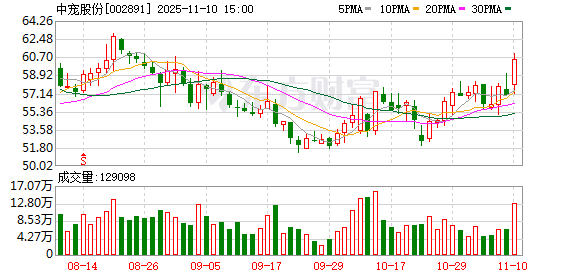
中宠股份跌2.03%,成交额8814.88万元,主力资金净流出776.75万元
Xin Lang Cai Jing· 2025-11-12 02:08
Core Viewpoint - Zhongchong Co., Ltd. has experienced a stock price increase of 66.93% year-to-date, indicating strong market performance in the pet food industry [1][2]. Company Overview - Zhongchong Co., Ltd. is located in Yantai, Shandong Province, established on January 18, 2002, and listed on August 21, 2017. The company primarily engages in the research, production, and sales of pet food for dogs and cats [1]. - The revenue composition of the company includes pet snacks (62.89%), pet staple food (32.21%), and pet supplies and others (4.90%) [1]. Financial Performance - For the period from January to September 2025, Zhongchong Co., Ltd. achieved an operating income of 3.86 billion yuan, representing a year-on-year growth of 21.05%. The net profit attributable to the parent company was 333 million yuan, reflecting an 18.21% increase year-on-year [2]. - The company has distributed a total of 322 million yuan in dividends since its A-share listing, with 264 million yuan distributed over the past three years [3]. Shareholder Information - As of October 20, 2025, the number of shareholders for Zhongchong Co., Ltd. was 43,000, a decrease of 3.09% from the previous period. The average circulating shares per person increased by 3.19% to 7,071 shares [2]. - Among the top ten circulating shareholders, Hong Kong Central Clearing Limited holds 14.32 million shares, a decrease of 7.01 million shares from the previous period. Dongfanghong Industrial Upgrade Mixed Fund is a new entrant among the top ten shareholders with 1.79 million shares [3].
可选消费W45周度趋势解析:海内外消费子版块均无共振,内部因素催化股价表现-20251111
Haitong Securities International· 2025-11-11 15:11
Investment Rating - The report assigns an "Outperform" rating to multiple companies including Nike, Midea Group, JD Group, Haier Smart Home, Gree Electric, Anta Sports, China Duty Free, and others [1]. Core Insights - The report highlights that domestic and overseas consumer subsectors are not showing synchronized movements, with internal factors driving stock performance [4][10]. - The performance of various sectors is analyzed, indicating that the U.S. hotel sector has outperformed others, while luxury goods and overseas cosmetics have seen significant declines [10][13]. Sector Performance Summary - **U.S. Hotels**: The sector saw a weekly increase of 7.9%, driven by strong performance from Marriott and Hilton, with Marriott's RevPAR growth meeting market expectations [5][13]. - **Pet Sector**: Increased by 1.1%, with leading brands showing significant growth in GMV despite overall sales being weak [5][13]. - **Gambling Sector**: Rose by 0.7%, with Macau's GGR exceeding expectations, indicating strong future performance [5][13]. - **Retail Sector**: Experienced a slight decline of 0.3%, with China Duty Free benefiting from new tax policies [7][13]. - **Snack Sector**: Fell by 1.9%, with competitive pressures affecting performance [7][13]. - **Gold and Jewelry Sector**: Decreased by 2.5% due to tax reforms impacting profitability [7][13]. - **Overseas Sportswear**: Dropped by 2.8%, facing tariff pressures and concerns over U.S. consumer spending [7][13]. - **Luxury Goods**: Declined by 3.0%, with concerns over upcoming earnings reports affecting stock prices [7][13]. - **Domestic Cosmetics**: Fell by 3.4%, with overall performance weaker than international brands [7][13]. - **Overseas Cosmetics**: Experienced a significant drop of 11.6%, primarily due to ELF Beauty's disappointing earnings [7][13]. Valuation Analysis - Most sectors are valued below their average over the past five years, with specific PE ratios indicating potential undervaluation [8][14]. - **Overseas Sportswear**: Expected PE of 28.6, 54% of the past five-year average [14]. - **Domestic Sportswear**: Expected PE of 14.1, 74% of the past five-year average [14]. - **Gold and Jewelry**: Expected PE of 22.1, 42% of the past five-year average [14]. - **Luxury Goods**: Expected PE of 25.6, 46% of the past five-year average [14]. - **Gambling**: Expected PE of 29.1, 47% of the past five-year average [14]. - **Overseas Cosmetics**: Expected PE of 35.5, 53% of the past five-year average [14]. - **Domestic Cosmetics**: Expected PE of 27.9, 52% of the past five-year average [14]. - **Pet Sector**: Expected PE of 40.3, 55% of the past five-year average [14]. - **Snack Sector**: Expected PE of 26.8, 65% of the past five-year average [14]. - **Retail Sector**: Expected PE of 28.6, 53% of the past five-year average [14]. - **U.S. Hotels**: Expected PE of 31.4, 19% of the past five-year average [14]. - **Credit Card Sector**: Expected PE of 28.9, 55% of the past five-year average [14].
双十一“它经济”热潮:年轻人血本氪金,“毛孩子”过得好上加好
2 1 Shi Ji Jing Ji Bao Dao· 2025-11-11 11:56
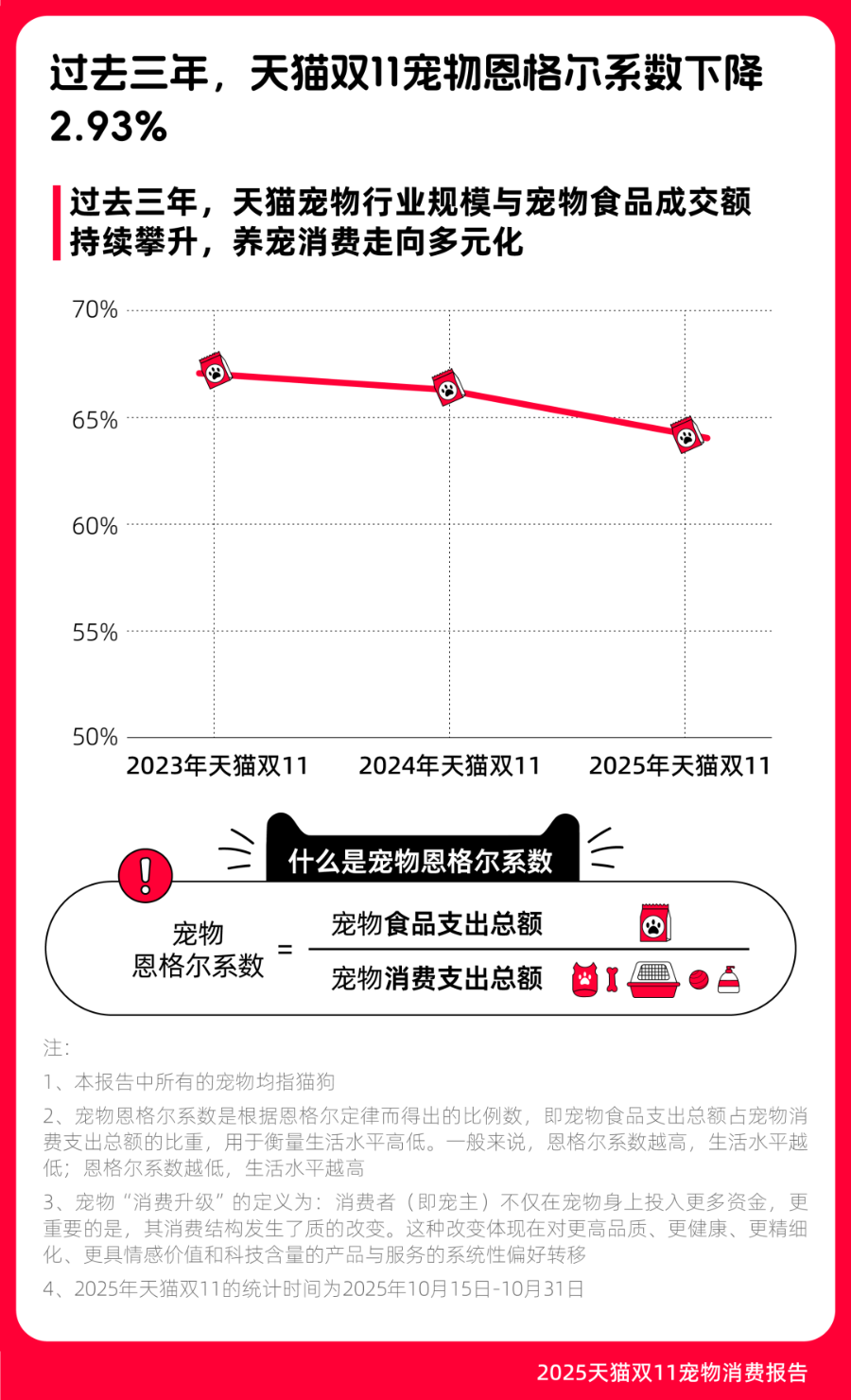
Core Insights - The pet consumption market in China is experiencing a significant upgrade, with consumers prioritizing quality and health for their pets over personal luxury items during shopping events like Double Eleven [1][2][3] - The trend indicates a shift from basic pet care to a focus on natural and healthy products, reflecting pets as family members with individual needs [1][7] - The market is characterized by a rapid growth in domestic brands, which are capturing a larger market share, indicating a structural change in consumer preferences [3][10] Group 1: Market Dynamics - The Double Eleven shopping event serves as a peak consumption period, showcasing the explosive growth of the pet category, with many consumers spending significantly on pet products [2][10] - Data shows that within the first hour of the Double Eleven pre-sale, 18 brands exceeded 10 million yuan in sales, and 587 brands saw year-on-year growth [3][10] - Domestic brands accounted for 68% of the brands that surpassed 10 million yuan in sales, highlighting the rise of local players in the pet food market [3][11] Group 2: Consumer Behavior - Young pet owners are increasingly making rational and informed choices, focusing on the nutritional needs of their pets rather than brand prestige [7][8] - The average spending on pet products is rising, with consumers prioritizing high-quality items such as premium pet food and smart pet devices [3][9] - The Engel coefficient for pet consumption on platforms like Tmall has decreased, indicating a diversification in spending habits and a shift towards higher-priced essential goods [3][8] Group 3: Industry Trends - The pet industry is projected to grow significantly, with estimates suggesting that by 2024, the market size will exceed 300 billion yuan [7][10] - The demand for smart pet products is on the rise, with substantial growth in categories like smart feeders and pet tracking devices, reflecting a trend towards technological integration in pet care [9][12] - The entry of non-traditional pet brands into the market is diversifying consumer choices and intensifying competition, as seen with brands like Adidas and Xiaomi [12][13] Group 4: Future Outlook - The Chinese pet market still has considerable growth potential compared to more mature markets like the US, where pet ownership rates are significantly higher [11][12] - The industry lacks dominant players, with the top five companies holding only 24.5% market share, indicating opportunities for new entrants and innovation [11][12] - Education and professional development in the pet care sector are crucial for sustainable growth, as the industry faces a shortage of qualified professionals [13]

2025 年三季报业绩总结:畜禽养殖盈利回落,宠物食品内销景气延续
Shenwan Hongyuan Securities· 2025-11-11 06:49
Investment Rating - The report maintains a "positive" outlook on the agricultural, forestry, animal husbandry, and fishery sectors, with specific attention to the potential for value reassessment in leading pig farming companies [2][3]. Core Insights - The agricultural sector's net profit for the first three quarters of 2025 increased by 11% year-on-year, with five sub-sectors showing profit growth, including animal health (+96%) and agricultural processing (+50%) [11][12]. - The pig farming industry is experiencing significant challenges, with a notable decline in pig prices leading to widespread losses among companies, although some are still managing to maintain profitability due to cost advantages [3][19]. - The pet food sector continues to show strong domestic sales growth, while exports are negatively impacted by increased tariffs, highlighting a divergence in performance between domestic and international markets [3][6]. Summary by Sections 1. Agricultural Sector Overview - The agricultural sector's net profit for Q1-Q3 2025 reached CNY 369.4 billion, reflecting an 11% increase year-on-year, with most sub-sectors reporting profit growth [11][12]. - In Q3 2025, the sector's net profit dropped by 58% year-on-year, with significant declines in the feed and breeding industries [13][14]. 2. Key Sub-Sectors Performance 2.1 Pig Farming - The pig farming sector saw a 30% increase in the number of pigs slaughtered in the first three quarters of 2025, but Q3 prices fell sharply, leading to a 68.4% drop in net profit for the quarter [21][16]. - The average profit per pig for self-breeding operations was approximately CNY 60 per head, but this dropped to CNY 43 in Q3, indicating a significant decline in profitability [32][33]. 2.2 Chicken Farming - The white feather chicken segment is facing price declines, but downstream companies are seeing profit recovery due to improved cost structures [53][59]. - The yellow feather chicken segment is experiencing a significant downturn, with profits down by 75.2% year-on-year for the two listed companies in this category [3][59]. 2.3 Pet Food - The domestic pet food market remains robust, with a 17.7% increase in revenue for the first three quarters of 2025, while exports to the U.S. fell by 25.6% due to tariffs [3][6]. - Leading domestic brands are gaining market share, with significant growth in online sales [5][6]. 2.4 Animal Health - The animal health sector reported a 70.2% increase in net profit, driven by high livestock inventory levels and the introduction of new products [4][3].



农林牧渔行业2025年三季报业绩总结:畜禽养殖盈利回落,宠物食品内销景气延续
Shenwan Hongyuan Securities· 2025-11-11 05:42
Investment Rating - The report maintains a "Positive" outlook on the agricultural, forestry, animal husbandry, and fishery industry for the third quarter of 2025 [2] Core Insights - The agricultural, forestry, animal husbandry, and fishery sector's net profit increased by 11% year-on-year in the first three quarters of 2025, with five sub-industries showing profit growth [16][17] - The overall performance of the sector declined in Q3 2025, with a 58% year-on-year drop in net profit, primarily due to significant losses in the breeding industry [18][19] - The pig farming sector faced a downturn with falling prices and a return to industry-wide losses, while the poultry sector showed mixed results with white feathered chickens stabilizing and yellow feathered chickens experiencing a significant decline [22][58] - The pet food segment continues to thrive domestically, although exports have been negatively impacted by increased tariffs [22][58] - The animal health sector benefited from high livestock inventory levels, leading to substantial revenue growth for companies in this space [22][58] Summary by Sections 1. Overview of Agricultural, Forestry, Animal Husbandry, and Fishery Sector - The sector's net profit for Q1-Q3 2025 reached 369.4 billion, marking an 11% increase year-on-year [16] - In Q3 2025, the sector's net profit was 95.9 billion, reflecting a 58% decrease year-on-year and a 27% decrease quarter-on-quarter [18] 2. Key Sub-Industry Performance 2.1 Pig Farming - The pig farming sector's revenue for Q1-Q3 2025 was 3036.4 billion, with a 9.9% year-on-year increase, but Q3 saw a significant profit drop of 68.4% [22] - The average profit per head for self-bred pigs was approximately 60 yuan, with significant variations among companies [36][38] 2.2 Poultry Farming - White feathered chicken companies reported a revenue of 243.4 billion in the first three quarters of 2025, with a net profit increase of 104.6% [64] - Yellow feathered chicken prices declined significantly, leading to a challenging market environment [58] 2.3 Pet Food - The pet food sector achieved a revenue of 103.0 billion in the first three quarters of 2025, with a year-on-year growth of 17.7% [22] - Domestic brands are gaining market share, while exports to the U.S. have decreased by 25.6% due to tariffs [22] 2.4 Animal Health - The animal health sector's revenue reached 132.7 billion in Q1-Q3 2025, with a 70.2% increase in net profit [22] - New product launches have contributed to above-average growth for some companies in this sector [22]
渤海证券研究所晨会纪要(2025.11.11)-20251111
BOHAI SECURITIES· 2025-11-11 01:29
Macro and Strategy Research - In October 2025, China's exports decreased by 1.1% year-on-year, while imports increased by 1.0%, resulting in a trade surplus of 90.074 billion USD [2][3] - The decline in export growth is attributed to high base effects and seasonal factors, but the overall decrease is considered manageable [2] - Looking ahead, the easing of US-China trade tensions and stable global manufacturing PMI suggest that export uncertainties have significantly reduced [3] Price Data Analysis - In October 2025, the Consumer Price Index (CPI) turned positive with a notable increase driven by rising food prices and core inflation influenced by international gold prices [4][5] - The Producer Price Index (PPI) saw a narrowing year-on-year decline, with improvements in key industries such as coal and photovoltaic equipment due to ongoing capacity management [5][6] Fund Research - The equity market saw most major indices rise, with the Shanghai Composite Index increasing by 1.08% [7] - Bond ETF scales reached new highs, indicating strong investor interest in fixed-income products [7][8] - The average return for equity funds was positive, with quantitative funds leading the gains [8] Industry Research - The light industry and textile sectors are under pressure from export declines, with furniture and clothing exports down by 12.66% and 15.96% respectively in October [11][12] - New government policies aimed at accelerating digital transformation are expected to enhance the competitiveness of these sectors in the medium term [11] - The computer industry reported a revenue of 935.835 billion CNY in the first three quarters of 2025, with a year-on-year growth of 9.14%, driven by strong performance in software development and IT services [13][14]
农业会是高低切换的重点方向之一吗?
2025-11-25 01:19
Summary of Agricultural Sector Conference Call Industry Overview - The agricultural sector is currently undervalued, with a PB percentile ranking low among the 31 sub-industries in the Shenwan index, indicating potential investment opportunities due to low valuations in various sub-sectors [1][3][6] Key Insights and Arguments - **Animal Health Sector**: This sub-sector has seen the highest growth, driven by specific events rather than a broad sector effect, with a 73% increase since September 2024 [4][5] - **Swine Farming**: Expected government interventions to address falling pig prices and production capacity reduction, with a focus on increasing imports of U.S. agricultural products like soybeans and wheat, which could lower feed costs and improve market expectations for swine farming [1][6][8] - **Seed Industry**: Potential investment opportunities driven by policy changes and a rebound in grain prices, particularly during the year-end policy announcement period [1][10] - **Pet Food Industry**: Facing intensified domestic competition and impacts from the U.S.-China tariff war, but leading companies like Guai Bao and Zhong Chong are expected to emerge stronger [1][13] - **Poultry Farming**: The high incidence of avian influenza during the peak season (October to February) may create investment opportunities, particularly in regions like France and the U.S. [2][14] Market Performance - The agricultural sector's performance has been relatively weak, ranking 22nd in terms of price changes since September 2024, but improved to 17th since April 2025 [3] - Specific stocks have shown significant gains, often driven by unique events rather than core business logic, indicating a lack of consistent performance across the sector [5] Future Investment Opportunities - The agricultural sector may benefit from ongoing anti-involution policies and low valuations across sub-sectors, particularly in swine farming, where supply increases, cost reductions, and consumption recovery are anticipated [6][9] - Recommended stocks include leading companies in swine farming like Muyuan and Wens, as well as low-cost or growth-oriented firms [9] Additional Insights - The seed industry may see price recovery due to recent declines in corn prices, which were driven by weather-related issues rather than supply increases [10][11] - The rubber industry is currently stable but faces short-term challenges; however, long-term prospects remain positive [12]


生猪去化或将加速:——农林牧渔行业周报-20251110
Guohai Securities· 2025-11-10 11:14
Investment Rating - The report maintains a "Recommended" rating for the agricultural, forestry, animal husbandry, and fishery industry [1] Core Views - The report highlights that the de-stocking of live pigs may accelerate, with a focus on the value reassessment opportunities in the pig sector due to ongoing regulatory measures [3][4] - The poultry sector is expected to see improvements in its fundamentals, while the animal health sector is poised for performance recovery and advancements in African swine fever vaccine clinical trials [5][6] - The pet economy is thriving, with strong growth in domestic brands, indicating a rapid development phase for the pet industry [9][10] Summary by Sections 1. Swine - The swine industry is undergoing deepening regulatory measures aimed at controlling prices through capacity reduction. Short-term pressures on pig prices are anticipated due to increased market supply and inventory adjustments. The expectation is for a gradual policy approach rather than aggressive interventions [3][4][15] - Key companies recommended include Muyuan Foods and Wens Foodstuffs, with additional attention on Dekang Agriculture, Shennong Group, and Juxing Agriculture [3][16] 2. Poultry - The poultry sector shows signs of fundamental improvement, with data indicating a rise in the number of breeding stock and a shift towards self-breeding [4][25] - Recommendations include Shennong Development and Lihua Stockbreeding, as the industry navigates through low price periods [4][25] 3. Animal Health - The animal health sector has seen revenue and profit growth among listed companies, with notable performances from Reap Bio and Keqian Bio. The clinical trials for African swine fever vaccines are progressing, which may enhance market prospects [5][32] - Recommended companies include Keqian Bio, Reap Bio, and attention on Huazhong Bio and other related firms [5][32] 4. Planting - Grain prices are on the rise, with significant increases in corn and soybean meal prices noted. The commercialization of genetically modified seeds is progressing, benefiting companies with early investments in research and development [7][37] - Companies to watch include Suqian Agricultural Development, Longping High-Tech, and Denghai Seeds [7][42] 5. Feed - The feed industry is experiencing price fluctuations, with a noted increase in production volume. The concentration of the industry is expected to continue rising [8][43] - Recommended companies include Haida Group and Hefa Shares [8][45] 6. Pets - The pet market is projected to reach a scale of 300.2 billion yuan in 2024, with significant growth in both dog and cat segments. The report emphasizes the rapid development of domestic brands in this sector [9][54] - Recommended companies in the pet food sector include Guibao Pet, Zhongchong Shares, and Petty Shares, with a focus on the medical segment as well [9][55]

饲料板块11月10日涨2.63%,中宠股份领涨,主力资金净流出718.75万元
Zheng Xing Xing Ye Ri Bao· 2025-11-10 08:42
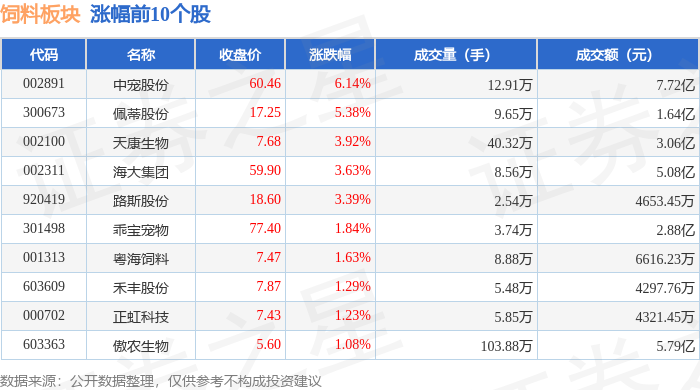
Market Performance - The feed sector increased by 2.63% compared to the previous trading day, with Zhongchong Co., Ltd. leading the gains [1] - The Shanghai Composite Index closed at 4018.6, up 0.53%, while the Shenzhen Component Index closed at 13427.61, up 0.18% [1] Individual Stock Performance - Zhongchong Co., Ltd. (002891) closed at 60.46, up 6.14%, with a trading volume of 129,100 shares and a transaction value of 772 million [1] - Petty Holdings (300673) closed at 17.25, up 5.38%, with a trading volume of 96,500 shares and a transaction value of 164 million [1] - Tiankang Biological (002100) closed at 7.68, up 3.92%, with a trading volume of 403,200 shares and a transaction value of 306 million [1] - Haida Group (002311) closed at 59.90, up 3.63%, with a trading volume of 85,600 shares and a transaction value of 508 million [1] - Other notable stocks include Lusi Co., Ltd. (920419) up 3.39%, and Guibao Pet (301498) up 1.84% [1] Capital Flow Analysis - The feed sector experienced a net outflow of 7.1875 million from institutional investors, while retail investors saw a net outflow of 70.5683 million [2] - Conversely, speculative funds had a net inflow of 77.7559 million [2] Detailed Capital Flow for Selected Stocks - Tiankang Biological (002100) had a net inflow of 26.2254 million from institutional investors, but a net outflow of 16.1094 million from retail investors [3] - Petty Holdings (300673) saw a net inflow of 15.1610 million from institutional investors, with a net outflow of 1.16273 million from retail investors [3] - Zhongchong Co., Ltd. (002891) had a net inflow of 10.5351 million from institutional investors, while retail investors experienced a net outflow of 2.13773 million [3] - Haida Group (002311) had a net inflow of 7.6228 million from institutional investors, but a net outflow of 34.6619 million from retail investors [3]
中宠股份:目前已在全球范围建成超22间现代化工厂
Zheng Quan Ri Bao· 2025-11-10 08:41
Group 1 - The company, Zhongchong Co., Ltd., is focused on global supply chain layout and has established over 22 modern factories worldwide [2] - All domestic factories are concentrated in Yantai, Shandong Province, with no current plans for establishing factories in other regions of China [2]