久立特材

Search documents
钢铁篇:底部涅槃,曙光渐近
2025-09-22 01:00
Steel Industry Analysis Summary Industry Overview - The steel industry is experiencing a significant recovery in profit margins, with profitability reaching nearly 80% in July 2025, despite a slight recent decline. This recovery is primarily due to a larger decrease in raw material costs compared to steel prices and expectations from production control policies [1][2]. Key Points Profitability and Market Performance - As of 2025, 27 steel companies reported a profitability ratio of 58.87%, a notable improvement from the previous year when most companies faced losses [2]. - The steel sector's stock prices saw a slight increase in the first half of 2025, with a stronger performance in Q1 compared to Q2, which was weaker due to slow policy implementation and market shifts towards technology sectors [3]. Demand Trends - Demand for steel in the real estate sector is declining but at a slower rate, while manufacturing sectors (automotive, machinery, home appliances, and shipbuilding) are showing growth, effectively offsetting the downturn in real estate [1][6]. - Infrastructure demand is expected to stabilize due to increased government bond issuance and special debt issuance, with a projected year-on-year decline in demand of around 1% [9]. Sector-Specific Insights - Manufacturing investment from January to July 2025 grew by 6.2%, with low inventory levels across various sectors, indicating robust demand [10]. - The automotive sector is projected to see an 8% increase in steel demand in 2025, driven by a 12.6% increase in production from January to July [12]. - The shipbuilding industry maintains a strong demand growth of around 20%, supported by long-term orders [14][15]. Export and Pricing Dynamics - Direct exports of steel increased significantly in 2025, with total import and export volumes exceeding 70 million tons, a year-on-year increase of 1.4 million tons [16]. - Domestic steel prices remain low compared to global markets, which has stimulated export growth despite challenges from anti-dumping investigations in Vietnam and South Korea [17]. Policy and Regulatory Environment - The steel industry is undergoing regulatory changes focusing on environmental standards and energy consumption, with a requirement for ultra-low emissions by 2026 [21][22]. - The carbon emissions trading market is being tightened, which will compel companies to reduce production capacity or energy consumption [23]. Raw Material Supply and Pricing - The raw material market is showing mixed trends, with iron ore prices remaining strong while coking coal prices have seen fluctuations due to production controls [24][26]. - Future supply of iron ore is expected to be relatively loose, while coking coal prices may remain firm due to ongoing supply disruptions [27]. Investment Recommendations - Investment focus should be on high-demand sectors within manufacturing, such as high-end automotive components and nuclear power-related needs, as well as capacity optimization strategies [28]. - Key companies to watch include leading firms like Hualing, Baosteel, and Nanjing Steel, along with flexible companies like Fangda Special Steel and New Steel [30]. Conclusion - The steel industry is poised for a recovery with stable long-term demand driven by manufacturing upgrades and infrastructure investments, despite challenges in the real estate sector and regulatory pressures. The focus on environmental compliance and production efficiency will shape the competitive landscape moving forward.
反内卷下,钢铁表外产能的退出路径
Changjiang Securities· 2025-09-21 23:30
Investment Rating - The industry investment rating is Neutral, maintained [9] Core Insights - The report highlights the exit paths for off-balance steel production capacity under the "anti-involution" policy, focusing on the need for stricter regulation and the removal of illegal production capacities [5][7] - Seasonal recovery in construction demand and liquidity support have contributed to a rebound in steel prices, although the demand during the "Golden September" period is not particularly strong [4][27] - The report emphasizes the importance of regulatory measures to ensure the exit of illegal and excess steel production capacities, which is crucial for improving the supply-demand balance in the steel industry [7][28] Summary by Sections Section: Current Market Conditions - Construction demand has shown seasonal recovery, with apparent consumption of five major steel products increasing by 0.34% year-on-year and 0.55% month-on-month [4] - Daily average pig iron production has risen to 2.4102 million tons, reflecting a slight increase of 0.47 tons per day [4] - Total steel inventory has increased by 0.32% month-on-month and 7.16% year-on-year [4] Section: Regulatory Environment - Recent inspections by the Central Environmental Protection Supervision Team have focused on illegal steel production capacities in several provinces, highlighting issues such as unauthorized construction and the persistence of "rebar steel" production [5][6] - The report identifies three main forms of illegal steel production: capacity replacement schemes, production under the guise of casting and forging, and the construction of illegal rebar steel [6] Section: Future Outlook - The report anticipates a clear direction for steel production regulation, emphasizing the need to eliminate illegal capacities and enforce strict compliance with production standards [7] - It suggests that the ongoing "anti-involution" policies will enhance the supply-side contraction expectations, potentially leading to significant valuation recovery for steel companies with low price-to-book ratios [27][28]
短期市场聚焦冷热不均
GOLDEN SUN SECURITIES· 2025-09-21 08:55
Investment Rating - The report maintains a "Buy" rating for the steel sector, specifically recommending stocks such as Hualing Steel, Nanjing Steel, Baosteel, and New Steel [3][6][9]. Core Insights - The report emphasizes that the current market is experiencing uneven performance, with a focus on the technology sector while traditional industries face significant adjustments. The report suggests that the era of capital oversupply is establishing a foundation for a golden period in capital markets [2]. - The report highlights that the average daily pig iron production has slightly increased, and the total inventory growth has narrowed, indicating a potential improvement in market conditions [14][26]. - The apparent consumption of steel has shown a month-on-month improvement, particularly in rebar demand, which has increased significantly [43]. Summary by Sections Market Review - The CITIC Steel Index closed at 1,778.35 points, down 2.74%, underperforming the CSI 300 Index by 2.30 percentage points, ranking 25th among 30 CITIC primary sectors [1][92]. Supply and Production - The average daily pig iron production rose by 0.5 million tons to 241.1 million tons, while the production of rebar decreased slightly, and hot-rolled production saw a minor increase [14][19]. - In August 2025, crude steel production was 77.37 million tons, a year-on-year decrease of 0.7%, while steel production increased by 9.7% to 122.77 million tons [15][8]. Inventory - Total steel inventory continued to accumulate, with a weekly increase of 0.3%, but the growth rate has narrowed by 0.6 percentage points compared to the previous week [26][28]. - The social inventory of five major steel products was 11.014 million tons, up 0.6% week-on-week and 7.3% year-on-year [28]. Demand - The apparent consumption of five major steel products was 8.503 million tons, up 0.8% month-on-month but down 4.6% year-on-year, indicating a mixed demand scenario [53]. - The average weekly transaction volume of construction steel was 106,000 tons, reflecting a 3.3% increase from the previous week [44]. Raw Materials - Iron ore prices have shown a slight increase, with the Platts 62% iron ore price index at $106.6 per ton, up 0.2% week-on-week and 17.9% year-on-year [62]. - The report notes that the coal and electricity investment completion amount reached 96 billion yuan, a year-on-year increase of 52.4%, indicating a positive outlook for related sectors [8]. Prices and Profits - The comprehensive steel price index increased by 0.5% week-on-week, suggesting a potential for continued price strength as industry fundamentals improve [72]. - The current spot price for rebar in Beijing is 3,200 yuan per ton, reflecting a 0.3% increase week-on-week [73].


原料成本支撑,钢价偏强运行
Minsheng Securities· 2025-09-21 08:33
Investment Rating - The report maintains a "Buy" recommendation for several steel companies, including Hualing Steel, Baosteel, Nanjing Steel, and others, based on their projected earnings and valuation metrics [3][4]. Core Insights - The steel prices are showing a strong upward trend supported by raw material costs, with significant increases in various steel products as of September 19, 2025 [1][11]. - The overall steel profit margins have improved, with notable increases in the gross margins for rebar, hot-rolled, and cold-rolled steel [1][2]. - The report indicates a shift from inventory accumulation to inventory reduction for rebar, suggesting a recovery in demand as the industry enters its peak season [3]. Price Trends - As of September 19, 2025, the prices for key steel products in Shanghai are as follows: - Rebar (20mm HRB400) at 3280 CNY/ton, up 70 CNY/ton from the previous week - High-line (8.0mm) at 3420 CNY/ton, up 60 CNY/ton - Hot-rolled (3.0mm) at 3460 CNY/ton, up 10 CNY/ton - Cold-rolled (1.0mm) at 3830 CNY/ton, up 30 CNY/ton - Common medium plate (20mm) at 3510 CNY/ton, up 50 CNY/ton [1][11][12]. Production and Inventory - As of September 19, 2025, the total production of the five major steel products was 8.55 million tons, a decrease of 1.78 million tons week-on-week, with rebar production specifically down by 5.48 million tons to 2.0645 million tons [2]. - The total social inventory of the five major steel products increased by 63,200 tons to 11.0023 million tons, while steel mill inventory decreased by 11,400 tons [2]. Profitability - The report highlights an increase in steel profitability, with gross margins for rebar, hot-rolled, and cold-rolled steel rising by 24 CNY/ton, 28 CNY/ton, and 28 CNY/ton respectively, while electric arc furnace steel margins increased by 10 CNY/ton [1][3]. Investment Recommendations - The report recommends focusing on the following companies: - For the general steel sector: Hualing Steel, Baosteel, Nanjing Steel - For the special steel sector: Xianglou New Materials, CITIC Special Steel, Yongjin Co. - For pipe materials: Jiuli Special Materials, Youfa Group, Wujin Stainless Steel - Additionally, it suggests paying attention to high-temperature alloy companies like Fushun Special Steel [3].

久立特材(002318):2025年半年报点评:盈利保持高增速,高端产品仍可期
Orient Securities· 2025-09-21 02:46
Investment Rating - The report maintains a "Buy" rating for the company with a target price of 31.68 CNY [6][3]. Core Views - The company has demonstrated strong profit growth, with a 26.39% year-on-year increase in revenue for the first half of 2025, reaching 6.105 billion CNY. The net profit attributable to the parent company increased by 36.44% to 804 million CNY [10]. - The gross margin for seamless pipes reached a new high of 34.35%, reflecting the company's competitive edge and cost advantages in high-end products [10]. - The company is well-positioned to benefit from the growing demand in deep-sea and acidic oil and gas markets, with over 60% of its revenue coming from these sectors. The company has established long-term partnerships with major global firms [10]. - The company is expanding its production capacity, with several key projects nearing completion, which is expected to inject new growth potential [10]. Financial Summary - Revenue projections for 2025-2027 are adjusted to 13.178 billion CNY, 10.823 billion CNY, and 11.289 billion CNY, respectively, with corresponding EPS estimates of 1.83 CNY, 1.62 CNY, and 1.70 CNY [3]. - The company’s financial metrics show a consistent increase in gross margin, net profit margin, and return on equity (ROE) over the forecast period [5][13]. - The projected net profit for 2025 is 1.787 billion CNY, with a year-on-year growth of 19.9% [5].
2025年1-5月中国焊接钢管产量为2392.2万吨 累计增长4.2%
Chan Ye Xin Xi Wang· 2025-09-21 02:13
2020-2025年1-5月中国焊接钢管产量统计图 数据来源:国家统计局,智研咨询整理 上市企业:宝钢股份(600019),新兴铸管(000778),常宝股份(002478),久立特材(002318),鸿路钢 构(002541),友发集团(601686),中信特钢(000708),金洲管道(002443),玉龙股份(601028) 相关报告:智研咨询发布的《2025-2031年中国焊接钢管行业发展模式分析及未来前景展望报告》 根据国家统计局数据显示:2025年5月中国焊接钢管产量为546万吨,同比下降1.4%;2025年1-5月中国 焊接钢管累计产量为2392.2万吨,累计增长4.2%。 知前沿,问智研。智研咨询是中国一流产业咨询机构,十数年持续深耕产业研究领域,提供深度产业研 究报告、商业计划书、可行性研究报告及定制服务等一站式产业咨询服务。专业的角度、品质化的服 务、敏锐的市场洞察力,专注于提供完善的产业解决方案,为您的投资决策赋能。 ...


特钢板块9月19日跌0.35%,翔楼新材领跌,主力资金净流出403.62万元
Zheng Xing Xing Ye Ri Bao· 2025-09-19 08:42
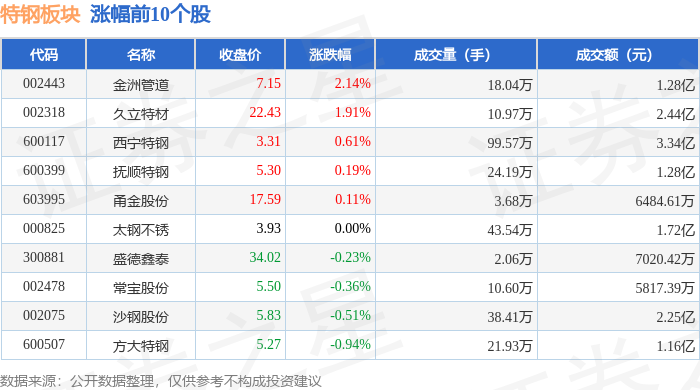
Market Overview - On September 19, the special steel sector declined by 0.35%, with Xianglou New Materials leading the drop [1] - The Shanghai Composite Index closed at 3820.09, down 0.3%, while the Shenzhen Component Index closed at 13070.86, down 0.04% [1] Stock Performance - Key stocks in the special steel sector showed varied performance, with Jinzhou Pipeline up by 2.14% and Xianglou New Materials down by 3.47% [1][2] - The closing prices and changes for notable stocks include: - Jinzhou Pipeline: 7.15, +2.14% - Xianglou New Materials: 63.40, -3.47% - Xining Special Steel: 3.31, +0.61% - Taiyuan Iron & Steel: 3.93, 0.00% [1][2] Trading Volume and Capital Flow - The total trading volume for the special steel sector was significant, with Jinzhou Pipeline achieving a transaction amount of 1.28 billion yuan [1] - The net capital flow showed a net outflow of 403.62 million yuan from main funds, while retail investors had a net inflow of 2328.13 million yuan [2][3] Individual Stock Capital Flow - Notable capital flows for specific stocks include: - Xining Special Steel: Main funds net inflow of 18.89 million yuan, retail net outflow of 39.89 million yuan [3] - Jinzhou Pipeline: Main funds net inflow of 12.61 million yuan, retail net outflow of 6.93 million yuan [3] - Xianglou New Materials: Main funds net outflow of 1.91 million yuan, retail net inflow of 14.58 million yuan [3]


能源领域终极畅享,行业卖铲人率先受益 | 投研报告
Zhong Guo Neng Yuan Wang· 2025-09-19 02:51
Core Insights - The report highlights the rapid development and commercialization potential of controlled nuclear fusion technology, which is seen as a key direction for future energy strategies globally [2][3][4] - The introduction of the Atomic Energy Law in China is expected to promote sustainable development in the nuclear energy sector and support research and technology development in controlled nuclear fusion [2][3] - The industry is experiencing significant growth opportunities, particularly in upstream materials and midstream processing sectors, driven by the bidding and construction activities of leading domestic fusion enterprises [4][5] Industry Overview - Controlled nuclear fusion is regarded as the "ultimate solution" in the energy sector, with the potential to lead a new technological revolution similar to the advent of the steam engine and electrification [2] - The commercialization of Tokamak fusion reactors is anticipated to occur between 2031 and 2035, according to a survey by FIA [2] Market Dynamics - The report indicates that high-temperature superconductors, first wall materials, low-temperature systems, heat exchangers, and vacuum chambers are considered critical components for fusion devices [4][5] - The domestic fusion supply chain is expected to benefit from the initial high growth phase, with upstream material suppliers and midstream processing companies poised to share in the industry's growth [4] Key Components and Technologies - High-temperature superconductors are projected to see a significant market expansion, with expectations that they will capture 25% of the global superconducting materials market by 2030 [4] - The blanket module, which includes the first wall, is identified as a critical component for the future of controlled nuclear fusion, with companies like Guoguang Electric being highlighted for their production capabilities [5] - Tungsten-copper divertors are noted as a promising solution for managing plasma contamination and heat, with companies such as Antai Technology recommended for their supply capabilities [6] Manufacturing and Processing - The vacuum chamber is emphasized for its high processing barriers and critical role in the safe operation of fusion reactors, with companies like Hezhong Intelligent suggested for their manufacturing experience [6][7] - The report suggests that companies with integrated solutions for vacuum chamber manufacturing and processing will have a competitive advantage in the market [6][7]
光大证券晨会速递-20250919
EBSCN· 2025-09-19 00:22
Macro Analysis - The Federal Reserve is expected to initiate a new round of easing, with guidance indicating three rate cuts within the year, aligning with the Fed's dual mandate framework that emphasizes employment risks [2] - The fourth quarter's rate cut is likely to be more of a "preventive cut" rather than a "recessionary cut," which is favorable for risk assets [2] Fiscal Data - In August, improvements in PPI have led to a rapid increase in corporate income tax, positively contributing to overall tax revenue [3] - Government debt supply is increasing, and with accelerated fiscal spending, there is potential for improvement in infrastructure investment [3] - Public budget revenue is progressing faster than expenditure, indicating a focus on effectively utilizing fiscal funds in future policies [3] Industry Research Steel Industry - The steel sector's ROA is at a low level since 2010, with PB_LF still having a 6.67% gap compared to the average since 2013, indicating potential for investment [5] - Companies in the steel sector are prioritizing investor returns, with a commendable overall dividend level; key recommendations include Baosteel, Ordos, and CITIC Special Steel [5] Construction Industry - Qihang Group's float glass business saw volume increase but price decrease, leading to revenue decline, while photovoltaic glass business experienced significant growth in both production and revenue [6] - The forecast for Qihang Group's net profit for 2025-2027 is maintained at 1 billion, 800 million, and 1.06 billion respectively, with a "buy" rating [6] Cement and Chemical Industry - Qingsong Jianhua, a leader in the Xinjiang cement industry, faced significant declines in revenue and profit in H1 2025, prompting a downward revision of net profit forecasts for 2025-2026 [8] - The company’s chemical business profitability remains under pressure, with new net profit forecasts of 350 million for 2025 and 380 million for 2026 [8] Internet Media - Baidu's net cash flow remains healthy, with its business model validated in Wuhan, and Kunlun chip shipments exceeding expectations [9] - The AI ecosystem's value is viewed positively, with revised Non-GAAP net profit forecasts for 2025-2027 at 18.2 billion, 20.5 billion, and 23 billion respectively, maintaining a "buy" rating [9]


【钢铁】从股息率角度分析钢铁板块投资价值——钢铁行业动态点评(王招华/戴默)
光大证券研究· 2025-09-18 23:07
Group 1 - The core viewpoint of the article indicates that the profitability of the general steel sector is at a low point, with the ROA for H1 2025 being 0.93%, the lowest level since 2010 [4] - The PB_LF of the general steel sector is currently at 0.96, which is 6.67% below the average since 2013, and significantly lower than the peaks in 2017 and 2021 by 83% and 69% respectively [5] - Among the general steel companies, 12 firms have a PB_LF below 1, with notable companies like Hebei Steel, New Steel, and Ansteel having PB_LF of 0.51, 0.52, and 0.54 respectively [6] Group 2 - Currently, 11 companies in the steel sector have a dividend yield above 3%, with the highest being Youfa Group at 6.09% [7] - The completion of ultra-low emission transformations in the industry is expected to further enhance the dividend payout ratios of general steel companies [8] - The average capital expenditure for the general steel sector from 2020 to 2024 is projected to be 82.4 billion, significantly higher than the average of 65.4 billion from 2010 to 2019, with expectations of a decline in capital expenditure post-2026 [9]