
新凤鸣

Search documents
新凤鸣跌2.03%,成交额3562.62万元,主力资金净流出16.02万元
Xin Lang Cai Jing· 2025-11-28 02:00
Core Viewpoint - The stock of Xin Feng Ming has experienced fluctuations, with a recent decline of 2.03%, while showing a year-to-date increase of 55.19% and a market capitalization of 25.81 billion yuan [1]. Financial Performance - For the period from January to September 2025, Xin Feng Ming reported a revenue of 51.54 billion yuan, representing a year-on-year growth of 4.77%, and a net profit attributable to shareholders of 869 million yuan, which is a 16.53% increase compared to the previous year [2]. - The company has distributed a total of 1.733 billion yuan in dividends since its A-share listing, with 720 million yuan distributed over the last three years [3]. Shareholder Information - As of November 20, 2025, the number of shareholders for Xin Feng Ming increased to 20,900, up by 2.77%, while the average circulating shares per person decreased by 2.69% to 72,451 shares [2]. - Among the top ten circulating shareholders, Hong Kong Central Clearing Limited is the ninth largest, holding 16.73 million shares as a new shareholder [3]. Business Overview - Xin Feng Ming Group Co., Ltd. specializes in the research, production, and sales of polyester filament, short fibers, and PTA, with its main business revenue composition being POY (42.73%), PTA (13.29%), FDY (13.27%), short fibers (11.16%), DTY (10.16%), and others [1]. - The company is classified under the basic chemical industry, specifically in chemical fibers and polyester, and is involved in several concept sectors including new materials and the Yangtze River Delta integration [1].

ETF日报|科技股冲高回落,电子板块惊现百亿买单!化工悄然逆袭,516020收涨1.3%,银行再秀防御力,银行ETF放量转阳
Sou Hu Cai Jing· 2025-11-27 15:10
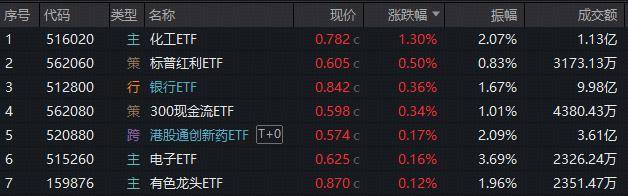
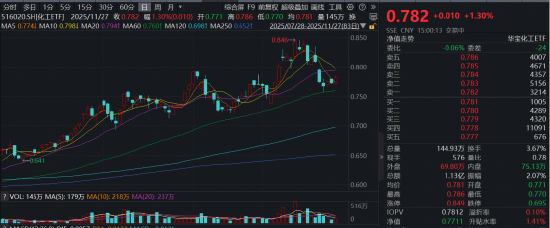
化工板块强势反超领涨,电解液、固态电池等多概念发力,化工ETF(516020)午后一度上探逾1.8%,场内放量收涨1.3%。消息面,电解液行业量价齐 升,头部电解液企业订单火爆,批量斩获长协大单。 银行再度彰显防御性,全市场规模最大银行ETF(512800)早盘自水下拉起,午后维持红盘窄震,场内逆市收涨0.36%收复5日、10日线。近期A股走势震 荡,低位补涨及防守型配置机会显现,银行板块配置或正当时。 周四(11月27日),大盘全天冲高回落,沪指微涨0.29%报收3875.26点,创业板指回吐逾2%收跌0.44%。个股整体涨跌参半,全市场成交额1.72万亿元,连 续2日小幅缩量。 | 序号 代码 | | ਦੇ ਵਿੱਚ ਹੈ 名称 | 现价 | 涨跌幅 | 振幅 | 成交额 | | --- | --- | --- | --- | --- | --- | --- | | 1 | 516020 | 主 化工ETF | 0.782 c | 1.30% | 2.07% | 1.13亿 | | 2 | 562060 | 策 标普红利ETF | 0.605 c | 0.50% | 0.83% | 3173.13万 | ...

重点关注,资金偷偷布局这个方向
Sou Hu Cai Jing· 2025-11-27 12:30
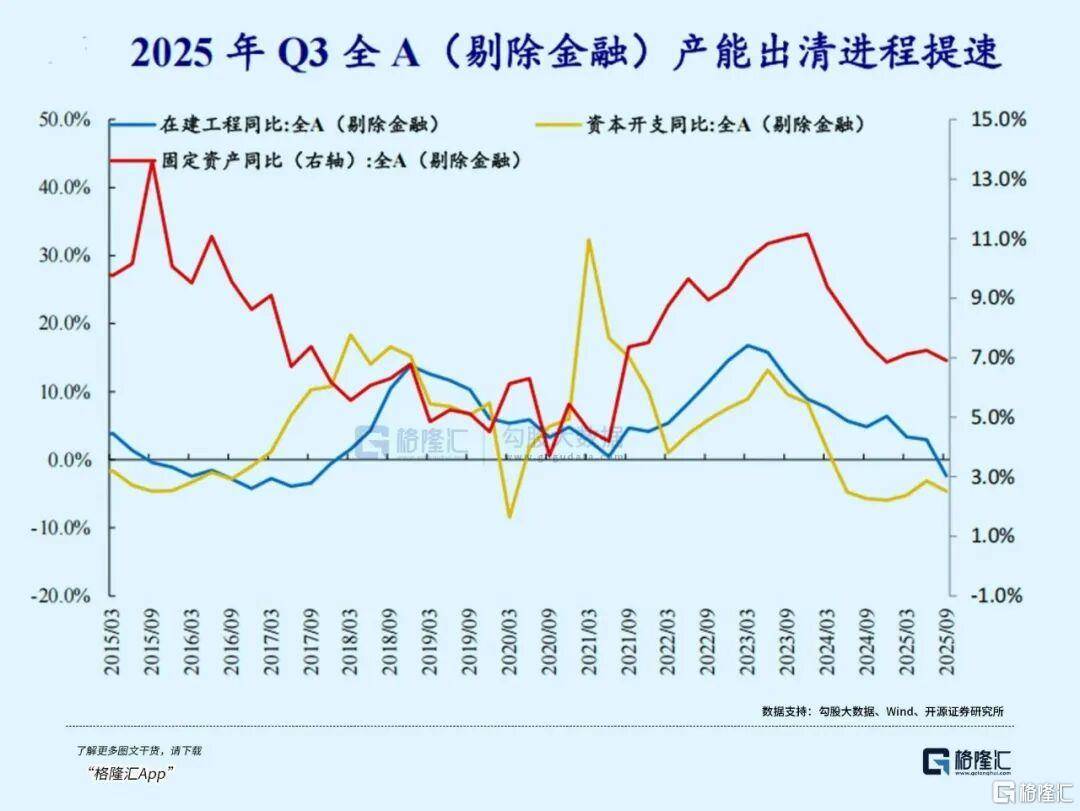
Core Viewpoint - The A-share market is at a critical point of style rebalancing by the end of 2025, with the ongoing "anti-involution" policy reshaping investment logic in cyclical industries [1][4] Group 1: Market Dynamics - Since Q3 2025, the A-share market has shown a significant "technology + cyclical" dual-driven pattern, indicating a transition from a single growth line to a balanced allocation of "growth + value" [1] - The technology sector has experienced a substantial cumulative increase, with the electronics industry rising by 45% and the communication equipment sector by over 38%, significantly outperforming the CSI 300 index's 14.7% [4] - The concentration of institutional holdings in the technology sector has reached nearly historical peaks, with TMT sector holdings exceeding 40.16%, indicating a risk of overcrowding [4] Group 2: Policy Impact - The Ministry of Industry and Information Technology has proposed three major measures for the chemical industry in 2026, signaling a shift from mere advocacy to substantial implementation of the "anti-involution" policy [4] - The "anti-involution" policy has extended to industry self-discipline, with products like long silk, PTA, and urea achieving industry collaboration through "production limits to maintain prices + price alliances + punitive agreements" [10] Group 3: Chemical Industry Insights - The chemical industry is experiencing a supply-side improvement driven by "downward capacity cycles + policy-guided elimination," with fixed asset investments in the chemical raw materials and products manufacturing sector decreasing by 5.6% year-on-year from January to September 2025 [5][6] - The demand side is supported by both domestic recovery and overseas improvement, with textile and apparel exports increasing by 8.7% year-on-year from January to October 2025 [12] Group 4: Investment Opportunities - Investment opportunities in the chemical industry under the "anti-involution" wave include selecting leading companies with strong management systems and cost advantages [14] - Specific sectors to focus on include: 1. Petrochemicals: Expected to see a turning point due to supply contraction and demand upgrades [15] 2. Coal chemicals: Benefiting from policy catalysts and cost advantages, with potential for profit recovery [16] 3. Polyester filament and PTA: Leading sectors in the implementation of the "anti-involution" policy, currently entering an inventory digestion phase [17]
头部电解液企业订单火爆,化工ETF(516020)收涨1.3%,机构:2026年化工行业或迎周期拐点向上
Xin Lang Ji Jin· 2025-11-27 11:53
Core Viewpoint - The chemical sector has shown significant strength in the market, outperforming major indices like the Shanghai Composite and CSI 300, driven by a "de-involution" trend and favorable supply-demand dynamics [1][2][7]. Group 1: Market Performance - The Shanghai Composite Index weakened towards the end of the trading day, while the ChiNext Index turned negative, with the chemical sector leading the gains [1]. - The Chemical ETF (516020) experienced a daily increase of 1.30%, with a trading volume of 1.13 billion yuan [1]. - The cumulative increase of the Chemical ETF's underlying index reached 26.07% year-to-date, significantly outperforming the Shanghai Composite Index (15.62%) and the CSI 300 Index (14.75%) [2][3]. Group 2: Stock Performance - Notable stocks in the chemical sector included Xin Fengming, which rose by 5.75%, and several others like Lu Xi Chemical and Wan Hua Chemical, which saw increases of over 3% [2][4]. - The trading volume and transaction amounts for leading stocks indicate strong investor interest, with Wan Hua Chemical achieving a transaction amount of 2.464 billion yuan [2]. Group 3: Industry Trends - The solid-state battery concept remains active, with a significant increase in lithium battery material demand, as evidenced by the rise in electrolyte prices from approximately 19,400 yuan/ton at the beginning of the year to 54,250 yuan/ton recently [5]. - The current price-to-book ratio of the chemical sector stands at 2.27, indicating a relatively low valuation compared to historical levels, suggesting potential for long-term investment [5]. Group 4: Future Outlook - The chemical industry is expected to experience a dual uplift in performance and valuation due to the "de-involution" trend, with leading companies likely to gain market share through improved management and energy efficiency [7]. - Analysts predict that the chemical sector may see a cyclical upturn starting in 2026, driven by supply-side reforms and increased demand, particularly as the U.S. enters a rate-cutting cycle [7]. Group 5: Investment Strategy - Investors are encouraged to consider the Chemical ETF (516020) for efficient exposure to the sector, as it tracks the CSI Sub-Industry Chemical Index and includes a diversified portfolio of leading stocks [8].





重点关注,资金偷偷布局这个方向
格隆汇APP· 2025-11-27 10:46
Core Viewpoint - The A-share market is at a critical point of style rebalancing by the end of 2025, with the ongoing "anti-involution" policy reshaping the investment logic in cyclical industries [2] Group 1: Market Dynamics - Since Q3 2025, the A-share market has shown a significant "technology + cyclical" dual-driven pattern, indicating a transition from a single growth line to a balanced allocation of "growth + value" [4] - The performance improvement in cyclical sectors is sustainable, with a 23% year-on-year increase in the exit scale of backward production capacity in industries like chemicals and non-ferrous metals as of Q3 2025 [4] Group 2: Drivers of Market Style Shift - Three main supports for the current market style switch include: 1. The technology sector's significant cumulative increase, with the electronics industry up 45% and communication equipment over 38% year-to-date as of November 2025, far exceeding the 14.7% rise of the CSI 300 index [6] 2. Institutional holdings in the technology sector nearing historical peaks, with TMT sector holdings surpassing 40.16% [6] 3. Clear policy signals from the Ministry of Industry and Information Technology regarding the chemical industry, enhancing the certainty of supply-side contraction in cyclical industries [6] Group 3: Chemical Industry Insights - The core logic for supply-side improvement in the chemical industry is driven by "downward capacity cycles + policy-guided exit," with fixed asset investment in the chemical raw materials sector decreasing by 5.6% year-on-year from January to September 2025 [8][11] - The chemical industry has significant advantages over traditional cyclical industries in capacity optimization efficiency, industry collaboration, and high-end transformation paths [12] Group 4: Demand Recovery - The recovery in demand for the chemical industry is supported by both domestic and overseas factors, with domestic engines including improved real estate conditions and a resurgence in textile exports [13][14] - China's chemical product sales have maintained the top global position, with sales amounting to approximately €2.24 trillion in 2023, accounting for 43.1% of global sales [16][17] Group 5: Investment Opportunities in the Chemical Sector - Investment opportunities in the chemical industry under the anti-involution wave include: 1. Selecting leading companies with strong management and cost control [20] 2. Focusing on three reversal areas: petrochemicals, coal chemicals, and polyester filament + PTA, with specific companies highlighted for their potential [21][22][23]


化学纤维板块11月27日涨1.08%,汇隆新材领涨,主力资金净流入2206.51万元
Zheng Xing Xing Ye Ri Bao· 2025-11-27 09:06
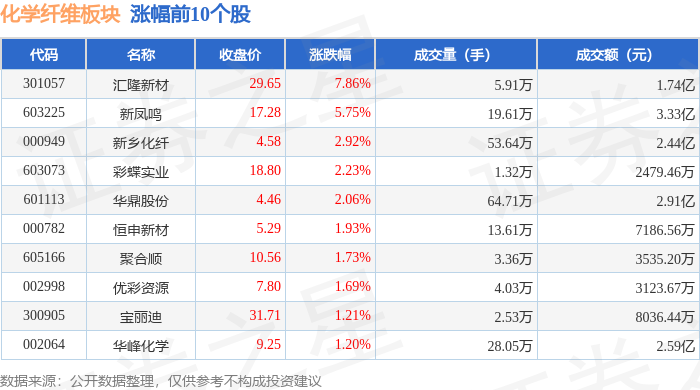
Market Overview - The chemical fiber sector increased by 1.08% on November 27, with Huilong New Materials leading the gains [1] - The Shanghai Composite Index closed at 3875.26, up 0.29%, while the Shenzhen Component Index closed at 12875.19, down 0.25% [1] Stock Performance - Huilong New Materials (301057) closed at 29.65, up 7.86% with a trading volume of 59,100 shares and a transaction value of 174 million [1] - New Fengming (603225) closed at 17.28, up 5.75% with a trading volume of 196,100 shares and a transaction value of 333 million [1] - Xinxiang Chemical Fiber (000949) closed at 4.58, up 2.92% with a trading volume of 536,400 shares and a transaction value of 244 million [1] - Other notable stocks include: - Caidi Industrial (603073) up 2.23% - Budweiser (601113) up 2.06% - Hengshen New Materials (000782) up 1.93% [1] Capital Flow - The chemical fiber sector saw a net inflow of 22.07 million from institutional investors, while retail investors experienced a net inflow of 1.61 million [2] - The sector's overall capital flow indicates a mixed sentiment, with institutional investors showing more confidence compared to retail investors [2] Individual Stock Capital Flow - Xinxiang Chemical Fiber had a net inflow of 39.34 million from institutional investors, while it faced a net outflow of 20.51 million from speculative funds [3] - Huilong New Materials experienced a net inflow of 16.84 million from institutional investors, with a net outflow of 7.09 million from speculative funds [3] - New Fengming had a net inflow of 9.51 million from institutional investors, but a net outflow of 19.19 million from retail investors [3]


新凤鸣股价涨5.08%,易方达基金旗下1只基金重仓,持有277.35万股浮盈赚取230.2万元
Xin Lang Cai Jing· 2025-11-27 06:22
Group 1 - The core viewpoint of the news is that Xin Fengming has seen a stock price increase of 5.08%, reaching 17.17 CNY per share, with a total market capitalization of 26.177 billion CNY [1] - Xin Fengming Group Co., Ltd. is located in Tongxiang City, Zhejiang Province, and was established on February 22, 2000. It was listed on April 18, 2017. The company's main business involves the research, production, and sales of civilian polyester filament, short fibers, and PTA, which is one of its main raw materials [1] - The revenue composition of Xin Fengming includes: POY 42.73%, PTA 13.29%, FDY 13.27%, short fibers 11.16%, DTY 10.16%, and others 4.72% [1] Group 2 - From the perspective of fund holdings, one fund under E Fund has a significant position in Xin Fengming. E Fund Strategy Growth Mixed Fund (110002) held 2.7735 million shares in the third quarter, accounting for 3.92% of the fund's net value, making it the ninth largest holding [2] - The E Fund Strategy Growth Mixed Fund (110002) was established on December 9, 2003, with a latest scale of 1.149 billion CNY. It has achieved a return of 65.89% this year, ranking 291 out of 8130 in its category [2] - The fund manager of E Fund Strategy Growth Mixed Fund (110002) is Zhang Qi, who has been in the position for 3 years and 222 days, with a total asset scale of 5.119 billion CNY [3]
聚酯产业的供需发展
Hong Ye Qi Huo· 2025-11-26 05:02
1. Report Industry Investment Rating No relevant content provided. 2. Core View of the Report The report comprehensively analyzes the supply - demand development of the polyester industry, focusing on the capacity development of raw materials and downstream polyester products. It details the growth trends, production capacity distributions, and market characteristics of PX, PTA, MEG, and various polyester products, providing an in - depth understanding of the industry's current situation and future trends [1][9]. 3. Summary by Relevant Catalogs 3.1 Raw Material - end Capacity Development 3.1.1 PX Capacity Development - From 2018 to 2023, domestic PX capacity increased from 1463000 tons to 43670000 tons. The average annual new production capacity from 2019 - 2023 was 4 - 8 million tons, with an average annual capacity growth rate of about 25%. There will be a new capacity launch window period from 2024 - 2025, but the capacity utilization rate has increased significantly [11][14][17]. - By enterprise nature, state - owned oil companies account for 38.2% of the total capacity, and private refining and chemical integration plants put into operation after 2019 account for 44.9% [17]. - Planned new capacity includes projects such as Shenghong Petrochemical (2 million tons in 2023), Zhongwei Guangdong Petrochemical (2.6 million tons in 2023), and Yulong Petrochemical (3 million tons in 2026) [16]. 3.1.2 PTA Capacity Development - Global PTA capacity is mainly concentrated in Asia, with China accounting for over 78% of Asia's capacity. From 2023 - 2025, 3 - 4 new domestic PTA plants will be put into operation annually, and in 2026, domestic production will slow down while India's new production capacity will increase [20][21]. - Domestically, PTA capacity is geographically concentrated, with over half in Jiangsu and Zhejiang, followed by coastal areas such as Liaoning, Fujian, Guangdong, and Hainan. The industry's CR2 is as high as 41%, and CR6 reaches 74% [23][24]. - The industry has good capacity matching, with an increasing proportion of large - scale and integrated plants [27]. - From 2016 - 2018, PTA profits were good due to limited new capacity growth. After 2019, with the release of private large - scale refining and chemical projects, PTA processing fees declined rapidly, and some high - cost small - scale plants were phased out [32]. 3.1.3 MEG Capacity Development - Domestic MEG capacity and production have been growing steadily, entering a new investment peak after 2018. In 2020, the capacity growth rate reached 47%. From 2021 - 2023, it continued to grow rapidly but at a declining rate. In 2024, the net investment growth rate dropped to 2.3%, and the capacity reached 3027500 tons [37][39]. - Ethylene - based MEG plants are mainly in Zhejiang, Jiangsu, and Liaoning, while coal - based plants are in Shaanxi, Xinjiang, Inner Mongolia, etc. Currently, ethylene - based capacity accounts for about 64%, and coal - based capacity accounts for 36% [41][42]. - MEG imports peaked in 2020 and have gradually declined. In 2024, the import dependence dropped to 25%. The main import sources are Saudi Arabia, Canada, and the United States. In 2025, the proportion from the United States decreased due to tariff issues [48]. - In September 2025, Yulong Petrochemical's launch marked a new expansion cycle for MEG, and the capacity growth rate will accelerate again in 2026 [50]. 3.2 Downstream Polyester Capacity Development 3.2.1 Overall Polyester Capacity - From 2019 - 2023, downstream weaving transferred and expanded, and the high pre - tax profits of polyester stimulated continuous investment planning, with an average annual investment of over 5 million tons of capacity [55]. - As of the end of 2024, the total polyester capacity was 8634000 tons, with filament accounting for about half and bottle chips accounting for nearly a quarter. The concentration of mainstream large - scale manufacturers has increased significantly, with CR3 reaching 38% and CR7 reaching 57%. Production areas are concentrated in Jiangsu, Zhejiang, and Fujian [58][59]. 3.2.2 Growth of Each Polyester Product - Since 2023, the capacity of bottle chips has increased rapidly, followed by filament and staple fiber. In 2024, the growth rate of bottle chips was still significant at 23%, while the growth rates of filament and staple fiber slowed down significantly [62]. 3.2.3 Staple Fiber Capacity - The investment growth rate of staple fiber has been relatively stable. In recent years, the years with higher growth rates were 2018, 2019, and 2021, with a capacity growth rate of over 7.5%. After a 4.8% increase in 2023, the investment growth rate slowed down significantly in 2024 and 2025. However, the capacity utilization rate was high in the past two years, resulting in production growth rates of 12.4% and 5.2% in 2023 and 2024 respectively [66]. - Staple fiber is mainly distributed in Jiangsu, Zhejiang, and Fujian, accounting for 85% in total, with Jiangsu accounting for nearly half. As the capacity expands, the downstream consumption structure has changed, and the proportion of differentiated staple fiber has increased significantly [72]. - China's staple fiber is mainly for export. After 2020, the export proportion has gradually increased, and the export destinations are relatively scattered [79]. 3.2.4 Bottle Chip Capacity - The expansion cycle of domestic polyester bottle chip capacity has two stages: 2011 - 2014 and 2018 to the present. The average annual investment growth rate in recent years has been nearly 13%, and the investment pace has accelerated since 2022 [82]. - As of November 2025, the cumulative capacity of polyester bottle chips was 2153000 tons. Four companies, Yisheng, Sanfangxiang, Huarun, and Wankai, accounted for about 78% of the capacity, with most having an integrated layout [88]. - From 2023 - 2024, many polyester bottle chip projects were launched. Newly launched single - set devices are larger in scale, reducing costs. Future launches will still be concentrated in China, mainly by large manufacturers, but some projects may be postponed due to profit issues [89]. - In 2024, China's total consumption of polyester bottle chips was about 9.8 million tons, accounting for about 1/4 of the global total. The main downstream consumption areas are soft drinks, exports, sheets and others, and oil bottles, accounting for 39%, 42.4%, 15.8%, and 2.9% respectively [92]. - The soft drink industry has a relatively large demand for bottle chips, with obvious seasonality. China is the world's largest net exporter of polyester bottle chips. Although there are trade frictions, the export market still has an optimistic outlook [95].
西部证券:化工业估值与盈利双底已现 高性能新材料成为增长核心
智通财经网· 2025-11-26 03:55
Core Viewpoint - The chemical industry is currently at a dual bottom in valuation and profitability, with potential for a turning point driven by anti-involution policies and a recovering demand environment [1] Group 1: Industry Performance - As of November 20, the chemical sector has seen a 37% increase, primarily driven by technology-related themes [1] - The basic chemical sector reported a net profit of 116 billion yuan for Q1-Q3 2025, reflecting a year-on-year increase of 7.45%, with varied performance across sub-sectors [1] - The supply side shows a 12.4% year-on-year decrease in the total amount of ongoing projects in the basic chemical sector for H1 2025 [1] Group 2: Demand and Supply Dynamics - The demand side is expected to improve due to the Federal Reserve's resumption of interest rate cuts and a stabilizing global political situation, with domestic exports and the automotive sector supporting demand [1] - The fertilizer sector anticipates a price increase for potash in 2026, with a tight supply-demand balance expected from 2026 to 2028 [2] - The refrigerant market is experiencing a steady increase in demand due to quota restrictions and the accelerated reduction of second-generation refrigerants [2] Group 3: Material and Technology Trends - The demand for high-performance new materials is accelerating, driven by AI and semiconductor needs, with a notable rise in demand for high-frequency and high-speed resins [3] - The semiconductor materials sector is focusing on domestic production to enhance supply chain security [3] - The cooling liquid market is evolving, with immersion cooling becoming a significant future direction due to increasing server power requirements [3] Group 4: Investment Recommendations - Recommended companies in the potash sector include Dongfang Tower, Yaqi International, and Salt Lake Co [4] - In the phosphochemical sector, suggested companies are Chuanheng Co, Yuntu Holdings, and Xingfa Group [4] - For refrigerants, companies like Juhua Co, Sanmei Co, and Yonghe Co are highlighted [4]

西部证券晨会纪要-20251126
Western Securities· 2025-11-26 02:08
Group 1: Chemical & New Materials Industry Strategy - The chemical industry is expected to reach a turning point due to valuation and profit bottoming out, driven by anti-involution policies and resource supply contraction, with demand gradually recovering [4][5] - As of November 20, 2025, the chemical sector has seen a 37% increase, with the basic chemical sector's net profit for Q1-Q3 2025 reaching 116 billion yuan, a year-on-year increase of 7.45% [4] - The demand side is supported by the Federal Reserve restarting the interest rate cut cycle and stabilizing global political situations, while domestic exports and the automotive sector bolster demand [4][5] Group 2: Resource Supply and Demand Dynamics - Potash prices are expected to rise in 2026, with the industry maintaining a tight supply-demand balance from 2026 to 2028 [5] - The phosphoric chemical sector is facing capacity constraints, with projected demand for phosphoric acid from 2025 to 2027 being 42.33 million tons, 43.26 million tons, and 43.88 million tons respectively [5] - The refrigerant sector is experiencing supply restrictions due to quota limitations, leading to a steady increase in market conditions for second and third-generation refrigerants [5] Group 3: Investment Recommendations - Recommended companies in the potash sector include Dongfang Iron Tower, Yaqi International, and Salt Lake Co [6] - In the phosphoric chemical sector, recommended companies include Chuanheng Co, Yuntu Holdings, and Xingfa Group [6] - The organic silicon industry is expected to see a supply-demand balance improve in 2026, with companies like Dongyue Silicon Material and Xingfa Group being highlighted [6] Group 4: AI and Semiconductor Demand - The demand for high-performance new materials is driven by the explosion in AI and semiconductor needs, with electronic resins and fillers seeing rapid growth [6] - The semiconductor materials sector is focusing on domestic supply chain security, emphasizing the importance of local production [6] - The cooling liquid market is expected to grow due to increasing server power demands, with immersion cooling becoming a significant future direction [6] Group 5: Company Performance - Kuaishou-W - Kuaishou-W reported Q3 2025 revenue of 35.554 billion yuan, a year-on-year increase of 14%, with net profit reaching 4.488 billion yuan, up 37% year-on-year [15][16] - The average daily active users (DAU) for Kuaishou in Q3 2025 was 416 million, reflecting a 2.1% year-on-year growth [15] - The company is actively commercializing its AI business, with AI revenue exceeding 300 million yuan in Q3 2025, contributing to a 4%-5% increase in online marketing revenue [16][17]