华泰柏瑞

Search documents
资金加仓恒生科技等赛道宽基核心资产受关注
Zhong Guo Zheng Quan Bao· 2026-02-08 20:22
Group 1 - The consumer and photovoltaic sectors saw significant gains, with several related ETFs rising over 3% last week, while gold and artificial intelligence sectors experienced declines, with some ETFs dropping over 9% [1][2] - A-shares market showed active trading in broad-based products, with ETFs tracking the CSI 500 index exceeding a total trading volume of 250 billion yuan, and those tracking the Sci-Tech 50 index surpassing 30 billion yuan [1][2] - The market outlook for February suggests a continuation of the upward trend, driven by concentrated earnings forecasts and the recovery of leading companies' performance, benefiting core assets [1][4] Group 2 - The Hong Kong consumer sector performed strongly, with ETFs such as the Hang Seng Consumer ETF leading the gains, while the photovoltaic sector also showed positive performance [1] - The gold sector underperformed, with commodity gold ETFs declining over 5%, and gold stock ETFs experiencing even greater declines, with some dropping over 13% [2] - The technology sector attracted significant capital inflow, with the Hang Seng Technology ETFs seeing substantial net inflows, particularly the Huatai-PineBridge Hang Seng Technology ETF, which had a net inflow of over 3.8 billion yuan last week [2] Group 3 - The satellite communication sector also experienced notable capital inflow, with the Yongying National Commercial Satellite Communication Industry ETF seeing a net inflow of over 1.8 billion yuan [3] - Several ETFs, including the Huazhong Gold ETF and the Southern CSI Nonferrous Metals ETF, reported net inflows exceeding 10 billion yuan this year [3] - Investment firms are focusing on five key areas for the Chinese equity market by 2026: technology, manufacturing, renewable energy, healthcare, and emerging experiential consumption [3] Group 4 - The market is expected to stabilize in February, with a shift in focus from January's credit and liquidity performance to macro and industry clues [4] - The "14th Five-Year Plan" is anticipated to provide a clearer framework for high-quality development and new growth drivers, stabilizing market perceptions of future growth [4] - Core assets are recommended for continued attention, as their valuations are at historical median levels, with stable profit expectations and increasing foreign capital inflow [4]
“巨无霸”缩水!宽基ETF开年大赎回,什么信号?
证券时报· 2026-02-08 09:33
Core Viewpoint - The stock ETF market has experienced significant net outflows since the beginning of the year, with a total reduction of nearly 700 billion yuan, primarily driven by a decrease in shares rather than market declines [1][2][3]. Group 1: ETF Market Overview - As of February 6, the total scale of stock ETFs is approximately 3.14 trillion yuan, down nearly 700 billion yuan since the start of the year [3][6]. - The net outflow of stock ETFs has been observed for 17 out of the 25 trading days since the beginning of the year, with a peak single-day net outflow exceeding 130 billion yuan [3][6]. - The largest net outflows have been recorded in major ETFs such as Huatai-PB CSI 300 ETF, which saw a net outflow of 196.54 billion yuan, and both E Fund and Huaxia's CSI 300 ETFs, each with net outflows exceeding 100 billion yuan [5][6]. Group 2: Share Reduction and Performance - The share reduction in major ETFs has been substantial, with declines of 40% to over 60% in various products, including the Huatai-PB CSI 300 ETF, which saw a 46.57% drop in shares [2][6]. - Despite the outflows, the average performance of stock ETFs has been positive, with an average increase of 3.59% since the beginning of the year [8]. - Specific ETFs, such as the Southern CSI 500 ETF, have recorded significant outflows while still achieving positive returns, indicating a disconnect between fund flows and market performance [8]. Group 3: Institutional Insights and Future Outlook - Institutional investors remain cautious about short-term market risks, leading to the observed outflows, but they maintain a generally optimistic outlook for the investment landscape in 2026 [2][10]. - The market is expected to shift from liquidity-driven dynamics to profit-driven and performance-validated trends, with a focus on the intrinsic resilience of A-shares and Hong Kong stocks [2][10]. - Analysts suggest that the ongoing regulatory measures and the evolving market environment will continue to influence investor behavior and capital allocation strategies [9][11].


“巨无霸”缩水!宽基ETF开年大赎回,什么信号?
券商中国· 2026-02-08 08:19
Core Viewpoint - The stock ETF market has experienced significant net outflows since the beginning of the year, with a total reduction of nearly 700 billion yuan, primarily driven by a decrease in shares rather than market declines [1][2][3] Group 1: ETF Market Overview - As of February 6, the total scale of stock ETFs is approximately 3.14 trillion yuan, down nearly 700 billion yuan since the start of the year [3][6] - The largest net outflows have been observed in the Huatai-PB CSI 300 ETF, which saw a net outflow of 1965.38 billion yuan, while the E Fund and Huaxia's CSI 300 ETFs also experienced outflows exceeding 1000 billion yuan [5][6] - Over 675 stock ETFs recorded net outflows, accounting for over 50% of the 1240 products tracked [5][6] Group 2: Share Reduction and Performance - The share reduction in major ETFs has been significant, with declines of 40% to over 60% in various products, including the Huatai-PB CSI 300 ETF, which saw a 46.57% drop in shares [2][6] - Despite the outflows, the average increase in stock ETFs is 3.59%, indicating that the outflows are not due to poor performance [8] - Specific ETFs like the Southern CSI 500 ETF and the Southern CSI 1000 ETF have shown positive performance despite significant net outflows [8] Group 3: Institutional Investor Sentiment - Institutional investors are currently exhibiting a cautious risk preference, leading to the observed outflows from broad-based ETFs [8][9] - Analysts suggest that the market is transitioning from liquidity-driven to earnings-driven dynamics, with a focus on profitability verification in 2026 [10][11] - The outlook for 2026 remains optimistic, with expectations for continued growth in emerging industries and a resilient A-share and Hong Kong market [10][11]

多赚20%以上,小白也能抓的“增强”红利?盘点2025年最强的指数增强基金!
Sou Hu Cai Jing· 2026-02-06 14:54
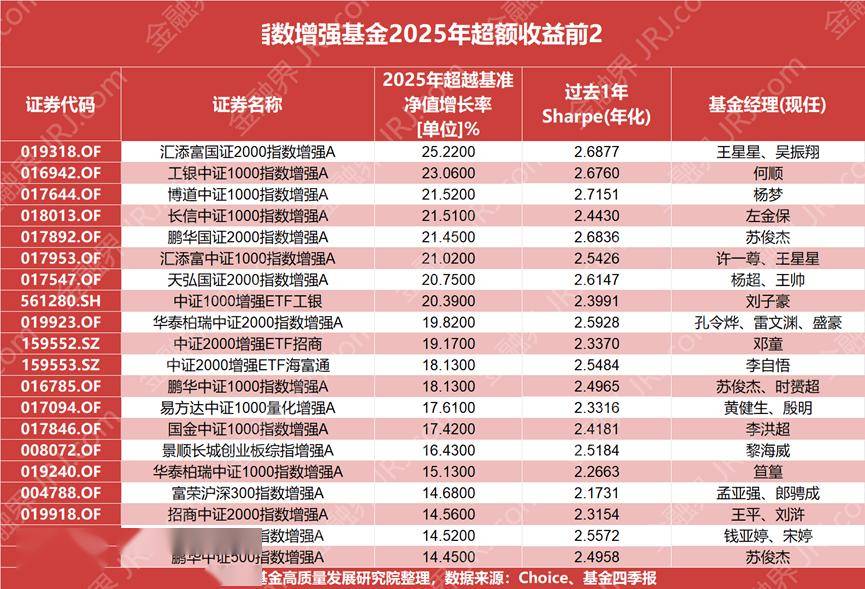
Core Insights - An emerging investment tool, index-enhanced funds, is gaining popularity among investors, with a significant increase in new products and total fundraising in 2025, surpassing previous years' totals [1] - Index-enhanced funds aim not only to track indices but also to outperform them by actively managing a portion of their assets through quantitative models and stock selection [1] Fund Performance - In 2025, the top-performing index-enhanced funds achieved substantial excess returns, particularly those tracking mid and small-cap indices like the Guozhen 2000 and Zhongzheng 1000, with the leading fund, Huaitianfu Guozhen 2000 Index Enhanced A, achieving a net value growth rate of 25.22% [2] - Other notable funds, such as the ICBC Zhongzheng 1000 Index Enhanced A and Baodao Zhongzheng 1000 Index Enhanced A, also reported excess returns exceeding 20% [2] Characteristics of Mid and Small-Cap Funds - Mid and small-cap index-enhanced funds are more successful in generating excess returns due to their index characteristics and the suitability of mainstream enhancement strategies [3] - The large number of constituent stocks in mid-cap indices, such as the Zhongzheng 2000, allows for a broad selection pool, facilitating the identification of potential stocks through quantitative models [3] - Information asymmetry and pricing inefficiencies in mid and small-cap stocks provide opportunities for quantitative strategies to discover mispriced assets and generate alpha returns [3] - The active trading and liquidity of small-cap stocks create a favorable environment for efficient trading execution and short-term price capture, enhancing overall returns [3]
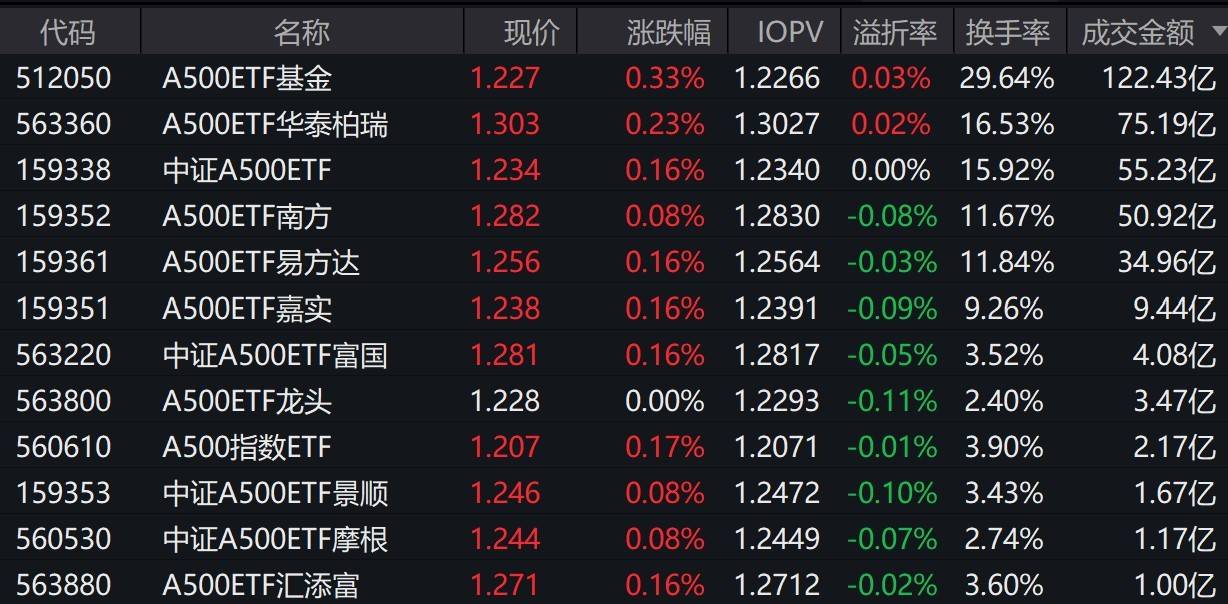
市场早盘探底回升,中证A500指数上涨0.22%,2只中证A500相关ETF成交额超75亿元
Sou Hu Cai Jing· 2026-02-06 03:54
Market Overview - The market showed a rebound in early trading, with all three major indices turning positive, and the CSI A500 index rising by 0.22% [1] - The chemical sector performed strongly, while humanoid robot concepts were active, and the non-ferrous metals sector saw a recovery [1] - Conversely, the consumer sector experienced a collective decline, with significant drops in the liquor and tourism hotel sectors [1] ETF Performance - Several ETFs tracking the CSI A500 index saw slight increases, with 12 ETFs having transaction volumes exceeding 100 million yuan, and 2 surpassing 7.5 billion yuan [1] - The A500 ETF Fund and A500 ETF Huatai-PineBridge had transaction volumes of 12.243 billion yuan and 7.519 billion yuan, respectively [1] Analyst Insights - Short-term support for the stock market is expected from policy, capital, and exchange rate factors, indicating that the second half of the spring market may primarily experience a fluctuating upward trend [1] - Analysts caution about potential phase adjustments and profit-taking risks [1]
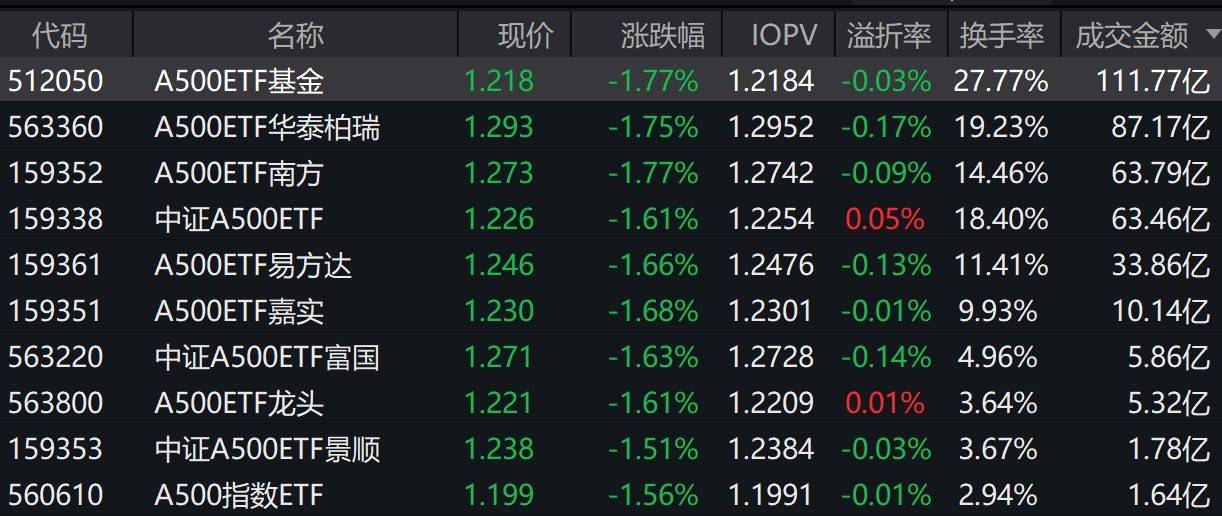
市场早盘震荡调整,中证A500指数下跌1.59%,2只中证A500相关ETF成交额超87亿元
Sou Hu Cai Jing· 2026-02-05 03:52
Core Viewpoint - The market experienced fluctuations in the morning session, with all three major indices falling over 1%, while the consumer sector saw significant gains, particularly in food and beverage, retail, and film industries [1] Group 1: Market Performance - The CSI A500 index dropped by 1.59% [1] - The consumer sector showed strong performance, with food and beverage, retail, and film sectors leading the gains [1] - The banking sector rose against the trend, while precious metals and computing hardware concepts saw collective declines [1] Group 2: ETF Trading Activity - The A500 index-tracking ETFs saw a decline of over 1%, with 10 ETFs exceeding a trading volume of 100 million yuan, and 2 surpassing 8.7 billion yuan [1] - Specific A500 ETFs had the following trading volumes: A500ETF Fund at 11.177 billion yuan and A500ETF Huatai-Pinebridge at 8.717 billion yuan [1] Group 3: Market Outlook - Analysts suggest that with the Spring Festival holiday approaching, the market is unlikely to establish a new sustained mainline in the short term, indicating that sector rotation will remain a key characteristic [1] - Overall, the A-share market is currently in a phase of repair and fluctuation [1]
机构资金动向解构:投资者应如何理解本轮机构减持?
Morningstar晨星· 2026-02-05 01:04
Group 1 - The core viewpoint of the article highlights the significant growth of stock ETFs over the past two years, with a total share increase of 62.24% from 13,707 billion shares at the end of 2023 to 22,238 billion shares by the end of 2025, followed by a decline of 5.64% in January 2026 [2][4][5] - The decline in shares is particularly pronounced in major broad-based ETFs, such as Huatai-PB CSI 300 ETF, which dropped from 888 billion shares to 493 billion shares, and E Fund CSI 300 ETF, which fell from 659 billion shares to 330 billion shares during the same period [5][6] - The increase in institutional investor participation in these ETFs is noted, with a significant rise in their shareholding proportions by the end of Q4 2025, indicating a potential signal of institutional funds withdrawing from broad-based ETFs in January 2026 [6][8] Group 2 - Investors are advised to consider market trends and policy directions in light of institutional fund adjustments, particularly in the context of recent regulatory changes aimed at stabilizing the capital market and fostering a slow bull market [8][10] - The article emphasizes the importance of focusing on the long-term fundamentals of underlying assets for sustainable investment returns, suggesting that investors should assess the professional capabilities of fund research teams and the stability of investment strategies [10][12] - Broad-based index funds like CSI 300 ETF and SSE 50 ETF are favored by institutional investors due to their transparency, lower fee structures compared to actively managed funds, and inherent diversification benefits that reduce non-systematic investment risks [12]

公募今年已分红逾330亿元 权益类基金占比近八成
Shang Hai Zheng Quan Bao· 2026-02-04 18:12
◎记者 朱妍 春节未至,公募基金的"红包"率先到来。数据显示,2026年以来,公募基金分红金额同比大幅提升,权 益类基金分红占比近八成。在政策、业绩、行业转型和资金需求共同作用下,公募分红力度加大已成为 行业高质量发展下的一大趋势。 Choice数据显示,2026年以来,截至2月4日,610只公募基金分红630次(不同份额分开计算),分红总 额达到334.64亿元,同比增长37.38%。 权益类基金是年内分红的"主力军",分红总额已达263亿元,占所有基金分红金额的近八成。其中:股 票型基金的分红额为194.38亿元,在各类产品中遥遥领先;混合型基金分红额达到68.65亿元。同时,在 分红次数方面,今年以来,共有14只基金分红2次及以上,这些产品均为权益类基金。 从单只基金分红额来看,最"大方"的5只产品均为ETF。沪深300ETF华泰柏瑞以98亿元的分红额暂居首 位,沪深300ETF易方达分红额为近45亿元。 排排网旗下融智投资FOF基金经理李春瑜认为,行业正从规模扩张转向"投资者利益优先",分红已经成 为提升持有体验的关键,被动型产品的发展提升了分红力度。此外,宽基ETF等产品的规模扩大、分红 机制成熟, ...
泽润新能(301636) - 301636泽润新能投资者关系管理信息20260204
2026-02-04 12:36
江苏泽润新能科技股份有限公司 投资者关系活动记录表 编号:2026-001 投资者关系活动 类别 ☑特定对象调研 □分析师会议 □媒体采访 □业绩说明会 □新闻发布会 □路演活动 □现场参观 □其他 (请文字说明其他活动内容) 参与单位名称及 人员姓名 浙商证券 陈明雨 华泰资管 王笑 平安资管 马继愈 银华基金 范文韬 博时基金 叶丽、田俊维 德邦基金 申屠旺 万家基金 王立晟 永赢基金 普淞锐 博道基金 郭晓萱 摩根基金 许凡 申万菱信 王瀚 华泰柏瑞 刘腾飞 格传基金 杨扬 柏乔资产 马波 时间 2026年2月3日、4日 地点 公司会议室、线上电话会议、机构反路演等 上市公司接待人 员姓名 董事、董事会秘书、财务总监 王亮先生 投资者关系活动主 要内容介绍 1.2025年业绩预告情况? 2025年公司预计实现归属于上市公司净利润为4000-5500万元 ,同比下降58.12%-69.54%。 2025年,公司营业收入总体保持稳定。然而,受全球光伏行业 周期性调整影响,阶段性供需错配导致公司光伏产品市场竞争加剧 ,尽管行业启动反内卷举措,但供需失衡的局面尚未根本改善,公 司内销毛利率持续下滑。与此同时,由 ...
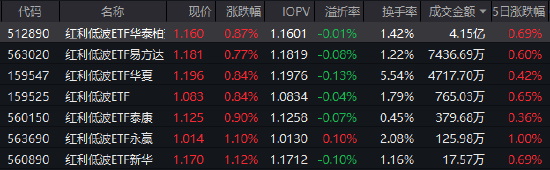
红利低波ETF华泰柏瑞(512890)成交额4.15亿元领跑同类 机构:关注高股息策略
Xin Lang Cai Jing· 2026-02-04 04:24
Core Viewpoint - The market experienced a downturn on February 4, with the Shanghai Composite Index turning negative and the ChiNext Index dropping over 2%. Despite this, the Huatai-PineBridge Low Volatility ETF (512890) rose by 0.87%, reaching a price of 1.160 yuan, with a turnover rate of 1.42% and a transaction volume of 415 million yuan, leading among similar ETFs [1][7]. ETF Performance - The Huatai-PineBridge Low Volatility ETF (512890) reported a price of 1.160 yuan, reflecting a 0.87% increase, with an indicative net asset value (IOPV) of 1.1601 yuan and a slight discount of -0.01% [2][8]. - The ETF's trading volume was 415 million yuan, with a 5-day price change of 0.69% [2][8]. Top Holdings - The top ten holdings of the Huatai-PineBridge Low Volatility ETF showed mostly positive performance during the morning session, with notable increases in Shanghai Bank (up 1.08%), Nanjing Bank (up 2.08%), and Ping An Bank (up 0.65%). However, COFCO Sugar fell by 1.61% [3][9]. Fund Inflows - The Huatai-PineBridge Low Volatility ETF has seen significant net inflows, with 670 million yuan over the last 5 trading days, 2.94 billion yuan over the last 20 days, and 4.68 billion yuan over the last 60 days. As of February 3, 2026, the ETF's latest circulation scale was 29.011 billion yuan [3][9]. Market Analysis - According to China International Capital Corporation (CICC), the A-share market is expected to experience short-term consolidation, but medium-term support factors remain unchanged, indicating a slow bull market. They recommend focusing on four key areas: the AI industry chain and commercial aerospace, supply-demand supported non-ferrous metals, cyclical sectors like chemicals and home appliances, and high-dividend strategies based on quality cash flow [5][11]. - Pacific Securities emphasized the attractiveness of bank sector valuations, highlighting significant dividend yield advantages and strong demand for high-dividend asset allocation. They noted that state-owned banks and quality regional banks have advantages in capital, dividends, and regional economic resilience, supporting low-volatility dividend strategies [6][11].