理想汽车

Search documents
耐世特(1316.HK):綫控转向量产将至
Ge Long Hui· 2026-02-14 13:25
Core Viewpoint - 2026 is projected to be the year of mass production for steer-by-wire (SBW) technology, aligning with the trend of autonomous driving, leading to an industry upgrade. The target price is set at HKD 10.2 based on an 18x PE valuation for 2026, with a buy rating [1]. Group 1: Industry Trends - The steering system in automobiles is transitioning from electric power steering (EPS) to steer-by-wire (SBW), with average selling prices (ASP) increasing from C-EPS at 1,000 yuan to R-EPS at 2,000 yuan, and further to SBW at 4,000 yuan [1]. - Currently, EPS remains the mainstream technology in the industry, with a domestic penetration rate reaching 99% [1]. Group 2: Company Developments - The company has seen a growing number of clients and orders for its steer-by-wire technology, being the exclusive supplier for Tesla's robotaxi and the supplier for the Li Auto L9 Livis, both set for mass production in the first half of the year [1]. - Tesla's Cybercab is a key vehicle for achieving Level 4 autonomous driving, aiming to eliminate human intervention through a combination of pure vision FSD solutions and steer-by-wire chassis [1]. Group 3: Regulatory Environment - The legal status of steer-by-wire technology has been clarified with the release of the national certification standard "Basic Requirements for Automotive Steering Systems," effective from July 1, 2026. This standard emphasizes safety requirements and introduces functional safety terminology and verification methods [3]. - The new regulations remove the mandatory mechanical connection between the steering wheel and the steering system, establishing the legal status of SBW and setting strict safety redundancy and failure response standards [3].
【公司点评/拓普集团】2025年经营业绩预告点评:2025年收入同比增长,“机器人+车+液冷”协同发展未来可期
东吴汽车黄细里团队· 2026-02-14 12:36
Core Viewpoint - The company forecasts a revenue of 28.75 to 30.35 billion yuan for 2025, reflecting a year-on-year growth of 8.08% to 14.10%, while net profit is expected to decline by 3.35% to 13.35% [3]. Revenue Forecast - For Q4 2025, the company anticipates revenue between 7.822 to 9.422 billion yuan, representing a year-on-year growth of 7.91% to 29.99% [4]. - The revenue forecast is supported by the Tier 0.5 collaboration model and a diverse product lineup [5]. Profit Analysis - The company expects a decline in net profit for 2025 due to rising raw material costs and depreciation of overseas production capacity, leading to a lower-than-expected profit growth [5]. - The projected net profit for 2025 is between 2.6 to 2.9 billion yuan, with a decrease in the non-recurring net profit forecast as well [3]. Customer Performance - Key customer performance in Q4 includes: - U.S. Customer A: 418,200 units sold, down 15.61% year-on-year and 15.87% quarter-on-quarter - Geely: 854,400 units sold, up 24.39% year-on-year and 12.27% quarter-on-quarter - BYD: 1,342,300 units sold, down 11.94% year-on-year but up 20.47% quarter-on-quarter - Seres New Energy: 154,200 units sold, up 59.85% year-on-year and 24.39% quarter-on-quarter - Li Auto: 109,200 units sold, down 31.19% year-on-year but up 17.15% quarter-on-quarter [6]. International Expansion - The company plans to issue H-shares and list on the Hong Kong Stock Exchange to accelerate its international strategy and enhance overseas production capacity [7]. Order Acquisition - In H1 2025, the company secured initial orders worth 1.5 billion yuan for its thermal management business, including sectors like liquid cooling and energy storage [8]. Profit Forecast and Investment Rating - The company maintains a net profit forecast of 2.813 billion yuan for 2025, with adjustments to the 2026-2027 profit expectations due to raw material price impacts [9]. - The current market valuation corresponds to a PE ratio of 44/37/29 for 2025-2027, and the company is rated as a "buy" due to ongoing growth potential from thermal management orders and new product developments [9].



【月度排名】2026年1月厂商销量排名快报
乘联分会· 2026-02-14 08:39
Core Viewpoint - The domestic narrow passenger car market in China experienced a retail sales decline of 13.9% year-on-year in January 2026, with sales reaching 1.544 million units, attributed to the end of the 12-year new energy vehicle purchase tax exemption policy, leading to a temporary dip in demand [2][4]. Sales Data Summary Wholesale Sales Rankings (January 2026) - Geely Automobile led with 270,167 units sold, a 1.3% increase, capturing 13.7% market share - BYD Automobile followed with 205,518 units, down 30.7%, holding 10.4% market share - Chery Automobile sold 193,969 units, down 12.0%, with a 9.8% market share - Volkswagen sold 128,001 units, down 1.7%, with a 6.5% market share - SAIC Passenger Vehicle sales increased by 53.6% to 77,421 units, capturing 3.9% market share [6]. Retail Sales Rankings (January 2026) - Geely Automobile again led with 209,661 units sold, down 12.6%, holding 13.6% market share - Volkswagen sold 132,300 units, down 3.5%, with an 8.6% market share - BYD's retail sales dropped significantly by 53.0% to 94,176 units, capturing 6.1% market share - SAIC Volkswagen sold 89,600 units, down 9.3%, with a 5.8% market share - Changan Automobile's sales decreased by 33.5% to 81,074 units, holding 5.2% market share [7]. New Energy Vehicle (NEV) Wholesale Sales Rankings (January 2026) - BYD led NEV sales with 205,518 units, down 30.7%, capturing 23.8% market share - Geely followed with 124,252 units, up 2.6%, holding 14.4% market share - Tesla China sold 69,129 units, up 9.3%, with an 8.0% market share - Chery sold 46,802 units, down 14.9%, with a 5.4% market share - SAIC Passenger Vehicle saw a significant increase of 576.9% to 28,179 units, capturing 3.3% market share [9]. New Energy Vehicle (NEV) Retail Sales Rankings (January 2026) - BYD again led with 94,176 units sold, down 53.0%, holding 15.8% market share - Geely sold 92,135 units, down 21.6%, with a 15.5% market share - Hongmeng Zhixing saw a significant increase of 65.5% to 57,915 units, capturing 9.7% market share - SAIC's sales increased by 83.3% to 40,016 units, holding 6.7% market share - Xiaomi Automobile sold 39,002 units, up 70.3%, with a 6.5% market share [10].





奔驰2025年全球营收同比下滑9%,高端车型销量平稳,中国市场承压
Hua Xia Shi Bao· 2026-02-14 07:56
市场普遍估算,贸易政策相关成本对奔驰利润的影响已达到10亿欧元。与此同时,外汇汇率波动、核心 原材料价格持续上行,再加上供应链各环节的整体成本抬升,正持续压缩企业利润空间,进一步拉低了 集团整体盈利指标。 2月12日,梅赛德斯-奔驰集团正式发布2025财年业绩报告。在全球豪华车市场格局洗牌、中国本土高端 新能源品牌崛起、电动化智能化转型加速等多重背景下,这家百年豪华车企正面临利润下滑、销量承压 的现实,同时仍在努力维持资金和高端市场的基本盘。 财报显示,2025年奔驰集团全年营业额为1322亿欧元,同比下滑9.2%;调整后息税前利润为82亿欧 元,较2024年大幅缩水40%,利润蒸发近一半;工业业务自由现金流54亿欧元,即使自由现金流保持正 向,但也远低于上一年的近92亿欧元。 主流市场疲软,高端车型稳健 事实上,奔驰的营收销量双下行并非偶然,而是多重因素叠加的综合结果,首当其冲的是当前全球贸易 摩擦与关税壁垒带来的直接冲击。 从业务板块来看,奔驰各细分业务表现不一。作为集团的主要营收与利润来源,乘用车业务2025年调整 后息税前利润约48亿欧元,较2024年明显下滑;调整后销售利润率也从8.1%降至约5.0 ...
2025巨亏超230亿!美团发布盈利预警,一季度将延续亏损!网友:真是实打实的百亿补贴!
Xin Lang Cai Jing· 2026-02-14 07:30
Group 1 - Meituan expects a net loss of approximately RMB 233 billion to RMB 243 billion for the fiscal year ending December 31, 2025, a stark contrast to a net profit of RMB 358.08 billion in 2024, indicating a significant reversal of nearly RMB 600 billion [9][11][24] - The primary reason for this drastic change is the expected operating loss of RMB 68 billion to RMB 70 billion in its core local business segment, which had an operating profit of approximately RMB 524.15 billion in 2024 [11][26][28] - The company attributes this loss to intensified competition in the industry and a strategic increase in ecosystem investments, which include enhanced marketing efforts, rider incentives, and resource allocation to improve operational efficiency [13][26][28] Group 2 - Meituan's stock price has dropped 22.5% since its peak in January, closing at HKD 82.5 on February 13, with its market capitalization briefly falling below HKD 500 billion [7][22] - The company anticipates that the trend of losses will continue into the first quarter of 2026, although it maintains that its operational status remains stable and it has sufficient cash to support business development [13][28] - The Hang Seng Technology Index, which includes Meituan and other internet companies, has seen a decline of 6.26% since February, reflecting broader market challenges [28][29]

追觅创始人俞浩为何如此“凡尔赛”?
Xin Lang Cai Jing· 2026-02-14 06:57
炒股就看金麒麟分析师研报,权威,专业,及时,全面,助您挖掘潜力主题机会! 来源:首席商业评论 最近追觅创始人俞浩火了。 近半年,俞浩在公开场合和内部讲话中多次释放高调甚至带有"马斯克式"风格的言论,主要集中在三 类: 1. 他提出:"追觅生态有望成为人类历史上首个估值达百万亿美元的企业生态。",并称公司要构 建:"人-车-家-太空-宇宙"的全球高端科技生态。 2. 在公司年会上,他曾表示:几年后自己可能成为全球首富,并祝愿追觅成为人类历史上最伟大的企 业。 3. 在汽车业务内部讲话中,他明确表示要"完全PK理想汽车",并称产品尺寸要全面大于理想L9、问 界M9等车型。 图源:微博 而且,在2月4日晚的追觅年会上,俞浩面对撒贝宁的北大保送,谈起了自己一路保送到清华的经历,并 调侃自己人生好像不够完整。他还与撒贝宁立下约定,等自己成为世界首富后,也能有机会说出那 句"我对钱没有兴趣"。这一路的凡尔赛,真的有点"脱口秀"的味道。 我想说,这晚会不请Papi酱真的可惜了,否则金句可以更多。 图源:微博 图源:微博 这可以说让商业圈炸了锅。余承东是谁?仅次于任正非的华为二号人物啊,至少公开场合。余承东对标 的都是谁?都 ...

拓普集团(601689):2025年收入同比增长,“机器人+车+液冷”协同发展未来可期
Soochow Securities· 2026-02-14 05:10
Investment Rating - The investment rating for the company is "Buy" (maintained) [1] Core Views - The company is expected to achieve revenue growth in 2025, driven by the synergistic development of "robotics + vehicles + liquid cooling" [1] - The revenue forecast for 2025 is projected to be between 287.50 billion to 303.50 billion yuan, representing a year-on-year growth of 8.08% to 14.10% [8] - The net profit attributable to the parent company is expected to decline by 3.35% to 13.35%, estimated at 26.00 billion to 29.00 billion yuan [8] - The company is planning to issue H shares and list on the Hong Kong Stock Exchange to accelerate its international strategy [8] Financial Performance Summary - Total revenue for 2023 is reported at 19,701 million yuan, with a projected increase to 29,939 million yuan in 2025, reflecting a year-on-year growth of 12.55% [1] - The net profit attributable to the parent company is forecasted to be 2,813 million yuan in 2025, a decrease of 6.25% compared to the previous year [1] - The earnings per share (EPS) is expected to be 1.62 yuan in 2025, with a price-to-earnings (P/E) ratio of 44.48 [1] Market Data - The closing price of the company's stock is 72.01 yuan, with a market capitalization of approximately 125,141.54 million yuan [6] - The company has a price-to-book (P/B) ratio of 5.38 [6] Operational Insights - The company has secured a 15 billion yuan order in its thermal management business, indicating strong demand in international markets [8] - The company’s revenue growth is supported by its Tier 0.5 collaboration model and a diverse product portfolio [8]
2025巨亏超230亿!美团发布盈利预警,一季度将延续亏损!网友:真是实打实的百亿补贴!
雪球· 2026-02-14 04:58
Market Overview - The three major U.S. stock indices closed mixed, with the Dow Jones up 0.1%, the Nasdaq down 0.22%, and the S&P 500 up 0.05%. The Russell 2000 small-cap index rose approximately 1.2%. All three indices recorded declines over the past week, with the Nasdaq showing the largest drop, indicating cautious market sentiment [1]. - Most popular tech stocks declined, with Nvidia and Apple dropping over 2%, and Google, Meta, and Broadcom falling over 1%. Investor concerns about the potential impact of artificial intelligence on traditional industries have heightened risk-averse sentiment [3]. Economic Indicators - The U.S. January CPI year-on-year decreased from 2.7% to 2.4%, the lowest since May 2025, while the core CPI fell from 2.6% to 2.5%, the lowest since March 2021. The core CPI rose 0.3% month-on-month, slightly above December's 0.2% increase [9][10]. - Following the CPI report, traders increased their expectations for interest rate cuts this year, with a 50% chance of three cuts by year-end. The probability of a cut in April is 30%, and over 80% for June [10]. Company-Specific News - Meituan issued a profit warning, expecting a net loss of approximately RMB 233 billion to RMB 243 billion for the fiscal year 2025, a stark contrast to a net profit of RMB 358.08 billion in 2024. This represents a significant reversal of nearly RMB 600 billion [16][18]. - The core reason for Meituan's drastic performance change is the profit collapse in its most profitable segment, "core local business," which is expected to incur an operating loss of RMB 68 billion to RMB 70 billion in 2025, compared to an operating profit of RMB 524.15 billion in 2024. This is attributed to unprecedented competition in the industry and strategic increases in ecosystem investments [18][20]. - Meituan plans to increase investments in marketing, rider incentives, and operational efficiency to counteract the losses, while also expanding its overseas business [20]. Market Sentiment and Trends - The Hang Seng Tech Index has shown weakness, declining 6.26% since February, influenced by liquidity shocks. Analysts suggest that the fundamentals and bullish logic for the Hong Kong tech sector remain unchanged [21]. - The performance of the Hang Seng Tech Index in February may be driven by macroeconomic data, policy pricing, and earnings verification, with U.S. inflation and employment data being key factors affecting valuation elasticity in Hong Kong tech stocks [21].

中概股全线走低、美股全线大跌,有色金属、半导体芯片、苹果重挫
Sou Hu Cai Jing· 2026-02-14 04:30
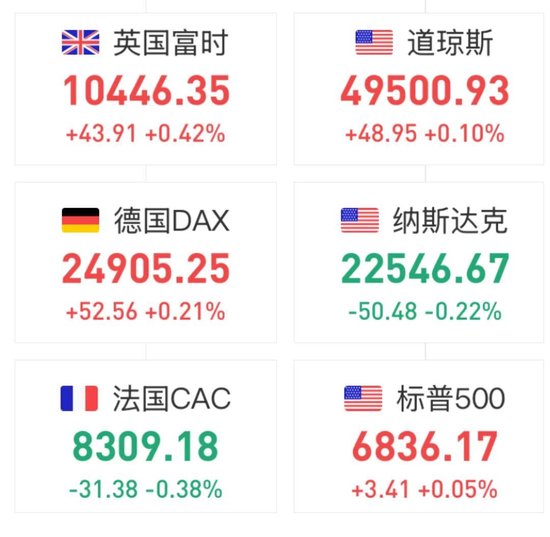
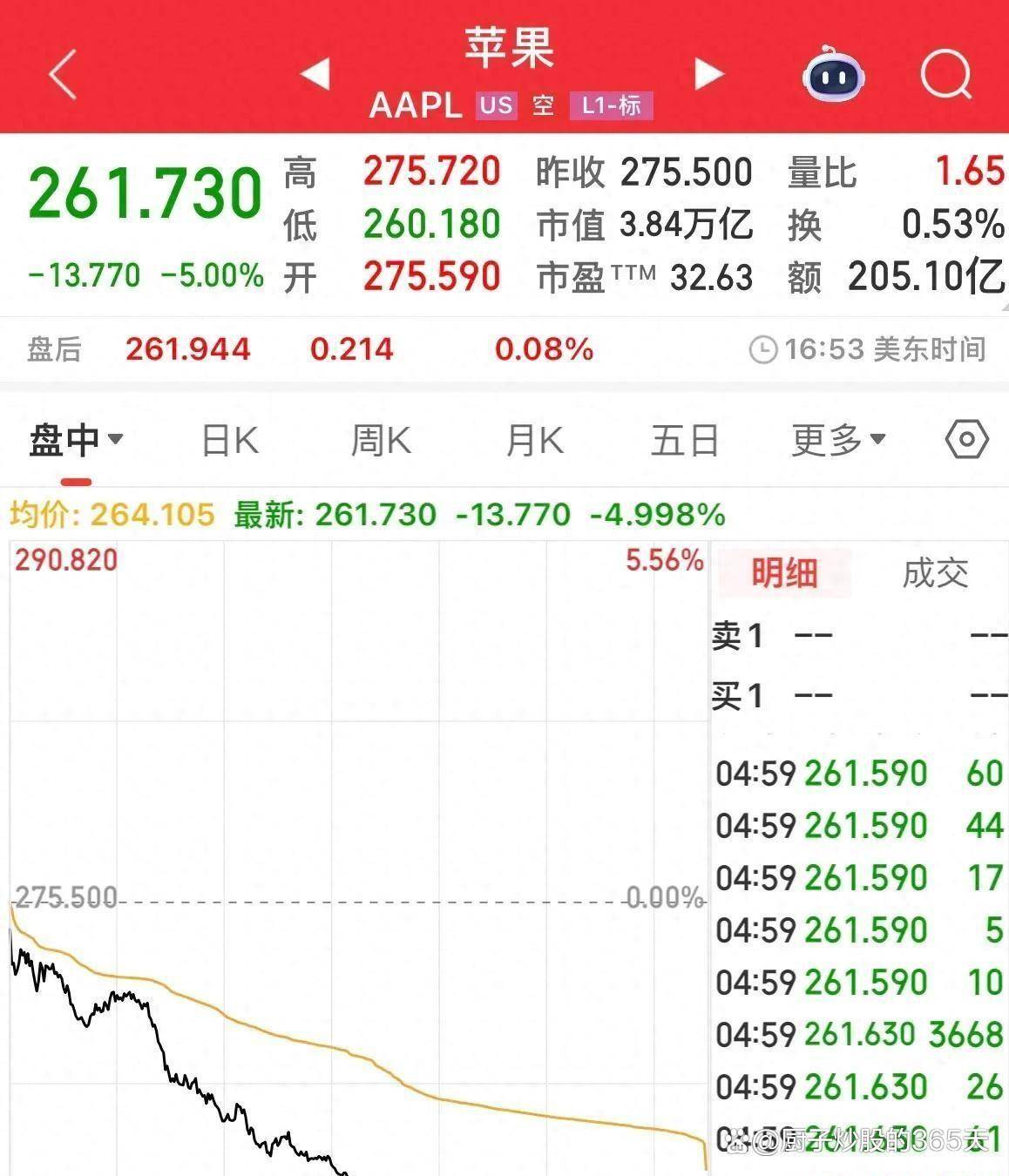
Market Overview - The US stock market experienced a significant decline, with the Dow Jones Industrial Average dropping 669.42 points (1.34%) to close at 49,451.98 points, the Nasdaq Composite falling 469.32 points (2.03%) to 22,597.15 points, and the S&P 500 decreasing by 108.71 points (1.57%) to 6,832.76 points [1][2][3] Market Sentiment - Over 4,100 stocks declined, indicating widespread market panic as investors rushed to sell assets, particularly in the tech and growth sectors. The VIX index surged, reflecting heightened risk aversion [2][3] Sector Performance - The sell-off affected nearly all sectors, with notable declines in precious metals and semiconductor stocks. The precious metals sector saw significant drops, with gold futures down 3.08% and silver futures plummeting 10.62% [4][5][6][8] - The Philadelphia Semiconductor Index fell by 2.5%, with individual stocks like AEHR Test Systems down 17.58% and Intel down over 3% [8][10] Major Companies - Apple Inc. experienced a substantial drop of 5.00%, resulting in a market cap loss of over $120 billion, attributed partly to regulatory concerns [12] - Other major tech companies also faced declines, with Tesla down 1.62%, Amazon down 2.20%, and Meta Platforms down nearly 3% [12] Financial Sector - Bank stocks fell across the board, with JPMorgan Chase down over 2%, Goldman Sachs down over 4%, and Citigroup down over 5%, driven by concerns over AI disrupting traditional wealth management [13][14] Economic Indicators - Recent economic data, including a drop in initial jobless claims and lower-than-expected existing home sales, contributed to market anxiety about potential economic overheating and prolonged high interest rates [24][25][26] Global Market Impact - The sell-off in the US markets had a ripple effect on global markets, with European indices also closing lower after initially opening higher, indicating a widespread sentiment of fear [18][19][20] AI Concerns - The market's decline was exacerbated by fears regarding the disruptive impact of AI technologies on various industries, leading to significant stock price drops in sectors perceived to be at risk [21][22][30] Storage Chip Sector - In contrast to the overall market trend, storage chip stocks saw gains, with companies like SanDisk and Seagate Technology rising significantly, reflecting a belief that AI's growth will increase demand for data storage [29]


晚间暴雷!黄金、白银、原油、美股全线崩盘,42只中概集体下跌
Sou Hu Cai Jing· 2026-02-14 04:22
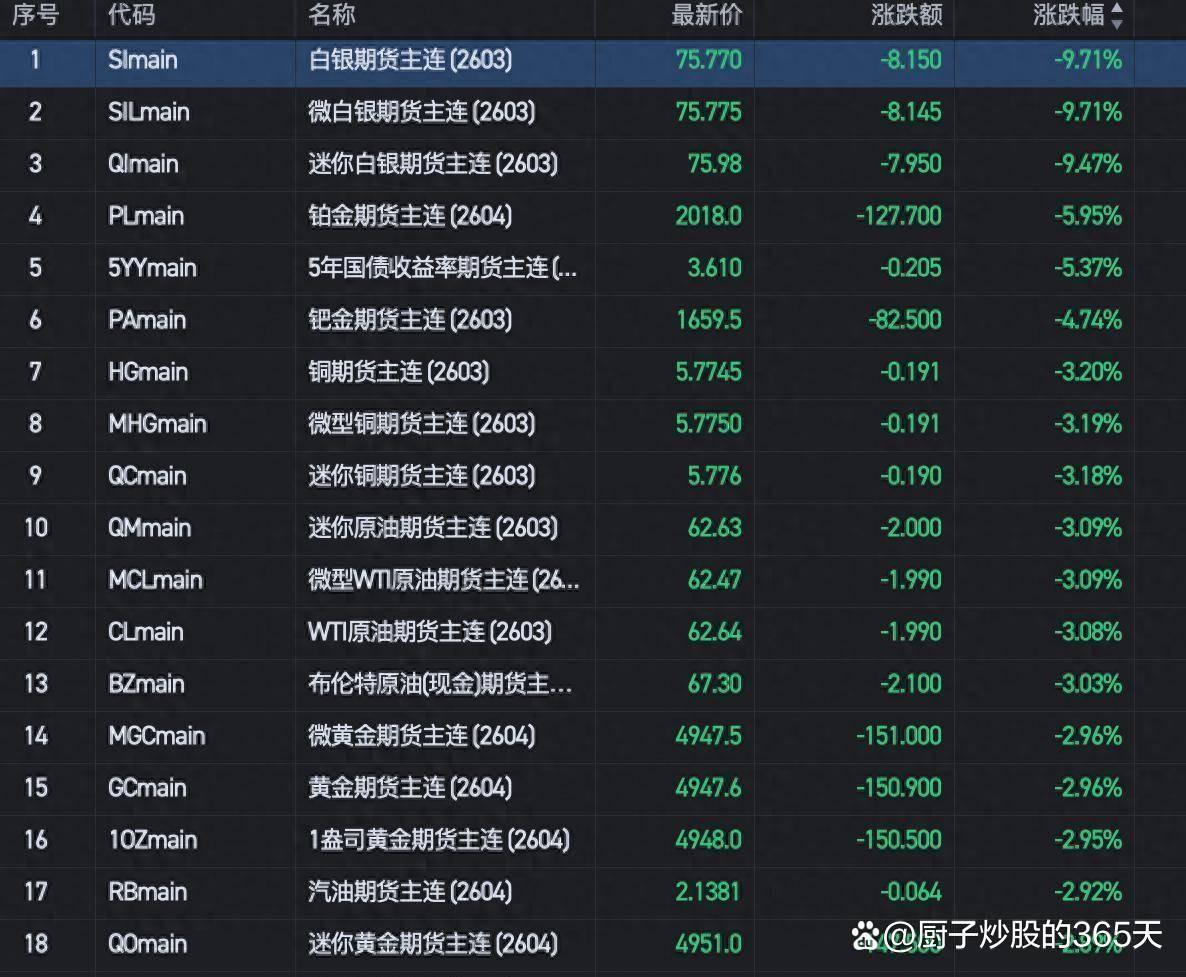
Market Overview - On February 13, 2026, a significant asset sell-off occurred in global financial markets, particularly impacting U.S. stock indices. The Dow Jones Industrial Average fell by 669.42 points (1.34%) to close at 49,451.98, while the Nasdaq Composite Index dropped 469.32 points (2.03%) to 22,597.15. The S&P 500 Index also declined by 108.71 points (1.57%) to 6,832.76 [1]. Commodity Market Impact - The sell-off extended to the commodity markets, with gold and silver experiencing substantial declines. COMEX gold futures fell by 3.08% to $4,941.4 per ounce, while COMEX silver futures plummeted by 10.62% to $75.01 per ounce [2][3]. Technology Sector Reaction - Major technology companies were severely affected, with Apple’s stock price dropping by 5%, resulting in a market value loss of over $120 billion (approximately 800 billion RMB). Other tech giants like Microsoft, Amazon, Tesla, Meta, and Nvidia also saw significant declines [3][4]. Chinese Concept Stocks - The Nasdaq Golden Dragon China Index, which includes many Chinese concept stocks, fell by 3% on the same day, indicating a collective sell-off in this sector. Over 40 Chinese concept stocks experienced substantial declines, with Tencent Music down 10.57% and Alibaba down 3.40% [3][4][6]. Employment Data Influence - The catalyst for this market turmoil was a strong U.S. employment report released on February 11, showing a non-farm payroll increase of 130,000 in January, significantly above the expected 70,000. This led to a shift in market expectations regarding Federal Reserve interest rate cuts, with the probability of a March rate cut dropping from 19.6% to 6% [5][6]. Capital Expenditure Concerns - Major tech companies announced aggressive capital expenditure plans for 2026, with Alphabet projecting $175 billion to $185 billion and Amazon estimating $200 billion, both nearly doubling their 2025 expenditures. This raised investor concerns about the return on such investments, especially as many companies reported record profits but saw stock price declines [10][11]. Market Sentiment and Volatility - The market's fear and volatility increased sharply, with the VIX index rising significantly. The sell-off was exacerbated by algorithm-driven trading, which triggered stop-loss orders and led to extreme price movements [15][16][17]. Global Market Impact - The financial turmoil that began in Wall Street quickly spread to global markets, with Asian and European stock markets opening lower in response to the U.S. declines [18].