
优衣库

Search documents
孤独经济,将成为未来5年最大的风口
创业家· 2025-05-05 07:32
Core Viewpoint - Loneliness is predicted to become the biggest economic trend in China over the next five years, with a growing focus on products and services that cater to this need [3][4]. Group 1: Economic Trends - The concept of the "Fourth Consumption Era" is introduced, characterized by the rise of the single economy, which includes trends like solo dining, solo travel, and pet economy [6][7]. - The shift in consumer mindset from valuing luxury and fashion to seeking inner satisfaction and emotional fulfillment is highlighted, with an emphasis on local traditions and interpersonal connections [9][11]. - The emergence of the "Lonely Economy" is anticipated, as single rates increase and demographic changes such as population decline and aging become more pronounced in China [12]. Group 2: Market Opportunities - The article suggests that there are significant opportunities for new lifestyles and business models in China, inspired by existing Japanese consumption patterns [12][13]. - A learning trip to Japan is proposed, focusing on how Japanese companies have thrived in a low-growth environment, with visits to successful brands like Uniqlo and 7-Eleven [13][14].


上海、深圳出现了4大奇怪现象,开始逐步蔓延,值得大家深思
Sou Hu Cai Jing· 2025-05-02 17:15
Core Insights - The article highlights the stark contrasts in living conditions and consumer behavior in major Chinese cities like Shanghai and Shenzhen, reflecting a broader societal shift and economic pressures [3][10][11] Group 1: Housing Market Dynamics - In Shanghai, high-income professionals are living in capsule apartments with rents as low as 800 yuan, while luxury properties are still being sold at high prices, indicating a growing divide in housing affordability [4][8] - Rental prices are projected to rise significantly, with Shanghai's average rent expected to increase by 12% by 2025, while the demand for smaller rental units has surged by 40% [4][6] - The disparity in housing transactions is evident, with luxury home sales increasing by 15% while affordable housing transactions have dropped by 22% [4][8] Group 2: Consumer Behavior Shifts - There is a notable decline in luxury goods sales, with a reported 8% drop in luxury sales in Shanghai, while fast-moving consumer goods under 100 yuan have seen a 25% increase in sales [5][6] - Young professionals are increasingly opting for budget-friendly options, with 62% of urban white-collar workers engaging in "consumption grading," prioritizing essential spending over luxury items [6][9] Group 3: Employment and Office Space Trends - The vacancy rate for office spaces in Shanghai and Shenzhen has reached record highs of 28.7% and 30.5% respectively, while demand for flexible workspaces is rising, with WeWork's occupancy rate at 92% [7][8] - The shift towards flexible employment is evident, with over 500,000 flexible workers in these cities, indicating a transformation in the job market and workspace preferences [7][10] Group 4: Population Movement and Urban Policy - Despite relaxed residency requirements, population growth in Shanghai and Shenzhen has slowed significantly, with net inflows at their lowest since 2019 [8][10] - Many young professionals are reconsidering their living situations, with a 45% increase in job seekers moving from Shenzhen to second-tier cities, driven by high living costs and better opportunities elsewhere [8][9]

伯希和递表、三巨头争霸:2700亿户外市场谁主沉浮?
3 6 Ke· 2025-05-02 02:10
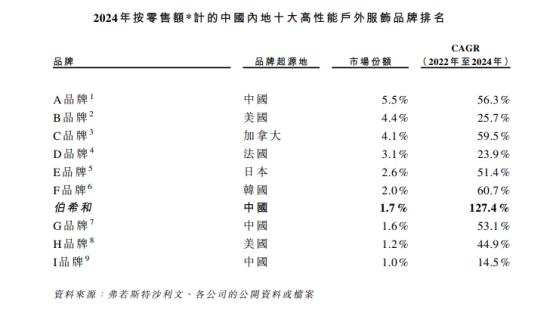
Core Insights - The Chinese outdoor market is undergoing significant changes, with major players like Ternua, Sanfu Outdoor, and Migo Dede releasing their 2024 financial reports, indicating a new competitive landscape [1] - The potential listing of Berghaus on the Hong Kong Stock Exchange could position it as the largest outdoor brand in China by revenue, highlighting the ongoing reshuffling in the 270 billion RMB outdoor goods market [1] Group 1: Financial Performance of Listed Companies - Ternua reported a revenue of 1.592 billion RMB for 2024, with its core outdoor business generating 1.369 billion RMB, marking an 8.91% year-on-year growth. The net profit reached 106.6 million RMB, a nearly 50% increase, attributed to the launch of mid-to-high-end product lines and effective marketing strategies [2][3] - Sanfu Outdoor achieved a revenue of 800 million RMB in 2024, a decline of 5.5%. However, in Q1 2025, it rebounded with a revenue of 190 million RMB, a 14.5% increase, and a net profit of 12.67 million RMB, indicating improved operational efficiency despite challenges [2][3] - Migo Dede's revenue for 2024 was 1.304 billion RMB, down 10.42%, with a net profit of 83.76 million RMB, a 21.57% decrease. The brand is focusing on its proprietary clothing line to tap into higher-margin markets [4] Group 2: Market Dynamics and Competitors - Berghaus has seen its revenue triple from 462 million RMB in 2021 to 1.733 billion RMB in 2023, making it the largest outdoor brand in China by revenue, despite ranking seventh in market share [5][6] - The outdoor market in China is projected to grow from 215 billion RMB in 2024 to 270 billion RMB by 2026, but lacks a dominant player comparable to Anta or Li Ning in the broader sports market [8] - The competition is intensifying as traditional sports brands like Nike and Adidas expand into the outdoor segment, while lifestyle brands like Lululemon and Uniqlo are targeting the "urban outdoor" demographic [8][10] Group 3: Future Outlook - The year 2025 is anticipated to be pivotal for the Chinese outdoor market, with increased IPO activity and a widening gap between brands. Success will likely depend on technological innovation and brand storytelling rather than just scale [11]


日本年轻人最爱逛的宝藏街区,不欢迎品牌连锁店
创业家· 2025-05-01 09:45
Core Viewpoint - The article discusses the concept of "involution" in consumer culture, highlighting how businesses often replicate each other, leading to a lack of uniqueness and excitement in shopping experiences [4][20]. Group 1: Examples of Involution - Many famous shopping streets in China look almost identical, offering the same local snacks and souvenirs, which detracts from the authentic local experience [2]. - Renowned shopping centers also exhibit a high degree of similarity, with luxury brands and common products dominating the landscape, making shopping feel monotonous [3][4]. Group 2: Causes of Involution - Involution occurs because businesses tend to engage in the same practices, leading to a homogenized market [5][20]. - The article references the work of Japanese sociologist Minoru Miura, who emphasizes the importance of unique offerings in combating this trend [5][20]. Group 3: Case Study of Shimokitazawa - Shimokitazawa, a vibrant Tokyo neighborhood, initially saw a decline in popularity due to the influx of chain stores, which made the area less distinctive [10][11]. - To regain its charm, the community began to reject chain stores and welcomed unique local shops, which successfully revitalized the area [12][15]. Group 4: Unique Business Strategies - The article highlights a Tommy flagship store in Tokyo that offers exclusive items not available in other locations, demonstrating the value of uniqueness in retail [16][17]. - It argues that in a world filled with sameness, distinctiveness is a rare and valuable resource [19]. Group 5: Learning from Japan - The article promotes a study trip to Japan, focusing on how the country has addressed low-growth challenges and the emergence of unique business models in a "low-desire society" [20][25]. - It suggests that understanding Japan's approach to consumer needs and societal changes can provide insights for future business strategies in China [20][25].
中澳羊毛贸易:全球产业链协作的大势所趋
Guan Cha Zhe Wang· 2025-04-29 07:45
Core Insights - The Australia-China wool trade exemplifies global industrial chain collaboration, with China accounting for 80% to 85% of Australia's wool exports [1][3] - The import quota for Australian wool to China is projected to increase from 33,100 tons in 2018 to 44,300 tons by 2024 [1] - The COVID-19 pandemic has shifted the dynamics of the wool market, with domestic demand in China rising significantly while exports have decreased [5][6] Industry Cooperation - Recent developments include a Chinese delegation visiting Australia to understand the wool industry, indicating a deepening of cooperation [3] - The Australian wool industry has established a strong partnership with China over the past 50 years, extending beyond industry to cultural exchanges [1][3] Market Dynamics - The Chinese wool market has seen a shift from a balanced export-import ratio to 30% exports and 70% domestic sales post-pandemic [5] - There is a growing demand for leisure and sports wool products in China, reflecting changing consumer preferences [5][7] Consumer Trends - The younger generation is becoming a significant consumer force, demanding diverse, stylish, and functional wool products [7][8] - E-commerce is playing a crucial role in increasing awareness and sales of Australian wool products in China [7] Sustainability and Innovation - Manufacturers are increasingly investing in sustainable practices, such as waterless dyeing and traceability, to meet consumer demand for eco-friendly products [8] - The potential for wool applications in healthcare and home textiles is expanding, driven by demographic changes and consumer awareness [8]

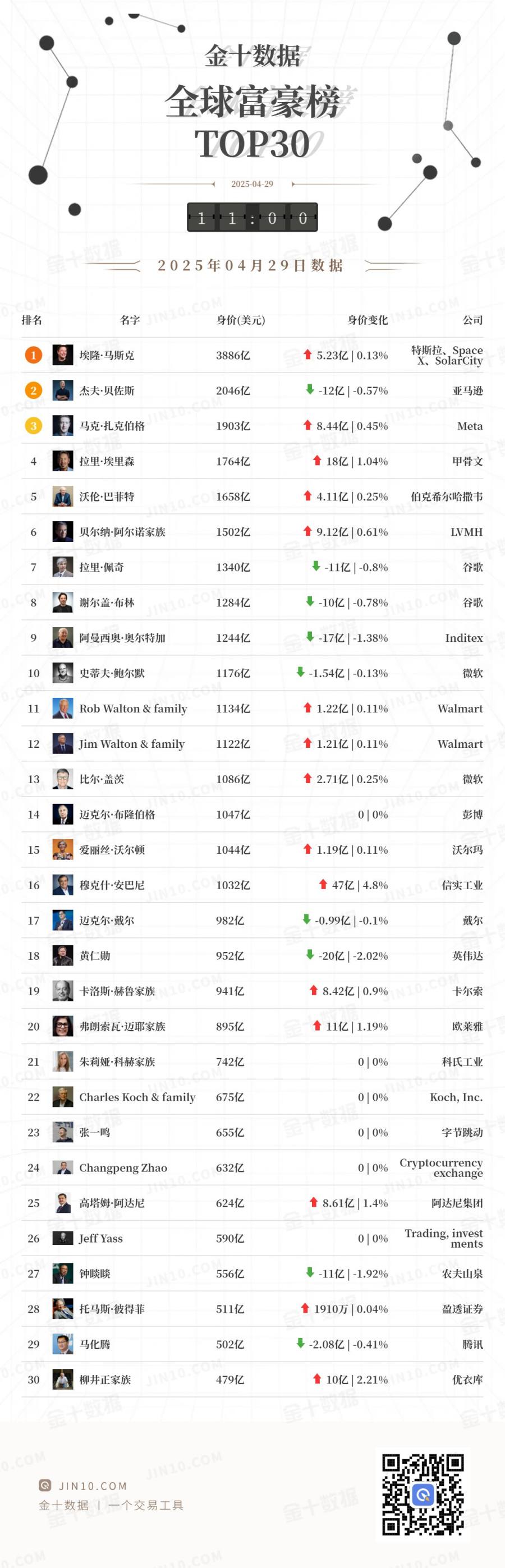
金十图示:2025年04月29日(周二)全球富豪榜
news flash· 2025-04-29 03:04
| 12 | Jim Walton & family | 1122亿 | 1 1.21亿 0.11% | Walmart | | --- | --- | --- | --- | --- | | 13 | 比尔·盖茨 | 1086亿 | 1 2.71亿 0.25% | 微软 | | 14 | 迈克尔·布隆伯格 | 1047亿 | 0 0% | 或博 | | 15 | 爱丽丝·沃尔顿 | 1044亿 | 1 1.19亿 0.11% | 沃尔玛 | | 16 | 穆克什·安巴尼 | 1032亿 | 1 47亿 4.8% | 信实工业 | | 17 | 迈克尔·戴尔 | 982亿 | + -0.99亿 -0.1% | 戴尔 | | 18 | 黄仁勋 | 952亿 | + -20亿 -2.02% | 英伟达 | | 19 | 卡洛斯·赫鲁家族 | 941亿 | 1 8.42亿 0.9% | 卡尔索 | | 20 | 弗朗索瓦·迈耶家族 | 895亿 | 11亿 1.19% | 欧莱雅 | | 21 | 朱莉娅·科赫家族 | 742亿 | 0 0% | 科氏工业 | | 22 | Charles Koch & famil ...
开润股份(300577):2024年箱包代工收入增长20% 服装代工并表嘉乐
Xin Lang Cai Jing· 2025-04-29 02:53
Core Insights - The company achieved a revenue growth of 37% in 2024, driven by the acquisition of Shanghai Jiale, which contributed both one-time gains and ongoing performance post-consolidation [1] - The main business segments include bag and apparel OEM and brand operations, with OEM accounting for 83% of total revenue in 2024 [1] - The company reported a total revenue of 4.24 billion yuan in 2024, a year-on-year increase of 36.6%, and a net profit attributable to shareholders of 0.381 billion yuan, up 229.5% year-on-year [1] Financial Performance - In 2024, the company recorded a revenue of 4.24 billion yuan, with a net profit of 0.381 billion yuan, benefiting from the consolidation of Shanghai Jiale, which contributed 0.848 billion yuan in revenue and 0.028 billion yuan in profit for the second half of the year [1] - A one-time gain of 0.096 billion yuan was recognized when control over Shanghai Jiale was obtained, measured at fair value [1] - The overall gross margin decreased by 1.5 percentage points to 22.9% due to the lower margin of Jiale and the impact of consolidation [1] Q4 2024 Performance - In Q4 2024, the company achieved a revenue of 1.215 billion yuan, representing a year-on-year growth of 47.9%, and a net profit of 0.060 billion yuan, marking a return to profitability [1] - The non-recurring net profit attributable to shareholders was 0.066 billion yuan, showing significant growth year-on-year [1] Q1 2025 Performance - In Q1 2025, the company continued its high growth trajectory with revenue of 1.234 billion yuan, up 35.6% year-on-year, and a net profit of 0.085 billion yuan, an increase of 20.1% [2] - The gross margin improved slightly by 0.5 percentage points to 24.7%, despite the drag from Jiale's consolidation [2] - The overall expense ratio increased by 1.9 percentage points, leading to a decline in net profit margin by 0.9 percentage points to 6.9% [2] Business Segments - The bag OEM segment generated revenue of 2.372 billion yuan in 2024, a growth of 20.3%, driven by recovery in downstream customer inventory demand and increased orders from key clients like Nike and Decathlon [2] - The apparel OEM segment saw a significant revenue increase of 146.43% to 1.162 billion yuan, primarily due to the consolidation of Shanghai Jiale [2] - The brand business reported revenue of 0.658 billion yuan, a growth of 5.1%, mainly supported by increased income from the Xiaomi brand [2]

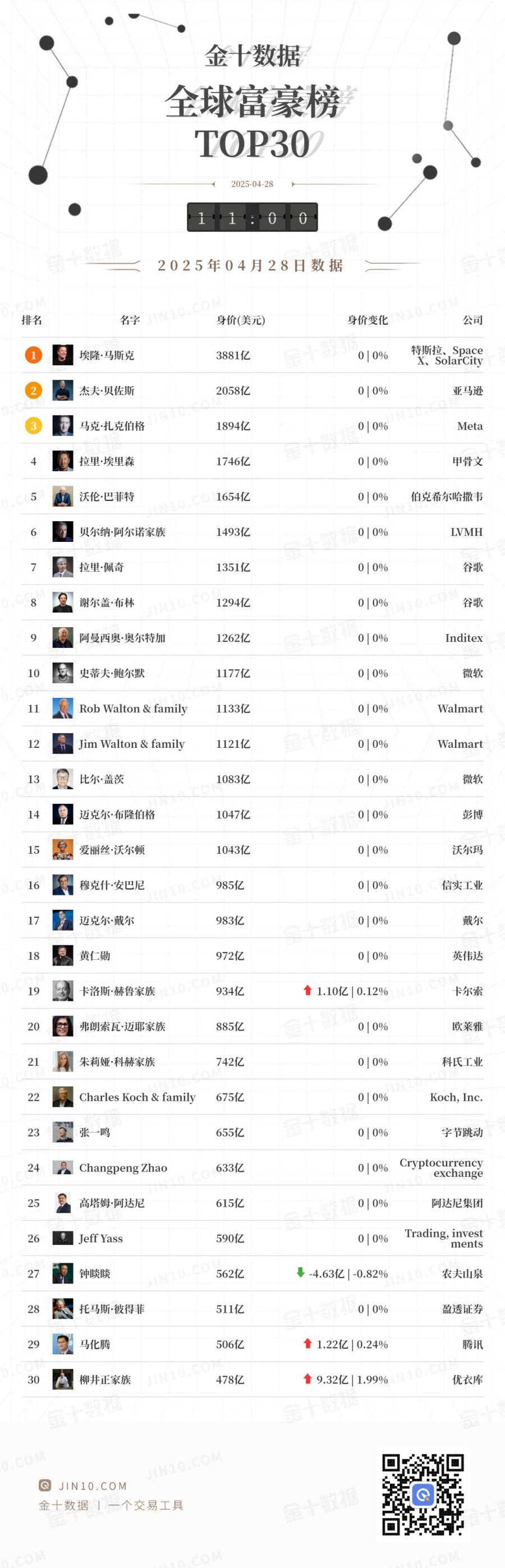
金十图示:2025年04月28日(周一)全球富豪榜





news flash· 2025-04-28 03:04
金十图示:2025年04月28日(周一)全球富豪榜 | 12 | Jim Walton & family | 1121亿 | 0 0% | Walmart | | --- | --- | --- | --- | --- | | 13 | 比尔·盖茨 | 1083亿 | 0 0% | 微软 | | 14 | 迈克尔·布隆伯格 | 1047亿 | 0 0% | 剪曲 | | 15 | 爱丽丝·沃尔顿 | 1043亿 | 0 0% | 沃尔玛 | | 16 | 穆克什·安巴尼 | 985亿 | 0 0% | 信实工业 | | 17 | 迈克尔·戴尔 | 983亿 | 0 0% | 戴尔 | | 18 | 黄仁勋 | 972亿 | 0 0% | 英伟达 | | 19 | 卡洛斯·赫鲁家族 | 934亿 | ↑ 1.10亿 0.12% | 卡尔索 | | 20 | 弗朗索瓦·迈耶家族 | 885亿 | 0 0% | 欧莱雅 | | 21 | 朱莉娅·科赫家族 | 742FL | 0 0% | 科氏工业 | | 22 | Charles Koch & family | 675亿 | 0 0% | Koch, Inc. | ...
面对老年人,更应该卖年轻化的商品 | “消费行业研究第一人”三浦展
创业家· 2025-04-27 10:18
未来10年,消费行业中哪一个赛道更具有发展潜力? 现代的消费者追求的不是"快感",而是"愉悦感"。第三消费社会之前的人类以"物"为焦点,而第四消费社会中人类以"人"为焦点。 对于人类来说,重要的不是消费了什么,而是和什么人一起做了什么。 虽然不知道哪个赛道比较好,但电商会进一步增加吧。婴儿潮世代会成为今后的老年人,需要面向这些人群,当然前提是,必须要尊重个人的 判断。 对于某一个品类会出现新商品,当前社会老龄化加剧,大家更加注重健康,对应的是市场的变化,更多的是在原有的基础上,基于个体情况的 多元化、个性化,改变了商品的使用方法。 比如,面向老年人不是说卖老年人的商品,而应该卖"年轻化"的商品。 如果没有多样化这个社会会饱和,而且如果不多样化,也不能制造出能够输出到海外的、有特色的产品。现在很遗憾地说,在全球人看来,特 别感受到中国魅力的产品还不多,所以我们可能更加需要好好地去思考什么是中国特色。 第三,随着生活越来越丰富、越来越好,大家会逐渐注重精神追求。 所谓精神上的追求更多是简约,刚才说到中国特色,是不是中国的特色和审美与简约是相悖的呢? 未来10年,人们已经不再是单纯购买物质的消费者,开始追求人与人之 ...
日本消费行业3月跟踪报告:必选提价激发囤货,可选趋缓龙头突围
Haitong Securities International· 2025-04-27 05:40
Investment Rating - The report suggests a focus on Japanese consumer companies with optimistic profit growth prospects, including Asics, Pan Pacific International Holdings, Fast Retailing, and Asahi Group [6]. Core Insights - The Japanese consumer confidence index fell for the fourth consecutive month to 34.1 in March, the lowest since March 2023, indicating a decline in consumer sentiment amid rising inflation [2][8]. - Essential consumer goods saw a surge in stockpiling due to anticipated price hikes in April, leading to a significant increase in sales, particularly in beer, which saw a year-on-year increase of over 30% [3][14]. - Discretionary consumption faced a slowdown, with mixed performance among companies; brands like Salia, Uniqlo, and Muji managed to attract consumers despite the overall decline in demand [3][5]. Macro Overview - Inflation in Japan is rising, with the Consumer Price Index (CPI) increasing by 3.6% year-on-year in March, while core CPI (excluding fresh food) rose by 3.2% [2][10]. - Real wages fell by 1.5% year-on-year in February, reflecting that wage growth is not keeping pace with inflation [2][8]. - The Producer Price Index (PPI) rose by 4.2% year-on-year in March, marking the highest level since 1980 [12]. Essential Consumption - Retail sales for essential goods increased primarily due to higher average transaction values, with notable growth in companies like PPIH (+5.9%), 7-Eleven (+1.0%), and Aeon (+2.9%) [4][16]. - The stockpiling trend was driven by consumers preparing for upcoming price increases, significantly boosting sales in food and daily necessities [3][14]. Discretionary Consumption - Discretionary spending showed varied performance, with restaurants like Salia and McDonald's increasing prices due to rising raw material costs, leading to year-on-year sales growth of 13.9% and 11.0%, respectively [5][26]. - Department store sales declined for the second consecutive month, with a year-on-year drop of 2.8% in March, influenced by a strong previous year's performance [33][37]. - The duty-free sales sector experienced its first negative growth in 36 months, reflecting a broader trend of reduced spending on high-priced items due to the appreciating yen and economic uncertainties [5][37]. Company Performance - Asahi and Kirin reported significant revenue increases in March, with Asahi's beer sales up 37% and Kirin's up 30%, driven by stockpiling ahead of price hikes [20][23]. - Uniqlo's same-store sales rose by 11.5% in March, benefiting from strong demand for seasonal products and effective marketing strategies [30][35]. - The performance of specialty stores like Muji and Nitori varied, with Muji seeing a 20.5% increase in same-store sales while Nitori experienced an 8.6% decline [35].