OPPO

Search documents
华为登顶2025年中国智能手机市场
Jing Ji Guan Cha Wang· 2026-01-15 01:50
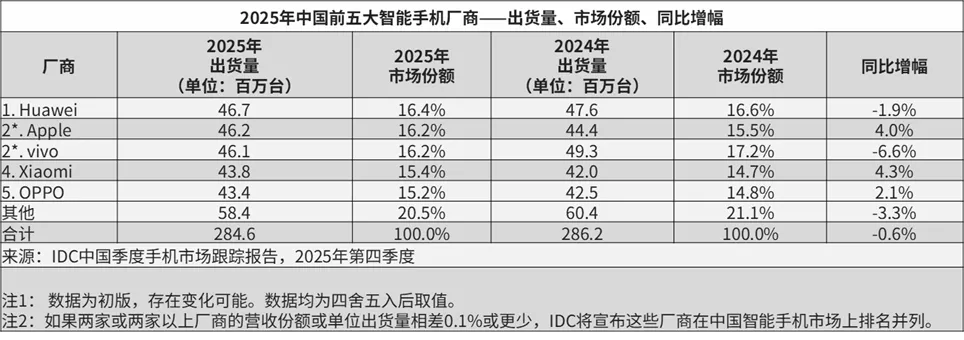
Group 1 - Huawei achieved the highest annual shipment volume in the Chinese smartphone market in 2025, with 46.7 million units and a market share of 16.4%, marking its return to the top position after several years [1][2] - The competition in the domestic market has shifted from scale expansion to value competition based on technological self-sufficiency, with Huawei's integrated hardware and software technology forming a core barrier in the saturated market [1] - The shortage of storage chips in 2026 is expected to increase cost pressures in the industry, but Huawei's supply chain management and technological accumulation are likely to continue supporting its market competitiveness [1] Group 2 - In 2025, the top five smartphone manufacturers in China by shipment volume were Huawei, Apple, vivo, Xiaomi, and OPPO, with total shipments of 284.6 million units, a slight decrease of 0.6% compared to 2024 [2] - Apple and vivo both had shipments of 46.2 million and 46.1 million units respectively, with Apple experiencing a year-on-year increase of 4.0%, while vivo saw a decline of 6.6% [2] - Xiaomi and OPPO reported shipments of 43.8 million and 43.4 million units respectively, with Xiaomi's shipments increasing by 4.3% and OPPO's by 2.1% compared to the previous year [2]

智谱CEO谈DeepSeek冲击;携程回应涉嫌垄断被立案调查
Sou Hu Cai Jing· 2026-01-15 01:17
Group 1 - The Chinese government has extended the personal income tax refund policy for residents purchasing new homes until December 31, 2027, which aims to support the housing market [2] - The policy allows for a full refund of paid personal income tax if the new home purchase amount is greater than or equal to the selling price of the current home [2] - If the new home purchase amount is less than the selling price, the refund will be proportional to the new purchase amount [2] Group 2 - OpenAI has signed a three-year agreement with Cerebras to procure up to 750 megawatts of computing power, with the total deal exceeding $10 billion [6][7] - Cerebras specializes in AI chips designed for inference tasks, integrating vast computing power and memory into a single chip [6] - This partnership may significantly increase Cerebras' valuation, with reports indicating a potential $22 billion valuation for a new funding round [7] Group 3 - Wang Xiaochuan stated that the future growth of medical AI will primarily occur outside of hospitals, emphasizing the technology's role in enhancing patient services rather than replacing doctors [8][9] - This perspective has sparked industry discussions on leveraging AI to improve patient experiences and healthcare quality [9] Group 4 - Ctrip is under investigation by the State Administration for Market Regulation for alleged monopolistic practices [11] - The company has stated it will cooperate with the investigation while continuing to operate its business normally [11] - In response to Ctrip's situation, a competitor, Zhaomi Technology, announced plans to launch a product aimed at countering Ctrip's market dominance [11] Group 5 - ByteDance is developing a new generation of AI headphones, which will be manufactured by GoerTek [5] - The company currently has no plans to launch the next generation of headphones publicly [5] Group 6 - Huawei is projected to reclaim the top position in the Chinese smartphone market by 2025, with a total shipment volume of approximately 285 million units, reflecting a year-on-year decline of 0.6% [22]





全球每卖三台手机,就有一台广东造
2 1 Shi Ji Jing Ji Bao Dao· 2026-01-15 01:11
Core Insights - The article highlights the dominance of Guangdong in the global smartphone market, with one in three smartphones sold worldwide being manufactured in the region. Guangdong's "smartphone team" includes major brands like Huawei, OPPO, Vivo, Honor, and Transsion, which collectively represent a significant portion of the global market share [1][6][30]. Group 1: Market Position and Performance - In 2024, the combined shipment volume of Guangdong smartphone brands is projected to account for approximately 34.6% of the global market [6][7]. - Huawei's global smartphone shipment volume is expected to reach 48.4 million units in 2024, holding a 4% market share [7]. - OPPO is projected to ship 104.8 million units globally in 2024, securing an 8.5% market share [8]. - Vivo's global shipment volume is anticipated to be 101 million units in 2024, with a market share of 8.5% [10]. - Transsion is expected to ship 106.9 million units in 2024, achieving an 8.6% market share, ranking fourth globally [12]. Group 2: Innovation and Technology - Guangdong's smartphone industry is characterized by a robust supply chain and innovation ecosystem, with 95% of smartphone components available within a one-hour commute in Dongguan [2][6]. - The region is advancing towards AI integration in smartphones, with brands like Huawei and Vivo launching AI-enabled devices that enhance user experience [17]. - Huawei's Mate 60 is noted as the world's first smartphone supporting satellite communication, showcasing technological advancements [18]. Group 3: Industry Structure and Ecosystem - The smartphone industry in Guangdong is structured around a "triangular" ecosystem involving design in Shenzhen, manufacturing in Dongguan, and component supply in Huizhou, creating a world-class supply chain [2][6]. - The region is home to leading companies in various sectors, including semiconductor design (e.g., HiSilicon), battery production (e.g., Desay Battery), and PCB manufacturing, contributing to a comprehensive smartphone manufacturing base [23][24][29]. - The industry is shifting from price competition to a focus on quality, technology, and brand, reflecting a broader trend in global manufacturing [3].

全球每卖三台手机,就有一台广东造
21世纪经济报道· 2026-01-15 01:08
Core Viewpoint - The article emphasizes the dominance of Guangdong in the global smartphone market, highlighting its significant contribution to smartphone manufacturing and innovation, with one in three smartphones sold worldwide being produced in Guangdong [1][14]. Group 1: Guangdong's Smartphone Industry - Guangdong is the most important hub for smartphone production in China, with major brands like Huawei, OPPO, vivo, Honor, and Transsion leading the market [14]. - In 2024, the combined shipment volume of Guangdong smartphone brands is expected to account for approximately 34.6% of the global market [14]. - The region's smartphone production ecosystem includes a robust supply chain, with 95% of smartphone components available within a one-hour commute in Dongguan [7][36]. Group 2: Competitive Advantages of Guangdong Brands - The "Five Tigers" of Guangdong (Huawei, OPPO, vivo, Honor, and Transsion) leverage unique strengths: Huawei focuses on technological innovation, vivo targets young consumers with imaging technology, OPPO emphasizes cost-effectiveness, Honor enhances user experience, and Transsion excels in overseas markets [4][7]. - In the high-end market, these brands collectively hold about half of the market share, showcasing their strong product competitiveness [15]. Group 3: Innovations and Future Trends - The integration of AI technology is becoming a new driving force for smartphone evolution, with Guangdong brands accelerating their development of AI capabilities in mobile devices [10][29]. - The article notes that Guangdong is transitioning from price competition to a focus on quality, technology, and brand value, indicating a shift towards higher-value products [10]. Group 4: Key Metrics and Market Performance - In 2024, Huawei's global smartphone shipment is projected to be 48.4 million units, capturing a 4% market share [16]. - OPPO is expected to ship 104.8 million units globally in 2024, holding an 8.5% market share, while vivo is anticipated to achieve similar figures [17][18]. - Transsion's smartphone shipments are projected to reach 106.9 million units in 2024, maintaining a 9.0% market share, reflecting its strong growth in emerging markets [20]. Group 5: Supply Chain and Manufacturing Capabilities - Guangdong's supply chain includes leading companies in semiconductor design, battery production, and PCB manufacturing, establishing it as a global innovation hub [22][34][35]. - The region's battery production is expected to reach 7.349 billion units in 2024, making it the largest producer in China [34].


21社论丨“新广货”彰显中国智造全球竞争力
21世纪经济报道· 2026-01-15 01:08
Core Viewpoint - The article highlights the significant growth and transformation of Guangdong's manufacturing industry, emphasizing its role in global trade and innovation, particularly in the consumer electronics sector, showcasing a shift from manufacturing to intelligent manufacturing [1][2][3]. Group 1: Trade Growth and Performance - In 2025, China's total foreign trade import and export value reached 45.47 trillion yuan, a year-on-year increase of 3.8%, marking a historical high and maintaining its position as the world's largest goods trading nation [1]. - Guangdong province accounted for over 20% of the national total in foreign trade, with exports reaching 26.99 trillion yuan, growing by 6.1%, serving as the main driver of overall trade growth [1]. Group 2: Globalization of Guangdong Products - The globalization of "Guangdong goods" represents the deep integration of Guangdong's manufacturing industry into the global value chain, evolving from imitation to independent research and brand development [2]. - In the consumer electronics sector, companies like OPPO and vivo have over 60% of their sales from overseas, while Transsion Holdings has a staggering 90% from international markets [2]. - By 2025, BYD is expected to achieve approximately 1.05 million overseas sales, a 145% increase year-on-year, positioning itself among the top sellers in the new energy vehicle market [2]. Group 3: Evolution of Export Models - The export model of "Guangdong goods" is evolving from OEM/ODM and product exports to building independent brands and direct foreign investments [2]. - In the first half of 2025, China is projected to surpass the United States as the largest source of foreign direct investment globally, with greenfield investments establishing overseas production bases becoming a new characteristic [2]. Group 4: Technological and Cultural Integration - Guangdong enterprises are at the forefront of this trend, with companies like BYD establishing factories in countries such as Thailand and Hungary, and brands like Shein localizing production in Vietnam and Turkey [3]. - The new "Guangdong goods" integrate advanced technology, sustainable practices, and cultural elements, forming a cluster of high-value, intelligent products and services, transitioning from price competition to comprehensive competition based on quality, technology, and brand [3]. - The rise of "Guangdong goods" indicates a trend where innovation and efficiency, honed by a large domestic market, are influencing the global manufacturing landscape, positioning Guangdong as a precursor to China's transformation into a "global innovation hub" [3].


突发!美国白宫宣布对特定半导体等加征25%关税;大厂80亿资产遭侵吞?宝能董事长姚振华实名举报;梁文锋旗下幻方量化,去年收益率56.6%
雷峰网· 2026-01-15 00:35
Key Points - The U.S. White House announced a 25% tariff on certain imported semiconductors and related products starting January 15, 2026, following a previous statement by former President Trump regarding tariffs on chips and semiconductors [4][5] - Baoneng Group's chairman, Yao Zhenhua, accused local authorities of undervaluing assets of Qoros Auto, claiming a third-party evaluation valued the assets at approximately 8 billion yuan, while they were set to be auctioned at 1.5 billion yuan [7][8] - Ctrip Group is under investigation for alleged monopolistic practices by the State Administration for Market Regulation, with the company stating it will cooperate with the investigation [10] - RoboSense announced it expects to sell 303,000 units of its robotic lidar products in 2025, marking a 1141.8% year-on-year increase [13] - Liang Wenfeng's company, Huanfang Quantitative, achieved a 56.6% return in 2025, with assets exceeding 70 billion yuan [10][11] - Tesla will discontinue the one-time purchase option for its Full Self-Driving (FSD) software, transitioning to a subscription-only model starting February 14, 2026 [39][40] - The Chinese smartphone market saw Huawei leading in shipments with 46.7 million units, followed closely by Apple with 46.2 million units, while the overall market experienced a slight decline of 0.6% year-on-year [27][28] - Meta plans to double its production capacity for AI smart glasses to 20 million units by 2026, focusing on AI integration [46][47] - TSMC is reportedly planning to invest significantly in the U.S. by building at least five new semiconductor factories, despite facing high production costs compared to its Taiwan facilities [50]



传一加手机CEO刘作虎在台湾遭通缉;携程回应“被立案调查”;字节正研发新一代豆包AI耳机,由歌尔股份代工;“死了么”APP征名丨邦早报
创业邦· 2026-01-15 00:26
Group 1 - Ctrip is under investigation by the State Administration for Market Regulation for alleged monopolistic behavior and will cooperate with regulatory requirements while maintaining normal business operations [3] - OnePlus founder Liu Zuohu is wanted in Taiwan for allegedly establishing a subsidiary without permission and illegally recruiting over 70 engineers, involving more than $70 million in funds [6] - Chasing Technology's founder Yu Hao announced the launch of a product to compete with Ctrip, aiming to reduce its market dominance [9] Group 2 - Baoneng Group's chairman Yao Zhenhua filed a complaint regarding the bankruptcy restructuring of Qoros Auto, alleging illegal operations leading to undervaluation of assets [10] - ByteDance is developing a new generation of AI headphones, which will be manufactured by GoerTek, with no plans for an IPO of the new headphones [12] - Baidu is considering upgrading its Hong Kong listing to a primary listing to increase exposure to mainland investors and prepare for potential unfavorable U.S. policies [12] Group 3 - Guangzhou Chali Group is addressing employee salary delays due to strategic missteps in its bottled tea business, while its core tea bag business remains operational [13] - Meta is discussing plans to double the annual production capacity of AI smart glasses to 20 million units by the end of the year [18] - Netflix is considering modifying acquisition terms for Warner Bros. Discovery, discussing an all-cash purchase of its film and streaming business [18] Group 4 - IDC forecasts that China's smartphone market will see a shipment of approximately 285 million units in 2025, with Huawei leading the market share [22] - The global in-app purchase revenue for short drama applications is expected to exceed $2.8 billion in 2025, marking a 116% year-on-year increase [22][23] - China's automotive production and sales are projected to reach historical highs in 2025, with over 34 million units produced and sold, driven by new energy vehicles [25]

【立方早知道】部分券商两融资金已用完/天普股份换届遭紧急问询/美国对特定半导体加征关税
Sou Hu Cai Jing· 2026-01-15 00:12
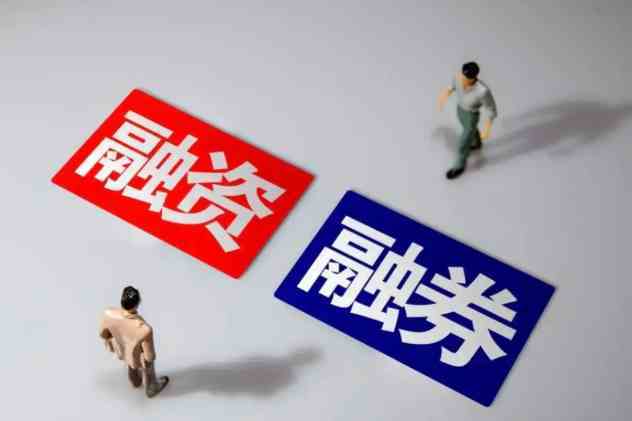
Focus Events - Some large and medium-sized brokerages have exhausted their margin financing funds, despite many brokerages raising the upper limit of margin financing last year. The current market sentiment is high, and the willingness to finance is unprecedented, leading to a situation where not only one brokerage's margin financing quota is no longer sufficient, but brokerages may also intentionally slow down liquidity release for risk control considerations [1] Company Focus - Qifu Life Service Holdings Limited announced the completion of the sale of 280,000 ounces of unallocated silver bars, receiving approximately RMB 161.7 million. This follows a previous announcement on January 9, where the company sold 400,000 ounces for about RMB 226.2 million. In total, Qifu has sold 21.15 tons of silver, generating proceeds of RMB 388 million [3] - CITIC Securities expects to achieve an operating income of RMB 74.83 billion in 2025, a year-on-year increase of 28.75%, and a net profit attributable to shareholders of RMB 30.05 billion, up 38.46% [19] - Aerospace Hongtu has disclosed a pre-loss announcement, expecting a net profit attributable to shareholders to be negative for the 2025 fiscal year [21] - Hu Silicon Industry has released a 2025 annual performance forecast, expecting a net loss of RMB 1.28 billion to RMB 1.53 billion, widening from a loss of RMB 971 million in the previous year [23] - Dayou Energy announced an expected net loss of RMB 1.7 billion for 2025, which represents an increase in loss of approximately RMB 609 million compared to the previous year [24] - CITIC Bank reported total assets of RMB 10.131658 trillion by the end of 2025, a year-on-year increase of 6.28%. The bank achieved a net profit of RMB 70.62 billion, up 2.98% from the previous year [26] - Wuzhong Development disclosed a major asset restructuring plan, proposing to exchange its main assets and liabilities with its controlling shareholder, Wuzhong Co., for 100% equity of Wuzhong Mining and 100% equity of Luzhong Mining [28] - Huibo Technology announced that its controlling shareholder plans to transfer 341 million shares, representing 25.6% of the total share capital, to Tianjin Baili Machinery Equipment Group Co., Ltd. The transfer price is approximately RMB 1.175 billion [29] Industry Dynamics - The U.S. announced a 25% import tariff on certain semiconductors and related products starting January 15 [14] - The China Automobile Industry Association predicts that total automobile sales in 2026 will reach 34.75 million units, with new energy vehicle sales expected to be 19 million units [14] - A meeting was held by the Ministry of Industry and Information Technology and other departments to discuss the regulation of competition in the new energy vehicle industry, emphasizing the need to resist disorderly price wars [14] - Huawei regained the top position in China's smartphone market share, with the latest IDC report indicating that Huawei led the market in 2025 [17]




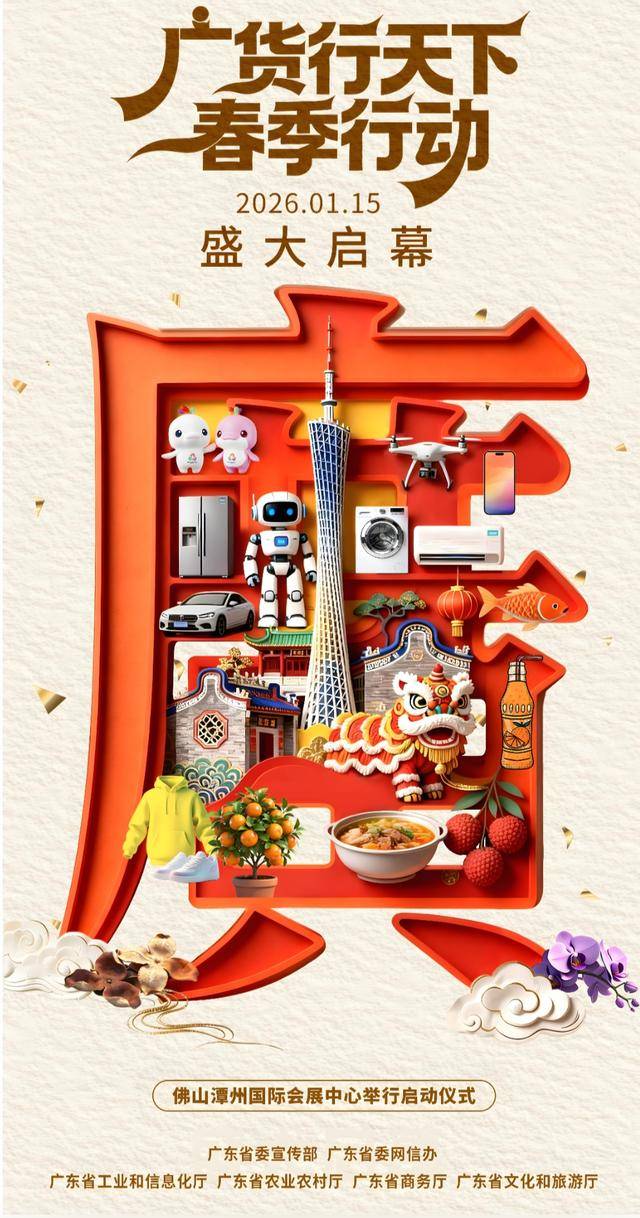
【深圳特区报】“广货行天下”春季行动今日在佛山启幕 广货已备好 等您来采购
Sou Hu Cai Jing· 2026-01-15 00:11
Core Viewpoint - The article highlights the significant growth and transformation of Guangdong's manufacturing industry, particularly in the context of the upcoming Spring Festival, showcasing the region's products and innovations to global consumers [3][12]. Group 1: Overview of Guangdong's Manufacturing - Guangdong's industrial economy has evolved from small-scale operations to a leading position, with classic products like home appliances and textiles now complemented by high-tech goods such as drones and 5G smartphones [8][10]. - The "Guangdong Goods Going Global" initiative aims to promote local products through various online and offline activities, enhancing visibility and sales on major e-commerce platforms [8][9]. Group 2: Technological Advancements - Guangdong produces 70% of the world's consumer drones, 40% of smartphones, and significant portions of industrial robots and integrated circuits, indicating its strong manufacturing capabilities [9][10]. - Traditional industries in Guangdong are undergoing transformation through technological innovation, with companies like Gree and TCL achieving remarkable efficiency improvements [10][11]. Group 3: Focus on Foshan - Foshan, as the first stop for the "Guangdong Goods Going Global" campaign, exemplifies the region's manufacturing strength, contributing nearly 30% of Guangdong's revenue in the home appliance sector [12][13]. - The city is actively promoting the transformation of traditional industries and has seen an average production efficiency increase of 16% through digitalization [12].
上证早知道|事关自动驾驶 上海部署;Meta扩产AI眼镜;473亿元资金 抢筹ETF
Shang Hai Zheng Quan Bao· 2026-01-14 23:17
Group 1 - The "Atomic Energy Law of the People's Republic of China" officially took effect on January 15, marking the first fundamental law in China's nuclear energy sector [1] - The second China eVTOL Innovation Development Conference was held in Shanghai from January 15 to 16 [1] - Huibo's controlling shareholder will change to Baile Equipment Group, with the actual controller changing to the State-owned Assets Supervision and Administration Commission of Tianjin [1] Group 2 - The Ministry of Finance, the State Taxation Administration, and the Ministry of Housing and Urban-Rural Development announced the extension of personal income tax policies supporting residents' housing purchases from January 1, 2026, to December 31, 2027 [1] - A joint meeting was held by the Ministry of Industry and Information Technology, the National Development and Reform Commission, and the State Administration for Market Regulation to resist disorderly "price wars" in the new energy vehicle industry [1] Group 3 - The Hainan Free Trade Port has seen 585,000 people engage in duty-free shopping, with a total amount of 3.89 billion yuan, representing year-on-year increases of 32.4% and 49.6% respectively [2] - The Ministry of Finance plans to issue 400 billion yuan of 91-day discount treasury bonds [2] - A guideline was issued to enhance the collaborative development of meteorological services in health and wellness, aiming for a comprehensive system by 2030 [2] Group 4 - IDC reported that Apple ranked first in China's smartphone market in Q4 2025, followed by vivo, OPPO, Huawei, and a tie between Honor and Xiaomi in fifth place [3] - Honor's global shipment volume exceeded 71 million units for the first time, with a year-on-year growth of approximately 55% in overseas shipments [3] Group 5 - Shanghai released the "Mosu Zhixing" action plan to accelerate the advancement of automotive intelligence, aiming for large-scale application of high-level autonomous driving by 2027 [4] - East Asia Securities predicts that the penetration of new energy vehicles, exports, and intelligent high-end development will be structural highlights in the automotive market in 2026 [4] Group 6 - Meta plans to double the production capacity of AI glasses to 20 million units by the end of 2026, driven by steady sales growth [5] - The global AR market is expected to enter a rapid development phase due to AI technology, supply chain optimization, and the entry of major players [5] Group 7 - Google launched the new MedGemma 1.5 AI medical model, enhancing capabilities in medical imaging and text processing [6] - AI in healthcare shows strong potential in improving medical device functions and assisting clinical decision-making [6] Group 8 - Huazhong University of Science and Technology's subsidiary plans to establish a semiconductor device research and production base with a total investment of 1 billion yuan [7] - Colorful Technology plans to issue convertible bonds to raise up to 1.46 billion yuan for AI-related projects [7] Group 9 - Four-dimensional Map expects revenue of 4.06 billion to 4.34 billion yuan in 2025, with a year-on-year growth of 15.42% to 23.50% [8] - The company anticipates a significant increase in revenue from its data compliance business in 2025 [8] Group 10 - Institutional investors net purchased 516 million yuan of Guangxun Technology, highlighting its strong market position in optical communication [9] - Jiarun Technology received a net purchase of 298 million yuan, focusing on expanding its network information security capabilities [10] Group 11 - Equity ETFs saw a net subscription of over 47 billion yuan in three trading days, with significant interest in thematic ETFs [11] - Institutional investors also net purchased several companies, indicating strong market confidence [11] Group 12 - Weili Transmission is advancing its wind power gearbox smart factory, which is expected to significantly increase revenue and improve profit margins [12] - The global wind energy market is projected to drive demand for core components like wind power gearboxes [12] Group 13 - Ouma Software is building a comprehensive AI ecosystem in the examination and assessment field, enhancing its core technologies [13] - The company aims to integrate AI into various examination processes, establishing a competitive edge and growth potential [13]