
青岛啤酒

Search documents
促消费政策催化,持续看好顺周期方向
CAITONG SECURITIES· 2025-09-03 11:00
Investment Rating - The industry investment rating is "Positive" (maintained) [2][9] Core Viewpoints - Recent policies aimed at boosting consumption, such as the "2025 Shaoxing City Consumption Promotion Policy," are expected to benefit cyclical sectors, particularly in the liquor and restaurant chains [5] - The policy includes subsidies for banquet consumption, which will directly stimulate demand for liquor and benefit suppliers in the banquet consumption chain [5] - The report anticipates that similar policies may be adopted in other regions, which could enhance overall consumer demand and support the recovery of liquor demand and banquet supply chain enterprises [5] - The restaurant industry is currently at the bottom of its cycle but is expected to gradually recover due to ongoing policy support, with specific recommendations for various segments including liquor, restaurant chains, beer, and yellow wine [5] Summary by Sections Recent Market Performance - The food and beverage sector has shown a performance of -7% over the last 12 months, compared to 2% for the CSI 300 and 11% for the Shanghai Composite Index [4] Policy Impact - The Shaoxing policy provides tiered subsidies for banquet consumption, with a maximum of 5,000 yuan for events with five tables or more and total spending exceeding 10,000 yuan [5] - The policy is expected to stimulate banquet consumption during the upcoming Mid-Autumn Festival and National Day holidays, benefiting liquor demand [5] Investment Recommendations - The report recommends focusing on the following companies: - Liquor: Guizhou Moutai, Wuliangye, Luzhou Laojiao, Shanxi Fenjiu, Shede Liquor, Gujing Gongjiu, Yingjia Gongjiu, and Jinshiyuan [5] - Restaurant Chains: Hai Tian Wei Ye, Anji Food, Angel Yeast, and Qianwei Central Kitchen [5] - Beer: Qingdao Beer, China Resources Beer, and Yanjing Beer [5] - Yellow Wine: Kuaijishan and Guyue Longshan [5]





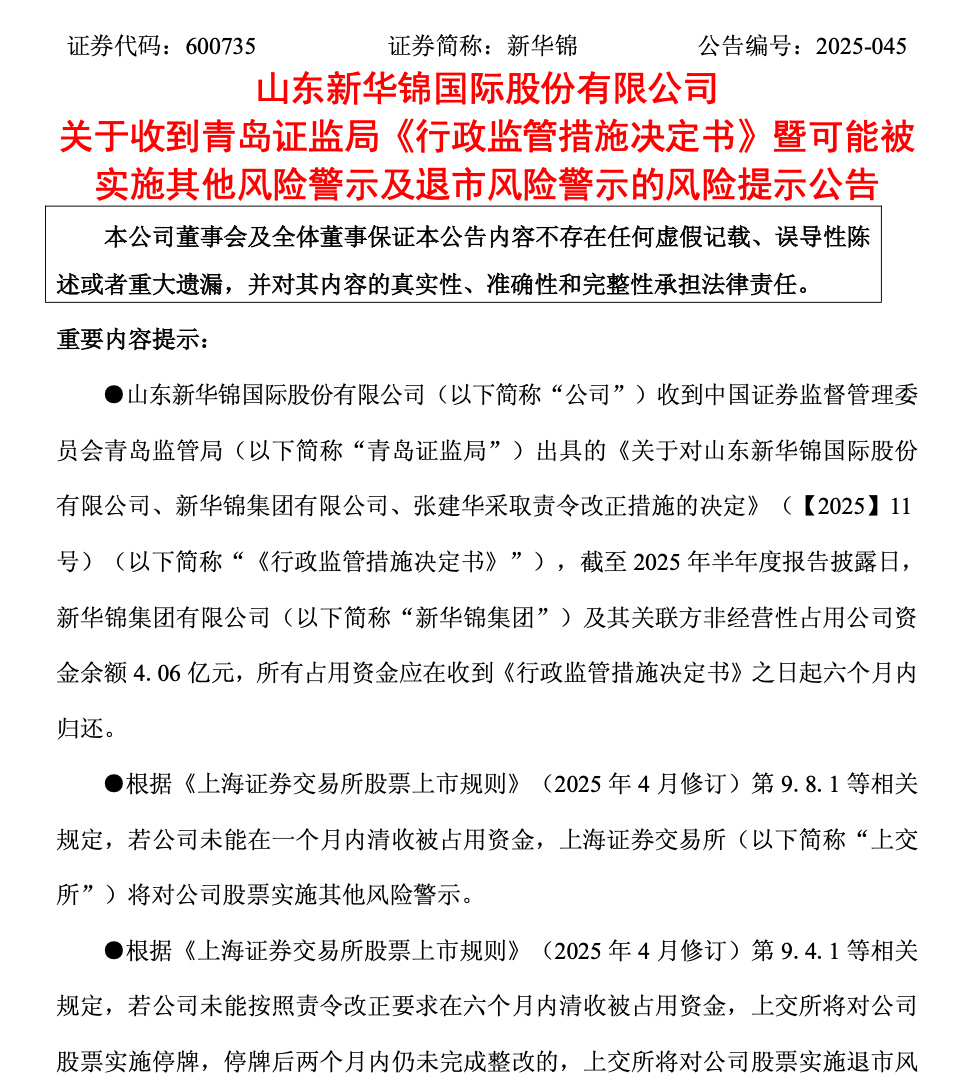
上市公司4亿元资金被占用,存在退市风险,股价6天跌掉29%!大股东变卖优质资产还钱
Mei Ri Jing Ji Xin Wen· 2025-09-03 10:16
Core Viewpoint - The announcement from Xinhua Jin reveals significant fund occupation issues, amounting to 406 million yuan, by its major shareholder, Xinhua Jin Group, raising concerns among over 20,000 shareholders about potential delisting risks if the funds are not recovered in time [1][10]. Fund Occupation Issues - Xinhua Jin Group and its affiliates have occupied 406 million yuan of the company's funds, with the occupation period from January 1, 2025, to June 30, 2025 [3][10]. - As of the half-year report disclosure date, the balance of occupied funds remains at 406 million yuan, indicating a failure to repay [3][10]. - In the first half of 2025, Xinhua Jin Group and its affiliates occupied approximately 801 million yuan, with partial repayments made in April, but funds were subsequently reallocated due to financial pressures from strategic investors [4][6]. Repayment Plans - Xinhua Jin Group intends to use 665 million yuan from the sale of Jimo Yellow Wine to repay the occupied funds, with this receivable already pledged to the company, granting it priority in repayment [2][12]. - The completion of the acquisition of Jimo Yellow Wine by Qingdao Beer is crucial for the repayment, but uncertainties remain regarding the execution of the sale and repayment agreements [14]. Financial Performance - For the first half of 2025, Xinhua Jin reported revenues of approximately 669 million yuan, a year-on-year decline of 24.92%, and a net profit attributable to shareholders of about 12.87 million yuan, down 39.45% [6][9]. - The company's net assets at the end of the reporting period were approximately 1.22 billion yuan, reflecting a slight increase of 0.97% compared to the previous year [9]. Market Reaction - Following the announcement of the fund occupation, Xinhua Jin's stock price fell over 4%, with a total decline of 29.66% over six trading days since the news broke [14].


量化大势研判:当成长只有预期在扩张
Minsheng Securities· 2025-09-03 09:32
Quantitative Models and Construction Methods Model Name: Quantitative Market Trend Analysis Framework - **Model Construction Idea**: The model aims to solve the systematic rotation problem of styles by conducting a bottom-up quantitative market trend analysis. It identifies the dominant asset characteristics that represent the future market's mainstream style through a comprehensive comparison of assets[1][5] - **Model Construction Process**: - The model considers five style stages based on the asset's industry lifecycle: external growth, quality growth, quality dividend, value dividend, and bankruptcy value[1][5] - The priority for asset comparison is based on the sequence: growth (g) > return on equity (ROE) > dividend (D)[1][5] - The model uses the spread of asset advantage differences to capture the trend changes of top assets, similar to factor timing[20] - **Model Evaluation**: The framework has shown good explanatory power for past A-share style rotations, achieving an annualized return of 27.25% since 2009[15] Model Backtesting Results - **Quantitative Market Trend Analysis Framework**: - 2009: Asset Comparison Strategy 133%, Wind All A 82%, Excess Return 51%[18] - 2010: Asset Comparison Strategy 7%, Wind All A -7%, Excess Return 14%[18] - 2011: Asset Comparison Strategy -33%, Wind All A -22%, Excess Return -11%[18] - 2012: Asset Comparison Strategy 5%, Wind All A 5%, Excess Return 0%[18] - 2013: Asset Comparison Strategy 41%, Wind All A 5%, Excess Return 36%[18] - 2014: Asset Comparison Strategy 48%, Wind All A 52%, Excess Return -4%[18] - 2015: Asset Comparison Strategy 55%, Wind All A 38%, Excess Return 16%[18] - 2016: Asset Comparison Strategy -14%, Wind All A -13%, Excess Return -1%[18] - 2017: Asset Comparison Strategy 32%, Wind All A 5%, Excess Return 27%[18] - 2018: Asset Comparison Strategy -21%, Wind All A -28%, Excess Return 7%[18] - 2019: Asset Comparison Strategy 41%, Wind All A 33%, Excess Return 8%[18] - 2020: Asset Comparison Strategy 69%, Wind All A 26%, Excess Return 44%[18] - 2021: Asset Comparison Strategy 47%, Wind All A 9%, Excess Return 38%[18] - 2022: Asset Comparison Strategy 44%, Wind All A -19%, Excess Return 62%[18] - 2023: Asset Comparison Strategy 5%, Wind All A -5%, Excess Return 10%[18] - 2024: Asset Comparison Strategy 62%, Wind All A 10%, Excess Return 52%[18] - 2025 (Aug): Asset Comparison Strategy 27%, Wind All A 23%, Excess Return 4%[18] Quantitative Factors and Construction Methods Factor Name: Expected Growth (gf) - **Factor Construction Idea**: The factor focuses on the highest analyst forecasted growth rates, regardless of the cycle stage[6] - **Factor Construction Process**: - The factor is constructed by selecting industries with the highest expected growth rates as forecasted by analysts[6] - The spread of expected growth advantage differences (Δgf) is used to capture the trend changes in top assets[20] - **Factor Evaluation**: The factor has shown significant excess returns since 2019, with notable performance in 2014-2015[34] Factor Name: Actual Growth (g) - **Factor Construction Idea**: The factor focuses on industries with the highest actual growth rates, particularly during transition and growth periods[6] - **Factor Construction Process**: - The factor is constructed by selecting industries with the highest actual growth rates (Δg)[6] - The spread of actual growth advantage differences (Δg) is used to capture the trend changes in top assets[24] - **Factor Evaluation**: The factor has shown significant excess returns in growth-dominant environments[36] Factor Name: Profitability (ROE) - **Factor Construction Idea**: The factor focuses on industries with high ROE and low valuation under the PB-ROE framework, concentrated in mature periods[6] - **Factor Construction Process**: - The factor is constructed by selecting industries with high ROE and low PB-ROE residuals[6] - The spread of ROE advantage differences is used to capture the trend changes in top assets[26] - **Factor Evaluation**: The factor has shown significant excess returns from 2016 to 2020, with weaker performance since 2021[39] Factor Name: Quality Dividend (DP+ROE) - **Factor Construction Idea**: The factor focuses on industries with the highest DP+ROE scores, concentrated in mature periods[6] - **Factor Construction Process**: - The factor is constructed by selecting industries with the highest DP+ROE scores[6] - The spread of DP+ROE advantage differences is used to capture the trend changes in top assets[42] - **Factor Evaluation**: The factor has shown significant excess returns in 2016, 2017, and 2023[43] Factor Name: Value Dividend (DP+BP) - **Factor Construction Idea**: The factor focuses on industries with the highest DP+BP scores, concentrated in mature periods[6] - **Factor Construction Process**: - The factor is constructed by selecting industries with the highest DP+BP scores[6] - The spread of DP+BP advantage differences is used to capture the trend changes in top assets[45] - **Factor Evaluation**: The factor has shown significant excess returns in 2009, 2017, and 2021-2023[46] Factor Name: Bankruptcy Value (PB+SIZE) - **Factor Construction Idea**: The factor focuses on industries with the lowest PB+SIZE scores, concentrated in stagnation and recession periods[6] - **Factor Construction Process**: - The factor is constructed by selecting industries with the lowest PB+SIZE scores[6] - The spread of PB+SIZE advantage differences is used to capture the trend changes in top assets[48] - **Factor Evaluation**: The factor has shown significant excess returns in 2015-2016 and 2021-2023[49] Factor Backtesting Results - **Expected Growth (gf)**: - Cable: 12 stocks, largest weight stock Zhongtian Technology, average market cap 21.791 billion yuan, 3-month performance 49.62%[34] - Cement: 19 stocks, largest weight stock Conch Cement, average market cap 17.929 billion yuan, 3-month performance 12.71%[34] - Glass Fiber: 6 stocks, largest weight stock China Jushi, average market cap 26.657 billion yuan, 3-month performance 63.67%[34] - Rare Earth and Magnetic Materials: 17 stocks, largest weight stock Northern Rare Earth, average market cap 31.018 billion yuan, 3-month performance 98.77%[34] - White Goods III: 10 stocks, largest weight stock Midea Group, average market cap 113.675 billion yuan, 3-month performance -1.21%[34] - **Actual Growth (g)**: - Integrated Circuits: 104 stocks, largest weight stock Cambricon-U, average market cap 45.058 billion yuan, 3-month performance 42.93%[37] - PCB: 38 stocks, largest weight stock Shenghong Technology, average market cap 27.163 billion yuan, 3-month performance 112.10%[37] - Tungsten: 4 stocks, largest weight stock Xiamen Tungsten, average market cap 30.523 billion yuan, 3-month performance 69.26%[37] - Lithium Battery Equipment: 12 stocks, largest weight stock Lead Intelligent, average market cap 11.731 billion yuan, 3-month performance 60.15%[37] - Weapons and Equipment III: 12 stocks, largest weight stock Great Wall Military Industry, average market cap 21.307 billion yuan, 3-month performance 80.22%[37] - **Profitability (ROE)**: - Beer: 7 stocks, largest weight stock Tsingtao Brewery, average market cap 26.758 billion yuan, 3-month performance -3.94%[39] - Liquor: 20 stocks, largest weight stock Kweichow Moutai, average market cap 162.722 billion yuan, 3-month performance 4.12%[39] - Non-dairy Beverages: 7 stocks, largest weight stock Eastroc Beverage, average market cap 32.754 billion yuan, 3-month performance -4.45%[39] - Network Connection and Tower Setup: 19 stocks, largest weight stock Zhongji Xuchuang, average market cap 64.299 billion yuan, 3-month performance 202.29%[39] - Building Decoration III: 28 stocks, largest weight stock Gold Mantis, average market cap 3.436 billion yuan, 3-month performance 4.42%[39] - **Quality Dividend (DP+ROE)**: - Automotive Motor Control: 15
白酒承压,跨界融合趋势来了
3 6 Ke· 2025-09-03 03:25
Core Viewpoint - The Chinese liquor industry, particularly the baijiu sector, is experiencing a downturn, with many companies reporting declines in revenue and net profit, while other alcoholic beverages like beer and yellow wine are capitalizing on this opportunity to attract younger consumers [1][2][3]. Baijiu Industry Performance - The total revenue of baijiu companies in the first half of 2025 was 241.51 billion yuan, a slight decrease of 0.9% from 2024 [1]. - The net profit attributable to shareholders was 94.56 billion yuan, down 1.2% from the previous year [1]. - Only six out of twenty baijiu companies reported positive revenue growth, with Kweichow Moutai leading at 91.1 billion yuan, a 9% increase [2]. - Thirteen companies experienced declines in both revenue and net profit, indicating a widespread downturn in the baijiu sector [3]. Other Alcoholic Beverages - The beer sector showed positive growth, with most companies reporting revenue increases, particularly Qingdao Beer, which exceeded 20 billion yuan in revenue [5]. - The total revenue of other alcoholic beverages, including beer, yellow wine, and pre-mixed drinks, was 5.3 billion yuan, with net profits totaling 700 million yuan [6]. - Companies like Zhangyu A and Bai Run Holdings dominated the pre-mixed drink market, with revenues close to 1.5 billion yuan each [6]. Market Trends and Consumer Behavior - The liquor market is becoming younger and more diversified, with a trend towards lower alcohol content beverages [1][7]. - Baijiu companies are actively seeking to attract younger consumers through marketing and product innovation, such as smaller packaging and lower alcohol options [7][8]. - Cross-industry collaborations are emerging, with beer companies like China Resources Beer venturing into the baijiu market, and baijiu brands launching beer products [9]. Future Outlook - The baijiu industry is expected to undergo further adjustments, with upcoming festivals like Mid-Autumn and National Day serving as critical indicators for market recovery [3]. - The success of lower alcohol products and cross-industry collaborations remains to be seen, as companies adapt to changing consumer preferences [8][9].
2025年7月中国啤酒进出口数量分别为0.34亿升和0.59亿升
Chan Ye Xin Xi Wang· 2025-09-03 01:30
Core Viewpoint - The report highlights the trends in China's beer import and export market, indicating a decline in imports and a growth in exports as of July 2025 [1] Import and Export Data - In July 2025, China's beer import volume was 0.34 billion liters, representing a year-on-year decrease of 17.5%, while the import value was 0.51 million USD, down 9.2% year-on-year [1] - Conversely, beer exports in July 2025 reached 0.59 billion liters, showing a year-on-year increase of 9.9%, with export value at 0.39 million USD, up 4.3% year-on-year [1] Industry Context - The report is part of a comprehensive analysis by Zhiyan Consulting, which specializes in industry research and provides various consulting services, including market analysis and feasibility studies [1]

青岛啤酒(600600):基本面稳中有增,成本红利释放
Hua Yuan Zheng Quan· 2025-09-02 11:36
Investment Rating - The report assigns a "Buy" rating for the company, indicating a positive outlook based on stable fundamentals and cost advantages [5]. Core Views - The company is expected to achieve net profits of 4.79 billion, 5.16 billion, and 5.59 billion RMB for the years 2025, 2026, and 2027 respectively, with year-on-year growth rates of 10.3%, 7.6%, and 8.3% [5]. - The current price-to-earnings (P/E) ratios for the years 2025, 2026, and 2027 are projected to be 20, 18, and 17 times respectively, which is favorable compared to the average P/E of 23 times for comparable companies [5]. Financial Performance Summary - In the first half of 2025, the company reported revenue of 20.49 billion RMB, a year-on-year increase of 2.11%, and a net profit of 3.90 billion RMB, up 7.21% year-on-year [7]. - The beer sales volume for the first half of 2025 reached 4.73 million tons, reflecting a growth of 2.3% year-on-year, with an average price of 4,271.8 RMB per ton, slightly down by 0.25% [7]. - The overall gross margin for the first half of 2025 was 43.7%, an increase of 2.1 percentage points compared to the same period last year [7]. - The company’s net profit margin improved to 19.39% in the first half of 2025, up 0.85 percentage points year-on-year [7]. Revenue and Profit Forecast - The projected revenue for 2025 is 32.85 billion RMB, with a growth rate of 2.20% compared to 2024 [6]. - The expected net profit for 2025 is 4.79 billion RMB, with a growth rate of 10.30% compared to 2024 [6]. - The earnings per share (EPS) for 2025 is forecasted to be 3.51 RMB [6].
金工定期报告20250902:预期高股息组合跟踪
Soochow Securities· 2025-09-02 09:04
Quantitative Models and Construction Methods - **Model Name**: Expected High Dividend Portfolio **Model Construction Idea**: The model aims to construct a portfolio with high expected dividend yield by leveraging historical dividend data, fundamental indicators, and short-term factors like reversal and profitability[5][10][16] **Model Construction Process**: 1. **Dividend Yield Calculation**: - Phase 1: Calculate dividend yield based on annual report profit distribution announcements - Phase 2: Predict and calculate dividend yield using historical dividend data and fundamental indicators[5][10] 2. **Screening Process**: - Exclude suspended and limit-up stocks from the CSI 300 constituents[15] - Remove the top 20% of stocks with the highest short-term momentum (21-day cumulative return)[15] - Exclude stocks with declining profitability (quarterly net profit YoY growth < 0)[15] 3. **Final Selection**: - Rank the remaining stocks by expected dividend yield - Select the top 30 stocks with the highest expected dividend yield and construct an equally weighted portfolio[11] **Model Evaluation**: The model demonstrates strong historical performance with significant excess returns and controlled drawdowns, making it a robust strategy for high-dividend stock selection[13] Model Backtesting Results - **Expected High Dividend Portfolio**: - Cumulative Return: 358.90% - Cumulative Excess Return (vs CSI 300 Total Return Index): 107.44% - Annualized Excess Return: 8.87% - Maximum Rolling 1-Year Drawdown of Excess Return: 12.26% - Monthly Excess Win Rate: 60.19%[13] Quantitative Factors and Construction Methods - **Factor Name**: Expected Dividend Yield Factor **Factor Construction Idea**: Predict future dividend yield by combining historical dividend data, fundamental indicators, and short-term influencing factors[5][16] **Factor Construction Process**: 1. Calculate historical dividend yield based on profit distribution announcements[5][10] 2. Predict future dividend yield using fundamental indicators and historical dividend patterns[5][10] 3. Incorporate two short-term factors: - **Reversal Factor**: Accounts for short-term price reversals - **Profitability Factor**: Reflects the company's earnings performance[5][16] **Factor Evaluation**: The factor effectively identifies high-dividend stocks and serves as a reliable input for portfolio construction[16] - **Factor Name**: Red Dividend Timing Framework (Composite Signal) **Factor Construction Idea**: Combines multiple single-factor signals to assess the market's outlook on dividend stocks[25][28] **Factor Construction Process**: 1. Evaluate five single-factor signals: - **Inflation**: PPI YoY (High/Low) - **Liquidity**: M2 YoY (High/Low) - **M1-M2 Gap**: Scissors Difference (High/Low) - **Interest Rate**: US 10-Year Treasury Yield (High/Low) - **Market Sentiment**: Dividend Stock Turnover Ratio (Up/Down)[28] 2. Assign binary signals (1 for bullish, 0 for bearish) to each factor 3. Aggregate the signals into a composite indicator[28] **Factor Evaluation**: The framework provides a systematic approach to timing dividend stock investments, though the September 2025 signal suggests a cautious stance[25][28] Factor Backtesting Results - **Expected Dividend Yield Factor**: - August 2025 Portfolio Average Return: 5.69% - Excess Return (vs CSI 300 Index): -4.80% - Excess Return (vs CSI Dividend Index): +4.70%[5][16] - **Red Dividend Timing Framework (Composite Signal)**: - Latest Signal (September 2025): 0 (Neutral)[25][28]






啤酒旺季平稳,饮料龙头势强
GOLDEN SUN SECURITIES· 2025-09-02 03:26
Investment Rating - The report maintains an "Increase" rating for the food and beverage industry [3][5] Core Insights - The beer sector shows stable performance during peak season, with slight revenue decline but consistent cost benefits contributing to profits [1][9] - The soft drink sector faces intensified competition, yet leading companies continue to demonstrate strong performance [2][17] Summary by Sections Beer Sector - The beer industry achieved total revenue of 879.3 billion CNY in 25H1, a year-on-year decrease of 0.5%, while net profit rose by 5.9% to 152.3 billion CNY [9] - The gross margin improved to 48.1%, up 1.3 percentage points year-on-year, and net margin increased to 18.7%, up 1.2 percentage points [9][15] - The revenue decline is attributed to weak overall demand and diversified consumer preferences, while profit performance remains strong due to cost reductions and structural upgrades [9][10] - Key players like Yanjing and Zhujiang outperformed in revenue and profit growth, while Budweiser Asia faced challenges due to weak channel performance [9][10] Soft Drink Sector - The soft drink industry reported total revenue of 226.4 billion CNY in 25H1, reflecting a year-on-year growth of 7.5%, with net profit increasing by 1.7% to 39.5 billion CNY [17] - The gross margin for the sector was 41.8%, up 0.6 percentage points, while net margin decreased to 17.5%, down 1.0 percentage points [17][22] - Despite fierce competition, leading companies like Dongpeng Beverage and Quanyuan maintained strong growth, while other companies experienced varying degrees of decline [17][18] - In 25Q2, the soft drink sector saw revenue rise to 107.1 billion CNY, a 14.7% increase year-on-year, but profit margins were pressured due to increased competition and spending [18][20] Key Investment Recommendations - The report suggests focusing on companies with strong single products and distribution channels, highlighting high-growth leaders and stable dividend or undervalued stocks [5][6]



东海证券晨会纪要-20250902
Donghai Securities· 2025-09-02 03:08
Group 1: Key Recommendations - Kangtai Biological (300601) shows good revenue growth with rapid R&D progress, achieving operating revenue of 1.392 billion yuan in H1 2025, up 15.81% year-on-year, but net profit down 77.30% due to rising costs and increased R&D investment [6][7][9] - The chemical industry overall performance in H1 2025 has recovered year-on-year, with total revenue of 1.124 trillion yuan, up 3.02%, and net profit of 69.724 billion yuan, up 4.43% [12][13] - Guomao Co., Ltd. (603915) reported operating revenue of 1.29 billion yuan in H1 2025, up 1.71%, but net profit decreased by 26.97% due to cautious capital expenditure in the manufacturing sector [18][19] - The market for unmanned forklifts is entering an accelerated penetration phase, with significant growth expected in the logistics sector [23][25] - Haier Biomedical (688139) experienced a strong overseas business performance, with revenue of 1.196 billion yuan in H1 2025, despite a slight decline in overall revenue [26][27][30] - Qingdao Beer (600600) achieved operating revenue of 20.491 billion yuan in H1 2025, up 2.11%, with net profit increasing by 7.21% [38][39][41] Group 2: Industry Insights - The chemical industry is witnessing structural optimization on the supply side, with a focus on domestic demand driven by new consumption trends and technological advancements [12][15][16] - The electronic industry is experiencing a mild recovery, with significant growth in AI-related sectors, particularly in cloud services and advertising [32][34][36] - The market for unmanned forklifts is projected to grow significantly, with sales expected to reach approximately 74,100 units by 2027, doubling the market size from 2024 [25][23] - The beer industry is facing external pressures but maintains stable growth, with Qingdao Beer focusing on product structure upgrades and channel expansion [38][40][41]



万联晨会-20250902
Wanlian Securities· 2025-09-02 01:44
Core Insights - The report highlights a significant increase in profits for the company, with a notable growth in franchise business [3][8] - Sales have stabilized and profitability has improved, indicating resilience in performance [12][15] - The company's net profit growth has turned positive year-on-year [21] Market Overview - On September 1, A-shares saw a collective rise, with the Shanghai Composite Index closing up 0.46% at 3,875.53 points, and the Shenzhen Component Index rising 1.05% [2][6] - The total trading volume in the A-share market was approximately 2.75 trillion RMB, with over 3,000 stocks experiencing gains [6] - The Hong Kong market also saw gains, with the Hang Seng Index closing up 2.15% [2][6] Company Performance - In the first half of 2025, the company achieved revenue of 4.102 billion RMB, a year-on-year increase of 19.54%, and a net profit of 331 million RMB, up 44.34% [8][9] - The franchise business revenue grew significantly, reaching 2.244 billion RMB, a 36.24% increase year-on-year [9][10] - The company has expanded its product matrix, launching multiple IP collaboration series, which contributed to revenue growth [9][10] Financial Metrics - The company's gross margin for the first half of 2025 was 23.81%, with a net margin of 8.11%, reflecting effective cost control [10] - The company plans to distribute a dividend of 1.00 RMB per 10 shares to all shareholders [8] Industry Trends - The report notes a recovery in beer sales, with Qingdao Beer achieving a revenue of 20.491 billion RMB in the first half of 2025, a 2.11% increase year-on-year [12][13] - The beer industry is experiencing a shift towards mid-to-low priced products, which are gaining popularity among consumers [18][19] - The white liquor industry is in a deep adjustment phase, with a focus on mid-range products as sales drivers [18][20]

