
蜜雪集团

Search documents
30亿免单火爆,阿里千问APP登顶App Store榜首
Jing Ji Wang· 2026-02-06 09:46
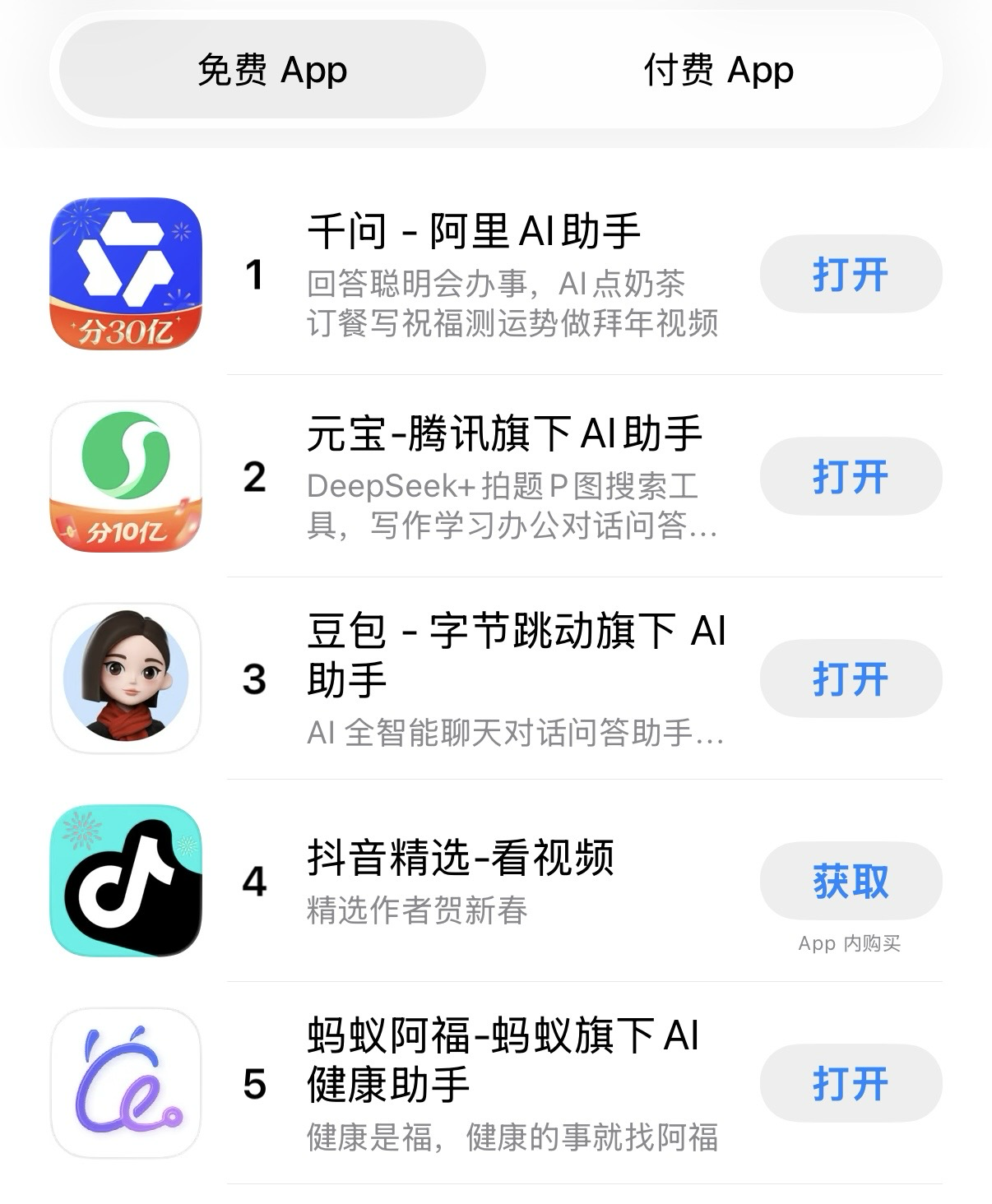
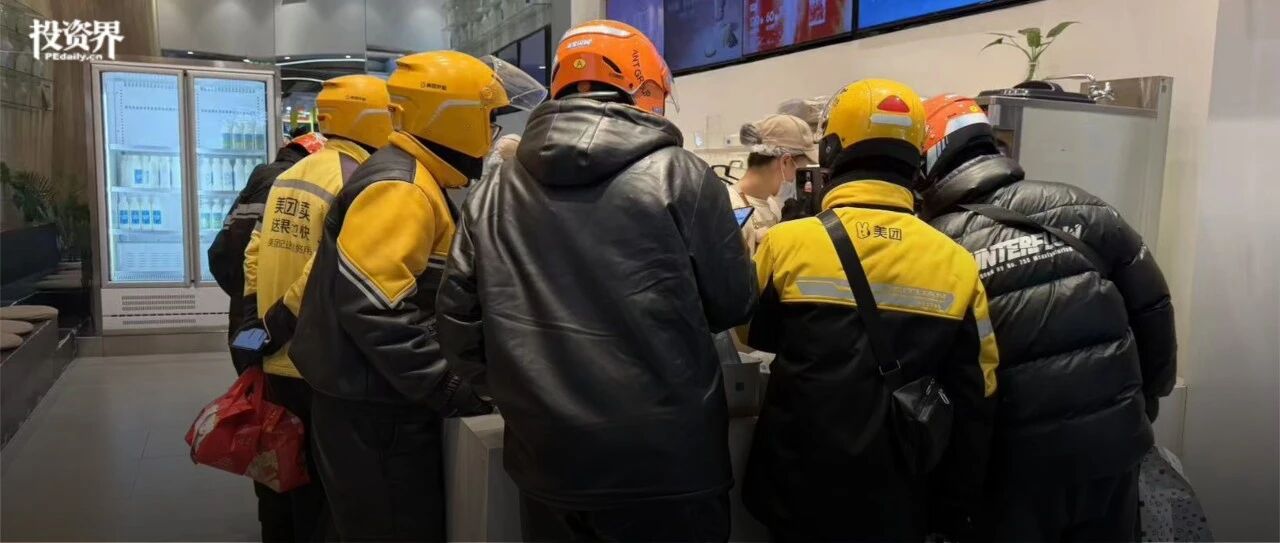
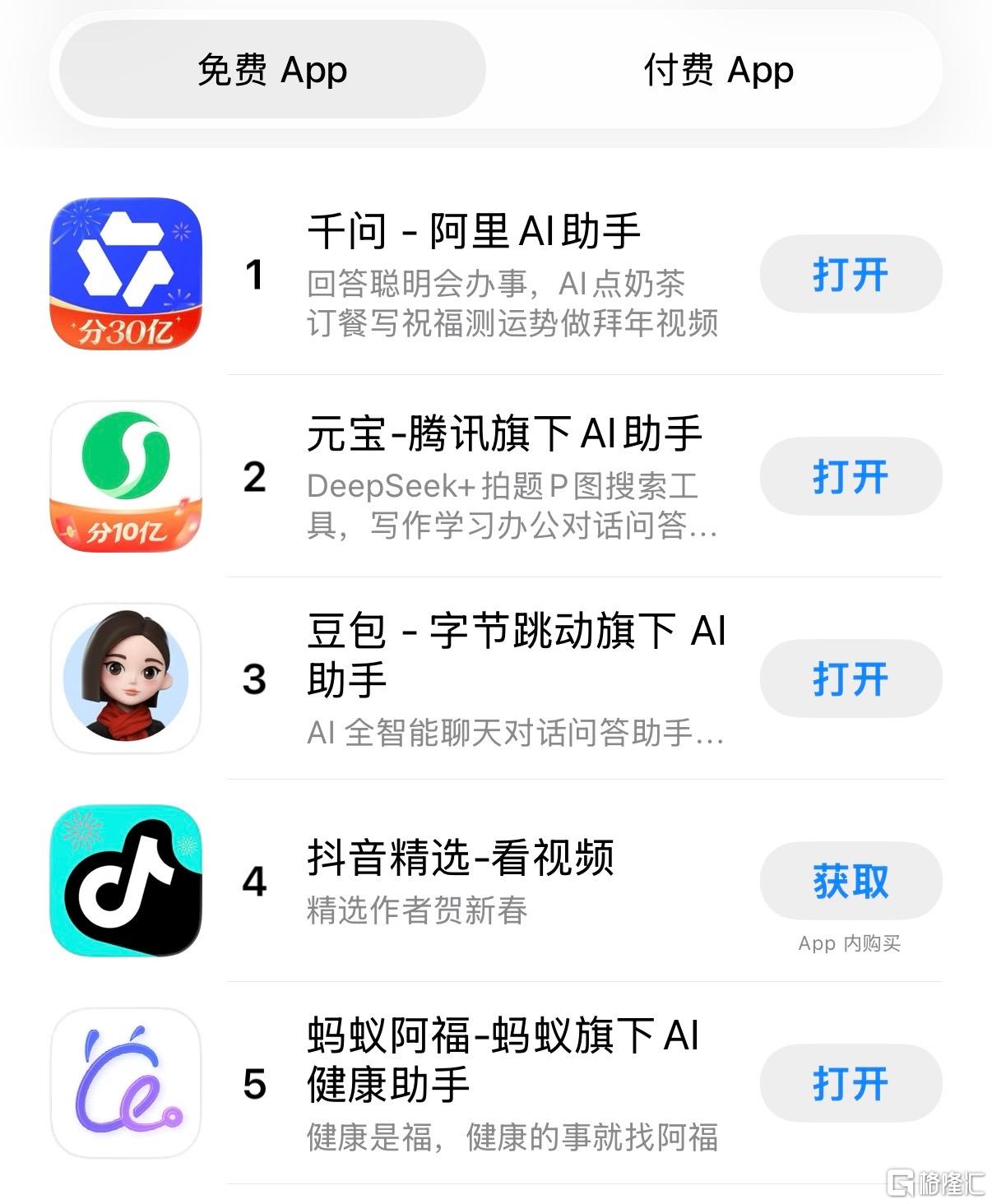
活动带动港股茶饮股多数上涨,截至盘中,古茗涨超4.12%创上市来新高,沪上阿姨和茶百道涨超3%,奈雪的茶、蜜雪集团也跟随上涨。 今天的奶茶攻势只是一个开端。千问App突破传统AI Agent只会聊天、娱乐和发红包的局限,接入淘宝闪购、支付宝、淘宝、飞猪、高德等阿里生态场 景,成为"能办事"的AI。 千问APP春节项目组负责人郑嗣寿表示,在春节这个生活消费活动密集的节点,千问希望通过真金白银的投入,培养用户"有事找AI"的习惯,推动AI融 入到真实世界的衣食住行之中。 2月6日一早,阿里千问App"春节30亿免单"火爆上线,5小时突破500万单,并超越豆包和元宝,火速登顶苹果App Store免费榜第一,排序形成"千元 豆"格局。 在社交平台上,网友纷纷晒出自己用千问App下单的"第一杯AI奶茶",不少奶茶店老板表示,一早醒来订单就爆了,全来自淘宝闪购,还有外卖小哥表 示,一个上午就赚了好几百元。 以千问春节30亿免单活动为起点,全国人民都将感受AI时代的全新生活方式和购物体验,共同迎来"AI超级Agent"出圈的千问时刻。(王宇) ...


阿里千问免单活动致多家奶茶店爆单,网友吐槽:系统崩了用不了
Sou Hu Cai Jing· 2026-02-06 09:19
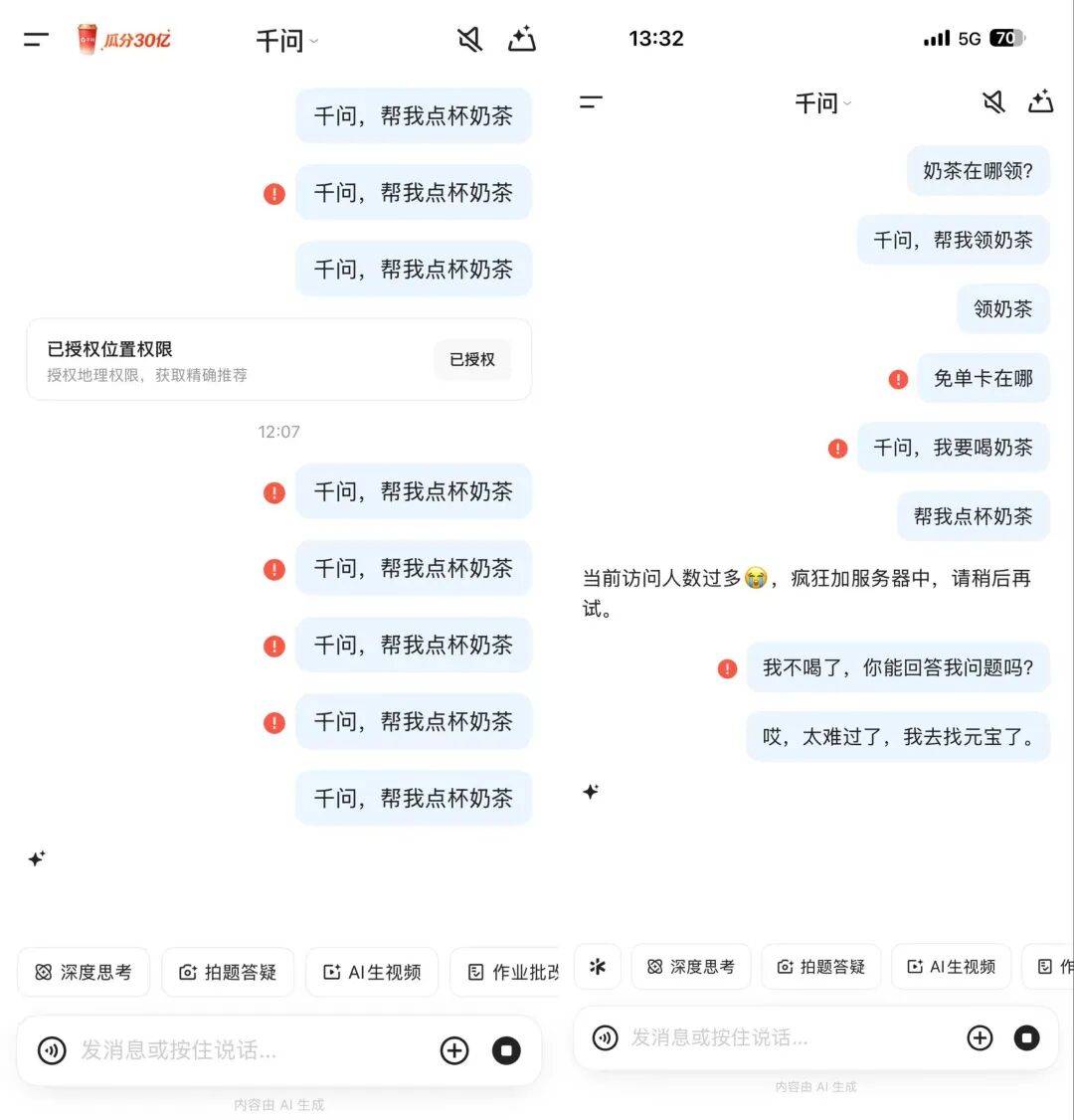
今日,阿里千问APP"春节30亿大免单"正式上线,率先发起"奶茶攻势"。据悉,该活动上线不到3小时,用户已通过千问APP下单超100万单奶茶。在此活 动影响下,港股茶饮股多数上涨,古茗涨超5%创上市来新高,茶百道涨超4%,沪上阿姨、蜜雪集团跟随上涨。 今日上午,多位用户在社交媒体晒出用千问APP下单的"第一杯AI奶茶"。根据用户对比,在各家AI应用的红包活动中,千问的玩法简单直接且门槛低。 不过,点奶茶免单活动的火爆导致千问APP一度"崩了",部分用户打开活动页面,发现页面无法点击或者出现卡顿,并显示 "系统开小差了,稍后再试 吧"。 据官方介绍,千问APP免单卡可在全国30多万家奶茶店使用,蜜雪冰城、瑞幸咖啡、霸王茶姬、奈雪的茶(02150.HK)、沪上阿姨(02589.HK)、茶百 道(02555.HK)、库迪咖啡等茶饮咖啡品牌支持使用。活动期间,每位用户可领取21张无门槛的25元免单卡,相当于525元钱,还有机会抽取价值10000 元的千问AI生活卡。活动页面还显示,第二波福利将于2月13日开启,用户可领取现金红包,最高可得2888元。 | = 115330亿 | 千问~ | | A +1 | 13:3 ...
中国AI大战:奶茶店干爆单了
投资界· 2026-02-06 07:46
Core Viewpoint - The article discusses the intense competition between major Chinese tech companies during the Spring Festival, particularly focusing on Alibaba's Qianwen app and Tencent's Yuanbao app, both of which have launched significant cash giveaway campaigns to attract users and promote AI integration into daily life [2][11][12]. Group 1: Alibaba's Qianwen App - Alibaba has invested 3 billion yuan (approximately 30 billion) in a promotional campaign through its Qianwen app, offering users a 25 yuan no-threshold coupon for free drinks, which has led to over 1 million orders within three hours of launch [2][5][9]. - The campaign is designed to encourage users to integrate AI into their daily lives, with the app connected to various Alibaba services, aiming to establish a habit of using AI for everyday tasks [10][11]. - The first wave of the promotion runs from February 6 to February 12, with a second wave starting on February 13, where users can receive cash red envelopes up to 2,888 yuan [9][10]. Group 2: Tencent's Yuanbao App - Tencent's Yuanbao app launched a 1 billion yuan cash giveaway campaign, which has seen significant user engagement, with the app quickly rising to the top of the App Store [11][12]. - The campaign utilizes a social sharing mechanism to encourage users to invite friends, reminiscent of the successful WeChat red envelope strategy from 2015 [11][12]. - However, the campaign faced challenges when WeChat restricted the sharing links due to violations, prompting Tencent to adjust its sharing mechanism [12]. Group 3: Market Impact - The promotional activities have led to a surge in stock prices for tea beverage companies, with shares of brands like Gu Ming and Cha Bai Dao rising significantly due to increased consumer demand [5]. - The competition has sparked a broader AI war among major tech companies, with Baidu also launching a 500 million yuan cash giveaway for its AI assistant, indicating a trend towards integrating AI into consumer services [13][14]. - The article suggests that this Spring Festival could mark a pivotal moment in the evolution of AI applications in China, potentially reshaping user behavior and market dynamics [16][17].
30亿奶茶免单炸场春节!千问冲上App Store免费榜第一,活动页面一度被挤崩!
Hua Er Jie Jian Wen· 2026-02-06 07:37
阿里巴巴旗下AI应用千问凭借"春节30亿免单"营销活动登顶苹果App Store免费应用榜首,活动反响热烈,一度因访问量过大导致页面短暂崩溃。 2月6日中午,千问在推出免单奶茶活动后迅速攀升至App Store免费应用榜第一名,超越字节跳动的豆包和腾讯的元宝。活动上线不到3小时即送 出超100万单奶茶,但因用户涌入导致服务器一度崩溃,活动页面显示"活动太火爆,请稍后再试"。 尽管活动反响热烈,阿里巴巴股价当日仍然下跌。投资者对AI应用通过高额补贴获取用户的商业模式持保留态度,市场更关注长期盈利能力而非 短期下载量激增,阿里巴巴港股跌3%,报155.4港元/股。 千问的营销攻势还引发平台生态冲突。微信已屏蔽千问的红包分享链接,迫使其改用口令形式传播,这是继元宝和百度文心助手之后第三个被微 信限制的AI应用春节营销活动。 千问成为第三个被微信屏蔽春节营销活动的AI应用。微信显示其链接"存在诱导或误导下载/跳转的内容",需跳转第三方浏览器访问。部分用户在 千问APP内分享活动至微信好友时,已自动改为复制口令形式。 2月4日,微信官方账号"微信派"发布公告称,元宝的春节营销活动通过"做任务""领红包"等方式诱导用户高 ...
30亿免单火爆,阿里千问APP登顶App Store榜首!
Ge Long Hui· 2026-02-06 06:48
2月6日一早,阿里千问App"春节30亿免单"火爆上线,5小时突破500万单,并超越豆包和元宝,火速登顶苹果App Store免费榜第一,排序形成"千元豆"格 局。 今天的奶茶攻势只是一个开端。千问App突破传统AI Agent只会聊天、娱乐和发红包的局限,接入淘宝闪购、支付宝、淘宝、飞猪、高德等阿里生态场景, 成为"能办事"的AI。 千问APP春节项目组负责人郑嗣寿表示,在春节这个生活消费活动密集的节点,千问希望通过真金白银的投入,培养用户"有事找AI"的习惯,推动AI融入到 真实世界的衣食住行之中。 以千问春节30亿免单活动为起点,全国人民都将感受AI时代的全新生活方式和购物体验,共同迎来"AI超级Agent"出圈的千问时刻。 在社交平台上,网友纷纷晒出自己用千问App下单的"第一杯AI奶茶",不少奶茶店老板表示,一早醒来订单就爆了,全来自淘宝闪购,还有外卖小哥表示, 一个上午就赚了好几百元。 活动带动港股茶饮股多数上涨,截至盘中,古茗涨超4.12%创上市来新高,沪上阿姨和茶百道涨超3%,奈雪的茶、蜜雪集团也跟随上涨。 ...
活动上线5小时,下单超过500万单!阿里千问回应“系统被挤崩”:正紧急加资源
Hua Xia Shi Bao· 2026-02-06 06:10
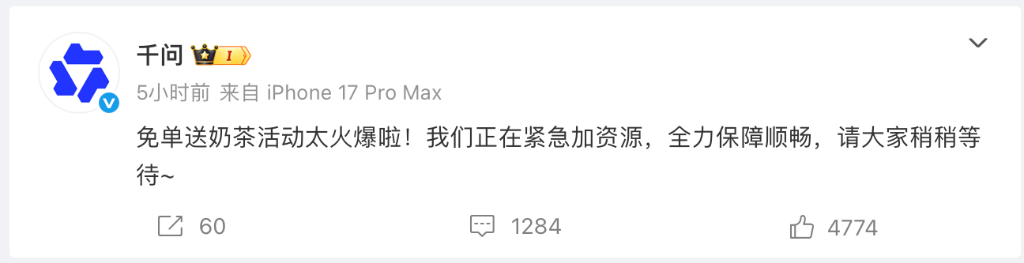
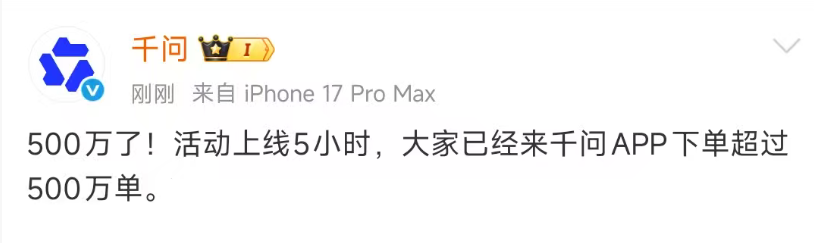
2月6日,阿里千问APP"春节30亿大免单"正式上线,发起奶茶攻势,请全国人民用AI一句话免费点奶茶。 刚刚,据千问:活动上线5小时,下单超过500万单。 随后,千问在社交平台发布动态回应称,免单送奶茶活动太火爆,正在紧急加资源,全力保障顺畅。 有网友称,自己的单子都没有骑手接单,商家好像也做不过来,一直在等。 界面显示,网页包含诱导分享、关注等诱导行为内容,请长按网址复制后使用浏览器访问。 目前腾讯元宝、百度文心、阿里千问都在布局春节红包,甚至推出了裂变式传播活动。此前媒体报道,腾讯元宝、 百度文心助手红包分享链接被微信屏蔽,页面显示网页存在诱导或误导下载/跳转的内容,需要跳转第三方浏览器访 问。目前,腾讯元宝、百度文心红包分享机制已变更为口令红包。 值得关注的是,这类因福利活动引发奶茶门店爆单的情况并非首次出现。 有用户反馈,出现服务器卡顿问题。部分用户分享的页面显示,"活动太火爆,请稍后再试"。 在此活动影响下,港股茶饮股多数上涨,古茗涨超5%创上市来新高,茶百道涨超4%,沪上阿姨、蜜雪集团跟随上 涨。 据此前报道:目前千问红包二维码分享链接已被微信封禁。 2025年7月外卖平台补贴大战期间,"奶茶咖啡 ...
港股茶饮板块上扬,古茗涨幅超4%
Cai Jing Wang· 2026-02-06 05:07
(wind) 2月6日,港股茶饮板块多支股票上扬。截至发稿,古茗涨幅4.12%,沪上阿姨涨幅3.93%,茶百道涨幅 3.74%,奈雪的茶涨幅0.93%,蜜雪集团涨幅0.6%。 (编辑:林辰) ...
国证国际晨报-20260206
国投证券(香港)· 2026-02-06 05:04
板块方面,大消费板块涨幅靠前。其中,思摩尔国际 6969.HK 涨 8.99%,名创 优品 9896.HK 涨 6.18%,毛戈平 1318.HK 涨 5.29%,达势股份 1405.HK 涨 5.21%, 周黑鸭 1458.HK 涨 4.46%,古茗 1364.HK 涨 3.86%,蜜雪集团(02097.HK)涨 2.9%,青岛啤酒股份 168.HK 涨 2.82%,茶百道 2555.HK 涨 1.75%。商务部等多 部门印发《2026「乐购新春」春节特别活动方案》,鼓励各地增加春节期间消费 品以旧换新补贴数量,加大线下实体零售支持力度,在一定程度上提振了市场 信心。 港股晨报 2026 年 2 月 6 日 国投证券(香港)有限公司 • 研究部 1. 国投证券国际视点:热门交易全面退潮,裁员潮引发衰 退担忧 昨日,港股三大指数集体录得上涨。其中,恒生指数涨 0.14%,国企指数涨 0.5%, 恒生科技指数涨 0.74%。大市成交金额 3,151.12 亿元,主板总卖空金额 650.73 亿元,占可卖空股票总成交额比率为 22.99%。南向资金北水方面,港股通交易 净流入 249.77 亿港元。港股通 10 ...
港股午评:恒指跌1.13%、科指跌0.47%,大金融股低迷,锂电池逆势上扬 ,茶饮及新能源车股走强、蔚来汽车涨超7%
Jin Rong Jie· 2026-02-06 04:11
Market Overview - The Hong Kong stock market experienced a significant decline, with the Hang Seng Index dropping 1.13% to 26,580.94 points, the Hang Seng Tech Index down 0.47% to 5,380.72 points, and the National Enterprises Index falling 0.52% to 9,045.82 points, indicating a weak overall performance and noticeable market divergence [1][2]. Sector Performance - Major technology stocks faced substantial pressure, with Alibaba down 2.57%, JD Group down 2.21%, and Tencent Holdings down 0.9%, contributing significantly to the index decline. Analysts attribute this adjustment to intensified market competition and regulatory changes, leading to evident capital outflows [2]. - Gold stocks plummeted due to a sharp drop in gold and silver prices, with companies like Zhaojin Mining and Zijin Mining experiencing declines. The decrease in demand for gold as a safe haven and the rebound of the US dollar index pressured gold prices [3]. - Digital currency and AI application stocks also performed poorly, affected by increased market volatility and regulatory uncertainties. Despite the promising outlook for AI applications, the sector is still in its early development stages, facing challenges in commercialization [4]. Active Sectors - Chinese medicine stocks showed strong performance due to favorable government policies supporting traditional Chinese medicine, with companies like Tongrentang Technology and China Traditional Chinese Medicine seeing significant gains [5]. - The paper industry and new consumption concept stocks were active, benefiting from stable raw material prices and improved supply-demand dynamics, attracting investor interest [6]. Corporate Developments - Meituan announced plans to acquire all shares of fresh food e-commerce platform Dingdong Maicai for $717 million, aiming to expand its presence in the fresh food sector and enhance market share [7]. - NIO projected its first quarterly profit, estimating adjusted operating profits between 700 million to 1.2 billion yuan for Q4 2025, a significant reduction in losses compared to the previous year, driven by increased sales and cost-cutting measures [8][9]. - Several companies reported positive earnings forecasts, including Tongda Group, which expects a profit of 115 to 125 million HKD for the fiscal year 2025, and Caike New Energy, which anticipates a revenue of 507 million yuan, reflecting year-on-year increases [10][11]. Institutional Insights - Analysts from Hang Seng Qianhai suggest that while short-term volatility and liquidity shocks may persist, the market's valuation attractiveness is gradually becoming evident, with potential for upward movement in the medium term [12]. - Guosen Securities remains optimistic about the Hong Kong market's future, despite potential risks from rising oil prices and long-term bond yields, emphasizing the resilience of corporate earnings [13]. - Guoyuan International highlights the potential for short-term fluctuations but maintains a positive long-term outlook for the Hong Kong market, citing strong capital resilience [14].

港股午评:恒指跌1.13%,科技金融低迷,千问完成超百万单奶茶,茶饮料股拉升
Ge Long Hui· 2026-02-06 04:08
Market Overview - The Hong Kong stock market experienced a significant decline in early trading, influenced by the drop in U.S. tech stocks and risk assets such as gold, silver, and Bitcoin [1] - The Hang Seng Index fell by 1.13%, while the Hang Seng China Enterprises Index and the Hang Seng Tech Index decreased by 0.52% and 0.47% respectively [1] Sector Performance - Major technology stocks, which serve as market indicators, showed poor performance with Alibaba, JD.com, and NetEase each dropping over 2% [1] - Cryptocurrency-related stocks faced the largest declines, and the financial sector, including insurance and Chinese brokerage firms, also performed poorly [1] - Gold stocks led the decline in the non-ferrous metals sector [1] Notable Company Developments - Alibaba's "Qianwen" event achieved over one million orders for milk tea, contributing to a rise in beverage stocks [1] - Gu Ming reached a historical high, with other brands like Hu Shang Aqi and Mixue Group also seeing gains [1] - The electric vehicle sector showed strength, with NIO achieving its first profitable quarter, leading to a surge of over 7% in its stock price [1]