DeepSeek

Search documents
东方证券: AI应用不断催化有望迎来商业化拐点 电商产业链或将先行受益
智通财经网· 2026-01-12 02:56
Core Viewpoint - The report from Dongfang Securities indicates that by 2026, AI is expected to transition from technological innovation and business logic restructuring to industrial application and global rule-making, with significant growth anticipated in various retail sectors driven by AI, particularly in cross-border e-commerce and e-commerce services [1]. Group 1: AI Commercialization and Market Trends - Recent AI applications are catalyzing growth, with 2026 projected to be a commercial turning point [2] - Companies like Zhiyu Technology and MiniMax have recently gone public, with market capitalizations of 698 billion and 1,054 billion HKD respectively, and MiniMax saw a 109% increase on its first trading day [2] - WeChat announced an AI application and online tool growth plan, providing comprehensive support including cloud development resources and AI computing power [2] - Meta's acquisition of AI startup Manus for over 2 billion USD (approximately 140 billion RMB) is noted as its third-largest acquisition [2] - Upcoming AI events include the AIGC China Developer Conference and the involvement of Huoshan Engine as an exclusive AI cloud partner for the Spring Festival Gala [2] Group 2: AI in Cross-Border E-commerce - AI tools are enhancing efficiency in content creation, customer service, and translation, while also improving inventory management through data analysis [3] - Over 30,000 merchants in Xiaogoods City are utilizing AI tools, with over 1 billion uses of self-developed AI applications [3] - Jiao Dian Technology reported a membership penetration rate exceeding 50% for its AI services on the China Manufacturing Network [3] - Huakai Yibai is leveraging its "Yibai Cloud" platform for intelligent enterprise management [3] - Jihong Co. is using its "Giikin" system to implement AI algorithms for market analysis and user profiling [3] Group 3: AI in E-commerce Services - TP companies are using AI tools to analyze consumer shopping preferences, enhancing product visibility and purchase intent [4] - Qingmu Technology has developed various technical tools to support the accelerated application of AI in e-commerce operations [4] - Yiwan Yichuang, as an early partner with Alibaba, is building a GEO-related team to gain competitive advantages [4] - Kaichun Co. has established an "AI Intelligent Laboratory" to deepen strategic cooperation with Alibaba [4] Group 4: Investment Recommendations - Recommended investments in AI-driven cross-border e-commerce include Xiaogoods City and Jiao Dian Technology for B2B, and Huakai Yibai and Jihong Co. for B2C [5] - Brand companies like Anker Innovations, Ugreen Technology, and Zhiou Technology are also highlighted for their AI-enhanced business efficiency [5] - In the AI e-commerce services sector, recommended companies include Qingmu Technology, Yiwan Yichuang, Liren Lizhuang, and Kaichun Co. [5]

马斯克宣布开源X推荐算法;印尼暂时封禁马斯克旗下AI聊天机器人
Sou Hu Cai Jing· 2026-01-12 02:16
Group 1: AI Developments - Elon Musk announced the open-sourcing of the X platform's content recommendation algorithm, which will cover all code used to recommend natural and advertising content, with updates every four weeks [2] - Indonesia has temporarily banned Musk's AI chatbot "Grok" due to concerns over potential generation of inappropriate content, marking the first country to restrict access to this AI tool [2] - DeepSeek is set to release its next-generation AI model, DeepSeek V4, in February, which is reported to outperform existing models in code generation capabilities [3] Group 2: Investments and Financing - OpenAI and SoftBank have jointly invested $1 billion in SB Energy to support the construction of AI data centers in the U.S., with each contributing $500 million [3] - Forvia Hydrogen has completed a strategic financing round of 300 million yuan, backed by Sinopec Capital, focusing on hydrogen storage solutions [4] - Turing Quantum has secured several hundred million yuan in strategic financing, aimed at advancing research and commercialization in optical quantum computing [5] - The industrial intelligence company Zhi You Wu Jie has completed a seed round financing of several million yuan, with plans to enhance product development and team expansion [6] Group 3: Mergers and Acquisitions - Mobileye has announced the acquisition of humanoid robotics company Mentee Robotics for approximately $900 million, which includes cash and stock components [7] Group 4: Technological Innovations - The "Tianma-1000" unmanned transport aircraft successfully completed its first flight test, designed for logistics, emergency rescue, and material delivery [8] - The upcoming Xiaomi 17 Max smartphone is expected to be released in March, featuring a large battery and screen, alongside other new models from various brands [8] - The Zhijie V9, a new luxury MPV from Huawei, is set to launch in Spring 2026, targeting the high-end market with advanced features and a long range [8]



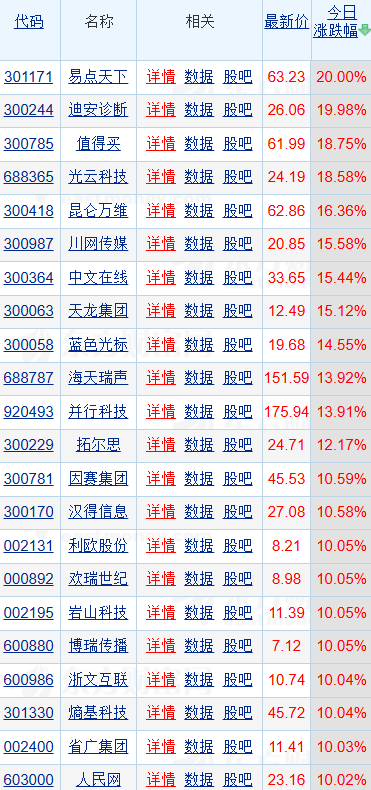
AIGC概念13股涨停!易点天下、迪安诊断20CM涨停,OpenAI入局AI医疗抢占万亿AI医疗市场
Jin Rong Jie· 2026-01-12 02:11
Group 1 - The AIGC concept sector is experiencing active performance, with 13 stocks hitting the daily limit up, indicating strong market interest and investment potential in this area [1][2] - Key stocks that saw significant gains include 易点天下 (20% increase), 迪安诊断 (19.98% increase), and several others with increases exceeding 15% [2] - The market is focused on the accelerated commercialization of AIGC applications, including multi-agent collaboration models and vertical large model registrations, which are driving positive performance expectations for related companies [1][4] Group 2 - DeepSeek's upcoming flagship system R2, expected to launch around February 2026, aims to address critical technology pain points in the AI field, potentially replicating previous market excitement [3] - ByteDance's Volcano Engine has become the exclusive AI cloud partner for the 2026 CCTV Spring Festival Gala, with its豆包大模型 seeing a daily token usage increase to 63 trillion, reflecting rapid growth in the domestic market [4] - The global AI healthcare market is projected to grow significantly, with an estimated size of approximately $26.65 billion in 2024, expected to surge to about $505.59 billion by 2033, indicating a compound annual growth rate of 38.8% [4]

AI应用繁花似锦,电商产业链先行受益
Orient Securities· 2026-01-12 01:47
Investment Rating - The report maintains a "Positive" outlook for the retail industry, indicating a potential return exceeding 5% relative to market benchmarks [8][12]. Core Insights - The report highlights that AI applications are rapidly evolving, with 2026 expected to mark a commercial turning point for the industry. Key developments include significant IPOs and strategic acquisitions in the AI sector, which are anticipated to drive growth in retail [8]. - The integration of AI in cross-border e-commerce and e-commerce services is emphasized, with specific companies identified as beneficiaries of this trend. The report suggests that AI tools can enhance operational efficiency across various segments of the retail industry [3][8]. Summary by Sections AI and Cross-Border E-commerce - AI is expected to create new traffic entry points for B2B platforms, transitioning from SEO to GEO. Companies like Xiaogoods City and Focus Technology are leveraging AI tools to improve operational efficiency and customer engagement [3][8]. - Xiaogoods City has over 30,000 merchants utilizing AI applications, with usage exceeding 1 billion times [8]. - Focus Technology reported a membership penetration rate of over 50% for its AI services [8]. AI and E-commerce Services - The report notes that e-commerce platforms are shifting from SEO to GEO, with third-party (TP) companies gaining advantages through AI tools that analyze consumer preferences [8]. - Companies such as Qingmu Technology and Yiwang Yichuang are developing proprietary technologies to support AI applications in e-commerce operations [8]. - Qingmu Technology has created a suite of tools to adapt to evolving AI technologies, while Yiwang Yichuang is building a dedicated team to enhance its competitive edge in the market [8].




1.12盘前速览 | 20万颗卫星申请创纪录!AI热点扩散,沪指放量破4100
Jin Rong Jie· 2026-01-12 01:46
【卫星互联网】 国家级战略:我国向国际电联申请超20万颗卫星频轨资源,专家解读此举标志卫星资源申请上升至国家 战略层面。 国内外进展:美FCC批准SpaceX部署7500颗二代星;上海、海南等地推进商业火箭及回收技术;国内多 款新火箭计划近期首飞。 应用与畅想:SpaceX在伊朗开通星链;NASA载人绕月任务计划2月发射;《人民日报》文章提及"南天 门计划"概念。 相关ETF: 卫星产业ETF(场内:159218) 【人工智能】 模型进展:DeepSeek V4或于春节发布,聚焦编程能力;行业领袖热议AI范式演进与模型"品味"竞争。 相关ETF: 云计算ETF(场内:159890,场外:021716)、软件龙头ETF(场内:159899,场外:018385)、 半导体设备ETF(场内:561980,场外:020464)、TMT50ETF(场内:159909,场外:004409) 产业生态:马斯克宣布一周内开源X平台推荐算法;沃尔玛将商品购物集成至Gemini;Meta成为全球最 大核能买家。 硬件与供应:闪迪要求客户预付全款锁定未来1-3年存储芯片配额;卖方提示部分光模块上游物料面临 硅光替代带来的过剩压力。 ...
全线大涨!刚刚,利好来袭!
天天基金网· 2026-01-12 01:35
Core Viewpoint - Chinese technology stocks are experiencing a significant boost, with expectations of a major turning point in profitability growth by 2026, surpassing the "Big Seven" U.S. tech companies for the first time since 2022 [2][5]. Group 1: Market Performance - Last week, A-shares in the technology sector surged, with AI applications and semiconductors seeing substantial gains, including over 10% weekly increases in indices related to semiconductors, AIGC, AI healthcare, and multimodal AI [3]. - An Asian technology index has risen approximately 6% this year, outperforming the Nasdaq 100 index, which increased by 2% [4]. Group 2: Investment Sentiment - Major financial institutions maintain a positive outlook on the Asian technology market, with Goldman Sachs recommending an overweight rating due to surging demand for AI and reasonable valuations driving stock price increases [4]. - Citigroup highlights the importance of Asian technology stocks in the semiconductor supply chain and their potential for profit growth, leading global long-term investors to increase their holdings [4]. Group 3: AI Development and Opportunities - The AI industry is witnessing rapid developments, with significant policy support for "AI + manufacturing" initiatives and the recent successful IPOs of companies like MiniMax and Zhiyu AI [7]. - The upcoming release of DeepSeek's V4 model is expected to trigger a new wave of AI application enthusiasm, with improvements in programming capabilities and data pattern understanding [7][8]. - Internet companies in China are intensifying their promotion of AI applications, with notable launches such as Alibaba's "Qianwen" app and Ant Group's AI assistant "Lingguang," which has reached 30 million monthly active users [8]. Group 4: IDC Industry Outlook - The IDC industry is anticipated to see an improvement in supply-demand dynamics due to increased AI-driven demand and policy support, with a potential recovery in orders and profitability by 2026 [9]. - Companies with leading positions in regional resources and reserves are recommended for attention as the industry moves towards a recovery phase [9].

港股异动 | AI概念股多数高开 AI产业迎来密集动态 机构看好相关公司商业化进程加速
智通财经网· 2026-01-12 01:33
Group 1 - The AI concept stocks experienced significant gains, with notable increases in companies such as Zhizhu (up 14.94% to HKD 182.3), MINIMAX (up 9.8% to HKD 378.8), and others [1] - DeepSeek is set to release its next-generation flagship model V4 in the coming weeks, which reportedly surpasses mainstream models like Claude and ChatGPT in code generation capabilities [1] - Elon Musk announced on social media that he will open-source the latest content recommendation algorithm for the X platform within a week, which is interpreted as his entry into the GEO space [1] Group 2 - CITIC Securities highlights the dynamic developments in the AI industry, noting recent financing rounds for overseas companies like xAI and Anthropic, and the introduction of "AI + manufacturing policies" in China [2] - The upcoming launch of DeepSeek-V4 is expected to trigger a new wave of AI application enthusiasm, with a focus on commercial validation in various downstream application scenarios [2] - The improvement in model capabilities, particularly in reasoning and reduced costs for long-window applications, is accelerating the commercialization process in key areas such as search & marketing, coding, multimodal, agents, and AI for science [2]
西部证券晨会纪要-20260112
Western Securities· 2026-01-12 00:56
Group 1: Home Appliances Industry - The report emphasizes the importance of capturing opportunities at the bottom of the consumer sector, focusing on the "dividend +" allocation direction as high-end consumption and certain mass-market products show signs of recovery [1][5] - The report highlights that the market is gradually returning its attention to the consumer sector due to the implementation of national subsidy policies and the demand for high-quality investments, although high valuations and non-mainstream sectors remain less attractive [1][5] - Key recommendations include focusing on companies with strong business models, high dividends, stable performance, and favorable valuations, such as Haier Smart Home, Midea Group, and Gree Electric [3][5] Group 2: Commercial Aerospace and Power Equipment Industry - The commercial aerospace sector in China is characterized by grand planning and significant potential, with expectations for a transition from "hundreds" to "thousands" of low-orbit satellites between 2026 and 2027, marking a shift to mass production and high-density launches [6] - The report suggests that the aerospace cable industry, which requires high environmental performance and reliability, is expected to see significant growth due to the increasing frequency of rocket launches, with recommendations to focus on companies like Hualing Cable [6][7] - The report also discusses the importance of rocket fuel tanks, which represent a significant cost in rocket structures, and suggests monitoring companies like Taisheng Wind Energy for investment opportunities [7] Group 3: Inflation and Economic Indicators - The report notes that the Consumer Price Index (CPI) increased by 0.8% year-on-year in December, the highest since March 2023, indicating a recovery in prices [10][11] - The Producer Price Index (PPI) showed a month-on-month increase of 0.2% in December, with a narrowing year-on-year decline, suggesting a potential acceleration in nominal GDP growth [11][12] - The report anticipates that the trends of rising inflation and nominal GDP growth will continue into 2026, supported by improving economic indicators [11][12]
硅谷教父马克·安德森2026开年访谈:AI革命才刚开始,智能的价格正在崩塌
3 6 Ke· 2026-01-12 00:39
Group 1 - The AI revolution is considered the largest technological revolution ever witnessed, surpassing the internet and comparable to electricity and the steam engine, with the industry still in its early stages [4][25][26] - The emergence of AI technologies has been accelerated by the democratization of access, with powerful AI models available to the public through platforms like ChatGPT, Grok, and Gemini [5][6] - The revenue growth of leading AI companies is unprecedented, indicating that the industry is still in its infancy and will continue to evolve significantly over the next five to ten years [6][25] Group 2 - The cost of AI is experiencing "hyper deflation," with unit costs declining faster than Moore's Law, leading to increased demand as prices drop [10][11] - The AI industry operates on two core business models: consumer and enterprise infrastructure, with consumer AI products rapidly deploying to a global audience [7][8] - The pricing model for AI services is shifting towards a "tokens by the drink" approach, which will further drive demand as costs decrease [9][10] Group 3 - The GPU market is expected to transition from a shortage to an oversupply, driven by significant investments in AI infrastructure and the emergence of smaller, efficient models that can replicate the capabilities of larger models [12][14][15] - Companies like DeepSeek and Kimi are emerging as significant players in the AI space, demonstrating that breakthroughs can come from unexpected sources, including smaller firms and open-source models [16][18] - The competitive landscape is evolving, with a mix of large models and smaller models, leading to a diverse range of applications and capabilities in the AI sector [19] Group 4 - Startups in the AI space are not merely "wrappers" around large models; they are developing their own models tailored to specific industry needs, enhancing productivity for professionals [20][21][24] - The pricing strategies of AI startups are more innovative compared to traditional SaaS companies, allowing for better research and development funding [24] - The current state of AI products is still early, with significant improvements expected in the coming years as costs drop and capabilities expand [25][26]

全线大涨!科技股,利好来袭!
券商中国· 2026-01-11 23:32
Core Viewpoint - The article highlights a positive outlook for Chinese technology stocks, with expectations of significant profit growth by 2026, potentially surpassing the "Big Seven" tech companies in the US for the first time since 2022 [1][4]. Group 1: Market Performance - Last week, A-share technology stocks experienced a substantial increase, with sectors like AI applications and semiconductors seeing gains of over 10% [2]. - An Asian technology index has risen approximately 6% this year, outperforming the Nasdaq 100 index, which increased by 2% [3]. Group 2: Investment Sentiment - Major financial institutions, including Goldman Sachs and Citigroup, maintain a positive outlook on the Asian technology sector, driven by surging demand for AI and reasonable valuations [3]. - The Chinese market is identified as a crucial component for investing in Asian technology stocks, fueled by advancements in AI development and supportive government policies [3]. Group 3: AI Applications and Opportunities - The AI industry is witnessing rapid developments, with new policies and significant company listings, such as MiniMax and Zhiyuan AI, indicating a growing interest in AI applications [5][6]. - The upcoming release of DeepSeek's V4 model is anticipated to enhance programming capabilities and improve understanding of data patterns, potentially sparking a new wave of AI application enthusiasm [5]. Group 4: IDC Industry Outlook - The IDC industry is expected to see improved supply-demand dynamics due to increased capital expenditure on AI and a rise in acceptance of domestic computing power [7]. - By 2026, the industry may enter a phase of order recovery and profit release, with conditions favorable for valuation recovery [7].