
格力电器

Search documents
聚焦顺周期,布局高价值,自由现金流ETF(159233)交投活跃
Xin Lang Cai Jing· 2026-01-19 03:32
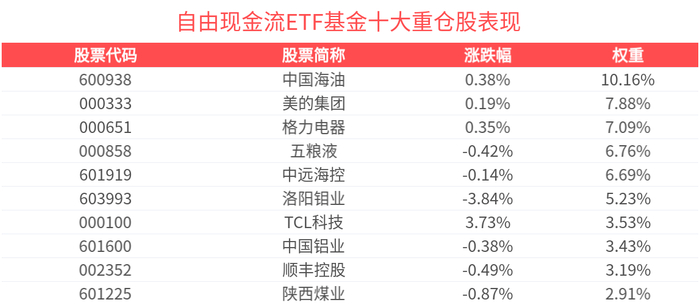
Core Viewpoint - The market is witnessing a strong performance in the free cash flow index, with significant gains in related sectors, particularly in cyclical industries, driven by recent positive developments in the automotive and transportation sectors [1][2]. Group 1: Free Cash Flow Index Performance - The CSI Free Cash Flow Index (932365) increased by 1.08%, with notable gains from stocks such as Xinhua Department Store (+9.99%), Zhongmin Energy (+9.93%), and Pinggao Electric (+9.76%) [1]. - The Free Cash Flow ETF (159233) rose by 1.28%, closing at 1.26 yuan, and is designed to track the CSI Free Cash Flow Index, focusing on cyclical industries [1]. Group 2: Automotive Sector Developments - A new electric vehicle quota agreement between China and Canada is expected to accelerate the entry of Chinese electric vehicles into the North American market, with a reduction in tariffs from 100% to 6.1% for a quota of 49,000 vehicles annually [1]. - The China Automobile Association projects that vehicle exports will reach 7.4 million units by 2026, reflecting a year-on-year growth of 4.3% [1]. Group 3: Transportation Sector Insights - The 2026 Spring Festival travel season is set to begin on February 2, with an expected 539 million passengers, marking a 5.0% increase year-on-year, which will boost demand in the transportation sector [2]. - The Spring Festival is anticipated to enhance profitability across various transportation segments, including railways, civil aviation, and logistics, leading to improved cash flow stability for transportation companies [2].

西部证券晨会纪要-20260119
Western Securities· 2026-01-19 02:39
Group 1: Commercial Aerospace - The commercial aerospace sector is transitioning from "single satellite testing" to "constellation networking," with significant growth expected as China develops reusable rocket technology and increases satellite launches [5][6][7] - The "Zhuque-3" rocket has a launch capacity of 21.3 tons, surpassing the Falcon 9's initial recovery capacity, indicating a strong foundation for future satellite launches [6] - The market potential for domestic satellite launches is substantial, with an estimated annual demand for approximately 4,000 satellites, suggesting a significant growth trajectory for the industry [6][7] Group 2: Automotive Industry - Spring Power (603129.SH) is projected to achieve net profits of 1.907 billion, 2.371 billion, and 2.805 billion yuan from 2025 to 2027, with a target market capitalization of 49.8 billion yuan based on a 21x PE ratio for 2026 [2][13] - The company is positioned as a leader in all-terrain vehicles and large-displacement motorcycles, with competitive advantages in performance and cost-effectiveness compared to international competitors [13][14] - The electric two-wheeler segment is expected to contribute significantly to revenue growth, with sales reaching 250,500 units and revenue of 872 million yuan in the first half of 2025, reflecting a year-on-year increase of 652.06% [15] Group 3: Financial Sector - The introduction of the "Derivatives Trading Supervision Management Measures" aims to regulate the derivatives market, enhancing the legal framework and promoting the development of the derivatives business [32][33][34] - The measures emphasize the importance of derivatives in managing risks and supporting the real economy, indicating a growing focus on regulatory oversight in the financial sector [32][34] - Major securities firms are expected to benefit from the regulatory changes, particularly those with strengths in derivatives trading, as the market becomes more structured and opportunities for growth arise [34] Group 4: Macro Financial Data - In December, new loans totaled 910 billion yuan, with a year-on-year decrease compared to the previous year, while corporate loans showed signs of recovery [18][19] - The social financing growth rate slowed, primarily due to government financing constraints, indicating a need for policy adjustments to stimulate economic activity [19][20] - The central bank's recent rate cuts and liquidity measures suggest a continued effort to support economic growth and maintain stable financing conditions [20][40]
涨超1.4%,自由现金流ETF(159201)近5个交易日净流入1.83亿元
Xin Lang Cai Jing· 2026-01-19 02:32
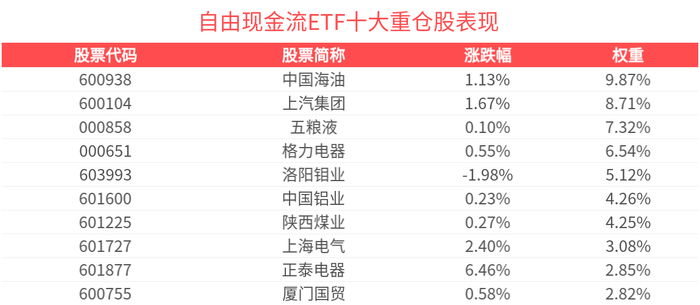
Core Viewpoint - The National Index of Free Cash Flow has shown a strong increase of 1.48%, with significant gains in constituent stocks such as Pinggao Electric and Zhengtai Electric, indicating a positive market sentiment towards companies with high and stable free cash flow [1][2]. Group 1: ETF Performance - The Free Cash Flow ETF (159201) has risen by 1.44%, with a latest price of 1.27 yuan, and has seen a turnover rate of 1.73% with a transaction volume of 166 million yuan [1]. - Over the past week, the average daily transaction volume of the Free Cash Flow ETF was 475 million yuan, reflecting strong investor interest [1]. - The ETF has recorded a net inflow of 125 million yuan recently, accumulating a total of 183 million yuan over the last five trading days [1]. Group 2: Historical Performance - As of January 16, the Free Cash Flow ETF has experienced a net value increase of 20.63% over the past six months, with a maximum monthly return of 7% since its inception [2]. - The ETF has a historical performance record of 80% for monthly profitability, with a 100% probability of profit for a six-month holding period [2]. Group 3: Index Composition - The National Index of Free Cash Flow reflects the price changes of listed companies with high and stable free cash flow, with the top ten weighted stocks accounting for 51.95% of the index [2]. - The top ten stocks in the index include China National Offshore Oil Corporation, SAIC Motor, and Gree Electric Appliances, among others, with China National Offshore Oil Corporation holding the highest weight at 9.87% [3]. Group 4: Fee Structure - The management fee for the Free Cash Flow ETF is 0.15%, and the custody fee is 0.05%, which are among the lowest in comparable funds [5].
如何看待白酒VS白电的配置机会
2026-01-19 02:29
Summary of Key Points from Conference Call Industry Overview - The conference call primarily discusses the **Chinese liquor industry** and the **white goods (appliances) industry**. The liquor industry is expected to undergo an adjustment period until 2025, with a potential balance in the second and third quarters of 2026. The white goods industry has shown resilience due to strong domestic demand and contributions from overseas markets [1][9]. Key Insights on the Liquor Industry - The liquor industry is projected to experience significant pressure in the first half of the year, with a rebound expected in the second half due to lower baselines and inventory reduction efforts [1][2]. - The price of **Moutai** is relatively stable, with the income-to-price ratio for urban residents nearing historical extremes, indicating limited downward price potential [3]. - **Wuliangye** is reducing prices on non-standard products to clear inventory, which could shorten the inventory cycle if quotas are reduced [1][3]. - The demand for liquor is closely tied to the economic cycle, with monetary policy indicators like M1 and M2 being crucial for understanding demand trends [1][5]. - Recommendations include low-position allocations in high-end liquors (Moutai, Wuliangye), regional brands (Gujinggong, Yanghe), and mid-range Fenjiu, which are seen as having good investment value [1][6]. Inventory and Seasonal Trends - The liquor industry is currently experiencing low inventory levels, with a significant drop in prices leading to potential sales exceeding expectations during the upcoming Spring Festival [4][8]. - Historical data suggests that if sales during the Spring Festival exceed expectations, it could alleviate pressure in the latter part of the year [4]. Economic Indicators and Demand Stability - Key indicators such as CPI show signs of stabilizing, suggesting that the liquor industry may be nearing a bottom [7]. - The relationship between liquor demand and economic cycles is significant, with macroeconomic changes and monetary policy having a substantial impact on demand [5]. Insights on the White Goods Industry - The white goods industry has performed well in recent years, supported by strong domestic demand and growth in overseas markets [9][15]. - Challenges include the impact of subsidy policies on demand, rising raw material costs, and competition from brands like Xiaomi [10][12]. - Despite these challenges, the overall impact on the fundamentals is expected to be limited, with leading companies capable of managing cost increases through price adjustments and efficiency improvements [12][13]. Valuation and Investment Opportunities - The current public fund holdings in the white goods sector are at historical lows, suggesting potential for recovery and rebound in valuations [17]. - The white goods sector is viewed as a dividend play, with expected stable growth and increasing dividend rates, making it an attractive investment option [18]. Comparative Analysis - The white goods industry is seen as having advantages over the liquor industry, particularly in terms of overseas market performance and resilience against domestic economic fluctuations [15][19]. - The liquor industry is currently facing a challenging environment, while the white goods sector is positioned for stable growth, making it a more favorable investment choice at this time [19].
小红日报|电力设备表现靓丽,标普A股红利ETF华宝(562060)标的指数收跌0.25%
Xin Lang Cai Jing· 2026-01-19 01:09
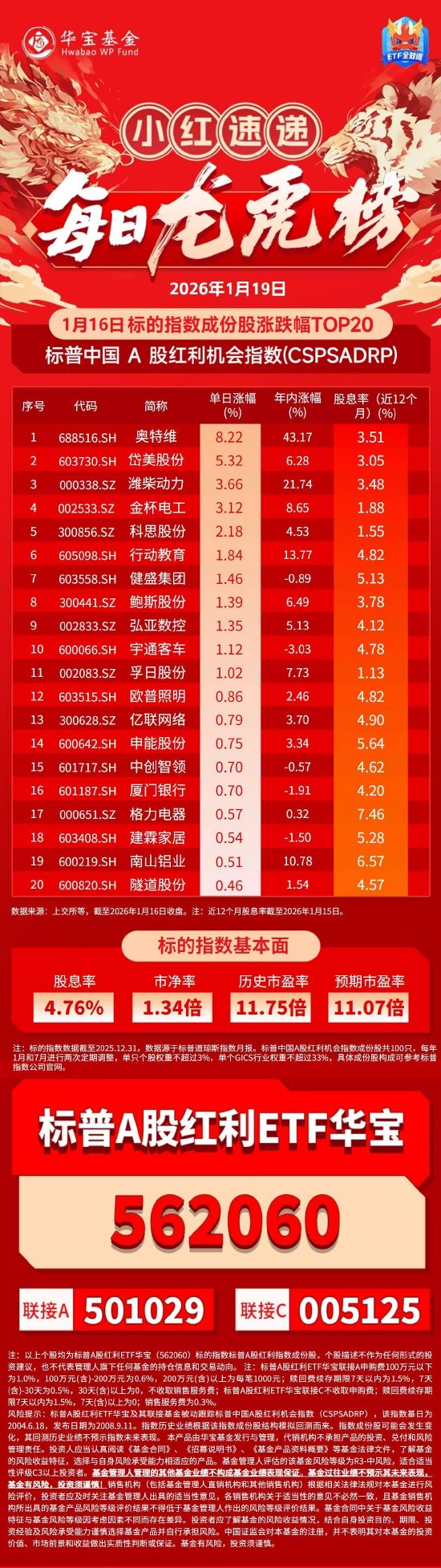
Group 1 - The article highlights the top 20 stocks in the S&P China A-Share Dividend Opportunity Index (CSPSADRP) based on their daily and year-to-date performance as of January 16, 2026 [1][6] - The stock with the highest daily increase is Aotewi (688516.SH) with a rise of 8.22% and a year-to-date increase of 43.17%, along with a dividend yield of 3.51% [1][6] - Other notable performers include Daimai Co. (603730.SH) with a daily increase of 5.32% and a year-to-date increase of 6.28%, and Weichai Power (000338.SZ) with a daily increase of 3.66% and a year-to-date increase of 21.74% [1][6] Group 2 - The list includes various companies with significant dividend yields, such as Gree Electric Appliances (000651.SZ) with a yield of 7.46% and Nanshan Aluminum (600219.SH) with a yield of 6.57% [1][6] - The data is sourced from the Shanghai Stock Exchange and reflects the closing prices as of January 16, 2026, with dividend yields calculated up to January 15, 2026 [1][6]





武汉新增一家大型商店,现场火爆!
Xin Lang Cai Jing· 2026-01-18 22:33
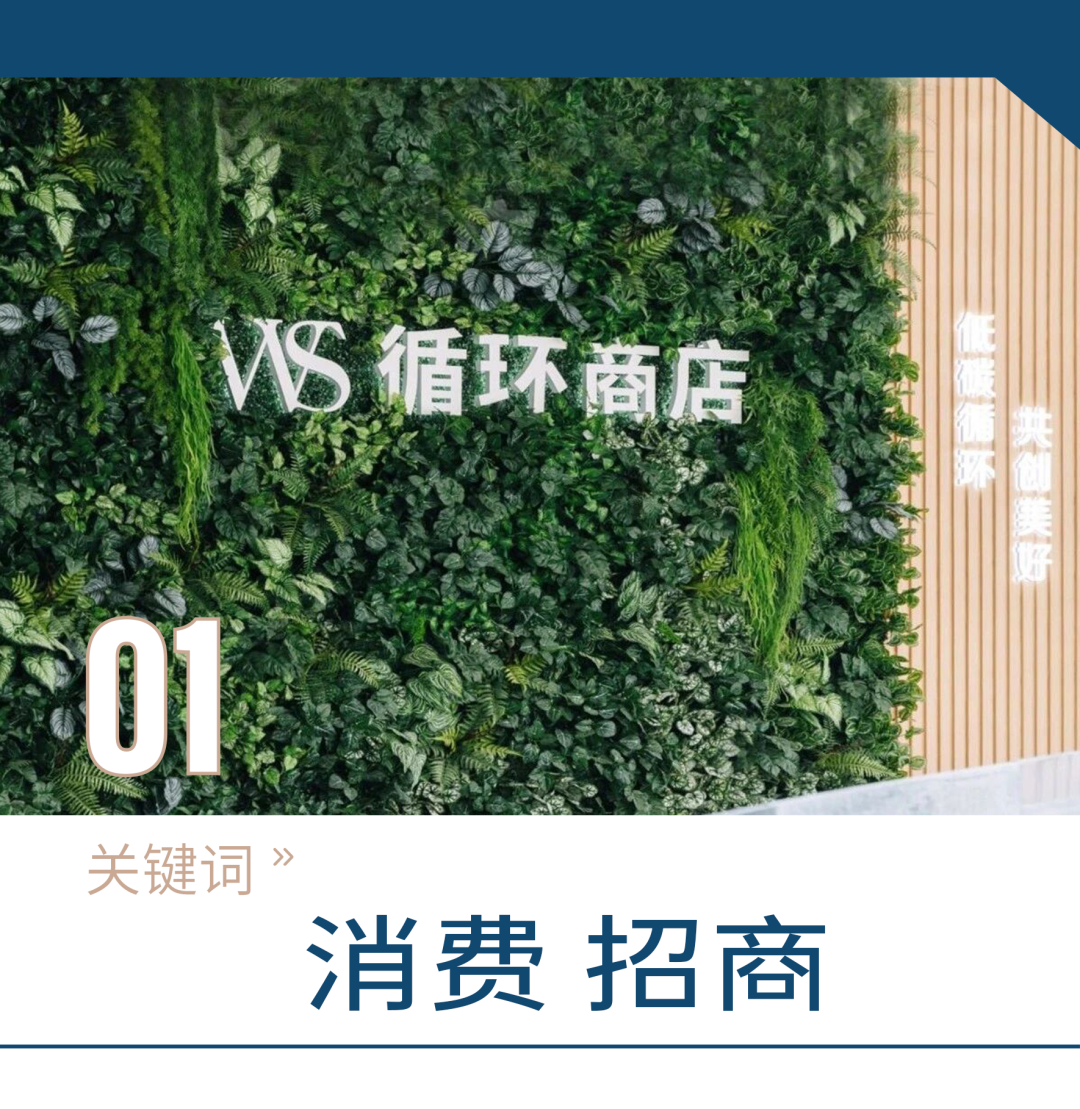
Group 1 - WS International Luxury Second-hand Store opened in Qingshan District, covering approximately 3,000 square meters with over 1,000 high-quality second-hand items from popular brands [4] - Hanyang District launched a car promotion event from January 18 to February 14, offering up to 5,000 yuan in subsidies for purchasing vehicles, which can be combined with national and local subsidies [5] - The establishment of the Guanggu Business School aims to cultivate 500 technology entrepreneurs and startups over the next three years, with a goal of helping at least 50 companies achieve annual revenues exceeding 100 million yuan [12] Group 2 - The "Spring Breeze Action" job fair was held, featuring 80 quality companies offering over 4,000 job positions, aimed at stabilizing employment and promoting development [20] - Wuhan's financial authorities introduced measures to support urban renewal projects, targeting at least 100 projects with a financing support goal of no less than 1,000 billion yuan [21] - The city is experiencing a surge in plum blossom viewing, with nearly 100,000 plum trees blooming across parks and streets, attracting public interest [22]
解锁新场景释放新活力,“共享计划”长株潭好物乐购汇圆满落幕
Xin Lang Cai Jing· 2026-01-18 15:20
Core Insights - The event "Changsha Second Industrial Products Supply and Demand Matching Conference" successfully attracted 150,000 visitors and facilitated over 20,000 transactions, with more than 1,000 intended bulk purchases [1] Group 1: Event Overview - The event showcased a wide range of products across various categories, including food, health, textiles, automotive, home appliances, and artificial intelligence, covering an exhibition area of 10,000 square meters with over 180 booths [2] - The event adopted a "direct sales" model, eliminating intermediaries and providing significant price discounts, allowing consumers to enjoy lower prices than online shopping [2] Group 2: Consumer Engagement - The event featured a popular "AI" section, attracting many visitors to experience cutting-edge technologies like exoskeleton robots and AI health advisors [2] - Online live streaming attracted tens of thousands of viewers, expanding brand influence and reducing buyer search costs for those unable to attend in person [3] Group 3: Economic Impact - The event served as a catalyst for high-quality development in the Changsha-Zhuzhou-Xiangtan consumer goods industry, providing a platform for local enterprises to enhance brand recognition and market reach [4] - Over 100 local enterprises achieved breakthroughs in product sales and established partnerships for raw material procurement, production collaboration, and channel sharing, enhancing supply chain efficiency [4] - The Changsha Industrial and Information Technology Bureau plans to continue promoting the "Shared Plan" to facilitate resource sharing and industry complementarity among the three cities, aiming for greater breakthroughs in brand building, technological innovation, and industry integration [4]

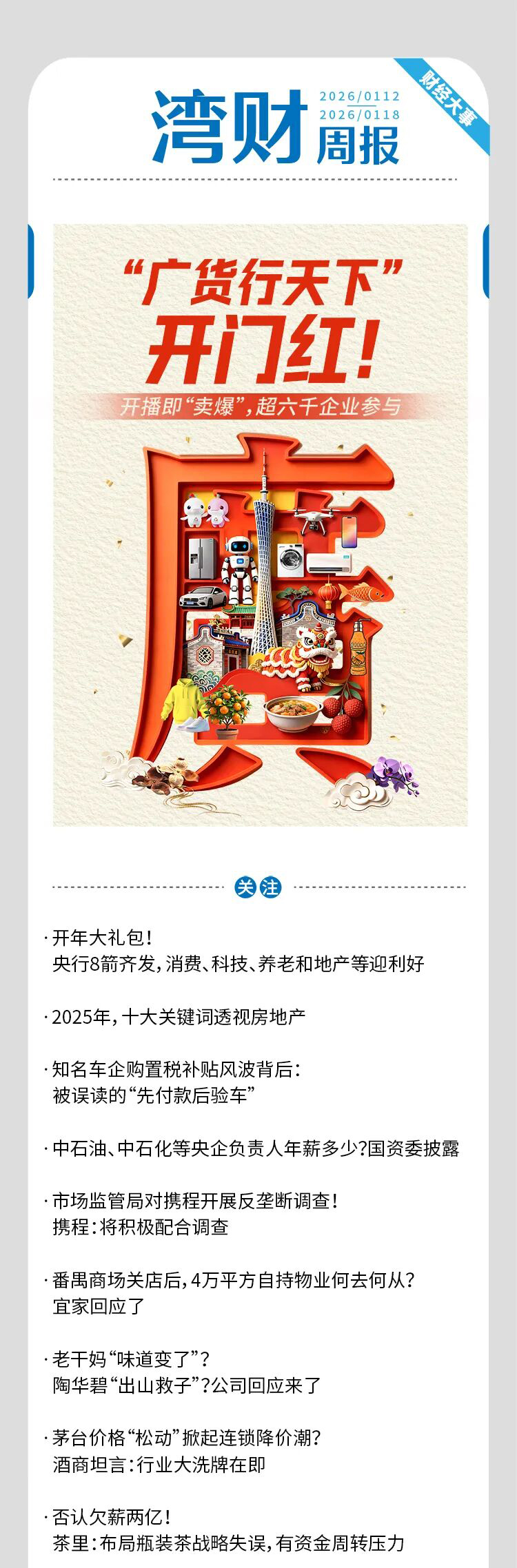
湾财周报 | 大事记 “广货行天下”开门红;央行发大礼包;携程被立案调查
Nan Fang Du Shi Bao· 2026-01-18 15:11
Group 1 - The "Guanghuo Hang Tianxia" spring campaign launched in Guangdong, with over 1,300 local appliance companies participating, aiming to boost sales through online and offline promotions [5] - The campaign will feature 12 synchronized promotional events throughout the first quarter, targeting over 6,000 enterprises to enhance online sales of quality products [5] Group 2 - The People's Bank of China announced eight major policy measures to support economic transformation, including a 0.25 percentage point reduction in various structural monetary policy tool rates and a special relending quota of 1 trillion yuan for private enterprises [6] - The measures also include increasing relending quotas for technological innovation to 1.2 trillion yuan and lowering the minimum down payment for commercial housing to 30% [6] Group 3 - In 2025, the national real estate market continued to adjust, with new residential sales area declining by 4.9% year-on-year to approximately 390 million square meters, and sales value dropping by 10% to around 5.4 trillion yuan [7] - The total transaction volume of new and second-hand residential properties reached 839 million square meters, indicating stable demand from residents [7] Group 4 - Zeekr Automotive clarified its cross-year vehicle purchase tax subsidy policy, stating that it has covered the tax subsidy for 8,125 users who placed orders in 2025 and received their vehicles in January 2026 [9] - The confusion arose from the overlap of two policies, leading to misinterpretations regarding payment and vehicle delivery [10] Group 5 - The State-owned Assets Supervision and Administration Commission disclosed the 2024 salary information for over 80 central enterprise leaders, showing a stable salary range without extreme high salaries [11] - The top earners are primarily from telecommunications and energy sectors, with China Mobile's former chairman leading at a pre-tax salary of 1.2582 million yuan [11] Group 6 - The State Administration for Market Regulation has initiated an antitrust investigation into Trip.com Group for suspected monopolistic behavior [12] - Trip.com has committed to cooperating with the investigation and ensuring normal business operations [12] Group 7 - IKEA announced the closure of its Guangzhou Panyu store, raising questions about the future of its 40,000 square meters of self-owned property [13] - IKEA is currently evaluating arrangements for the asset and will comply with relevant laws and regulations [13] Group 8 - CHALI Tea clarified rumors regarding a 200 million yuan salary debt, admitting to cash flow pressures due to strategic missteps in bottled tea, while assuring that its core bagged tea business remains operational [16] - The company is addressing salary issues for departing employees in batches, although some employees have expressed ongoing concerns about unpaid wages [16] Group 9 - The white wine market is experiencing a price decline, influenced by the price adjustments of flagship products like Moutai, leading to a broader price reduction across various brands [15] - The industry is facing inventory pressures, prompting some distributors to lower prices to stimulate sales, indicating a shift towards a "price for volume" strategy [15]
全球视野看家电:从三星电子看家电龙头产业升级之路
Changjiang Securities· 2026-01-18 14:25
Investment Rating - The report maintains a "Positive" investment rating for the home appliance industry [13] Core Insights - The report analyzes Samsung Electronics' successful transition from home appliances to semiconductor storage, display panels, and mobile phones, providing a reference for China's leading home appliance companies in their industrial upgrades [4] - Samsung Electronics has achieved an average annual compound growth rate of 19% in net profit from 1993 to 2024, making it the largest and fastest-growing home appliance company globally [7][34] - The report emphasizes the importance of proactive engagement with industry changes and policy opportunities during the growth phase of home appliances, highlighting Samsung's strategic investments and efficiency improvements [8][9] Summary by Sections Background and Timing - Samsung Electronics entered the semiconductor storage industry in 1983 when the penetration rate of home appliances in South Korea was rapidly increasing, supported by a strong GDP growth rate of over 10% [8][46] - The company capitalized on government support and market opportunities to navigate early losses and establish a profitable cycle in the semiconductor industry [8][46] Challenges and Strategies - Samsung leveraged its latecomer advantage and implemented a counter-cyclical investment strategy to quickly capture market share, achieving a 39% market share in the storage sector by 2024 [9] - The company focused on efficiency and cost advantages across various dimensions, including organizational structure and production strategies [9] Effects and Outcomes - By 2017, Samsung surpassed Intel to become the world's largest semiconductor manufacturer, with R&D investment increasing from 2% in 1980 to 12% in 2024 [10] - The company successfully expanded into display panels and mobile phones, creating a synergistic industrial system that enhanced its brand image and market position [10] Comparison with Midea Group - Midea Group is positioned to achieve significant industrial upgrades, with a projected 22% revenue contribution from non-home appliance sectors by 2024 and a growth rate of 15%-20% in recent years [11] - The report highlights Midea's advantages in cash flow stability and efficiency, suggesting a strong potential for industrial upgrades [11]

家电零部件行业延续领涨,智能厨电行业快速发展
Xiangcai Securities· 2026-01-18 12:22
Investment Rating - The report maintains an "Overweight" rating for the home appliance industry [1][8]. Core Views - The home appliance industry has experienced a decline of 0.34% this week, with the home appliance components sub-industry leading the gains [3][10]. - The valuation of the home appliance industry is at a historical low, indicating potential for upward movement, with a current PE ratio of 15.63, ranking 25th among 31 industries [4][26]. - The smart kitchen appliance sector is rapidly developing, highlighted by Boss Electric's investment of 100 million RMB in Youte Smart Kitchen, focusing on the cooking robot market, which is projected to grow significantly [5][47]. Summary by Sections Industry Performance - The home appliance industry has shown a relative performance of -0.2% over the past month, +2.7% over three months, and -13.0% over the past year compared to the CSI 300 index [2][3]. Valuation Insights - The home appliance industry's PE ratio of 15.63 is higher than the CSI 300's 13.50, with a valuation percentile of 39.2%, indicating a more attractive investment opportunity compared to the broader market [4][26]. Smart Kitchen Appliances - The cooking robot market in China is expected to reach 3.7 billion RMB by 2025 and exceed 11.7 billion RMB by 2030, reflecting a significant growth trajectory [5][47]. Investment Recommendations - The report suggests focusing on three main lines for investment in 2026: 1. Companies with stable market positions and high dividend yields in the white goods sector [6][54]. 2. Companies innovating with new products and technologies in niche markets such as cleaning robots and smart home devices [6][54]. 3. Opportunities arising from the "trade-in" policy and advancements in AI and smart home technologies [6][54].