
珀莱雅

Search documents
国产化妆品“一姐”珀莱雅港股IPO,今年第三季度业绩下滑
Ge Long Hui· 2025-11-12 10:25
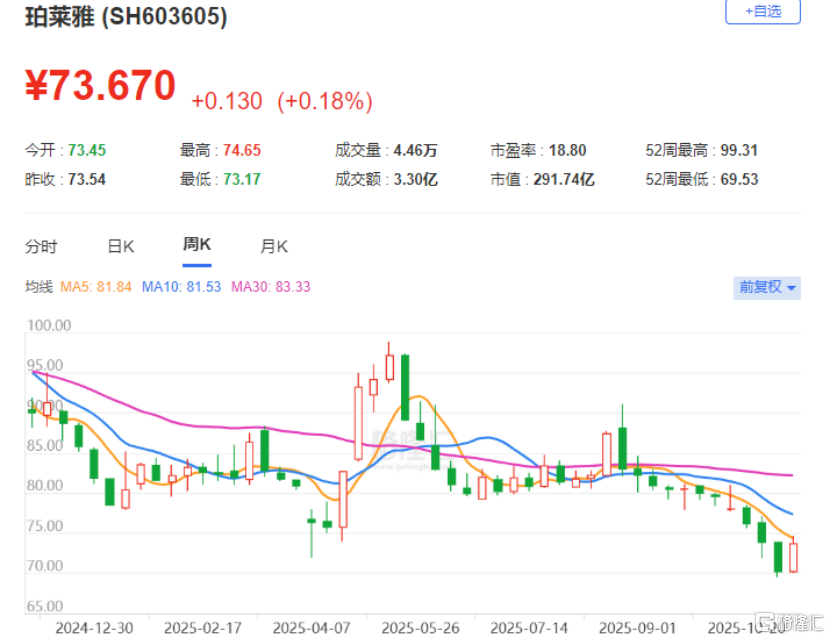
Core Viewpoint - The article highlights the competitive landscape of the Chinese cosmetics market, focusing on the success of local brand Proya, which is preparing for an IPO in Hong Kong while facing challenges from both international and domestic competitors [1][23]. Company Overview - Proya, established in 2006 and listed on the Shanghai Stock Exchange in 2017, is headquartered in Hangzhou and has a market capitalization of approximately 29.2 billion RMB [5][9]. - The company has a diverse product range covering skincare, makeup, and personal care, with its main brand contributing over 70% of its revenue [11][23]. Market Trends - In 2024, local cosmetic brands are projected to hold a market share of 49.9% in China, an increase from previous years but still lower than South Korea and Japan [1]. - The per capita spending on cosmetics in China is around 664 RMB, significantly lower than that in developed Asian countries, indicating potential growth as income levels rise [1][21]. Financial Performance - Proya's revenue has shown a growth trend, with figures of approximately 6.39 billion RMB in 2022, 8.90 billion RMB in 2023, and projected 10.78 billion RMB in 2024 [19][20]. - The gross profit margin has remained around 70%, but the company reported a decline in third-quarter performance for 2025, with revenue dropping by 11.63% year-on-year [19][20]. Sales Channels - Over 70% of Proya's revenue comes from online direct sales, with a significant reliance on platforms like Tmall and JD.com [16][17]. - The company has experienced a compound annual growth rate of 44% in online sales from 2019 to 2024, surpassing leading foreign skincare brands [8]. Competitive Landscape - Proya is the only domestic brand among the top five cosmetics brands in China, holding a market share of 1.3% [23]. - The company faces intense competition from international giants like L'Oréal and Shiseido, as well as domestic brands such as Shanghai Jahwa and Huaxi Biological [23]. Future Outlook - The Chinese cosmetics market is expected to grow at a compound annual growth rate of 6.6% from 2024 to 2029, driven by increasing consumer demand for skincare and makeup products [21][23]. - Proya's upcoming IPO aims to raise funds for research and development, brand building, and digital transformation, reflecting its ambition for expansion [9][23].


珀莱雅联合创始人做LP
FOFWEEKLY· 2025-11-12 10:04
Core Viewpoint - The primary focus of the article is the resurgence of the primary market, with a notable return of Limited Partners (LPs) who had previously withdrawn from the investment scene, indicating a positive shift in market sentiment [2][3]. Fundraising Market - The fundraising market has seen a significant uptick, with multiple institutions announcing the completion of new fundraises, including a revival of previously slowed dollar funds [3]. - Data indicates a marked increase in fundraising, investment, and exit activities, suggesting a robust recovery in the market [3]. Return of LPs - A noteworthy trend is the gradual return of major LPs, including foreign LPs, who are showing renewed interest in the market [3]. - Fang Yuyou, co-founder of Proya, has recently invested 20 million in a consumer equity investment fund, highlighting the active role of individual LPs in the current market [7][8]. Market Dynamics - The investment landscape is experiencing a structural "warming" after years of capital winter and valuation adjustments, with significant increases in LP activity [10]. - In September, LP investment activity reached a peak, with a 40.3% month-on-month increase and a 38.3% year-on-year increase, marking the highest level of activity this year [10]. Fund Registration - The number of newly registered private equity and venture capital funds in September was 557, representing a 51.4% month-on-month increase and an 84.4% year-on-year increase, indicating a strong recovery in fund registrations [10]. Investment Trends - Early-stage investment institutions are particularly active, with reports of tripling the number of projects invested in compared to the previous year [10]. - There is a noticeable increase in roadshows and industry conferences, with investors actively seeking opportunities in popular projects [11]. Conclusion - The signals of market recovery are becoming increasingly clear, with LPs becoming more proactive in their investments as supportive policies are implemented [13].

青松股份(300132):收入回暖,盈利大幅改善
Haitong Securities International· 2025-11-12 09:34
Investment Rating - The report maintains an "Outperform" rating for the company, with a target price of RMB 10.50 based on a target PE of 35x for 2026 [4][13]. Core Insights - The company has turned around after four years of adjustments, entering a growth phase with improved revenue and profit [4][14]. - For the first three quarters of 2025, revenue, net profit attributable to shareholders, and recurring net profit were RMB 1.55 billion, RMB 111 million, and RMB 75 million, representing year-on-year increases of 12.00%, 246.98%, and 146.48% respectively [4][14]. - The mask category has shown significant growth, leading the overall revenue increase, while the company is expected to gain market share as the industry recovers from a downturn [4][16]. Financial Summary - Revenue projections for 2025-2027 are RMB 2.185 billion, RMB 2.446 billion, and RMB 2.689 billion, with respective growth rates of 12.6%, 11.9%, and 9.9% [3][5]. - Net profit attributable to shareholders is forecasted to be RMB 142 million, RMB 154 million, and RMB 203 million for 2025-2027, with growth rates of 160.0%, 8.5%, and 31.4% [3][5]. - The company's gross profit margin for Q3 2025 was 21.77%, up 2.83% year-on-year, indicating improved operational efficiency [4][14]. Product Category Performance - In H1 2025, revenue from masks, skincare, and wipes was RMB 450 million, RMB 323 million, and RMB 125 million, with year-on-year growth of 21%, 7%, and a decline of 9% respectively [4][15]. - The gross profit margins for masks, skincare, and wipes were 19.01%, 16.67%, and 13.45%, reflecting improvements due to increased capacity utilization and revenue growth [4][15]. Industry Outlook - The cosmetics industry has faced a downturn since 2022, leading to intensified competition and the exit of smaller players, which is expected to benefit leading companies like the report's subject [4][16]. - The company's subsidiary, North Bell, is positioned to attract quality brands and gain market share due to its scale advantages and ongoing R&D investments [4][16].

中国“双11”促销效果下降
日经中文网· 2025-11-12 08:00
Core Insights - The "Double 11" shopping festival in China has evolved into a prolonged promotional period, with consumers becoming accustomed to discounts and promotions, leading to a decline in consumer enthusiasm [2][6] - Consumer confidence remains low, with the consumer confidence index at 89.6 in September, below the optimistic threshold of 100, indicating ongoing economic challenges [6] - Japanese brands are facing tough competition in the Chinese market, with a notable shift towards domestic products and a slight recovery in sales for certain categories [7][8] E-commerce Trends - E-commerce companies have extended promotional periods to over a month, with JD.com starting promotions three days earlier than in 2024, and Alibaba's promotions lasting until November 14 [6][10] - The trend of "emotional consumption" has emerged, with increased sales in outdoor sports products and cartoon-themed items during the early phase of the Double 11 promotions [6] Japanese Brands in China - Japanese brands are experiencing a decline in circulation on major e-commerce platforms, but there are signs of recovery with a 1% increase in circulation for the first ten months of the year [7] - Specific categories such as sports and outdoor products have seen significant growth, with a 19% increase, while clothing and skincare products grew by 4% [7][8] Consumer Behavior - Consumers are increasingly price-sensitive, with a focus on finding the lowest prices for everyday items, reflecting a shift in purchasing behavior [4][6] - The concept of "fail-proof shopping" is gaining traction among Chinese consumers, emphasizing the need for brands to provide value beyond discounts [10]



可选消费W45周度趋势解析:海内外消费子版块均无共振,内部因素催化股价表现-20251111
Haitong Securities International· 2025-11-11 15:11
Investment Rating - The report assigns an "Outperform" rating to multiple companies including Nike, Midea Group, JD Group, Haier Smart Home, Gree Electric, Anta Sports, China Duty Free, and others [1]. Core Insights - The report highlights that domestic and overseas consumer subsectors are not showing synchronized movements, with internal factors driving stock performance [4][10]. - The performance of various sectors is analyzed, indicating that the U.S. hotel sector has outperformed others, while luxury goods and overseas cosmetics have seen significant declines [10][13]. Sector Performance Summary - **U.S. Hotels**: The sector saw a weekly increase of 7.9%, driven by strong performance from Marriott and Hilton, with Marriott's RevPAR growth meeting market expectations [5][13]. - **Pet Sector**: Increased by 1.1%, with leading brands showing significant growth in GMV despite overall sales being weak [5][13]. - **Gambling Sector**: Rose by 0.7%, with Macau's GGR exceeding expectations, indicating strong future performance [5][13]. - **Retail Sector**: Experienced a slight decline of 0.3%, with China Duty Free benefiting from new tax policies [7][13]. - **Snack Sector**: Fell by 1.9%, with competitive pressures affecting performance [7][13]. - **Gold and Jewelry Sector**: Decreased by 2.5% due to tax reforms impacting profitability [7][13]. - **Overseas Sportswear**: Dropped by 2.8%, facing tariff pressures and concerns over U.S. consumer spending [7][13]. - **Luxury Goods**: Declined by 3.0%, with concerns over upcoming earnings reports affecting stock prices [7][13]. - **Domestic Cosmetics**: Fell by 3.4%, with overall performance weaker than international brands [7][13]. - **Overseas Cosmetics**: Experienced a significant drop of 11.6%, primarily due to ELF Beauty's disappointing earnings [7][13]. Valuation Analysis - Most sectors are valued below their average over the past five years, with specific PE ratios indicating potential undervaluation [8][14]. - **Overseas Sportswear**: Expected PE of 28.6, 54% of the past five-year average [14]. - **Domestic Sportswear**: Expected PE of 14.1, 74% of the past five-year average [14]. - **Gold and Jewelry**: Expected PE of 22.1, 42% of the past five-year average [14]. - **Luxury Goods**: Expected PE of 25.6, 46% of the past five-year average [14]. - **Gambling**: Expected PE of 29.1, 47% of the past five-year average [14]. - **Overseas Cosmetics**: Expected PE of 35.5, 53% of the past five-year average [14]. - **Domestic Cosmetics**: Expected PE of 27.9, 52% of the past five-year average [14]. - **Pet Sector**: Expected PE of 40.3, 55% of the past five-year average [14]. - **Snack Sector**: Expected PE of 26.8, 65% of the past five-year average [14]. - **Retail Sector**: Expected PE of 28.6, 53% of the past five-year average [14]. - **U.S. Hotels**: Expected PE of 31.4, 19% of the past five-year average [14]. - **Credit Card Sector**: Expected PE of 28.9, 55% of the past five-year average [14].
商社美护行业周报:10月CPI表现超预期,离岛免税新政落地海南免税消费市场升温-20251111
Guoyuan Securities· 2025-11-11 14:43
Investment Rating - The report maintains an "Overweight" rating for the industry, with a focus on new consumption sectors such as beauty care, IP derivatives, and gold jewelry [6][29]. Core Insights - The October CPI performance exceeded expectations, with a year-on-year increase of 0.2%, higher than the consensus forecast of -0.04%. The core CPI, excluding food and energy, rose by 1.2%, marking the highest increase since March 2024 [4][24]. - The implementation of the new duty-free policy in Hainan has led to a surge in tourism consumption, with duty-free shopping amounting to 506 million yuan from November 1 to 7, representing a year-on-year growth of 34.86% [5][27]. - Key events in the beauty care sector include Kimberly-Clark's acquisition of Kenvue, expected to complete in the second half of 2026, and Amorepacific's Q3 operating profit increasing by 41% [4][24]. Summary by Sections Market Performance - For the week of November 3 to November 7, the retail trade, social services, and beauty care sectors saw changes of +0.31%, +0.11%, and -3.10% respectively, ranking 17th, 19th, and 31st among 31 primary industries [15][17]. Key Industry Data and News - The beauty care sector is highlighted by Kimberly-Clark's acquisition of Kenvue and Amorepacific's significant profit increase. Additionally, new medical devices have received regulatory approval [4][24]. - In the travel sector, the number of domestic flights increased by 4.9% compared to 2019, with a total of approximately 101,000 flights executed in the week [5][24]. - The IP derivatives market is seeing growth, with significant sales expected from the film "Wang Wang Mountain" and new store openings in the toy sector [5][28]. Investment Recommendations - The report recommends focusing on companies such as Shangmei Co., Juzhibio, Marubi, Runben, Proya, Chaohongji, and Furuida within the beauty care and new consumption sectors [6][29].
化妆品板块11月11日跌0.09%,拉芳家化领跌,主力资金净流出6415.55万元
Zheng Xing Xing Ye Ri Bao· 2025-11-11 08:46
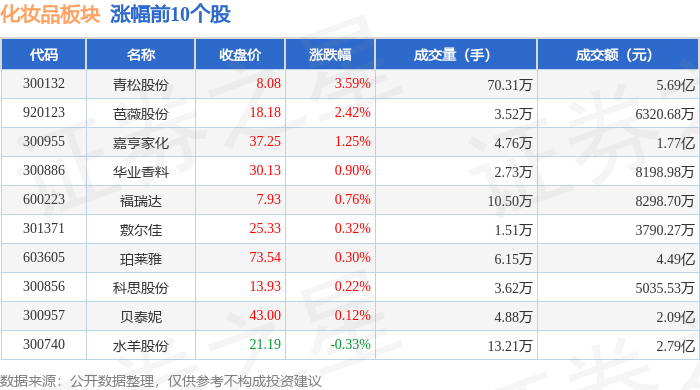
Core Insights - The cosmetics sector experienced a slight decline of 0.09% on November 11, with Lafang Jiahua leading the drop [1] - The Shanghai Composite Index closed at 4002.76, down 0.39%, while the Shenzhen Component Index closed at 13289.0, down 1.03% [1] Market Performance - Notable gainers in the cosmetics sector included: - Yusong Co., Ltd. (300132) with a closing price of 8.08, up 3.59% and a trading volume of 703,100 shares, totaling 569 million yuan [1] - Bavi Co., Ltd. (920123) with a closing price of 18.18, up 2.42% and a trading volume of 35,200 shares, totaling 63.21 million yuan [1] - Lafang Jiahua (603630) closed at 23.17, down 1.45%, with a trading volume of 50,100 shares, totaling 116 million yuan [2] - The overall net capital flow in the cosmetics sector showed a net outflow of 64.16 million yuan from main funds, while retail funds saw a net inflow of 28.82 million yuan [2][3] Capital Flow Analysis - Main funds showed significant outflows in several companies: - Jiahen Jiahua (300955) had a main fund net outflow of 15.26 million yuan, with a retail net inflow of 21.48 million yuan [3] - Lafang Jiahua (603630) experienced a main fund net outflow of 7.23 million yuan, but retail funds saw a net inflow of 9.61 million yuan [3] - Shanghai Jahwa (600315) had a main fund net inflow of 1.61 million yuan, while retail funds had a net outflow of 12.56 million yuan [3]

美妆“抗老”宣传罚单频现 这个双11谁还在“擦边”冒险?
Feng Huang Wang· 2025-11-11 05:56
Core Viewpoint - The competition in the beauty and skincare sector during this year's Double Eleven shopping festival is intense, with brands aggressively promoting anti-aging claims despite regulatory risks [1][2][3]. Group 1: Marketing Strategies - Many beauty brands are using "anti-aging" and "anti-aging" as key marketing slogans to address consumer anxieties about aging [2]. - Brands like Proya and Pechoin are prominently featuring "anti-aging" in their promotional materials, with specific product claims such as "scientific anti-aging" and "visible youth in 4 weeks" [9][12]. - Despite these claims, some brands' customer service representatives have stated that their products do not have anti-aging effects, highlighting a contradiction in marketing versus product classification [10][13]. Group 2: Regulatory Compliance - The National Medical Products Administration has not recognized "anti-aging" as an approved claim under the 26 categories of cosmetic efficacy, making such claims a regulatory risk [2][15]. - Several brands have faced administrative penalties for making unapproved efficacy claims, indicating a growing concern over compliance in the industry [4][17]. - The current regulatory framework requires that any claims made must be supported by scientific evidence, which many brands fail to provide, leading to potential accusations of false advertising [15][16]. Group 3: Market Dynamics - Despite previous penalties, many brands continue to push the boundaries of regulatory compliance, suggesting that the cost of non-compliance is perceived as low compared to the potential sales benefits of appealing to consumer desires for anti-aging products [18]. - The strong consumer demand for anti-aging products drives brands to prioritize short-term profits over long-term regulatory compliance, creating a challenging environment for maintaining ethical marketing practices [18][19].
大消费反攻!布局时点到了?丨每日研选
Sou Hu Cai Jing· 2025-11-11 01:05
Core Viewpoint - The consumer sector is showing signs of recovery, driven by favorable policies, rising CPI, and the imminent closure of Hainan Free Trade Port, leading to increased investment enthusiasm in the sector [2][4]. Group 1: Consumer Sector Analysis - The consumer sector is believed to be at the bottom, with fundamentals gradually improving, as indicated by the third-quarter reports [4]. - The "14th Five-Year Plan" emphasizes the importance of consumption, suggesting a positive outlook for the sector [4]. - Key investment opportunities include the restaurant chain sector, which is nearing the end of price wars, and companies like Anjiexin Foods and Lihai Foods are seeing improved net profit margins [4]. Group 2: Duty-Free Industry Insights - Hainan's duty-free sales data shows a significant recovery in Q3 2025, with a notable increase in average transaction value, and a stable outlook for Q4 [5]. - Continuous policy support, including a clear timeline for the island's closure and an expanded range of duty-free products, is expected to enhance the operational conditions for companies like China Duty Free Group and Hainan Development [5]. Group 3: Structural Upgrades in Consumption - The toy industry is evolving with IP incubation and category innovation, favoring leading companies with strong design and supply chain capabilities [6]. - The beauty industry is integrating medical, beauty, and health services, which is expected to enhance customer spending and repeat purchases [6]. - The consumer industry is transitioning from "functional supply" to "scenario value supply," indicating a structural upgrade in brand consumer goods [6]. Group 4: New Consumption Trends - Four new consumption themes are emerging: 1. Brand globalization 2.0, focusing on pricing power and emerging markets [7]. 2. Emotional value sectors like trendy toys and pet products are expected to benefit from rising GDP per capita [7]. 3. AI-driven consumption in service sectors is showing potential for profitability [7]. 4. Channel transformation emphasizing user experience and operational efficiency, particularly in instant retail and cost-effective dining [7]. Group 5: High-Growth Opportunities in Emotional Consumption - The gold and jewelry sector is undergoing significant changes, with rising gold prices and a shift towards emotional consumption, suggesting opportunities in high-end and trendy gold segments [8]. - Retail e-commerce is focusing on offline retail transformation and AI-enabled cross-border e-commerce leaders [8]. - The cosmetics sector is seeing growth in domestic brands that meet emotional value and safety ingredient innovation [8]. - The medical beauty sector remains resilient, with opportunities in differentiated products and mergers in downstream medical beauty institutions [8].





晨会报告:今日重点推荐-20251111
Shenwan Hongyuan Securities· 2025-11-11 00:58
Group 1: Key Insights on the Liquor Industry - The liquor industry is entering a strategic layout period as it approaches a bottom, with a bullish outlook for high-quality companies [2][10] - Historical performance from 2012 to 2015 indicates that stock price turning points precede fundamental turning points, with expectations for a fundamental turning point in Q3 2026 [2][10] - If the fundamentals recover as anticipated, a dual boost in valuation and performance is expected from late 2026 to 2027 [2][10] - Recommended stocks include Luzhou Laojiao, Shanxi Fenjiu, Kweichow Moutai, and Wuliangye, with additional attention on Yingjia Gongjiu and Jinhuijiu [2][10] Group 2: Analysis of the Cycle Industry Funds - Cycle industry funds can be categorized into five types: Cycle + Satellite, Sector Rotation, Sub-sector, Cycle Rotation, and Cycle Balance [10] - These funds have shown the ability to generate stable excess returns compared to sector indices over the long term [10] - The funds are particularly adept at stock selection in sectors such as public utilities, basic chemicals, oil and petrochemicals, and non-ferrous metals [10] Group 3: Insights on the Agricultural and Livestock Industry - The livestock sector is experiencing a decline in profitability, particularly in pig farming, with significant price drops leading to losses [18][21] - The overall agricultural sector saw a 11% increase in net profit year-on-year, with notable growth in animal health and agricultural product processing [18][21] - The pet food segment remains robust in domestic sales, with a 17.7% increase in revenue year-on-year, despite challenges in export due to tariffs [18][21] Group 4: Performance of the Cosmetics and Aesthetic Medicine Industry - The cosmetics sector has shown weaker performance compared to the market, with a 3.1% decline in the beauty care index [12][14] - The upcoming Double 11 shopping festival is expected to boost sales for companies like Up Beauty and Maogeping, with strong performance anticipated in their main brands [12][14] - Key recommendations include focusing on companies with strong channel and brand matrices, such as Maogeping and Up Beauty, as well as those with improving growth rates like Proya and Marubi [12][14]