宝马

Search documents
李想宣布回归“创业公司管理模式”:理想未来十年将押注具身智能;宝马下一代3系、i3路试谍照双双曝光丨汽车交通日报
创业邦· 2025-11-27 10:59
Group 1 - Li Auto's chairman Li Xiang announced a return to a startup management model starting from Q4 2025 to tackle new challenges in technology and the market. The company reported Q3 2025 revenue of 27.4 billion yuan and cash reserves of 98.9 billion yuan, with an expected annual R&D investment of 12 billion yuan, over 6 billion yuan of which will be allocated to AI [2] - The China Passenger Car Association's secretary-general Cui Dongshu reported that from January to October 2025, the automotive industry produced 27.33 million vehicles, a year-on-year increase of 11%. The industry's revenue reached 88.778 billion yuan, up 7.9% year-on-year, while profits were 3.895 billion yuan, reflecting a 4.4% increase year-on-year [2] - In October 2025, the automotive industry generated revenue of 10.543 billion yuan, a year-on-year increase of 8.6%, with profits of 412 million yuan, up 13.7% year-on-year. The profit margin for the automotive industry was reported at 3.9%, showing a significant decline from September [2] Group 2 - BMW's next-generation 3 Series and electric i3 model have been spotted in testing, with the company developing 40 new or updated models. The i3 is expected to follow the iX3's design, featuring a dual-motor all-wheel-drive system with a total output of 345 kW and a 0-100 km/h acceleration time of 4.9 seconds [2] - Dongfeng and Huawei's joint brand "Yijing" is set to unveil its first model, a large six-seat SUV, next year. The vehicle has been confirmed to be a three-row, six-seat model based on promotional materials released by Yijing [4]



市场监管总局召开2025年第五次企业公平竞争座谈会 强调将进一步加强重点领域反垄断执法
Mei Ri Jing Ji Xin Wen· 2025-11-27 10:19
Core Viewpoint - The State Administration for Market Regulation (SAMR) held its fifth enterprise fair competition symposium for 2025, focusing on "promoting fair competition and optimizing the business environment" with foreign enterprises such as Samsung, BMW, Johnson & Johnson, Bayer, Charoen Pokphand, Procter & Gamble, and IKEA [1] Group 1: Regulatory Actions - SAMR is enhancing antitrust enforcement and deepening institutional openness in the competition field [1] - The agency will strengthen antitrust enforcement in key areas and improve fair competition reviews and operator concentration reviews [1] - SAMR aims to eliminate obstacles to the construction of a unified national market and create a market-oriented, law-based, and international first-class business environment [1] Group 2: Engagement with Foreign Enterprises - The symposium involved in-depth discussions with various foreign enterprises to gather opinions and suggestions [1] - The participation of major global companies indicates a commitment to fostering a competitive and fair market environment in China [1]
英国工业快被英国卖光了
虎嗅APP· 2025-11-27 00:00
Group 1 - The article highlights the exorbitant costs associated with environmental protection measures in the UK, specifically mentioning the £460 billion Hinkley Point C nuclear power station, which spent £700 million to protect fish, resulting in minimal impact on fish populations [4][5]. - The UK is experiencing a significant decline in its industrial capabilities, with the closure of its last two blast furnaces marking a potential loss of iron production capacity, making it the first G7 country unable to produce primary steel [8][12]. - The article discusses the acquisition of British Steel by Hebei Jingye Group for £70 million, which has since led to losses of approximately £700,000 per day due to high operational costs and tariffs [11][12]. Group 2 - The decline of the UK automotive industry is noted, with many iconic brands sold to foreign companies, leading to a loss of domestic manufacturing capabilities [16][18]. - The article mentions that the production of electric vehicles is increasingly shifting to China due to cost advantages in battery production, impacting the UK's automotive sector [22]. - The military industrial complex in the UK is also in decline, with reports indicating that the UK can no longer produce artillery barrels, highlighting a broader deterioration in defense manufacturing capabilities [26][27]. Group 3 - The article emphasizes the historical context of the UK's industrial decline, tracing it back to the post-war era and the shifts between nationalization and privatization, which have led to a focus on financial services over manufacturing [15][28]. - The narrative suggests that the UK's transition from a manufacturing powerhouse to a service-oriented economy serves as a cautionary tale for other nations regarding the risks of deindustrialization [28].
外媒聚焦阿里千问:一家企业如何确立全球AI版图中的核心地位
Huan Qiu Wang· 2025-11-26 10:11
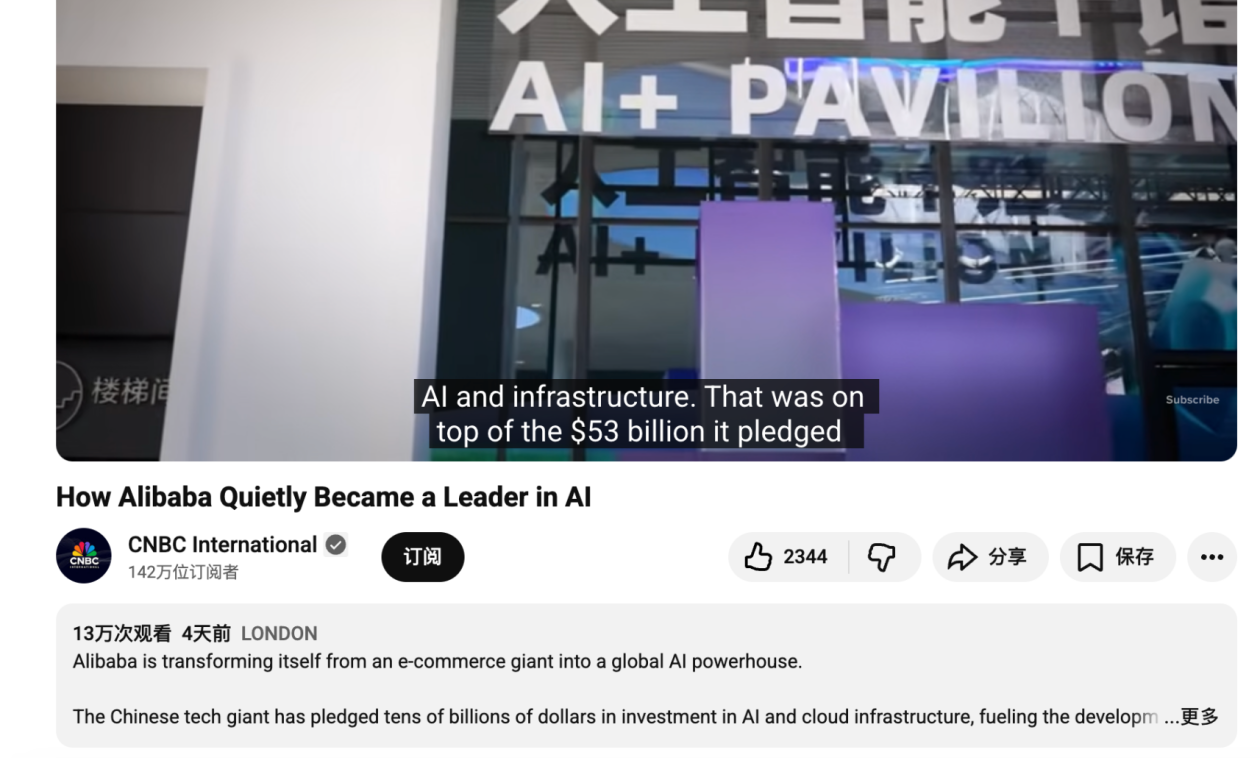
Core Insights - Alibaba has positioned itself as a leader in AI through a dual strategy of "technology leadership" and "ecosystem implementation" [1][4] - The company is making a bold strategic bet by going "All in AI," marking a significant shift in its business focus [4] Technology Development - Alibaba's long-term investment in core technology development is highlighted, including the establishment of its first AI lab in 2016 and the creation of the world-class research institution, DAMO Academy [4] - The company has developed its foundational models and self-researched chips, laying a solid technical foundation for its emergence in the current large model wave [4] - Alibaba's Qianwen team has consistently released powerful models, such as Qianwen 2.5 and the more advanced Qianwen 3, maintaining a leading position in the rapidly evolving AI landscape [4] Ecosystem Implementation - Alibaba's strategy effectively transforms top-tier technology into real-world impact through open-source and cloud services, contrasting with the closed-source model prevalent in the U.S. [5] - The open-source approach has attracted 16 million global developers to Alibaba's "ModelScope" community, creating a large and active AI ecosystem [5] - Successful applications driven by Alibaba's AI technology include the Quark smart assistant, which has nearly 150 million monthly active users and has achieved over 10 million downloads within a week of its public testing [5] Commercial Value - Alibaba Cloud's AI-related projects have shown three-digit growth for eight consecutive quarters, indicating that its AI strategy is entering a harvest phase [5] Global Partnerships - Major global companies, such as BMW, are integrating Alibaba's Qianwen model into their next-generation smart vehicles, demonstrating trust in Alibaba as a comprehensive AI partner with strong technical foundations and extensive cloud infrastructure [6] - Potential collaborations with companies like Apple further validate Alibaba's dual-driven strategy in the global AI landscape [6] - Alibaba is playing a crucial role in China's ambitious plan to dominate the AI race by 2030, supported by its robust technology and ecosystem [6]

汽车智能化月报系列(三十):9月城区NOA渗透率达16%,小鹏发布第二代VLA、Robotaxi、全新一代IRON-20251126
Guoxin Securities· 2025-11-26 08:56
Investment Rating - The report maintains an "Outperform" rating for the automotive industry [4][6]. Core Insights - The penetration rate of NOA (Navigation on Autopilot) in urban areas reached 16% in September, with significant advancements in autonomous driving technologies from companies like Xiaopeng and others [1][16]. - The report highlights a continuous increase in the adoption of high-resolution cameras, with 800 million pixel cameras accounting for 46.7% of the market by September 2025, reflecting a year-on-year increase of 28 percentage points [2]. - The market share of lidar technology is also on the rise, with a penetration rate of 12.2% for passenger vehicles by September 2025, up 5.3 percentage points year-on-year [2]. Summary by Sections Industry News - Xiaopeng launched its second-generation VLA, Robotaxi, and the new generation IRON, marking a significant step in the integration of AI in transportation [1][16]. - Other notable developments include the mass production plans for autonomous trucks by Xiaoma Zhixing and the acquisition of a pure unmanned license by WeRide in Switzerland [1]. High-Frequency Core Data Updates - The penetration rate of front-view cameras in passenger vehicles reached 67.8% by September 2025, with a notable increase in the adoption of 800 million pixel cameras [2]. - The share of Nvidia chips in the driving domain increased to 57.6%, reflecting a year-on-year growth of 25.9% [2]. Smart Driving - The penetration rate of passenger vehicles equipped with L2-level or higher functions reached 34.8% by September, with significant growth in both highway and urban NOA functionalities [3]. - The report indicates that the penetration rates for various sensors, including front-view cameras and lidar, have shown consistent growth [3]. Investment Recommendations - The report recommends investing in companies such as Xiaopeng Motors, Leap Motor, and Geely for complete vehicles, while suggesting Xiaoma Zhixing and WeRide for L4 technologies [4]. - For components, it recommends companies like Hesai Technology for data acquisition and Horizon Robotics for data processing [4].

全球第二!这一地为何迅速崛起成全球电动汽车重要生产基地?
Zhong Guo Qi Che Bao Wang· 2025-11-26 05:52
全球汽车电动化加速前行,创新奇迹也层出不穷。 如今,匈牙利街头,越来越多挂着当地牌照的来自世界众多品牌的电动汽车穿梭其间,这些车辆不 仅是匈牙利交通道路上的新风景,更是匈牙利电动汽车产业蓬勃发展的鲜活见证。 多方力量推动发展 在当前全球经济格局深刻调整、多种因素影响汽车业的大背景下,匈牙利电动汽车产业却凭借自身 独特的优势,成为连接东方技术与西方市场的关键纽带。中国车企作为全球电动汽车技术的领军者之 一,拥有先进的电池技术、高效的生产工艺以及丰富的创新经验;而欧洲则拥有成熟的汽车市场、完善 的基础设施以及高素质的消费群体。众多中国企业入驻匈牙利,不仅为匈牙利带来了先进的技术和大量 的资金,还促进了当地相关产业的协同发展,使得匈牙利迅速融入全球电动汽车产业链。 有舆论认为,匈牙利的成功逆袭,为一些国家参与全球电动汽车产业链提供了全新的思路和模式。 它证明了在全球化的浪潮中,即使是自然资源、市场规模有限的国家,只要能够找准自身定位,充分发 挥自身优势,积极参与国际合作,就有可能在全球产业分工中占据一席之地,实现经济的快速发展和产 业的转型升级。 日前,据报道,匈牙利方面表示,匈牙利已一举成为全球第二大电动汽车生产 ...

两年内放弃中国零件,特斯拉做得到吗?
创业邦· 2025-11-26 03:34
Core Viewpoint - The article discusses the ongoing trend of American automotive companies, including Tesla and General Motors, moving away from Chinese supply chains due to U.S. government policies aimed at boosting domestic manufacturing and reducing reliance on foreign components, particularly from China [6][10][21]. Group 1: U.S. Policy and Automotive Industry Response - The U.S. government has implemented policies, such as the Inflation Reduction Act, which restricts the use of Chinese components in electric vehicle batteries, pushing American automakers to seek alternatives [13][15]. - Tesla is reportedly planning to stop using Chinese-made parts in its U.S. vehicles within the next one to two years, reflecting a broader trend among U.S. automakers to "de-China" their supply chains [6][10]. - General Motors has also indicated plans to shift away from Chinese suppliers, with requirements for suppliers to comply starting in 2024 [13][21]. Group 2: Impact on Global Supply Chains - The U.S. has proposed significant tariffs on imported vehicles and parts, which could increase production costs for American-made cars, potentially leading to higher prices for consumers [15][16]. - European automakers are also feeling the pressure, with companies like Ferrari announcing price increases due to U.S. tariffs affecting their imports [15][16]. - The article highlights that while U.S. automakers are attempting to sever ties with Chinese suppliers, the complexity and reliance on Chinese components make complete detachment challenging [23]. Group 3: Future Outlook and Market Dynamics - Despite the push for "decoupling," the article suggests that the actual impact on the automotive industry may be less severe than anticipated, as many domestic suppliers still play a crucial role in the supply chain [21][23]. - The article emphasizes that the transition away from Chinese suppliers will not happen overnight, as many components, such as thermal management systems and glass products, are difficult to replace due to their competitive pricing and quality [23]. - The potential for increased vehicle prices in the U.S. market could lead to a shift in consumer behavior, possibly benefiting Chinese exports if American manufacturers cannot meet demand at competitive prices [23].


从造车到造“人”,这些车企发出人形机器人量产信号!
Zheng Quan Shi Bao Wang· 2025-11-26 03:10
Core Insights - The automotive industry is increasingly investing in humanoid robots, viewing them as a new growth engine and a strategic positioning battle in the smart industry landscape [1][3][7] - Major automotive companies like GAC Group and Xpeng Motors are showcasing their humanoid robots and have announced production timelines, indicating a shift towards mass production [2][4] - The market for humanoid robots is projected to reach $20 trillion, highlighting the significant potential for growth in this sector [3] Group 1: Industry Trends - Automotive companies are leveraging their expertise in mechanical engineering, power systems, and artificial intelligence to enter the humanoid robot market [1][2] - The integration of humanoid robots into automotive production is seen as a way to enhance efficiency and reduce manufacturing costs [2][4] - The competition in the humanoid robot space is characterized by a long-term race focused on technology, cost, and compliance [1][8] Group 2: Production and Development Strategies - Companies are adopting various strategies to enter the humanoid robot market, including self-research and investment partnerships [4][5] - Self-research allows companies to reuse core technologies, while investment partnerships provide flexibility and reduce risks associated with technology uncertainty [4][5] - The timeline for mass production of humanoid robots is set for 2026, with companies like Tesla and Xpeng leading the charge [7] Group 3: Application Scenarios - Humanoid robots are envisioned for various applications, including industrial manufacturing and customer service roles [6][8] - Current applications are primarily in the testing phase, with significant challenges remaining in achieving the necessary perception, decision-making, and interaction capabilities for home use [6][8] - The industry is still in the exploratory stage, with many companies yet to generate substantial revenue from humanoid robots [7][8]



从造车到造“人”车企发出人形机器人量产信号
Zheng Quan Shi Bao· 2025-11-25 23:44
Group 1 - The automotive industry is increasingly investing in humanoid robots, viewing them as a new growth engine and a strategic positioning battle in the smart technology sector [1][3][6] - Major companies like Xpeng Motors and GAC Group have announced plans for mass production of humanoid robots, with Xpeng aiming for 2026 and GAC for 2025 [2][3] - Analysts highlight the synergy between automotive technology and humanoid robotics, suggesting that the transition from automotive to robotics can be smoother due to shared technologies [2][4] Group 2 - Companies are adopting different strategies to enter the humanoid robot market, with self-research and investment partnerships being the most common approaches [4][5] - Tesla's Optimus robot utilizes technology from its Full Self-Driving (FSD) system, showcasing the reuse of existing technologies to expedite development [4] - The humanoid robot market is projected to reach a scale of 20 trillion USD, indicating significant future potential [3][6] Group 3 - Despite the promising outlook, many companies have yet to generate substantial revenue from humanoid robots, facing technical and commercialization challenges [6][7] - High costs associated with software training and integration pose a significant barrier to mass production, making it difficult for consumers to accept robots priced similarly to cars [7] - The industry is still in the exploratory phase, with a lack of mature supply chain systems for humanoid robots [6][7]
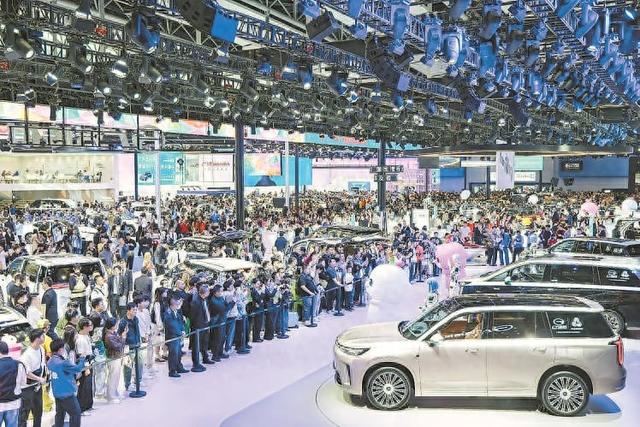
从广州车展看2026年车市动向:合资车用上“中国脑”
Bei Jing Ri Bao Ke Hu Duan· 2025-11-25 22:45
Core Insights - The 2025 Guangzhou International Auto Show showcases 93 new car models and 629 new energy vehicles, highlighting the industry's shift towards electrification and intelligence [1][3] - In October, new energy vehicles accounted for over 50% of total car sales for the first time, indicating a significant market trend [3] - The event emphasizes advancements in L3-level autonomous driving and next-generation battery technologies, which are seen as key areas for technological breakthroughs [4][5] New Energy Vehicles - Out of 1,085 vehicles displayed, 629 are new energy models, making up 58% of the total [3] - Notable new energy models include Xiaopeng's X9 Super Extended Range version priced at 309,800 yuan and Leap Motor's D19 Extended Range version with a 500 km pure electric range [3] - The market is witnessing a diversification in demand, with extended range vehicles addressing range anxiety while pure electric vehicles offer lower operating costs [3] Technological Advancements - Huawei's booth was one of the most popular, showcasing its smart driving solutions, including L3-level autonomous driving tests in seven major cities [4] - GAC Group's flagship model, the A800, has begun L3-level highway testing at speeds of 120 km/h, marking a significant milestone in autonomous vehicle testing [4] Battery Technology - SAIC MG introduced the MG4 model featuring semi-solid-state batteries, set for delivery in December [5] - GAC Group announced the production of a pilot line for solid-state batteries, aiming for small-scale trials by 2026 and mass production by 2027-2030 [5] Market Dynamics - Several luxury brands, including Beijing Hyundai and Lamborghini, were absent from the show, indicating a potential decline in competitiveness in the Chinese market [5] - Joint ventures between foreign brands and Chinese tech companies are emerging, with Volkswagen and Xiaopeng collaborating on a new electric SUV featuring L2-level assisted driving [5][6] Collaborations and Innovations - Audi launched the A5L with Huawei's smart driving technology, while BMW and Mercedes are partnering with Chinese tech firms to enhance their models with localized smart features [6] - These collaborations aim to shorten development cycles and quickly adapt to market changes, reflecting a strategic shift among joint venture brands [6]