
巨化股份

Search documents
2025年1-9月中国硫酸(折100%)产量为8329.6万吨 累计增长5.4%
Chan Ye Xin Xi Wang· 2025-12-02 03:27
Core Viewpoint - The report highlights the growth of China's sulfuric acid production, indicating a positive trend in the industry with a projected increase in output and market potential from 2025 to 2031 [1] Industry Summary - As of September 2025, China's sulfuric acid production reached 9.24 million tons, reflecting a year-on-year growth of 5.6% [1] - Cumulatively, from January to September 2025, the total production of sulfuric acid in China was 83.296 million tons, marking a cumulative growth of 5.4% [1] - The report provides insights into the sulfuric acid market, emphasizing the potential investment opportunities and industry dynamics for the upcoming years [1] Company Summary - Key listed companies in the sulfuric acid sector include Zijin Mining (601899), Jiangxi Copper (600362), Juhua Co., Ltd. (600160), Zhongjin Gold (600489), Tongling Nonferrous Metals (000630), Longbai Group (002601), Yuntianhua (600096), Zhejiang Longsheng (600352), and Chuanfa Longmangan (002312) [1]


己内酰胺价格触底反弹
Zhong Guo Hua Gong Bao· 2025-12-02 03:02
Core Viewpoint - The caprolactam market has begun to rebound after hitting a five-year low price of 8050 yuan per ton in early November, driven primarily by self-imposed production cuts by companies to stabilize prices [1][2][4]. Group 1: Price Trends - On November 24, spot prices in East China rose to 8700 yuan, and by November 26, prices reached 9000 yuan, marking an increase of 950 yuan or 11.8% from the low point earlier in the month [1][5]. - The average production profit for caprolactam from January to October was -1557 yuan, with some companies facing losses exceeding 600 yuan in October [3]. Group 2: Production and Capacity - During the 14th Five-Year Plan period, China's caprolactam industry has maintained a rapid growth rate, with production capacity expected to reach 6.94 million tons and output to 6.54 million tons by 2024 [2]. - Companies have voluntarily reduced production by 20% to manage supply and stabilize prices, with overall industry operating rates dropping to around 80% by November 20 [4][5]. Group 3: Demand and Market Dynamics - The compound annual growth rate of caprolactam consumption over the past five years is 13.5%, with a projected demand growth of 28% in 2024, driven by the textile sector [2]. - Analysts predict a significant slowdown in demand growth in 2025, facing pressures from weak costs, subdued demand, and high inventory levels [2][3]. Group 4: Future Outlook - The supply-side dynamics remain favorable, with expectations that production cuts will continue into December, potentially tightening supply further [6]. - The recent global supply chain adjustments, including production cuts by Japanese companies, may present both challenges and opportunities for domestic firms [6].
石化ETF(159731)近7天获得连续资金净流入,合计“吸金”2132.16万元
Sou Hu Cai Jing· 2025-12-02 02:25
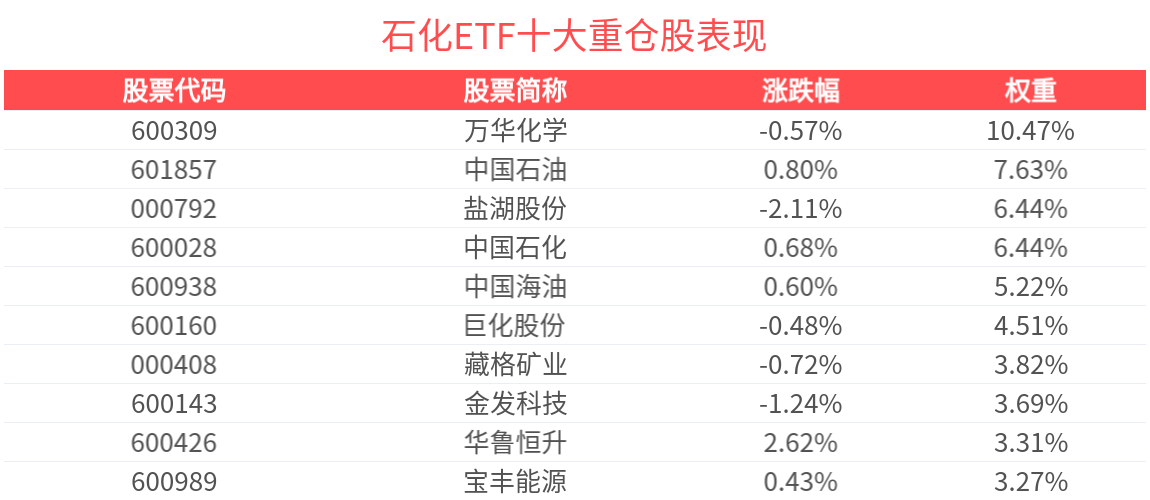
Core Insights - The China Petroleum Industry Index rose by 0.16% as of December 2, 2025, with significant gains from stocks like Hengyi Petrochemical and Tongcheng New Materials [1] - The Petrochemical ETF (159731) experienced a slight decline of 0.12%, priced at 0.83 yuan [1] - Over the past week, the Petrochemical ETF attracted a net inflow of 21.32 million yuan, reaching a new one-year high in both share count and scale [1] Fund Performance - The Petrochemical ETF's net value increased by 28.05% over the past two years, with a maximum monthly return of 15.86% since inception [1] - The longest consecutive monthly gain for the ETF was 7 months, with a total increase of 27.01%, and an average monthly return of 4.96% during rising months [1] - As of December 1, 2025, the ETF outperformed its benchmark with an annualized excess return of 4.62% over the last six months [1] Index Composition - The top ten weighted stocks in the China Petroleum Industry Index account for 56.67% of the index, including Wanhua Chemical, China Petroleum, and Yilong Lake [1] - The individual weightings of these stocks vary, with Wanhua Chemical at 10.47% and China Petroleum at 7.63% [3]






化工板块震荡拉升,化工ETF天弘(159133)盘中价格创上市以来新高!前十月规模以上工业企业利润稳定增长
Sou Hu Cai Jing· 2025-12-01 06:16
Core Insights - The Tianhong Chemical ETF (159133) reached a record high since its listing, with a turnover of 1 billion yuan and a trading volume of 18.37% [1] - The underlying index, the CSI Sub-Industry Chemical Theme Index (000813), increased by 0.82%, with notable gains from several constituent stocks [1] Group 1: Product Highlights - The Tianhong Chemical ETF tracks the CSI Sub-Industry Chemical Theme Index, which includes listed companies involved in the manufacturing and sales of chemical products such as pesticides and fertilizers, reflecting the overall performance of quality enterprises in the chemical industry [2] Group 2: Key Events - A significant agreement was reached on November 23, 2023, for the 2026 China potash fertilizer import contract, setting the price at 348 USD/ton (CFR), maintaining a competitive pricing position globally [2] - On November 26, 2023, BASF and a subsidiary of Sinopec signed a strategic cooperation agreement to promote the large-scale application of biogas, accelerating the low-carbon transition in the chemical industry [3] Group 3: Institutional Perspectives - According to Dongguan Securities, from January to October 2023, the total profit of large-scale industrial enterprises in China reached 59,502.9 billion yuan, reflecting a year-on-year growth of 1.9% [3] - The refrigerant sector is expected to see improved supply-demand dynamics due to the implementation of production quota management for third-generation (HFCs) refrigerants starting in 2024, leading to an overall upward trend in refrigerant prices before 2025 [3]
基础化工行业专题:东升西落,全球化工竞争格局的重塑
Guotou Securities· 2025-12-01 05:33
Investment Rating - The report maintains an investment rating of "Outperform the Market - A" for the chemical industry [4]. Core Insights - The global chemical competition landscape is being reshaped, with European and Japanese companies facing capacity exits due to high energy costs and environmental pressures, while Chinese companies are rapidly gaining market share due to significant cost advantages [1][15]. - The EU chemical capacity utilization rate has decreased from 75.6% in Q2 2025 to 74.6% in Q3 2025, significantly below the long-term average of 81.3% [2][31]. - China's chemical industry is characterized by high capital investment and R&D, leading to a strong cost advantage and enhanced global competitiveness [3][36]. Summary by Sections 1. Europe: Dual Dilemma of High Energy Costs and Environmental Pressure - European chemical companies are heavily reliant on natural gas, with over 40% of raw materials sourced from it, leading to increased production costs [20]. - The average wholesale electricity price in the EU rose by 30% year-on-year to $90 per megawatt-hour in H1 2025, expected to be twice that of the US and 1.5 times that of China [2][20]. - The EU's carbon emissions trading system (ETS) and the Carbon Border Adjustment Mechanism (CBAM) are tightening regulations, further squeezing the competitiveness of European chemical products [23][29]. 2. China: Scale Effects and Cost Advantages of Super Factories - China leads globally in chemical capital expenditure and R&D, accounting for 47% and 32% of the global total, respectively [36][38]. - The production capacity of ethylene in China has doubled from 26.69 million tons in 2019 to 54.49 million tons in 2024, with import dependency decreasing from 8.8% to 5.0% [10]. - Major Chinese companies like Wanhua Chemical are expected to further reduce costs through technological upgrades and capacity expansions, enhancing their competitive edge [9][12]. 3. Domestic Chemical Core Assets Exhibit Strong Competitive Strength - The report highlights the increasing global influence of Chinese chemical companies, which are leveraging cost, scale, and technological advantages to expand their market presence [12]. - Key players in the industry include Wanhua Chemical, Hualu Hengsheng, and others, which are positioned to benefit from the ongoing industry consolidation and optimization [12].


化工ETF(159870)涨超1.7%,展望2026年6F仍是最紧缺环节
Xin Lang Cai Jing· 2025-12-01 02:48
Core Insights - The price agreement for 6F has exceeded expectations, with November delivery prices corresponding to an average of 85,000 (including tax) and December delivery prices expected to be around 130,000 to 140,000, significantly higher than the initial market expectation of 80,000 to 90,000 [1] - The net profit per ton for December 6F is estimated to be around 60,000 to 70,000 based on a cost of 60,000, corresponding to a 10x price-to-earnings ratio [1] - The industry is projected to remain tight through 2026, with current capacity just over 300,000 tons and only a 60,000-ton increase expected next year, primarily in the second half [1] Industry Developments - The solid-state battery sector is expected to see significant developments by the end of the year, including: 1. The Ministry of Industry and Information Technology is expected to release mid-term review results in December, with leading manufacturers likely to exceed expectations [1] 2. Bidding for pilot lines from major clients is starting to open [1] 3. Major manufacturers are expected to conduct road tests by the end of the year [1] Market Performance - As of December 1, 2025, the CSI Sub-Industry Chemical Theme Index (000813) rose by 1.82%, with notable increases in component stocks such as: - Andong Biological (603077) up 10.05% - Duofluor (002407) up 6.98% - Tianci Materials (002709) up 6.93% [1] - The Chemical ETF (159870) also increased by 1.74%, marking a third consecutive rise [1] Index Composition - The CSI Sub-Industry Chemical Theme Index (000813) closely tracks the performance of major companies in the chemical sector, with the top ten weighted stocks accounting for 45.41% of the index. These include: - Wanhua Chemical (600309) - Salt Lake Co. (000792) - Tianci Materials (002709) - Cangge Mining (000408) - Juhua Co. (600160) - Hualu Hengsheng (600426) - Duofluor (002407) - Hengli Petrochemical (600346) - Baofeng Energy (600989) - Yuntianhua (600096) [2]
氯碱周报:SH:供需仍存压力累库持续,预计价格偏弱运行,V:供应压力增长,价格难有持续向上驱动-20251201
Guang Fa Qi Huo· 2025-12-01 02:09
氯碱周报 S H :供需仍存压力累库持续 , 预计价格偏弱运行 V :供应压力增长 , 价格难有持续向上驱动 广发期货研究所 蒋诗语 投资咨询资格:Z0017002 本报告及路演当中所有观点仅供参考,请务必阅读此报告倒数第二页的免责声明 观点及策略建议 ◼ 烧碱主要观点:烧碱行业供需仍存一定压力,山东氯碱企业开工高位,主力下游企业押车情况仍存,企业库存偏高,短期暂无利好显现。华东地区下周供应仍宽裕,传统需求 淡季延续,出口没有明显提振,预估华东价格延续趋弱表现。整体看需求端支撑较弱,长期看供需仍有压力。预计烧碱价格偏弱运行。 ◼ PVC主要观点:本周PVC盘面底部震荡,预计下周仍延续震荡格局,供应端下周压力不减,开工率仍有提升空间。需求端维持低迷,软制品支撑较好,整体下游开工维持低位。 11月-次年1月处于传统需求淡季,北方进入冬季室外施工逐渐减少,整体地产需求减量仍形成利空影响。出口方面,国内货源有价格优势,出口签单表现较好,前期印度官方取消 2024年发布的进口PVC BIS认证政策,有利于国内PVC进入印度市场,虽然印度取消BIS认证,但是反倾销税预期执行,预期外需难以大幅提升。整体需求端对PVC支撑乏 ...
盘前速递 | 石化ETF(159731)连续6天净流入,合计“吸金”1882.16万元
Xin Lang Cai Jing· 2025-12-01 01:38
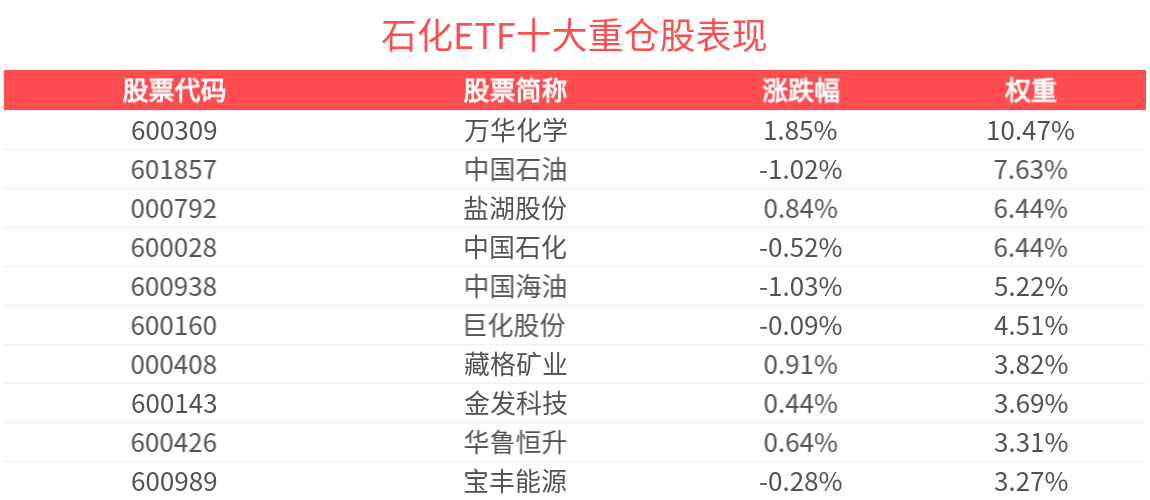
Core Insights - The China Petroleum Industry Index rose by 0.64% as of November 28, 2025, with leading stocks including Hengyi Petrochemical, Guangdong Hongda, Kuncai Technology, Xingfa Group, and Tongkun Co. [1] - The Petrochemical ETF (159731) increased by 0.49%, reaching a latest price of 0.82 yuan, and has seen a total net inflow of 18.82 million yuan over the past six days [1]. - The Petrochemical ETF's latest scale reached 193 million yuan, marking a one-year high, with a total share count of 234 million, also a one-year high [1]. Performance Metrics - The Petrochemical ETF's net value increased by 25.88% over the past six months [1]. - The highest single-month return since inception was 15.86%, with the longest consecutive monthly gain being seven months and a maximum cumulative increase of 27.01% [1]. - The average monthly return during the rising months was 4.96%, and the ETF outperformed the benchmark with an annualized excess return of 4.95% over the past six months [1]. Index Composition - As of November 28, 2025, the top ten weighted stocks in the China Petroleum Industry Index accounted for 56.67% of the index, including Wanhua Chemical, China Petroleum, and Yilong Mining [1]. - The weightings of the top stocks are as follows: Wanhua Chemical at 10.47%, China Petroleum at 7.63%, and Salt Lake Potash at 6.44% [3].
液冷及液冷工质市场更新
2025-12-01 00:49
Summary of Liquid Cooling Market Update Industry Overview - The global liquid cooling market is experiencing rapid growth, with an expected annual growth rate of 20%-25% over the next 3-5 years. The market size for the first three quarters of 2024-2025 is projected to reach approximately $6-7 billion, with North America holding the largest share at 50%-55% [1][2][20]. Key Insights and Arguments - **Market Dynamics**: North American data centers are adopting alternative energy solutions such as renewable energy, battery energy storage systems (BESS), and distributed power generation to address power supply bottlenecks, although these solutions are costly [1][5]. In contrast, domestic manufacturers in China are circumventing chip restrictions by procuring previous-generation GPU chips and utilizing Southeast Asian data centers [1][5]. - **Cooling System Design**: High-power GPU systems in data centers typically employ N+N or 3+3+1 redundancy in power supply systems and N+1 redundancy in thermal management systems. Key components like circulation pumps in cold plate liquid cooling systems also utilize N+1 redundancy [1][6][7]. - **AI Cluster Operations**: In domestic AI cluster operations, both air cooling and liquid cooling coexist, with H100 liquid-cooled cabinets generally using a 30% air cooling and 70% liquid cooling configuration. Single-chip power consumption does not exceed 1,000 watts, primarily relying on unidirectional liquid cooling plates [1][8]. - **Cooling Technology Selection**: The choice between cold plate and silent liquid cooling technologies is based on the thermal flow density of GPU chips. Air cooling is recommended for under 1 kW, unidirectional liquid cooling plates for 1-2 kW, and bidirectional liquid cooling plates for over 2 kW. Future Ultra series may require a shift to bidirectional phase change solutions [1][8]. - **Market Share**: In North America, the company Viant Technology ranks among the top three in the liquid cooling market, holding a market share of 20%-25%. Their product line includes both air and liquid cooling systems, providing comprehensive solutions for data centers [2][20]. Additional Important Points - **Challenges in Silent Liquid Cooling**: Silent liquid cooling systems face high costs, maintenance difficulties, and large footprint issues, making widespread adoption challenging in the short term. However, significant growth in GPU chip capacity over the next 3-5 years may drive some high-density applications to transition to silent liquid cooling [3][10]. - **Corrosion Prevention**: To combat electrochemical corrosion in liquid cooling systems, deionized water or a solution containing 25%-30% propylene glycol is commonly used, with corrosion inhibitors added to enhance resistance [13][14]. - **Future Trends**: The development of liquid cooling media is shifting from unidirectional to bidirectional systems, with the introduction of microchannel technology. New refrigerants like electronic fluorinated liquids may replace traditional water-based coolants in the future [12][15][16]. - **Market Competition**: The refrigerant market is witnessing significant demand growth, particularly in liquid cooling media. North American clients primarily use refrigerants produced by European and American manufacturers, while domestic companies like Juhua and Dongyangguang are also producing refrigerants for local data centers [18][19]. - **Integration vs. Decoupled Delivery**: Integrated delivery systems provide a simplified deployment process, while decoupled delivery offers greater flexibility for future expansions. Each method has its advantages depending on specific user needs [21][23]. This summary encapsulates the key points from the liquid cooling market update, highlighting the industry's growth, technological advancements, and competitive landscape.




如何看大化工的投资机会?
2025-12-01 00:49
Summary of Conference Call on Chemical Industry Investment Opportunities Industry Overview - The chemical industry is currently experiencing historically low gross margins per ton due to rapid domestic capacity expansion leading to oversupply, while demand has not significantly decreased, indicating potential improvement in supply-demand dynamics in the future [1][2][3] - Companies are proactively reducing capital expenditures, with expectations of continued negative growth in capital expenditures for chemical listed companies from 2024 to 2026 [1][2] Supply and Demand Dynamics - Both domestic and international supply sides are showing signs of contraction. Domestically, companies are reducing capital expenditures due to poor profitability, while internationally, the Russia-Ukraine conflict has increased energy costs in Europe and led to operational difficulties for global chemical leaders, accelerating the shutdown of production lines [1][3] - The demand side is expected to recover, with the U.S. entering a rate-cutting cycle, followed by China and the UK, which may lead to a resonance in demand between China and the U.S. [1][3] Emerging Opportunities - New industries such as renewable energy, energy storage, photovoltaics, and AI are expected to drive incremental demand for chemical products, with the industry projected to enter an upward cycle from 2026 to 2027 [1][3] - Recommended sectors include: - **Bottom Elastic Products**: Organic silicon and industrial silicon benefiting from high energy consumption characteristics and energy-saving trends (e.g., Hengsheng Silicon, Xin'an Chemical, Xingfa Group) [1][4] - **Soda Ash**: Benefiting from anti-dumping policies despite expansion (e.g., Boyuan Chemical) [1][4] - **PTA and Polyester Filament**: Stable growth in end-user demand (e.g., Tongkun, Xinfengming) [1][4] Investment Recommendations - Focus on quality stocks with bottom valuations and potential volume growth, such as Wanhua Chemical, Hualu Hengsheng, Longbai Group, and Huahong New Materials [2][4][7] - Growth companies in tires and new materials are also worth attention, such as Sailun Tire, Xin Nuobang, and Shengquan Group, which benefit from AI, new energy development, and domestic substitution [5] Strategic Outlook for 2026 - The strategy for the petrochemical industry in 2026 will adopt a top-down framework due to prolonged low margins (10%-20%) and the completion of capital expenditures in 2023 and 2024 [6][7] - Anticipation of three rate cuts by the Federal Reserve in 2026, reducing rates to around 3%, is expected to support a soft landing for the global economy [6] Key Focus Areas in Petrochemical Sector - The PTA sector is highlighted as a key area of focus, with optimism regarding market corrections and support from national policies [7][8] - Attention should also be given to cyclical sectors, including private refining companies like Satellite Chemical, Baofeng Energy, and Hengli Petrochemical, which are expected to experience reversals [8] Additional Investment Opportunities - Other notable investment opportunities include the POE market and Xinjiang coal chemical stocks, which are expected to perform well due to stable operations and significant profit margin potential [11] - Companies like Aerospace Engineering and 3D Chemical are highlighted for their safety margins and potential valuation recovery due to supportive policies [11]