
华创证券

Search documents
黔有“资”谈 | 华创证券陈强:目前贵州证券市场流动性充裕
Sou Hu Cai Jing· 2026-01-26 10:52
"十四五"期间,作为贵州省内唯一全牌照综合性证券公司的华创证券,成为西部地区第二家取得基金投顾业务试点资格的证券公司,创新业务稳步推进。 记者日前采访了华创证券执行委员会联席主任、总裁陈强,探讨了目前贵州证券市场的特点,以及贵州应该怎样利用资本工具来发展壮大实体经济。 位于贵阳市区的华创证券办公大楼 陈强说,"十四五"期间,贵州证券公司分支机构服务网络日益完善,截至2025年9月,贵州辖区已形成"本土券商+全国性机构分支"的多元布局,全省超 3000名从业人员,构建起覆盖全省主要市县的服务网络;期货经营机构目前虽仅有8家,但头部机构加速落地。而且,贵州证券市场的交易活跃度显著提 升,证券交易成交金额大幅增长。 记者了解到,2025年1月至9月,贵州辖区证券市场(包括股票、基金、债券等)累计成交金额的同比增速远高于全国平均水平。那么目前贵州资本市场在 全国的优势有哪些、"股债基期"中哪一个最适合目前的贵州发展? 陈强说,目前贵州资本市场有三个方面优势:首先是形成了以贵州茅台为核心,新能源、新材料和生物医药产业为特色的上市企业群,这个方面传统行业 起到了"稳定器"的作用,培育中的新兴产业为未来增长提供潜力。其二是 ...



贵州茅台午后涨超1%告别9连跌!食品饮料ETF连续8日获得资金净流入
Mei Ri Jing Ji Xin Wen· 2026-01-26 06:40
1月26日午后,食品饮料板块上扬,贵州茅台股价翻红,截至14点10分,贵州茅台涨超1%。此前,或受 指数基金大额流出、卖出权重股,以及批价疲弱的影响,贵州茅台自1月13日以来"9连跌",累计跌超 6%。 基本面上,截至1月26日,已有5家白酒上市公司披露2025年业绩预告,行业整体承压明显。其中,洋河 股份、口子窖、水井坊的归母净利润同比最大降幅均超过60%;金种子酒、*ST岩石则预计将继续处于 亏损状态。 多家公司在公告中坦言,当前白酒行业处于深度调整期,行业竞争格局发生深刻变革,存量竞争博弈加 剧,导致2025年行业持续低迷。 但也有机构在困境中看到了"机遇"。西部证券曹柳龙指出:当前公募基金持仓白酒已经低于第二轮 (2009年)和第四轮(2019年)白酒周期启动时的仓位,筹码出清,新一轮周期启动的筹码条件已基本 满足。 华创证券董广阳、欧阳予团队认为:2026年全年看,酒企从被动应对进入主动调整,机会在于茅台批价 回落并企稳之后,预期筑底企稳,越往年中越明朗,仓位加起来更确定。 投资工具方面,普通个人投资者可以通过行业主题ETF把握贝塔机会,如食品饮料ETF (515170.SH),相比纯酒类ETF,更 ...
【每周经济观察】:法国制造业PMI升至近四年新高——海外周报第124期
Huachuang Securities· 2026-01-25 10:50
Economic Data Review - The US January S&P Global Manufacturing PMI rose to 51, indicating expansion, while the Q3 actual GDP annualized growth rate was finalized at 4.4%[1] - Japan's December export growth was below expectations at 5.1%, compared to the forecast of 6.1%[10] - The Eurozone's January ZEW Economic Sentiment Index increased to 40.8, and France's Manufacturing PMI reached a near four-year high of 51[10] US Economic Indicators - The WEI index for the US decreased to 2.34% from 2.48%[15] - The US Redbook retail sales year-on-year growth marginally fell to 5.5% from 5.7%[17] - The 30-year mortgage rate in the US rose to 6.09% from 6.06% the previous week, while the MBA Market Composite Index increased by 14.1% to 397.2[21] Employment Trends - ADP's weekly job additions fell to 46,000, down from 70,000 the previous week[26] - Initial jobless claims in the US rose to 200,000 from 199,000 the prior week, while continuing claims decreased to 1.849 million[30] - The INDEED job vacancy index showed a slight decline, averaging 105.3, down 0.5% from the previous week[34] Price Movements - The RJ/CRB Commodity Price Index increased by 3.4% to 312.24, while US gasoline prices rose to $2.70 per gallon, up 1.3% from the previous week[36] Financial Conditions - Financial conditions in the US and Eurozone tightened, with the Bloomberg Financial Conditions Index for the US dropping to 0.812 from 0.848[43] - Offshore dollar liquidity showed improvement for the yen against the dollar, while the euro's liquidity worsened[46] - The 10-year US-EU bond yield spread narrowed to 132.3 basis points from 134.6 basis points[48]
机构本周首次青睐47只个股
Di Yi Cai Jing· 2026-01-25 09:15
-芯碁微装获天风证券、国金证券两家机构给予"买入"评级,最高目标价为243.00元,该股最新收盘价为 183.56元; -浙江荣泰获华创证券给予"推荐"评级,被给予目标价139.8元; Wind数据显示,机构本周首次关注47只个股,11股被给予目标价。 -春风动力、炬光科技、陕西旅游、美的集团、等个股在列。 ...
华创证券张瑜:全球视野下的夏普比复盘与A股的“新常态”
智通财经网· 2026-01-24 23:58
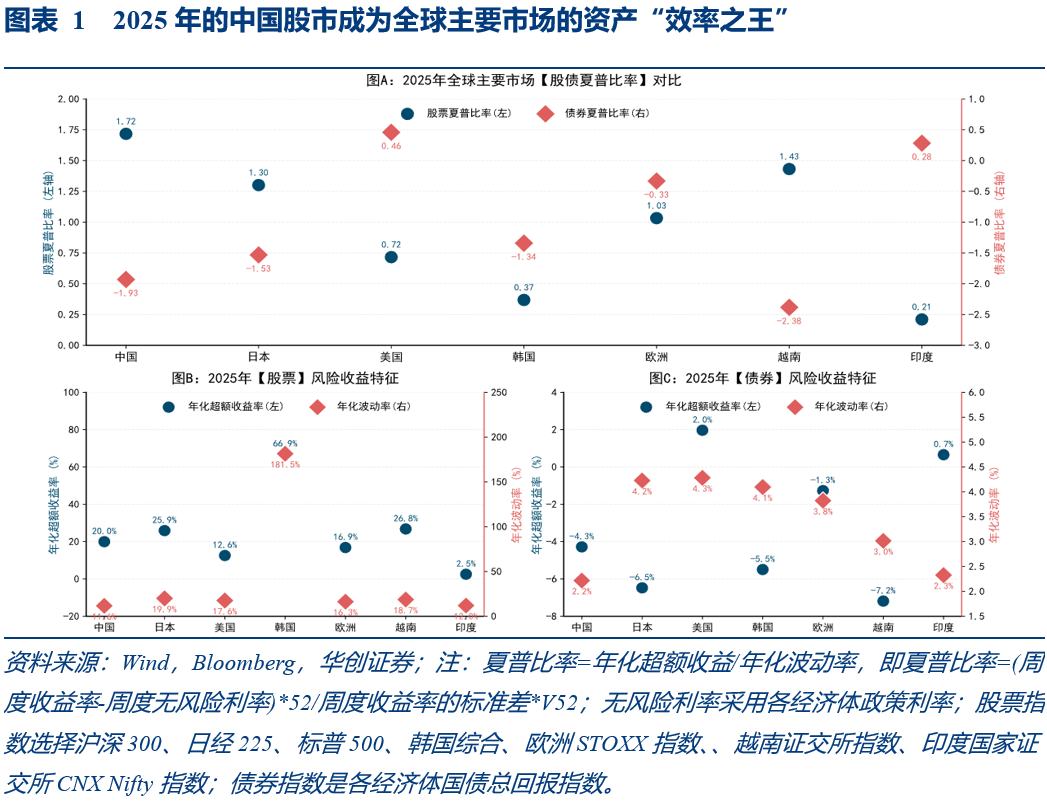
Group 1 - The core finding indicates that by 2025, the Chinese stock market is projected to have the highest Sharpe ratio of 1.72 among major global markets, characterized by significantly reduced annual volatility, making it an attractive investment option [1][2][7] - The average Sharpe ratios over the past two decades for China and the US were 0.20 and 0.85 respectively, but in 2025, China's ratio surpasses the US for the first time since 2020, with the US at 0.72 [1][2][7] - Emerging markets like China and Vietnam exhibit higher volatility in their Sharpe ratios compared to developed markets, with China's ratio volatility being the highest at 1.60 [6][7] Group 2 - In 2025, the performance of global asset classes shows a clear "strong stocks, weak bonds" trend, with equity assets becoming the primary source of excess returns, while bond markets face significant challenges [2][3] - The Chinese stock market's Sharpe ratio of 1.72 is supported by an annualized return of nearly 20% and a volatility of only 11.6%, indicating a robust recovery following macro policy adjustments [2][3] - The bond market in China faces difficulties, with a Sharpe ratio of -1.93, primarily due to negative annualized returns, contrasting with the US and India, which maintain positive Sharpe ratios [3] Group 3 - Historical analysis shows that the Sharpe ratio for the Chinese market in 2025 is the highest since 2014, achieved under low volatility conditions, indicating a shift towards a "high efficiency, low volatility" investment environment [7] - The relationship between Sharpe ratios and the proportion of equity assets in residents' financial portfolios is significant, with higher Sharpe ratios correlating with increased equity allocation [10] - In OECD countries, a 0.1 unit increase in the Sharpe ratio corresponds to a 1.56 percentage point increase in the equity allocation of residents' financial assets, suggesting potential for increased stock market participation in China if the Sharpe ratio continues to rise [10]

年终奖都不要了,分析师转会再起小高潮
财联社· 2026-01-24 12:43
华源证券研究所在本周迎来了自己的新宏观团队,来自中信建投孙苏雨。作为近年来的黑马研 究所之一,华源的案例只是一个。 刚步入2026年,不到1个月就超过10家券商有分析师转会,不 少新财富明星分析师连年终奖都没等,就敲定了新下家。在不少分析师看来,这是大势所趋。 "2025年的年终奖,要到2026年下半年才可能拿到,不仅周期长,金额也不确定。"不少分析师 心里,即便年末换所意味着要放弃年终奖,生存优先成了近期转会的核心原因。 多数研究所采用利润导向考核机制,收缩态势明显,降薪成为不少分析师的常态。相较于模糊 的短期收益,更稳定的发展平台显然更值得取舍,当然,为了赶上新一届分析师评选的执业变 更窗口期也是一个动因,毕竟结果关系到后续派点资源、话语权,这是长期生存发展的关键。 "在好平台,付出能有更合理的回报。"一位刚跟着首席跳槽的分析师坦言,但他也强调,跳槽 的还有一个原因是"热爱卖方研究、勤奋认真"。一些研究所管理层也认为,卖方研究"高强 度、快节奏、重结果"的行业特性,是筛选长期适配人才的关键指标。 像孙苏雨一样从头部跳到特色券商的分析师还有很多,理由自然并非仅是薪酬。北京一分析师 说, 过去看重头部券商的跨 ...

2026保险业前瞻:“报行合一”有望带动行业费用率改善
2 1 Shi Ji Jing Ji Bao Dao· 2026-01-23 14:37
Core Viewpoint - The 2026 regulatory work meeting of the National Financial Regulatory Administration established the financial regulatory tone for the "14th Five-Year Plan" period, emphasizing the continuous promotion of "reporting and operation integration" in the insurance industry and the adjustment of predetermined interest rates [1] Group 1: Trends in the Insurance Industry - The insurance industry is expected to exhibit three core trends in 2026: low upper limits on predetermined interest rates for traditional insurance, the rise of dividend insurance as a market mainstream due to its "fixed income + floating" characteristics, and the strategic position of insurance funds as "patient capital" [1] - Dividend insurance is gaining popularity as it effectively balances the risk of interest margin losses for insurance companies and the inflation resistance needs of customers, with a current predetermined interest rate research value of 1.89% [2][3] - The sales of dividend insurance are closely linked to investment yield rates and competing product yields, with the decline in bank deposit rates making dividend insurance more attractive to residents [4] Group 2: Reporting and Operation Integration - The "reporting and operation integration" initiative has been implemented in the auto insurance sector and is now being extended to non-auto insurance areas, which is expected to fundamentally change the industry's cost competition model [5][6] - This integration is anticipated to improve industry expense ratios, reduce overall operating costs, and enhance insurance companies' ability to price risks accurately [7] - The competition in the bancassurance channel is expected to shift from a focus on fees and products to a competition based on professional capabilities and comprehensive services [8] Group 3: Strategic Investment Directions - The meeting highlighted the importance of cultivating "patient capital" to support the development of new productive forces, with insurance funds being well-suited for long-term, stable funding support [9] - Infrastructure and real estate, along with private equity, are expected to become key areas for alternative investments by insurance funds, aligning with their investment characteristics [10] - Insurance companies are encouraged to increase their equity investment in strategic emerging industries, focusing on sectors like 5G, artificial intelligence, healthcare, and new consumption, which are seen as having significant growth potential [11]
【环球财经】“去美元化交易”卷土重来,黄金避险属性持续凸显
Zhong Guo Jin Rong Xin Xi Wang· 2026-01-21 10:11
新华财经上海1月21日电(葛佳明)受格陵兰岛争端持续发酵等因素影响,美国市场日前再现股债汇"三 杀",避险情绪升温,黄金持续走强,COMEX黄金、现货黄金相继升破每盎司4800美元关口。截至发 稿,现货黄金价格21日最高触及每盎司4888美元的高位。 美国桥水基金创始人瑞·达利欧(Ray Dalio)警告称,在地缘紧张局势加剧和市场不安情绪的笼罩下, 各国政府和投资者正在重新评估对美国资产的配置意愿。多位接受新华财经采访的分析师表示,地缘政 治与经济不确定性持续推升全球避险需求,当前全球资本市场对黄金的态度或正逐步从传统的"避险保 值工具"转变为"货币属性替代品"。 "去美元化交易"卷土重来 衡量投资者恐慌情绪和市场风险的芝加哥期权交易所波动指数(又称"恐慌指数")20日大幅上涨 26.67%,收于20.09,为2025年11月25日以来的最高水平。 投资者对日本债券的恐慌抛售以及丹麦养老基金计划抛售美债的消息大幅影响美债走势,长期美债收益 率大幅冲高,触及四个月高点。此外,美元对大多数主要货币走低,美元指数一度下跌0.7%至98.23。 当地时间1月20日,纽约股市标普500指数大跌2.1%,抹去了2026 ...
油气ETF博时涨1%,化工提价预期提振
Sou Hu Cai Jing· 2026-01-21 04:21
Group 1 - The Shanghai Composite Index rose by 0.16%, the Shenzhen Component Index increased by 0.76%, and the ChiNext Index gained 0.85% on January 21 [2] - Precious metals, lead, and zinc sectors showed significant gains, with oil and gas ETFs also performing well, particularly the Boshi Oil and Gas ETF which rose by 1.00% [2] - The National Development and Reform Commission announced an increase in domestic gasoline and diesel prices by 85 yuan per ton, marking the first adjustment of retail price limits since 2026 [2] Group 2 - Natural gas power plants have become a crucial part of the U.S. electricity system, with natural gas being the primary fuel source since the shale gas revolution [3] - As of 2024, the U.S. natural gas generation capacity is projected to be approximately 571 gigawatts, accounting for 43% of total generation capacity, the highest among all power sources [3] - The EIA forecasts that the share of natural gas in power generation will be 40% by 2025, with total consumption expected to reach 91.8 billion cubic feet per day, reflecting a growth rate of around 4% over three years [3]


A股行情带火分析师招聘,AI应用、新兴科技等多赛道“抢人大战”同步打响
Xin Lang Cai Jing· 2026-01-20 02:48
Group 1 - The A-share media sector has experienced a significant surge since the beginning of 2026, driven by the strong catalyst of Generative Engine Optimization (GEO), with the Shenwan Media Industry Index rising over 15% from January 1 to 16, outperforming the CSI 300 Index during the same period [1] - The rapid increase in market interest has led to a surge in demand for analysts in the media sector, prompting several brokerages to initiate recruitment drives for media industry analysts due to previous reductions in research team sizes [1][2] - Major brokerages, including Guosheng Securities and Dongwu Securities, have publicly announced recruitment for chief analysts and analysts specializing in media and internet sectors, indicating a competitive talent acquisition landscape [2] Group 2 - The turnover of high-end talent in the media industry has accelerated, with notable cases of core analysts switching firms, reflecting the industry's recovery and renewed interest from investors [2] - The resurgence of the media sector began in 2023, fueled by the AI technology wave, which has revitalized the industry and created new investment opportunities, leading to a significant increase in the media sector's performance [2] - Brokerages are not only focusing on the media sector but are also actively recruiting analysts in emerging fields such as AI applications, advanced manufacturing, and other high-growth areas, indicating a broader trend in talent acquisition across various sectors [3][4] Group 3 - Guojin Securities has established a chief analyst position specifically for the embodied intelligence sector, focusing on humanoid robots and intelligent equipment, showcasing a targeted approach to emerging technologies [3] - Traditional sectors like pharmaceuticals and cyclical industries are also seeing high demand for talent, with brokerages seeking to balance their recruitment efforts between new and established fields [3] - The urgency for high-end talent acquisition is reflected in the increasing trend of brokerages "poaching" analysts from competitors, highlighting the competitive nature of the current job market in the financial services industry [3][4]