广达

Search documents
存储涨价惩罚PC市场,为何唯独放过了苹果(AAPL.US)与联想(00992)?
智通财经网· 2025-11-18 07:57
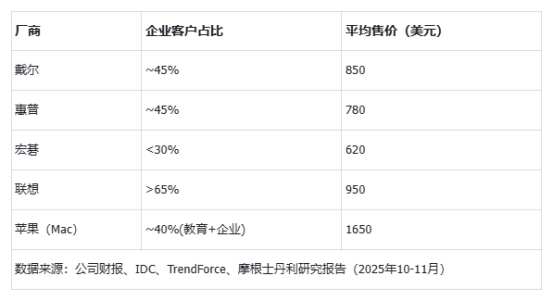
Core Insights - The global storage chip contract prices have experienced a rare nonlinear surge since Q2 2025, driven by the high demand for high-bandwidth memory (HBM) from AI accelerators like NVIDIA's H100 [1] - Major storage manufacturers such as Samsung, SK Hynix, and Micron are shifting production capacity from traditional PC DRAM and NAND to more profitable HBM, tightening supply for traditional PC DRAM and NAND [1][2] - Companies like Lenovo and Apple are viewed as exceptions that may benefit from this storage price uptrend due to their strong customer bases and supply chain management capabilities [1][3] Supply Chain Dynamics - The demand for high-performance SSDs and HBM has surged due to AI data centers, leading manufacturers to prioritize production for high-margin products, which has squeezed the supply of mid-range DDR and client SSDs [2] - In 2025, the global DRAM market revenue is expected to exceed $200 billion, with HBM contributing over half of the profit growth despite accounting for less than 30% of the market [2] - The average storage cost increase of 20% for an $800 laptop could raise the bill of materials (BOM) by $30-$50, potentially eroding 3-6 percentage points of gross margin if manufacturers cannot pass on costs [2] Impact on Consumer-Oriented Manufacturers - Dell, HP, and Acer, which heavily rely on the consumer market, face significant profit margin threats due to their sensitivity to storage price increases [3] - The average selling price of global consumer PCs is projected to be around $620 in 2025, making these companies vulnerable to price sensitivity in a highly competitive market [3] - Morgan Stanley's report indicates that Dell and HP are the most sensitive to rising storage prices, predicting a 2-4 percentage point decline in their PC gross margins for FY 2026 [3] Resilience of Lenovo and Apple - Lenovo and Apple are better positioned to withstand the pressures of rising storage prices due to their strong supply chain control and customer structure [4][10] - Lenovo's market share exceeds 25%, with over 65% of its revenue coming from enterprise and government clients, allowing it to pass on costs more effectively [6][7] - Apple maintains absolute control over its supply chain, benefiting from long-term contracts that ensure priority access to components, which helps it manage costs effectively [9] Competitive Advantages - Lenovo's procurement strategy, which includes multi-regional sourcing, enhances its bargaining power and allows it to secure better prices and delivery guarantees [8] - Apple's BOM structure has a lower storage cost percentage, allowing it to absorb price increases more easily, and its strong brand allows for higher pricing flexibility [9][10] - Both companies are expected to maintain or even expand their market share during this "super cycle" of storage price increases, leading to greater industry differentiation [10]



AI算力与模型应用月报:计算机专题报告:超节点渐成共识,产业链成长动能明确-20251117
Guohai Securities· 2025-11-17 11:35
Investment Rating - The report maintains a "Recommended" rating for the computer industry [1] Core Insights - The report highlights the increasing consensus on supernodes as a foundational infrastructure for AI, driven by significant capital expenditures from major cloud service providers (CSPs) and advancements in GPU/ASIC technologies [5][8] - OpenAI has secured substantial power agreements totaling over $1 trillion, indicating a robust demand for AI computing power [5][14] - The report emphasizes the growth potential in various segments including servers, liquid cooling, power supply, and storage, with clear growth momentum identified [7][8] Summary by Sections Demand Side - CSPs are raising their capital expenditure forecasts, with Google increasing its 2025 capex to $91-93 billion, Meta to $70-72 billion, and Amazon to $125 billion, primarily for AI infrastructure [5][29] - OpenAI has signed significant power agreements with NVIDIA, AMD, and Broadcom, totaling 26GW and over $1.1 trillion in value [5][15] - Sovereign AI investments are projected to reach $1 trillion over the next five years, with major projects in the US, EU, and Saudi Arabia [5][25] Supply Side - The report notes the continuous iteration of chips, with supernodes becoming a consensus in AI infrastructure, as evidenced by new product launches from various manufacturers [34][5] - NVIDIA's upcoming GPU architectures are expected to enhance computational capabilities significantly, with the Blackwell Ultra and Rubin architectures set to launch in the coming years [36][39] - Major companies like AMD and Huawei are also advancing their AI chip offerings, with AMD's Helios solution and Huawei's Atlas series expected to drive further innovation [41][44] Growth Segments - The server market is experiencing substantial growth, with companies like Hon Hai and Wistron achieving significant increases in AI server shipments [7] - Liquid cooling technology is becoming essential in AI data centers, with companies reporting high double-digit revenue growth [7] - The storage chip industry is entering a period of severe shortage, driving up DRAM prices and increasing demand from CSPs [7] Multi-modal and Application Ecosystem - The report outlines the rapid evolution of AI models, with major updates from OpenAI and Alibaba, and a significant increase in token usage across platforms [7][8] - OpenAI's new applications and models are enhancing its ecosystem, with a notable increase in daily token usage [7][8]



本周焦点“英伟达财报”,大摩:会是过去几个季度里最强的,打破“增长见顶”认知
美股IPO· 2025-11-17 00:55
大摩表示,行业调研显示需求出现实质性加速,英伟达已完全解决了早期机架相关问题,而需求持续激增。Blackwell芯片进入全面量产爬坡阶段将 是关键驱动因素。英伟达在GTC大会上的积极表态进一步强化了这一趋势。目前增长瓶颈更多出现在英伟达供应端以及配套硬件(存储、服务器) 和空间/电力方面,但这些都不应减缓明显的需求加速趋势。 摩根士丹利上调英伟达目标价至220美元。分析师预计英伟达即将公布的第三季度财报将成为突破性的一个季度,有望打破市场对其增长见顶的认 知。 大摩分析师Joseph Moore在11月14日的报告中表示,行业调研显示需求出现实质性加速,英伟达已完全解决了早期机架相关问题,而需求持续激 增。目前增长瓶颈更多出现在英伟达供应端以及配套硬件(存储、服务器)和空间/电力方面,但这些都不应减缓明显的需求加速趋势。 Blackwell芯片进入全面量产爬坡阶段将是关键驱动因素。英伟达在GTC大会上的积极表态进一步强化了这一趋势。 大摩认为,下周业绩是英伟达过去几个季度中表现最强劲的一次财报,尽管英伟达股价表现不俗,但相对于AI同行股票表现滞后,预计这种情况将 出现逆转。 供需数据显示需求加速超预期 Bla ...


下周焦点“英伟达财报”,大摩:会是过去几个季度里最强的,打破“增长见顶”认知
Hua Er Jie Jian Wen· 2025-11-16 03:46
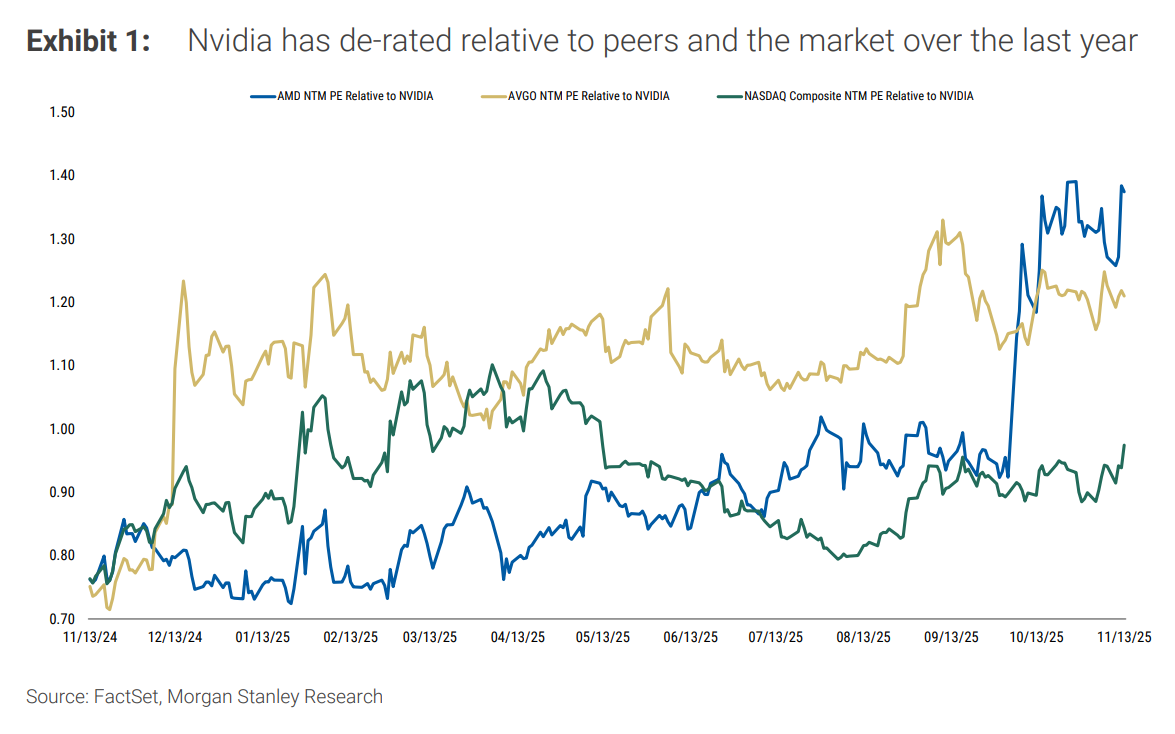
Core Viewpoint - Morgan Stanley raised Nvidia's target price to $220, anticipating that the upcoming Q3 earnings report will be a breakthrough quarter, challenging the market's perception of growth peaking [1] Group 1: Demand Acceleration - Industry research indicates a substantial acceleration in demand for Nvidia, contrasting with the market's belief that growth metrics have peaked [4] - Cloud service capital expenditure expectations for Q3 have been raised to $142 billion, with major cloud service providers increasing their spending by over $20 billion each [4] - ODM manufacturer Quanta expects its AI server revenue to accelerate growth by over 100% year-on-year by Q1 2026, planning to double AI server production capacity next year due to visible orders extending to 2027 [4] Group 2: Revenue Projections - Morgan Stanley adjusted Nvidia's revenue expectations for October from $54.4 billion to $55 billion and for January from $61.2 billion to $63.1 billion, projecting record quarterly growth of $8 billion for both months [5] - Nvidia's CEO Jensen Huang indicated that revenue needs to be in the range of $70-80 billion over the next five quarters, with the stock currently 10% lower than its peak following this statement [6] Group 3: Long-term Outlook - Morgan Stanley raised Nvidia's fiscal year 2027 revenue forecast from $278 billion to $298.5 billion and non-GAAP EPS from $6.59 to $7.11, suggesting potential for higher guidance based on strong order backlogs [8] - The new target price of $220 is based on a 26x P/E ratio of the projected $8.43 EPS for fiscal year 2027, reflecting a discount compared to the average forward P/E of 32x over the past two years [8] Group 4: Key Growth Drivers - The Blackwell chip is identified as a core growth engine for Nvidia, with strong demand signals for the Vera Rubin chip, indicating robust market demand despite competitive enthusiasm [5]
英伟达不满足于只卖GPU,谋划颠覆
半导体行业观察· 2025-11-15 01:42
Core Insights - Nvidia plans to launch the Vera Rubin platform for AI and high-performance computing next year, which could significantly impact the AI hardware supply chain [2] - The company intends to deliver L10-level VR200 computing racks pre-installed with all necessary hardware, simplifying the design and integration work for original design manufacturers (ODMs) while potentially compressing their profit margins [2][3] - Nvidia is shifting from allowing partners to build their own components to providing fully integrated solutions, which may enhance production efficiency and reduce costs [3][4] Summary by Sections - **Nvidia's Strategy**: Nvidia is moving towards a model where it provides complete computing racks, including CPUs, GPUs, and cooling systems, rather than individual components, which marks a significant shift in its supply chain strategy [2][5] - **Impact on Partners**: Partners will transition from system designers to system integrators and support service providers, focusing on assembly and logistics while Nvidia standardizes and produces the core computing engines [5] - **Market Implications**: The integration of advanced cooling systems and the potential for Nvidia to expand its role in the supply chain raises questions about the future dynamics of the server market, particularly with the introduction of the Kyber NVL576 rack-level solution [4][5]

液冷供应链格局
傅里叶的猫· 2025-11-13 04:21
Core Insights - The article discusses the liquid cooling market, which is projected to be worth hundreds of billions, and highlights a recent order received by a liquid cooling company from a major overseas tech firm [1] Liquid Cooling Supply Chain - Liquid cooling solutions are not fully customized but are flexibly adapted based on customer needs, with cold plate technology being a standardized core component [3][4] - Different customer requirements lead to system-level adjustments, such as variations in CDU configurations and manifold designs, necessitating tailored solutions for each project [3][4] Collaboration with Major Companies - The article analyzes partnerships between leading liquid cooling companies and major CSPs, emphasizing the importance of collaboration to ensure stable supply chains [5][6] - The partnership with Meta focuses on providing a complete liquid cooling solution, including cold plates and integrated systems, with a significant emphasis on collaboration with manufacturers like 天弘 [5][6] - Google, having more experience in liquid cooling technology, has specific requirements for CDU and is working with 天弘 and 富士康 to develop solutions [6] - Major companies are diversifying their supplier base to mitigate risks associated with relying solely on Taiwanese manufacturers, ensuring timely delivery of critical components [6][7] Technical Trends - The mainstream technology in the liquid cooling industry remains single-direction cold plate design, favored by companies like Meta and Google for its superior temperature control and reliability [9] - Alternative technologies, such as large-area cold plates and phase change cooling, are not yet widely adopted due to their inherent challenges [9] - Specific product configurations vary, with examples including Meta's ASIC chip project, which features a cabinet containing 64 ASIC cards, highlighting the increasing demand for efficient cooling solutions [9]

重庆,委以重任,彻底起飞
盐财经· 2025-11-12 10:25
Core Viewpoint - The establishment of the new Liangjiang New Area in Chongqing marks a significant administrative and economic transformation, enhancing its role as a key economic driver in the region [2][8]. Group 1: Administrative Changes - The Liangjiang New Area has officially gained administrative district functions, transitioning from a national-level development zone to a fully-fledged administrative district [4]. - The administrative adjustment includes the incorporation of the entire Jiangbei District and most of the Yubei District into the Liangjiang New Area, leading to the cancellation of the original Jiangbei and Yubei districts [4]. Group 2: Economic Performance - In 2024, the GDP of Liangjiang New Area is projected to reach 518.2 billion yuan, accounting for approximately 16% of Chongqing's total GDP of 32,193.15 billion yuan [11]. - The area contributes significantly to Chongqing's economy, with 20% of the city's industrial output, 30% of total imports and exports, 60% of automobile production, and 70% of cross-border e-commerce transactions [11]. Group 3: Comparison with Other National-Level New Areas - Liangjiang New Area ranks fourth among national-level new areas in terms of GDP, with a growth rate of 6.0% in 2024, which is competitive compared to other regions [12]. - Despite its leading position within Chongqing, Liangjiang's economic "first-mover advantage" is still lower compared to other national-level new areas, such as Shanghai's Pudong New Area, which has a GDP of 1.78 trillion yuan and a regional dominance of about 33% [13]. Group 4: Strategic Importance - The transformation of Liangjiang New Area is seen as essential for enhancing its capacity to attract high-quality resources and investments, especially in the context of changing global economic conditions [22][28]. - The integration of administrative and development functions is expected to improve efficiency in resource allocation and economic management, which is crucial for the area's future growth [26][27]. Group 5: Industrial Trends - Recent years have seen a shift in Chongqing's industrial layout, with significant developments moving westward and some towards the south and east, indicating a diversification of economic activities [31][32]. - The new Liangjiang New Area is positioned to serve as a core economic engine for Chongqing, with a focus on enhancing its influence in the broader southwestern region of China [32][33].

黄仁勋难道惹了不该惹的人?美媒调转枪口:英伟达正在扼杀美国AI
Xin Lang Cai Jing· 2025-11-12 02:22
Core Viewpoint - Nvidia CEO Jensen Huang expressed concerns about the US-China AI competition, predicting that China will win in the generative AI race within the next 5 to 10 years due to its vast pool of AI talent and criticized US chip export controls as counterproductive [3][4]. Group 1: AI Competition - Huang stated that China has approximately 1 million professionals working in AI research, while Silicon Valley has only about 20,000 focused on large model development [4]. - He predicted that by 2027, China's AI computing power will surpass the total of all other countries combined [4]. Group 2: US Response and Industry Impact - Huang's comments sparked significant backlash in the US, with media criticizing Nvidia's role in the AI sector and suggesting that its business model may contribute to an economic bubble [4][5]. - Despite concerns, Silicon Valley remains a core hub for AI innovation, with major companies like Google, Microsoft, and Meta leading in technological development [5]. Group 3: Broader Implications - Huang's remarks highlight the complexities of global AI competition and the intensifying US-China tech rivalry, raising questions about the effectiveness of US technology restrictions on curbing China's rise [5]. - The incident may impact Huang's reputation and Nvidia's future, as any potential leadership change could increase market uncertainty [5].

坚定AI科技信心
2025-11-26 14:15
Summary of Key Points from the Conference Call Industry Overview - The AI technology sector is undergoing a once-in-20-years transformation, similar to the early stages of the mobile internet and new energy industries, with a projected compound annual growth rate (CAGR) of 45%-50% over the next five years, and global AI infrastructure investment expected to reach $4 trillion by 2030 [2][4][8]. Core Insights and Arguments - Despite market skepticism regarding potential bubbles and overstated expectations in the AI field, the underlying logic remains unchanged, with increasing computational power required for large model upgrades, as evidenced by companies like NVIDIA and OpenAI ramping up investments [2][6]. - AI technology is beginning to show economic benefits, with companies like Google generating hundreds of billions in revenue through AI while significantly reducing programmer costs, indicating a trend towards improved profitability in the coming years [2][7]. - The AI industry is expected to remain in a state of high demand for the next 1.5 to 3 years, with strong demand anticipated until the end of 2026, and a sustained CAGR of 45%-50% projected for the next five years [2][8][9]. Storage Market Dynamics - Recent significant price increases in the storage market, particularly for DRAM and NAND Flash, with large-capacity TLC NAND Flash reaching historical highs, are expected to continue into Q4, indicating substantial earnings elasticity for related companies [2][25]. - Major storage suppliers like Samsung and SK Hynix are adopting conservative capital expenditure plans for 2026, which may reduce supply-side pressure and support a prolonged storage cycle with high price increases [2][26]. Market Performance and Investment Opportunities - The AI technology sector has shown strong market performance in 2025, with key predictions made at various points throughout the year being validated by market outcomes [3]. - The semiconductor storage sector is transitioning from low-end module models to high-value areas such as main control chip design and packaging, with significant revenue growth expected for enterprise-level SSDs [4][31]. Future Trends and Projections - The AI sector is expected to continue driving demand for DRAM, DDR5, HBM, and enterprise-level SSDs, with predictions of demand exceeding supply capabilities by 2026 [29]. - The light chip sector is experiencing strong growth, with a notable increase in global capacity shortages, indicating a favorable environment for domestic supply chain companies [23]. Challenges and Opportunities - The computing industry is facing challenges due to the AI sector not accelerating significantly yet, but there is confidence in long-term trends, particularly in domestic computing and quantum computing sectors [32][33]. - Investment opportunities in satellite communication are emerging due to increased governmental focus and financing, with companies like Zhenlei Technology and Tongyu Communication expected to perform well [27][28]. Conclusion - The AI and semiconductor storage sectors are poised for significant growth, driven by technological advancements and increasing demand, while companies that adapt to these trends are likely to see substantial benefits in profitability and market position [2][4][9][31].
⼤摩:2026将是AI科技硬件之年
美股研究社· 2025-11-04 12:04
Core Insights - Morgan Stanley predicts that 2026 will be a pivotal year for explosive growth in AI hardware, primarily driven by strong demand for AI server hardware [6][7] - The report highlights a significant redesign upgrade in AI servers driven by GPUs and ASICs, with new platforms from NVIDIA and AMD expected to enhance computing power and cabinet density [6][7] AI Server Rack Demand Surge - AI server cabinet demand is projected to surge from approximately 28,000 units in 2025 to at least 60,000 units in 2026, representing over 100% growth [7][13] - The transition from single GPU designs to integrated rack systems is expected to benefit ODM manufacturers like Quanta, Foxconn, Wistron, and Wiwynn [13] Power and Cooling Solutions - The report emphasizes that the challenges of power consumption and cooling due to hardware upgrades present significant opportunities for power and cooling suppliers [18][19] - A shift to 800V high-voltage direct current (HVDC) power solutions is anticipated, with the value of power solutions for Rubin Ultra cabinets projected to exceed ten times that of current GB200 cabinets by 2027 [20][22] Liquid Cooling Necessity - Liquid cooling has transitioned from an optional solution to a necessity, with the total value of cooling components for a GB300 cabinet estimated at approximately $49,860, expected to increase by 17% for the next-generation Vera Rubin platform [23][26] Value Chain Upgrades - The report indicates that the upgrade of AI platforms will have profound impacts on printed circuit boards (PCBs) and interconnect components, with increasing requirements for layer counts and material grades [30][31] - The evolution of NVIDIA's GPUs shows a trend towards more complex and higher-value PCB manufacturing processes, creating structural growth opportunities for PCB and upstream material suppliers [32][33]