抖音电商

Search documents
消费分层与渠道融合:2025年上半年中国零售业态演变与发展
Lian He Zi Xin· 2025-12-02 11:06
Investment Rating - The report indicates a stable growth outlook for the retail industry in China, with a focus on online retail and the transformation of offline channels [3][20]. Core Insights - The retail industry in China is experiencing a dual engine of growth driven by consumption upgrades and cost-performance demands, with online retail showing a steady increase while offline retail is facing differentiation [3][20]. - The total retail sales of consumer goods reached 24.55 trillion yuan in the first half of 2025, marking a 5% year-on-year increase, with online retail accounting for approximately 30% of total retail sales [3][20]. - The report highlights a shift in consumer behavior, with the Z generation increasing spending on smart home appliances and emotional consumption products, while the silver economy is driving growth in health products and services for the elderly [4][20]. Summary by Sections Online Retail - The online retail market in China continued to grow steadily, with physical online retail sales increasing by 6% year-on-year, although the penetration rate slightly declined [5][20]. - Traditional e-commerce platforms like Alibaba, JD, and Pinduoduo dominate the market with a combined market share of 65%, while new platforms like Douyin and Kuaishou are experiencing explosive growth through content-driven sales [5][6][20]. - Instant retail and community group buying are identified as key growth drivers, with instant retail sales increasing by 25% year-on-year [6][20]. Chain Supermarkets - The chain supermarket sector is undergoing a critical transformation, with 47.5% of surveyed enterprises reporting sales growth, while 45% face profit decline [9][20]. - The industry is experiencing a "store closure wave," with a closure-to-opening ratio of 0.67, indicating a contraction in overall scale [10][20]. - Leading companies like Walmart and Hema are adapting their strategies to focus on membership models and fresh produce, while local supermarkets are optimizing layouts and improving product quality [11][20]. Shopping Centers - The shopping center market is witnessing a recovery, with foot traffic in first to fifth-tier cities increasing by 8.7% year-on-year [12][20]. - Experience-driven upgrades are becoming essential, with a significant portion of shopping centers incorporating dining, entertainment, and family-oriented experiences [12][20]. - The integration of online and offline experiences is creating new growth opportunities, with projects like JD Mall and Suning integrating digital experiences with physical retail [14][20]. Industry Challenges and Future Trends - The retail industry faces challenges such as consumer fatigue and rising cost pressures, with rental and labor costs increasing by 4-5% [15][16][20]. - Future trends indicate that online retail will continue to grow, with a focus on instant retail and technological empowerment, while chain supermarkets will accelerate their transformation towards community-oriented and online integration [18][20]. - Shopping centers will deepen experience upgrades and innovate their operations, with a focus on sustainability and digital transformation [19][20].
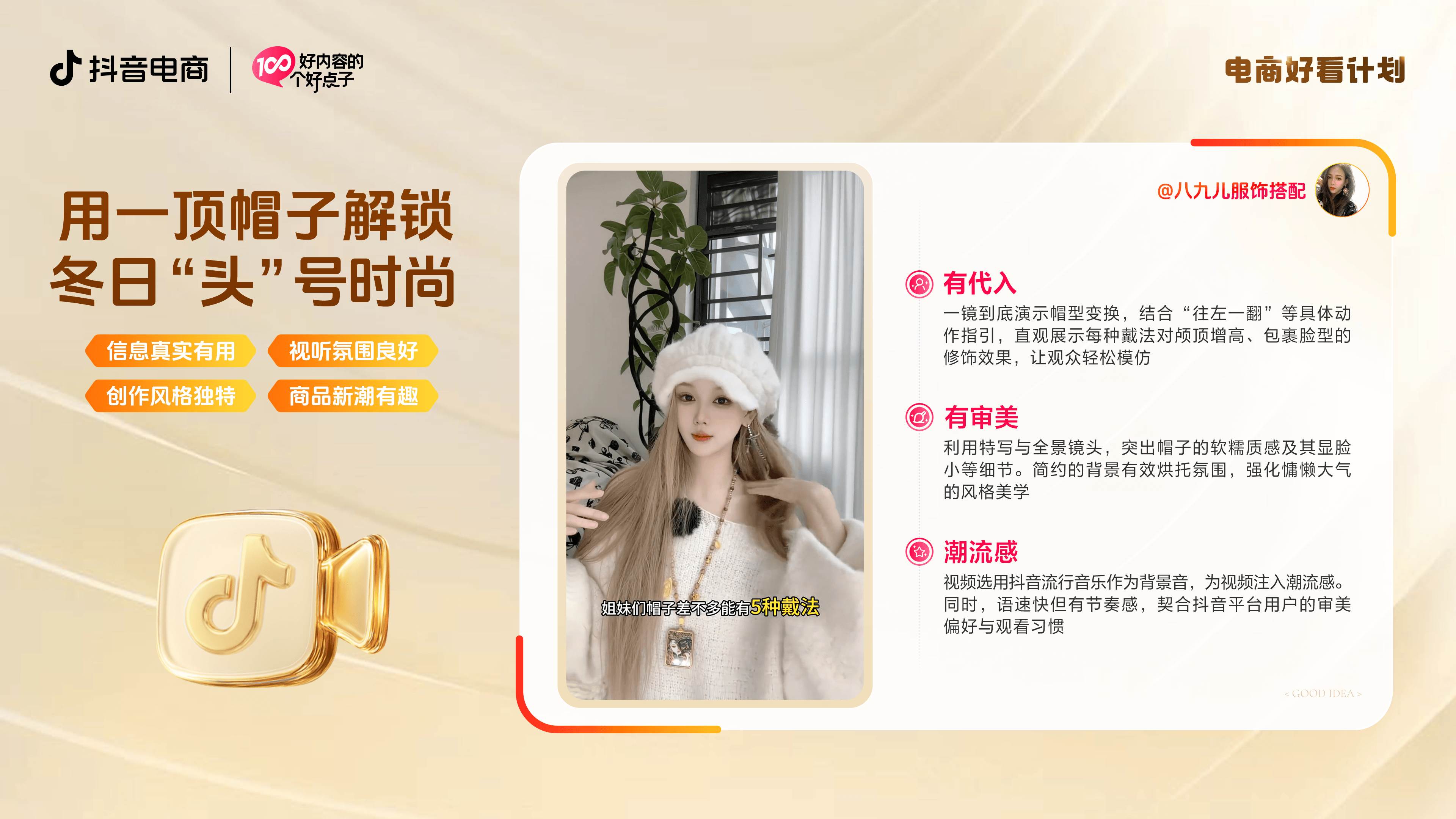
「抖音电 商好看内容」|告别无效创作,用好点子卖爆好商品
Sou Hu Cai Jing· 2025-12-01 12:25
Core Insights - The article emphasizes the effectiveness of high-quality short videos and live content on Douyin e-commerce in driving brand awareness and sales across various industries [1] - Douyin e-commerce has upgraded its "E-commerce Good Content Plan" to encourage merchants and influencers to create content based on four dimensions: authenticity, audiovisual atmosphere, unique creative style, and trendy products [1] Fashion Industry - Fashion merchants face challenges in differentiating their products in a highly competitive market, with the formula for effective content being: "Fashion Good Content = Relatable + Aesthetic + Individuality + Trendiness" [2][5] - Successful examples include using styling techniques to help users visualize how products would look on them, enhancing the overall shopping experience [5] Home Appliances Industry - The home appliances sector requires a focus on real-life scenarios to effectively communicate product benefits, with the formula being: "Home Appliances Good Content = High Information Density + Pain Point Solutions + Immersive Audiovisual Experience + Realistic Creative Style" [6][8] - Demonstrating product features in relatable settings can significantly enhance user engagement and drive sales [8] Maternal and Child Industry - The maternal and child sector must balance trust and emotional connection, with the effective content formula being: "Maternal and Child Good Content = Valuable Information + Aesthetic Appeal + Contextual Relevance + Emotional Connection" [9][12] - Successful content transforms complex information into relatable narratives that resonate with parents [12] Food and Health Industry - In the food sector, the challenge lies in visualizing the enjoyment of food, with the formula being: "Food E-commerce Good Content = Authentic Information + Visual Appeal + Selective Product Choices + Lifestyle Presentation" [13][15] - Engaging content that showcases cooking processes and relatable scenarios can stimulate appetite and drive conversions [15] Beauty Industry - The beauty sector faces challenges in converting views into purchases, with the effective content formula being: "Beauty Good Content = High Information Density + Transformation Effects + Authentic Persona + Detailed Product Selection" [16][18] - Content that showcases real-life transformations and relatable personas can enhance product appeal and drive sales [18] Personal Care and Household Cleaning Industry - The personal care and household cleaning sector must present product advantages in relatable contexts, with the formula being: "Personal Care Good Content = Practical + Effective + Relatable + Visually Appealing" [19][21] - Demonstrating product effectiveness through real-life scenarios can help consumers make informed decisions [21] Floral and Gardening Industry - The floral and gardening sector can leverage "cloud garden tours" to engage users, with the formula being: "Floral Good Content = Practical Information + Precise Product Selection + Atmospheric Expression + Captivating Audiovisuals" [22][24] - Creating an emotional connection through visual storytelling can enhance user engagement and drive sales [24] Jewelry and Luxury Goods Industry - The jewelry sector must convey a sense of luxury and value, with the formula being: "Jewelry Good Content = Credible Information + High-Quality Visuals + Distinct Aesthetic + Unique Product Stories" [25][27] - Content that highlights the transformative effects of jewelry can resonate with consumers seeking identity and emotional connection [27] 3C Digital Products Industry - The 3C digital products sector needs to present technical features in an engaging manner, with the formula being: "3C Good Content = Core Differentiation + Real-World Validation + Strong Persona + Highlighted Product Features" [28][30] - Demonstrating practical usage scenarios can enhance user understanding and drive interest [30] Automotive Industry - The automotive sector can awaken latent demand through relatable content, with the formula being: "Automotive Good Content = Verifiable Information + Relatable Audiovisual Presentation + Distinct Persona + Tangible Product Highlights" [31][33] - Establishing trust through authentic narratives can encourage proactive consumer engagement [33] Conclusion - Douyin e-commerce encourages merchants to adopt effective content strategies to stimulate consumer interest and drive sales, aiming to enhance the quality of video content on the platform [34]

2025年Q4电商行业战略动态调查报告——AI与即时零售重塑竞争格局
Sou Hu Cai Jing· 2025-11-30 17:12
Core Insights - The Chinese e-commerce industry has transitioned from a traffic-driven era to a "hardcore competition" phase focused on technology and ecosystem collaboration by Q4 2025 [1][22] - Key trends include the commercialization of AI technology, the intensification of instant retail, the deepening of omnichannel operations, and the evolution of competitive dimensions [3] Group 1: AI Technology Commercialization - AI has shifted from a technology reserve to a key growth driver for e-commerce giants, with Alibaba making significant investments leading to substantial revenue growth in AI-related products [4] - JD has applied AI extensively in marketing and service, achieving over 90% coverage in intelligent customer service and an 18% increase in conversion rates for core categories [4] - Smaller merchants benefit directly from AI, with Pinduoduo's AI selection system improving ROI by 40% for partners, while Douyin and Kuaishou have reduced content production cycles by 50% [4] Group 2: Instant Retail Market Competition - Instant retail has become a critical battleground for growth, with Alibaba, JD, and Meituan competing fiercely, aiming for a trillion-yuan transaction scale within three years [6] - In Q4, the transaction volume for instant retail reached 220 billion yuan, a 65% year-on-year increase, with Meituan holding a 45% market share [6] - The market is projected to exceed one trillion yuan by 2026, with front warehouse models contributing over 50% of transaction volume [6] Group 3: Omnichannel Operations - The fragmentation of traffic has driven platforms to transition towards "omnichannel collaboration," with Douyin e-commerce integrating advertising and e-commerce traffic pools [8] - Traditional platforms are accelerating their content transformation, with Alibaba and JD enhancing their content capabilities to complement their existing strengths [8] - Omnichannel operations have become a standard in the industry, moving away from single-channel strategies [8] Group 4: Shift from Price Wars to Value Wars - As customer acquisition costs rise, platforms are shifting from price competition to "value wars," focusing on quality and service [9] - Pinduoduo's "billion support plan" aims to enhance merchant quality, while JD emphasizes "quality retail" strategies [9] - The emergence of "heart-price ratio" reflects a consumer trend prioritizing product quality and service experience over mere pricing [9] Group 5: Company-Specific Strategies - Alibaba is focusing on AI and instant retail as dual drivers for growth, but faces short-term profit pressures due to significant investments [12] - JD is leveraging high-frequency delivery to expand into local life services, showing promising conversion rates but facing challenges with ongoing losses [13] - Pinduoduo remains the only major player with positive net profit growth, emphasizing cost-effectiveness and agricultural product sales [15] - Douyin e-commerce is rapidly increasing its market share through deep integration of content and commerce, but still needs to cultivate user habits for shelf-based e-commerce [16] Group 6: Future Trends - AI is expected to fundamentally reshape the e-commerce landscape, with intelligent systems becoming new traffic hubs [17] - Instant retail is projected to evolve into a core business model, with continuous innovations in operational models [17] - The integration of content and commerce will become standard, with platforms adopting a closed-loop system for user engagement [17] Group 7: Strategic Variables - The focus for the next year will be on breakthroughs in AI technology and instant retail profitability models by major players like Alibaba and JD [22] - The progress of content platforms like Douyin and Kuaishou in shelf-based e-commerce will be crucial for determining the final shape of omnichannel integration [22]



AIGC正在成为新品上新的「超级内容合伙人」
Sou Hu Cai Jing· 2025-11-30 07:16
Core Insights - AIGC is transforming content production in the fashion industry, moving beyond traditional methods to create immersive experiences that enhance user engagement and brand storytelling [2][3][4] - The integration of AIGC tools allows brands to significantly increase content output while reducing production costs and time, enabling a focus on creativity and emotional connection with consumers [5][6][7] Group 1: AIGC's Impact on Content Production - AIGC tools have enabled brands to produce over 100 short videos daily from a single account, a significant increase from the previous maximum of 6 to 12 videos [5] - The introduction of features like "抖店智能成片" and "百应智能成片" allows brands to automate video production, enhancing efficiency and freeing up resources for creative development [5][6] - AIGC is shifting the content creation process from a labor-intensive model to a more automated and efficient system, allowing brands to focus on high-level creative strategies [7] Group 2: Enhanced User Engagement - AIGC creates immersive environments that enhance the storytelling of products, making them more appealing to consumers [3][11] - Brands like moody and 海丽汉森 have successfully utilized AIGC to create engaging live-streaming experiences that significantly increase viewer retention and conversion rates [11][12] - The use of AIGC has led to substantial increases in key performance metrics, such as a 2000% increase in GMV for 海丽汉森's AIGC-enhanced live stream [12] Group 3: The Future of Brand Storytelling - AIGC is redefining the competitive landscape by emphasizing creativity and aesthetic appeal as key differentiators in content production [14][17] - The technology allows brands to explore new creative possibilities, enabling them to craft unique narratives that resonate with consumers [15][16] - As AIGC democratizes content creation, the focus shifts from technical execution to innovative storytelling and emotional engagement [14][17] Group 4: User Participation and Brand Interaction - AIGC is transforming user interaction from passive consumption to active participation, allowing consumers to become co-creators of brand content [19][21] - The introduction of AI filters enables users to engage with brands in a more personalized manner, enhancing brand loyalty and community building [19][26] - This shift in user engagement strategies is helping brands to balance creative demands with production capabilities, fostering a new era of collaborative marketing [26][27]

电商与实体零售进入战略相持阶段
3 6 Ke· 2025-11-26 11:34
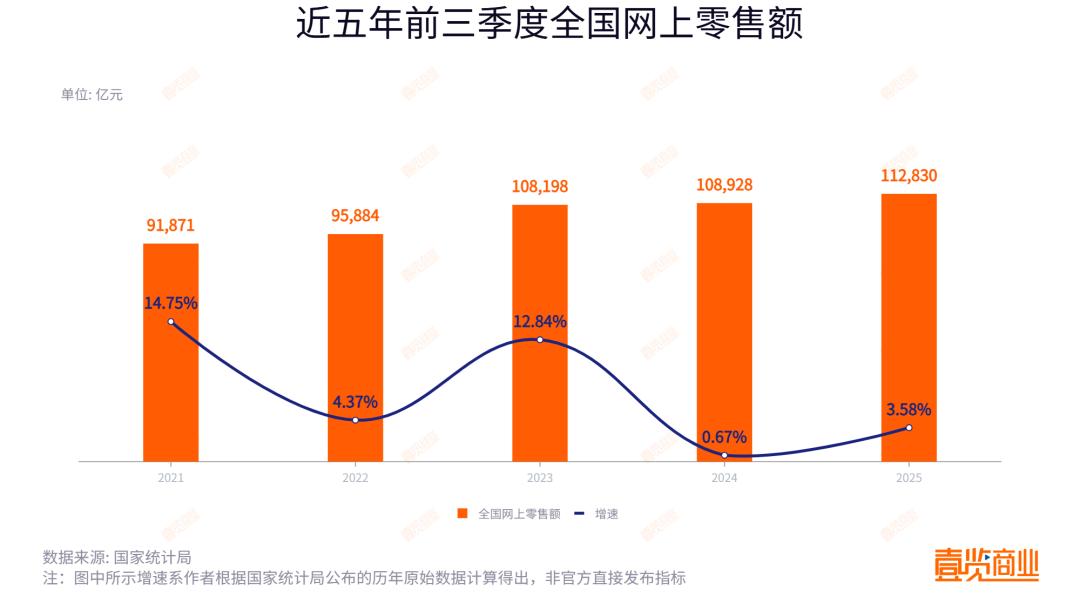
Group 1 - The core point of the article highlights the shift in China's retail landscape, indicating that the online retail growth has plateaued, leading to intensified competition for existing market share rather than expanding the overall market [1][6][28] - The online retail sales growth has entered a low-growth phase, with the growth rate dropping from 14.75% in 2021 to near zero in 2024, and only a slight rebound to 3.58% expected in 2025 [2][4] - The total e-commerce penetration rate has declined for two consecutive years, reaching a low of 25.02% in 2025, signaling that the online channel's growth potential is nearing its ceiling [6][12] Group 2 - Offline retail has shown resilience, with growth rates recovering after a brief decline in 2022, surpassing online growth in 2024 with a rate of 4.59% compared to online's 0.67% [8][12] - The market dynamics have stabilized with online and offline retail maintaining a balance of approximately 30% and 70% market share respectively, indicating a shift from pure online migration to more complex consumption and competition [15][28] - Online platforms are increasingly engaging in price wars to capture market share, with traditional platforms like Taobao and JD.com adopting low-price strategies to compete against emerging players like Pinduoduo and Douyin [16][17][18] Group 3 - The intense competition has led to increased operational pressures for merchants, with high return rates and costs associated with logistics and customer service impacting profitability [20][22] - Platforms are now focusing on internal adjustments and seeking alliances to restore balance in the commercial ecosystem, moving away from solely consumer-centric strategies [23][24] - Offline retailers are enhancing their value propositions by creating unique shopping experiences that cannot be replicated online, thus initiating a counter-offensive against online competition [25][27] Group 4 - The article concludes that the stagnation in e-commerce penetration is not indicative of retail decline but rather a sign of China's economic transition from a goods-oriented society to a service-oriented one, emphasizing the importance of experience over mere ownership [28][29] - Future retail competition will focus on creating deeper value, emotional connections, and seamless integration between online and offline experiences, rather than a zero-sum game [29][30]
这个厮杀激烈的行业,迎来越来越多的女性CEO
吴晓波频道· 2025-11-24 00:20
Core Viewpoint - The rise of female CEOs in China's retail industry signifies a shift in leadership dynamics, with women increasingly taking on top roles in both multinational and local companies, reflecting new strategies to navigate the challenges of the retail landscape [3][9]. Group 1: Female Leadership in Retail - More women are assuming leadership positions in China's retail sector, marking a significant change from a historically male-dominated landscape [3][9]. - Notable examples include Zhu Xiaojing at Walmart China, Huang Yamei at Ito-Yokado, and Xu Min at Procter & Gamble, all of whom have taken on key roles in recent years [10][11][12]. - The trend indicates a broader acceptance and recognition of female leadership capabilities within the industry [9][10]. Group 2: Career Paths of Female CEOs - Female CEOs in retail often come from diverse backgrounds, with three main pathways to leadership: cross-industry experience, internal promotions, and financial expertise [24][30]. - Zhu Xiaojing, for instance, has a background in consulting and has held various roles in multinational companies before leading Walmart China [25]. - Xu Min's journey at Procter & Gamble showcases a long-term commitment to the company, rising through the ranks from a management trainee [26]. Group 3: Advantages of Female CEOs - Research suggests that female CEOs tend to adopt conservative financial strategies, such as lowering leverage and reducing aggressive mergers and acquisitions, which can enhance company survival rates during economic uncertainty [36]. - Zhu Xiaojing emphasizes the importance of intuition, collaboration, and resilience as key traits for effective leadership in the current retail environment [37]. - The concept of the "glass cliff" suggests that women are often appointed to leadership roles during crises, which can present both challenges and opportunities for demonstrating their capabilities [38]. Group 4: Challenges Faced by Female CEOs - Female leaders like Ni Wenling at Watsons and Yan Xiaolei at Hema are stepping into roles during challenging times, with their companies facing declining revenues and market pressures [38][41]. - Zhu Xiaojing has navigated significant challenges at Walmart, including a reduction in the number of traditional stores while expanding e-commerce and membership models [43]. - Chen Jia at Aldi faces the challenge of implementing a low-price strategy in a highly competitive market, where price wars are common [46].



外卖大战 “烧” 到拼多多?
36氪未来消费· 2025-11-20 07:23
Core Viewpoint - Pinduoduo's Q3 financial results indicate a slowdown in growth, particularly in advertising revenue, which has dropped to single-digit growth for the first time, raising concerns about the company's future performance [2][5][6]. Financial Performance - In Q3, Pinduoduo reported revenue of 108.3 billion yuan, a year-on-year increase of 9%, slightly above market expectations and better than the previous quarter's 7% growth [3]. - Operating profit for the quarter was 27.1 billion yuan, reflecting a year-on-year growth of only 1% [3]. - Following the earnings report, Pinduoduo's stock price fell over 7%, marking its worst single-day performance since the release of Q1 results [4]. Advertising Revenue - Pinduoduo's advertising revenue for the quarter was 53.3 billion yuan, missing expectations by 2.1 billion yuan and showing only an 8% year-on-year increase [5]. - This marks the first time Pinduoduo's advertising revenue growth has fallen to single digits, contrasting with Alibaba's 10% growth in customer management revenue for Q2 [6][7]. Reasons for Slowdown - The management team attributed the slowdown to increased competition and the unsustainability of high growth rates as the platform scales [8]. - Analysts suggest that the decline in advertising revenue may be due to a slowdown in GMV growth, which was only 9% in Q3, slightly above the industry average [9]. - Increased competition from platforms like Douyin and the impact of the instant retail battle are also seen as contributing factors [9]. Marketing Expenses and Subsidies - Pinduoduo's marketing expenses decreased by 0.5% year-on-year to 30.3 billion yuan, which was 2.6 billion yuan less than market expectations, as national subsidies have lessened [12]. - The reduction in subsidies has alleviated some financial pressure on Pinduoduo, allowing for a potential recovery in operating profit [12]. International Expansion - Pinduoduo's commission revenue reached 54.9 billion yuan in Q3, a 10% year-on-year increase, driven by clearer tariff policies and the expansion of Temu in international markets [14]. - Temu has seen significant growth, leading in global e-commerce app downloads and monthly active users, with a total download count exceeding 1.2 billion [15]. - However, international expansion poses challenges due to varying compliance requirements across countries and logistical issues in Latin America [16]. Future Outlook - Temu is expected to achieve breakeven in the first half of 2026 and potentially turn a profit in the second half, which could signal a new phase of profitability for Pinduoduo [17].

平台扶持加码,带动中小商家成双11增长中坚力量 |新京报评论
Sou Hu Cai Jing· 2025-11-19 09:33
▲每年"双11",都是各大电商平台集中促销的节点。图/IC photo 由此可见,当平台主动帮商家降低经营成本,分担风险之后,中小商家就敢于放开手脚,轻装上阵,积极地参与大促,抓住快速 成长的机会,放大经营规模。 内容电商激发经济新增量 2025年"双11"收官,各大电商平台销售额创新高,《2025"抖音商城双11好物节"数据报告》(以下简称"报告")显示,10月9日至 11月11日,全域兴趣电商模式有效拉动实体经济新增量,平台上有6.7万个品牌销售额同比翻倍,超过10万商家直播销售额同比翻 倍。 这无疑是一种多赢。电商促销期间,通过补贴让利,推动消费需求集中释放,直播带货精准链接用户需求,刺激消费新增量,从 而进一步拉动了经济增长。这在报告中,也得到了数据印证——"双11"期间,销售额破亿元的单品数量同比增长129%,销售额破 千万元的店铺直播间数同比增长53%。 政策搭台 让中小商家大展身手 以往每年电商大促期间,中小商家囿于资金实力、品牌声量等客观因素,在动辄破千万、破亿的交易战报背后,只能默默沦为品 牌商家们的"陪衬",有的中小商家甚至刻意避开"双11"这样的促销节点,来避免和大商家们的正面竞争。 但 ...

大促观察:达人带货总额八成来自中小达人,直播电商普惠价值放大
2 1 Shi Ji Jing Ji Bao Dao· 2025-11-17 12:00
Core Insights - The "Douyin Mall Double 11 Goods Festival" in 2025 has successfully concluded, showcasing a significant boost in sales and engagement across various brands and merchants on the platform [1] - The event highlighted the emergence of inclusive value within the live-streaming e-commerce ecosystem, with small and medium influencers contributing significantly to sales [2][6] Group 1: Performance Metrics - During the event from October 9 to November 11, 67,000 brands saw their sales double year-on-year, and over 100,000 merchants achieved live-streaming sales that also doubled [1] - More than 540,000 influencers achieved sales growth of over 100% compared to the previous year, with those having fewer than 1 million followers contributing to 80% of total sales [2] Group 2: Small and Medium Influencers - Small and medium influencers have become a backbone of the Douyin e-commerce platform, leveraging their deep understanding of specific categories to build strong relationships with their followers [2] - Their flexible collaboration models and strict product selection standards promote a healthy competitive environment focused on product quality [2] Group 3: New Merchants - Over 20,000 new merchants participated in the Double 11 event, achieving live-streaming sales exceeding 1 million yuan for the first time, supported by various platform policies [3] - Douyin e-commerce's initiatives, such as commission waivers and logistics support, have significantly reduced operational costs for new merchants [3] Group 4: Regional Industry Growth - The live-streaming e-commerce model has revitalized traditional industry clusters, with notable sales growth in various regions, such as a 137% increase in sales for the Haining fur industry [4] - The integration of traditional craftsmanship with modern product design has led to substantial sales increases, exemplified by the 198% growth in sales for the Yongkang cookware industry [4] Group 5: Agricultural Support - Douyin e-commerce has facilitated direct sales of agricultural products through initiatives like the "Open Eating Festival," resulting in significant sales increases for various seasonal products [5] - This direct-to-consumer model has reduced intermediaries, benefiting farmers and enhancing the development of related industries such as packaging and logistics [5] Group 6: Digital Transformation - The rise of small and medium influencers, new merchants, and regional industry growth is driven by algorithmic recommendation technology and quality content, creating new growth opportunities for individuals and small businesses [6]
中通快递被约谈后,中通云仓宣布获A轮融资
Sou Hu Cai Jing· 2025-11-17 06:14
Core Insights - Zhongtong Cloud Warehouse Technology Co., Ltd. has increased its registered capital from 700 million to approximately 723 million yuan, with new shareholders including Zhengzhou Airport Science and Technology Industry Venture Capital Fund and Shanghai Guotai Junan Innovation Equity Investment Fund [1] - The company announced the completion of its Series A financing round, raising about 200 million yuan, which will be used for the construction of a nationwide intelligent warehousing and distribution network, expansion of overseas warehouse operations, and continuous R&D upgrades of its technology systems [1] - Zhongtong Cloud Warehouse, established in June 2018, is primarily owned by Hu Xiangliang, who also holds a significant stake in Zhongtong Express [1] Company Overview - Zhongtong Cloud Warehouse provides omnichannel logistics supply chain services to brand owners, distributors, offline stores, and e-commerce platforms, with a global warehousing network covering 99% of domestic districts and 94% of towns, operating over 270 warehouses with a total area exceeding 2 million square meters [3] - The company has 80 central warehouses, indicating a robust infrastructure to support its logistics operations [3] Regulatory Challenges - Prior to the financing announcement, Zhongtong Express, an important affiliate of Zhongtong Cloud Warehouse, faced scrutiny from the State Post Bureau due to operational irregularities, including poor service quality and inadequate protection of delivery personnel's rights [3] - On the same day, Zhongtong Cold Chain was announced to be removed from the Douyin e-commerce platform due to violations such as providing false logistics tracking and manipulating order fulfillment data, which compromised consumer rights and disrupted platform operations [4] Violations and Partnerships - Douyin e-commerce reported specific violations by logistics providers, including evading platform requirements and creating false tracking information, which led to the decision to terminate partnerships with certain logistics companies [4] - Zhongtong Cloud Warehouse has maintained a close partnership with Douyin e-commerce, having collaborated with nearly a thousand influencers and streamers to create value for both the platform and its clients [4]