
金力永磁

Search documents
十五五的产业政策:变局与破局
2025-11-05 02:30
Summary of Key Points from the Conference Call Industry Overview - The conference call discusses the "15th Five-Year Plan" (十五五) in China, focusing on the transition from quantity to quality in industrial policy, emphasizing industrial ecology, cutting-edge standards, AI integration, and the reduction of traditional subsidies [1][3][8]. Core Insights and Arguments - **Shift in Policy Focus**: The main goal remains unchanged, but constraints have adjusted. Technology will be the core focus for the coming years, with a gradual reduction in direct subsidies and a shift towards building an innovative ecosystem to avoid destructive competition [3][8][12]. - **Gradual Rebalancing**: The policy framework will continue but with nuanced adjustments. The emphasis will be on achieving a balance between multiple objectives, including geopolitical risks and trade friction [3][10][12]. - **AI and Innovation**: AI is expected to enhance productivity through large-scale real-world applications, with a flexible GDP growth target set around 4.5% for the next five years [8][11]. - **Decline of Subsidy-Driven Profits**: Industries that have relied on subsidies will see diminishing returns, shifting the competitive focus to research intensity and execution capabilities of enterprises [8][15]. - **Economic Rebalancing**: The government aims to shift economic growth from supply-driven to demand-driven, with social security reforms expected to stimulate consumption and reduce high savings rates [13][30]. Important but Overlooked Content - **Local Incentive Mechanisms**: The existing local government incentive structures are criticized for promoting quantity over quality, necessitating a reform to encourage consumption rather than production [14][27]. - **Challenges in Total Factor Productivity (TFP)**: TFP growth has significantly slowed, indicating a need for structural reforms to enhance efficiency and resource allocation [17][18]. - **Emerging Industries**: China is rapidly advancing in strategic emerging industries such as AI, robotics, and biotechnology, with expectations to become a leader in these sectors by 2050 [42][43]. - **Supply Chain Vulnerabilities**: Despite advancements, China still faces challenges in high-end semiconductor production and relies on foreign technology for critical components, which poses geopolitical risks [43][44]. Conclusion - The conference call highlights a pivotal moment in China's industrial policy, emphasizing a transition towards innovation and quality, while addressing the need for structural reforms to enhance productivity and consumption. The focus on AI and emerging industries indicates a strategic shift that could redefine China's economic landscape in the coming years [1][3][8][12][42].
外资10月以来密集调研A股 覆盖309家公司 重视“含科”量
Zheng Quan Shi Bao· 2025-11-04 17:48
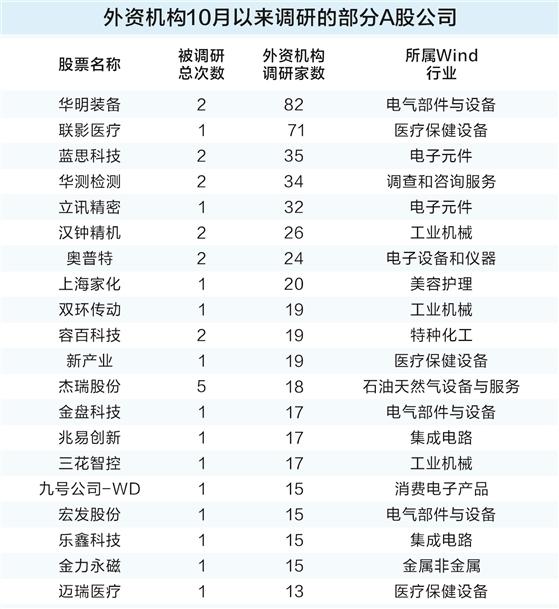
Group 1: Foreign Investment Focus - Since October, foreign institutions have conducted research on 309 A-share listed companies, primarily focusing on high-growth industries such as artificial intelligence, industrial automation, new energy, semiconductors, and consumer electronics [1][3] - Notably, 35 companies received attention from more than 10 foreign institutions, indicating a strong interest in companies like Huaming Equipment, United Imaging Healthcare, Lens Technology, and others [3] - Major foreign institutions involved in the research include Goldman Sachs, UBS, and Morgan Stanley, with Goldman Sachs alone researching over 50 A-share companies since October [5][6] Group 2: Company-Specific Insights - Huaming Equipment was the most researched company, with 82 foreign institutions focusing on its Q3 performance and future export orders [3][4] - United Imaging Healthcare attracted 71 foreign institutions, which were particularly interested in its performance in overseas markets and project deliveries [4] - Other companies like Lixun Precision, Han's Laser, and Jereh Group also received significant attention, reflecting a trend towards sectors like industrial machinery and medical equipment [1][3] Group 3: Economic Outlook and Policy Implications - Foreign institutions are optimistic about China's "14th Five-Year Plan," with Goldman Sachs raising its forecasts for China's export growth and GDP growth [2][6] - The focus on building a robust domestic market and enhancing advanced manufacturing capabilities is expected to positively impact A-shares, particularly in sectors related to self-sufficiency and emerging industries [6][7] - Goldman Sachs predicts that China's export volume will grow by 5% to 6% annually over the next few years, contributing to overall economic expansion [7]


资管一线 | 逆向加仓 不惧短期波动 外资为何执着 “捡漏” 中国科技股?
Xin Hua Cai Jing· 2025-11-04 11:44
Group 1 - The core viewpoint is that foreign investment in Chinese technology stocks has significantly increased due to their attractive valuations and improvements in the industrial fundamentals, indicating a long-term strategic interest rather than short-term speculation [1][6]. - As of November 4, various technology sub-sectors have seen substantial increases, with the communication equipment sector rising by 116.37%, optical communication modules by 111.59%, CPO concept by 95.24%, and computing power by 70.95% [2]. - Multiple international institutions have intensified their research on Chinese technology companies, with notable firms like Morgan Stanley and Manulife Investment conducting extensive surveys [2][3]. Group 2 - Valuation attractiveness is the primary factor for foreign interest, with many foreign institutions viewing recent market fluctuations as opportunities for reverse investment strategies [3][4]. - Institutional investors generally adopt a "allocation-type" strategy, focusing on medium to long-term investments, while individual investors tend to use more direct methods such as ETFs to invest in Chinese technology stocks [4][5]. - The core logic behind foreign investment in Chinese technology stocks increasingly focuses on substantial progress in industrial fundamentals and structural opportunities, particularly in key areas like semiconductors, biotechnology, and artificial intelligence [5][6]. Group 3 - Despite recent market volatility, the medium-term outlook remains optimistic, supported by factors such as gradual profit recovery, continuous net inflows of various external funds, and the restructuring of valuations driven by technology narratives [6].
金力永磁:订单整体排期直抵2026年Q1-Q2,绑定全球顶流厂商稳坐龙头
Quan Jing Wang· 2025-11-04 01:00
Core Viewpoint - The company, Jinli Permanent Magnet, is poised for sustained growth in order volume, driven by strong demand in various sectors, particularly in the electric vehicle and wind power industries [1][2] Group 1: Order Growth and Market Position - As of the third quarter of 2025, the company reported sufficient orders for the fourth quarter, with international orders secured through 2026 [1] - The company has established deep partnerships with leading global enterprises, reflecting robust downstream market demand [1] - In the electric vehicle sector, sales revenue is projected to reach 2.615 billion yuan in 2025, with a year-on-year increase of 23.46% and a domestic market share exceeding 30% [1] Group 2: Sector-Specific Performance - In the wind power sector, the company collaborates with four of the top five wind turbine manufacturers, benefiting from the trend of larger wind turbines, which has increased the material usage per unit from 1.2 tons to 3 tons, achieving a market share of over 36% [2] - The energy-efficient variable frequency air conditioning segment shows strong performance, with a market share surpassing 54% and projected revenue of 1.446 billion yuan in 2025, reflecting an 18.48% increase in sales [2] Group 3: Emerging Markets and Future Outlook - The company is entering new markets such as humanoid robotics, having delivered small batches of joint magnetic components, with a unit usage of 3.5 kg, and is associated with Tesla's Optimus model [2] - In the low-altitude aircraft sector, products have been validated by leading manufacturers, leading to small batch deliveries and opening new growth opportunities [2] - By the fourth quarter of 2025, the company is expected to maintain a leading market share of 28% in the global high-performance neodymium-iron-boron sector, with a high capacity utilization rate and a planned increase to 60,000 tons by 2027 [2]
陕西煤业20251103
2025-11-03 15:48
Summary of Shaanxi Coal Industry Conference Call Company Overview - **Company**: Shaanxi Coal Industry - **Industry**: Coal Mining and Power Generation Key Points Production and Sales - In Q3 2025, Shaanxi Coal's production is expected to remain high at approximately 43 million tons, maintaining over 14 million tons per month [2][3] - The company is balancing production and sales, with stable coal sales channels [2][3] - Q3 sales volume decreased slightly year-on-year due to settlement timing issues [3] Cost and Pricing - The total cost in Q3 was 280 RMB/ton, consistent with the first half of the year [2][3][8] - Costs are projected to rise slightly in Q4 due to project settlements, but remain manageable [2][3] - Coal prices have increased since the end of June, reaching 428 RMB/ton in September, with a slight increase expected in October [2][3] - Most mining areas are close to the long-term contract price ceiling of 520 RMB/ton, with discounts from the second quarter being phased out [2][3][5][6] Profitability - Non-recurring gains contributed approximately 1.3 billion RMB to profits, mainly from stock sales and asset management plan returns [2][3] - Monthly net profit, excluding non-recurring items, stabilized around 1.5 billion RMB [2][3] Power Generation Segment - The power generation segment contributed about 900 million RMB to net profit in the first nine months, expected to exceed 1.2 billion RMB for the full year [2][3] - The company plans to increase installed power capacity to 8.3 million kilowatts and develop multiple thermal power projects [2][3][14] Regulatory Environment - The national policy remains cautious regarding long-term coal supply, with new capacity applications in Shaanxi halted since March 2023 to prevent oversupply [2][15][16] - The government is implementing measures to control excessive production and ensure safety, impacting private mines more than state-owned enterprises [11][12] Future Strategy - Shaanxi Coal is focusing on coal and power integration, gradually exiting asset management plans to concentrate on core business [2][13] - The company plans significant capital expenditure of around 10 billion RMB for power plant construction, with projects expected to complete between late 2026 and mid-2027 [17] Market Outlook - Future coal price trends are uncertain, but a return to rational pricing is anticipated following significant losses in the industry [7] - The company is cautious about external resource purchases, preferring to utilize its own resources due to cost advantages [18] Tax and Cost Implications - An increase in coal prices will lead to higher related taxes, with an estimated increase of about 14 RMB per ton for every 100 RMB rise in coal price [19] - Labor costs do not directly correlate with coal price changes, as hiring decisions depend on overall business conditions [20]

稀土永磁概念下跌1.22%,6股主力资金净流出超亿元
Zheng Quan Shi Bao Wang· 2025-11-03 13:03
Market Performance - As of November 3, the rare earth permanent magnet sector declined by 1.22%, ranking among the top declines in concept sectors [1] - Within the sector, companies such as Jinli Permanent Magnet, China Rare Earth, and Wolong New Energy experienced significant declines, while Baogang Co., Yujing Co., and Zhongkuang Resources saw increases of 4.72%, 3.40%, and 2.42% respectively [1] Capital Flow - The rare earth permanent magnet sector experienced a net outflow of 3.193 billion yuan, with 48 stocks seeing net outflows, and 6 stocks exceeding 100 million yuan in outflows [2] - The largest net outflow was from Northern Rare Earth, amounting to 1.182 billion yuan, followed by Jinli Permanent Magnet, Lingyi Intelligent Manufacturing, and China Rare Earth with net outflows of 339 million yuan, 294 million yuan, and 291 million yuan respectively [2] Top Gainers and Losers - The top gainers in the rare earth permanent magnet sector included Baogang Co., China Aluminum, and Antai Technology, with net inflows of 325 million yuan, 14.3 million yuan, and 1.970 million yuan respectively [4] - The top losers in the sector included Northern Rare Earth, Jinli Permanent Magnet, and Lingyi Intelligent Manufacturing, with declines of 3.76%, 6.97%, and 2.69% respectively [3]



金属新材料板块11月3日跌1.29%,金力永磁领跌,主力资金净流出5.03亿元
Zheng Xing Xing Ye Ri Bao· 2025-11-03 08:47
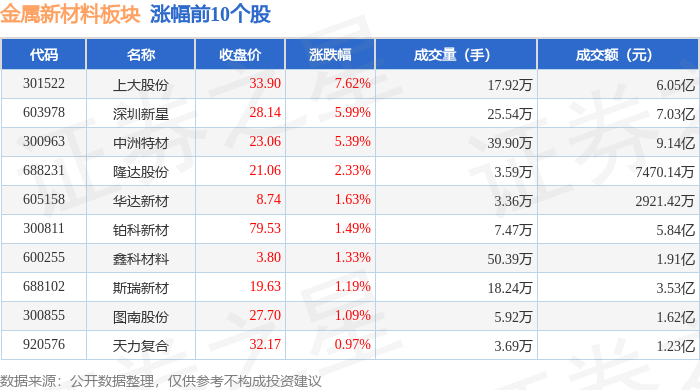
Market Overview - The metal new materials sector experienced a decline of 1.29% on November 3, with Jinli Permanent Magnet leading the drop [1] - The Shanghai Composite Index closed at 3976.52, up 0.55%, while the Shenzhen Component Index closed at 13404.06, up 0.19% [1] Stock Performance - Notable gainers in the metal new materials sector included: - Shangda Co., Ltd. (301522) with a closing price of 33.90, up 7.62% and a trading volume of 179,200 shares, totaling 605 million yuan [1] - Shenzhen New Star (603978) closed at 28.14, up 5.99% with a trading volume of 255,400 shares, totaling 703 million yuan [1] - Zhongzhou Special Materials (300963) closed at 23.06, up 5.39% with a trading volume of 399,000 shares, totaling 914 million yuan [1] - Major decliners included: - Jinli Permanent Magnet (300748) closed at 36.45, down 6.97% with a trading volume of 745,500 shares, totaling 272.6 million yuan [2] - Ni'an New Materials (688786) closed at 29.31, down 4.74% with a trading volume of 30,500 shares, totaling 90.2 million yuan [2] - Dadi Energy (688077) closed at 33.10, down 4.34% with a trading volume of 44,800 shares, totaling 148 million yuan [2] Capital Flow - The metal new materials sector saw a net outflow of 503 million yuan from institutional investors and a net outflow of 104 million yuan from speculative funds, while retail investors had a net inflow of 607 million yuan [2] - Specific stock capital flows included: - An Tai Technology (696000) had a net outflow of 93.98 million yuan from institutional investors [3] - Shenzhen New Star (603978) saw a net inflow of 74.61 million yuan from institutional investors [3] - Shangda Co., Ltd. (301522) had a net inflow of 35.76 million yuan from institutional investors [3]
贝森特称中国优势只有两年?G7多伦多密谋,加拿大公布26个项目
Sou Hu Cai Jing· 2025-11-03 08:45
Core Viewpoint - G7, led by Canada, announced 26 cooperative projects aimed at establishing a critical mineral supply chain to counter China's dominance in the rare earth sector [1][3] Group 1: G7 Initiatives - G7's core objective is to create a dedicated supply chain for critical minerals, particularly rare earths, to reduce reliance on China [1] - The G7 has introduced a purchasing agreement requiring member countries to buy rare earths from within the Western system, even at inflated prices [5] - Canada is taking the lead by establishing a scandium production facility in Quebec and expanding rare earth processing facilities in Ontario [5] Group 2: Challenges and Internal Dynamics - The establishment of a complete supply chain will take considerable time, and the requirement for members to purchase high-priced domestic rare earths poses challenges [3][5] - The U.S. has not signed any agreements, indicating a reluctance to fully commit while still wanting to support allies [7] - Internal disagreements among G7 members complicate the initiative, with Canada seeking to attract investment and Japan concerned about supply chain security versus costs [11] Group 3: China's Competitive Advantage - China holds a significant advantage in rare earth refining, possessing over half of the global patents and lower refining costs compared to the U.S. [9] - The technological expertise and established supply chain in China are critical factors that contribute to its competitive edge in the rare earth industry [15][19] - China's unique extraction technologies and the development of a complete industrial ecosystem make it difficult for other nations to replicate its success quickly [17][19] Group 4: Future Outlook - G7's ambition to build an alternative supply chain within 12 to 24 months may be overly optimistic given the complexities involved [28] - The competition in the rare earth sector is fundamentally a contest of technological prowess, with China leveraging its long-term investments in research and development [26][28] - The G7's response appears to be a reaction to China's technological advancements, highlighting a sense of urgency and concern among member nations [23][25]

A股收评:三大指数收涨,沪指涨0.55%创业板指涨0.29%北证50跌0.98%,钍基熔盐概念、海南板块走高!超3500股上涨,成交2.13万亿缩量2169亿
Ge Long Hui· 2025-11-03 07:36
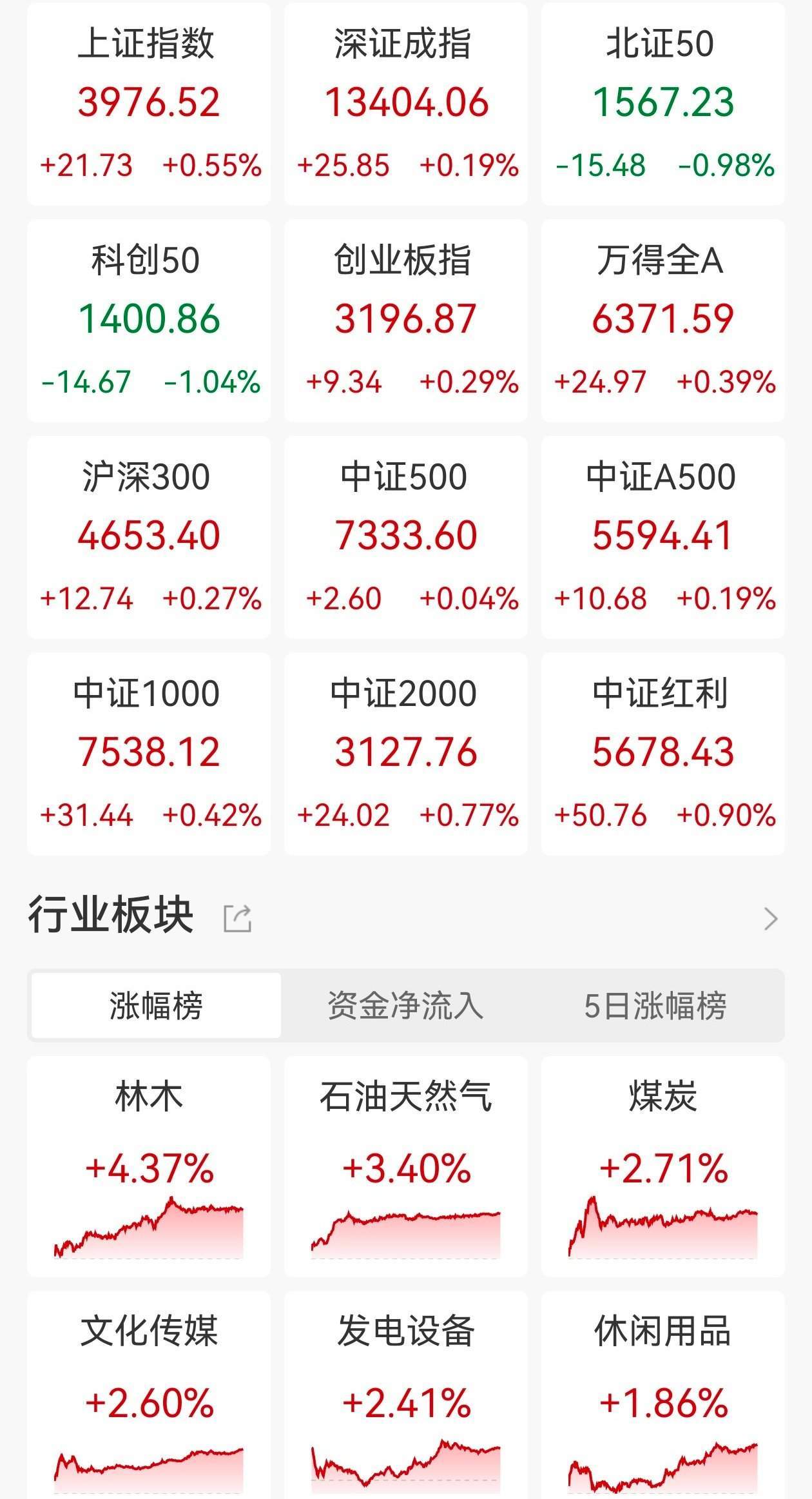
Market Overview - The three major A-share indices experienced slight increases, with the Shanghai Composite Index rising by 0.55% to close at 3976 points, the Shenzhen Component Index up by 0.19%, and the ChiNext Index increasing by 0.29% [1][2] - The total market turnover was 2.13 trillion yuan, a decrease of 216.9 billion yuan compared to the previous trading day, with over 3500 stocks rising [1] Index Performance - Shanghai Composite Index: 3976.52 (+21.73, +0.55%) [2] - Shenzhen Component Index: 13404.06 (+25.85, +0.19%) [2] - ChiNext Index: 3196.87 (+9.34, +0.29%) [2] - The total turnover of the market was 2.13 trillion yuan, reflecting a contraction in trading volume [1] Sector Performance - The thorium-based molten salt concept saw significant gains, with Donghua Technology hitting the daily limit [3] - The Hainan sector surged, with companies like Haima Automobile and Zhongjie Oil & Gas reaching their daily limit [3] - The shipbuilding sector also performed well, with Guorui Technology rising over 12% [3] - The media sector was active, with Dongfang Mingzhu hitting the daily limit [3] - Other notable sectors with gains included gaming, short drama concepts, space station concepts, and cultural media [3] - Conversely, the small metals sector declined, led by Jinli Permanent Magnet, and the jewelry sector fell due to adjustments in gold trading tax policies, with Chaohongji hitting the daily limit [3] - Battery stocks generally fell, with Bolivian dropping nearly 7%, and sectors like composite flow batteries and precious metals also saw declines [3]

恒生指数早盘涨0.58% 内银股回暖
Zhi Tong Cai Jing· 2025-11-03 07:35
Market Overview - The Hang Seng Index rose by 0.58%, gaining 150 points to close at 26,057 points, while the Hang Seng Tech Index fell by 0.24%. The morning trading volume was HKD 132.1 billion [1] Banking Sector - The banking sector showed signs of recovery, with third-quarter earnings indicating a stabilization trend. This is favorable for long-term capital allocation as the year-end approaches. Notable performers include Huishang Bank (03698) up 4.79%, China Construction Bank (00939) up 3.12%, and Bank of China (03988) up 2.27% [1] Coal Sector - Most coal stocks experienced gains due to the onset of the heating season and increased regulatory enforcement. Institutions are optimistic about coal prices maintaining an upward trend. Key gainers include Yanzhou Coal Mining (600188) up 5.62%, China Qinfa (00866) up 4%, and China Coal Energy (601898) up 3.5% [1] Oil Sector - CNOOC (00883) saw a rise of over 3% as its third-quarter net profit exceeded market expectations, with key projects progressing smoothly [2] Biotechnology Sector - Kangfang Bio (09926) increased by over 5% following the recognition of its fourth breakthrough therapy, which is expected to accelerate clinical development and market entry [3] Medical Sector - Spring Medical (01858) surged over 7%, with overseas business becoming a significant revenue source and third-quarter performance showing rapid year-on-year growth [4] Dairy Sector - Modern Dairy (01117) rose by 5% after acquiring China Shengmu, triggering a comprehensive offer with a total price exceeding HKD 2 billion [5] Entertainment Sector - Giant Star Legend (06683) increased by over 8% after becoming a strategic shareholder of Galaxy, actively building a global IP ecosystem [6] Gold Sector - Gold mining and jewelry stocks faced significant declines due to new tax policies potentially impacting short-term physical demand, although long-term demand remains unaffected. Notable declines include Laopuhuangjin (06181) down 8% and Chow Tai Fook (01929) down over 7% [6] Company Management - Jieli Yongci (300748) (06680) fell by over 7% as some directors and senior management plan to reduce their shareholdings [7]