
中国银河

Search documents
券商开年密集发债,重资本业务扩张需求激增
Zhong Guo Ji Jin Bao· 2026-01-18 12:35
Group 1 - The core viewpoint of the article highlights a significant surge in bond issuance by securities firms at the beginning of 2026, driven by a strong A-share market and an increase in capital demand, with a total issuance of 119.52 billion yuan, representing a year-on-year growth of 71.87% [1][2] - The bond issuance is characterized by diversification, with both traditional leading firms like China Galaxy and internet brokers like East Money participating, and various types of products being issued, including conventional corporate bonds and perpetual subordinated bonds [2][3] - The bond issuance trend is a continuation from 2025, where the total issuance exceeded 1.89 trillion yuan, with both the number and scale of bonds issued showing over 44% year-on-year growth [3] Group 2 - The increase in bond issuance is attributed to a combination of business transformation, policy guidance, and a low-cost environment, with firms transitioning from traditional channel businesses to capital-intensive models [4][5] - The active A-share market has led to a growing demand for capital-intensive business expansion, prompting firms to leverage debt financing to seize profit opportunities [4][6] - The current low interest rate environment has made bond issuance an attractive option for firms to refinance high-interest debt and optimize financial structures, thereby enhancing profit margins for future business expansion [4][6] Group 3 - The regulatory environment has positively influenced the expansion of financing channels, with securities firms being included in the issuance of technology innovation bonds, aligning fundraising with national strategic goals [5][6] - The bond issuance trend is expected to continue in the short to medium term, as long as market activity remains robust, sustaining the demand for capital [6][7] - The competitive landscape is shifting towards a "stronger gets stronger" dynamic, where leading firms are better positioned to capitalize on low-cost debt financing, potentially widening the gap between them and smaller firms [7][8]





券商开年密集发债,重资本业务扩张需求激增
中国基金报· 2026-01-18 12:33
Core Viewpoint - The bond issuance by securities firms in China has surged significantly at the beginning of 2026, driven by a strong A-share market and increased capital demand for business expansion and transformation [2][4]. Group 1: Bond Issuance Growth - As of January 17, 2026, the total bond issuance by securities firms reached 119.52 billion yuan, marking a year-on-year increase of 71.87% [4]. - The number of bonds issued totaled 44, which is an increase of 2 compared to the same period last year [4]. - The bond issuance is characterized by diversification, with both traditional and internet securities firms participating, and various types of bonds being issued, including conventional corporate bonds and perpetual subordinated bonds [4]. Group 2: Drivers of Bond Issuance - The increase in bond issuance is attributed to three main factors: business transformation, policy guidance, and a low-cost financing environment [6]. - The active A-share market has led to a growing demand for capital-intensive business models, prompting securities firms to seek additional capital [6]. - The current low interest rate environment has made bond issuance an attractive option for refinancing high-interest debt and optimizing financial structures [6][10]. Group 3: Policy and Market Impact - Regulatory support has expanded financing channels for securities firms, allowing them to issue bonds aligned with national strategies, particularly in technology innovation [7]. - The trend of bond issuance is expected to continue in the short to medium term, as long as market activity remains robust [10]. - The issuance of bonds by securities firms is likely to enhance market liquidity by providing high-quality assets and facilitating capital flow into the market [10][11]. Group 4: Competitive Landscape - The bond issuance trend is leading to a "stronger gets stronger" dynamic, where leading firms are better positioned to capitalize on financing opportunities due to their higher credit ratings and larger business scales [11]. - The differentiation among firms is expected to accelerate, with larger firms solidifying their competitive advantages through low-cost debt, while smaller firms may struggle to keep pace [11].


衍生品新规释放积极信号,关注板块发布业绩预增机遇
GF SECURITIES· 2026-01-18 10:26
Core Insights - The report highlights that new regulations in derivatives are expected to release positive signals for the non-bank financial sector, with a focus on companies likely to announce performance increases [1][5]. Group 1: Market Performance - As of January 16, 2026, the Shanghai Composite Index closed at 4101.91, down 0.45%, while the Shenzhen Component Index rose by 1.14% to 14281.08 [10]. - The average daily trading volume in the Shanghai and Shenzhen markets reached 3.47 trillion yuan, an increase of 21.50% month-on-month [5]. Group 2: Industry Dynamics and Weekly Commentary Insurance Sector - Listed insurance companies are expected to continue high growth, with improvements in long-term interest rate spreads anticipated [12][16]. - As of January 12, 2026, the total scale of private equity securities investment funds by insurance capital reached 184.5 billion yuan, with 11 funds established [16]. - The report suggests focusing on companies such as China Ping An, China Life, and New China Life for potential investment opportunities [16]. Securities Sector - The China Securities Regulatory Commission (CSRC) emphasized stability and quality improvement in its 2026 work meeting, aiming to prevent market volatility and enhance internal stability [17][18]. - The CSRC's new derivatives regulations aim to standardize the market, encourage risk management, and improve the income structure of brokerage firms [25][26]. - The report indicates that the derivatives market is expected to grow significantly, with the scale of over-the-counter derivatives increasing from 0.32 trillion yuan in 2015 to 2.38 trillion yuan in 2023, reflecting a compound annual growth rate of 29% [26]. Group 3: Key Company Valuations and Financial Analysis - China Ping An (601318.SH) has a current price of 66.33 yuan, with a target value of 85.17 yuan, indicating a buy rating [6]. - New China Life (601336.SH) is rated as a buy with a current price of 82.09 yuan and a target value of 94.21 yuan [6]. - China Life (601628.SH) is also rated as a buy, with a current price of 47.52 yuan and a target value of 55.47 yuan [6].



盘中,大跳水!摩根大通最新警告:这个热门品种回调风险大!
券商中国· 2026-01-18 09:38
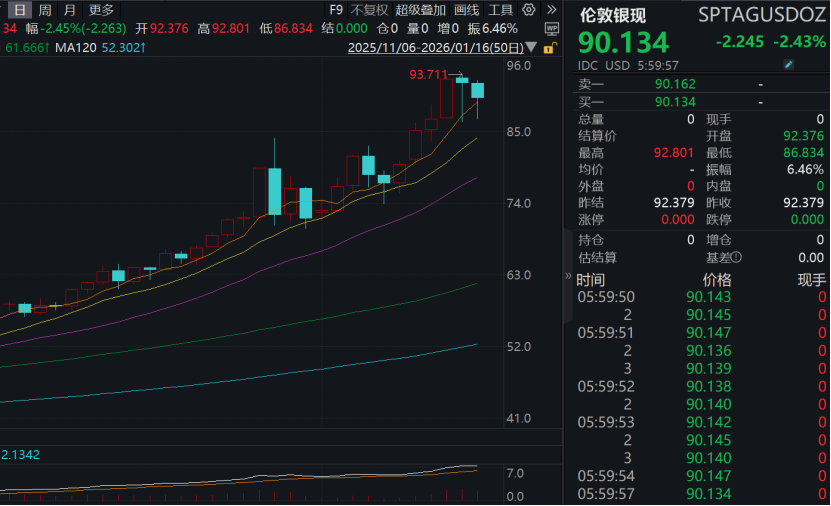
Core Viewpoint - Silver prices have experienced significant volatility recently, with a sharp increase followed by a notable decline, raising concerns about future market stability and demand dynamics [1][2]. Group 1: Price Volatility - On January 15, silver prices hit a historical high of $93.71 per ounce before dropping sharply, with an intraday decline exceeding 7% [1]. - The following day, January 16, silver prices again saw a dramatic drop, with intraday losses surpassing 6%, closing just above the $90 per ounce mark [2]. Group 2: Market Risks - According to JPMorgan, silver faces multiple risks, including suppressed industrial demand due to high prices and continued outflows from ETFs, indicating a significant risk of market correction [1][7]. - The report highlights that industrial demand is under increasing pressure, particularly from the solar energy sector, where rising silver prices could threaten demand by 50-60 million ounces in the coming years [7]. Group 3: Supply and Demand Dynamics - Bloomberg reported that U.S. President Trump decided against imposing tariffs on key mineral imports, including silver, which alleviated some market fears regarding supply disruptions [4]. - Daniel Ghali from TD Securities noted that the U.S. government's targeted approach to trade measures could ease concerns about the impact on physical metal prices [5]. Group 4: Investment Trends - Despite a projected increase in global silver ETF holdings by 278 million ounces in 2025, there has been a notable divergence in price and volume, with significant net outflows from major silver ETFs since late last year [8]. - Analysts from various institutions remain optimistic about silver's long-term prospects, citing supply constraints and industrial demand as key supportive factors, despite the need for short-term price corrections [9].

非银存款同比少减2.84万亿元,券商分析师解读
券商中国· 2026-01-18 09:38
Core Viewpoint - The financial data for December 2025 indicates a decrease in non-bank deposits by 330 billion yuan, with a year-on-year reduction of 2.84 trillion yuan, raising market concerns about the implications for the stock market and financial institutions [1][2][3]. Group 1: Non-Bank Deposit Trends - Non-bank deposits decreased by 330 billion yuan in December, which is significantly lower than the average reduction of 532.7 billion yuan in 2022 and 2023, indicating a notable shift in market dynamics [2]. - Analysts attribute the high year-on-year reduction to a low base effect from December 2024, when non-bank deposits saw a historic drop of 3.17 trillion yuan due to regulatory changes [1][2]. - The overall non-bank deposit scale reached 34.5 trillion yuan by the end of December, accounting for 10.5% of total deposits, reflecting a slight decrease in proportion compared to previous years [2]. Group 2: Market Influences - The reduction in non-bank deposits is partly attributed to seasonal factors, such as the return of funds to deposits from off-balance-sheet products and the influence of a vibrant stock market [3][4]. - Analysts suggest that the capital market's performance, particularly the "924" market rally, has led to significant capital inflows, impacting the overall deposit landscape [3][5]. - The trend of "deposit migration" continues, but the pathways and timing of fund flows may become more complex due to varying asset return expectations and market conditions [3].

盘中,大跳水!摩根大通最新警告:这个热门品种回调风险大!
Xin Lang Cai Jing· 2026-01-18 07:07
白银价格剧烈波动! 在经历了前期的疯狂上涨后,最近两个交易日,白银价格大幅波动。周四(1月15日)盘中,现货白银一度触及93.71 美元/盎司的历史新高,但随后大幅跳水,盘中跌幅一度超过7%,当天收盘时跌幅收窄至0.65%;周五(1月16日), 现货白银再度出现跳水行情,盘中跌幅一度超过6%,收盘时下跌2.43%,险守90美元/盎司关口。 对于白银接下来的走势,摩根大通表示,白银面临多重风险,其中包括工业需求受高价抑制、ETF资金持续流出等。 该行表示,白银市场回调风险较大,但黄金依然看涨。 不过,也有机构认为,长期以来,金银价格走势具备高度相关性。长期的避险情绪以及白银市场供应端的紧张状态不 会改变,白银价格上涨逻辑依然稳固。 白银价格盘中跳水 1月15日,白银价格一度下跌7.3%,随后收复大部分失地。此前四个交易日,白银暴涨超20%;1月16日,白银价格再 度剧烈波动,现货白银盘中跌幅一度超过6%,收盘时险守90美元/盎司。 彭博社称,美国总统特朗普未对包括白银和铂金在内的关键矿物进口全面加征关税,他表示将转而寻求双边谈判,并 提出了设定价格底线的构想。这一决定是在进行了长达数月的审查后作出的,旨在评估外 ...

资本补充与业务扩张双线发力 券商开年发债规模同比增长超七成
Shang Hai Zheng Quan Bao· 2026-01-16 18:34
Group 1 - The core viewpoint of the articles highlights a significant increase in bond issuance by securities firms at the beginning of 2026, with a total issuance exceeding 119.8 billion yuan, representing a year-on-year growth of over 73% [1][2][4] - A total of 27 securities firms have issued 44 bonds as of January 16, 2026, with leading firms like Huatai Securities, Guotai Junan, and China Galaxy Securities showing notable issuance volumes of 17.5 billion yuan, 14.8 billion yuan, and 14 billion yuan respectively [2][3] - The bond issuance is driven by a combination of business expansion, rising funding needs, and a low-interest-rate environment, allowing firms to actively position for future growth and structural adjustments [1][4][5] Group 2 - The current bond issuance structure indicates a clear strategic direction, with 12 short-term financing bonds, 27 corporate bonds, and 3 subordinated bonds issued, primarily aimed at supplementing working capital and repaying maturing debts [2][3] - Some firms are also utilizing international financing channels to increase capital for overseas subsidiaries, as seen with GF Securities planning to raise over 6 billion HKD through H-share placements and convertible bonds [3] - The favorable market conditions, including a strong performance in the capital market and low interest rates, have created an attractive environment for bond issuance, allowing firms to optimize their debt structure through refinancing [4][5]



沪深两市单日成交额近4万亿 机构看好中资券商配置机会(附概念股)
Zhi Tong Cai Jing· 2026-01-16 12:46
Group 1 - The core viewpoint of the news is the adjustment of the minimum margin requirement for margin trading in the Shanghai and Shenzhen stock exchanges, increasing it from 80% to 100% for new margin contracts, which reflects a regulatory approach to stabilize the market and manage leverage [2][3] - The adjustment is expected to lead to a slowdown in the growth of margin financing in the short term, but it will create a more stable overall business environment for the securities industry [3] - The securities sector is anticipated to benefit from the migration of household deposits and the reconstruction of the stock market mechanism, which will support the growth of wealth management, investment banking, and institutional business [2][3] Group 2 - The adjustment of the margin requirement is seen as a measure to guide the market towards a healthier and more sustainable medium to long-term trend, similar to adjustments made in 2015 [2] - Companies in the securities industry, particularly those with strong capital and risk management capabilities, are recommended for investment opportunities [3] - The news highlights several Chinese securities firms listed in Hong Kong, including Huatai Securities, GF Securities, and China Galaxy, among others, indicating a broad interest in the sector [4]


大周期在途中!汇安基金杨坤河解构有色金属板块投资逻辑
Sou Hu Wang· 2026-01-16 10:35
Group 1 - The rapid development of AI is driving the non-ferrous metals industry from a traditional cycle to a new growth era, with expectations for a strong performance in 2025 and continued activity into 2026 [1][2] - The consensus among institutions is that the non-ferrous metals sector is likely to benefit from a bull market driven by monetary, demand, and supply factors in 2026, with a focus on the "AI leap + century change" super cycle [1][2] - Investment strategies should focus on technology and resources, with a particular emphasis on the non-ferrous sector's performance in 2026, supported by factors such as the onset of a Federal Reserve easing cycle and the rise of resource nationalism amid de-globalization [1][2] Group 2 - The global environment is favorable for non-ferrous resources due to a long-term interest rate decline, and 2026 marks the beginning of China's "14th Five-Year Plan," which is expected to bring continued policy support [2] - Supply constraints for global resources are becoming more pronounced, driven by the spread of resource nationalism, which may significantly increase the cost of acquiring upstream resources and lead to heightened safety stock levels in demand countries [2] - Emerging demand in new sectors is expected to resonate with supply constraints, with these sectors showing a higher price acceptance for commodities than previously anticipated [2] Group 3 - The non-ferrous metals sector encompasses numerous sub-sectors, and utilizing professional public fund research teams to invest in the super cycle may become essential [3] - The manager of the Hui'an Quantitative Pioneer Mixed Fund, Yang Kunhe, has a unique background combining industry and finance, which informs his research-driven investment approach [3] - As of the end of 2025, the Hui'an Quantitative Pioneer Mixed A fund achieved a 67.94% annual return, ranking in the top third among comparable equity mixed funds over the past three years [3] Group 4 - Investors are advised to temper expectations for the non-ferrous sector in 2026, as short-term volatility and corrections are likely, despite the overall sector being in a long-term cycle [4] - The investment logic for non-ferrous metals should not be confined to historical strong cycles but should be viewed in the context of the current era [4]
中国银河证券:计算机行业开门红迎底部反转 AI应用与国产算力成全年投资双主线
Xin Lang Cai Jing· 2026-01-16 09:24
Core Viewpoint - The computer industry is expected to experience a strong start in early 2026, with a potential bottom reversal in industry prosperity driven by AI applications and opportunities in the domestic computing power supply chain [1][5]. Industry Performance - As of early 2026, the computer industry index has increased by 18.04%, ranking third among SW primary industries, significantly outperforming major indices such as the Shanghai Composite Index (3.96%), CSI 300 (2.42%), ChiNext Index (4.56%), and STAR Market 50 Index (11.66%) [6]. - The Wind AI application index has risen by 19.25%, indicating strong market recognition of the AI application sector, which is becoming a core driver for the rebound in the computer sector's prosperity [6]. AI Application Trends - The AI application sector is witnessing a series of favorable catalysts, reshaping flow logic. Major AI model companies like Zhipu and MiniMax have recently gone public and performed strongly, while international movements, such as NVIDIA's $1 billion collaboration with Eli Lilly and OpenAI's acquisition of Torch, further enhance the positive outlook for AI applications [2][6]. - The transition from traditional SEO (Search Engine Optimization) to GEO (Generative Engine Optimization) is accelerating, pushing AI applications from a technology validation phase to a commercial value realization phase [2][6]. Commercialization Pathways - B-end AI applications are expected to see the first wave of explosive growth, with a focus on sectors such as AI + marketing, AI + industrial software, AI + healthcare, and AI + finance [7]. - Traditional C-end companies with strong user bases and brand influence can further solidify their competitive advantages through AI empowerment, making them worthy of long-term investment tracking [7]. Computing Power Infrastructure - The domestic computing power sector is entering a new development cycle, with a recovery trend in AIDC bidding observed in Q4 2025. Major internet companies in China are expected to accelerate data center layouts in 2026 [3][7]. - If H200 supply is restored, it will significantly enhance large model training efficiency, further accelerating the implementation of AI applications and driving demand for domestic computing power chips in inference [3][7]. Investment Recommendations - The report suggests focusing on two main investment lines for 2026, with eight specific sub-sector recommendations: 1. Large model and MaaS vendors, including Alibaba-W, Zhipu, MiniMax, and iFlytek 2. Domestic computing power and data center supply chain, including Cambrian, Haiguang Information, Runze Technology, and Inspur 3. AI + marketing sector, including BlueFocus and Visual China 4. AI + industrial software sector, including Dingjie Zhizhi and BGI 5. AI + healthcare sector, including Jingtai Holdings and Weining Health 6. AI + office sector, including Kingsoft Office and Wanjing Technology 7. AI + ERP sector, including Kingdee International and Yonyou Network 8. AI + finance sector, including Hengsheng Electronics and Tonghuashun [8].