长江存储

Search documents
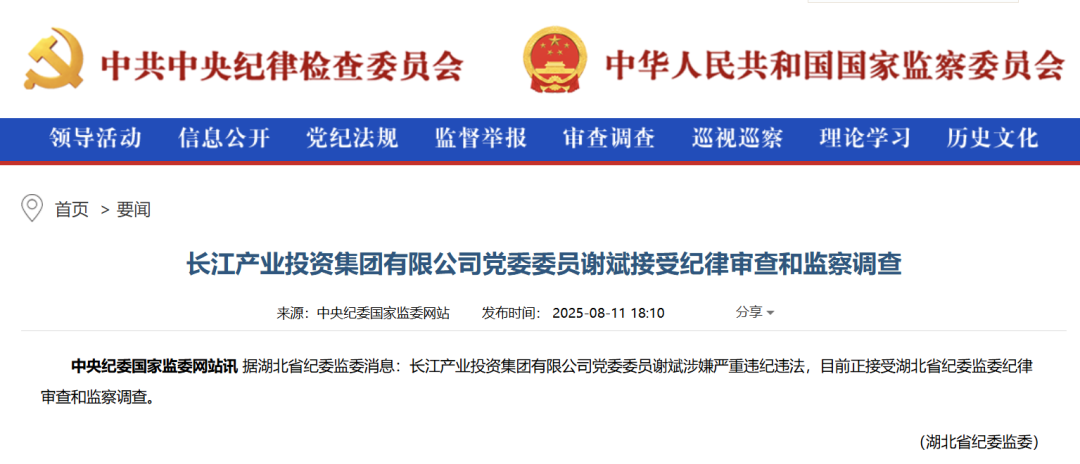
长江产业投资集团党委委员谢斌接受审查调查
Zhong Guo Ji Jin Bao· 2025-08-11 14:30
Core Viewpoint - The recent investigation into Xie Bin, a member of the Party Committee of Changjiang Industrial Investment Group, highlights significant issues of corruption within the organization, raising concerns about governance and compliance in state-owned enterprises [1][2]. Group 1: Investigation Details - Xie Bin is under investigation for serious violations of discipline and law, currently undergoing scrutiny by the Hubei Provincial Commission for Discipline Inspection and Supervision [1]. - Xie Bin, born in November 1970 and a senior economist, has held various positions in local enterprises and represented Changjiang Industrial Investment Group at public events [2]. Group 2: Company Overview - Changjiang Industrial Investment Group was established in January 2022, with a registered capital of 33.6 billion and total assets amounting to 250.9 billion [4]. - The group manages over 700 billion in subscribed funds and has 25 controlled secondary subsidiaries, including five listed companies [4]. - The company focuses on national strategies and the construction of modern industrial clusters in Hubei, emphasizing eight major industry sectors such as optoelectronic information, high-end manufacturing, and new energy [4].

光刻胶禁运阴霾下,中国半导体产业的至暗与曙光
材料汇· 2025-08-10 12:02
Core Viewpoint - The article emphasizes the critical role of photoresist in the semiconductor industry, highlighting the risks posed by the current reliance on foreign suppliers, particularly Japan, which dominates 90% of the high-end photoresist market. The potential for supply disruptions could severely impact China's semiconductor capabilities, especially in advanced processes below 14nm [2][11][23]. Group 1: Importance of Photoresist - Photoresist is described as an essential material in semiconductor manufacturing, likened to a precision tool that enables the creation of intricate circuit patterns on silicon wafers [4][11]. - The production of high-end photoresist involves complex chemical formulations and stringent manufacturing processes, making it a highly specialized field with significant technical barriers [7][23]. Group 2: Current Market Situation - China's domestic production of high-end photoresist is alarmingly low, with KrF photoresist at 15% and ArF photoresist below 5% [2][11]. - The article outlines various types of photoresist used in semiconductor manufacturing, including G-line, I-line, KrF, ArF, and EUV photoresists, each serving different technological nodes [8][10]. Group 3: Risks of Supply Disruption - The article discusses potential scenarios of supply disruption due to geopolitical tensions, particularly the risk of a comprehensive technology embargo from the U.S. and its allies, which could lead to a halt in semiconductor production in China [27][28][29]. - The impact of such disruptions would be felt across various sectors, including automotive, consumer electronics, and advanced computing, leading to significant economic repercussions [33][34][38]. Group 4: Strategies for Mitigation - The article suggests immediate emergency strategies, such as inventory management, global sourcing through gray channels, and temporary use of lower-performance alternatives to maintain production [42][44][45]. - Long-term strategies include building a self-sufficient photoresist supply chain through national collaboration, technological innovation, and investment in research and development [51][55][58]. Group 5: Future Outlook - The article concludes that while the current situation poses severe challenges, it also presents an opportunity for China to strengthen its semiconductor industry by investing in domestic capabilities and reducing reliance on foreign technology [62].


反噬来了!北美芯片价格暴跌66%,外媒:简直是“灭顶之灾”!
Sou Hu Cai Jing· 2025-08-08 05:20
Core Viewpoint - The rapid development of China's chip industry has led to a significant drop in North American chip prices by 66%, creating a challenging situation for Western chip manufacturers [1][3][9] Group 1: Market Dynamics - China has become a global leader in the production of mid-to-low-end chips, surpassing the U.S. in chip output in 2024 [1][3] - The strong supply capacity of Chinese mid-to-low-end chips and their competitive pricing have contributed to the price decline in North America [3][5] - Chinese companies, such as Yangtze Memory Technologies, have successfully captured market share from American firms like Micron and Samsung through aggressive pricing strategies [3][5] Group 2: Impact on Western Companies - The influx of low-priced Chinese chips has pressured U.S. chip manufacturers, leading to significant revenue declines, such as a 96% drop in Wolfspeed's performance over three years and a 41.9% revenue decrease for Microchip Technology in Q4 2024 [5][7] - Many U.S. companies are facing survival challenges, resulting in layoffs and factory closures to cope with the market downturn [5][7] Group 3: Future Outlook - China's dominance in mid-to-low-end chips is expected to continue, as these chips are crucial for various consumer products, including air conditioners and electric vehicles [7][9] - Despite existing gaps in high-end chip technology, China is making strides, with companies like SMIC achieving mass production of 7nm chips [7][9] - The ongoing technological advancements suggest that China may soon break through existing barriers in the high-end chip market, further solidifying its global position [9][11] Group 4: Geopolitical Implications - The U.S. has attempted to counter China's chip rise through tariffs and sanctions, but these measures have not effectively curbed China's growth and have instead led to price drops in the U.S. market [9][11] - The potential for increased tariffs could backfire, leading to higher costs for American companies and further reliance on Chinese chips [7][9]

半导体板块上扬,富满微20%涨停,东芯股份续创新高
Zheng Quan Shi Bao Wang· 2025-08-07 04:24
Group 1 - The semiconductor sector experienced a significant rise on August 7, with stocks such as Fuman Micro reaching a 20% limit up, and Dongxin shares increasing over 17%, marking a new high [1] - U.S. President Trump announced on August 6 that the U.S. will impose approximately 100% tariffs on chips and semiconductors, while stating that there will be no fees for manufacturing within the U.S. [1] - ShenGang Securities indicated that the U.S.-China AI competition may enter a phase focused on global output standards and high-end computing chip competition, with subsequent export control measures potentially restricting China's imports of chips, semiconductor manufacturing equipment, and materials [1] Group 2 - Domestic chip leaders, represented by Yangtze Memory Technologies, are actively promoting the localization of manufacturing equipment, with their first fully domestic production line expected to begin trial production in the second half of 2025 to reduce reliance on foreign equipment [1] - There is a recommendation to pay attention to breakthroughs in self-controllable technology, improvements in domestic foundry yield rates, and the recovery of the traditional semiconductor cycle [1]

起诉3次还是保守了?长江存储用3年在美诉讼告诉我们对面有多不要脸
Hu Xiu· 2025-08-07 01:31
(小记:为了做这期视频我们翻了非常多的资料,前前后后准备了一个多月的时间。奈何几次诉讼的跨 度横跨了三年多的时间,消息来源我们已经尽可能跟大家确认过了,但不排除依旧存在纰漏。在这里我 们欢迎大家的指正,也欢迎大家在评论区提供更有价值的信息~) 长江存储近日对美光提起第三起诉讼,指控美光资助并推动了针对长江存储的抹黑活动,一开始我们以 为,这事儿的华点可能是,美光作为一个美国企业到底发表了哪些逆天的言论,长江存储又跟它爆发了 怎么样激烈的口水仗?结果稍微了解了一下之后,发现事情并不简单。 ...

有研新材在互动平台表示,台积电、英特尔、中芯国际、长江存储等都是公司重要的客户。



Xin Lang Cai Jing· 2025-08-06 07:43
有研新材在互动平台表示,台积电、英特尔、中芯国际、长江存储等都是公司重要的客户。 ...
有研新材(600206.SH):长江存储等都是公司重要的客户
Ge Long Hui· 2025-08-06 07:37
Core Viewpoint - The company has identified major clients including TSMC, Intel, SMIC, and Yangtze Memory Technologies, indicating strong partnerships within the semiconductor industry [1] Group 1 - The company is actively engaging with significant players in the semiconductor sector, which may enhance its market position and revenue potential [1]
制裁了个寂寞?比尔盖茨预言成真,日媒:美国越封锁,中国越强大
Sou Hu Cai Jing· 2025-08-04 07:12
Core Viewpoint - The Chinese chip industry has not only survived the sanctions imposed by the U.S. but has thrived, particularly in the mature chip sector, positioning itself as a global leader in this market. Group 1: Impact of U.S. Sanctions - In 2019, the U.S. placed hundreds of Chinese chip companies, including Huawei and Yangtze Memory Technologies, on an "entity list," prohibiting them from purchasing American technology [3] - Despite the restrictions on EDA software, photolithography machines, and advanced process foundries, Chinese chip companies adopted a "fight to the end" mentality, leading to significant advancements during a period of apparent dormancy [3][9] Group 2: Growth in Chip Production - After failing to procure ASML's EUV photolithography machines, China invested 150 billion yuan in new wafer fabs across major cities, resulting in a monthly production capacity increase of 350,000 wafers for mature chips [4] - China has achieved a global leading position in mature process capacity (28nm and above), with projections indicating a 43% market share by 2027 [6] Group 3: Technological Advancements - Chinese companies have made significant strides in chip design software, with firms like Huada Jiutian and Gekun Electronics successfully developing designs for 14nm and above [10] - In chip manufacturing equipment, Shanghai Micro Electronics and Zhongwei have achieved mass production of 28nm photolithography machines and successfully integrated 5nm etching machines into TSMC's supply chain [10] Group 4: Market Dynamics and Competition - The return of Huawei's Kirin chips has pressured Qualcomm, resulting in a loss of approximately 40 million chips sold in China, translating to hundreds of billions in economic losses for Qualcomm [10] - Yangtze Memory Technologies has captured an 8.1% global market share in NAND flash memory, forcing competitors like Samsung and Micron to reduce prices by 50% [10] - Chinese companies like BYD and Unisoc have significantly impacted the automotive chip market, leading to a 60% profit drop for Infineon and NXP [10] Group 5: Export Growth - China's chip export value has surged from 437.2 billion yuan in 2014 to 1.14 trillion yuan in 2024, marking a significant increase and breaking the 1 trillion yuan barrier for the first time [11] - The U.S. strategy to restrict high-end chips has inadvertently allowed China to dominate the mature chip market, with global analysts noting that U.S. sanctions have only strengthened China's position [11]

AI算力+15000亿储存芯片+半导体,技术壁垒或成最大焦点!
Xin Lang Cai Jing· 2025-08-04 02:52
Core Insights - The explosive growth in AI computing power demand is creating historic opportunities for storage chips, which are essential components in the semiconductor industry and represent a significant portion of the global chip market [1][3]. Industry Overview - The Chinese storage chip market is projected to exceed 1.5 trillion yuan by 2025, with a surge in demand for high-end storage products like HBM and DDR5 [1]. - AI model training is driving exponential increases in memory bandwidth requirements, with Nvidia's H100 AI server needing 640GB of HBM and 2TB-4TB of DDR5, leading to a projected HBM market size of $30 billion by 2025, accounting for 28% of the global DRAM market [3]. Policy Support - China's "14th Five-Year Plan" identifies storage chips as a key area for breakthroughs, with the National Big Fund Phase III focusing on advanced processes and storage technologies to support local companies like Yangtze Memory Technologies and Changxin Memory Technologies [3]. Market Trends - Historical trends show that technological revolutions create new demands that benefit core component suppliers first, as seen in the 5G commercialization and the electric vehicle revolution [3]. Company Analysis - **GigaDevice**: A leader in the global NOR Flash market and automotive DRAM, producing a full range of storage chips with clients including Samsung, Apple, and Huawei [5]. - **Lanqi Technology**: A global leader in memory interface chips, with over 50% market share in DDR5 interface chip shipments and recognized by Intel [5]. - **Jiangbolong**: A leader in storage module packaging and testing, with a partnership with SanDisk to develop 218-layer 3D flash memory technology, achieving a 200% year-on-year revenue increase in enterprise storage products by Q1 2025 [6]. - **Yangtze Memory Technologies**: Engaged in traditional storage and computing industry, focusing on enterprise SSDs, server manufacturing, and AI glasses [8]. - **Confidential Storage Chip Company (Code: 666XXX)**: Specializes in HBM and DDR5 development, with core technologies in 3D stacking and hybrid bonding, expected to see an 80% revenue growth by 2025 and a net profit margin increase to 25% [10].
决战混合键合
半导体行业观察· 2025-08-04 01:23
Core Viewpoint - Hybrid bonding technology is rapidly transitioning from laboratory to mass production, becoming a new pillar in storage chip manufacturing, particularly in the context of advanced packaging technologies like 3D NAND and HBM [2][3]. Group 1: Hybrid Bonding Technology - Hybrid bonding eliminates size limitations and parasitic effects associated with traditional bump structures, resulting in shorter signal transmission paths, lower power consumption, and higher speeds [3]. - In 3D NAND, hybrid bonding is expected to replace some existing structures, enabling stable manufacturing at higher stacking layers (e.g., over 300 layers) [3][7]. - Leading companies like Micron, SK Hynix, and Samsung are actively investing in hybrid bonding technology for HBM4 and next-generation CUBE architectures, highlighting its strategic importance [3][5]. Group 2: Samsung's Initiatives - Samsung has shown a strong commitment to hybrid bonding, recognizing its necessity for manufacturing 16-layer HBM [4][5]. - The company plans to produce HBM4 samples by 2025, with mass production expected in 2026, and has already tested a 16-layer HBM sample using hybrid bonding technology [5][6]. - Samsung is also preparing for a custom HBM business, responding to demand from major tech companies like Google and NVIDIA for tailored HBM products [6][7]. Group 3: SK Hynix's Developments - SK Hynix is also pursuing hybrid bonding technology, planning to mass-produce 16-layer HBM4 by 2026 and exploring the potential for over 20 layers [9][10]. - The company aims to implement hybrid bonding for its NAND products, targeting 400-layer NAND flash production by 2025 [10][11]. Group 4: Micron's Position - Micron has been relatively quiet about hybrid bonding but has begun delivering HBM4 samples, which feature a capacity of 36 GB and a bandwidth of up to 2 TB/s [13][14]. - The company is focusing on optimizing existing technologies and may adopt hybrid bonding later than its competitors [14]. Group 5: Equipment Manufacturers - Equipment manufacturers like BESI and Applied Materials are leading the hybrid bonding equipment market, with BESI having developed systems for high-precision bonding since 2019 [15][16]. - Applied Materials has integrated its hybrid bonding platform with wafer processing data, emphasizing system-level integration [16][17]. - Other companies, including ASMPT and Korean firms like Hanmi Semiconductor and Hanwha, are also entering the hybrid bonding equipment market, with various development stages and partnerships [18][19][20]. Group 6: Future Outlook - The semiconductor industry is increasingly focused on hybrid bonding as a key technology to overcome traditional packaging limitations and achieve higher performance integration [25]. - As Moore's Law slows, hybrid bonding is expected to play an irreplaceable role in advancing the industry towards greater integration and performance [25].