
TCL电子

Search documents
AI消费火热!粤企加速布局AI智能体,解锁人机交互新模式
Nan Fang Du Shi Bao· 2025-05-15 09:09
Core Insights - The article highlights the rapid development and integration of AI technologies in various sectors within Guangdong, particularly focusing on consumer electronics like AI smartphones, AI glasses, and AI toys [1][2][4][11]. AI Smartphones - The launch of AI smartphones marks the beginning of an "autonomous driving" era in mobile technology, with significant consumer interest reflected in a survey where over 70% expressed a willingness to purchase AI smartphones [4][5]. - Guangdong produced 683 million smartphones in 2024, accounting for 40% of the national output, with a target to manufacture over 100 large-scale AI-enabled devices by 2027, including 100 million AI smartphones [4][5]. AI Glasses - The AI glasses market is experiencing a surge, with nearly 90% of surveyed consumers showing interest in purchasing AI glasses, making it the highest among all categories [7][11]. - Companies like Huawei and OPPO are actively participating in the "hundred glasses battle," showcasing their AI glasses at international events like CES 2025, indicating a growing competitive landscape [7][8]. AI Toys - There is a rising consumer interest in AI toys, with 88.35% of respondents indicating a high willingness to purchase, particularly for products that offer emotional interaction [11][12]. - Companies in Guangdong are innovating in the AI toy sector, integrating advanced AI functionalities into traditional toys, leading to significant order increases, such as one company reporting over 2 million orders for AI-enabled plush toys [11][12]. Industry Trends - The integration of AI technologies across various consumer electronics is reshaping human-computer interaction, with predictions that AI glasses could eventually perform functions similar to smartphones [6][10]. - The AI toy market is projected to reach a scale of 30 to 40 billion RMB by 2028, indicating substantial growth potential in the emotional companionship segment [12].


中国银河证券:出口订单进入观望期 短期建议关注受美国市场影响较小公司
智通财经网· 2025-05-15 01:41
Core Viewpoint - The report from China Galaxy Securities indicates a significant decline in China's exports to the U.S. due to fluctuating tariff policies, with a projected 21% year-on-year drop in April 2025 exports to the U.S. despite a temporary reduction in tariffs from 145% to 30% [1][2] Group 1: Tariff Policy Changes - The U.S. has implemented a complex tariff structure, with a total tariff rate of 145% on Chinese goods, including a 125% "reciprocal tariff" and additional tariffs related to fentanyl issues [1] - The recent U.S.-China Geneva Economic and Trade Talks resulted in a temporary suspension of certain tariffs, reducing the overall tariff on most Chinese goods to 30% [2] Group 2: Impact on Exports - In April 2025, China's total exports reached $315.7 billion, with exports to the U.S. at $33 billion, reflecting a 21% decline year-on-year [3] - A significant portion of U.S. importers are adopting a wait-and-see approach, with 89% of surveyed companies prioritizing order cancellations and 61% shifting procurement to Southeast Asia [3] Group 3: Supply Chain Dynamics - The report anticipates a trend towards international supply chain diversification, with companies seeking to establish supply capabilities in regions like Southeast Asia and Mexico to mitigate tariff impacts [4] - Temporary measures such as storing goods in bonded warehouses and utilizing re-export strategies are being employed by U.S. importers to navigate the current tariff landscape [3] Group 4: U.S. Retail Market Conditions - The U.S. is experiencing a stockpiling phenomenon, but overall inventory levels have not shown significant increases, indicating potential supply shortages in the retail market [5] - Price increases among brands are not widespread, with only 1% of products on Amazon experiencing price hikes, suggesting that inflationary pressures may build if inventory levels continue to decline [6] Group 5: Future Outlook for Exports - The report suggests that while some Chinese companies have established overseas production bases, the pace of capacity expansion varies, with some firms expected to meet U.S. demand from overseas by Q3 2025 [8] - The competitive landscape is expected to intensify, putting pressure on profit margins for smaller export-oriented firms, while larger companies with international capabilities may better withstand these challenges [9]

银河证券晨会报告-20250514
Yin He Zheng Quan· 2025-05-14 14:50
Key Insights - The report highlights the positive impact of the recent US-China trade agreement, which includes the cancellation of 91% of additional tariffs and a 90-day suspension of 24% tariffs, creating a more stable environment for negotiations and potential cooperation [2][3] - The agreement is expected to reduce uncertainty in trade, improve investor sentiment, and enhance corporate profit expectations, particularly for industries heavily reliant on exports [3][4] - The report suggests that sectors previously affected by tariffs, such as electronics, consumer goods, and machinery, may see a recovery in market performance [3][4] Electronics Industry - The electronics sector is experiencing a structural recovery, with high growth in AI-related hardware and a stable performance in consumer electronics, supported by government subsidies [19][16] - Sub-sectors like semiconductors are witnessing a resurgence, with domestic replacements accelerating and a strong performance from leading companies [16][19] - The report notes a divergence in performance among companies within the consumer electronics space, with some benefiting from AI and global expansion while others face challenges from competition and demand weakness [17][19] Military Industry - The recent India-Pakistan conflict has highlighted China's military exports, with Pakistan being a significant customer for Chinese military equipment, which may enhance China's military trade reputation [22][23] - The report anticipates increased demand for military equipment due to the conflict and suggests that domestic military enterprises are less affected by US tariff wars, presenting a stable investment opportunity [24][22] - The long-term outlook for the military sector remains positive, with expectations of sustained high demand leading up to the centenary of the Chinese military in 2027 [24][22] Construction Materials - The construction materials sector is showing signs of recovery, with a notable improvement in profitability in Q1 2025 compared to the previous year, driven by stabilizing infrastructure investment and a gradual recovery in demand [27][30] - The report indicates that cement prices may see upward pressure due to improved demand and supply optimization, while glass fiber and other materials are also expected to benefit from emerging market demand [30][27] - The construction materials market is anticipated to continue its recovery, supported by favorable policies and a focus on renovation and upgrading existing properties [30][28] Banking Sector - The banking sector is benefiting from a series of financial policies aimed at optimizing credit structures and enhancing profitability, with a notable increase in bank stock performance [32][37] - The report emphasizes the importance of structural monetary policy tools and the potential for increased capital inflows into the banking sector, which may further enhance its valuation [33][37] - The outlook for the banking sector remains positive, with expectations of continued support from government policies and a focus on technological financial services [36][37]
银河证券每日晨报-20250514
Yin He Zheng Quan· 2025-05-14 03:46
Key Insights - The report highlights the positive impact of the recent US-China trade agreement, which includes the cancellation of 91% of additional tariffs and a 90-day suspension of 24% tariffs, creating a more stable environment for negotiations and potentially benefiting various sectors in the A-share market [2][3] - The electronic industry is experiencing a structural recovery, with high growth in segments driven by AI infrastructure, while consumer electronics are supported by government subsidies, leading to stable performance in the Apple supply chain [19][22] - The military industry is poised for growth due to increased domestic demand and military trade opportunities, particularly following the recent India-Pakistan conflict, which has enhanced the visibility of Chinese military equipment [22][24] - The construction materials sector is seeing a recovery in profitability, with expectations of improved demand driven by real estate policies and infrastructure investments, particularly in cement and fiberglass [27][30] - The banking sector is benefiting from a series of financial policies aimed at optimizing credit structures, with a positive outlook for long-term value realization in bank stocks [32][37] Electronic Industry - The semiconductor sector is witnessing a recovery with accelerated domestic substitution, while the consumer electronics segment shows a mixed performance, with some companies benefiting from AI and global expansion [16][17] - The PCB and LED markets are experiencing growth due to increased demand from AI applications and government support, respectively [18][19] Military Industry - The recent India-Pakistan conflict has highlighted the effectiveness of Chinese military equipment, potentially leading to increased military trade opportunities with countries in the Middle East and along the Belt and Road [22][23] Construction Materials - The construction materials sector is expected to recover, with improved profitability driven by stabilizing demand in the real estate market and infrastructure investments, particularly in cement and fiberglass [27][30] Banking Sector - The banking sector is expected to benefit from a comprehensive set of financial policies, including interest rate cuts and structural tools aimed at enhancing credit quality and supporting economic growth [32][37]
关税冲击影响跟踪:宏观与消费
2025-05-13 15:19
关税冲击影响跟踪:宏观与消费 20250513 摘要 • 中美贸易摩擦缓和预期提升风险偏好,利好中国市场,但 30%关税仍是重 要影响。中国资本市场有望相对美国表现更好,短期内贸易摩擦调整较多 的板块或反弹,科技加红利仍是看好的主线。 • 预计全年中国对美出口仍将保持正增长,即使美国加征 30%的关税,对美 出口下降 25 个百分点,对整体出口影响为 3.6 个百分点,对 GDP 影响大 约是 0.5 个百分点。 • 政策应对方面,应重点落实存量政策,通过政策性金融工具应对短期冲击, 预计规模在 8,000 亿到 1 万亿左右,而非增发国债或调整赤字率。 • 中国消费产业链具备国际竞争力,在中美贸易摩擦中表现出强韧性。建议 关注国际化能力优秀且海外产能布局丰富的消费行业龙头,如美的、海尔、 海信家电和 TCL 电子。 • 医药行业大部分药品获得关税豁免,但医疗设备加征 145%关税导致对美 出口基本停滞。创新药板块表现强势,医疗设备及耗材类公司股价表现弱 势。关注美国 CPI 上升及特朗普政策对医药行业的影响。 Q&A 目前中国面临的关税情况如何? 目前,中国面临的关税包括 20%的芬太尼关税、10%的对等关 ...
降关税之后:市场关注哪些机会?
2025-05-13 15:19
Summary of Conference Call Records Industry or Company Involved - Focus on the impact of US-China tariff adjustments on various industries, including technology, communication, manufacturing, and the internet sector. Core Points and Arguments US-China Tariff Adjustments - The US has reduced tariffs on China from 145% to 30%, including the cancellation of 91% of pressure tariffs and a delay on some reciprocal tariffs, leading to positive market reactions. However, uncertainty remains regarding the full implementation of the 34% reciprocal tariffs [1][2][34]. - The market is optimistic about the potential cancellation of the 20% fentanyl tariff due to China's strict management since 2018, but the 24% delayed reciprocal tariffs are less likely to be removed [2][3]. Domestic Policy Shifts - The Chinese government is adopting an active fiscal policy, including accelerated bond issuance and interest rate cuts, to stabilize growth. This policy response is expected to be quicker than in previous years [1][4]. - Investment opportunities include high-yield assets, overseas expansion, and gold assets due to global order restructuring [1][4]. Stock Market Dynamics - The US-China agreement is expected to enhance market risk appetite, primarily driven by changes in the intrinsic logic of the Chinese stock market, such as declining discount rates and risk-free rates, making equities more attractive [1][5][6]. - The Shanghai Composite Index is projected to reach 3,500-3,600 points before July, with the Hang Seng Index expected to hit new highs in the second half of the year [1][6]. Export Chain and Technology Sector - The export chain, particularly in sectors related to Apple, Nvidia, and Tesla, is anticipated to recover significantly, supported by favorable liquidity and risk appetite [1][7]. - The technology sector is expected to continue its growth trajectory, driven by trends in AI and robotics, which present substantial market opportunities [7]. Hong Kong Stock Market - The investment value of the Hong Kong internet sector has improved due to the easing of US-China geopolitical tensions, with strong fundamentals and reasonable valuations. Key stocks to watch include Alibaba and Kuaishou [1][8][45][46]. Communication Industry - The communication sector has been significantly impacted by tariff changes, with major players experiencing notable adjustments in stock prices. However, strong capital expenditure growth in North America is expected to drive demand for optical modules and related technologies [2][21][23][24][25]. Manufacturing Supply Chain Trends - There is a trend of global manufacturing supply chains relocating to third countries, with China focusing on a "China for China" strategy to serve its domestic market [2][35]. Investment Opportunities - In the current environment, there are promising investment opportunities in financials and high-dividend assets, particularly as risk-free rates decline [9][10]. - Companies with strong overseas production capabilities and those involved in the AI supply chain are recommended for investment [18][20][28][32]. Long-term Market Outlook - The long-term outlook for the Hong Kong stock market is positive, driven by strong fundamentals in technology and new consumer sectors, alongside increased capital inflows from mainland investors [11][14]. Other Important but Possibly Overlooked Content - The impact of the H20 chip ban on domestic cloud manufacturers is significant, affecting their capital expenditure and market expectations [27]. - The home appliance industry is seeing a shift due to tariff reductions, with high-margin products like robotic vacuums gaining competitive advantages [53][54][57][58]. - The textile manufacturing sector is experiencing accelerated capacity transfer overseas, particularly to Southeast Asia, driven by economic factors [41][43]. This summary encapsulates the key insights from the conference call records, highlighting the implications of tariff adjustments and domestic policies on various sectors and investment opportunities.
2025中国家电出海:不高端,就出局
3 6 Ke· 2025-05-13 11:54
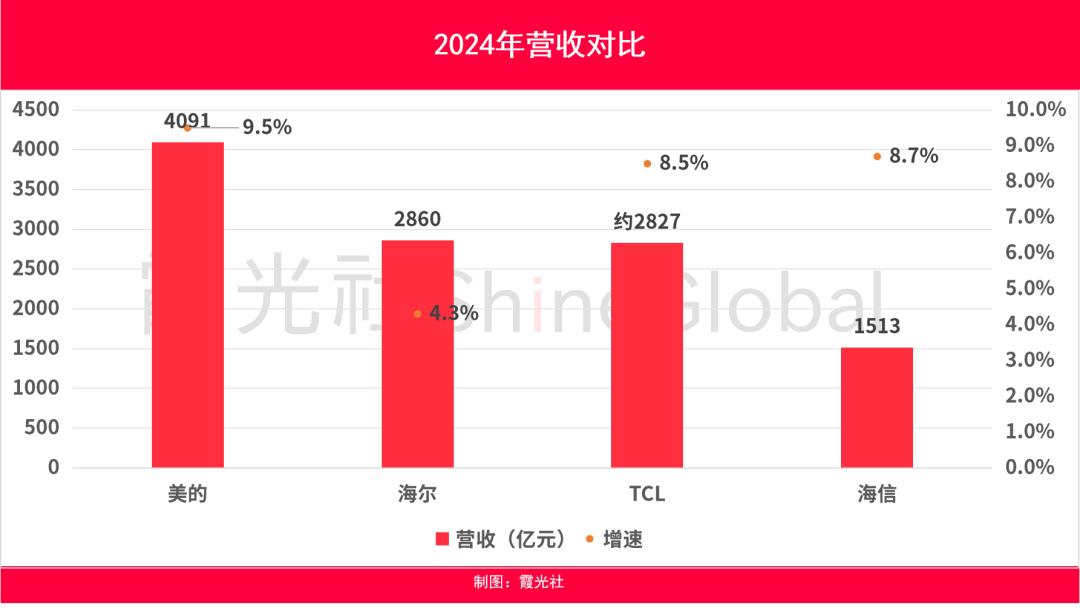
Core Insights - The major Chinese home appliance companies, including Midea, Haier, TCL, and Hisense, reported significant revenue growth in their 2024 financial results, with Midea leading the way with a revenue of 409.1 billion yuan, a year-on-year increase of 9.5% [1][3] - The overall trend indicates a slowdown in the white goods market while the black goods segment is driven by high-end and smart product offerings, with a notable increase in overseas market contributions [3][6] Group 1: Financial Performance - Midea achieved a revenue of 409.1 billion yuan, marking a 9.5% increase year-on-year, making it the only company to surpass 400 billion yuan in revenue [1][3] - Haier and TCL both reported revenues close to 300 billion yuan, with Haier's revenue at 285.98 billion yuan and TCL's at approximately 300 billion yuan, both showing growth [1][3] - Hisense reported a revenue of 151.3 billion yuan, with an 8.7% growth [1][3] Group 2: Overseas Market Contributions - Midea's overseas revenue reached 169.03 billion yuan, accounting for 41.32% of its total revenue, with a year-on-year growth of 12.01% [4] - Haier's overseas revenue was 143.91 billion yuan, making up 50.32% of its total revenue, with a growth of 5.43% [4] - Hisense's overseas revenue reached 356.29 billion yuan, showing a significant growth of 28% [4] Group 3: Strategic Trends - The growth of these companies is primarily driven by globalization and high-end product strategies, as they adapt to a more competitive domestic market [3][6] - Midea has focused on high-end branding through its COLMO and Toshiba brands, with a reported 20% increase in retail sales for these brands [7][8] - Haier has utilized a merger and acquisition strategy to enhance its high-end market presence, with 80% of its U.S. sales produced locally [12][14] Group 4: Market Dynamics - The overall retail sales of home appliances in China reached 907.1 billion yuan in 2024, reflecting a 6.4% year-on-year increase, aided by government incentives [4][5] - Despite the positive growth, challenges remain for domestic sales, as companies like Hisense and Midea have announced layoffs, indicating a tough market environment [5][6] - The global market for televisions is experiencing slower growth, with a reported increase of only 1.8% in global TV shipments [25] Group 5: Future Outlook - Chinese home appliance companies are increasingly becoming favored in international markets, with significant exports to Asia, Latin America, and Africa showing robust growth [25][26] - The production capacity of traditional white goods in China is substantial, with a 65.5% share of the global market, indicating a strong manufacturing base [26] - The shift towards high-tech, high-value, and high-quality products positions Chinese home appliance brands for future growth in the global market [26][27]



首席之声:中美经贸会谈联合声明解读


2025-05-12 15:16
Summary of Key Points from the Conference Call Industry and Company Involvement - The conference call primarily discusses the impact of recent U.S.-China trade negotiations and tariff adjustments on various industries, particularly focusing on the Chinese economy and sectors such as home appliances, electronics, and renewable energy. Core Insights and Arguments - **Tariff Adjustments**: The U.S. has reduced tariffs on Chinese imports to an average of approximately 9.2%, significantly lower than the previous 145% rate, which is expected to positively impact the U.S.-China economic and trade chain [1][2] - **GDP Impact**: The fluctuation in China's GDP is projected to decrease from an estimated 1.7% under the previous tariff regime to around 0.7% with the new adjustments, indicating a more stable economic outlook [1][3] - **Export Share Decline**: The new tariffs may lead to a potential 34% decline in China's export share, but the overall impact is deemed manageable, allowing for market pricing adjustments [1][4] - **Sector-Specific Benefits**: Industries such as home appliances, optical electronics, consumer electronics, and clean energy are expected to see significant profit improvements due to tariff reductions, with potential for recovery in previously underperforming sectors [1][9] - **Long-Term Competitiveness**: Emerging sectors like automotive, shipbuilding, and semiconductors are highlighted as having medium to long-term competitive advantages, alongside traditional export sectors like textiles and light industrial products [1][10] Additional Important Insights - **Renewable Energy Sector**: The tariff adjustments are particularly beneficial for the renewable energy sector, with companies like CATL and Sungrow expected to recover quickly due to strong U.S. demand [1][11] - **Market Sentiment**: The overall market sentiment is optimistic, with expectations of improved pricing and recovery in stock performance for companies heavily impacted by previous tariffs, such as Haier and Ecovacs [1][15][16] - **Impact on Transportation and Logistics**: The reduction in tariffs is anticipated to boost shipping and logistics sectors, particularly for companies like COSCO and Orient Overseas, as export activities to the U.S. are expected to increase [1][25] - **Pharmaceutical Sector**: The pharmaceutical industry is expected to remain stable, with innovative drug companies like BeiGene and Hengrui benefiting from favorable market conditions despite previous tariff impacts [1][18][19] - **Cross-Border E-commerce**: Companies in the cross-border e-commerce space are adjusting to tariff changes, with some facing increased costs but also opportunities for profit margin recovery due to improved logistics and inventory management [1][22][23] - **Textile Industry Dynamics**: The textile sector is adapting to the new trade environment, with companies that have shifted production overseas likely to benefit from reduced tariff impacts [1][24] This summary encapsulates the key points discussed in the conference call, highlighting the implications of tariff changes on various sectors and the overall economic outlook for China amidst evolving U.S.-China trade relations.
港股概念追踪|家电行业抢出口明显 机构看好二季度家电板块态势修复(附概念股)
智通财经网· 2025-05-12 01:24
华泰证券研报称,2024 年家电板块累计上涨约 25.4%,涨幅居行业前列,表现明显优于上证综指与沪 深 300。得益于内需"以旧换新"政策红利以及出口补库,全年板块收入同比增长 5.6%,归母净利润增长 7.1%,盈利能力稳健。2025 年 1—4 月家电"换新"维持拉动力,但出口面临关税挑战,板块承压回调约 1.6%。展望 2025 年二季度,政策持续发力、内需具备支撑,叠加前期高基数效应减退,预计板块将呈 结构性修复态势,机会主要来自内销需求回暖与出口预期修复两端。 家电板块相关港股: TCL电子(01070)、海信家电(00921)、海尔智家(06690)、美的集团(00300)、小米集团(01810)、JS环球 生活(01691)等。 智通财经APP获悉,家电板块2024年整体收入、归母净利润分别同比+6%、+9%;25Q1收入、归母净利 润分别同比+14%、+22%。2024Q4国补集中发力下,板块收入端有明显提速。 内销受益补贴程度分化,海外抢出口明显。 自24Q3需求低点以来,同比增速逐季度改善,其中24Q4主要受益于国补政策的集中发力以及海外旺盛 需求的双重拉动; 25Q1内销依旧有国补拖底 ...

家电行业周报:4月出口表现出较强韧性,暖通产业链Q1销售数据高增
SINOLINK SECURITIES· 2025-05-11 07:35
Investment Rating - The industry is rated as "Buy" with expectations of an upward movement exceeding 15% in the next 3-6 months [38] Core Insights - April exports showed strong resilience with a year-on-year increase of 8.1%, driven primarily by robust demand from non-US regions [11][1] - The HVAC industry experienced significant sales growth in Q1 2025, with exports outperforming domestic sales due to preemptive stocking by overseas distributors amid tariff uncertainties [2][11] - The domestic appliance sector is expected to benefit from strong domestic demand and continued high demand from emerging markets, which is likely to sustain export growth [5][36] Summary by Sections Export Data - In April, China's exports (in USD) increased by 8.1% year-on-year, continuing a positive growth trend [11] - Major trading partners included ASEAN, Europe, and the US, with export values of 1.48 trillion, 1.21 trillion, and 1.07 trillion respectively, showing year-on-year changes of +12.6%, +6.1%, and -1.5% [11] HVAC Industry Performance - The HVAC industry saw a total sales volume of 58.873 million units in Q1 2025, a 15.3% increase year-on-year, with exports at 31.521 million units (+24.5%) outpacing domestic sales [12][15] - Central air conditioning sales reached 36.1 billion yuan, up 7.9% year-on-year, with both domestic and export markets showing growth [12][15] Market Trends - The Shanghai Composite Index rose by 2.00% and the home appliance index increased by 3.3% in the latest week [16] - Key stocks showed significant gains, with Springlight Technology up 46.41% and Greer up 16.79% [16] Raw Material Prices - Recent trends indicate a slight decline in copper and aluminum prices, with copper down 0.15% and aluminum down 0.12% in the last week [20][21] - Year-to-date, copper prices have increased by 9.21%, while aluminum has decreased by 5.32% [21] Real Estate Data - In March 2025, new residential construction area decreased by 24.3% year-on-year, indicating a slowdown in the real estate sector [27][30] - The total area under construction and completed also showed declines of 10.0% and 14.8% respectively [27][30] Investment Recommendations - Focus on domestic demand and subsidy-driven growth in the white goods sector, with specific attention to companies like Gree Electric, Midea Group, and Haier Smart Home [36] - Consider opportunities in the black goods sector, which continues to see structural upgrades, and small appliances that are recovering from previous challenges [36]