
宁波银行

Search documents
银行业 2026 年经营展望:资产负债篇:到期存款流向是资负格局的关键
Guoxin Securities Hongkong· 2026-01-13 05:12
Investment Rating - The report maintains an "Outperform" rating for the banking sector [6] Core Insights - The expected M2 growth rate for 2026 is approximately 7.5%, with credit growth around 6.0% and social financing growth at about 8.0%. This aligns with the goal of stabilizing economic growth and ensuring reasonable price recovery [2][18][19] - The banking sector is expected to see a structural differentiation in retail credit, with corporate lending remaining the primary contributor to new loans, accounting for approximately 80% to 85% of new loans [33][37] - The report highlights the importance of deposit flows, particularly the trend of deposits moving from large banks to smaller banks, which will influence the asset-liability gap for large banks in 2026 [3][41] Summary by Sections M2 and Credit Growth - The M2 increment for 2026 is estimated at about 25.4 trillion yuan, with fiscal net injection contributing approximately 12.0 trillion yuan and bank credit (including write-offs and ABS) contributing around 16.8 trillion yuan [2][29][24] - The anticipated new social financing for 2026 is about 35.3 trillion yuan, reflecting a growth rate of approximately 8.0% [30][32] Credit Allocation - Corporate lending is expected to remain strong, while retail lending will show structural improvements, contributing about 10% to 15% of new loans [33][37] - The report notes that retail credit is likely to experience a slight positive growth, particularly in quality consumption scenarios and personal operating loans [33][37] Asset-Liability Dynamics - The asset-liability gap for large banks is projected to continue, with marginal changes primarily driven by the liability side, influenced by deposit flows [3][41] - The report estimates that the maturity of fixed-term deposits for the six major banks in 2026 will be around 57 trillion yuan, with 2-year and longer-term deposits accounting for 27 to 32 trillion yuan [49][52] Investment Recommendations - The report recommends focusing on high-quality stocks with improving fundamentals, specifically highlighting Ningbo Bank and Changshu Bank, while also suggesting attention to Changsha Bank and Chongqing Rural Commercial Bank for potential excess returns [4] - Additionally, it emphasizes the value of stable, high-dividend stocks, recommending China Merchants Bank, Industrial and Commercial Bank of China, and Jiangsu Bank [4]




理财产品跟踪报告2025年第15期(12月15日-12月28日):基金新发总规模收敛,保险产品结构性调整
Huachuang Securities· 2026-01-13 05:12
Group 1: Investment Rating - The report does not explicitly provide an investment rating for the industry Group 2: Core Insights - The bank wealth management product market remains stable with a total of 1,264 new products launched, showing no significant seasonal fluctuations [1][13] - Fixed income products dominate the market, accounting for 94.54% of new issuances, although this is a slight decrease from 98.5% in the previous period [1][22] - The average investment threshold for new products continues to favor low entry points, with 64.95% of new products requiring an investment of 1 yuan or less [1][21] - The fund market shows a trend of increasing quantity but decreasing scale, with 87 new funds launched raising a total of 46.215 billion yuan, reflecting a 15.68% decrease from the previous period [2][27] - The bond fund sector remains the primary focus, despite a significant drop in issuance scale, while equity funds are seeing a rise in expectations [2][30] - The insurance market has seen a contraction in new product launches, with 79 new products introduced, a decrease of 24.04% from the previous period [3][40] - The structure of new insurance products indicates a shift towards savings and long-term cash flow products, with annuity insurance maintaining a dominant position [3][41] Group 3: Summary by Sections Bank Wealth Management Products - The market for new bank wealth management products is stable, with 1,264 new products launched, indicating a steady supply rhythm [1][13] - Fixed income products continue to dominate, comprising 94.54% of new issuances, while the number of mixed and equity products remains low [1][22][23] - The majority of new products are targeted at low investment thresholds, reflecting a demand for stable wealth management options [1][21] Fund Products - The fund market has seen a rise in the number of new funds but a decrease in total fundraising, with 87 new funds raising 46.215 billion yuan [2][27] - Bond funds remain the mainstay, although their issuance has decreased significantly, while equity funds are gaining traction [2][30][34] - The issuance strategy has shifted from "blockbuster-driven" to "high-frequency volume" as the market adjusts to year-end conditions [2][27] Insurance Products - The insurance market has contracted, with 79 new products launched, reflecting a 24.04% decrease [3][40] - The balance between life insurance and annuity insurance remains stable, with annuity insurance taking a leading role [3][41] - The structure of new insurance products shows a trend towards savings-oriented and long-term cash flow products, with a notable increase in universal insurance offerings [3][45][46]
A股银行股普涨,宁波银行、杭州银行涨超3%
Ge Long Hui A P P· 2026-01-13 03:43
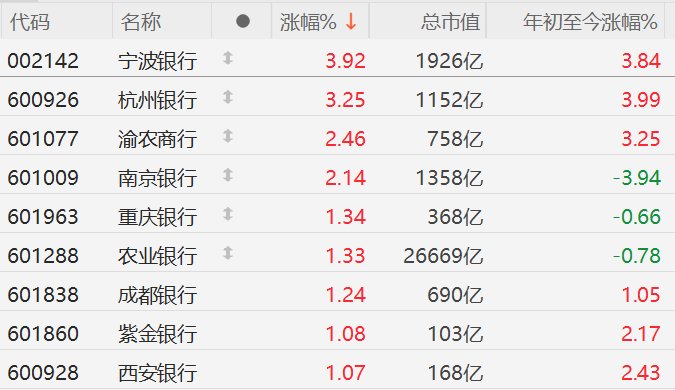
Group 1 - The A-share market saw a general rise in bank stocks, with notable increases in Ningbo Bank and Hangzhou Bank, both rising over 3% [1] - Other banks such as Chongqing Bank, Agricultural Bank, and Xian Bank also experienced gains of over 1% [1] Group 2 - Ningbo Bank's stock increased by 3.92%, with a total market capitalization of 192.6 billion [2] - Hangzhou Bank's stock rose by 3.25%, with a market cap of 115.2 billion [2] - Chongqing Bank and Agricultural Bank saw increases of 1.34% and 1.33% respectively, with market caps of 36.8 billion and 26,669 billion [2] - The year-to-date performance shows that Ningbo Bank and Hangzhou Bank have increased by 3.84% and 3.99% respectively, while Nanjing Bank has decreased by 3.94% [2]




银行股普涨,宁波银行、杭州银行涨超3%
Ge Long Hui· 2026-01-13 03:41
Core Viewpoint - The A-share market saw a significant increase in bank stocks on January 13, with notable gains from several banks, indicating a positive trend in the banking sector [1]. Group 1: Stock Performance - Ningbo Bank (002142) experienced a rise of 3.92%, with a total market capitalization of 192.6 billion [2]. - Hangzhou Bank (600926) increased by 3.25%, with a market cap of 115.2 billion [2]. - Chongqing Rural Commercial Bank (601077) saw a gain of 2.46%, with a market value of 75.8 billion [2]. - Nanjing Bank (601009) rose by 2.14%, but has a year-to-date decline of 3.94%, with a market cap of 135.8 billion [2]. - Agricultural Bank of China (601288) increased by 1.33%, with a substantial market capitalization of 2,666.9 billion [2]. - Other banks such as Chengdu Bank (601838), Zijin Bank (601860), and Xi'an Bank (600928) also reported gains of 1.24%, 1.08%, and 1.07% respectively [2].
【盘中播报】沪指涨0.04% 医药生物行业涨幅最大
Zheng Quan Shi Bao Wang· 2026-01-13 03:39
Market Overview - The Shanghai Composite Index increased by 0.04% as of 10:28 AM, with a trading volume of 995.73 million shares and a transaction value of 1,824.82 billion yuan, representing a 1.67% increase compared to the previous trading day [1] Industry Performance - The pharmaceutical and biological sector led the gains with a rise of 2.60%, followed by media at 2.07%, and oil and petrochemicals at 1.50% [1] - The defense and military industry experienced the largest decline at 5.76%, followed by electronics at 1.95%, and electric power equipment at 1.37% [2] Top Performing Stocks - In the pharmaceutical sector, Xinjianjiang surged by 30.00%, while in media, Liujin Technology rose by 25.66% [1] - The top performer in the oil and petrochemical sector was Bohai Chemical, which increased by 10.14% [1] - In the non-banking financial sector, Hualin Securities saw a rise of 10.02% [1] Declining Stocks - The largest decline in the defense and military sector was seen in Guolian Aviation, which fell by 14.12% [2] - In the electronics sector, Jiuzhiyang dropped by 13.00% [2] - The electric power equipment sector's top loser was Tongguang Cable, which decreased by 11.66% [2]



银行ETF指数(512730)涨近1%,超半数A股银行进行2025年度中期分红
Xin Lang Cai Jing· 2026-01-13 02:51
Group 1 - China Merchants Bank announced a cash dividend distribution of approximately RMB 20.897 billion (including tax), with a cash dividend of RMB 1.013 per share, to be implemented on January 16, 2026 [1] - Over half of the 42 listed banks in A-shares have announced their mid-term dividend plans for 2025, with three banks, including China Merchants Bank, Postal Savings Bank, and Jiangsu Bank, announcing dividends this week [1] - China Galaxy Securities noted that the central bank's 2026 work meeting continues to emphasize a moderately loose monetary policy, which is expected to optimize the bank's credit structure and alleviate the pressure on interest margins [1] Group 2 - As of January 13, 2026, the CSI Bank Index (399986) rose by 0.96%, with notable increases in stocks such as Ningbo Bank (up 4.92%) and Hangzhou Bank (up 3.12%) [2] - The Bank ETF Index (512730) increased by 0.84%, with the latest price reported at RMB 1.68 [2] - As of December 31, 2025, the top ten weighted stocks in the CSI Bank Index accounted for 65.61% of the index, including China Merchants Bank, Industrial Bank, and Agricultural Bank [2]
双融日报:鑫融讯-20260113
Huaxin Securities· 2026-01-13 01:47
- The report introduces the "Huaxin Market Sentiment Temperature Indicator," which is constructed based on six dimensions: index fluctuation, trading volume, number of rising and falling stocks, KDJ indicator, northbound capital, and margin trading data. This indicator is classified as an oscillation indicator, similar to the RSI indicator, and is more suitable for range-bound markets rather than trend prediction. It may experience lagging effects during trending markets, indicating the emergence of trends. When the indicator remains near 80 or above or 20 or below for an extended period, its applicability should be reassessed [19] - The sentiment indicator provides a comprehensive score ranging from "overcool" (0-19), "cool" (20-39), "neutral" (40-59), "warm" (60-79), to "overheat" (80-100). The current sentiment score is 95, indicating an "overheat" market condition. Historical data suggests that when the sentiment score is below or near 60, the market tends to find support, while scores above 90 may lead to resistance [8][19] - The sentiment indicator is evaluated as a useful tool for high-frequency trading strategies in oscillating markets, offering guidance for high-selling and low-buying opportunities. However, it lacks predictive power for trends and may require adjustments during prolonged extreme sentiment levels [19] - Backtesting results show that the sentiment indicator effectively identifies market conditions, with scores below 60 correlating with market support and scores above 90 correlating with resistance. The current score of 95 aligns with the "overheat" classification [8][19]
银行业周报(20260105-20260111):银行理财收益率走低,打通入市卡点可提升吸引力-20260112
Huachuang Securities· 2026-01-12 14:52
Investment Rating - The report maintains a "Recommended" rating for the banking sector, indicating an expectation that the sector will outperform the benchmark index by more than 5% in the next 3-6 months [25]. Core Insights - The average yield of bank wealth management products has been on a downward trend, with the average yield falling below the average personal deposit rate of listed banks for the first time since 2012. This trend is attributed to regulatory changes and market conditions [7][8]. - There is a potential for increasing the allocation of equity assets in wealth management products, which could enhance overall returns and attract more investors. Currently, equity products account for only 0.08% of the total wealth management product market, which has a total size of 31.63 trillion yuan [2][8]. - The banking sector is expected to see a systematic recovery in valuations in 2026, driven by a combination of improved fundamentals and capital inflows. The investment logic is shifting from pure defensive strategies to a dual focus on dividends and growth [8]. Summary by Sections Wealth Management Products - As of December 2025, the total market size of wealth management products reached 31.63 trillion yuan, with fixed income products making up 76.60%, cash management products 20.87%, mixed products 2.37%, and equity products only 0.08% [2]. - Regulatory bodies are exploring ways to facilitate greater equity market participation by wealth management funds, which could lead to an increase in the proportion of equity investments [2][8]. Company Earnings Forecasts and Valuations - Key companies in the banking sector have been rated as "Recommended" with projected earnings per share (EPS) and price-to-earnings (PE) ratios indicating potential for growth. For example, Ningbo Bank is projected to have an EPS of 4.33 yuan in 2025 with a PE ratio of 6.48 [3]. - The report highlights several banks, including China Merchants Bank and Jiangsu Bank, as having strong growth potential and favorable valuations, suggesting they are well-positioned for investment [3][8]. Market Performance - The report notes that the banking index underperformed the broader market indices, with a weekly decline of 1.90% compared to a 2.79% increase in the CSI 300 index [7]. - The report emphasizes the importance of monitoring market trends and the performance of individual banks to identify investment opportunities [5][8].
去年被罚超五百万元、涉诉金额过亿元!永安财险合规症结何在
Nan Fang Du Shi Bao· 2026-01-12 12:48
Core Viewpoint - The appointment of Wang Hao as the Chief Actuary of Yong'an Property Insurance Co., Ltd. is seen as a significant step towards improving corporate governance and risk management amidst ongoing legal and regulatory challenges faced by the company [2][10]. Regulatory Issues - In 2025, Yong'an Insurance received a total of 26 fines amounting to over 5 million yuan, with penalties issued across multiple provinces including Henan, Shandong, and Guangdong [2][4]. - Specific fines included 650,000 yuan for the Guangzhou branch due to false financial data and improper benefits to policyholders, and 630,000 yuan for the Zhengzhou branch for providing false reports [3][4]. - Common violations included "false financial data," "fictitious expenses," and "misappropriation of funds," indicating significant governance and compliance issues within the company [4]. Legal Challenges - Yong'an Insurance is facing two major lawsuits with potential liabilities exceeding 100 million yuan, stemming from disputes over credit guarantee insurance contracts with partners [5][6]. - The lawsuits involve claims from Chongqing Ma Shang Consumer Finance and Ningbo Bank, with the court ruling in favor of the partners, indicating that Yong'an may be liable for service fees regardless of insurance payout obligations [6]. Management Changes - The company has undergone significant management changes, including the appointment of a new general manager in February 2025, ending a six-year vacancy in the position [7][8]. - The restructuring of the management team is part of a broader effort to address compliance and governance shortcomings that have persisted due to a prolonged power struggle among shareholders [7][9]. Financial Performance - Despite the regulatory and legal challenges, Yong'an Insurance reported a premium income of 8.054 billion yuan in the first three quarters of 2025, a year-on-year increase of 1.12%, and a net profit of 833 million yuan, representing a 144% increase [9]. - The company's solvency ratios are robust, with core solvency adequacy ratio at 339.68% and comprehensive solvency adequacy ratio at 347.52%, indicating a stable financial position [9].

每日投行/机构观点梳理(2026-01-12)
Xin Lang Cai Jing· 2026-01-12 12:34
Group 1: Federal Reserve and Employment Data - Goldman Sachs expects the Federal Reserve to maintain its current policy in January, with two rate cuts anticipated in the remainder of 2026 due to initial signs of labor market stability [1] - JPMorgan has removed its forecast for a rate cut in 2026, now predicting a 25 basis point increase in Q3 2027 [1] - Societe Generale believes the decline in unemployment and rising wages provide a stronger rationale for the Fed to hold rates steady in January [1] Group 2: Oil Prices and Geopolitical Risks - Goldman Sachs indicates that despite ongoing geopolitical risks, oil prices may continue to decline due to ample supply, predicting Brent and WTI crude oil prices to average $56 and $52 per barrel respectively in 2026 [2] Group 3: Chinese Economic Outlook - CITIC Securities forecasts a "mild re-inflation" in China in 2026, driven by a slight increase in PPI and CPI, with core CPI expected to rise due to various factors including food prices and service costs [3] - CITIC Securities also notes that the balance between external and internal demand will be crucial for the A-share market, with a higher probability of upward movement in early 2026 [4] Group 4: Commodity Prices and Market Trends - CITIC Jinpu predicts that copper prices will continue to rise, with the market not yet at an end, and expects significant support for copper prices despite short-term corrections [5] - CITIC Securities anticipates that investment in the power grid during the 14th Five-Year Plan period may reach 3.8 trillion yuan, focusing on high-quality development and stability in the energy sector [6] Group 5: Currency and Market Dynamics - Huatai Securities expects the Federal Reserve to pause rate cuts from January to May, with potential cuts occurring after the new Fed chair takes office [7] - Huachuang Securities highlights the commercialization of brain-computer interfaces, indicating a growing market with significant potential for expansion beyond the medical field [8] - Shenwan Hongyuan predicts that the RMB will appreciate by 2-3% annually over the next few years, with a total appreciation of over 30% in the next decade, benefiting the stock market [10]



