
洋河股份

Search documents
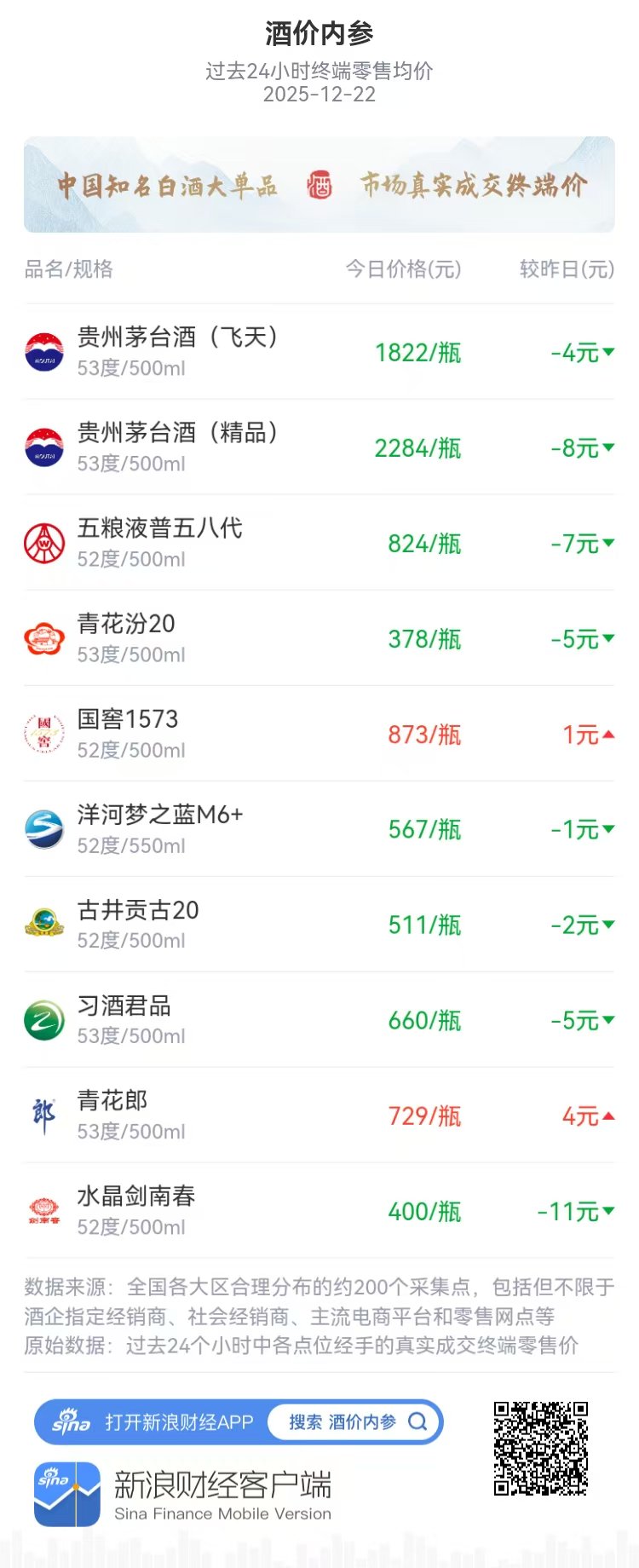
酒价内参12月22日价格发布 市场创新低水晶剑南春领跌
Xin Lang Cai Jing· 2025-12-22 00:55
Core Viewpoint - The Chinese liquor market, particularly the top ten baijiu products, has experienced a significant price decline, with the overall retail price dropping to a new low since the expansion of the product list on November 18, 2023, indicating a continued downward trend in the market [1]. Price Trends - The total retail price for the top ten baijiu products is now 9048 yuan, down 38 yuan from the previous day, marking a decrease of 2.6% from the peak price of 9291 yuan recorded on November 25, 2023 [1]. - The market is characterized by eight products experiencing price declines and only two products showing price increases [1]. Individual Product Performance - The following products have seen notable price changes: - Water Crystal Jian Nan Chun: down 11 yuan per bottle [1][4] - Premium Moutai: down 8 yuan per bottle [1][3] - Wuliangye Pu Wu Eight Generation: down 7 yuan per bottle [1][3] - Qinghua Fen 20 and Xijiu Junpin: down 5 yuan per bottle each [1][3] - Flying Moutai: down 4 yuan per bottle [1][3] - Gujing Gong Gu 20: down 2 yuan per bottle [1][4] - Yanghe Dream Blue M6+: down 1 yuan per bottle [1][4] - Qinghua Lang: up 4 yuan per bottle [1][4] - Guojiao 1573: up 1 yuan per bottle [1][4] Market Conditions - The market is facing dual pressures from cash flow recovery and sales performance as the year-end approaches, contributing to the downward pressure on prices for most brands [1].

食品饮料行业周度更新:从中国快消品数据报告,看食品饮料消费结构-20251222
Changjiang Securities· 2025-12-21 23:30
Investment Rating - The industry investment rating is "Positive" and is maintained [9] Core Insights - In the first three quarters of 2025, the Chinese fast-moving consumer goods (FMCG) market exhibited distinct characteristics of "price reduction, volume increase, structural differentiation, and channel reshaping." The overall market average price decreased by 2.4% year-on-year, but the decline has narrowed, indicating price stabilization. Third to fifth-tier cities have become the main drivers of sales recovery, while competition in first and second-tier cities has intensified. Notably, packaged food sales led with a growth rate of 3.4%, although the momentum is slowing due to price sensitivity. Beverages are the only category to experience a decline, significantly impacted by price wars and competition from freshly brewed tea drinks [2][4][27]. Summary by Sections Market Overview - The FMCG market in China is characterized by a "price reduction, volume increase" trend, with a 2.4% year-on-year decline in average prices, which is stabilizing. Sales growth in lower-tier cities contributed approximately 80% to market growth, with a year-on-year increase of 4-6% [17][21][27]. Category Performance - Packaged food sales grew by 3.4% year-on-year, driven by stable demand for core and snack food categories. However, growth momentum is slowing, with quarterly growth rates of 4.6%, 4.2%, and 2.9%. In contrast, the beverage category saw a 1.1% decline in sales, despite a 3.6% increase in volume, primarily due to a 4.6% drop in average prices [21][25][27]. Channel Dynamics - The channel landscape is evolving, with traditional offline channels continuing to shrink. Emerging formats such as warehouse membership stores and snack collection stores are experiencing rapid growth, with increases of approximately 40%, 51%, and 92% respectively. E-commerce channels also showed resilience with a growth rate of about 7% [22][27]. Subsector Performance - The food and beverage sector has seen a mixed performance, with the overall index down 3.66% since the beginning of the year, lagging behind the CSI 300 index. However, subsectors like snack foods, food composites, and soft drinks have shown relative strength in recent weeks [29][35]. Industry Trends - The liquor industry is undergoing strategic adjustments, with major companies like Kweichow Moutai and Wuliangye implementing market reforms. Fast food and coffee brands are leveraging price adjustments and co-branding initiatives to attract consumers. The soft drink sector is focusing on product innovation and brand exposure, while the dairy sector is investing in capacity expansion and governance changes [35][36][37].






“失意”2025:白酒行业“深水区”探底 亟待价值重塑
Zhong Guo Ji Jin Bao· 2025-12-21 22:05
Core Insights - The Chinese liquor industry is undergoing significant challenges, with a deep adjustment phase leading to price declines and market restructuring [1][3][5] - Major liquor companies are shifting from passive responses to proactive strategies to stabilize prices and regain market confidence [1][4][11] Price Dynamics - The wholesale price index for liquor dropped by 9.9% year-on-year in the first half of 2025, with premium liquor prices falling by 14.96% [3] - The price of Feitian Moutai has decreased by approximately 35% from the beginning of the year, falling below the retail guidance price of 1499 yuan [3] - Many first-tier liquor brands are facing "price inversion," where wholesale prices are lower than factory prices, leading to significant market pressure [3][5] Market Concentration - In the first three quarters of 2025, only two out of twenty listed liquor companies achieved revenue growth, while the total revenue for the sector declined by 5.83% [5] - The top six liquor companies accounted for 84% of market share, indicating increasing concentration and challenges for smaller firms [5][6] Management Changes - The liquor industry has seen numerous executive changes in 2025, with key figures resigning amid poor performance [7][8] - These changes are viewed as attempts to adapt to new market conditions and enhance operational efficiency [8] Transformation and Innovation - Brands focusing on "low-alcohol and health" products, such as Jin Liquor, have experienced growth, with an expected overall increase of about 10% in 2025 [10] - Major liquor companies are innovating by introducing lower-alcohol products and engaging in direct consumer interactions to adapt to changing consumer preferences [11][12]
“失意”2025:白酒行业“深水区”探底,亟待价值重塑
Zhong Guo Ji Jin Bao· 2025-12-21 13:20
Core Insights - The Chinese liquor industry is undergoing significant adjustments, facing challenges from macroeconomic policies and reduced consumer demand, leading to a decline in prices and market confidence [3][4][7] - Major liquor companies are shifting from passive responses to proactive strategies, focusing on price stabilization and product innovation to navigate the current downturn [3][6][14] Price Dynamics - The wholesale price index for liquor dropped by 9.9% year-on-year in the first half of 2025, with premium liquor prices falling by 14.96% [4] - High-end liquor, such as Moutai, has seen its wholesale price fall below the retail guidance price, with a 35% decrease since the beginning of the year [5] - Major companies like Wuliangye and Moutai are implementing strict price controls and discount strategies to support their distribution channels and stabilize the market [6][8] Performance Metrics - In the first three quarters of 2025, the total revenue of 20 listed liquor companies in A-shares was 320.23 billion yuan, a decline of 5.83% year-on-year, with net profits down by 6.76% [7] - The third quarter saw a more severe decline, with total revenue dropping by 18.42% and net profits by 22.03% [7] Market Concentration - The market is experiencing a "Matthew Effect," with the top six liquor companies capturing 84% of the market share, indicating increasing concentration [7][8] - Smaller liquor companies are facing severe challenges, with several experiencing financial distress and "exploding" due to unsustainable business models [8] Management Changes - The liquor industry has seen numerous executive changes in 2025, with key figures resigning amid poor performance, reflecting the pressure for companies to adapt to new market conditions [9][10][12] - Notable departures include the chairman of Yanghe and the general manager of Jinzhongzi, both of whom failed to improve their companies' competitive positions [10][11] Transformation and Innovation - Brands focusing on "low-alcohol and health" products, such as Jin Liquor, have reported growth, highlighting a shift in consumer preferences towards healthier options [13][14] - Traditional liquor companies are accelerating their transformation efforts, introducing lower-alcohol products and engaging in innovative marketing strategies to attract younger consumers [14][15]

“失意”2025:白酒行业“深水区”探底,亟待价值重塑
中国基金报· 2025-12-21 13:18
Core Viewpoint - The Chinese liquor industry is undergoing significant adjustments, facing challenges from macro policies and shrinking consumer demand, leading to a decline in prices and market confidence [3][5]. Price Decline and Control Upgrades - The wholesale price index for liquor in China fell by 9.9% year-on-year in the first half of 2025, with premium liquor prices dropping by 14.96% [5]. - The price of Feitian Moutai has decreased by approximately 35% from the beginning of the year, falling below the retail guidance price of 1499 yuan [5]. - Major liquor companies are tightening their supply and implementing measures to stabilize prices, with Wuliangye and Moutai taking significant steps to support their distributors and maintain market order [6][7]. Concentration Increase and Small Enterprises' Struggles - In the first three quarters of 2025, only two out of twenty listed liquor companies achieved revenue growth, while the total revenue for the sector decreased by 5.83% year-on-year [9]. - The top six liquor companies accounted for 84% of the market share, indicating a growing concentration in the industry [9]. - Many small and medium-sized enterprises are facing severe challenges, with some experiencing financial distress and "exploding" due to unsustainable business models [10]. Frequent Personnel Changes - The liquor industry has seen numerous personnel changes in 2025, with key figures resigning amid poor performance, reflecting the pressure for companies to adapt to new market conditions [12][13]. - The frequent turnover is viewed as a strategy to bring in new ideas and improve execution efficiency during a challenging market cycle [13]. Value Restructuring and Accelerated Transformation - Brands that focus on "low-alcohol and health" products, such as Jin Liquor, have seen growth, with an expected increase of around 10% in overall performance for 2025 [15]. - Major liquor companies are shifting their focus to younger consumers and value-for-money products, with new product launches aimed at capturing changing consumer preferences [16][17].


年度消费观察:2025,年轻人没有抛弃白酒
Sou Hu Cai Jing· 2025-12-21 13:15
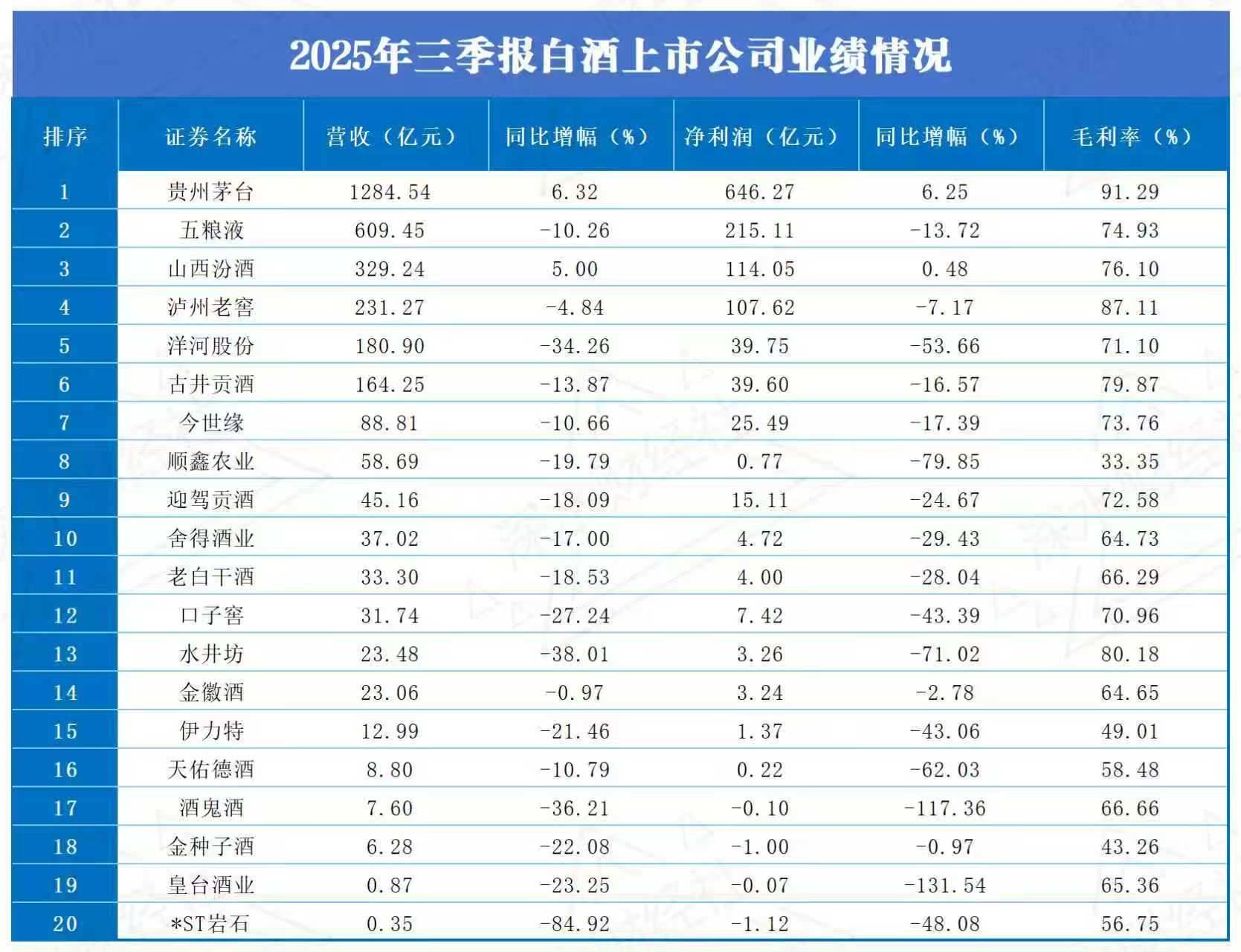
Core Viewpoint - The price of Moutai has dropped below 1499 yuan per bottle, attributed to industry cyclical adjustments, consumption downgrade, and high inventory levels among traditional liquor companies [1][2][6]. Industry Trends - The current state of the liquor industry shows a collective downward trend among liquor companies, unable to support previous price levels [2][6]. - The white liquor industry has experienced revenue growth rates of 12%, 15.37%, and 10.49% from 2022 to the first three quarters of 2024, but is projected to face negative growth by 2025 [6][11]. - In the third quarter, 20 listed liquor companies reported a total revenue of 317.78 billion yuan, a year-on-year decline of 5.90%, with net profits down 6.93% [6][8]. Company Performance - Major liquor companies, including Moutai, Wuliangye, and others, collectively reported a revenue decline of 6.3% and a net profit drop of 13.2% in the first three quarters [9]. - Moutai's revenue was 128.45 billion yuan with a growth of 6.32%, while Wuliangye saw a revenue drop of 10.26% [8][9]. Consumer Behavior Changes - Traditional consumption logic is fading, with younger consumers favoring brands like Jinjiu, which has seen a growth of over 20% in 2025 [12][13]. - The shift in consumer preferences is evident as younger demographics prioritize health and emotional value, leading to a rise in demand for low-alcohol and health-oriented products [28][29]. - The main consumption scenarios have shifted from formal events to casual gatherings and personal enjoyment, with new drinking styles emerging [16][17]. Market Dynamics - The white liquor market is undergoing significant changes, with a downward shift in the main sales price segment from 300-500 yuan to 100-300 yuan [15]. - The rise of "self-pleasing" consumption among younger consumers indicates a departure from traditional brand loyalty, focusing instead on quality and experience [18][19]. - The emergence of new brands and products that cater to the evolving preferences of consumers highlights the industry's need to adapt to changing market dynamics [12][14].
食品饮料行业周报 20251215-20251219:政策重视扩内需提消费 26 年重申看好顺周期方向-20251221
Shenwan Hongyuan Securities· 2025-12-21 13:13
Investment Rating - The report maintains a "Buy" rating for high-end liquor companies and recommends several key stocks in the food and beverage sector [6][8]. Core Insights - The report emphasizes the importance of expanding domestic demand as a strategic initiative for economic stability and security, with government agencies prioritizing this in 2026 [6][8]. - Despite recent price fluctuations in high-end liquor, the report anticipates a recovery in the sector, projecting a potential turning point in fundamentals by Q3 2026 [6][8]. - The report identifies systemic opportunities in consumer goods, particularly in the food sector, with a focus on CPI as a core observation indicator [6][8]. Summary by Sections 1. Weekly Insights on Food and Beverage - The food and beverage sector saw a 1.05% increase last week, with the liquor segment declining by 0.58% [5]. - The report ranks the food and beverage sector 13th among 31 sub-industries in terms of performance [5]. 2. Market Performance of Food and Beverage Segments - The report highlights the recent price movements of key liquor brands, including Moutai and Wuliangye, with Moutai's bottle price increasing by 45 RMB to 1545 RMB [7][30]. - Wuliangye is focusing on optimizing its product matrix and channel strategies to enhance long-term growth [7]. 3. Industry Matters - The report discusses the expected improvement in the supply-demand dynamics of the dairy industry in 2026, recommending stocks like Yili and New Hope Dairy [8][9]. - It also notes the high dividend yield of Hai Tian Wei Ye, projecting a dividend payout of 17.54 billion RMB [9][26]. 4. Valuation Table - The food and beverage sector's dynamic PE is reported at 20.10x, with a premium rate of 24% [30]. - The liquor segment's dynamic PE stands at 18.49x, with a premium rate of 14% [30].


今日财经要闻TOP10|2025年12月21日
Xin Lang Cai Jing· 2025-12-21 12:14
Group 1 - SpaceX responded to misleading reports regarding the safety of its flights, emphasizing that public safety is always its top priority during flight tests [1][10] - The company stated that all incidents involving spacecraft debris were managed within pre-coordinated control areas established by the U.S. Space Force and the FAA [1][10] - SpaceX criticized the media for relying on anonymous sources and non-scientific analyses, asserting that its safety management tools are well-established and effective [1][10] Group 2 - Longjiang Securities reported that China has become the second country after Germany to approve L3 autonomous driving vehicles for road use, marking a significant step towards mass production [3][12] - The approval of the first batch of L3 vehicles is expected to accelerate the commercialization of autonomous driving technology and benefit the entire industry chain [3][12] - The report suggested investment opportunities in intelligent driving algorithm providers, related hardware suppliers, and Robotaxi operating platforms [3][12][13] Group 3 - Morgan Stanley's Liu Mingdi identified four key themes for investment in 2026, including "anti-involution," AI, overseas expansion, and consumption, with real estate as a potential theme [5][15] - The "anti-involution" theme focuses on sectors with strong growth prospects, such as batteries and photovoltaics, and industries closely tied to the macroeconomy [5][15] - Liu emphasized that AI infrastructure capital expenditure is expected to grow, benefiting Chinese suppliers, and highlighted the importance of energy storage, photovoltaics, and batteries in the AI infrastructure sector [5][15] Group 4 - The Chinese fireworks and firecrackers association supported Shanxi province's decision to shift from a complete ban to a scientific management model for fireworks, allowing for limited use [8][18] - This change reflects a balance between cultural needs and safety governance, aiming to preserve traditional customs while managing safety risks effectively [8][18] Group 5 - RRP Semiconductor in India saw its stock price surge over 55,000% in 20 months, becoming a "meme stock" despite having negative revenue and minimal operational capacity [9][19] - The stock's rise is attributed to network speculation and a growing retail investor base in India, as there are few listed semiconductor companies available for investment [9][19] Group 6 - The Mexican proposal to impose tariffs on Chinese goods has prompted a strong response from China, which is prepared to take various countermeasures if the proposal is enacted [10][20] - China is aware of the complexities behind Mexico's proposal, particularly the pressure from the U.S. to align with its tariff policies [10][20] - The Chinese government maintains that it will protect its rights and interests, indicating a readiness to respond if the tariff proposal proceeds [10][20]

创意碰撞实战交锋,2025首届大学生品牌建设创新大赛落幕
Xin Lang Cai Jing· 2025-12-21 11:27
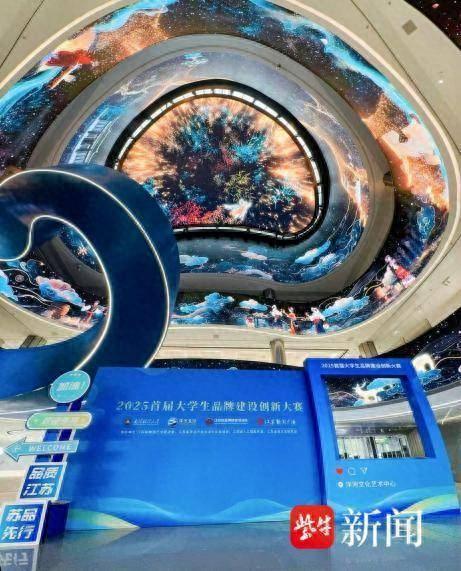
Group 1 - The core theme of the competition is "telling brand stories and innovating brand futures," focusing on the integration of brand building and innovation practices [1][11] - The competition featured 59 teams from various universities in the Yangtze River Delta, emphasizing the combination of professional knowledge and market demand in brand innovation [3][11] - The event included a "Brand Elite" invitation competition where top teams showcased their professional skills and market insights through timed presentations and defenses [5][6] Group 2 - Nanjing University’s Qingfeng team won the first prize in the undergraduate category and the "Brand Elite" invitation competition with their project "Oasis Recipe," which aimed to translate technical concepts into relatable language for consumers [8] - The competition attracted over 205 teams from more than 40 universities, covering various disciplines such as economics, management, arts, engineering, and information technology, highlighting cross-disciplinary collaboration [11] - The event concluded with a signing ceremony between Jiangsu Yanghe Brewery Co., Ltd. and the winning teams, facilitating the immediate transition of competition results into practical internship opportunities [8][11]
食品饮料周报(25年第47周):把握成本红利与效率提升主线,关注创新与困境反转机会-20251221
Guoxin Securities· 2025-12-21 08:22
Investment Rating - The report maintains an "Outperform the Market" rating for the food and beverage sector [4][5][69]. Core Views - The food and beverage sector is expected to benefit from cost advantages and efficiency improvements, with a focus on innovation and opportunities for turnaround [3][5]. - The report highlights a positive outlook for 2026, emphasizing four main investment themes: cost benefits, efficiency improvements, innovation-driven growth, and turnaround opportunities in the liquor segment [3][5]. Summary by Relevant Sections Market Performance - The food and beverage sector (A-shares and H-shares) rose by 1.97% this week, with A-shares outperforming the CSI 300 by approximately 2.29 percentage points [1]. - The top five gainers in the food and beverage sector this week were: Huanlejia (44.42%), Zhuangyuan Ranch (35.96%), Huangshi Group (21.16%), Junyao Health (17.02%), and Sunshine Dairy (14.72%) [1]. Subsector Insights - **Liquor**: Demand remains weak, with premium liquor companies focusing on supply-side optimization. Recommended stocks include Luzhou Laojiao, Shanxi Fenjiu, and Kweichow Moutai [2][10]. - **Beverages**: The beverage sector shows continued prosperity, with leading companies outperforming. Recommended stocks include Nongfu Spring and Dongpeng Beverage [2][14]. - **Food**: The snack segment is highlighted for its strong growth potential, particularly in konjac snacks, with key recommendations being Weidong and Yanjinpuzi [2][11]. Key Company Earnings Forecasts - Kweichow Moutai: EPS forecast for 2025E is 72.12, with a PE ratio of 19.6 [4]. - Shanxi Fenjiu: EPS forecast for 2025E is 9.73, with a PE ratio of 18.4 [4]. - Dongpeng Beverage: EPS forecast for 2025E is 8.85, with a PE ratio of 30.8 [4]. - Wuliangye: EPS forecast for 2025E is 6.61, with a PE ratio of 16.7 [4]. - Babi Food: EPS forecast for 2025E is 1.14, with a PE ratio of 25.6 [4]. - Weidong: EPS forecast for 2025E is 0.61, with a PE ratio of 18.4 [4]. Investment Recommendations - The recommended investment portfolio includes Babi Food, Dongpeng Beverage, Weidong, and Shanxi Fenjiu, which have shown an average increase of 3.55%, outperforming the food and beverage sector by 1.54 percentage points [15].

