天弘基金

Search documents
行业“黑马”永赢基金,5年管理规模暴涨4300亿
Sou Hu Cai Jing· 2025-11-25 00:46
Core Insights - The article highlights the significant performance of Yongying Fund in the recent A-share market rally, particularly through its "Yongying Technology Smart Selection Mixed Fund A," which achieved a return of 178.11% over the past year, far surpassing its peers and the CSI 300 index [3][8] - Yongying Fund's assets under management (AUM) have seen remarkable growth, increasing from 189.9 billion yuan at the end of 2020 to 626.3 billion yuan by November 8, 2025, marking an increase of over 430 billion yuan in five years [3][8] Performance Analysis - As of November 21, 2025, Yongying Fund's "Yongying Technology Smart Selection Mixed Fund A" ranked first among 4,455 similar funds, with a return of 178.11%, while the average return of similar funds was only 22.63% [3][8] - The mixed fund's scale grew from 26.5 billion yuan at the end of 2024 to 106.5 billion yuan by November 4, 2025, representing a nearly fourfold increase [3][8] Strategic Development - Yongying Fund was established in November 2013 and initially focused on fixed-income investments, leveraging its banking background to establish a foothold in the competitive public fund industry [4] - In 2018, the fund made a strategic shift to aggressively enter the equity market by recruiting well-known fund managers, which significantly contributed to its rapid growth in mixed fund products [4][5] Product Strategy - The fund's "productism" strategy emphasizes a tool-oriented approach, viewing products as communication bridges with investors, which has led to the creation of specialized investment tools like the "Smart Selection Series" [6][7] - Yongying Fund has developed a diversified asset allocation platform through a matrix layout, covering various investment styles and strategies, including growth stocks and quantitative models [7] Challenges Ahead - Despite its impressive growth, Yongying Fund faces potential risks, including redemption pressures following market corrections and regulatory constraints on concentrated investments in specific sectors [9][10] - The fund has experienced a wave of departures among its fund managers, raising concerns about the stability and experience of its management team, as the average tenure of its fund managers is now below the industry average [10]


上周超500亿资金抄底股票ETF,恒生科技、中证500、创业板指、科创50“吸金”居前
Ge Long Hui· 2025-11-25 00:40
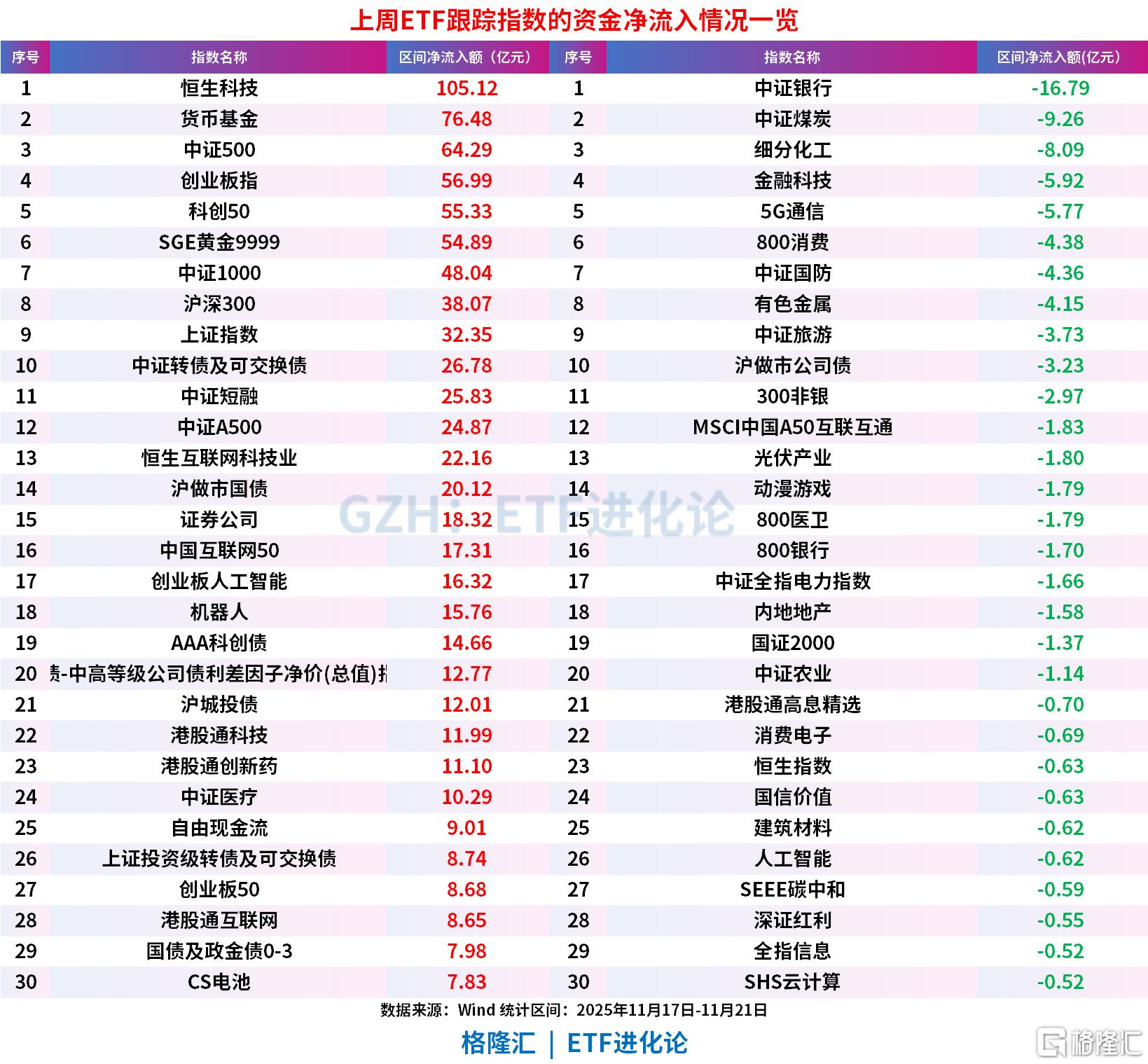
Market Performance - The A-share market saw a decline across major indices last week, with the CSI 300, Shanghai Composite Index, and SME Index showing returns of -3.77%, -3.90%, and -5.10% respectively. The ChiNext Index, CSI 1000, and CSI 500 had lower returns of -6.15%, -5.80%, and -5.78% respectively [1] - In terms of industry performance, banks, food and beverage, and media sectors had relatively better returns of -0.87%, -1.36%, and -1.39% respectively, while sectors like comprehensive, electric equipment and new energy, and basic chemicals lagged with returns of -9.47%, -9.41%, and -8.24% respectively [1] Fund Flows - The ETF market experienced a net inflow of 98 billion, with stock ETFs contributing 54.577 billion, QDII stock ETFs 15.544 billion, commodity ETFs 6.495 billion, bond ETFs 13.8 billion, and money market fund ETFs 7.648 billion. Notably, on November 21, there was a significant inflow of 50 billion aimed at "bottom-fishing" through ETFs [2] - Specific indices such as Hang Seng Technology, money market funds, CSI 500, ChiNext Index, and others saw net inflows ranging from 10.512 billion to 0.3235 billion, while sectors like CSI Bank, CSI Coal, and others experienced net outflows [2][4] ETF Performance - The top-performing ETFs included the S&P Biotechnology ETF and Emerging Asia ETF, with weekly gains of 1.35% and 0.67% respectively. Conversely, several new energy and photovoltaic ETFs saw significant declines, with losses ranging from -11.70% to -13.44% [12][14] - A total of 41 new funds were launched last week, with a combined issuance scale of 35.635 billion, marking an increase from the previous week. This included 14.022 billion in equity funds, 8.056 billion in mixed funds, and 13.557 billion in bond funds [15] Regulatory Changes - The Shanghai and Shenzhen stock exchanges announced new regulations requiring the 5.7 trillion ETF market to standardize fund names. The revised guidelines mandate that fund names must include core investment elements and the fund manager's abbreviation, with a deadline for compliance set for March 31, 2026 [15] - Sixteen hard technology-themed funds were approved on November 21, including the first seven AI ETFs, three chip ETFs, and four chip design theme ETFs, involving multiple fund management companies [16]

“避险走强、进攻收缩”!ETF资金结构生变
券商中国· 2025-11-24 23:34
Core Viewpoint - The ETF market is experiencing a shift in funding structure amid a volatile market and weak expectations, with a notable preference for low-risk, low-volatility bond ETFs over high-volatility equity ETFs [1][2]. Group 1: ETF Market Trends - In the past month, there has been a clear divergence in the scale changes of different index-linked ETFs, with low-risk bond ETFs seeing significant net inflows ranging from tens to hundreds of millions [2][3]. - The overall trend indicates that investors are increasingly favoring stable assets, with bond ETFs becoming the primary tool for enhancing portfolio stability in a turbulent market [2][3]. Group 2: Performance of Low-Risk ETFs - As of November 23, bond-related ETFs have shown substantial growth, with specific ETFs like the Hai Fu Tong Zhong Zheng Short Bond ETF increasing by 10.67 billion, making it one of the fastest-growing ETFs in the market [4]. - Other notable increases include the Hua Bao Cash Management ETF with 8.93 billion, and the Tian Hong Zhong Zheng AAA Technology Innovation Bond ETF with 5.60 billion, reflecting a strong demand for bond ETFs [4]. Group 3: Pressure on Equity ETFs - In contrast to bond ETFs, equity index ETFs have faced net outflows, with the CSI 300 index ETF seeing a decrease of 38.76 billion, marking the largest outflow among broad-based products [5][6]. - Technology-themed ETFs have also experienced declines, with the Fu Guo Zhong Zheng Hong Kong Internet ETF dropping by 8.44 billion, indicating pressure on the growth sector [5][6]. Group 4: Investor Behavior and Market Sentiment - The current market sentiment remains cautious, leading investors to prioritize stability and risk management through low-volatility bond ETFs and cash management products [7]. - The decline in trading activity has resulted in reduced interest in high-volatility equity products, as investors are more inclined to lower leverage and exposure to risky assets [7].

四季度以来近2000亿元资金流入权益类ETF
Shang Hai Zheng Quan Bao· 2025-11-24 18:03
Core Viewpoint - The equity ETFs have seen significant inflows, with a total net subscription of 196.48 billion yuan since the beginning of the fourth quarter, indicating strong investor interest despite market fluctuations [1][2]. Fund Inflows - As of November 21, the net subscription for equity ETFs reached 40.79 billion yuan in a single day, marking the highest daily inflow since April 9 [1][2]. - The inflow pattern shows a "barbell" configuration, with strong interest in both underperforming broker-themed ETFs and technology growth ETFs [3]. ETF Performance - Broker-themed ETFs have attracted substantial capital, with notable net subscriptions including 9.27 billion yuan for Guotai Junan ETF and 5.70 billion yuan for Huabao Broker ETF [3]. - Technology growth ETFs also received significant attention, with net subscriptions of 7.31 billion yuan for Huaxia Sci-Tech 50 ETF and 4.58 billion yuan for Jiashi Sci-Tech Chip ETF [3]. Market Outlook - The upcoming launch of new ETFs is expected to bring additional capital into the market, with 54 funds currently in issuance and 24 about to start [4]. - Analysts predict that absolute return funds will be a key source of new liquidity, driven by the conversion of household deposits [4]. - Public funds currently maintain a relatively high stock position, with an average equity position of 89.09% as of November 21 [4]. Investment Strategy - The market is currently in a policy and earnings lull, leading to a potential for short-term volatility without new catalysts [5]. - Long-term fundamentals for A-shares remain strong, with a focus on balanced investment across sectors such as consumption, real estate, and non-bank financials [5]. - Mid-term attention should be directed towards sectors benefiting from manufacturing recovery and technology growth, including AI and innovative pharmaceuticals [5].
最高涨近130%!超1800只基金受益
券商中国· 2025-11-24 15:21
Core Viewpoint - The A-share market has shown significant gains since the "9.24" rally, with 34 core indices achieving an average increase of over 50%, and four indices exceeding 100% growth as of November 21 [1][4]. Index Performance - The top-performing indices since the "9.24" rally include: - 北证50: 129.66% - 科创200: 109.57% - 创业板50: 105.20% - 科创创业20: 104.91% - 科创50: 99.96% - 科创100: 95.53% - 创业板指: 90.79% [2][3][4]. Fund Growth - Over 1,800 index funds have been established, with more than 35% of current funds launched since the second half of 2024 [1][8]. - The stock ETF market has seen significant growth, with nearly 60% of the total issuance in the last five years [1][8]. Fund Distribution - Among the 34 core indices, 32 have attracted public fund investments, with the 沪深300 index having the highest number of funds at 319 [5][6]. - The 中证A500 index has seen 279 funds since its launch in September 2024, while some older indices like 中小100 have fewer than 10 funds [5][6]. Performance Disparity - The performance of index funds varies significantly, with the 中证A500 index having around 80 fund companies involved, while some indices have very few funds despite being established for a long time [6][7]. - The largest沪深300 ETF has exceeded 4,000 billion in size, while many others remain below 100 billion [6][7]. Industry Evolution - The index fund industry has shifted from focusing on individual products to building comprehensive capabilities, with a growing emphasis on cost efficiency and tracking accuracy [8][9]. - The total ETF market has surpassed 5.6 trillion, with significant contributions from major fund management companies [8][9].

海外市场震荡触发QDII限购潮,多只跨境基金收紧申购通道
Hua Xia Shi Bao· 2025-11-24 12:56
Core Viewpoint - The recent surge in demand for QDII funds, driven by ongoing volatility in overseas markets, has led to a wave of purchase restrictions across various QDII products, indicating a proactive management approach by fund companies to control product scale and performance [2][3][4]. Group 1: QDII Fund Purchase Restrictions - As of November 24, multiple QDII funds, including Bosera Hang Seng Technology ETF and Huaxia S&P 500 ETF, have suspended large-scale subscriptions and regular investment plans [2][4]. - Nearly 90 QDII products have tightened investment channels since November, with some funds lowering the minimum investment threshold to as low as 10 yuan [2][5]. - Fund companies like Huatai-PineBridge and Morgan Stanley have significantly reduced subscription limits, with some products now allowing a maximum of only 10 yuan for single-day subscriptions [4][5]. Group 2: Reasons Behind Purchase Restrictions - The primary drivers for the recent purchase restrictions are structural tensions in foreign exchange quotas and fund companies' active management of product scale and performance [3][6]. - The rapid growth in fund size could lead to increased redemption costs and dilution of existing returns, prompting fund companies to limit new inflows to protect the interests of current investors [6]. Group 3: Market Dynamics and Risks - The tightening of subscription channels has led to increased premiums in the secondary market for certain popular QDII products, with some experiencing premiums exceeding 10% [7][8]. - Fund companies have issued multiple risk warnings regarding the high premiums of their products, advising investors against blindly chasing high-priced funds [7][8]. Group 4: Future Market Outlook - Optimism regarding the future of the U.S. stock market persists, with expectations of continued positive performance supported by factors such as potential Federal Reserve interest rate cuts and the ongoing development of AI technology [9]. - Conversely, caution is advised as market sentiment shifts, with concerns about high valuations and the sustainability of business models in the AI sector becoming more pronounced [10].

债券ETF跟踪:信用债类ETF大幅净流入
ZHONGTAI SECURITIES· 2025-11-24 12:27
Report Summary 1. Report Industry Investment Rating No information about the industry investment rating is provided in the report. 2. Core Viewpoints - Bond - type ETFs had significant net inflows in the past week, with credit - type ETFs leading the way, and large cumulative net inflows throughout the year [3]. - The net values of various bond ETF products recovered significantly in the past week, with some products performing well and others showing different trends [4]. - Credit - bond ETFs and science - innovation bond ETFs had certain increases in unit net value, and their discount rates were at specific levels [5]. 3. Summary by Relevant Catalogs 3.1 Funds Flow - As of November 21, 2025, bond - type ETFs had a total net inflow of 12.729 billion yuan in the past week. Interest - rate, credit, and convertible - bond ETFs had net inflows of 3.538 billion yuan, 6.636 billion yuan, and 2.555 billion yuan respectively. Among credit - type ETFs, short - term financing, corporate bonds, and urban investment bonds had net inflows of 2.598 billion yuan, 1.269 billion yuan, and 1.212 billion yuan respectively, while market - making credit bonds had a net outflow of 252 million yuan, and science - innovation bonds had a net inflow of 1.809 billion yuan. - As of November 21, 2025, the cumulative net inflows of interest - rate, credit, and convertible - bond ETFs for the year were 74.2 billion yuan, 445.363 billion yuan, and 25.137 billion yuan respectively, with a total of 544.7 billion yuan [3]. 3.2 Net Value Performance - Throughout the week, the net values of various bond ETF products recovered significantly. As of November 21, 2025, the 5 - year local - bond ETF and 10 - year local - bond ETF performed well, rising 0.15% and 0.14% respectively. The government - financial bond ETF and 0 - 4 local - bond ETF both rose 6BP. Treasury - bond ETFs and state - development - bond ETFs performed steadily. Convertible - bond ETFs and Shanghai - Stock - Exchange convertible - bond ETFs fell 1.72% and 1.37% respectively last week [4]. 3.3 Performance of Credit - Bond ETFs and Science - Innovation Bond ETFs - As of November 21, 2025, the median unit net values of credit - bond ETFs and science - innovation bond ETFs were 1.0126 and 1.0008 respectively, rising 0.01% and 0.02% throughout the week. Among credit - bond ETFs, Dacheng Credit - Bond ETF performed well, rising 0.04%. Among science - innovation bond ETFs, Fuguo, Boshi, and JingShun Science - Innovation Bond ETFs performed relatively well. As of November 21, 2025, the median discount rate of credit - bond ETFs was 25BP, and that of science - innovation bond ETFs was 22BP [5]. 3.4 Credit - Type ETF Duration Tracking - As of November 21, 2025, the holding durations of short - term financing ETFs, corporate - bond ETFs, and urban - investment - bond ETFs were 0.40 years, 1.84 years, and 2.21 years respectively. Among market - making credit - bond ETFs, the median holding durations of products tracking the Shanghai - market - making corporate - bond and Shenzhen - market - making corporate - bond indexes were 3.789 years and 2.87 years respectively. Among science - innovation bond ETFs, the median holding durations of products tracking the AAA science - innovation bond, Shanghai - AAA science - innovation bond, and Shenzhen - AAA science - innovation bond indexes were 3.47 years, 3.56 years, and 3.24 years respectively [8]. 3.5 Report Abstract - Last week, the ChinaBond New Composite Index rose 0.03% throughout the week. Short - term pure - bond and medium - long - term pure - bond funds rose 0.02% and 0.02% respectively. The ChinaBond AAA Science - Innovation Bond Index and the Shanghai Stock Exchange Benchmark Market - Making Corporate - Bond Index rose 0.03% and 0.03% respectively [7].
六连跌后反弹!港股科技进入筑底布局期?
Sou Hu Cai Jing· 2025-11-24 09:10
Group 1 - The core viewpoint is that the Hong Kong stock market, particularly the technology sector, is experiencing a rebound due to improved market sentiment and liquidity, following a period of six consecutive declines [2] - The Hang Seng Technology Index rose over 3% as of 14:30, indicating a strong recovery in the tech sector [2] - Recent inflows into technology ETFs, including a net inflow of 8.684 billion yuan into the Hang Seng Technology ETF and 2.512 billion yuan into the Hang Seng Internet ETF, reflect a recognition of the fundamentals of Hong Kong tech stocks [2] Group 2 - The acceleration of commercialization in generative AI is expected to benefit Hong Kong-listed companies like Alibaba, while geopolitical factors are driving the need for chip self-sufficiency, which will also benefit local semiconductor firms [5] - The long-term upgrade trend in the technology industry, combined with improved liquidity in the Hong Kong market, is anticipated to provide growth opportunities for investors [5] - The current pessimistic sentiment in the Hong Kong market is believed to have been sufficiently released, suggesting a potential for recovery and upward movement in stock prices [5]

ETF改名潮,千余只基金明年3月底前完成
Feng Huang Wang· 2025-11-24 07:33
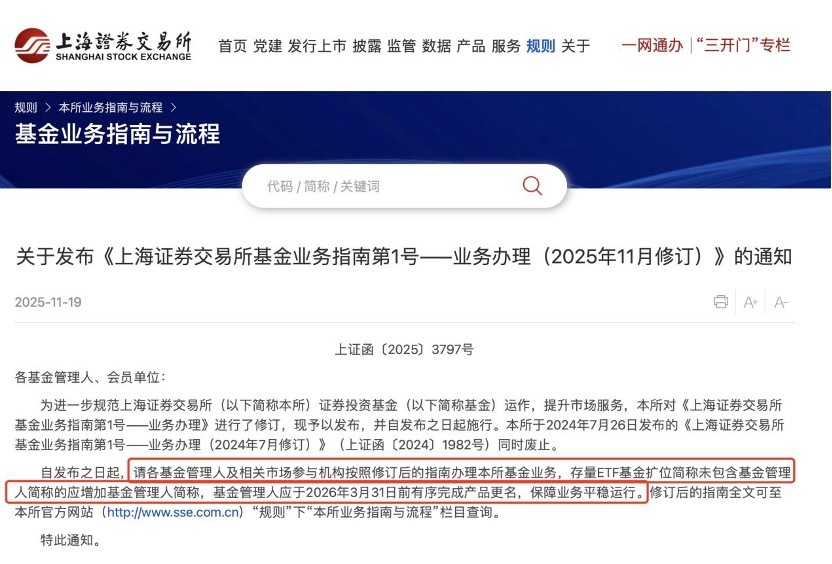
Core Viewpoint - The recent regulatory changes by the Shanghai and Shenzhen Stock Exchanges mandate a standardized naming convention for ETFs, enhancing product recognition and investor decision-making efficiency [2][4][8]. Group 1: Regulatory Changes - The revised guidelines require that the expanded abbreviations for ETFs must include the fund manager's name and follow specific naming structures, such as "core investment element + ETF" [4][5]. - Existing ETFs must complete their name changes by March 31, 2026, to comply with the new regulations [5][6]. Group 2: Market Impact - As of November 24, there are 1,367 ETFs in the market, with a significant increase in similar products leading to potential confusion among investors [5]. - Major fund companies like E Fund and Harvest have already begun adjusting their ETF names to align with the new standards, improving product clarity and investor experience [7][8]. Group 3: Industry Perspectives - Industry experts believe that the new naming conventions will enhance the identification of ETFs, allowing investors to better understand the underlying indices and the fund managers [8][9]. - The inclusion of fund manager names in ETF abbreviations is expected to reduce the likelihood of investors confusing similar products, thereby improving overall market efficiency [9][10].
天赐良基日报|多只红利ETF规模刷新纪录;16只硬科技主题基金同日获批
Mei Ri Jing Ji Xin Wen· 2025-11-24 07:31
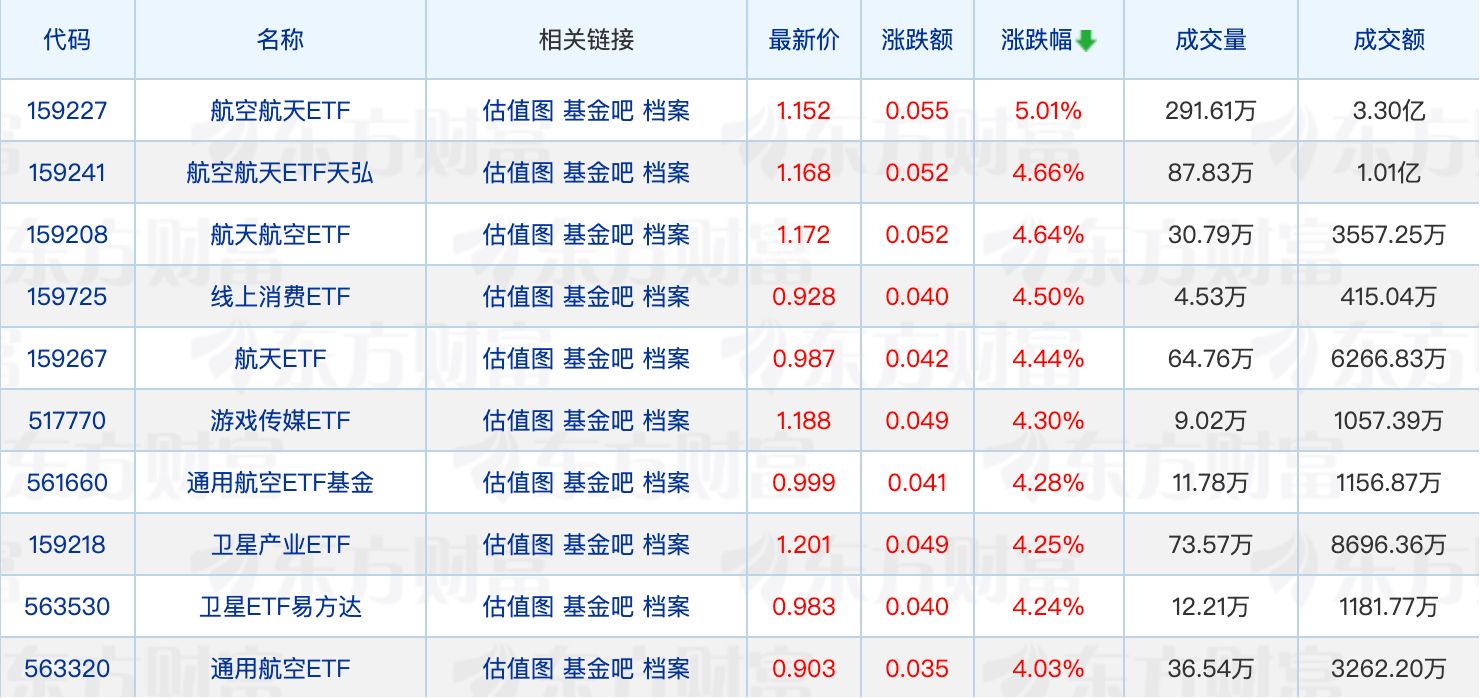
Group 1: Fund News Overview - 16 hard technology-themed funds were approved on November 21, including 7 AI ETFs, 3 chip ETFs, 4 chip design ETFs, and 2 actively managed technology equity funds from various fund managers such as E Fund, GF Fund, and Morgan Asset Management [1] - Several dividend ETFs have reached record sizes, with one product exceeding 26.6 billion yuan. As of November 21, the net inflow for dividend-themed ETFs in November reached 6.318 billion yuan, totaling 35.623 billion yuan year-to-date, representing a 49.31% increase since the beginning of the year [2] - More than half of Hong Kong stock funds have a return rate exceeding 30%. As of November 18, out of 337 funds with "Hong Kong" in their names, 336 had positive returns this year, with 174 funds achieving returns over 30%, accounting for approximately 52% [3] Group 2: Fund Manager Updates - Fund subscriptions for multiple funds managed by Lan Xiaokang will be limited starting November 24, with a maximum subscription amount of 500,000 yuan per day per account. The two funds, managed by Lan Xiaokang, have scales of 9.668 billion yuan and 7.170 billion yuan respectively [4] Group 3: ETF Market Commentary - The market showed a slight recovery, with the Shanghai Composite Index rising by 0.05%, the Shenzhen Component Index by 0.37%, and the ChiNext Index by 0.31%. The total trading volume in the Shanghai and Shenzhen markets was 1.73 trillion yuan, a decrease of 237.9 billion yuan from the previous trading day. Sectors such as aerospace, internet services, and communication equipment saw significant gains, while energy metals and insurance sectors experienced declines [5] - The commercial aerospace sector is highlighted as a key opportunity, with satellite applications and 6G technology showing strong integration potential. The next important phase for satellite networks will be the deployment of powerful on-orbit computing capabilities, which can be explored through aerospace ETFs and general aviation ETFs [9]