小米

Search documents
8 个月 50 亿产值,非程序员用秒哒赚疯了?秒哒如何解决后端难、token 贵、屎山烦
AI前线· 2025-12-18 00:40
Core Insights - The article emphasizes that the most valuable opportunity in the industry currently lies in AI Coding, with the no-code tool "秒哒" (MiaoDa) generating significant value and user engagement globally [2] - The tool has been widely adopted, serving over 10 million users and creating more than 5 billion yuan in value across various application scenarios [2] User Demographics and Needs - 81% of MiaoDa's users are non-programmers, primarily from the workforce and academic sectors, highlighting the challenge of articulating complex application needs [3] - The team has designed a unique approach to address this issue, differentiating MiaoDa from similar products by enhancing the "demand communication phase" [4] Demand Communication and User Experience - MiaoDa employs a "Product Manager AI" to facilitate deeper conversations with users, transforming vague requests into structured product documentation [4][6] - This design significantly lowers the barrier for expression and reduces the risk of rework due to unclear requirements [6] Strategy and Development Focus - The current strategy prioritizes building a robust foundational capability to ensure a smooth user experience, with plans to develop vertical versions tailored to specific business needs in the future [7] - MiaoDa also offers a deep research mode for complex business requirements, integrating with mainstream AI platforms for enhanced functionality [7] Backend Challenges and Solutions - The article discusses the challenges in backend capabilities, leading to the emergence of the BaaS (Backend as a Service) concept, with MiaoDa being recognized as a leading player in this space [9] - Key challenges include ensuring stable and efficient cloud database operations, integrating AI with databases, and managing underlying resources effectively [9][10][11] Product Experience and User Accessibility - MiaoDa aims to simplify complex database capabilities into an easy-to-use product experience, achieving a significant advantage by allowing users to complete integrations in one conversation without external configurations [12] - The article highlights the importance of maintaining code quality and preventing "code bloat" through careful review and structured development processes [15] Competitive Landscape and Future Outlook - The article concludes that while China has started its Vibe Coding development 1-2 years later than abroad, the competitive gap is narrowing, with Chinese products expected to catch up rapidly [17] - The core competitive advantages in Vibe Coding products are identified as strong code generation capabilities and superior user experience [17]



腾讯“坐不住”了,官宣大牛负责AI
Sou Hu Cai Jing· 2025-12-17 21:52
有媒体报道,腾讯近期完成了一次组织调整,正式新成立AI Infra部、AI Data部、数据计算平台部。 姚顺雨毕业于国内顶尖的清华"姚班"计算机科学精英班,后在美国普林斯顿大学获得计算机科学博士学位,并在机器学习与大规模语言模型研究领域积 累深厚科研成果。他曾担任OpenAI研究员,参与智能体(Agent)与大规模AI系统设计的前沿工作。这样的学术与工程交融背景,是其被腾讯重用的关 键原因。 题外话,据传当年清华同一届有三位同学都叫"姚顺雨/宇"!2019年他们一起毕业:一个是本文所指的主角,清华姚班的AI大神,本科rap社创始人,后 来普林斯顿博士毕业进OpenAI搞大模型,最近去了腾讯;一个是物理天才,本科拿特奖在顶刊发论文,后来跑去Stanford念PhD,又加入Anthropic搞 AI,刚离职加入 Google;还有一个是人文学院的才女,双学位加身。 腾讯今日对外确认,姚顺雨(Vinces Yao)已正式出任腾讯"CEO/总裁办公室"首席AI科学家,直接向腾讯总裁刘炽平汇报。在此角色之外,他兼任腾讯 AI基础设施(AI Infra)与大语言模型部负责人,并在大模型组织架构调整中承担核心职责。此任命 ...

【重磅深度】2025年主流车企城市NOA试驾报告—11月深圳篇
东吴汽车黄细里团队· 2025-12-17 14:11
Core Insights - 2025 is identified as a pivotal year for automotive intelligence, initiating a three-year cycle that will elevate domestic electrification penetration rates to over 50%-80%, leading to a restructuring of the automotive landscape [4][11] - Leading intelligent driving manufacturers have successfully implemented complex urban scenarios such as roundabouts and U-turns, enhancing high-level functionalities like parking from space to space and scene understanding, thereby improving the driving experience for passengers and safety personnel [4][11] Group 1: Intelligent Driving Experience Evaluation - A comprehensive evaluation was conducted on seven intelligent driving manufacturers, including AITO, Blue Mountain, Xiaopeng, Ideal, Tengshi, Xiaomi, and NIO, using both large sample concentrated road tests and small sample in-depth road tests, focusing on scene realization, takeover frequency, and comfort [5][11] - The report does not rank the intelligent capabilities of specific manufacturers due to subjective factors and real-world conditions affecting the evaluation [5][11] Group 2: Performance Trends - Compared to Q1, the performance gap among manufacturers in Q4 is narrowing, with the second-tier manufacturers improving their capabilities in urban scenarios like roundabouts and U-turns, and showing a significant reduction in takeover frequency [7][11] - The first-tier manufacturers are currently undergoing a foundational architecture transition, with tangible results expected to be validated through iterative improvements [7][11] Group 3: Specific Manufacturer Insights - In Shenzhen, the intelligent driving systems must handle complex scenarios such as roadside parking and narrow road navigation, with proactive understanding being more suitable [6][11] - Huawei and Xiaopeng lead in overall takeover frequency and performance across various scenarios, particularly excelling in challenging situations [6][11] - Wei brand Blue Mountain demonstrated strong capabilities in handling complex scenarios during large sample concentrated road tests [6][11] Group 4: Road Test Methodology - The concentrated road test involved nearly 50 participants testing various models along a standardized route, while the small sample in-depth tests were conducted by the same evaluators under similar conditions to ensure consistency [12][15] - The concentrated road test aimed to assess the overall performance, reliability, and efficiency of the intelligent driving systems under real-world conditions [41][12] Group 5: Technical Developments - The report highlights advancements in intelligent driving technologies, including the latest iterations of systems from manufacturers like Huawei, Xiaopeng, and NIO, showcasing improvements in perception and decision-making capabilities [19][20][27] - Each manufacturer has adopted different hardware and software solutions, with most having developed their own intelligent driving chips [36][36]

大反转!欧盟,宣布放弃!丁仲礼院士的含金量还在上升......
Zhong Guo Ji Jin Bao· 2025-12-17 13:42
Core Viewpoint - The European Union is planning to abandon its 2035 ban on the sale of new internal combustion engine vehicles, marking a significant retreat in its green policy efforts [3]. Group 1: EU Policy Changes - The EU Commission has proposed to relax the current arrangement that essentially bans the sale of new fuel vehicles starting in 2035, responding to pressure from the automotive industry [3]. - The proposal still requires approval from EU member states and the European Parliament, and if implemented, it will allow certain non-pure electric models to continue being sold [3]. - The new targets set by the EU include a 90% reduction in carbon dioxide emissions by around 2035 compared to 2021 levels, a shift from the previous requirement for all new passenger cars and vans to achieve "zero emissions" by 2035 [4]. Group 2: Industry Reactions - Major automotive companies, including Volkswagen, have welcomed the proposal, stating that it is a pragmatic approach to market realities while allowing for the continued existence of plug-in hybrid electric vehicles (PHEVs) and range-extended models [3]. - Analysts suggest that the global automotive industry is entering a "reset moment," rather than progressing linearly towards electrification [5]. - The CEO of Swedish electric vehicle manufacturer Polestar warned that relaxing emission targets could harm both climate efforts and Europe's competitiveness [5]. Group 3: Competitive Landscape - The relaxation of emission targets may weaken investments in critical areas such as charging infrastructure, potentially causing Europe to fall further behind China in the transition to cleaner transportation [5]. - Chinese electric vehicle manufacturers have established a leading position over the past decade, with companies like BYD and Xiaomi making rapid advancements in technology [7]. - Despite the EU's potential policy changes, analysts believe that Chinese companies will not face direct impacts and may continue to expand into markets in South America, the Middle East, and Southeast Asia [8].
大反转!欧盟,宣布放弃!丁仲礼院士的含金量还在上升......
中国基金报· 2025-12-17 13:34
Core Viewpoint - The European Union is reconsidering its plan to ban the sale of new internal combustion engine vehicles by 2035, marking a significant retreat in its green policy [3][4]. Group 1: EU Policy Changes - The EU Commission plans to relax the current arrangement that essentially bans the sale of new fuel vehicles starting in 2035, responding to pressure from the automotive industry [3]. - The proposal allows for the continued sale of plug-in hybrid electric vehicles (PHEVs) and range-extended models, addressing the concerns of major car manufacturers like Volkswagen and Fiat [3][4]. - The new targets set by the EU include a 90% reduction in carbon emissions by around 2035 compared to 2021 levels, a shift from the previous requirement for all new passenger cars and vans to achieve "zero emissions" [4]. Group 2: Industry Reactions - Analysts suggest that the global automotive industry is entering a "reset moment," rather than progressing linearly towards electrification [5]. - Executives from electric vehicle manufacturers warn that relaxing emission targets could undermine investments in critical areas like charging infrastructure and hinder Europe's transition to cleaner transportation [5]. - The EU's decision follows Ford's announcement of a $19.5 billion impairment and restructuring costs, indicating challenges in the electric vehicle market [4]. Group 3: Competitive Landscape - The slowdown in electric vehicle transitions in the US and Europe may provide Chinese automakers an opportunity to solidify their advantages, as they have established a leading position in the electric vehicle market over the past decade [8]. - Traditional automakers like Ford are shifting focus back to fuel and hybrid models, indicating a need to adapt to local market demands [8]. - Despite potential impacts from reduced subsidies and the abandonment of the "ban on fuel vehicles," Chinese automakers are expected to remain competitive, even with EU tariffs in place [8][9].

腾讯“坐不住”了,官宣大牛负责AI
首席商业评论· 2025-12-17 12:16
Core Viewpoint - Tencent has appointed Vinces Yao as the Chief AI Scientist, marking a strategic focus on AI research and development within the company [1][4]. Group 1: Organizational Changes - Tencent has recently undergone an organizational adjustment, establishing new departments: AI Infra, AI Data, and Data Computing Platform [3]. - Vinces Yao, a graduate of Tsinghua University and Princeton University, has a strong background in machine learning and large-scale language models, which is a key reason for his appointment [3]. Group 2: Competitive Landscape - Tencent's latest model, Tencent HY 2.0, features a mixed expert architecture and has been integrated into various products and cloud services [4]. - The competition in the AI field is intensifying, with Alibaba's Qwen series and Google's Gemini models posing significant challenges to Tencent [7]. Group 3: Impact of Vinces Yao's Appointment - Yao's experience at OpenAI emphasizes the importance of models' capabilities in real-world environments, which is crucial for differentiating next-generation AI products [8][9]. - His core philosophy focuses on enhancing the intelligence execution capabilities of models, which could benefit all of Tencent's business lines, particularly WeChat [9]. Group 4: Market Reaction - As of December 17, 2025, Tencent's stock price was approximately HKD 605.00, reflecting a cautious optimism from investors regarding the company's core business growth and AI strategy [10]. - The stock has shown resilience despite recent fluctuations, supported by expectations of recovery in Chinese tech stocks and ongoing investments in AI [10]. Group 5: Talent Acquisition Strategy - Tencent is actively recruiting top AI talent from ByteDance, indicating a sense of urgency in enhancing its AI capabilities [11]. - Yao has already contributed to recruiting additional talent from various AI firms, signaling Tencent's commitment to strengthening its foundational technology in AI [11]. Group 6: Future Outlook - Yao's role as a bridge between research and product implementation is expected to lead to substantial improvements in Tencent's AI capabilities, which is reflected in the slight increase in stock price following the announcement [12].

11月深圳篇:2025年主流车企城市NOA试驾报告
Soochow Securities· 2025-12-17 09:00
Investment Rating - The report does not provide specific investment recommendations for individual companies or suppliers in the smart driving sector [2][5][7]. Core Insights - 2025 marks a pivotal year for automotive intelligence, initiating a three-year cycle that will elevate the domestic electrification penetration rate to 50%-80%+ [2]. - Leading smart driving manufacturers have successfully implemented urban NOA (Navigation on Autopilot) experiences, enhancing complex scenario handling and passenger experience [2]. - The report evaluates the smart driving experiences of seven manufacturers through both large sample and small sample road tests, focusing on various dimensions such as scenario implementation and comfort [2][4]. - The performance gap among manufacturers is narrowing, with second-tier manufacturers improving their capabilities significantly compared to Q1 [2]. Summary by Sections Road Test Overview - The report includes both large sample concentrated road tests and small sample in-depth road tests to assess the smart driving capabilities of various models [4][28]. - The concentrated road test was conducted on a fixed route in Shenzhen, covering complex scenarios such as narrow passages and busy intersections [31][67]. Performance Evaluation - The average takeover frequency across the tests was noted, with specific scores assigned to each vehicle based on their performance in various driving scenarios [36][37]. - The report highlights that the Wanjie M7 achieved the highest overall evaluation score, with an average takeover frequency of 0.47, indicating excellent smart driving performance [36][37]. - The performance of the Wei brand Lanshan and Xiaopeng models was also noted, with average takeover frequencies of 1.83 and 2.40, respectively, showcasing their capabilities in complex scenarios [40][42]. Model-Specific Insights - The report details the specific smart driving versions tested, including Huawei ADS 4.0, Xiaopeng XOS 5.7.8, and others, along with their respective performance metrics [12][14][18][19]. - Each model's strengths and weaknesses in handling various driving scenarios were analyzed, with particular attention to their ability to manage complex urban environments [2][67]. Future Outlook - The report anticipates that the advancements in smart driving technology will continue to evolve, with manufacturers focusing on enhancing their systems to better handle complex driving conditions [2][22].






【快讯】每日快讯(2025年12月17日)
乘联分会· 2025-12-17 08:38
Domestic News - Chongqing has issued the "Chongqing Hydrogen Station Industry Development Plan (2025-2035)", focusing on the construction of hydrogen infrastructure along major highways to enhance the application scale of hydrogen fuel cell vehicles [6] - Guangzhou is actively promoting the construction of the first batch of vehicle-network interactive application pilot cities in the country to facilitate vehicle-network collaboration [7] - Zhengzhou's "14th Five-Year Plan" emphasizes accelerating the production and efficiency of new energy vehicles, aiming to enhance local supply chain capabilities [8] - XPeng Motors has obtained an L3 autonomous driving road testing license in Guangzhou, initiating regular L3 road tests [9] - China FAW plans to mass-produce solid-state batteries by the end of 2027, which will be first used in its Hongqi flagship models [10] - Xiaomi has open-sourced the MiMo-V2-Flash large model, which has a total parameter count of 309 billion, designed for AI applications [11] - Geely has signed a strategic cooperation agreement with iTaxi to promote the electrification of taxi fleets in Poland, with 50 Geely EX5 vehicles delivered for operation [12] - Great Wall Motors announced the official launch of the WEY G9 in Malaysia, featuring a hybrid system and a price of approximately 517,800 RMB [13] International News - The EU plans to abandon the 2035 ban on internal combustion engines, allowing some plug-in hybrid vehicles and range-extended electric vehicles to be sold [14] - Japan intends to impose a new tax on private electric vehicles based on weight starting in May 2028 [15] - Maruti Suzuki anticipates that electric vehicles will account for 45% of its total sales in India next year [16] - Tesla plans to start battery production in Germany by 2027, with an expected annual capacity of up to 8 GWh, sufficient for approximately 130,000 electric vehicles [17] Commercial Vehicles - Suzhou King Long has received the highest level of certification for functional safety standards, establishing a robust product development and management process [18] - Jiushi Intelligent and Dongfeng Motor have signed a comprehensive strategic cooperation agreement to develop innovative autonomous vehicle products across various categories [19] - Yunnan has lifted restrictions on 168,800 pickup trucks, allowing them to have the same urban road access as small passenger cars, promoting logistics and rural development [20] - Hubei Ezhou has issued new regulations to support the commercial operation of autonomous delivery vehicles, aiming to enhance the logistics sector [22]



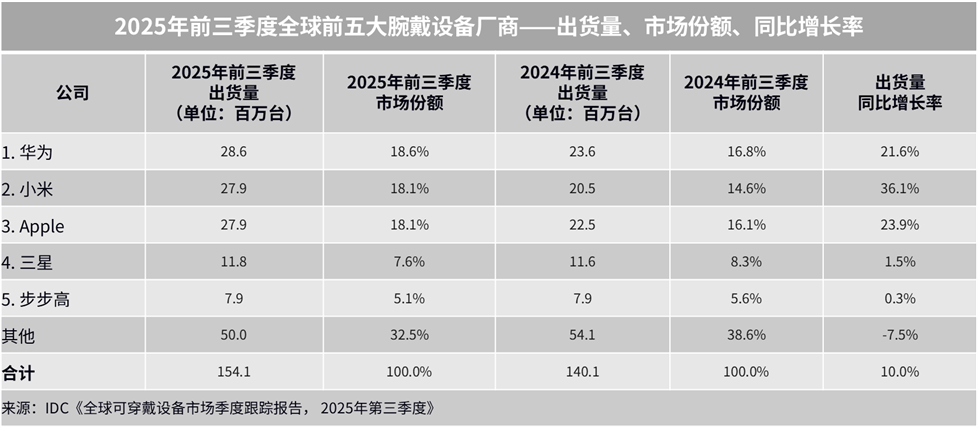
IDC:2025年前三季度全球腕戴设备市场同比增长10%
智通财经网· 2025-12-17 05:51
Core Insights - The global wearable device market is projected to ship 150 million units in the first three quarters of 2025, reflecting a year-on-year growth of 10.0% [1] - The Chinese market alone is expected to ship 58.43 million units, marking a significant year-on-year increase of 27.6% [1][9] - Major manufacturers are actively launching new products, which is driving growth in both global and developed markets [1] Global Market Performance - The global smartwatch market is expected to ship 120 million units in the first three quarters of 2025, with a year-on-year growth of 7.3% [1] - The global wristband market is projected to ship 32.86 million units, showing a year-on-year increase of 21.3% [1] - The top five manufacturers in the global wrist-worn device market include Huawei, Xiaomi, Apple, Samsung, and BBK, with Huawei leading at 28.6 million units shipped [3] Company-Specific Insights - **Huawei**: Achieved the highest global shipment volume of 28.6 million units, with a year-on-year growth of 21.6%. The new Watch GT 6 series features significant upgrades and is expanding its overseas market presence [3][4] - **Xiaomi**: Recorded a shipment of 27.9 million units, marking a 36.1% year-on-year increase. The growth is driven by its entry-level products like the Mi Band 10 and Redmi Watch series [4] - **Apple**: Launched three new models in Q3 2025, including the Apple Watch S11, which supports 5G. Apple maintains a strong position in the mid-to-high-end market [5] - **Samsung**: Released the Galaxy Watch 8 series, successfully reversing a decline in shipments earlier in the year [6] - **BBK**: Maintained a strong position in the children's smartwatch market in China, leveraging its brand and product diversity [7] Chinese Market Performance - The Chinese wrist-worn device market is expected to ship 58.4 million units in the first three quarters of 2025, with a year-on-year growth of 27.6% [9] - The top five manufacturers in China include Huawei, Xiaomi, BBK, Apple, and Honor, with Huawei leading at 20.8 million units shipped [9] Future Market Predictions - The Chinese wrist-worn device market is projected to ship 79.58 million units in 2026, with a growth rate of 5.1% [11] - The adult smartwatch segment is expected to grow by 8.2%, while the children's smartwatch market is anticipated to recover in 2026 [11] - The wristband market is expected to continue its growth trajectory, driven by high cost-performance ratios and diverse product offerings [11] Industry Trends - The wearable market is entering a "value competition" phase, with manufacturers focusing on health function upgrades, AI applications, and 5G technology [12] - There is a growing demand across different age groups and a penetration into lower-tier markets, which may unlock long-term growth potential for the industry [12]


兆威机电20251216
2025-12-17 02:27
Summary of Zhaowei Electromechanical Conference Call Company Overview - **Company**: Zhaowei Electromechanical - **Industry**: Intelligent Automotive and Advanced Industrial Manufacturing Key Points Financial Performance - Significant growth in Q3 2025, driven by intelligent automotive and advanced industrial manufacturing sectors - Full-year growth expected to remain strong, with intelligent automotive business accounting for over 60% of revenue, growing more than 30% year-on-year [2][3][4] Business Segments - **Intelligent Automotive**: - Expected revenue growth of over 30% in 2026, benefiting from applications of motion actuators and EMB-related products [2][8] - Collaborations with major domestic manufacturers like BYD, Changan, and Ideal [9][10] - **Robotics**: - Three business models: modular, standard hands, and customized hands - Anticipated doubling of revenue from modular clients like F Company and Amazon by 2026 [2][5][6] - **Advanced Industrial Manufacturing**: - Revenue growth of approximately 10% year-on-year, supported by the successful rollout of platform products like roller motors [3][4] Cost Reduction Strategies - Cost reduction in dexterous hands achieved by replacing hollow cup motors with brushless motors and using alternative materials for gearboxes [7] - Pricing for dexterous hands: - 17 degrees of freedom priced at approximately 50,000 yuan - 6 degrees of freedom priced between 20,000 to 30,000 yuan, with future iterations expected to drop below 10,000 yuan [7] Market Collaborations - Successful partnerships with North American clients, including F Company, Meta, and Amazon, ensuring diversified market development [6][16] - Anticipated supply of hundreds of hand modules to F Company in 2025, with potential for increased deliveries in 2026 [6] Product Development and Innovations - Introduction of new products in the automotive sector, including motion actuators and heat management actuators in collaboration with Schaeffler [9][11] - Roller motors projected to generate over 50 million yuan in revenue in 2025, with expectations of exceeding 100 million yuan in 2026 [4][18] Gross Margin Insights - Overall gross margin close to 35% in Q3 2025, with expectations to maintain around 34% for the full year [4][11] - Focus on high-margin applications in the automotive sector, despite industry-wide pressures [11] Future Growth Areas - Anticipated growth in automotive, consumer electronics, and robotics sectors, with a strong emphasis on intelligent and automated solutions [20][21] - Plans to establish a factory in Thailand with an investment of 100 million USD, aimed at serving North American clients and Bosch's Indian factory needs [19] Strategic Direction - Continued focus on core businesses in transmission and control, with plans to expand the supply chain and develop innovative solutions for emerging market demands [21] Additional Notes - The company is preparing for an H-share listing, having received approval from the China Securities Regulatory Commission [15] This summary encapsulates the key insights and projections from Zhaowei Electromechanical's conference call, highlighting its robust growth trajectory and strategic initiatives across various business segments.