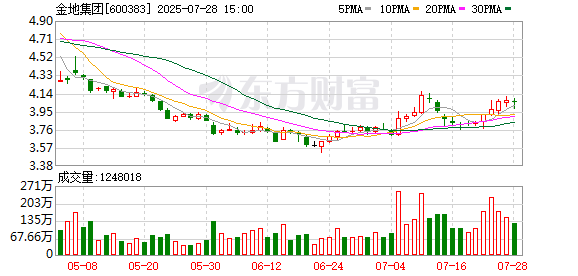
金地集团

Search documents
上半年房地产行业完成81宗并购交易;景瑞控股清盘呈请聆讯再次延期 | 房产早参
Mei Ri Jing Ji Xin Wen· 2025-07-29 00:18
Group 1: Real Estate Industry Mergers and Acquisitions - In the first half of the year, the real estate industry completed 81 merger and acquisition transactions, an increase of 2 compared to the same period in 2024 [1] - The total transaction scale for 60 disclosed transactions was approximately 29.1 billion yuan, representing a year-on-year decline of 58%, indicating a significant contraction in overall M&A activity [1] - Major real estate companies are accelerating the divestiture of non-core assets, while asset management companies (AMCs) and local special bonds are entering the market to provide new solutions for distress and inventory reduction [1] Group 2: Land Recovery in Chongqing - Chongqing plans to recover 2,161 acres of idle land through the issuance of special bonds, with an estimated total recovery price of 3.39 billion yuan [2] - A total of 25 parcels of idle land are expected to be recovered, contributing to a cumulative total of 419 parcels and approximately 29,500 acres across 9 regions, with a total recovery amount of about 48.2 billion yuan [2] - This initiative aims to optimize land resource allocation and reduce ineffective land accumulation, signaling local governments' proactive approach to resource activation and market stabilization [2] Group 3: Gindal Group Organizational Restructuring - Gindal Group announced a new organizational structure, establishing four major regional companies and ten regional companies, shifting from a three-tier to a 2.5-tier management model [3] - This restructuring is expected to enhance management efficiency and focus resources on core markets and businesses, thereby strengthening competitiveness in key regions [3] - The move reflects Gindal's proactive response to market changes, which may help stabilize investor confidence in the company and the industry [3] Group 4: Jingrui Holdings Liquidation Hearing Postponement - Jingrui Holdings' liquidation hearing has been postponed to October 16, 2025, as per the Hong Kong High Court's order [4] - The company has committed to notifying shareholders and investors of any significant developments regarding the petition in accordance with listing rules [4] - This postponement may represent a final opportunity for the company to reach a restructuring agreement, potentially serving as a template for similar companies facing distress [4] Group 5: Dayuecheng Share Unlocking - Dayuecheng announced the unlocking of 283 million shares, accounting for 6.61% of the company's total share capital, with the unlocking date set for August 4, 2025 [5] - The unlocking is based on the approval from the China Securities Regulatory Commission, involving a total fundraising amount of 2.426 billion yuan [5] - This action may increase the tradable shares of Dayuecheng in the market, potentially affecting market liquidity and investor sentiment [5]


金地集团调整组织架构:总部“强管控” 城市公司大合并
Zhong Guo Jing Ying Bao· 2025-07-28 22:13
Core Viewpoint - The company, Gindal Group, has undergone a significant organizational restructuring aimed at streamlining operations and enhancing management efficiency in response to declining business volume and market conditions [2][6]. Organizational Restructuring - The restructuring includes merging the Engineering Management Center and Cost Management Center into a new "Engineering and Cost Management Center" and establishing a Supply Chain Management Center [2][3]. - The company has reduced its regional companies from five to four and consolidated its city companies into ten regional companies, transitioning from a three-tier management model to a "2.5-tier" model [2][5]. - The new structure emphasizes a more efficient and flat management approach, with the headquarters acting as the decision-making center and directly managing regional companies [5][6]. Management Changes - Key personnel changes include the reassignment of executives, such as the former chairman of the Southern Region, Du Hong, who has been appointed as the general manager of the Eastern Region [3][4]. - The company has retained the "Investment Management Working Group" and "Performance Management Working Group," while dissolving others [3]. Business Focus - The company aims to focus on core cities and strategically abandon less critical markets due to a decline in sales and project turnover [6]. - The strategic direction remains centered on real estate development, with aspirations for breakthroughs in this sector despite current operational challenges [6]. Financial Outlook - Gindal Group anticipates a net loss of between 3.4 billion to 4.2 billion yuan for the first half of 2025, primarily due to decreased sales volume and revenue [6]. - The company has resumed land acquisitions in key cities, driven by improved market conditions and reduced debt pressure, with cash reserves of approximately 19.38 billion yuan and a debt-to-asset ratio of 64.82% as of the end of Q1 2025 [7].

住房租赁新项目密集开业,友邦保险Pre-REITs收购引关注
Sou Hu Cai Jing· 2025-07-28 12:39
Core Insights - The report indicates that housing rental companies are showing significant development in scale expansion and operational efficiency under the backdrop of continuous policy support [6][8]. Group 1: Market Expansion - In the recent report, 22 new rental projects were opened by sample companies, marking a substantial increase compared to the previous reporting period, indicating a vibrant supply side in the housing rental market [2]. - The sample companies are strategically focusing on cities with high market demand and population density, primarily in economically active regions such as the Yangtze River Delta, Pearl River Delta, and central core cities [4]. Group 2: Company Performance - Vanke's rental division, Vanke Boyu, has achieved a management scale of 262,000 rooms, with a rental rate of 95.6% and a customer satisfaction rate exceeding 95% [8]. - The company has also reported a significant reduction in customer acquisition costs, with self-owned channels accounting for 88.5% of customer acquisition [8]. Group 3: Diverse Product Offerings - The new projects launched include a variety of product types such as white-collar apartments, talent apartments, hotel apartments, large rental communities, and guaranteed rental housing, catering to different residential needs [5]. Group 4: Investment Trends - The long-term rental apartment investment market is experiencing diverse participation, with entities like AIA Insurance and local state-owned enterprises actively engaging in asset acquisitions [12][14]. - AIA Insurance's acquisition of the Yumi Community in Shanghai, which offers 2,252 guaranteed rental units, exemplifies the growing interest in long-term rental assets [13]. Group 5: Future Outlook - The continuous encouragement of policies is enhancing the market's recognition of the value of long-term rental apartment assets, attracting diverse capital, including insurance and state-owned enterprise funds [14][15]. - The improvement of exit mechanisms such as REITs is expected to invigorate the long-term rental apartment investment market, potentially attracting more capital and driving industry scale expansion and operational upgrades [15].


房地产行业周度观点更新:如何看待反内卷对地产的间接影响?-20250727
Changjiang Securities· 2025-07-27 12:11
丨证券研究报告丨 行业研究丨行业周报丨房地产 [Table_Title] 如何看待反内卷对地产的间接影响? ——房地产行业周度观点更新 报告要点 [Tablary] 地产行业属性与传统产能概念差别很大,直接出台相关反内卷政策的概率不高,但也会受到一 些间接影响。反内卷一定程度上将缓和物价下行压力,有助于降低实际利率,但可能对生产、 就业和收入等总量数据造成一定压力。关键还是需求端扩张性政策的配合,既提升居民就业和 收入预期,反内卷又降低实际利率,如此方能更有效地提振地产需求;但如果没有收入提升预 期,物价的提升反而会压制实际可支配收入,提振地产需求依赖总需求扩张引致的良性通胀, 而非供给侧优化之下的成本上涨。 分析师及联系人 [Table_Author] SAC:S0490520040001 SAC:S0490525060001 SFC:BUV416 刘义 侯兆熔 请阅读最后评级说明和重要声明 %% %% %% %% research.95579.com 1 [Table_Title 如何看待反内卷对地产的间接影响? 2] ——房地产行业周度观点更新 核心观点 止跌回稳的政策目标一定程度上对市场预期有所提振, ...



上海土地市场热度回升
Guotou Securities· 2025-07-27 08:16
Investment Rating - The industry investment rating is maintained at "Outperform the Market - A" [7] Core Insights - The Shanghai land market is experiencing a resurgence, with the sixth batch of land auctions yielding a total of 28.957 billion yuan from 8 plots, indicating strong demand for core urban land [1] - The report suggests that under a backdrop of loose liquidity, the entry of core land in major cities is expected to restore market confidence and stabilize the real estate sector [1] - The report highlights potential investment opportunities in distressed real estate companies such as JinDi Group and New Town Holdings, as well as leading firms maintaining land acquisition intensity like China Merchants Shekou and Poly Developments [1] Sales Review (July 19-25) - A total of 13,042 units were sold across 32 monitored cities, representing an 18.5% week-on-week increase; however, cumulative sales for 2025 stand at 465,000 units, down 6.2% year-on-year [2][13] - First-tier cities sold 3,431 units, down 11.5% week-on-week, while second-tier cities saw a significant increase of 47% with 8,491 units sold [2][14] - The second-hand housing market also showed growth, with 23,343 units sold across 18 monitored cities, a 2.5% increase week-on-week, and a cumulative year-on-year increase of 10.4% [17] Land Supply (July 14-20) - The planned construction area for residential land supply across 100 cities is 4.8 million square meters, with a cumulative supply of 12.261 million square meters for 2025, reflecting an 11.7% year-on-year decline [3][21] - The average floor price for land supply across 100 cities is 5,376 yuan per square meter, with a 0.5% increase week-on-week and a 9.8% increase year-on-year [3][22] Land Transactions (July 14-20) - The total planned construction area for residential land transactions across 100 cities is 2.28 million square meters, with a cumulative total of 10.516 million square meters for 2025, showing a 5.1% year-on-year increase [4][43] - The average transaction floor price for residential land is 5,899 yuan per square meter, reflecting a 1.7% week-on-week increase and a 9.4% year-on-year increase, with an overall premium rate of 10.7% [4][45]
债市调整中信用利差走高,3-5年二永债调整幅度更大
Xinda Securities· 2025-07-26 15:11
Report Industry Investment Rating No relevant content provided. Core Viewpoints - Risk preference increase impacts the bond market, with significant increases in short - to medium - term credit spreads. Credit spreads mostly rise, with larger increases in the short - to medium - term, and only spreads of 5 - year low - to medium - grade and 7 - year bonds narrowing [2][5]. - This week, most urban investment bond spreads rise. Spreads of external rating AAA, AA +, and AA platforms all increase by about 4BP [2][11]. - Industrial bond spreads generally rise by about 4BP. Central and local state - owned enterprise and mixed - ownership real estate bond spreads rise by 4 - 5BP, and private real estate bond spreads increase by 15BP [2][17]. - The yields of secondary and perpetual (two - type) bonds all rise. The spreads of 3 - to 5 - year high - to medium - grade two - type bonds increase significantly, and their overall performance is weaker than that of ordinary credit bonds [2][27]. - The excess spreads of industrial perpetual bonds remain flat, and the excess spreads of urban investment bonds decline slightly [2][32]. Summary by Directory 1. Risk preference increase impacts the bond market, with significant increases in short - to medium - term credit spreads - Domestic commodity prices rise sharply due to the expected "anti - involution" policy, and the A - share market hits a new high this year. The adjustment of interest - rate bonds intensifies, with the yields of 1Y, 3Y, and 5Y China Development Bank bonds rising by 4BP, 8BP, and 10BP respectively, and those of 7Y and 10Y bonds rising by 9BP [5]. - Some institutional liabilities are affected, leading to large - scale selling of credit bonds and a significant rise in yields. The yields of 1Y credit bonds of all grades rise by 10 - 11BP; the yields of 3Y AA and above - grade credit bonds rise by 10 - 11BP, and those of AA - grade bonds rise by 7BP; the yields of 5Y AA + and above - grade credit bonds rise by 11BP, and those of other grades rise by 6 - 8BP; the yields of 7Y AA + and above - grade credit bonds rise by 5 - 6BP, and those of AA - grade bonds rise by 3BP; the yields of 10Y AA + and above - grade bonds rise by 10 - 12BP, and those of AA - grade bonds rise by 8BP [5]. - Credit spreads mostly rise, with larger increases in the short - to medium - term. Only spreads of 5 - year low - to medium - grade and 7 - year bonds narrow. Rating spreads and term spreads show obvious differentiation [5]. 2. Spreads of all grades of urban investment bonds rise by about 4BP - This week, most urban investment bond spreads rise. Spreads of external rating AAA, AA +, and AA platforms all increase by 4BP. For AAA - grade platforms, spreads mostly rise by 3 - 4BP, with Hainan rising by 5BP, and Tianjin and Liaoning rising by 2BP; for AA + - grade platforms, spreads mostly rise by 3 - 4BP, with Jilin rising by 5BP, Yunnan and Tianjin rising by 2BP, and Qinghai remaining flat; for AA - grade platforms, spreads mostly rise by 2 - 5BP, with Gansu and Henan rising by 6BP, Hebei rising by 1BP, and Guizhou falling by 1BP [2][11]. 3. Industrial bond spreads generally rise by about 4BP - Industrial bond spreads generally rise by about 4BP. Central and local state - owned enterprise and mixed - ownership real estate bond spreads rise by 4 - 5BP, and private real estate bond spreads increase by 15BP. The spreads of Longfor rise by 3BP, those of Midea Real Estate rise by 4BP, those of CIFI rise by 160BP, those of Gemdale rise by 1BP, and those of Vanke fall by 4BP. Spreads of coal and steel bonds of all grades rise by 4BP respectively; spreads of chemical bonds of all grades rise by 3 - 4BP. The spreads of Shaanxi Coal Industry rise by 6BP, those of HBIS Group rise by 5BP, and those of Jinkong Coal Industry rise by 4BP [2][17]. 4. Spreads of 3 - to 5 - year two - type bonds rise significantly - This week, the yields of two - type bonds all rise. The spreads of 3 - to 5 - year high - to medium - grade two - type bonds increase significantly, and their overall performance is weaker than that of ordinary credit bonds. Specifically, the yields of 1Y secondary capital bonds of all grades rise by 7 - 8BP, and spreads rise by 2 - 3BP; the yields of 1Y perpetual bonds of all grades rise by 9BP, and spreads rise by 5BP. The yields of 3Y two - type bonds of all grades rise by 12 - 14BP, and spreads rise by 4 - 6BP. The yield of 5Y AAA - grade secondary capital bonds rises by 14BP, the yields of other grades rise by 17BP, and spreads rise by 7BP; the yields of perpetual bonds of all grades rise by 12 - 14BP, and spreads rise by 3 - 5BP [2][27][29]. 5. The excess spreads of industrial perpetual bonds remain flat, and the excess spreads of urban investment bonds decline slightly - This week, the excess spreads of AAA - grade industrial perpetual bonds remain flat. The spreads of 3Y industrial bonds remain at 3.82BP, at the 1.69% quantile since 2015, and the excess spreads of 5Y industrial perpetual bonds remain at 7.65BP, at the 4.55% quantile since 2015. The excess spreads of urban investment AAA 3Y perpetual bonds decline by 0.12BP to 3.63BP, at the 0.29% quantile; the excess spreads of urban investment AAA 5Y perpetual bonds decline by 0.41BP to 9.80BP, at the 9.10% quantile [2][32]. 6. Credit Spread Database Compilation Instructions - Market - wide credit spreads, commercial bank two - type spreads, and urban investment/industrial perpetual bond credit spreads are calculated based on ChinaBond medium - and short - term notes and ChinaBond perpetual bond data, with historical quantiles since the beginning of 2015. Urban investment and industrial bond - related credit spreads are compiled and statistically analyzed by Cinda Securities R & D Center, with historical quantiles since the beginning of 2015 [38]. - Industrial and urban investment individual bond credit spreads = individual bond ChinaBond valuation (exercise) - yield to maturity of same - term China Development Bank bonds (calculated by linear interpolation method), and then the industry or regional urban investment credit spreads are obtained by arithmetic mean method [38]. - Excess spreads of bank secondary capital bonds/perpetual bonds = credit spreads of bank secondary capital bonds/perpetual bonds - credit spreads of same - grade and same - term bank ordinary bonds; excess spreads of industrial/urban investment perpetual bonds = credit spreads of industrial/urban investment perpetual bonds - credit spreads of same - grade and same - term medium - term notes [38]. - Both industrial and urban investment bonds select medium - term notes and public - offering corporate bonds as samples, and guarantee bonds and perpetual bonds are excluded. If the remaining term of an individual bond is less than 0.5 years or more than 5 years, it is excluded from the statistical sample. Industrial and urban investment bonds use external entity ratings, while commercial banks use ChinaBond implicit debt ratings [38].
中国城市运行周期跟踪(2025.Q2):量价回落,波动加剧
GUOTAI HAITONG SECURITIES· 2025-07-25 08:28
Investment Rating - The report assigns an "Accumulate" rating for the real estate industry [5]. Core Insights - The overall market in Q2 2025 shows weak transaction volumes, stable prices lacking trends, and increasing inventory with heightened de-stocking pressure [3]. - Only 19% of the 27 cities analyzed exhibit signs of market bottoming, indicating a general trend of "volume contraction, price stagnation, and inventory pressure" [12]. - The new housing market is experiencing a downturn, with first-tier cities showing a significant slowdown in sales growth, while the second-hand housing market demonstrates relative resilience but with increasing regional disparities [12][13]. Summary by Sections 1. Transaction Decline and Lengthening De-stocking - The report highlights that the real estate cycle varies significantly across cities due to localized policies and differing reliance on land finance [8]. - A comprehensive scoring model based on seven core indicators is used to assess the real estate cycle of each city, categorizing them into four stages: bottoming, rising, topping, and declining [8][9]. 2. Price Trends: Q2 New and Second-hand Housing Prices Decline - In Q2 2025, new housing prices experienced a slight decline after a period of stabilization, with 85% of cities unable to sustain price increases for more than two months [17]. - Second-hand housing prices also fell, with 78% of cities still in a downward trend by June [17][19]. 3. Transaction Volume: Weak Recovery and Increased Volatility - First-tier cities maintained an upward trend in new housing transactions until June, where a decline of 12% was noted [22]. - Second-tier cities saw a 15% year-on-year drop in new housing transactions in Q2, reflecting greater inventory pressure and declining buyer confidence [22][27]. 4. Demand Entering a Tug-of-War Phase Leading to Rising Inventory Cycles - The de-stocking cycle for first-tier cities increased to 20 months by June 2025, indicating intensified market supply-demand conflicts [29]. - Second-tier cities faced even longer de-stocking cycles, reaching 23 months, highlighting structural issues such as declining population attraction and excess land supply [29]. 5. Company Profit Forecasts - The report includes profit forecasts for key companies, with several companies rated as "Accumulate" based on their projected earnings per share (EPS) and price-to-earnings (PE) ratios [32].




房地产行业2025年6月楼市、地市、政策、房企全扫描
2025-07-25 00:52
Summary of Real Estate Industry Conference Call Industry Overview - The conference call focuses on the **real estate industry** in China, specifically analyzing the market conditions as of June 2025 and the first half of the year [1][2][3]. Key Points and Arguments New Housing Market Performance - In June 2025, the new housing transaction area increased by **12% month-on-month** but decreased by **9% year-on-year** [1][2]. - Among first-tier cities, **Beijing** showed a strong performance with a **13% year-on-year increase** and a **23% month-on-month increase**; however, **Shenzhen** experienced a **35% year-on-year decline** [1][2]. - Second-tier cities saw a **16% month-on-month increase** but a **9% year-on-year decline** in new housing transactions [4]. Second-Hand Housing Market - In the first half of 2025, the second-hand housing market in 18 monitored cities saw a **15% year-on-year increase** in transaction area, but June marked the first month of negative growth since June 2024, with a **4% year-on-year decline** [5]. Inventory and Depletion Cycle - As of June 2025, the inventory of new residential properties in 12 major cities decreased by **17% year-on-year**, but the overall depletion cycle increased to **17.2 months** [6]. Land Auction Market - The land auction market showed a decline in heat compared to the previous year, with a **7.8% average premium rate** in the first half of 2025, up **4.3 percentage points year-on-year** [3][8]. - The average floor price increased by **50% month-on-month** and **17% year-on-year** [7]. Real Estate Companies' Performance - The top 100 real estate companies reported a **22% year-on-year decline** in sales in June, with a cumulative sales amount of **1.8 trillion yuan**, down **11% year-on-year** [9]. - However, land acquisition amounts significantly increased by **57% year-on-year** in June, reaching **140.4 billion yuan** [9]. Financing Conditions - The financing scale for the real estate industry decreased by **10% year-on-year** in the first half of 2025, but June saw a **16% year-on-year increase** in bond issuance [10][11]. Government Policies - The government has implemented various measures to stabilize the real estate market, including optimizing housing fund policies and providing financial support for urban renewal [12][14]. Debt Maturity Outlook - From July 2025 to June 2026, the expected maturity scale of domestic and foreign bonds in the real estate sector is **743.7 billion yuan**, with a notable peak in March and April 2026 [13]. Market Performance and Future Outlook - The overall real estate sector's absolute return in June was **0.9%**, underperforming the CSI 300 index by **1.6 percentage points** [15]. - The Central Urban Work Conference held on July 15, 2025, is expected to enhance policy support for urban renewal, crucial for the market's transition from growth to stability [16]. Additional Insights - Companies to watch include those with stable fundamentals in first and second-tier cities, smaller firms with significant breakthroughs, and real estate brokerage firms benefiting from the recovery in the second-hand housing market [17][18].

楼市“半年考”| 55家房企上半年交房超50万套背后:交付高峰期已过,企业“保交付”压力持续减轻
Mei Ri Jing Ji Xin Wen· 2025-07-24 09:27
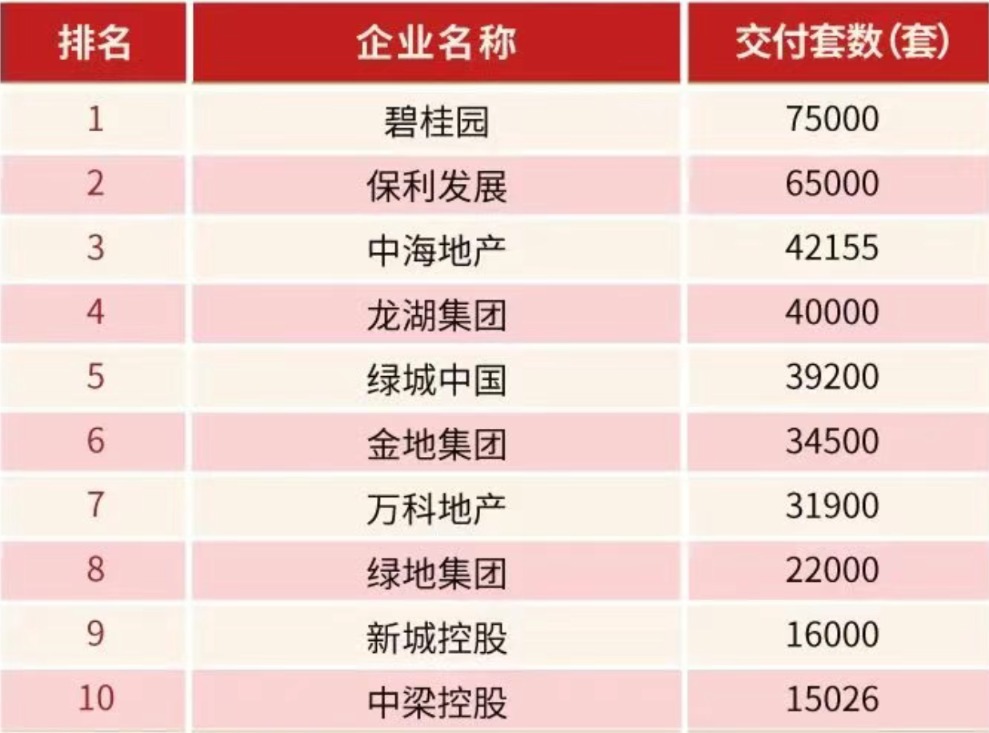
Core Viewpoint - The delivery of residential properties remains a crucial task for the real estate market in 2025, with a notable decline in delivery volumes compared to the previous year, indicating a shift in focus for companies from "guaranteeing delivery" to seeking development opportunities [1][9]. Delivery Performance - In the first half of 2025, 55 real estate companies delivered over 500,000 units, with 15 companies delivering more than 10,000 units each [1]. - Major companies like Greenland Group, Sunac China, and Jianye Group saw delivery declines exceeding 50% compared to the same period last year [1]. - The top three companies in terms of delivery volume were Country Garden (75,000 units), Poly Developments (65,000 units), and China Overseas Property (42,155 units), with the top ten companies accounting for 56.46% of total deliveries [2][1]. Industry Trends - The pressure to ensure delivery is easing as the peak delivery period has passed, allowing companies to shift their focus towards development and operational strategies [1][9]. - Companies like Country Garden and Sunac China are actively working on completing their delivery commitments while also restructuring their financing to align with current market conditions [3][4]. Innovations in Delivery - Some companies have begun implementing innovative delivery methods, such as "delivery and certificate issuance" on-site, enhancing customer experience and operational efficiency [10]. - The focus on improving delivery quality includes better communication with homeowners and offering personalized services during the delivery process [10]. Strategic Shifts - The industry is witnessing a strategic shift where companies are prioritizing product quality, operational efficiency, and asset management over mere scale [11][12]. - Companies are categorizing their strategies into three main types: product-focused, light-asset models, and asset operation, reflecting a more nuanced approach to market challenges [11].



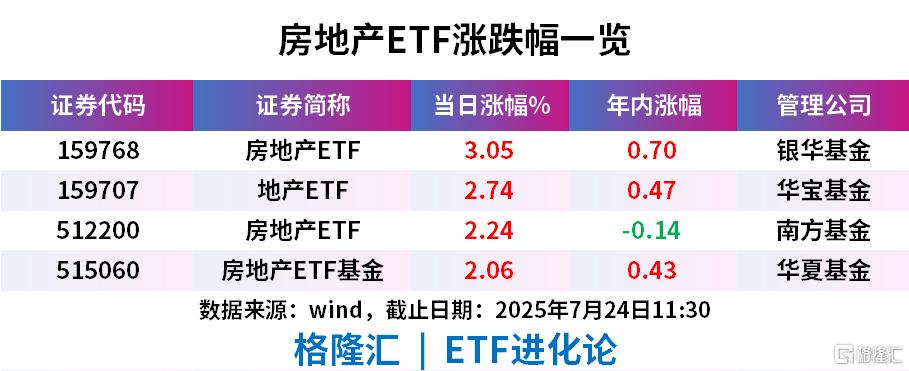
房地产贷款增速回升!房地产ETF涨超3%,地产ETF、房地产ETF基金涨超2%
Ge Long Hui A P P· 2025-07-24 04:44
Group 1 - Hong Kong real estate stocks collectively surged, with Country Garden and Agile Group leading with a 7% increase, while Shimao Group rose over 4% [1] - A-shares such as China Merchants Shekou, China Vanke, and Greenland Group also saw gains of over 2% [1] - Real estate ETFs, including Poly Developments and China Merchants Shekou, increased by over 3%, indicating positive market sentiment [1][3] Group 2 - The People's Bank of China reported that as of the end of Q2 2025, the total balance of RMB loans was 268.56 trillion yuan, a year-on-year increase of 7.1%, with real estate loans at 53.33 trillion yuan, up 0.4% [4] - Guangdong's financial regulatory authority announced that banks provided over 1 trillion yuan in credit for 1,812 "white list" projects, with real estate loans in the region growing by 2.77% year-on-year [5] - In Suzhou, land auction prices reached new highs, with Greenland winning a plot for 46.67 billion yuan, setting a new record for floor prices in the area [6] Group 3 - China Overseas Land & Investment acquired a residential plot in Shanghai for 53.63 billion yuan, with a floor price exceeding 90,000 yuan per square meter, reflecting strong demand in prime locations [7] - Bank of America Securities noted that the performance of the domestic real estate sector has been mixed, emphasizing the importance of location and profit outlook in stock performance [8] - The report suggests that the upcoming political bureau meeting in July will be a critical event for potential policy adjustments in the real estate sector [8]