零跑汽车

Search documents
理想汽车失销冠交付量仅完成目标63% 单季归母净利亏6.2亿李想急调管理模式
Chang Jiang Shang Bao· 2026-01-11 23:31
Core Viewpoint - Li Auto has experienced a significant decline in sales and profitability, leading to a restructuring of its product lines and management approach to regain market competitiveness [1][4][6]. Sales Performance - In 2025, Li Auto delivered a total of 406,300 vehicles, representing an 18.81% year-on-year decline, and only achieved approximately 63% of its revised sales target of 640,000 vehicles [6][7]. - The company has fallen from the top position in the new energy vehicle sector to fifth place, trailing behind competitors such as Leap Motor, Hongmeng Zhixing, Xiaomi Auto, and XPeng [7]. Financial Performance - In Q3 2025, Li Auto reported a net loss of 624 million yuan, ending a streak of 11 consecutive profitable quarters [8]. - The company's revenue for 2023 was 123.85 billion yuan, a 173.5% increase year-on-year, but revenue growth slowed to 16.64% in 2024, with a net profit decline of 31.37% [8]. Organizational Restructuring - Li Auto is restructuring its product lines into two main categories: the first line, led by Tang Jing, will cover models MEGA, L9, L8, and L7; the second line, led by Li Xinyang, will focus on the i series and L6 [2]. - The restructuring is a response to declining sales and aims to return to a startup management model to enhance value creation and better meet user needs [2][5]. Market Challenges - The company has faced challenges including a recall of 11,411 vehicles due to safety concerns related to cooling system failures, which may impact consumer confidence [9][10]. - A recent fire incident involving the Li Auto MEGA has raised concerns among consumers and the media, further complicating the company's recovery efforts [10]. Future Outlook - Despite current challenges, the CEO remains optimistic about achieving significant milestones, including surpassing 1.5 million cumulative deliveries and expanding into new international markets [10].


浙江零跑汽车销售服务公司注册资本增至8.5亿元
Zheng Quan Ri Bao· 2026-01-11 14:08
Group 1 - The core point of the article is that Zhejiang Leap Motor Sales Service Co., Ltd. has increased its registered capital from 200 million to 850 million yuan [2] Group 2 - The change in registered capital indicates a significant increase of 325% [2] - This capital increase may reflect the company's growth strategy and potential expansion plans in the automotive industry [2] - The information was sourced from Tianyancha business data [2]

“9系”集中登场,车企开年亮剑
虎嗅APP· 2026-01-11 14:06
Core Viewpoint - The article discusses the competitive landscape in the high-end electric vehicle (EV) market, highlighting the launch of new flagship models by various automakers and the strategic importance of establishing a high-end brand image in the rapidly evolving automotive industry [2][5][9]. Group 1: High-End Market Dynamics - The introduction of the "9 series" models by NIO, Zhijie, and SAIC Volkswagen signifies a strategic move by automakers to penetrate the high-end EV market, with expected pricing between 300,000 to 500,000 yuan [2][5]. - The penetration rate of EVs in the 300,000 to 400,000 yuan price range has increased over 30 times in the past six years, indicating a growing consumer acceptance of high-end electric vehicles [5]. - The competition for high-end market share is intensifying, with brands like BYD launching premium sub-brands to target the luxury EV segment [7]. Group 2: Market Performance and Challenges - Despite initial success, high-end models from domestic brands often struggle with consistent sales performance, as seen with the BYD Yangwang U8, which saw a significant drop in monthly sales after an initial surge [8]. - Establishing a high-end brand perception requires more than just superior specifications; it necessitates effective brand marketing and service system development [9]. - The recent price cuts by traditional luxury brands like BMW, with reductions of up to 300,000 yuan on over 30 models, pose a challenge for new entrants in the high-end market to justify their pricing [14]. Group 3: Consumer Expectations and Brand Strategy - Consumer perceptions of high-end vehicles are evolving, shifting from a focus on brand and performance parameters to an emphasis on technological attributes and emotional experiences [16]. - The "9 series" models are designed to meet these new consumer expectations, incorporating advanced technology such as Huawei's new generation of assisted driving hardware [16]. - The proliferation of "9 series" models may dilute brand recognition, making it essential for companies to leverage unique features and capabilities to stand out in a crowded market [17].
鸿蒙智行首款MPV定档,定位50万级豪华市场
第一财经· 2026-01-11 11:31
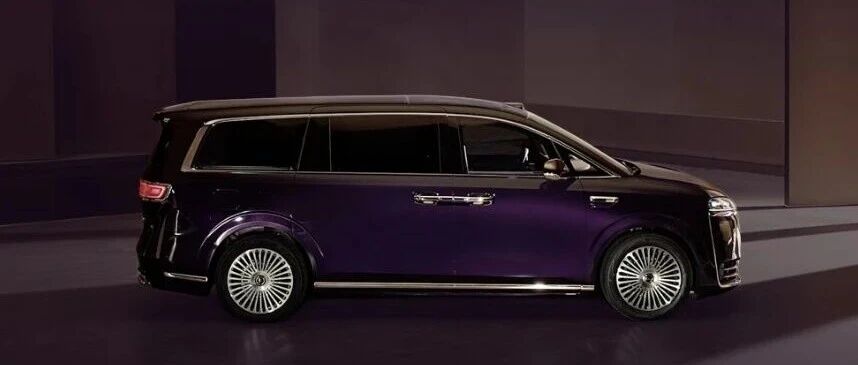
Core Viewpoint - The article discusses the launch of Huawei's first MPV, the Zhijie V9, which is set to enter the market in Spring 2026, highlighting its specifications, competitive positioning, and the growing potential of the new energy MPV market [3][4]. Group 1: Product Information - The Zhijie V9 has a length of over 5.3 meters and a wheelbase exceeding 3.2 meters, featuring a range-extended power system [3]. - It will be equipped with a 53 kWh battery and a 60-liter fuel tank, achieving a maximum CLTC comprehensive range of 1250 kilometers [3]. - The vehicle is positioned in the 500,000 RMB range as a mid-to-large luxury new energy MPV [3]. Group 2: Competitive Landscape - The new energy MPV segment is experiencing significant growth, with a year-on-year sales increase of 33% from January to October 2025, while traditional fuel MPVs saw a decline of 13.9% [4]. - The market is becoming increasingly competitive, with eight new MPV models launched in the first three quarters of 2025, covering price ranges from 100,000 to 500,000 RMB [4]. - In 2026, competition is expected to intensify with the introduction of several new models, including Leapmotor D99 and Geely Galaxy V900, alongside the Zhijie V9 [4].
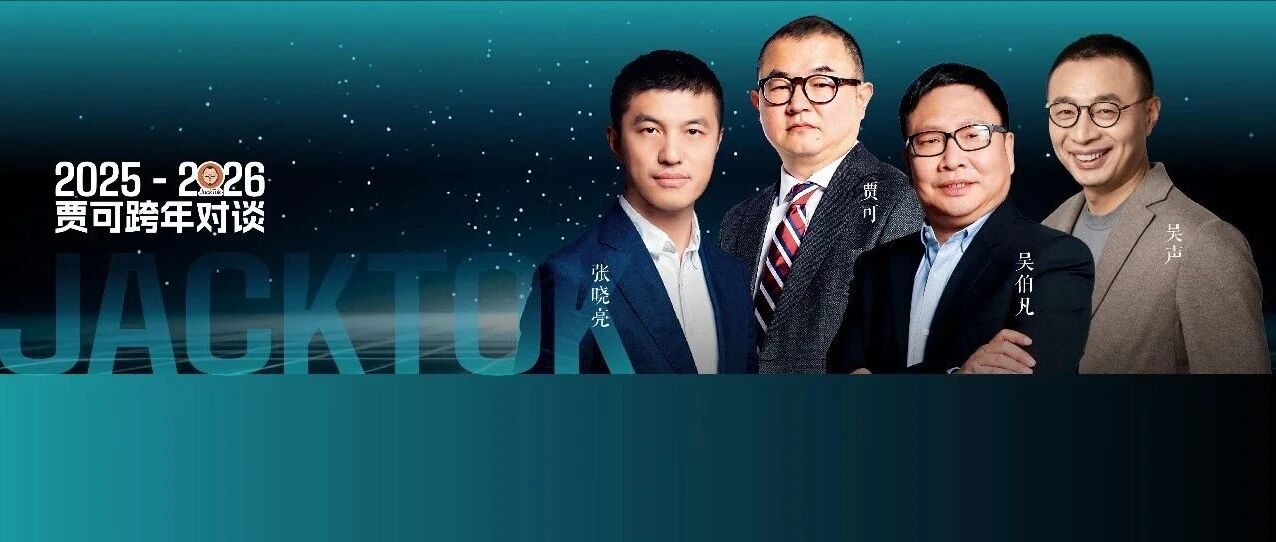
贾可吴伯凡吴声张晓亮,4万字2025-2026跨年对谈全文(上)
汽车商业评论· 2026-01-10 23:05
Core Viewpoint - The article discusses the evolution and current state of the Chinese automotive industry, highlighting the significance of achieving global sales leadership for domestic brands and the need for industry maturity and strategic resource consolidation [5][31][44]. Group 1: Achievements in the Automotive Industry - In 2025, Chinese domestic brands achieved global sales leadership, with total sales expected to reach 27 million units, surpassing Japanese brands by approximately 2 million units [13][20]. - The domestic market is projected to exceed 34 million units, marking a growth of about 3 million units from the previous year [13][20]. - The automotive industry contributes over 10% to China's GDP, emphasizing its critical role in the national economy [18][25]. Group 2: Industry Challenges and Maturity - The industry faces challenges such as declining profit margins, with the average profit rate rising slightly from 4.3% to 4.4% [35][25]. - There is a need for the industry to transition from aggressive competition to value-based competition, as highlighted by government interventions aimed at curbing price wars and promoting sustainable practices [31][36]. - The government has implemented measures to address industry chaos, including guidelines to prevent arbitrary price reductions and improve supply chain management [34][31]. Group 3: Resource Consolidation and Strategic Adjustments - Traditional automakers are increasingly consolidating resources and streamlining operations to enhance efficiency and competitiveness [45][47]. - Companies like Geely and Dongfeng are integrating their brands to strengthen their market position and improve operational effectiveness [45][47]. - The article emphasizes the importance of strategic focus and resource allocation in navigating the evolving automotive landscape, with companies needing to adapt to new market realities [51][53].
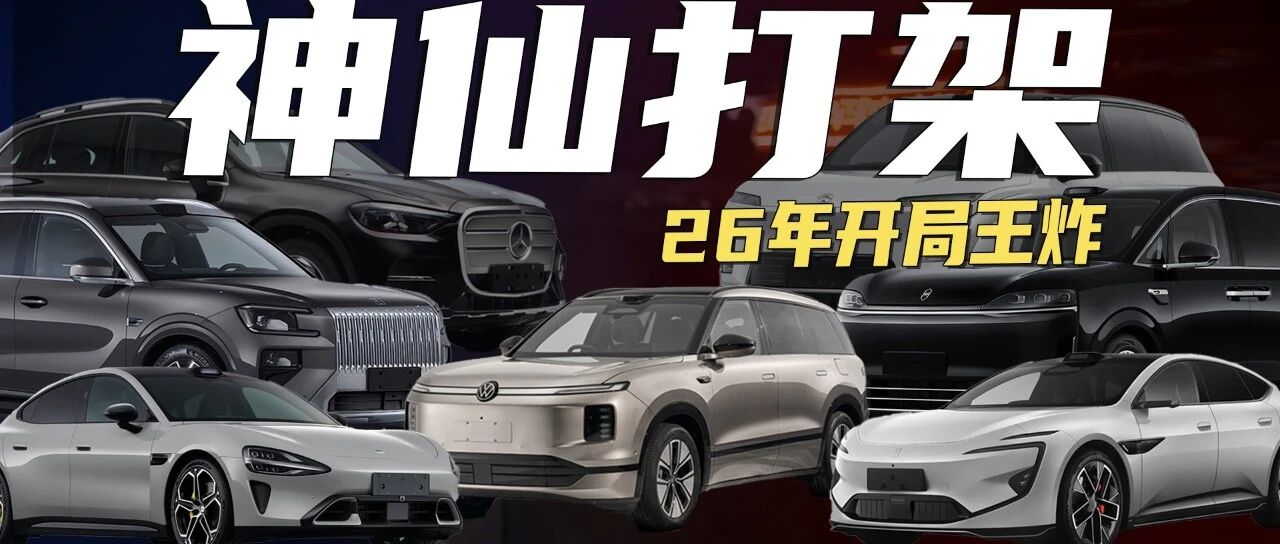
2026开局王炸!比亚迪宋Ultra、蔚来ES9、智界V9、极氪8X、大众ID.ERA、奔驰GLC纯电等多款新车登陆工信部!
电动车公社· 2026-01-10 16:06
Core Viewpoint - The automotive market in China is expected to experience cautious optimism for 2026, with predictions of a decline in passenger car sales after a peak in 2025 [1][2]. Group 1: Market Predictions - Morgan Stanley forecasts a 9% year-on-year growth in China's passenger car sales in 2025, followed by a 5% decline in 2026 [2]. - Despite continued growth in new energy vehicle (NEV) sales and exports, there may be a 30% drop in the first quarter due to changes in subsidies and purchase tax policies, impacting overall annual sales [3]. Group 2: Industry Competition - The consensus is that the Chinese automotive industry is entering a decisive phase, with expectations that only 5-10 NEV companies will survive in the coming years [7]. - As competition intensifies, there are indications of a significant influx of new models, with at least 24 different new energy vehicles expected to be launched, indicating fierce competition ahead [8][9]. Group 3: Key Trends for 2026 - Key themes for 2026 include technological iteration, configuration upgrades, larger vehicle sizes, and responses from joint ventures [10].


开年新车公告:宁德“LFP+三元”电池上车零跑、小米SU7更新三元Max版
高工锂电· 2026-01-10 12:19
摘要 高压平台 + 超快充电池已成高端 SUV 标配。 2026 年工信部新车第一弹来袭。 据第 403 批《道路机动车辆生产企业及产品公告》,开年共有 82 款新车公示,纯电车型 49 款,混动 / 增程共 33 款。其中,比亚迪系新车公示 最多,共 32 款,弗迪电池配套车型包括王朝、海洋系列,以及方程豹、领汇、腾势品牌。 宁德时代紧跟弗迪其后,拿下 28 款新车配套,三元车型共 16 款, LFP 车型 11 款," LFP+ 三元"电池 1 款,该电池上车零跑 SUV D19 。 从零跑的官方宣传来看, D19 部分车型搭载了宁德时代 115KWh 超混电芯,能量密度提升了 18.5% ,率先满足 2026 年最新电池国标。 值得一提的是,宁德时代此前已提出 AB 电池概念,可实现" LFP+ 三元"以及" LFP+ 钠电"等组合。而最新双核电池的概念在其去年首个科技日上 着重强调,成为行业焦点。 事实上,宁德时代双核电池可视为 AB 电池的加强版。 具体来看,宁德时代"双核架构"的其中一个矩阵为,骁遥 " 三元铁/ 双三元 " 双核电池(三元+铁锂/ 三元自生成负极电池),输出功率大于 1000kW ...

2025年汽车以旧换新超1150万辆,全年乘用车零售2374.4万辆
Xinda Securities· 2026-01-10 11:06
Investment Rating - The industry investment rating is "Positive" [2] Core Insights - The report highlights that in 2025, over 11.5 million vehicles will be replaced under the vehicle trade-in program, leading to a total retail of 23.744 million passenger cars, with approximately 54% being new energy vehicles [20][3] - The report indicates a projected growth in the automotive market, with a U-shaped sales trend expected for passenger vehicles in 2026, maintaining overall sales levels similar to 2025 [20] - Key companies to watch include BYD, Geely, Great Wall Motors, and others in the passenger vehicle sector, as well as major players in commercial vehicles and auto parts [3][20] Industry Performance - The A-share automotive sector underperformed the market, with a weekly increase of 2.53% compared to the 2.79% rise in the CSI 300 index, ranking 24th among A-share industries [3][9] - The report notes that the passenger vehicle segment saw a 3.8% year-on-year increase in retail sales, while new energy vehicles experienced a 17.6% growth [20] Key Industry News - The Ministry of Commerce announced that the vehicle trade-in program will exceed 11.5 million vehicles in 2025, contributing to over 1.6 trillion yuan in new car sales [20] - Geely received the largest L3 autonomous driving test license in China, covering an area of 9,224 square kilometers [20] - Baidu's autonomous driving platform, "萝卜快跑," obtained the first full unmanned testing license in Dubai, paving the way for commercial operations [20] Upstream Data Tracking - The report includes tracking of key material prices such as steel, aluminum, and lithium carbonate, which are crucial for automotive manufacturing [23][24]



车企密集明确2026销量目标,市场格局将会有哪些变化?
Xin Lang Cai Jing· 2026-01-10 10:07
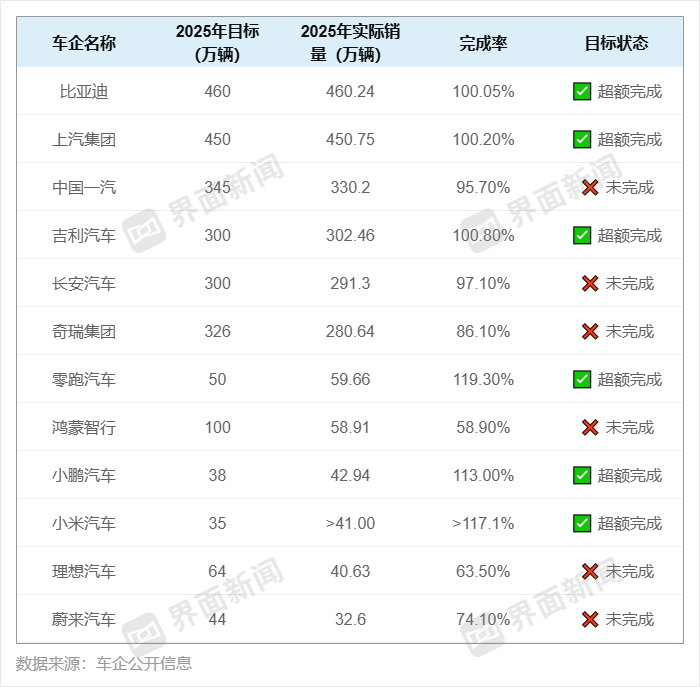
Core Insights - The Chinese automotive market is experiencing unprecedented differentiation as companies announce their annual sales and plans for 2026, reflecting a deep competition regarding survival, development, and industry positioning [1] Group 1: Sales Performance in 2025 - In 2025, six companies achieved their sales targets, including three traditional automakers (BYD, Geely, SAIC) and three new players (Leap Motor, Xpeng, Xiaomi) [1] - BYD led with 4.6024 million units sold, exceeding its target and becoming the global leader in pure electric vehicle sales [1] - Geely delivered 3.0246 million units, achieving a 100.8% completion rate and a 39% year-on-year growth [1] - SAIC's sales surpassed 4.5075 million units, marking a 12.32% increase year-on-year [1] - Leap Motor topped the new energy vehicle sales with 596,600 units delivered, achieving a 119% completion rate [2] - Xpeng delivered 429,400 units, a 113% completion rate with a 126% year-on-year growth [2] - Xiaomi, as a newcomer, delivered over 410,000 units, exceeding its first-year target [1] Group 2: Differentiation in Performance - Companies like Li Auto and Hongmeng Zhixing failed to meet their targets, with Li Auto delivering 406,000 units, only 63.5% of its goal, and Hongmeng Zhixing delivering 589,100 units, significantly below its 1 million target [2] - The performance disparity among automakers is attributed to differences in sales scale, product structure, transformation stages, and technological accumulation [2] - The differentiation is further accelerated by electrification and intelligent technology, along with strong policy guidance [2] Group 3: Strategic Approaches for 2026 - Automakers are adopting different strategies for 2026, categorized into three camps: aggressive, stable, and conservative [2] - Leap Motor and Hongmeng Zhixing represent the aggressive camp, with Leap aiming for 1 million units (a 67.5% increase) and Hongmeng targeting between 1 million to 1.3 million units, requiring up to 120% year-on-year growth [3][4] - The stable camp includes Great Wall and Xiaomi, focusing on steady growth rather than aggressive targets [7][8] - Great Wall set a target of over 1.8 million units for 2026, reflecting a 36% growth rate, while Xiaomi aims for 550,000 units, a 34% increase [7][8] Group 4: Challenges and Opportunities - Leap Motor's growth is supported by its dual breakthrough in scale and profitability, but it faces challenges in expanding production and maintaining quality [4] - Hongmeng Zhixing plans to launch 11 to 18 new models in 2026, but must balance brand differentiation and collaboration among its multiple brands [5] - The conservative camp, represented by Geely and Li Auto, emphasizes quality over sheer volume, with Geely targeting 3.45 million units for a 14% growth [10][11] - Li Auto and NIO are expected to adopt more cautious strategies in 2026, focusing on consolidating their market positions rather than aggressive growth [11][12] Group 5: Market Dynamics and Future Outlook - The 2026 Chinese automotive market is characterized by a strategic landscape where aggressive players like Leap and Hongmeng fight for market share, stable players like Great Wall and Xiaomi serve as the backbone of industry transformation, and conservative players like Geely and Li Auto represent rationalization in the industry [14] - The competition will shift from merely selling units to achieving profitability and sustainable sales, with a projected electric vehicle penetration rate exceeding 60% [15] - The outcomes of this competition will reshape the Chinese automotive industry and influence the global market dynamics [15]
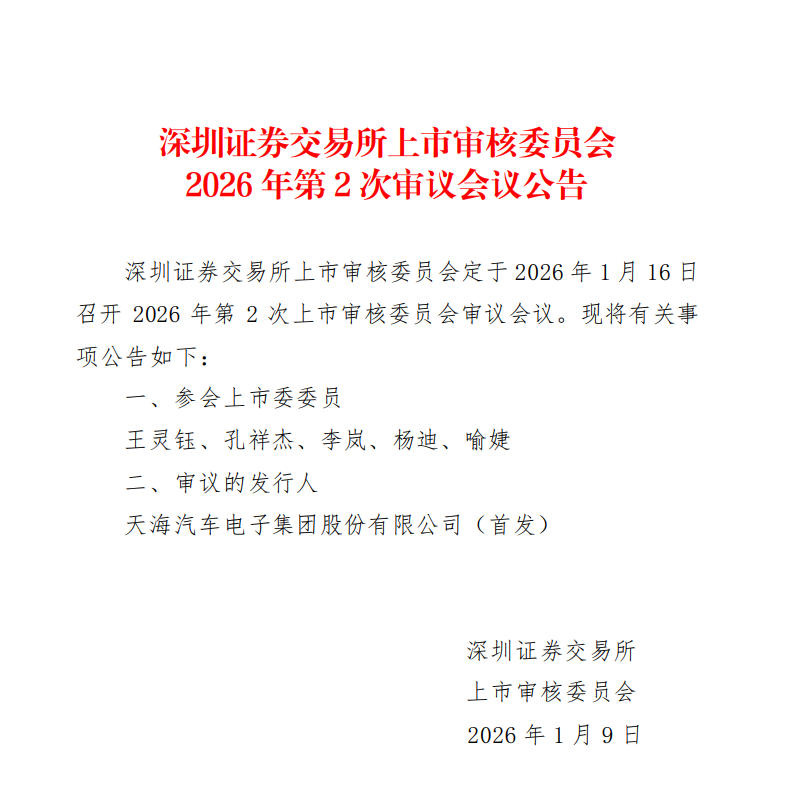
天海电子IPO将于1月16日上会
Zheng Quan Ri Bao Wang· 2026-01-10 02:46
Core Viewpoint - Tianhai Electronics plans to raise approximately 2.46 billion yuan through its IPO, with funds allocated to various projects aimed at enhancing production capacity and technological advancement in the automotive components sector [2]. Group 1: Fundraising and Investment Projects - The IPO is expected to raise around 2.46 billion yuan, which will be directed towards projects including connector technology upgrades, harness production base, automotive electronics production base, smart transformation and information technology construction, and the Tianhai Intelligent Connected Vehicle Industry Research Institute and supporting industrial park [2]. Group 2: Company Overview and Partnerships - Tianhai Electronics specializes in the research, production, and sales of automotive components such as automotive harnesses, connectors, and electronics, primarily serving the new energy vehicle and traditional fuel vehicle manufacturing sectors [2]. - The company has established multi-level and multi-dimensional partnerships with well-known automotive manufacturers including Chery Automobile, SAIC Group, Geely Automobile, Changan Automobile, Li Auto, NIO, Leap Motor, and Xpeng Motors [2]. Group 3: Strategic Goals and Market Position - The construction of the fundraising projects is expected to enhance the company's research and development capabilities, improve the intelligence and informatization of production processes, and expand existing production capacity, thereby supporting the gradual implementation of the company's development plan [2]. - These initiatives aim to strengthen the company's core competitiveness and profitability, ultimately increasing its market share [2].