中国长城

Search documents
CPU涨价会持续多久
2026-01-26 02:50
Summary of Conference Call Notes Industry and Company Involved - The discussion primarily revolves around the **CPU** industry, particularly focusing on **x86** and **ARM** architectures, with mentions of major players like **Intel**, **AMD**, and cloud service providers such as **Alibaba Cloud** and **Tencent Cloud**. [1][2][4][24] Core Points and Arguments 1. **Demand Growth for CPUs**: The demand for CPUs is expected to grow exponentially, driven by three linear factors rather than a simple linear increase. High-performance x86 and ARM architectures will benefit from this trend. [1][21] 2. **Impact of AI and Agents**: The rise of AI agents is significantly driving CPU demand. The increase in agent numbers and their complexity is leading to higher CPU utilization, as evidenced by various workloads where CPU tasks dominate processing time. [4][6][13] 3. **Price Increases**: CPU prices are anticipated to rise steadily over the next year, although not as dramatically as storage prices. This increase is viewed as a healthy adjustment for the industry. [14][21] 4. **Supply Chain Constraints**: The supply of CPUs is constrained by production capacity issues, particularly for advanced nodes (3nm and 5nm) at foundries like TSMC. This is leading to a competitive environment for resources between CPUs and GPUs. [20][21] 5. **Cloud Service Pricing**: The rising costs of CPUs and storage are expected to be passed on to cloud service providers, leading to potential price increases for services offered by companies like Alibaba and Tencent. [22][24] 6. **Server Manufacturers**: Companies involved in server manufacturing, such as Inspur and Huqian, are expected to experience increased demand and flexibility due to the rising CPU prices. [2][25] 7. **Investment Opportunities**: Key investment opportunities are identified in domestic companies like **Haiguang Information** and **Zhongke Shuguang**, as well as international firms like **AMD** and **Intel**. [24][25] Other Important but Possibly Overlooked Content 1. **Agent Workloads**: Detailed analysis of agent workloads shows that CPU tasks can account for up to 90% of processing delays, indicating a critical need for CPU resources in AI applications. [7][11] 2. **Batch Size and Performance**: Increasing batch sizes in processing tasks can lead to diminishing returns in throughput and increased CPU context-switching bottlenecks, highlighting the need for efficient CPU management in AI workloads. [10][11] 3. **Long-term Trends**: The transition to a new paradigm in AI processing, where CPU tasks are more prominent due to the nature of agent interactions, suggests a long-term shift in resource allocation from GPUs to CPUs. [15][19] 4. **Market Dynamics**: The competitive landscape is shifting, with domestic firms potentially expanding into markets previously dominated by larger players, indicating a changing dynamic in the CPU market. [23][24] This summary encapsulates the key insights and projections discussed during the conference call, emphasizing the evolving landscape of the CPU industry and its implications for investment and market strategies.


市文物局局长张立新:将启动琉璃河遗址申遗前期工作
Xin Jing Bao· 2026-01-25 23:15
张立新:北京中轴线申遗成功后,我们按照世界遗产保护要求,完善修改并公布实施了《北京中轴线世 界文化遗产保护条例》,校准完善了《北京中轴线保护管理规划(2022年—2035年)》文本,印发实施 了《北京中轴线保护传承三年行动计划(2025年—2027年)》,明确了此后三年北京中轴线保护传承45 项重点任务。 北京进入"两会"时间。"十四五"期间,中轴线申遗、琉璃河考古、博物馆文创等成为北京文博领域的关 键词。2026年是"十五五"的开局之年,北京文博领域又将给我们哪些新期待?1月24日,北京市文物局 党组书记、局长张立新走进新京报千龙网访谈间接受专访。 今年将推进正阳门城楼向社会开放 新京报:北京中轴线申遗成功之后,如何持续做好文化遗产的保护和利用工作? 2025年,我们完成了先农坛地祇坛保护展示工程,北京育才学校从先农坛原址腾退移交,先农坛内坛与 庆成宫实现连通。15处北京中轴线遗产点完成了世界文化遗产标志碑牌设置。 我们非常重视中轴线文化遗产的阐释与传播。比如,举办北京中轴线申遗成功一周年系列活动;在香港 国际授权展、深圳文博会、文化强国建设高峰论坛等活动期间,在北京故宫、上海艺术宫、四川三星堆 博物馆等地 ...
计算机行业点评:CPU涨价能持续多久?
SINOLINK SECURITIES· 2026-01-25 02:53
Investment Rating - The report suggests a positive investment outlook for the industry, indicating a potential increase in value over the next 3-6 months, with expectations of growth exceeding the market by more than 15% [40]. Core Insights - The report highlights three core logic points driving the rigid demand for CPU in the Agent era, emphasizing the shift in computational load from GPU to CPU due to the complexity of tasks performed by Agents [11][16]. - The global Agent ecosystem is predicted to experience exponential growth, with active Agents expected to rise from approximately 28.6 million in 2025 to 2.216 billion by 2030, alongside a significant increase in task execution and token consumption [16][21]. - A supply-demand imbalance is emerging, with Intel shifting production capacity to server CPUs, leading to delivery issues in consumer electronics, while NVIDIA plans to enhance CPU core counts in response to bottlenecks [33][37]. Summary by Sections Section 1: Three Core Logics Revealing the Rigid Demand for CPU - The shift in computational load towards CPU is driven by the Multi-Agent architecture, which increases OS scheduling pressure due to the complex workflow of Agents [11]. - The challenge of long context scenarios necessitates KV Cache offloading to CPU, which increases CPU load due to the need for task scheduling and data transfer [11][12]. - High concurrency in tool usage by Agents leads to significant CPU consumption, as non-model inference tasks are primarily handled by CPUs [15]. Section 2: Expansion of the Agent Ecosystem Igniting CPU Performance Bottlenecks - The number of active Agents is projected to grow significantly, with task execution expected to increase from 44 billion in 2025 to 415 trillion by 2030, indicating a shift towards deeper reliance on Agents in business processes [16][17]. - Token consumption is anticipated to surge from 0.0005 PetaTokens in 2025 to 152,667 PetaTokens by 2030, reflecting the increasing complexity of tasks handled by Agents [17]. Section 3: Supply-Demand Imbalance and New Shortboards in Computing Power - Intel's urgent shift in production to server CPUs has resulted in a decline in consumer electronics delivery rates, while NVIDIA's new architecture aims to address CPU bottlenecks [33]. - Market data indicates a growth in global client CPU shipments, with a 7.9% quarter-on-quarter increase and a 13% year-on-year increase in the second quarter of 2025 [33][34]. Section 4: Related Companies - Key companies in the CPU sector include Haiguang Information, Zhongke Shuguang, He Sheng New Materials, China Great Wall, Longxin Zhongke, and others [4][38]. - Domestic computing power companies include Haiguang Information, Cambricon, Dongyangguang, and others, while overseas companies include Zhongji Xuchuang, New Yisheng, and others [4][38].


计算机行业周报20260124:Token需求“通胀”:从CPU到云服务
Guolian Minsheng Securities· 2026-01-24 13:25
Investment Rating - The report maintains a "Recommended" rating for the industry [4] Core Insights - The demand for Tokens is driving inflation across the AI industry chain, with price increases being observed from storage to CPUs and now extending to cloud services, marking a significant shift in the pricing dynamics of the cloud computing sector [14][30] - AWS has initiated a price increase for its EC2 machine learning capacity blocks by approximately 15%, breaking a long-standing trend of declining prices in the cloud services industry, which may lead to a revaluation of cloud computing and related service providers [14] - The report highlights potential investment opportunities in cloud computing, CPUs, and databases, suggesting companies such as Alibaba, Kingsoft Cloud, and Inspur for cloud computing; Haiguang Information and Longxin for CPUs; and companies like StarRing Technology and DM Database for databases [30] Summary by Sections 1. Cloud Computing Price Trends - The report indicates that the AI industry chain is experiencing a price transmission trend, with cloud computing being the next area to see price increases following storage and CPU price hikes [14] - AWS's price adjustment reflects anticipated supply-demand dynamics, suggesting that successful price increases could lead to further adjustments in the future [14] 2. CPU Market Dynamics - The report notes a persistent supply-demand imbalance in the CPU market, particularly with Intel facing production limitations that may lead to continued shortages into 2026 [16] - The importance of CPUs is expected to rise significantly due to the increasing demand from AI applications, with the report emphasizing the need for optimization across both CPU and GPU resources [24][25] 3. Database Sector Growth - The report anticipates a rapid increase in the number of database PCU nodes driven by the demand for AI agents, which could lead to significant revenue growth for database providers [26] - The emergence of AI-native databases is highlighted as a key trend, with companies like Alibaba's PolarDB gaining traction in the market [29] 4. Investment Recommendations - The report suggests focusing on companies in the cloud computing sector such as Alibaba, Kingsoft Cloud, and UCloud, as well as CPU manufacturers like Haiguang Information and Longxin, and database firms like StarRing Technology and DM Database [30]




构建不动产金融新生态 交大高金举办2026中国不动产金融论坛
Zheng Quan Shi Bao Wang· 2026-01-24 13:20
为进一步推动不动产行业构建可持续的金融新生态,上海交通大学上海高级金融学院(高金/SAIF)近日 举办了"2026中国不动产金融论坛"。 论坛以"贯通与破局"为主题,汇聚专家与业界领袖,深入探讨在不动产市场发展格局调整下,如何通过 贯通资产、资本与资金的循环链路,破局传统发展模式的约束,构建不动产金融新生态。 原银保监会普惠金融部主任,中国长城(000066)资产管理公司原党委书记、董事长李均锋认为盘活存 量资产是推动高质量发展、激发新动能的关键。金融资产管理公司(AMC)通过市场化、专业化手段,积 极参与央企混改、盘活地方国企房产、破产重整等实践,有效提升资产价值,对优化资源配置具有重要 意义。 中金公司(601995)研究部执行负责人、董事总经理张宇解读了商业不动产REITs试点启动对行业的影 响。他表示,商业不动产REITs的正式启航标志着中国REITs市场进入新阶段,带来广阔发展空间。张 宇分析,REITs能助房企降负债、防风险,构建良性循环体系,推动向"轻资产运营"转型。同时,在低 利率环境下,REITs有助于优质资产价值重估,为投资者提供新投资渠道。他提出完善产品架构、加强 市场建设等推动REIT ...
突发公告,利欧股份、中国长城、航天电子、锋龙股份4家公司重要公告
Sou Hu Cai Jing· 2026-01-24 04:12
Group 1: Zhejiang Fenglong Co., Ltd. - The stock of Zhejiang Fenglong Co., Ltd. experienced a dramatic rise, achieving 14 consecutive trading days of limit-up, resulting in a price increase of 279.93% [1][4] - The company's static price-to-earnings ratio soared to 3557 times, significantly higher than the industry average of 43 times, indicating irrational speculation [1][6] - Despite the stock surge, the company reported a loss of over 7 million in 2023 and only a modest profit of 4 million projected for 2024, which does not justify the current stock price [4][6] Group 2: China Great Wall Technology Co., Ltd. - China Great Wall Technology Co., Ltd. announced an expected net loss of 35 million to 70 million for 2025, although this represents a reduction in losses by over 95% compared to the previous year [3][7] - The company attributed its reduced losses to asset sales, increased revenue, and decreased costs, but acknowledged ongoing challenges with asset impairment provisions [3][7] - The market is closely monitoring the results of the company's communication with auditing firms, as discrepancies in reported data could impact stock prices [7] Group 3: Aerospace Electronic Co., Ltd. - Aerospace Electronic Co., Ltd. proposed a significant related-party transaction plan, with a total amount not exceeding 10.72 billion, which is a 15% increase from the previous year's 9.292 billion [3][6] - The majority of the funds will be allocated for product sales, raw material purchases, and operational costs, aimed at ensuring stable supply chains for research and production [6][9] - The company emphasized that these transactions are conducted at market prices or according to national standards, ensuring transparency and reliability [6][9] Group 4: Lio Co., Ltd. - Lio Co., Ltd. faced a significant stock price drop of over 20% in two consecutive days, triggering an abnormal fluctuation alert [4][9] - The company stated that there were no undisclosed issues affecting stock prices and that operations remained normal, with no significant changes in the internal or external environment [4][9] - The company is currently focused on digital marketing and pump products, with ongoing exploration in AI applications, but has not yet achieved scale [7][9]


再论CPU-海光信息-龙芯中科-中国长城
2026-01-23 15:35
Summary of CPU Industry Conference Call Industry Overview - The CPU iteration speed has significantly accelerated, reducing from a five-year cycle to a one-year cycle, driven by increasing data volumes and higher demands for CPU I/O interfaces and core counts [1][3] - CPU price increases are primarily driven by supply-side factors, with upstream foundries raising prices due to AI demand squeezing capacity, leading to price hikes in both consumer and server-grade CPUs [1][4] Key Insights - **Price Trends**: CPU prices are expected to continue rising, a trend anticipated to persist long-term. The price increase sequence starts with upstream foundries, followed by consumer CPUs, and server CPUs are expected to catch up in 2026 [3][4] - **AI Influence**: The development of AI has accelerated CPU upgrades and iteration speeds, necessitating more advanced I/O interfaces and core counts due to growing data requirements [3] - **Domestic Market Growth**: The domestic market for CPUs is experiencing a significant impact from the acceleration of domestic production, with steady increases in shipments of domestic server and PC CPUs since 2023, expected to accelerate in 2025 [1][6] Company-Specific Insights - **Haiguang Information**: Focuses on server CPUs, with an expected shipment of approximately 1-1.2 million server CPUs and 300,000-400,000 PC CPUs by 2025. The 7,580 model has seen large-scale procurement [1][7] - **Loongson Technology**: Utilizes a self-developed architecture, with successful launches of desktop models 3A6000, 3B6660, and server model 3C6000, showing significant cost-performance advantages and expected market share growth in 2026 [1][7] - **China Great Wall Technology**: Its subsidiary, Phytium, is a key competitor in the ARM CPU space, with models like S2500 gaining market attention. Expected shipment increases are anticipated as domestic capacity issues are resolved [2][7] Policy Impact - Government policies, such as the Ministry of Finance's Document No. 13, support the procurement of domestic products by government and affiliated units, effectively promoting the application of domestic CPUs in government and enterprises [6][8] - Continuous policy support since 2024 has accelerated the release and implementation of new products by relevant companies, addressing capacity bottlenecks and significantly enhancing overall shipment volumes [8]
相城大道抢筹臻镭科技 5.017 亿,利欧股份遭深南东路抛售 3.269 亿
Ge Long Hui· 2026-01-23 11:28
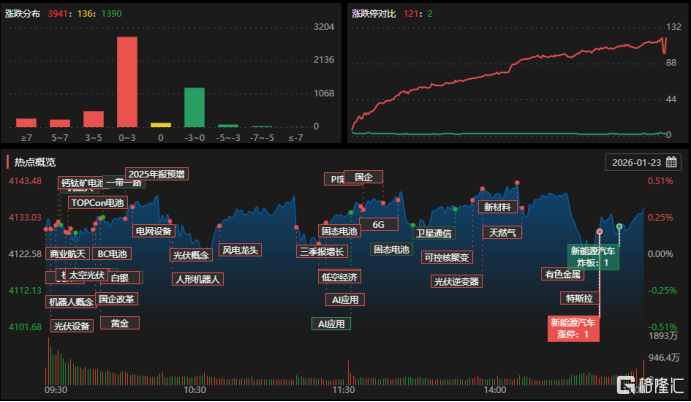
Market Overview - On January 23, the A-share market saw all three major indices rise, with the Shanghai Composite Index increasing by 0.33% to close at 4136 points, the Shenzhen Component Index rising by 0.79%, and the ChiNext Index up by 0.63% [1]. High-Performance Stocks - Fenglong Co., Ltd. achieved an 18-day consecutive limit-up, Jianghuai Microelectronics had a 5-day limit-up streak, and Jin'an Guoji recorded 4 limit-ups in 7 days. Other notable stocks include Baiyin Youse with 4 consecutive limit-ups and Hanshang Group with 3 limit-ups in 5 days [3][4]. Stock Performance Data - Fenglong Co., Ltd. (002931) rose by 10.00% to a price of 99.53 with a turnover rate of 19.20% [4]. - Jianghuai Microelectronics (603078) also increased by 10.00% to 31.36, with a turnover rate of 23.74% [4]. - Jin'an Guoji (002636) saw a 10.00% rise to 25.63, with an expected increase in 2025 earnings [4]. - Baiyin Youse (601212) increased by 9.97% to 10.37, driven by gold, silver, and lithium battery materials [4]. Trading Activity - The top three net buying stocks on the Dragon and Tiger list were Jin'an Guoji, Zhenlei Technology, and Jiejiacreative, with net purchases of 9.38 billion, 8.35 billion, and 5.38 billion respectively [6]. - The top three net selling stocks were Liou Co., China Great Wall, and Shen Nan Electric, with net sales of 10.36 billion, 5.96 billion, and 6.82 billion respectively [7]. Institutional Activity - Among stocks with institutional trading, the highest net buying was seen in Jin'an Guoji, Weichai Heavy Industry, and Hongbao Li, with net purchases of 2.66 billion, 1.46 billion, and 1.33 billion respectively [8]. - Conversely, the highest net selling was in Shen Nan Electric, Jinko Solar, and Fenglong Co., with net sales of 3.69 billion, 2.41 billion, and 1.62 billion respectively [9]. Sector Insights - The commercial aerospace sector is gaining attention, with SpaceX planning an IPO before July and Blue Arrow Aerospace's IPO status changing to "under inquiry" [12]. - The 2026 Beijing Commercial Aerospace Exhibition is anticipated to mark a significant year for the industry, with expectations for large-scale launches and recovery validations [12]. Notable Stock Movements - Dongfang Risheng (300118) rose by 20.00% to 20.76, driven by its space photovoltaic and integrated energy storage technology [12]. - The stock of Jin'an Guoji (002636) is expected to see a significant increase in earnings for 2025, contributing to its recent performance [4].



数据复盘丨钙钛矿电池、商业航天等概念走强 191股获主力资金净流入超1亿元




Zheng Quan Shi Bao Wang· 2026-01-23 09:56
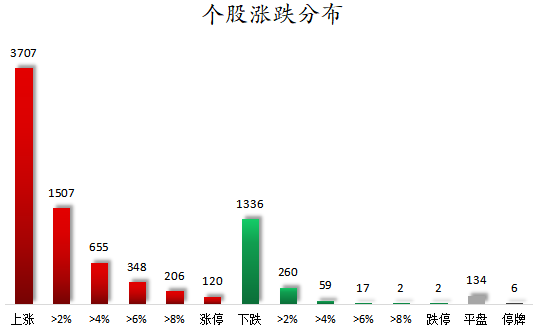
Market Overview - The Shanghai Composite Index closed at 4136.16 points, up 0.33%, with a trading volume of 1.3369 trillion yuan. The Shenzhen Component Index rose 0.79% to 14439.66 points, with a trading volume of 1.7484 trillion yuan. The ChiNext Index increased by 0.63% to 3349.50 points, with a trading volume of 822.63 billion yuan. The STAR Market 50 Index closed at 1553.71 points, up 0.78%, with a trading volume of 110.8 billion yuan. The total trading volume of both markets was 3.0853 trillion yuan, an increase of 393.5 billion yuan compared to the previous trading day [1]. Sector Performance - The market saw more sectors gaining than losing, with notable increases in power equipment, non-ferrous metals, precious metals, defense and military, steel, media, computer, environmental protection, and textile and apparel sectors. Concepts such as perovskite batteries, commercial aerospace, satellite internet, sapphire, lithium mining, cultivated diamonds, small metals, gold, and interactive short dramas were particularly active. In contrast, sectors like communication, insurance, banking, coal, and home appliances experienced declines [1]. Individual Stock Performance - A total of 3707 stocks rose, while 1336 stocks fell, with 134 stocks remaining flat and 6 stocks suspended. Excluding newly listed stocks, there were 120 stocks hitting the daily limit up and 2 stocks hitting the limit down [2]. - Among the stocks that hit the daily limit up, 23 stocks had consecutive limit-up days of 2 or more, with Fenglong Co., Ltd. leading with 18 consecutive limit-ups [3]. Capital Flow - The net capital outflow from the two markets was 4.167 billion yuan, with the ChiNext seeing a net inflow of 1.515 billion yuan. The CSI 300 index experienced a net outflow of 1.005 billion yuan, while the STAR Market saw a net outflow of 3.171 billion yuan. Out of 31 sectors, 13 sectors had net capital inflows, with the power equipment sector leading with a net inflow of 8.977 billion yuan [4][6]. - The top sectors with net inflows included non-ferrous metals (4.552 billion yuan), media (2.173 billion yuan), and defense and military (2.157 billion yuan). Conversely, the communication sector had the highest net outflow of 7.992 billion yuan, followed by electronics (6.350 billion yuan) and machinery (5.077 billion yuan) [4][6]. Notable Stocks - 191 stocks had net capital inflows exceeding 1 billion yuan, with Jin Feng Technology receiving the highest net inflow of 1.861 billion yuan. Other notable stocks included Lens Technology (1.594 billion yuan), Qian Zhao Optoelectronics (1.267 billion yuan), and Xian Dao Intelligent (1.217 billion yuan) [7][8]. - Conversely, 116 stocks experienced net capital outflows exceeding 1 billion yuan, with Xin Yi Sheng leading with a net outflow of 3.471 billion yuan, followed by Zhong Ji Xu Chuang (3.103 billion yuan) and Li Ou Shares (2.604 billion yuan) [10][11]. Institutional Activity - Institutional investors had a net selling of approximately 1.02 billion yuan, with 22 stocks seeing net purchases and 14 stocks net sales. Jin Feng Technology was the most purchased stock by institutions, with a net purchase amount of approximately 266 million yuan [13][14].
中国长城跌6.21%,深股通龙虎榜上净卖出1.65亿元
Zheng Quan Shi Bao Wang· 2026-01-23 09:34
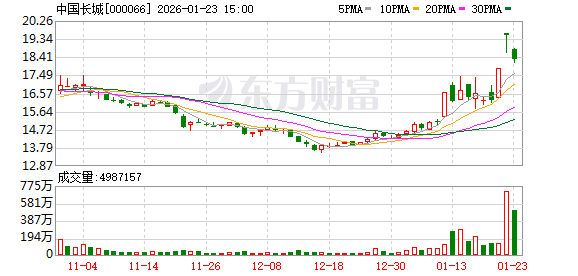
Group 1 - The stock of China Great Wall fell by 6.21% with a turnover rate of 15.46% and a trading volume of 9.159 billion yuan, showing a fluctuation of 4.09% [2] - Institutional investors net sold 93.7485 million yuan, while the Shenzhen Stock Connect recorded a net sell of 165 million yuan, leading to a total net sell of 444 million yuan from brokerage seats [2] - The stock was listed on the Shenzhen Stock Exchange for a daily decline deviation of -7.40%, with the top five trading seats collectively transacting 1.895 billion yuan, where buying amounted to 596 million yuan and selling reached 1.299 billion yuan, resulting in a net sell of 703 million yuan [2] Group 2 - The latest margin trading data shows that the stock's margin balance is 2.563 billion yuan, with a financing balance of 2.551 billion yuan and a securities lending balance of 12.2636 million yuan [3] - Over the past five days, the financing balance increased by 646 million yuan, representing a growth of 33.92%, while the securities lending balance rose by 7.1476 million yuan, marking an increase of 139.71% [3] - On January 23, the top buying and selling brokerage seats included the Shenzhen Stock Connect, which had a buying amount of 207.9734 million yuan and a selling amount of 373.1750 million yuan [3][4]