
陕西煤业

Search documents
高利润公司分红“破冰”:25家季利超30亿企业首派中期红包
2 1 Shi Ji Jing Ji Bao Dao· 2025-11-10 13:25
Core Insights - The A-share market is experiencing an unprecedented wave of dividend reform, with 25 companies announcing their first interim dividend plans since listing, distributing a total of 69.39 billion yuan, averaging 2.78 billion yuan per company [1][3][4] Group 1: Dividend Trends - The trend of interim dividends is becoming a new standard for high-quality companies, with over half of the 207 companies reporting profits exceeding 3 billion yuan in Q3 2025 implementing interim dividends, a significant increase from three years ago [1][3] - The number of companies choosing to implement interim dividends has seen exponential growth, with 72.5% of companies with profits over 10 billion yuan in 2025 participating in interim dividends, compared to only 10% in 2023 [2][3] Group 2: Leading Companies - China Shenhua leads the way with a dividend payout of 19.47 billion yuan, followed by Industrial Fulian and Industrial Bank, with these three companies accounting for 54.73% of the total dividends distributed [4][5] - Notable companies like China Shenhua and Industrial Fulian have significant market capitalizations, with China Shenhua's market cap reaching 852.86 billion yuan and Industrial Fulian's rising from 427.16 billion yuan to 1.44 trillion yuan [3][4] Group 3: Regulatory Influence - Regulatory policies are significantly driving the change in the dividend landscape, with new rules imposing stricter requirements on companies that have not paid dividends for years, thereby encouraging higher dividend payouts [6][7] - The 2025 financial forum introduced policies aimed at promoting long-term investment, emphasizing the importance of companies' long-term dividend capabilities [7][8]



瞭望 | 陕西:十三轮战略重组塑造新国企
Sou Hu Cai Jing· 2025-11-10 08:30
Core Viewpoint - The restructuring of state-owned enterprises (SOEs) in Shaanxi Province emphasizes not only the physical integration of institutions and assets but also the deep fusion of resources, mechanisms, and strategies, leading to a transformation from decentralized operations to concentrated development, thereby releasing strong new development momentum [1][6]. Group 1: Background and Context - Shaanxi Province has historically faced challenges with its SOEs, characterized by a high number of enterprises that are dispersed and homogeneous, which has hindered high-quality economic development [3][4]. - The province has undertaken 13 rounds of strategic restructuring, reducing the number of provincial SOEs from over 40 to 23, focusing on resource complementarity and competitive advantage [1][4]. Group 2: Economic Performance - In 2024, Shaanxi's provincial SOEs reported total assets of 3.39 trillion yuan, operating revenue of 1.68 trillion yuan, and total profits of 861.2 billion yuan, maintaining a leading position among local state-owned asset systems in China [1][5]. - The total profit of Shaanxi's SOEs increased by 9.9% year-on-year, with industrial output value rising by 5.4% [5]. Group 3: Restructuring Strategies - The restructuring approach includes strategies such as homogenization integration, industrial chain integration, and professional integration, aiming to enhance operational efficiency and reduce redundant competition [4][10]. - The focus is on market-oriented reforms, optimizing equity structures, and introducing professional managers to strengthen the market competitiveness of enterprises [4][10]. Group 4: Innovation and Development - Post-restructuring, Shaanxi SOEs are prioritizing innovation as a core element of their development strategy, with significant investments in technology and research [8][9]. - The Shaanxi Energy Group has implemented 18 reform measures to support technological innovation, leading to substantial advancements in various fields [8][9]. Group 5: Regulatory Innovations - The province is innovating its state asset supervision model to ensure the sustainable operation of restructured SOEs, focusing on comprehensive, penetrating, and intelligent regulation [10][11]. - The introduction of external directors and specialized supervisory roles aims to enhance oversight and reduce decision-making risks within SOEs [10][11]. Group 6: Future Directions - Shaanxi's SOEs are targeting emerging industries such as new materials, hydrogen energy, and new energy vehicles, with a focus on transforming strategic plans into tangible outcomes [12]. - The province aims to create distinctive industrial clusters that contribute to high-quality economic development, leveraging its unique regional advantages [12].


陕西煤业(601225) - 01_陕西煤业2025年第二次临时股东大会会议材料
2025-11-10 08:00
陕西煤业股份有限公司 2025 年第二次临时股东大会会议资料 陕西煤业股份有限公司 2025 年第二次临时股东大会会议资料 二 O 二五年十一月 1 | 会 | 议 | 须 知 | 3 | | --- | --- | --- | --- | | | | 现场会议议程 | 4 | | 议案一 | | 关于调整公司治理结构并修订《公司章程》的议案 5 | | | 议案二 | | 关于修订公司《股东会议事规则》的议案 | 79 | | 议案三 | | 关于修订公司《董事会议事规则》的议案 | 100 | | 议案四 | | 关于修订公司《独立董事工作制度》的议案 | 116 | | 议案五 | | 关于修订公司《募集资金管理制度》的议案 | 135 | | 议案六 | | 关于修订公司《利润分配制度》的议案 | 152 | | 议案七 | | 关于公司 年度日常关联交易情况预计的议案 2026 | 161 | 陕西煤业股份有限公司 2025 年第二次临时股东大会会议资料 会 议 须 知 为维护投资者的合法权益,确保股东和股东代表在公司召开 2025 年第二次临时股东大会期间依法行使权利,保证股东大会 的正常秩序和议 ...

煤炭专题:布局PPI转正关键时点
Xinda Securities· 2025-11-10 07:45
Investment Rating - The coal industry is rated as "Positive" [2] Core Viewpoints - The coal industry is currently in a new round of prosperity cycle that started in 2021, with price fluctuations gradually returning to a reasonable range [3][11] - The impact of coal prices on the Producer Price Index (PPI) is significant, with expectations that coal PPI will turn positive by the second quarter of 2026 [3][41] - The supply-demand situation in the coal market is expected to remain balanced, with regional disparities, driven by policies that restrict supply and increasing mining costs [3][12] Summary by Sections 1. Coal Supply and Demand Review and Outlook - The coal market has experienced a significant price increase since 2021 due to global economic recovery and structural mismatches in supply and demand [11] - From 2023 to June 2025, coal prices have declined to recent lows due to a phase of supply-demand loosening, but have stabilized since July 2025 due to policy constraints [3][11] - The demand for coal is expected to remain stable, supported by electricity generation and industrial needs, despite a peak in overall coal demand [16][19] 2. Correlation Analysis between Coal and PPI - The coal mining sector has a weight of approximately 2.3% in the PPI index, and coal price fluctuations have a strong transmission effect on PPI [38][39] - The coal industry has been a significant contributor to PPI changes, especially during periods of PPI recovery [41][44] 3. Historical Opportunities in Coal Sector during PPI Recovery - Historical data shows that the coal sector has experienced significant price increases during previous PPI recovery phases, particularly in 2016 and 2021 [3][4] - The coal sector's performance is often led by small to mid-cap companies with high growth potential during the early stages of PPI recovery [4] 4. Investment Recommendations - The report suggests focusing on companies that benefit from rising coal prices, such as Shanxi Coking Coal, Lu'an Environmental Energy, and Shenhua Shares [4] - Companies with stable performance and dividend attributes, such as Shaanxi Coal and China Coal Energy, are also recommended for investment [4]
浙商证券:煤炭涨势未止 行业基本面向上
Zhi Tong Cai Jing· 2025-11-10 05:56
Core Viewpoint - The report from Zheshang Securities indicates that coal prices are experiencing a strong upward trend, with expectations for further increases in the fourth quarter, driven by supply constraints and rising demand from power plants [1] Group 1: Coal Market Overview - As of November 6, 2025, the average daily coal sales from key monitored enterprises reached 7.25 million tons, a week-on-week increase of 0.6% and a year-on-year increase of 0.1% [1] - The average daily coal production from key monitored enterprises was 7.37 million tons, a week-on-week increase of 2.5% but a year-on-year decrease of 0.4% [1] - Total coal inventory (including port storage) stood at 23.8 million tons, a week-on-week increase of 3.8% and a year-on-year decrease of 19.9% [1] Group 2: Price Trends - The price of thermal coal (Q5500K) in the Bohai Rim region was 694 CNY/ton as of November 7, 2025, reflecting a week-on-week increase of 1.31% [2] - The price of coking coal at Jingtang Port was 1800 CNY/ton, with a week-on-week increase of 3.4% [3] - The price of anthracite coal in Yangquan remained stable at 930 CNY/ton [4] Group 3: Supply and Demand Dynamics - The report anticipates a supply-demand gap to widen, with an expected increase in coal consumption of approximately 50 million tons due to heating needs, potentially leading to localized coal shortages [1] - The cumulative coal sales from key monitored enterprises this year reached 215.6 million tons, a year-on-year decrease of 2.4% [1] Group 4: Investment Recommendations - The report suggests focusing on flexible thermal coal companies such as China Shenhua (601088), Shaanxi Coal and Chemical Industry (601225), and others, as well as coking coal companies like Huaibei Mining (600985) and Shanxi Coking Coal (000983) [5][6]


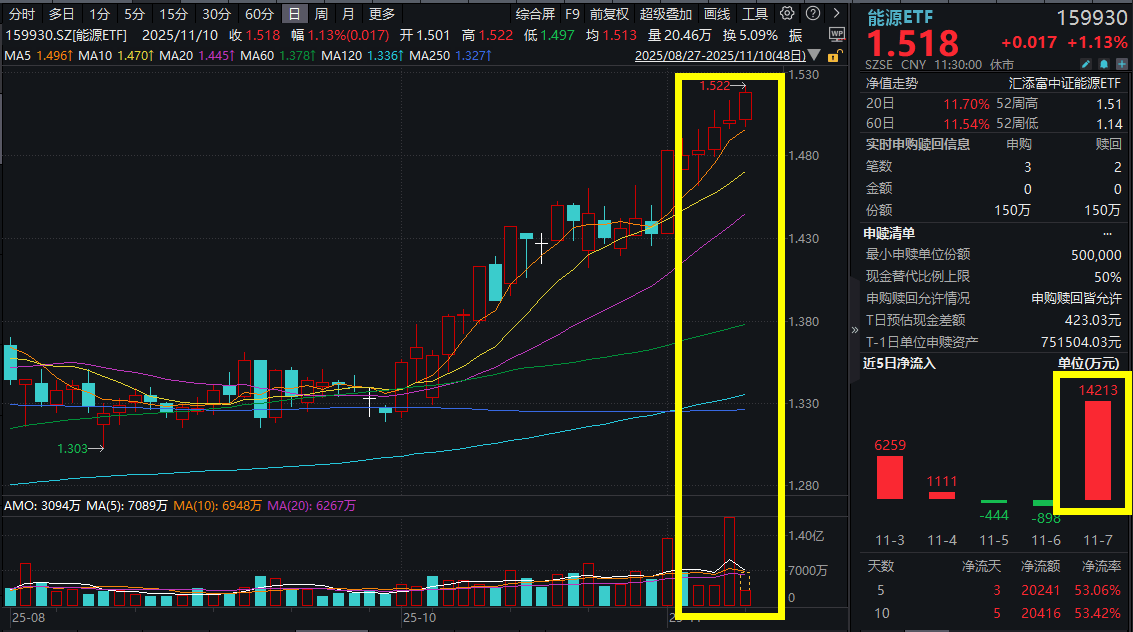
超700亿美元,"三桶油"接连斩获大单!中国石油涨超2%,能源ETF(159330)涨超1%,上一交易日大举吸金超1.4亿元,份额、规模齐创上市以来新高
Sou Hu Cai Jing· 2025-11-10 05:19
Core Viewpoint - The A-share market showed weakness on November 10, with the Shanghai Composite Index slightly down and the ChiNext Index dropping over 2%, while the coal and oil sectors experienced upward movement, particularly the Energy ETF (159330), which rose over 1% and attracted significant capital inflow [1][3]. Group 1: Market Performance - The Energy ETF (159330) saw a substantial inflow of over 140 million yuan in the previous trading day and over 200 million yuan in the last five days, reaching new highs in both share and scale since its inception [1]. - Among the 25 component stocks of the Energy ETF, 20 stocks increased in value, with notable gains from major oil companies such as China National Offshore Oil Corporation (CNOOC) rising over 2% and China Petroleum and China Petrochemical both rising over 1% [3]. Group 2: Industry News - During the China International Import Expo, major oil companies signed procurement agreements totaling approximately 71.385 billion USD, with China Petroleum alone signing contracts worth 17.485 billion USD [3]. - A new round of domestic refined oil price adjustments is set to take place on November 10 at 24:00 [4]. Group 3: Coal Market Insights - The price of thermal coal at northern ports increased to 817 yuan/ton, a week-on-week rise of 47 yuan/ton, with significant price increases at mining sites in Shanxi, Inner Mongolia, and Shaanxi [5]. - Analysts predict a tightening supply-demand balance for coal, with expectations of sustained strong demand as the coal consumption peak season approaches, making price increases likely [5]. Group 4: Oil Market Insights - OPEC+ announced a pause in production increases starting January 2026, which is expected to alleviate concerns over oil supply excess [6]. - The International Energy Agency (IEA) forecasts a global oil supply increase of 2.4 million barrels per day by 2026, with non-OPEC+ countries contributing 1.2 million barrels per day [7]. Group 5: Investment Perspective - The energy sector is highlighted for its high dividend yields, with coal and oil sectors ranking among the top in dividend rates, making them attractive for investors seeking stable returns [8][9]. - The Energy ETF (159930) is noted for its low valuation at a price-to-book ratio of 1.34, positioning it as a preferred investment choice amid market volatility [10].



迎接煤炭新周期 - 煤价强势上涨超预期
2025-11-10 03:34
Summary of Coal Industry Conference Call Industry Overview - The coal industry is experiencing a new cycle with coal prices rising unexpectedly to 1,860 CNY/ton due to a reduction in market coal trading entities, leading to concentrated supply and increased marginal sensitivity [1][2][3] - Current prices for thermal coal and coking coal are strong, with Shanxi Datong 5,500 kcal thermal coal rising to 720 CNY and Shaanxi Yulin 5,800 kcal thermal coal also at 720 CNY [1][4] Key Points and Arguments - **Supply and Demand Dynamics**: The tight supply-demand balance is the primary reason for the recent price increases. The number of coal trading entities has significantly decreased, concentrating market supply and increasing sensitivity to price changes [2][3] - **Logistics and Pricing Mechanisms**: The implementation of logistics bundling and price-volume linkage mechanisms has raised entry barriers, disadvantaging small coal operators and forcing them out of the market. This has led to a more concentrated supply and increased price volatility [3][4] - **Inventory Levels**: National power plant inventories have decreased by 2.3% year-on-year, while port inventories have dropped by 7.8%, indicating tight inventory conditions [1][5][6] - **Global Commodity Market Influence**: The global commodity market is showing a resonance effect, with European and Australian thermal coal futures prices rising by 3.9% and 6.0%, respectively, indicating a continued upward trend in domestic and international thermal coal prices [1][8] Additional Important Insights - **Future Price Predictions**: Coal prices are expected to remain high and may exceed expectations, potentially reaching between 800-1,000 CNY depending on weather conditions. A colder winter could push prices above 900 CNY [13][14] - **Impact of Safety Inspections**: Ongoing safety checks and capacity verifications are limiting production in certain regions, contributing to a tighter supply situation despite strong downstream demand [11][12] - **Investment Recommendations**: For large investors, it is recommended to consider state-owned enterprises like China Shenhua and China Coal Energy for stable dividends. Smaller investors should focus on more elastic stocks like Yanzhou Coal and Shanxi Coal International, which have low valuations and significant upside potential [14][15] Conclusion The coal industry is currently characterized by rising prices driven by supply constraints and strong demand. The market dynamics are influenced by logistics mechanisms and global commodity trends, with future price movements expected to remain robust. Investors are advised to strategically position themselves in both large-cap and elastic stocks to capitalize on potential gains.
煤价如期大涨,继续全面看好板块机会 (1)
2025-11-10 03:34
Summary of Coal Industry Conference Call Industry Overview - The coal industry is experiencing significant price increases, with domestic coal prices rising due to a surge in overseas coal prices, specifically a 3.3% increase in Australian coal prices and a 2.1% increase in Indonesian coal prices [1][3] - Despite the rise in overseas prices, the imported coal's landed price remains 50-100 RMB lower than the northern port prices, potentially exerting downward pressure on domestic coal prices [1][3] Key Points on Coal Prices - Northern nine ports have seen a significant year-on-year decrease in coal inventory, down 18% compared to 2023 and 12% compared to 2024, indicating that the inventory accumulation phase is not meeting expectations, which is a key driver for the current price increase [1][5] - The strong performance of coking coal is attributed to reduced imports from Mongolia, production cuts in Shanxi, and environmental reductions in Wuhai, leading to tight supply and expected price increases due to winter storage and steel production [1][6] - The stock performance of thermal coal companies has been robust, with leading Hong Kong thermal coal companies seeing price increases of 6%-10%, supported by favorable domestic and international factors [1][7][8] Supply and Demand Dynamics - The primary reasons for the continued rise in coal prices in 2025 include a significant reduction in imported coal (approximately 10 million tons year-on-year) and negative domestic production growth, compounded by seasonal demand not decreasing as expected and policy-driven supply contractions [1][9] - The current market dynamics suggest that if supply does not recover significantly, the supply-demand gap will widen in the fourth quarter, with prices potentially rising to 900-1,000 RMB if the situation does not improve [1][9][15] Challenges Faced by Traders and Power Plants - Traders are facing challenges due to the significant price gap between pit and port coal, leading to losses when shipping coal to ports, which diminishes their willingness to stockpile [1][10] - Power plants are struggling with procurement issues, as long-term contract prices are significantly lower than current market prices, leading to limited purchasing capabilities and potential rapid inventory depletion if demand increases [1][11] Future Outlook - The coal market is expected to maintain a tight supply situation, with limited immediate relief from increased imports or production from Xinjiang due to regulatory constraints [1][12][14] - The fourth quarter is anticipated to see a supply-demand gap comparable to 2020, when coal prices surged from 600 RMB to 1,000 RMB, indicating a potential for significant price increases [1][15] - Predictions for 2025 suggest an average price of around 700 RMB, with a confirmed upward trend for 2026, influenced by fourth-quarter performance [1][16] Investment Recommendations - Short-term investment strategies should focus on flexible varieties such as thermal and coking coal, with specific recommendations for companies like Liu'an Huanneng, Yanzhou Coal, Jinko Coal, and Shanxi International [1][17]
煤价如期大涨,继续全面看好板块机会
2025-11-10 03:34
Summary of Coal Industry Conference Call Industry Overview - The coal industry is experiencing a significant price increase, with domestic coal prices rising due to a surge in overseas coal prices, specifically a 3.3% increase in Australian coal prices and a 2.1% increase in Indonesian coal prices [1][3] - Despite the rise in overseas prices, the imported coal's tax-inclusive price remains lower than the northern port prices by 50-100 RMB, which may exert potential pressure on domestic coal prices [1][3] Key Points on Coal Prices - Northern nine ports have seen a significant year-on-year decrease in coal inventory, down 18% compared to 2023 and 12% compared to 2024, indicating that the inventory accumulation phase is not meeting expectations, which is a key driver for the current price increase [1][5] - The strong performance of coking coal is attributed to reduced imports from Mongolia, production cuts in Shanxi, and environmental reductions in Wuhai, leading to tight supply of main coking coal varieties [1][6] - The stock performance of thermal coal companies has been robust, with leading Hong Kong thermal coal companies seeing stock increases of 6%-10% [1][7] Supply and Demand Dynamics - The expected increase in coal prices in 2025 is primarily due to a reduction in imported coal (approximately 10 million tons year-on-year) and negative domestic production growth, alongside seasonal demand not following typical patterns [1][9] - The current market is characterized by a significant supply-demand gap, with expectations that if supply does not recover significantly, prices could rise to between 900-1,000 RMB [1][9][15] Challenges Faced by Traders and Power Plants - Traders are facing challenges due to the significant price gap between pit and port prices, leading to losses when shipping coal to ports, which diminishes their willingness to stockpile [1][10] - Power plants are struggling with low long-term contract prices compared to current market prices, leading to procurement challenges and potential rapid depletion of static inventory, which could exacerbate market tensions [1][11] Future Outlook - The coal market is expected to remain tight, with limited immediate relief from increased imports or production from Xinjiang due to stringent safety regulations [1][12][14] - The fourth quarter is anticipated to see a supply-demand gap comparable to 2020, when coal prices surged from 600 RMB to 1,000 RMB, indicating a potential for continued price increases [1][15] - Predictions for 2025 suggest an average price of around 700 RMB, with a confirmed upward trend for 2026, influenced by the fourth quarter's policy environment [1][16] Investment Recommendations - Short-term investment strategies should focus on flexible varieties such as thermal and coking coal, with specific recommendations for companies like Liu'an Huanneng, Yanzhou Coal, and Shanxi International [1][17]

动力煤价上破800元,炼焦煤联动走强 | 投研报告
Zhong Guo Neng Yuan Wang· 2025-11-10 03:08
Core Viewpoint - The coal industry is experiencing a significant price increase, particularly in thermal coal, with prices surpassing key thresholds and indicating a potential upward trend in the market [1][2][3]. Group 1: Thermal Coal Price Dynamics - As of November 7, the Qinhuangdao Q5500 thermal coal price reached 817 RMB/ton, marking a substantial increase, with other ports reporting prices as high as 778 RMB/ton [1][2]. - The price surge is attributed to a combination of supply constraints due to strict production checks post-National Day and increased demand driven by colder weather in northern regions [2][3]. - The current price has surpassed the previously indicated target of 750 RMB/ton for coal-electricity profit sharing and is now within the anticipated price range of 800-860 RMB/ton [1][2][3]. Group 2: Coking Coal Market Trends - As of November 7, the price of coking coal at the Jingtang Port was reported at 1860 RMB/ton, rebounding from a low of 1230 RMB/ton in July [2]. - Coking coal futures have shown a significant rebound, increasing from 719 RMB in June to 1270 RMB, representing a cumulative increase of 76.6% [2]. - The price of coking coal is closely linked to thermal coal prices, with a notable price ratio of 2.4 times, suggesting that coking coal prices will follow the upward trend of thermal coal [2][3]. Group 3: Investment Logic - The upward movement in thermal coal prices is expected to follow a four-step process, including the restoration of long-term contracts and reaching a profit-sharing equilibrium for coal and power companies [3]. - The ideal target price for coal is projected to be around 750 RMB by 2025, with the potential for further increases driven by market dynamics [3]. - Coking coal prices are influenced more by market supply and demand, with target prices derived from the ratio to thermal coal prices, indicating potential future price levels [3]. Group 4: Investment Recommendations - The coal sector presents dual investment logic: cyclical elasticity and stable dividends, with both thermal and coking coal prices positioned for upward movement due to improving supply-demand fundamentals [4][5]. - Key stocks to consider include those benefiting from cyclical logic such as Jinko Coal and Yanzhou Coal, and those with strong dividend potential like China Shenhua and Shaanxi Coal [5].