大疆

Search documents
不再低调!多家科技企业亮出底牌,外媒:欠中国制造一个客观认识
Sou Hu Cai Jing· 2025-11-29 07:40
Core Insights - The transformation of China's manufacturing industry from low-end processing to high-tech output has been a gradual process over the past two decades, with significant milestones marking its evolution [1][3][14] - China's manufacturing output surpassed that of the United States in 2010, reaching $1.92 trillion, highlighting its position as a global leader in various industrial products [1][3] - The shift in manufacturing focus from labor-intensive to capital-intensive goods has been driven by policy support and increased R&D investment, which rose from 89.6 billion yuan in 2000 to 706 billion yuan in 2010 [3][5] Manufacturing Evolution - The 1990s saw the rise of private enterprises due to state-owned enterprise reforms, leading to a geographical expansion of the industrial chain from coastal to inland areas [5] - The 2008 financial crisis impacted exports but spurred domestic demand for machinery and infrastructure, contributing to the growth of high-speed rail technology exports [5] - By 2016, China led in electric vehicle battery production and initiated significant investments in semiconductors, while 5G standards were established in 2017 [5] Key Players and Innovations - Huawei's journey from a small agency to a global telecommunications leader illustrates the importance of innovation and market expansion, achieving a market share of 28.6% in 2023 [7][8] - DJI's rapid growth in the drone market, with a 70% market share in 2023, showcases the company's commitment to R&D and technological independence [10] - TCL's transformation from traditional manufacturing to smart appliances has resulted in significant growth, with a 42% increase in overseas sales in 2022 despite industry declines [12] Trade and Global Positioning - In 2022, China's total trade volume reached 42.07 trillion yuan, with exports of 23.97 trillion yuan, reflecting a 10.5% growth driven by high-tech product demand [14] - Reports indicate a shift in perception among foreign media, recognizing China as a leading innovator in advanced industries, with companies like Huawei and Tencent strengthening domestic supply chains [14] - The ongoing focus on high-end sectors, AI, and digitalization positions China for continued competitiveness in the global manufacturing landscape [14]


中美是打是和?贝森特对华交底,中国运回黄金,18国将在深圳开会
Sou Hu Cai Jing· 2025-11-28 15:59
Core Insights - The recent high-level call between China and the U.S. indicates a recognition of long-term competition but also the potential for cooperation [1][7][22] - China's continuous increase in gold reserves, reaching 73.9 million ounces, signals a strategic move to build a financial "moat" and reduce reliance on the U.S. dollar [3][5][14] Group 1: U.S.-China Relations - U.S. Treasury Secretary's statement reflects a realistic view of U.S.-China relations, acknowledging competition while leaving room for cooperation [7][18] - The recent appreciation of the Renminbi suggests a market reassessment of U.S.-China dynamics following the call and the Fed's interest rate cuts [7][9] - The upcoming APEC summit in Shenzhen will serve as a platform for discussing regional cooperation and financial interconnectivity [12][22] Group 2: China's Financial Strategy - China's gold purchases are part of a broader strategy to enhance the international credibility of the Renminbi and prepare for external risks [5][14] - The reduction of U.S. Treasury holdings to $700.5 billion indicates a deliberate move to decrease dollar dependency [5][9] - The potential establishment of Shenzhen as a global gold reserve center could reshape the international financial landscape [14][16] Group 3: Economic Policies - China maintains low interest rates and focuses on stabilizing its real estate market while promoting high-end manufacturing [10][24] - The contrasting economic strategies of the U.S. and China highlight a long-term structural competition rather than a short-term political game [9][20] - The APEC summit is expected to be a critical moment for China to push for the internationalization of the Renminbi and establish itself as a key player in global gold pricing [14][24]

机器人的上限在北京,生死在广东
3 6 Ke· 2025-11-28 10:14
Core Insights - The Chinese robotics industry is experiencing a shift from a focus on advanced algorithms to practical manufacturing challenges, particularly in the context of commercializing humanoid robots [1][3][19] - The Pearl River Delta region, particularly the 50-kilometer industrial belt from Shenzhen to Foshan, is emerging as a critical area for the practical application and production of robotics, leveraging its engineering capabilities and supply chain advantages [2][18] Group 1: Industry Trends - The initial phase of investment in robotics was characterized by a belief in software-driven solutions, but recent developments indicate a need for more durable and cost-effective physical implementations [1][3] - The "Sim2Real" gap highlights the challenges of transferring algorithms from simulation to real-world applications, necessitating physical feedback and robust manufacturing processes [5][19] Group 2: Regional Advantages - Shenzhen is recognized for its rapid validation environment, where policies and market dynamics foster quick iterations and product development [6][9] - Dongguan is positioned as a key area for scaling production, with a focus on reducing costs and increasing capacity to meet market demands [10][12][13] - Foshan serves as a practical testing ground for robotics applications, emphasizing the importance of real-world performance metrics like MTBF and ROI for industrial clients [14][16] Group 3: Future Outlook - The integration of advanced algorithms with robust manufacturing capabilities is essential for the future of embodied intelligence in robotics [19] - The collaboration between top research teams in Beijing and Shanghai and the manufacturing prowess of the Pearl River Delta is seen as a vital strategy for advancing China's robotics industry towards a trillion-dollar market [18][19]



大疆撕扯“小大疆”
3 6 Ke· 2025-11-28 08:15
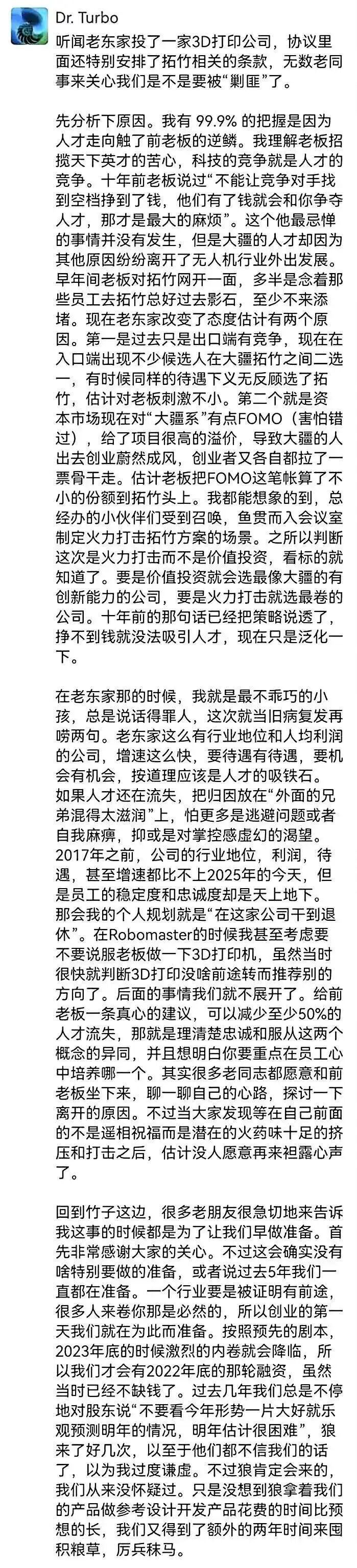
Core Insights - The rivalry between DJI and its former employees who have founded new companies, particularly Tuo Zhu, has intensified, highlighting a battle for talent, technology, and market space [1][2][19] - DJI's investment in a 3D printing company, Smart Pie, has been perceived as a direct attack on Tuo Zhu, indicating a shift from value investment to competitive aggression [1][4][19] - The emergence of "DJI alumni" companies has created a competitive landscape where these startups are increasingly attracting talent away from DJI, posing a significant threat to its market dominance [13][14][16] Company Dynamics - DJI has historically been a breeding ground for talent, with many former employees establishing successful startups that often compete directly with DJI [8][9][13] - Tuo Zhu, founded by former DJI employee Tao Ye, has rapidly grown to capture a significant market share in the 3D printing sector, achieving approximately 60 billion RMB in revenue and a 29% market share by 2024 [11][19] - The competitive landscape has shifted, with candidates increasingly choosing Tuo Zhu over DJI, even when offered similar compensation, indicating a change in the perceived value of working for each company [4][13] Market Trends - The global drone market is experiencing stagnation, with growth rates around 5% in 2023 and a decline in consumer drone sales, which poses challenges for DJI's traditional business model [16][17] - DJI is diversifying its product offerings into new areas such as robotic vacuums, panoramic cameras, and outdoor power supplies, as it seeks to find new growth avenues amidst a saturated market [17][18] - The rise of "DJI alumni" companies is creating a closed loop of talent migration, where former employees leverage their DJI experience to attract investment and build competitive startups [14][15]
双11大促|中国扫地机器人线上市场量额双降两成,石头、科沃斯、云鲸排销额前三
Xin Lang Cai Jing· 2025-11-28 00:09
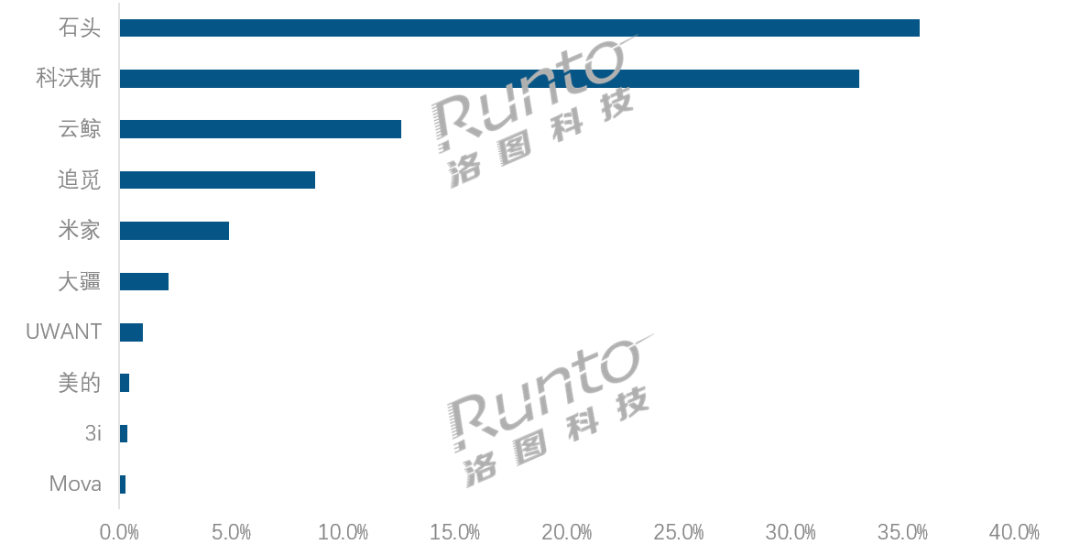
Group 1 - The 2025 Double 11 promotion period saw a total online sales volume of 1.178 million units, a decline of 24.4% compared to the same period in 2024 [1][3] - The decline in sales is attributed to two main factors: policy-induced pre-spending and a high comparative base effect, as well as the normalization of promotional events in the Chinese market [1][6] - The top four brands captured a significant market share during the promotion, indicating that leading brands tend to gain more market share during promotional periods [1] Group 2 - Stone ranked first with a 35.8% online market sales share, with its high-end P20 Ultra Plus series contributing 57.5% of its sales [3] - Ecovacs held a 33.1% sales share during the promotion, performing well across various price segments, particularly with its T80S series launched in September [3] - Cloud Whale achieved a 12.6% sales share, with its newly launched Xiaoyao 002 MAX series contributing 42.3% of its sales [4] Group 3 - Chase ranked at 8.8% in online sales share, focusing on high-end users and offering over ten products in the 4000 yuan and above market segment [4] - Xiaomi captured a 4.9% sales share, with a product lineup concentrated in the entry-level segment, emphasizing basic functionality without shortcomings [4] - DJI's ROMO series, launched in August 2025, quickly gained traction, ranking sixth in both sales volume and revenue during the Double 11 promotion [4] Group 4 - The market for robotic vacuum cleaners is under pressure to maintain high growth rates in the coming year, influenced by policy, consumer behavior, and industry dynamics [6] - There is significant potential for growth in the reputation of robotic vacuum cleaners, with companies encouraged to focus on improving navigation accuracy, cleaning efficiency, and multifunctionality [6]


E-bike,引领通勤3.0时代丨热门赛道
创业邦· 2025-11-28 00:09
Industry Overview - E-bike (Electric Bicycle) is defined as a two-wheeled bicycle that uses a battery as auxiliary power, combining human pedaling with electric motor assistance. It allows users to switch between pure pedaling, electric assist, or pure electric drive modes, making it suitable for urban commuting, outdoor leisure, and fitness [5][6]. - The core technology of E-bikes revolves around power assistance, energy management, and intelligent control, with key components including motors, batteries, and control systems. The mainstream models typically have a range of about 80 kilometers [9][10]. Market Dynamics - The E-bike industry has shown a steady growth trend in financing activities from 2020 to 2025, with the number of financing events increasing from 5 in 2020 to a peak of 10 in 2023. Although a slight decline is expected in 2024 and 2025, the numbers remain higher than in early 2020, indicating a transition to a more rational growth phase [13]. Key Players - Xunlu Innovation, established in July 2023, focuses on smart two-wheeled vehicles and has completed four rounds of financing within two years, with significant investments from firms like Sequoia Seed Fund and Shunwei Capital [16][17]. - Tezeus, founded in September 2022, specializes in high-end E-bikes and has developed proprietary technologies for lightweight and intelligent designs. The company plans to expand its market presence in Europe and has secured significant funding for product development [20][21]. - Urtopia, based in Zhejiang, emphasizes smart hardware and lightweight materials, targeting the mid-to-high-end market in Europe and the US. The company has achieved substantial growth in brand recognition and sales through a direct-to-consumer model [24][25]. Recent Developments - Urtopia announced the acquisition of the American E-bike brand Pedego in November 2025, marking a significant step in its international expansion strategy [29]. - In June 2025, Urtopia unveiled its lightweight mid-drive motor at the EUROBIKE exhibition, showcasing advancements in high-torque density technology [30]. - The launch of the LDN200 folding E-bike by BIJEN in June 2025 aims to redefine urban commuting solutions, combining electric assistance with comfort [31]. Financing Trends - Recent financing rounds for key players include Xunlu Innovation's A round of several tens of millions of RMB in August 2025, Tezeus's Pre-A round of 50 million RMB in May 2025, and Urtopia's A round exceeding 10 million USD in July 2024 [19][23][27].

阿里千问发力硬件产品,发布号称“市面上最好AI眼镜”
Xuan Gu Bao· 2025-11-27 23:36
Group 1 - Alibaba has launched its first AI glasses powered by its self-developed Qianwen model, marking its entry into the consumer-grade AI wearable device market, priced at 1899 yuan [1] - The glasses are integrated with Alibaba's ecosystem, including Alipay, Gaode Map, Taobao, Feizhu, and Alibaba Business Travel, enhancing their functionality [1] - Tianfeng Securities highlights the vast global user base for glasses and the low current AI penetration rate as key factors for the growth potential in the AI glasses market, predicting sales could reach approximately 1.4 billion units with a 70% penetration rate at maturity [1] Group 2 - The future form of AI glasses is expected to be a combination of AI and AR, with optical display and AI services being key components [2] - Cost analysis of AR glasses indicates that optical modules and screens represent the largest expenses, while chips are the highest cost in smart glasses [2] Group 3 - Hengxuan Technology's new generation of smart wearable chip, BES2800, has been widely adopted in products like TWS earphones, smartwatches, and smart glasses, including the Alibaba Quark AI glasses [3] - Nanchip Technology has provided a power chip solution for the Quark AI glasses, ensuring long battery life and stable power supply through its battery balancing IC [3]

12月4号,大疆的竞争对手来了!| 1127 张博划重点
Hu Xiu· 2025-11-27 14:39
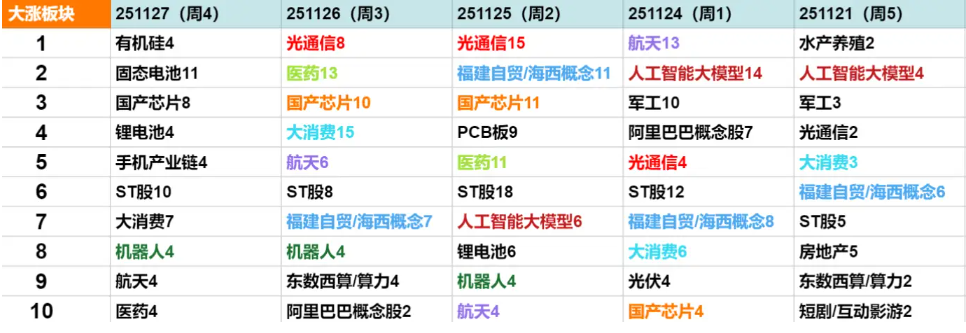
Market Performance - On November 27, the market experienced a pullback after an initial rise, with mixed performance across the three major indices. The ChiNext Index and Shenzhen Component Index turned negative after previously gaining over 2% [1] - The total trading volume in the Shanghai and Shenzhen markets was 1.71 trillion yuan, a decrease of 736 billion yuan compared to the previous trading day [1] - By the end of the trading session, the Shanghai Composite Index rose by 0.29%, while the Shenzhen Component Index fell by 0.25%, and the ChiNext Index declined by 0.44% [1] Sector Performance - The top-performing sectors included organic silicon, solid-state batteries, and domestic chips, with respective gains of 4, 11, and 8 [2] - Other notable sectors included the AI large model and lithium batteries, which also showed positive performance with gains of 14 and 4 [2] - The consumer sector and aerospace also performed well, indicating a diverse range of strong sectors in the market [2]
我们离实现“无人机灭火”还有多远?
凤凰网财经· 2025-11-27 14:26
Core Viewpoint - The article discusses the current limitations and challenges of using drones for firefighting, particularly in high-rise buildings, highlighting that the technology is still in its early stages and not yet ready for widespread practical application [2][11]. Group 1: Sales and Business Impact - The sales of firefighting drones are minimal, contributing very little to the overall revenue of companies involved in this sector. For instance, Helen Zhe has sold only three units of its first-generation firefighting drone [3]. - Other companies, such as Chen An Technology and Qing Niao Fire Protection, also report that their drone business has not yet generated significant revenue, with most of their focus still on traditional firefighting equipment [3]. Group 2: Technical Limitations - Current drone technology faces physical limitations in practical applications, particularly in high-rise firefighting scenarios. The existing drones struggle with the volume of water they can carry and the effects of high-pressure water flow [5][8]. - The predominant methods for firefighting using drones include "water delivery" and "fire extinguishing projectiles," but both have limitations in effectiveness against large fires [6][7]. Group 3: Environmental Challenges - High-rise fires present unique challenges due to turbulent airflow and strong winds, which require drones to have high power and stability to operate effectively [10]. - The article suggests that a coordinated approach using multiple drones may be necessary to tackle larger fires, as single units are insufficient [10]. Group 4: Future Directions - The industry needs to focus on developing a comprehensive framework for drone firefighting, including airspace management, collaborative command systems, and technical standards for high-capacity drones [11]. - There is a call for innovation and experimentation within the industry to fully realize the potential benefits of firefighting drones [11].

湖南摄影城某影石门头被强拆,疑因大疆经销商“排他协议”
凤凰网财经· 2025-11-27 14:26
Core Viewpoint - The incident involving the removal of the影石 brand storefront at Hunan Photography City highlights escalating competition and potential anti-competitive practices in the drone and camera market, particularly between影石 and大疆 [1][4][5]. Group 1: Incident Overview - On November 19, unidentified individuals forcibly removed the影石 brand signage from a store operated by a dealer who had invested nearly 1 million yuan in renovations [1][4]. - The property management had previously informed the dealer of an unknown "exclusive agreement" that prohibited the entry of competing brands, specifically naming影石 andInsta360 as direct competitors to大疆 [1][4]. Group 2: Legal and Market Implications - Legal experts suggest that the exclusive agreement may violate anti-monopoly laws, categorizing it as an invalid anti-competitive agreement [4]. - The incident is part of a broader competitive landscape, with影石's chairman previously commenting on大疆's monopolistic tendencies in the consumer electronics sector [5][6]. Group 3: Market Dynamics - A report from久谦咨询 indicated that大疆 captured 43% of the global market share in the panoramic camera segment within three months of launching its first product, intensifying competition with影石 [5]. - The competitive tension is evident as both online and offline confrontations escalate, reflecting the fierce rivalry in the market [6].