德赛西威

Search documents
智能座舱产业链洗牌加速:芯片换挡,Tier 1上位
Xin Lang Cai Jing· 2025-10-26 04:48
Core Viewpoint - The competition in the smart automotive sector is increasingly focusing on smart cockpits and electronic products, with companies like Junsheng Electronics securing significant orders for cockpit and in-car screen projects, indicating a shift in automotive competition towards in-car electronics and user interaction experiences [1][2][3]. Industry Trends - The smart cockpit market in China is projected to reach a pre-installation rate of 74.6% in the first half of 2025, with expectations to exceed 80% for the entire year [4]. - The Chinese government is reinforcing the development of smart cockpits as a key research direction in its "14th Five-Year" digital economy development plan, promoting domestic production of critical hardware and software [5]. - The automotive chip market is experiencing a shift, with international giants like Qualcomm and Renesas seeing a slowdown in growth, while domestic manufacturers are rapidly capturing the mid-to-low-end market due to cost advantages [5][6]. Company Developments - Desay SV's smart driving business revenue reached 4.15 billion yuan in the first half of 2025, marking a 55.5% year-on-year increase, indicating strong growth in the cockpit domain [7]. - System integrators are gaining profit leadership as hardware margins compress, with companies like Desay SV showcasing integrated solutions that combine multiple functionalities into a single chip, reducing costs [7][8]. - Domestic cockpit chip penetration in mainstream models is increasing, with over 90% of self-owned brand vehicles reportedly using domestic MCU or SoC solutions [6]. Technological Innovations - Leading automotive companies are transitioning from purchasing components to defining entire vehicle systems through self-developed operating systems and algorithms, enhancing their technological sovereignty [9]. - The integration of AI and ecosystem collaboration is becoming a new competitive focus, with companies like Xiaopeng and Xiaomi extending user experiences through integrated hardware and software solutions [9][10]. - The core competitiveness of smart cockpits is evolving from hardware specifications to ecosystem integration and algorithm collaboration, reflecting a shift in consumer focus from the number of screens to system capabilities [10].
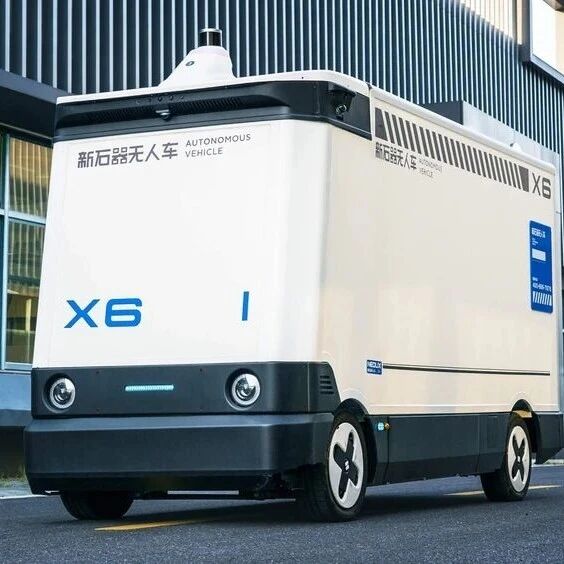
不装人的它,为何能一把融6亿美金?
虎嗅APP· 2025-10-25 03:14
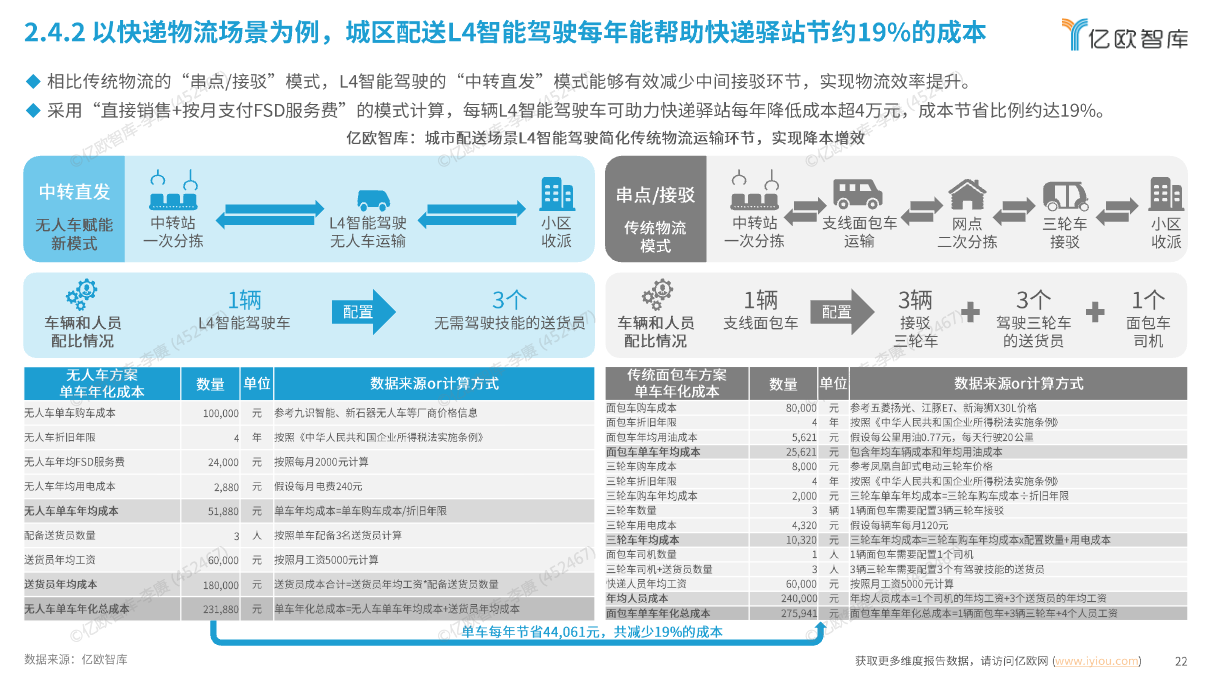
Core Insights - The article highlights the significant investment in the L4 autonomous driving sector, particularly in urban logistics, with Neolix securing over $600 million in Series D funding, marking the largest private equity financing in China's autonomous driving field to date [2] - The funding will be utilized for algorithm and technology development, new product development, and enhancing service networks to meet the growing demand in domestic and international urban logistics markets [2][5] Investment Landscape - Since early 2025, the L4 autonomous urban logistics sector has attracted over 4 billion RMB in investments, indicating a robust interest from investors [2] - Neolix had previously raised 1 billion RMB in a C+ round earlier this year, while other leading companies in the sector have also secured substantial funding [2] Industry Trends - The surge in capital investment is attributed to the maturity of technology and business models among startups, which have begun to demonstrate commercial value, driven by market demand rather than speculative financing [5] - The integration of autonomous vehicles in logistics is expected to reduce costs significantly, with estimates suggesting a potential cost reduction of 1/3 to 2/3 in logistics delivery [5][10] Operational Efficiency - The introduction of autonomous vehicles is projected to streamline logistics processes by eliminating redundant steps and reducing resource inputs, potentially saving 19% in operational costs [8] - Companies like Zhongtong and SF Express have already deployed over 1,800 autonomous vehicles, indicating a shift towards large-scale adoption [9] Future Outlook - The year 2025 is anticipated to be a pivotal year for the autonomous logistics vehicle sector, with ongoing competition focusing on advancements in L4 technology, expanding usage scenarios, and balancing growth with customer service [12] - Neolix's proprietary L4 autonomous driving technology is set to be commercially deployed, enhancing its operational capabilities in urban logistics [12][14] Market Expansion - Neolix aims to expand its operations internationally, having secured the first official autonomous vehicle license in the UAE, with plans to deploy 5,000 vehicles by the end of next year [16] - The collaboration with Didi Freight to test autonomous delivery services reflects a strategic move towards capturing immediate demand in logistics [18] Competitive Landscape - The autonomous vehicle sector is witnessing an influx of new entrants, intensifying competition across product forms, application scenarios, and customer ecosystems [18] - The ability to maintain operational efficiency while meeting diverse customer needs will be crucial for the survival and success of autonomous vehicle companies in this rapidly evolving market [18]

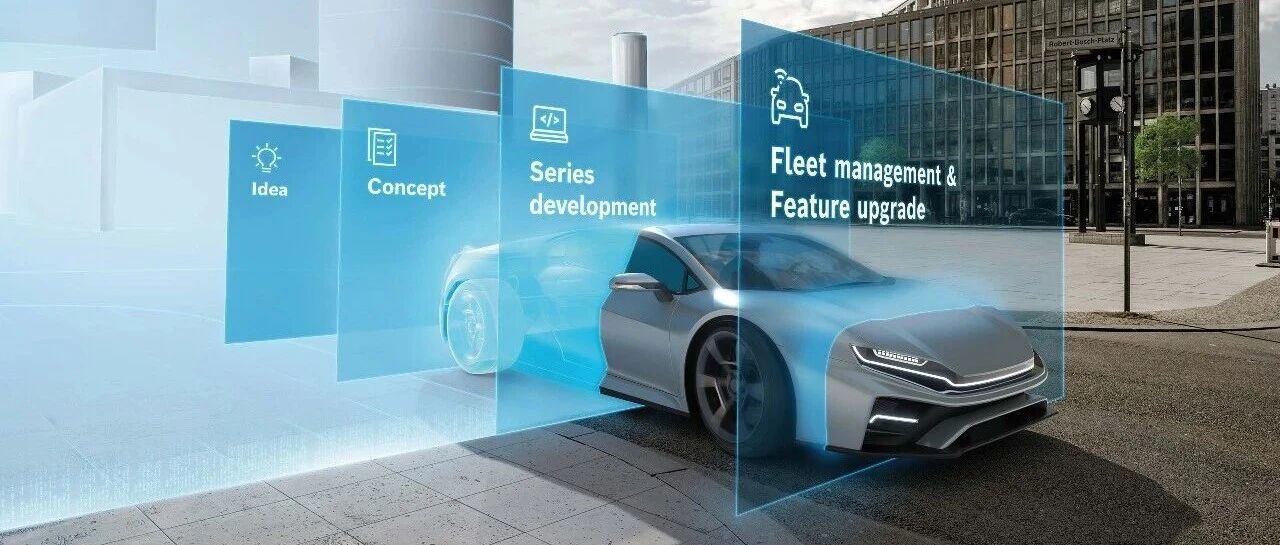
2025年全球汽车Tier1厂商排名
自动驾驶之心· 2025-10-24 16:03
Core Insights - The article discusses the competitive landscape of global Tier 1 automotive suppliers, highlighting the rise of Chinese manufacturers in the electric and intelligent driving sectors while traditional players face challenges [2][4][5]. Group 1: Global Tier 1 Suppliers Ranking - The top 20 global Tier 1 automotive suppliers for 2025 are led by Bosch, ZF Friedrichshafen, and Denso, with strengths in automotive electronics, powertrains, and autonomous driving [2]. - Notable Chinese suppliers like Desay SV and Foryoung are making significant strides in intelligent driving and automotive electronics, indicating a shift in market dynamics [2][5]. Group 2: Trends in Electrification and Intelligence - The electrification trend is accelerating, with battery manufacturers like CATL and BYD increasing their market share, particularly in the context of rapid growth in new energy vehicles [3]. - Intelligent driving and smart cockpit technologies are emerging as core growth areas, with Chinese firms gaining market share in these domains [3]. Group 3: Market Competition Dynamics - Traditional Tier 1 suppliers such as Bosch and ZF are experiencing revenue and profit declines in 2024, despite their established technological advantages [4]. - Chinese Tier 1 suppliers are breaking through barriers in the new energy and intelligent driving sectors, challenging the dominance of international players [5]. Group 4: Regional Market Changes - The Chinese market is witnessing rapid growth in new energy vehicles, providing substantial opportunities for local Tier 1 suppliers [10]. - In contrast, the European and American markets are experiencing a slowdown in electrification but continue to demand advancements in autonomous driving and smart cockpit technologies [10]. Group 5: Technological Innovation and Collaboration - Suppliers with comprehensive capabilities in hardware, software, and system integration are expected to capture larger market shares in the future [6]. - Traditional Tier 1 suppliers are investing in Chinese startups and developing localized products to regain their competitive edge [6].



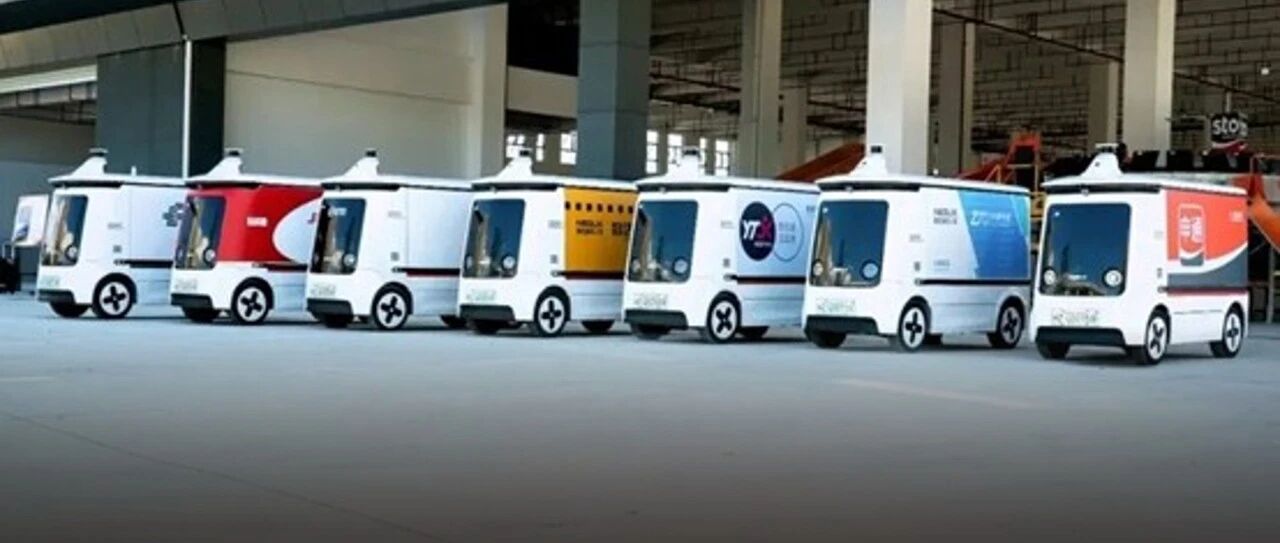
无人车火热吸金85亿,邮政顺丰释放万台需求
3 6 Ke· 2025-10-24 11:41
Core Insights - The largest private equity financing in China's autonomous driving sector occurred on October 23, with New Stone completing over $600 million in Series D funding, marking a significant milestone in the industry [1] - New Stone has delivered over 10,000 L4 autonomous vehicles, becoming the first in the world to achieve this milestone, indicating a shift from research and testing to large-scale commercial deployment of unmanned delivery [1] - The market for unmanned vehicles is expected to expand significantly, with predictions of over 100,000 units needed by 2027, driven by demand in urban logistics and other sectors [5] Financing and Investment - Since the beginning of the year, leading unmanned vehicle companies have raised approximately 8.5 billion yuan in funding, highlighting the sector's attractiveness to investors [2] - Prior to New Stone's $600 million Series D funding, other significant investments included 400 million dollars for Jiushi in Series B and 1 billion yuan for New Stone in Series C+ [4] Market Demand and Expansion - The demand for unmanned vehicles is projected to reach tens of thousands, with major logistics companies like China Post and SF Express expressing needs for thousands of units [4] - New Stone's CEO predicts that by 2027, major cities will operate thousands of unmanned delivery vehicles, potentially creating a "smart logistics network" for shared use [5] Competitive Landscape - Intense competition is leading to price reductions in the industry, with the cost of main models dropping to the range of 80,000 to 100,000 yuan, down from 150,000 to 200,000 yuan earlier this year [7] - In Shenzhen, the leading city for functional unmanned vehicle operations, the monthly delivery volume surpassed one million in September, with New Stone leading in active vehicle numbers [8] Operational Developments - New Stone has deployed over 1,200 vehicles in Qingdao, making it the city with the highest number of unmanned vehicles globally [10] - The company is expanding its services beyond logistics to include fresh produce, cold chain, and supermarket deliveries, with these new scenarios accounting for over 50% of total orders [10]

给热到发烫的无人车,泼盆冷水
汽车商业评论· 2025-10-24 02:40
Core Viewpoint - The article discusses the rapid development and investment in the low-speed autonomous vehicle market in China, highlighting significant financing events and the increasing adoption of autonomous vehicles in logistics and delivery sectors [4][11]. Investment and Financing - New Stone Technology announced the completion of over $600 million in Series D financing, marking it as the largest private equity financing in China's autonomous driving sector to date [4]. - In 2025, several companies, including New Stone and NineSight, secured substantial funding, indicating strong investor interest in the autonomous vehicle market [10][11]. Market Dynamics - The low-speed autonomous vehicle market is experiencing a shift, with companies like Desay SV and New Stone entering the space, showcasing strong execution capabilities [6][9]. - The logistics sector, particularly the express delivery industry, is a major driver for the adoption of autonomous vehicles, with significant orders for autonomous delivery vehicles already placed [13][15]. Industry Trends - The period from 2018 to 2023 was characterized as a demonstration phase for autonomous vehicles, with companies exploring various application scenarios and refining AI technologies [9]. - By 2024, the industry is expected to enter a growth phase, with commercial value becoming more apparent and market demand beginning to surge [9][10]. Competitive Landscape - The express delivery sector has become a key player in the autonomous vehicle market, with major companies like Jitu Express and SF Express investing heavily in autonomous delivery vehicles [15][18]. - New Stone and NineSight dominate the market, holding a combined 90% share of the autonomous vehicle orders in the express delivery sector, making it challenging for new entrants [18]. Future Outlook - The potential market for autonomous delivery vehicles in China is vast, with estimates suggesting a need for 30 million autonomous vehicles for last-mile delivery [24]. - However, there are concerns about the sustainability of the current business models, with industry experts suggesting that the market may not meet overly optimistic capital market expectations [26][27].
不装人的它,为何能一把融6亿美金?
Hu Xiu· 2025-10-24 02:36
Core Insights - The article highlights the significant funding achievement of Neolix, a leading L4 autonomous delivery company in China, which secured over $600 million in Series D financing, marking the largest private equity investment in the Chinese autonomous driving sector to date [2][3]. Group 1: Funding and Investment - Neolix's recent funding round was led by StoneVenture from the UAE, with participation from several prominent investors, indicating strong confidence in the autonomous logistics market [2]. - The total capital raised in the L4 autonomous delivery sector has exceeded 4 billion RMB since early 2025, showcasing a growing interest from investors in this space [3]. Group 2: Market Demand and Technology - The demand for autonomous delivery vehicles has surged due to their ability to significantly reduce logistics costs, with estimates suggesting cost reductions of 1/3 to 2/3 [6][10]. - Neolix's CEO emphasized the transition to a cost-saving phase for autonomous vehicles, which has led to increased adoption by logistics companies [6]. Group 3: Industry Trends and Future Outlook - The autonomous delivery sector is expected to experience explosive growth in 2025, driven by mature technology and business models that meet market demands [5][23]. - Neolix plans to expand its operations internationally, having received the first official permit for autonomous vehicles in the UAE, with a goal of deploying 5,000 vehicles by the end of next year [22]. Group 4: Competitive Landscape - The competition in the autonomous delivery market will focus on technological leadership, the ability to access diverse usage scenarios, and balancing growth with customer service [17][28]. - The industry is witnessing an influx of new players, indicating a highly competitive environment where companies must innovate and adapt to maintain their market position [27].
【10月24日IPO雷达】大明电子申购、超颖电子上市
Xuan Gu Bao· 2025-10-24 00:01
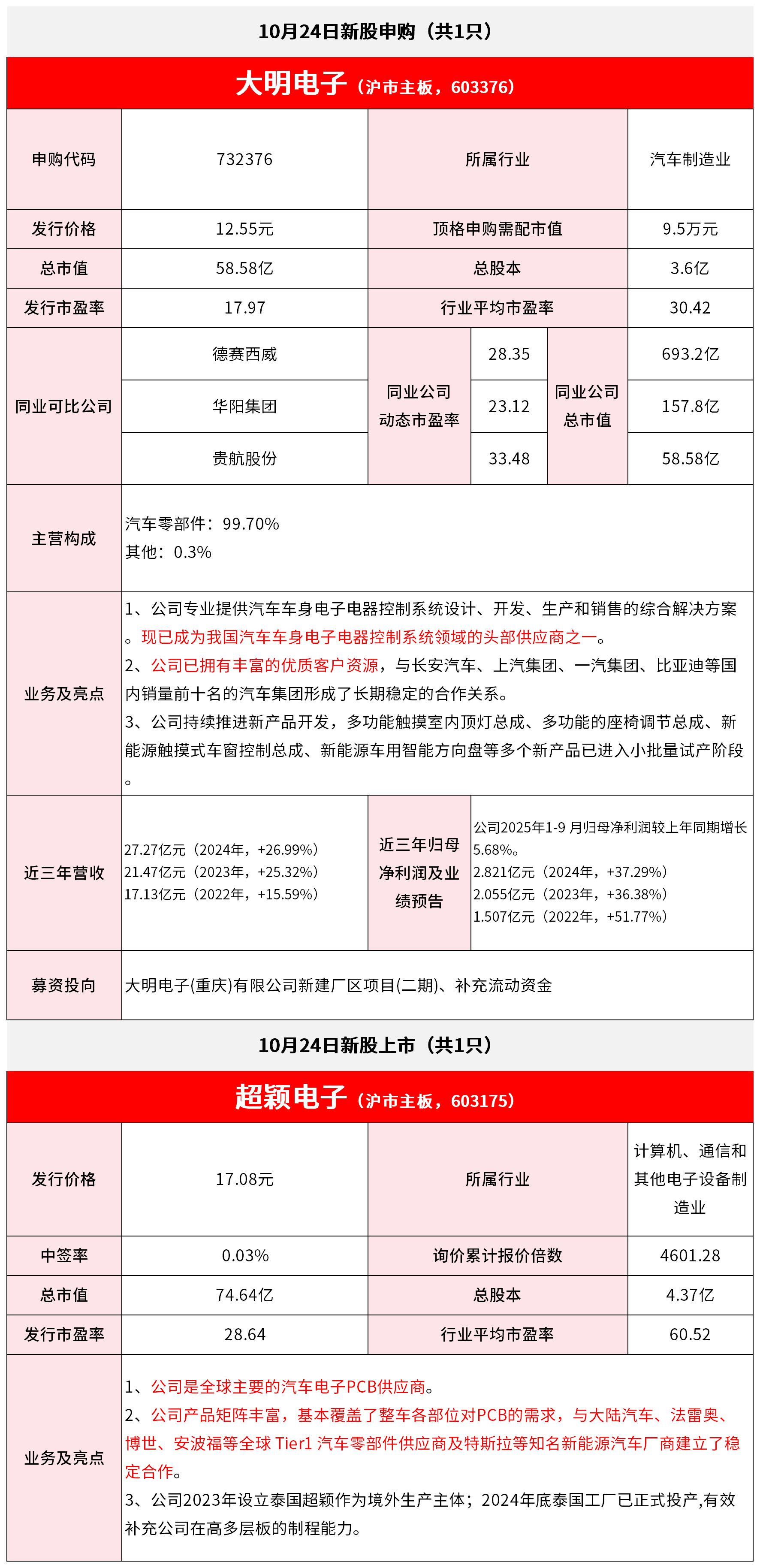
Core Viewpoint - The news discusses the IPO details of two companies, Daming Electronics and Chaoying Electronics, highlighting their financial metrics, business focus, and market positioning. Group 1: Daming Electronics - The IPO code is 732376 with an issue price of 12.55 yuan and a total market value of 58.58 billion yuan [2] - The company has an issuance price-to-earnings ratio of 17.97, with a primary business focus on automotive components, accounting for 99.70% of its revenue [2][3] - Daming Electronics specializes in automotive body electronic control system design and has established long-term stable partnerships with major automotive groups [3] - The company has shown significant revenue growth over the past three years, with projected revenues of 27.27 billion yuan in 2024 (+26.99%), 21.47 billion yuan in 2023 (+25.32%), and 17.13 billion yuan in 2022 (+15.59%) [3] Group 2: Chaoying Electronics - The IPO price for Chaoying Electronics is 17.08 yuan, with a total market value of 74.64 billion yuan and an issuance price-to-earnings ratio of 28.64 [5] - The company is a major global supplier of automotive electronic PCBs, with a diverse product matrix covering various vehicle components [6] - Chaoying Electronics has established partnerships with leading Tier 1 automotive suppliers such as Bosch and Aptiv, and has set up a production base in Thailand to enhance its manufacturing capabilities [6]
大明电子:聚焦电动化、智能化 努力成为全球汽车车身电子领域一流企业
Shang Hai Zheng Quan Bao· 2025-10-23 18:39
Core Viewpoint - Daming Electronics Co., Ltd. is focused on the research, development, production, and sales of automotive body electronic control systems, aiming to become a leading comprehensive solution provider in the industry with a strong competitive edge globally [8][24]. Company Overview - Daming Electronics was established in 1989 and is one of the few companies in China specializing in automotive body electronic control systems [8]. - The company has developed a comprehensive product system and has successfully entered the supply chains of well-known foreign brands, establishing a diversified customer matrix [8][9]. Business Operations - The company specializes in automotive electronic components, with a complete product range including driver assistance systems, cockpit central control systems, intelligent optical systems, window control systems, and seat adjustment systems [13]. - Daming Electronics has maintained a high production and sales rate across its product lines, indicating strong market demand and stable operational capabilities [17]. Financial Performance - The company's revenue for 2022, 2023, and the first half of 2025 was 1713.46 million, 2147.35 million, and 1297.32 million respectively, showing continuous growth [20]. - The net profit for the same periods was 150.66 million, 205.47 million, and 114.37 million, demonstrating strong profitability [21]. - The overall gross margin for 2022, 2023, and the first half of 2025 was 20.91%, 20.65%, and 18.13%, respectively, indicating a stable gross profit trend [22]. Research and Development - The company has over 160 patents, with more than 15 being invention patents, showcasing its commitment to innovation [18]. - R&D expenses as a percentage of revenue were 5.77%, 5.30%, and 4.35% for the years 2022 to 2025, reflecting ongoing investment in innovation [23]. Market Position - Daming Electronics has established stable partnerships with major domestic automotive manufacturers and has successfully entered the supply chains of international brands like Ford and Toyota [15]. - The company holds a market share of 12.87% in driver assistance systems and 16.29% in window control systems, indicating a strong competitive position in the domestic market [33]. Future Strategy - The company aims to optimize production capacity and enhance its technological capabilities to strengthen its market position and achieve growth in market share [24]. - Daming Electronics plans to leverage its core technologies and product advantages to become a globally competitive player in the automotive body electronic control systems sector [24][28]. Industry Landscape - The automotive electronics industry is characterized by high concentration, with major players from traditional automotive manufacturing countries dominating the market [30]. - Domestic suppliers have improved their competitiveness due to government support and rapid technological advancements, allowing them to gain recognition from global automotive manufacturers [30]. IPO Objectives - The primary purpose of the IPO is to expand capital scale, enhance market competitiveness, and improve corporate governance and management levels [34]. - The company plans to use the raised funds for expanding production capacity and optimizing operational efficiency [38][40].
A股晚间热点 | 二十届四中全会公报发布 机构火速解读
智通财经网· 2025-10-23 14:39
Group 1 - The 20th Central Committee's Fourth Plenary Session emphasizes building a strong domestic market and accelerating the new development pattern, focusing on expanding domestic demand and enhancing the internal circulation of the economy [1] - The session is expected to provide new policy expectations and investment clues for the A-share market, potentially boosting market confidence and attracting long-term capital [1] - The session outlines a development blueprint that supports the stable and long-term growth of the A-share market, alongside ongoing reforms in China's capital markets [1] Group 2 - The Chinese government is set to engage in economic and trade consultations with the U.S. in Malaysia, addressing important issues in the bilateral economic relationship [2] - The State-owned Assets Supervision and Administration Commission (SASAC) is focusing on the "14th Five-Year Plan" for central enterprises, aiming to enhance core functions and competitiveness [3] Group 3 - The EU has imposed sanctions on 12 Chinese companies due to their alleged assistance to Russia in circumventing Western sanctions, which has drawn strong opposition from China [4] - China's telecommunications sector has made significant advancements in quantum communication, achieving over 80 kilometers of transmission with a speed exceeding 10 Tb/s, marking international recognition of its technological capabilities [5] Group 4 - The Shenzhen stock market has seen a surge, with 15 stocks hitting the daily limit up, indicating a strong regional market performance [6] - The new consumption sector in Hong Kong has faced a sell-off, with significant declines in stocks like Pop Mart, raising concerns about future growth and valuation [7] Group 5 - The automotive sector has seen over 10 million applications for the vehicle trade-in subsidy in 2025, indicating a robust market response to the policy [14] - Key automotive companies such as BYD, Great Wall Motors, and others are recommended for their strong sales performance and potential for new models [14] - The AI glasses market is gaining attention with Alibaba's AI glasses set to begin pre-sales [15]

晒50亿大单、港股IPO申请获聆讯,均胜电子尚存四大隐忧
Sou Hu Cai Jing· 2025-10-23 13:21
Core Viewpoint - Junsheng Electronics has recently announced significant new orders totaling 200 billion yuan, indicating a strong push in the automotive smart driving and electrification sectors, alongside progress in its Hong Kong IPO process [2][30][57] Group 1: Recent Developments - Junsheng Electronics disclosed a 50 billion yuan order for automotive smart electrification projects on October 20, following a previous announcement of a 150 billion yuan order in mid-September [2][30] - The company is advancing its Hong Kong IPO, as indicated by the release of its H-share issuance hearing materials [2][30] - Following these announcements, the stock price of Junsheng Electronics rebounded, experiencing three consecutive days of gains with continued net inflow of main funds [2][30] Group 2: Market Sentiment and Concerns - Despite the positive news, investor sentiment quickly turned cautious, with stock price adjustments observed shortly after the announcements [4][31] - Concerns were raised regarding the company's ability to convert orders into actual performance, the status of its new robotics business, and the high goodwill balance of approximately 7.3 billion yuan [4][31][36] Group 3: Order and Financial Performance - Junsheng Electronics reported a total of 393 billion yuan in new global orders since September, with the total lifecycle value of new orders approaching 600 billion yuan since 2025 [9][36] - The estimated total lifecycle value of new projects for 2024 is around 839 billion yuan, with current disclosures indicating approximately 70% of last year's new order value [9][37] - The company has faced increasing inventory risks, with inventory levels rising from 74.37 billion yuan in 2022 to 96.51 billion yuan in 2025, alongside a lengthening inventory turnover period [11][39] Group 4: Profitability Challenges - The automotive industry is experiencing intense competition, leading to a "micro-profit" era where companies are pressured to lower prices, impacting Junsheng Electronics' profit margins [13][41] - The company's operating profit margins have been relatively low compared to peers, with figures of 0.8%, 3.8%, 4.13%, and 5.42% from 2022 to the first half of 2025 [14][42] - Junsheng Electronics is attempting to reduce costs and improve operational efficiency to maintain profitability amidst these challenges [14][42] Group 5: Robotics Business Development - Junsheng Electronics is pivoting towards the robotics sector, establishing a subsidiary focused on intelligent robotics and forming strategic partnerships for technology development [43][44] - The global intelligent robotics market is projected to grow significantly, with expectations of reaching 123.9 billion USD by 2029 [43] - The company has launched several robotics components, although revenue from this segment currently represents less than 0.1% of total income [46][43] Group 6: Financial Health and Debt - Junsheng Electronics has accumulated significant goodwill and debt, with total liabilities reaching 473.44 billion yuan and an asset-liability ratio of 69.46% as of mid-2025 [28][56] - The company has faced substantial financial expenses, which have eroded profits, with financial costs reported at 4.78 billion yuan, 8.9 billion yuan, and 8.28 billion yuan from 2022 to 2024 [28][56] - The company is accelerating its efforts to complete the Hong Kong IPO process to improve its financial standing and market perception [57]