德赛西威

Search documents
看好端侧AI创新成长!消费电子ETF(159732)跌3%,顺络电子跌6%
Mei Ri Jing Ji Xin Wen· 2025-10-17 04:18
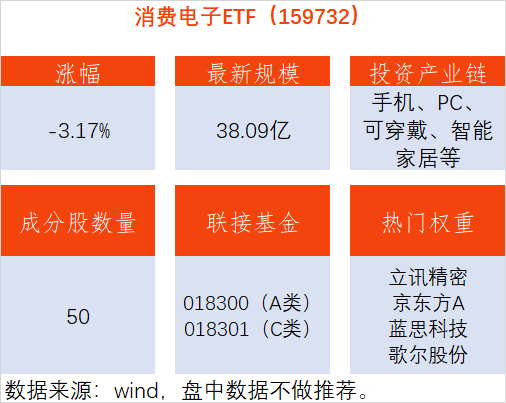
Group 1 - A-shares experienced a collective decline, with the Shanghai Composite Index dropping by 0.84% during the trading session, while sectors such as soft drinks, forestry, and highways showed gains [1] - The consumer electronics sector faced a downturn, with the Consumer Electronics ETF (159732) falling by 3.17%, and key stocks like Desay SV Automotive, Shunluo Electronics, and Sanhuan Group declining by 8.94%, 6.85%, and 6.12% respectively [1] - Some individual stocks showed positive movement, with Wentai Technology increasing by 5.55% and Heertai rising by 2.10% [1] Group 2 - The penetration rate of AI smartphones is projected to rise from 34% in 2025 to 53% by 2028, indicating a significant growth trend in the market [3] - The Chinese smart glasses market is expected to see retail sales reach nearly 1.4 million units in 2025, representing a year-on-year increase of 216% [3] - The global AI application terminal market is experiencing continuous growth, with the consumer electronics industry benefiting from the synergy of AI technology and the national replacement cycle [3] - The Consumer Electronics ETF (159732) tracks the Guozheng Consumer Electronics Index, primarily investing in 50 A-share listed companies involved in the consumer electronics industry, with a focus on electronic manufacturing and optical optoelectronics [3]


科技股深度调整,5G通信ETF(515050)跌超3%,昨日获1199万元资金加仓
Mei Ri Jing Ji Xin Wen· 2025-10-17 04:18
10月17日,A股市场蓄力回调,前期表现强势的电力设备新能源、电子、通信等科技板块领跌。截 至11:14,5G通信ETF(515050)跌超3%,盘中成交额超1.4亿元,持仓股光库科技、唯捷创芯逆市上 涨,德赛西威、生益科技、中兴通讯跌超8%,移远通信、信维通信、立讯精密、星网锐捷等纷纷调 整。 【免责声明】本文仅代表作者本人观点,与和讯网无关。和讯网站对文中陈述、观点判断保持中立,不对所包含内容 的准确性、可靠性或完整性提供任何明示或暗示的保证。请读者仅作参考,并请自行承担全部责任。邮箱: news_center@staff.hexun.com 每日经济新闻 (责任编辑:董萍萍 ) 资料显示,5G通信ETF(515050)跟踪中证5G通信主题指数,最新规模超80亿元。深度聚焦英伟 达、苹果、华为产业链。国盛金工团队分析,从行业权重分布看,该指数是一只"硬科技"纯度极高的 5G主题指数。通信与电子两大核心赛道合计占比近八成(79.4%),其中通信44%的权重直接锁定基 站、光模块、射频等5G网络基建红利;电子35%则向上游半导体、PCB、消费电子组件延伸,形成"网 络建设+终端配套"的闭环。相关ETF全称:华 ...
A500ETF基金(512050)成交额超32亿居同类第一,机构称“活钱”的持续提升或助推市场上行
Xin Lang Cai Jing· 2025-10-17 03:30
Group 1 - The A500 index components showed mixed performance, with Huatian Technology leading the gains at 10.02%, followed by Wentai Technology at 5.96% and Shandong Gold at 3.29%, while Desay SV fell [1] - The A500 ETF fund's latest price is 1.15 yuan, with a turnover rate of 19.72% and a trading volume of 3.248 billion yuan, indicating active market trading [1] - As of October 16, the A500 ETF fund had an average daily trading volume of 5.003 billion yuan over the past month, ranking first among comparable funds [1] Group 2 - The A500 index consists of 500 securities selected from various industries based on market capitalization and liquidity, reflecting the overall performance of representative listed companies [2] - As of September 30, 2025, the top ten weighted stocks in the A500 index accounted for 19% of the index, including Ningde Times, Kweichow Moutai, and China Ping An [2] - The A500 ETF fund and its enhanced version closely track the A500 index, with various related index funds available for investment [2]






多部门印发数字经济创新企业培育措施,数字经济ETF(560800)盘中蓄势
Sou Hu Cai Jing· 2025-10-17 02:53
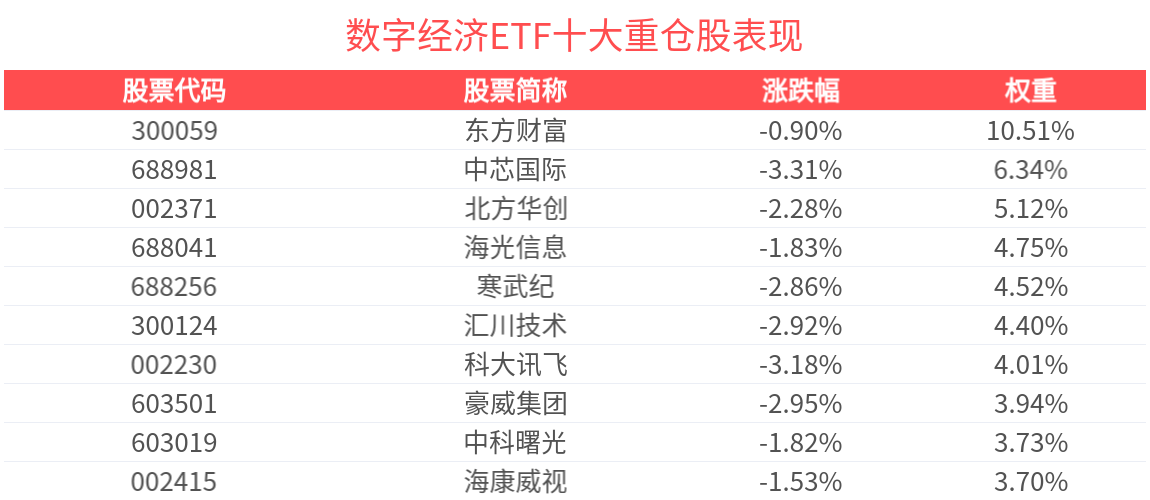
Core Viewpoint - The digital economy theme index has experienced a decline, with significant movements in constituent stocks, while the government is promoting the cultivation of innovative enterprises in the digital economy sector [1][2]. Group 1: Market Performance - As of October 17, 2025, the CSI Digital Economy Theme Index (931582) fell by 2.39%, with major declines in stocks such as Desay SV Automotive (002920) and others [1]. - The digital economy ETF (560800) saw a trading volume of 16.07 million yuan, with a turnover rate of 2.36% [1]. - Over the past month, the average daily trading volume of the digital economy ETF was 31.11 million yuan [1]. Group 2: Share Growth - The digital economy ETF has seen a significant increase in shares, growing by 12 million shares over the past two weeks [1]. Group 3: Government Initiatives - On October 4, the National Development and Reform Commission and other departments issued measures to strengthen the cultivation of innovative enterprises in the digital economy, aiming to foster more "unicorn" and "gazelle" companies [1]. Group 4: Industry Outlook - Securities firms are optimistic about the continued stabilization and improvement of the fundamentals in advanced manufacturing and digital economy sectors, suggesting potential investment opportunities in technology growth companies and dividend assets [1][2]. - Financial analysts emphasize the importance of domestic opportunities in key areas such as advanced processes, AI computing chips, and semiconductor equipment, highlighting the potential for growth in domestic enterprises benefiting from localization [2]. Group 5: Index Composition - As of September 30, 2025, the top ten weighted stocks in the CSI Digital Economy Theme Index accounted for 54.31% of the index, with companies like Eastmoney (300059) and SMIC (688981) among the leaders [2].





阿里发布Qoder CLI助推AI开发效率,人工智能AIETF(515070)持仓股盘中震荡
Mei Ri Jing Ji Xin Wen· 2025-10-17 02:44
Core Viewpoint - The A-share market is experiencing a significant decline, with the ChiNext Index and Shenzhen Component Index both dropping over 2%. The AI ETF (515070) is also facing a decline, indicating a challenging environment for technology stocks, particularly in the AI sector [1]. Group 1: Market Performance - The A-share market's three major indices are seeing an expanded decline, with the ChiNext Index and Shenzhen Component Index both falling more than 2% [1]. - The AI ETF (515070) has dropped over 2% during trading, reflecting broader market trends affecting technology stocks [1]. Group 2: Company Developments - Alibaba officially launched a new AI programming tool, Qoder CLI, on October 16, which significantly optimizes resource consumption, with memory usage reduced by approximately 70% compared to similar tools and response times controlled within 200 milliseconds [1]. - Qoder CLI supports a self-programming mode that allows developers to describe tasks in natural language, enabling AI to autonomously complete code development and verification, thus enhancing development efficiency [1]. Group 3: Industry Trends - The rapid development of Agents is pushing human-machine collaboration into a new paradigm, opening broader pathways for the practical application of AI technology [1]. - As foundational model capabilities continue to enhance and iterate, Agents tailored for various verticals will become key hubs connecting AI models with end users, significantly improving operational efficiency and intelligence levels across industries [1].
三季度资管机构调研热情下降,科技和医药医疗股受青睐
2 1 Shi Ji Jing Ji Bao Dao· 2025-10-16 12:41
Group 1 - The enthusiasm of asset management institutions for researching listed companies has decreased in the third quarter, with a 24.8% decline in the number of research activities compared to the previous quarter [1][5] - In the second quarter, during a period of market stagnation, asset management institutions increased their research activities by 49.31% [1] - The focus of asset management institutions remains on technology stocks, with a growing interest in pharmaceutical and medical stocks in the third quarter [2][3] Group 2 - Insurance asset management companies conducted a total of 7,687 research activities on 5,850 individual stocks in the first three quarters, with a significant focus on Shenzhen Main Board and Sci-Tech Innovation Board stocks [2] - The most active insurance asset management company was Taikang Asset, which conducted 860 research activities on 566 stocks, primarily on the Shanghai Main Board [2] - The research frequency of brokerage asset management subsidiaries was slightly lower, with 4,216 research activities on 3,321 stocks, showing a preference for high-growth potential and technology-intensive companies [3] Group 3 - Wealth management companies conducted over 2,100 research activities on more than 1,700 listed companies in the first three quarters, with a notable preference for Shenzhen Main Board and Sci-Tech Innovation Board companies [4] - Trust companies showed less enthusiasm compared to other asset management institutions, with 1,580 research activities on 1,337 stocks [4] - The overall investment ratio of wealth management companies in equities remains low, but their management scale reached 27.48 trillion yuan by the end of June [3] Group 4 - The Sci-Tech 50 index rose by 49.02% in the third quarter, significantly outperforming the broader market, with the CSI 300 index increasing by 17.9% [7] - Insurance asset management companies focused on 600 Sci-Tech Innovation Board companies in the third quarter, which, along with Shenzhen Main Board stocks, accounted for 53.57% of their research activities [7] - The most researched stock in the third quarter was Mindray Medical, with 538 institutions conducting research, followed by Huichuan Technology and Maiwei Biological-U [8]

融资11轮后,上海这家智驾公司要IPO了!
Guo Ji Jin Rong Bao· 2025-10-16 07:41
Core Viewpoint - Magic View Intelligent Technology (Shanghai) Co., Ltd. has submitted an IPO application to the Hong Kong Stock Exchange, with Guotai Junan International and Guosen Securities (Hong Kong) as joint sponsors. The company has shown a compound annual growth rate (CAGR) of 73.9% over the past three years, with a valuation exceeding 2.5 billion yuan after 11 rounds of financing, but it has not yet achieved profitability, accumulating losses of 773 million yuan over three and a half years [1][4][12]. Company Overview - Founded in 2015 in Shanghai, Magic View Intelligent is an AI-driven provider of intelligent driving solutions. It ranks eighth among third-party solution providers in China's intelligent driving solutions industry based on projected revenue for 2024 [3][7]. Financial Performance - The company's revenue for the years 2022 to 2025 (first half) is reported as 118 million yuan, 147 million yuan, 357 million yuan, and 189 million yuan, respectively, with a CAGR of 73.9%. The revenue for the first half of 2025 shows a year-on-year increase of 76.3%. However, net losses for the same periods are -200 million yuan, -228 million yuan, -233 million yuan, and -112 million yuan, with cumulative losses of 773 million yuan over three and a half years [4][5][6]. Cash Flow and Funding Needs - The company has experienced significant cash outflows, with net cash outflows of 114 million yuan, 154 million yuan, 139 million yuan, and 73 million yuan during the reporting period. As of the end of August 2025, the company had approximately 144 million yuan in cash and equivalents, indicating a need for further financing to sustain operations [5][6]. Use of IPO Proceeds - The funds raised from the IPO are intended to enhance the company's R&D capabilities, focus on continuous upgrades of intelligent driving solutions, expand production capacity, improve delivery capabilities, deepen sales and marketing networks, and support business expansion [6]. Market Position and Growth Potential - The global market for intelligent driving solutions (L0 to L2+) is projected to grow from 120.7 billion yuan in 2020 to 320 billion yuan by 2024, with a CAGR of 27.6%. In China, the market is expected to grow from 21.6 billion yuan in 2020 to 91.2 billion yuan by 2024, with a CAGR of 43.3% [7]. Product Offerings - Magic View Intelligent's product portfolio includes Magic Drive (driving solutions), Magic Parking (automated parking solutions), and Magic Safety (active safety solutions). The Magic Drive solution has generated over 60% of the company's revenue in recent years, with a gross margin currently at 62.1% [10]. Customer Base - The company serves a diverse customer base, including OEMs and tier-one suppliers. In 2024, the number of customers reached 143, with the top five customers contributing 65.9% of revenue, indicating a degree of concentration [11]. Shareholder Structure - The company was founded by Yu Zhenghua, who holds approximately 29.65% of the shares, making him the largest single shareholder. The company has undergone multiple financing rounds, with the latest valuation reaching 2.543 billion yuan [12][13].

一天之内,三件大事联动!从美联储到A股,全球市场迎来关键日
Sou Hu Cai Jing· 2025-10-16 04:57
Core Insights - The global financial market experienced a historic upheaval on October 16, 2025, marked by the Federal Reserve's policy shift, a significant rebound in A-shares, and gold prices soaring past $4,200, fundamentally altering global capital flow dynamics [3][4]. Group 1: Federal Reserve Policy Shift - The Federal Reserve announced the end of its balance sheet reduction, with its balance sheet size decreasing from a peak of $9 trillion to $6.6 trillion, concluding a three-year quantitative tightening cycle [3]. - The anticipated interest rate cut of 25 basis points on October 28, with a 93.5% probability of a total cut of 50 basis points by December, was driven by a deteriorating job market and tariff impacts [3]. - The unemployment rate rose to 4.3% in August, prompting the Fed to abandon its anti-inflation priority strategy [3]. Group 2: A-share Market Dynamics - The A-share market saw a dramatic rebound, with the ChiNext Index surging 2.36% to surpass 3,000 points, and the Sci-Tech 50 Index rising 1.4% to reach a new yearly high [3]. - Northbound capital inflow reached 12.9 billion, with the electronic sector receiving a significant boost of 67.78% in main capital allocation [3]. - Semiconductor stocks were ignited by the announcement from SMIC regarding a 90% yield on 14nm chips, highlighting the domestic substitution narrative [3]. Group 3: Gold Market Surge - COMEX gold futures rose by 1.48% to $4,224.9, marking a 23% increase year-to-date [4]. - Global gold ETFs saw a net inflow of $3.3 billion in a single day, the highest since 2020 [4]. - The revaluation of gold's safe-haven status was driven by the Fed's interest rate cut cycle and escalating geopolitical conflicts [4]. Group 4: Market Restructuring Effects - The anticipated Fed rate cut led to a 0.39% decline in the US dollar index, stabilizing the RMB at around 7.12, with northbound capital increasing by over 5 billion in electronic stocks [4]. - The ChiNext Index's price-to-earnings ratio recovered from 50 times to 67 times, while the average price-to-sales ratio for semiconductor firms on the Sci-Tech board exceeded 15 times [4]. - Technology growth stocks, with a PE ratio of 72 times, took over the leadership from financial heavyweight stocks, which had a PE ratio of 8 times [4]. Group 5: Technological Revolution - The demand for AI computing power ignited a chip revolution, with Apple's M5 chip pre-orders starting and TSMC's 3nm capacity fully booked [4]. - The national supercomputing internet phase II project commenced, with data center construction investments surpassing 1 trillion [4]. - The photovoltaic leader Longi Green Energy announced mass production of perovskite batteries, creating a "dual drive" effect between new energy and semiconductors [4]. Group 6: Geopolitical Dynamics - China implemented quota controls on rare earth exports, leading to a daily surge in Northern Rare Earth stocks [4]. - The US escalated AI chip export restrictions to China, with Cambrian receiving a 10 billion investment from the national team [4]. - The passage of a nationalization bill for lithium mines in Chile accelerated CATL's expansion in South America [4]. Group 7: Future Market Restructuring - The valuation system is shifting from PE to PS, with the median PS for Sci-Tech board companies reaching 12 times, breaking the traditional 20 times PE framework [4]. - The visibility of orders for semiconductor equipment companies extends to 2026, with advance payments exceeding 40% of revenue [4]. - The digital yuan's cross-border payment pilot expanded to 47 countries, while SWIFT system transaction volume decreased by 12% [4]. Group 8: Investment Strategies - Recommended investments include infrastructure for computing power (Zhongji Xuchuang), servers (Inspur), and IDC (Baoxin Software) [5]. - Focus on domestic substitution in semiconductor equipment (Northern Huachuang), EDA software (Hua Da Jiu Tian), and materials (Hu Silicon Industry) [5]. - Capture policy dividends by monitoring the Ministry of Industry and Information Technology's monthly updates on "little giant" companies [5].

私募下半年以来累计调研1.85万次,除了TMT,还在关注哪些方向?
Xin Lang Cai Jing· 2025-10-16 03:04
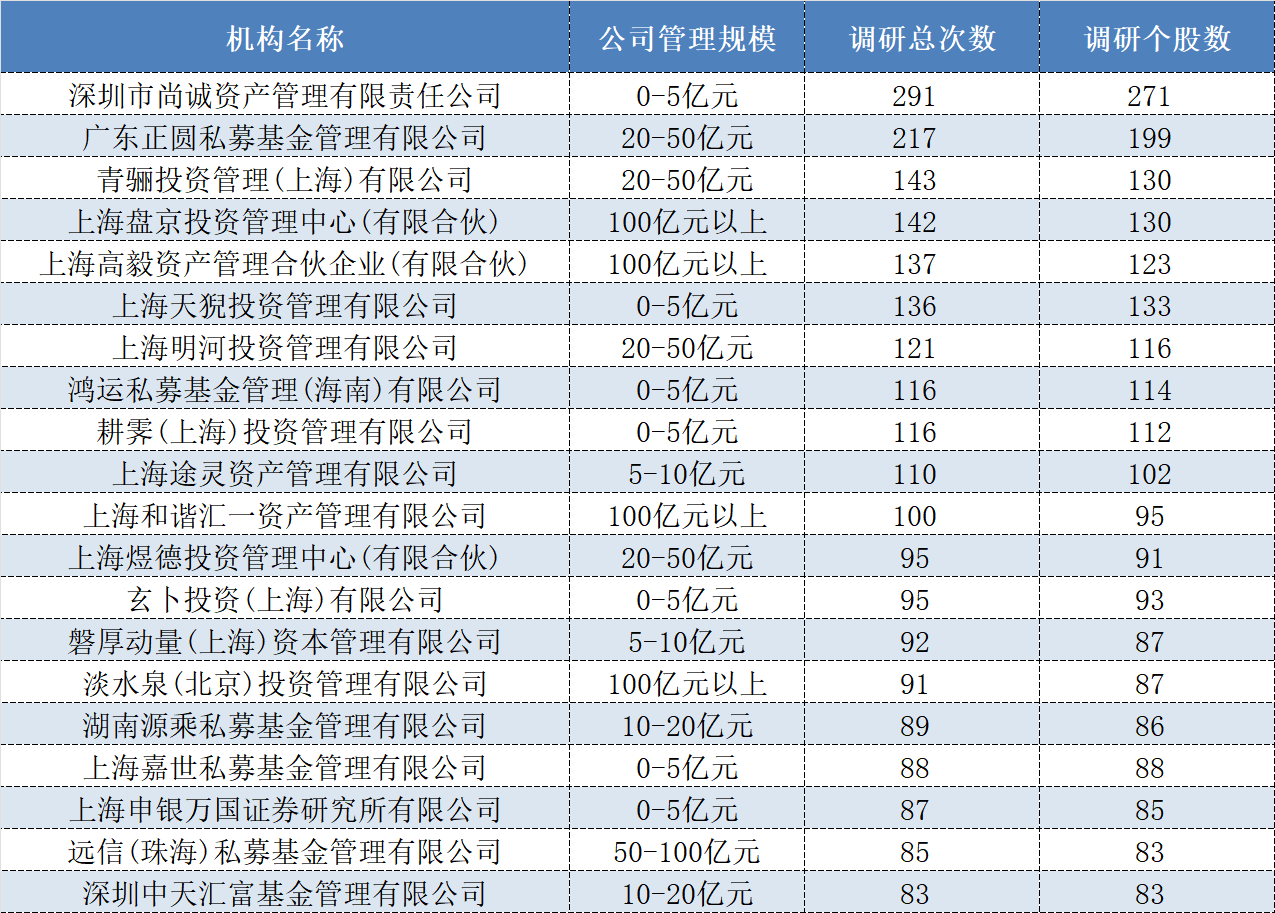
Core Insights - The article highlights the active engagement of private equity firms in conducting research on listed companies, with a total of 2712 private equity firms researching 1490 stocks, resulting in 18,500 research instances since the beginning of the second half of the year [1][4]. Group 1: Private Equity Research Activity - The most active private equity firms include Shenzhen Shangcheng Asset Management with 291 research instances and Guangdong Zhengyuan Private Equity with 217 instances, covering 271 and 199 stocks respectively [2][1]. - Other notable firms include Qingli Investment and Pankin Investment, with 143 and 142 research instances respectively, both covering 130 stocks [1][2]. - A total of 45 private equity firms conducted between 50 to 100 research instances during the same period [1]. Group 2: Focus Areas of Research - The TMT (Technology, Media, and Telecommunications) sector is a primary focus, with 384 stocks researched, accounting for 25.77% of the total [4]. - Within the TMT sector, the electronics and computer industries had 207 and 118 stocks researched respectively, while the telecommunications and media sectors had fewer stocks at 38 and 21 [4]. - Other sectors with significant research interest include machinery and pharmaceuticals, with 200 and 179 stocks researched respectively [5]. Group 3: Market Performance - The average increase in the 31 Shenwan primary industry indices since the beginning of the second half of the year is 15.13% [5]. - Specific indices in the TMT sector, such as telecommunications, electronics, and power equipment, have seen increases exceeding 40% [5]. - The machinery and basic chemicals sectors also performed well, with increases of 24.16% and 16.47% respectively [5]. Group 4: Stock Performance - Among the 1490 stocks researched, 558 stocks saw price increases between 0%-20%, while 406 stocks increased between 20%-50%, together making up 64.7% of the total [7]. - A total of 44 stocks experienced price increases exceeding 100%, and 154 stocks increased between 50%-100% [7]. - Five stocks attracted over 100 private equity firms for research, including Maiwei Biotech and Mindray Medical, with respective price increases of 66.97% and 3.14% [8].




AI人工智能长期发展趋势不变,AI人工智能ETF(512930)涨超1.0%冲击2连涨
Xin Lang Cai Jing· 2025-10-16 02:44
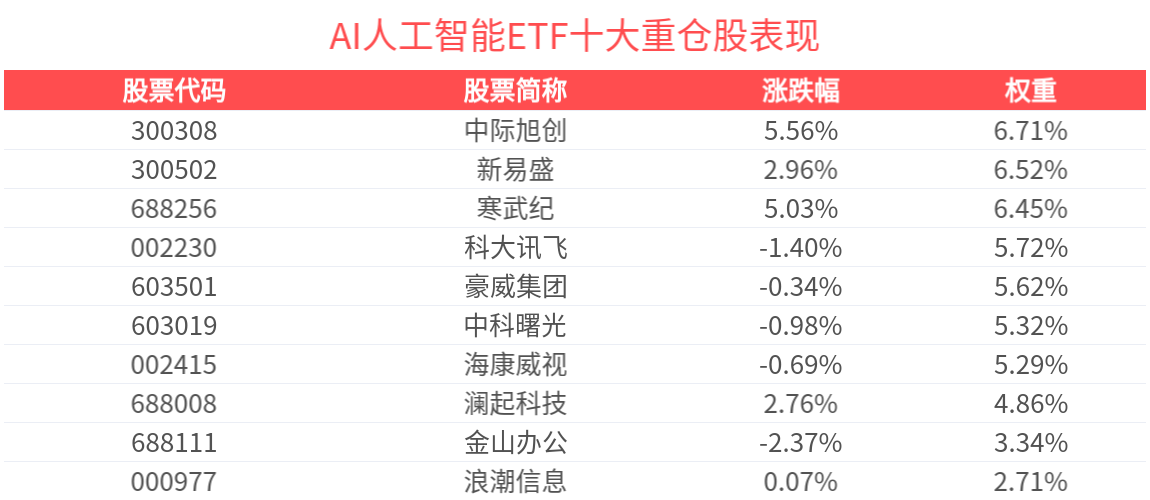
Core Viewpoint - The long-term development trend of AI remains unchanged globally, with overseas markets entering a virtuous cycle driven by AI performance and capital expenditure, while the domestic AI ecosystem is rapidly improving, indicating acceleration in the AI industry chain in China [1] Group 1: AI Industry Performance - As of October 16, 2025, the CSI Artificial Intelligence Theme Index (930713) rose by 1.14%, with notable increases in constituent stocks such as Zhongji Xuchuang (300308) up by 5.56%, Cambricon (688256) up by 5.03%, and Xinyi Sheng (300502) up by 2.96% [1] - The AI Artificial Intelligence ETF (512930) increased by 1.08%, with a latest price of 2.06 yuan, and has accumulated a rise of 1.65% since the beginning of October 2025 [1] Group 2: ETF Tracking and Composition - As of October 15, 2025, the AI Artificial Intelligence ETF has a tracking error of 0.009% over the past three months, the highest tracking precision among comparable funds [2] - The CSI Artificial Intelligence Theme Index includes 50 listed companies involved in providing foundational resources, technology, and application support for AI, reflecting the overall performance of AI-themed listed companies [2] - The top ten weighted stocks in the CSI Artificial Intelligence Theme Index as of September 30, 2025, include Xinyi Sheng (300502), Zhongji Xuchuang (300308), and Cambricon (688256), collectively accounting for 61.36% of the index [2]