东鹏饮料

Search documents
消费热潮来袭!政策加码,股市资金涌入,机构密集调研揭示哪些新机遇?
Sou Hu Cai Jing· 2025-12-25 03:59
Group 1 - The core viewpoint of the articles highlights the proactive measures taken by various regions in China to stimulate consumer spending ahead of the traditional consumption peak season, with a focus on integrating business and finance to enhance consumer demand [1][3] - During the "14th Five-Year Plan" period, China's total retail sales of consumer goods are projected to increase from 39.1 trillion yuan in 2020 to 48.3 trillion yuan by 2024, representing an average annual growth rate of 5.5% [1] - The Ministry of Commerce, the People's Bank of China, and the financial regulatory authority have issued a notice to strengthen collaboration between local departments and financial institutions to promote consumer spending [1] Group 2 - In the capital market, over 22 billion yuan has flowed into more than 20 ETFs focused on consumption themes, including tourism and food and beverage, since December 1 [3] - The Wande Consumer Index and Wande Domestic Demand Upgrade Index consist of 87 stocks primarily in the pharmaceutical, automotive, electronics, and food and beverage sectors, with a total financing balance of nearly 320 billion yuan, reflecting a growth of over 45% since the end of last year [3] - Several companies, such as Huichuan Technology and Mindray Medical, have attracted significant institutional interest, with Huichuan receiving over 1,600 institutional visits and Mindray hosting around 1,000 [3]


华源证券:食品饮料板块复苏分化 关注ROA企稳与结构性景气赛道
智通财经网· 2025-12-25 03:57
Core Viewpoint - The report from Huayuan Securities indicates a recovery sequence in the food and beverage industry, with soft drinks and snacks leading the recovery, followed by the catering supply chain, condiments, dairy products, beer, and finally, liquor [1][2]. Group 1: Recovery Sequence Analysis - The recovery rhythm of different consumption sectors shows both differences and commonalities, driven by industry supply-demand dynamics and supply chain structures [2]. - The commonality lies in the prevailing competition in the existing market, where companies focus on increasing sales to digest capacity and enhance operational efficiency [2]. - ROA (Return on Assets) is identified as a leading indicator for the operational recovery of consumer enterprises, with a detailed analysis of the stages of enterprise and channel adjustments [2]. Group 2: Historical Context and Insights - An analysis of Japan's consumption differentiation in the 1990s reveals that industries that can capture structural opportunities typically meet two conditions: addressing demand pain points and having low penetration rates [3]. - The rapid development of cost-effective options and health-oriented niche categories in Japan during that period illustrates the potential for growth in low-penetration sectors [3]. Group 3: Investment Strategy - From a pricing perspective, rising CPI may lead to valuation recovery in traditional industries with higher penetration rates, such as liquor, beer, and dairy products, which are expected to attract incremental capital [4]. - Recommendations include focusing on leading companies in these sectors, such as Kweichow Moutai, Luzhou Laojiao, and Yili Group [4]. - From a volume perspective, companies with high supply chain efficiency in cost-effective consumption are likely to see volume growth, with specific recommendations for companies in the catering supply chain and soft drinks [4].
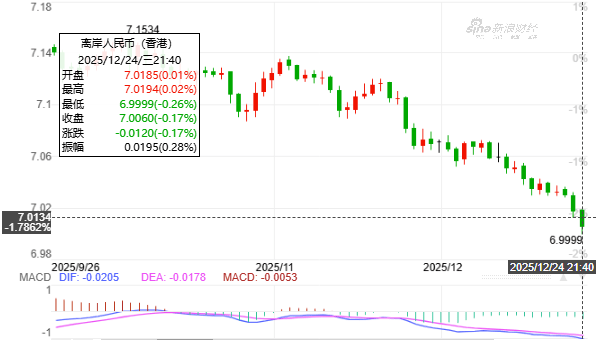
离岸人民币兑美元升穿7.0!是什么在助推这波上涨,谁将受益?
Sou Hu Cai Jing· 2025-12-24 14:43
Group 1 - The core driving factors for the recent appreciation of the offshore RMB against the USD include a shift in economic focus towards domestic demand and consumption, significant gold purchases by the central bank, and a weakening USD due to market conditions [1][4][5] - The offshore RMB has seen a strong upward trend, breaking the 7.0 mark against the USD, reaching 6.9999, the highest since October 2024, with onshore RMB also surpassing 7.02 [1][2] - The appreciation trend began in late November 2025, with onshore and offshore RMB appreciating over 900 and 1000 basis points respectively, with annual appreciation rates of 3.7% and 4.4% [4][5] Group 2 - The international metal market has experienced a surge in prices, with spot gold exceeding $4500 per ounce, silver above $70 per ounce, and copper reaching $12000 per ton, all setting historical peaks [2] - Domestic exporters are increasingly converting their foreign currency receipts into RMB immediately upon arrival, indicating a shift in behavior due to currency fluctuations [2][5] Group 3 - The appreciation of the RMB is expected to benefit several industries, particularly the non-ferrous metals sector, which is closely tied to price movements and performance in the context of global liquidity [9] - Import-dependent industries such as paper manufacturing, aviation, and oil refining will also benefit from the RMB appreciation, as it reduces costs for raw materials priced in USD [11][12][16] - Financial institutions, including banks and brokerages, are likely to see increased opportunities due to foreign capital inflows and the appreciation of RMB-denominated assets [16] Group 4 - The appreciation of the RMB may put pressure on export-oriented industries, which will need to find ways to balance profit margins amid rising costs and competitive pricing challenges [18] - Key sectors to watch include non-ferrous metals and paper manufacturing, which are expected to resonate positively with the appreciation and price increases, while consumer and pharmaceutical sectors may also attract foreign investment [18]
华源证券:重视ROA企稳的消费板块 寻找价或量仍景气的细分赛道
智通财经网· 2025-12-24 13:01
Core Viewpoint - Different consumer sectors exhibit both differences and commonalities in recovery rhythms, with ROA being a leading indicator for operational recovery in consumer enterprises [1][2] Group 1: Recovery Rhythm Analysis - The recovery rhythm of various consumer sectors is influenced by industry supply and demand, as well as supply chain structures, with a focus on stock market competition as a mainstream phenomenon [2] - The stages of enterprise and channel adjustments are outlined, starting from oversupply to a new balance in supply and demand, with ROA serving as a key indicator throughout these stages [2] - Current recovery sequences indicate that soft drinks and snacks are leading, followed by food supply chains, condiments, dairy products, beer, and finally, liquor [2][3] Group 2: Investment Strategy - Emphasis on sectors where ROA stabilizes, indicating potential valuation recovery opportunities, with a preference for sectors that still show price or volume growth [3] - Price logic suggests that rising CPI may drive valuation recovery in traditional industries with high penetration rates, such as liquor, beer, and dairy products, which are likely to attract incremental capital [3][4] - Recommended companies in the liquor sector include Kweichow Moutai, Luzhou Laojiao, and Shanxi Fenjiu, while in dairy, focus on Yili and Mengniu [3] Group 3: Volume Logic - In the context of cost-effective consumption, companies with high supply chain efficiency are expected to gain volume, with specific recommendations for companies in the food supply chain and soft drinks [4] - Industries with low penetration rates may withstand economic cycles, with recommendations for low-alcohol beverages and functional foods that can enhance brand premium through specialization [4] - Companies benefiting from overseas market expansion include Angel Yeast and Bailong Chuangyuan [4]




野村:2026年食品饮料策略 - 继续找寻细分高成长赛道和渠道
野村· 2025-12-24 12:57
Investment Rating - The report suggests a focus on individual stocks rather than the overall industry, indicating potential for high individual stock appreciation despite overall industry pressure [2][3]. Core Insights - Consumer confidence is gradually recovering, with strong growth in consumer-close channels such as convenience stores and membership stores, which saw a year-on-year increase of 4.9% [1][9]. - The food and beverage sector is currently undervalued, with cost stability expected to support corporate profitability as raw material costs are anticipated to remain flat or decrease next year [1][2]. - The alcoholic beverage segment is under pressure, particularly the baijiu industry, which is facing clearing and restrictions, while beer remains stable and the competition in yellow wine is changing significantly [1][6]. Summary by Sections B2B and B2C Business - B2B business in new retail channels and restaurant recovery is relatively weak, but significant changes are observed in C-end offline channels [4]. - C-end consumer confidence is gradually recovering, with stronger growth dynamics in consumer-close channels [4]. Industry Performance - The demand for alcoholic beverages is under pressure, with baijiu production declining and prices in a downward trend, although recent company price control has led to a rebound [5][6]. - The snack sector is experiencing rapid growth, while baking and cooked food operations are under pressure. Brands like Wancheng and Weilong are responsive to channel changes, leading to sustained growth [5][6]. Consumer Confidence and Economic Impact - The consumer confidence index has steadily improved, rising from 87.5 to 89.4 from January to October 2025, indicating a positive trend in consumer spending [12]. - Despite overall industry pressures, there are many growth opportunities in specific segments such as pre-processed foods and snacks, with products like electrolyte water and sugar-free tea continuing to grow rapidly [13]. Valuation and Investment Recommendations - The valuation of food and beverage companies is currently at historical lows, with many companies offering attractive dividend yields, such as Chongqing Beer exceeding 3% [15][16]. - The report recommends focusing on leading brands in specific segments, including top brands like Dongpeng Beverage and Nongfu Spring, as well as snack brands like Wancheng Group and Yanjinpuzi, and pre-processed food companies like Sanquan Foods and Anjui Foods [16].
扩内需:食品饮料行业投资机会
2025-12-24 12:57
Summary of Key Points from the Conference Call Industry Overview - The food and beverage industry is experiencing systemic opportunities driven by policies aimed at expanding domestic demand and increasing residents' income levels, which are expected to enhance consumption capabilities [1][2] - The liquor industry is undergoing a deep adjustment, with expectations of entering an EPS killing phase by 2025, while high-end liquor brands like Moutai and Lao Jiao are recommended for investment [1][4] - The dairy industry has completed supply-demand adjustments, with anticipated increases in demand for milk powder and liquid milk due to fertility and income policies, highlighting companies like Yili and New Dairy as potential recovery opportunities [1][5] - The snack food sector is benefiting from the "lipstick effect," new channels, and health trends, with recommendations for companies such as Salted Fish, Wei Long, Wan Chen Food, and Qiaqia Food [1][6] - The beverage sector is seeing a clear trend towards health, with non-traditional channels gaining market share, making high-growth companies like Dongpeng Beverage noteworthy [1][7] Key Insights and Arguments - The central economic work conference in 2026 will prioritize expanding domestic demand, which is expected to lead to a series of policies stimulating consumption, positively impacting the food and beverage industry [2] - The food and beverage sector has faced significant changes in volume, price, and channel structure over the past six years, with varying performances across sub-sectors [3] - The liquor sector is expected to see marginal improvements in 2026, driven by policies aimed at boosting business and government consumption [4] - The dairy sector is projected to enter a recovery phase, with increased demand anticipated due to supportive policies [5] - The snack food market is expected to gradually recover, supported by rising incomes and new retail channels [6] Additional Important Content - Cost fluctuations are a significant factor affecting the performance of consumer goods companies, with some agricultural product costs declining, providing investment opportunities [9] - The planting area for sunflower seeds is expected to recover, leading to a projected 10% decrease in the cost of sunflower seeds, which will positively impact Qiaqia Food's gross margin [10][11] - The konjac market is facing supply-demand imbalances, with high prices expected to ease in 2026, alleviating cost pressures for companies like Wei Long and Salted Fish [12] - The sugar molasses market is currently at low prices, providing strong support for Angel Yeast's profitability [13] - Innovative companies are leveraging product and channel innovations to drive growth, with notable examples including Nongfu Spring and Uni-President [14] - Efficient supply chain management is crucial for companies, with Dongpeng Beverage demonstrating strong performance in this area [15] Future Outlook - Dongpeng Beverage is expected to achieve double-digit growth in 2026 through strategic measures and product innovations [16] - Wan Chen is enhancing store quality and accelerating store openings, which is expected to improve profitability in the snack food sector [17][18] - Hai Tian Flavoring has implemented efficiency improvements under new management, resulting in revenue and profit growth exceeding industry averages [19] - The restaurant industry is expected to see a mild recovery, with companies like Yihai International and Tianhe Flavoring showing potential for improvement [20][21] - In the liquor sector, companies like Yanghe and Budweiser are expected to benefit from product and channel improvements, leading to potential breakthroughs in performance [22][23][25] - Gan Yuan Food is focusing on expanding e-commerce and high-end membership stores, with a stable development outlook [26][27] - Overall, companies in the food and beverage sector are expected to experience gradual recovery and growth, making them worthy of investor attention [28]





食品饮料2026年投资策略报告:曙光渐显,在分化中前行-20251224
Hua Yuan Zheng Quan· 2025-12-24 12:13
Group 1: Core Insights - The report emphasizes the recovery stage of consumer spending, highlighting that different sectors exhibit both commonalities and differences in their recovery rhythms, driven by supply-demand dynamics and industry structure [4][5] - ROA (Return on Assets) is identified as a leading indicator for the operational recovery of consumer companies, with a focus on analyzing various sub-sectors [4][13] Group 2: Sector Performance - The current recovery sequence indicates that soft drinks and snacks are leading, followed by the catering supply chain, condiments, dairy products, beer, and finally, liquor [5][25] - The report draws parallels with Japan's 1990s consumption differentiation, noting that sectors addressing consumer pain points and with low penetration rates are likely to succeed [5][6] Group 3: Investment Strategy - The report suggests focusing on sectors where ROA is stabilizing, indicating potential valuation recovery opportunities, particularly in traditional sectors like liquor, beer, and dairy [6][8] - It recommends identifying sub-sectors with either price or volume growth, with a preference for price-driven strategies [6][8] Group 4: Detailed Sector Analysis - The frozen food sector is showing signs of marginal improvement, with leading companies enhancing operational efficiency through product innovation and channel reforms [27][28] - The snack sector is experiencing high demand, driven by new channel developments, although competition is intensifying [33][35] - The beer industry is under pressure, with a focus on high-end products, but overall growth is slowing due to external economic factors [39][41] - The dairy sector is nearing the end of its adjustment phase, with expectations of improved performance as raw milk prices rise [41][42] - The liquor sector is currently in a phase of inventory reduction, with performance risks gradually clearing as channels stabilize [43][48]


如何布局跨年攻势?科技与内需主题轮动!消费ETF(159928)三连跌走势,资金逢跌布局,3日累计巨幅净流入超7亿元!
Sou Hu Cai Jing· 2025-12-24 06:48
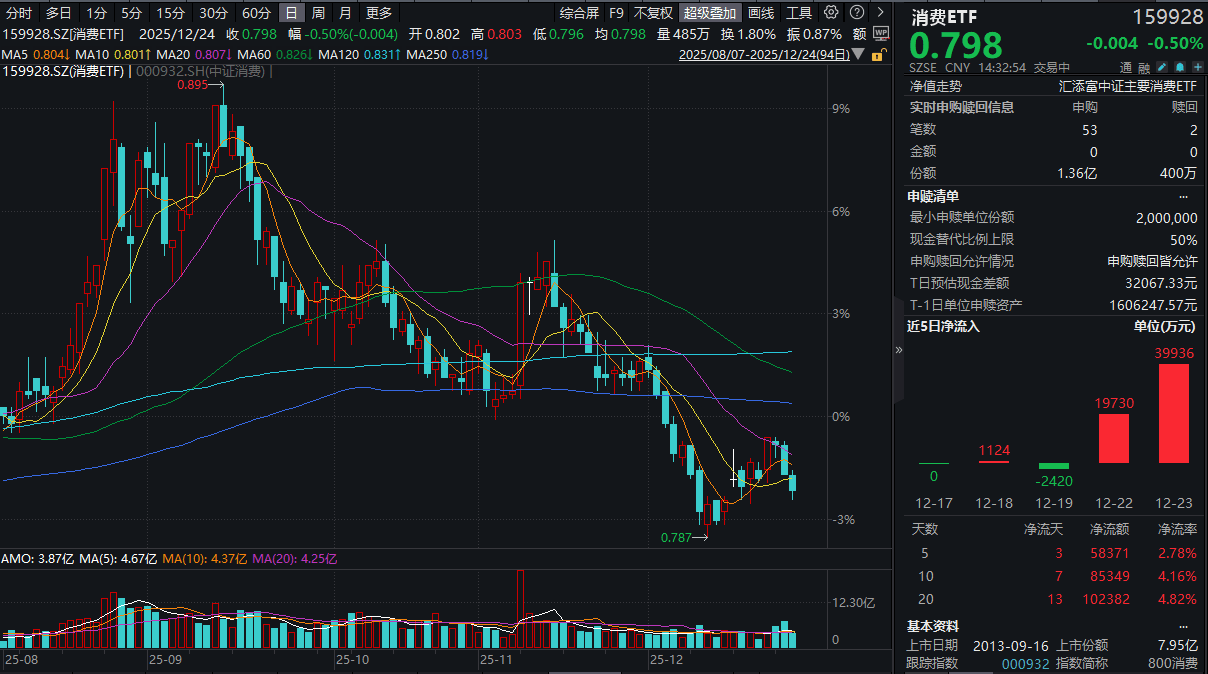
Market Overview - A-shares experienced a rebound, with the consumption ETF (159928) declining by 0.5% and a trading volume exceeding 380 million yuan [1] - The consumption ETF has seen a net subscription of over 130 million units during the day, accumulating a significant net inflow of over 700 million yuan over three days [1] Spring Market Expectations - As the year-end approaches, discussions about the spring market are intensifying, with analysts expecting positive policies to boost investor confidence [3] - The anticipated improvement in corporate earnings and favorable liquidity conditions are expected to contribute to a "spring rally," with technology growth and domestic consumption identified as key investment themes [3] Valuation Insights - The consumption ETF's underlying index has a TTM price-to-earnings ratio of 19.32, placing it in the 2.8% percentile over the past decade, indicating a high valuation attractiveness [5] - Seasonal trends in Q4 suggest a potential shift in market style towards undervalued sectors, particularly in December [5] Investment Themes - The rotation between domestic demand and technology themes is noted, with significant inflows into sectors like dairy, retail, and food processing [7] - External factors such as the Federal Reserve's interest rate cuts and the Bank of Japan's rate hikes are expected to stabilize market risk appetite [7] AI Applications - The domestic AI industry is entering a phase of large-scale demonstration applications, driven by advancements in computing architecture and product iterations [8] - Notable developments include the launch of new GPU architectures and AI health applications achieving significant user engagement [8] Commercial Aerospace - The upcoming launch of the Long March 12 rocket and advancements in satellite networking are highlighted as key developments in China's commercial aerospace sector [9] - The National Space Administration's action plan aims to support the development of new technologies and applications in commercial aerospace [9] Hainan Free Trade Zone - The Hainan Free Trade Port has officially launched its full island closure, with significant foreign investment projects commencing operations [9] - The first day of customs supervision saw substantial imports benefiting from zero tariffs, indicating a positive start for the free trade zone [9] Domestic Consumption - Policies aimed at boosting consumption are being implemented, with new consumption scenarios emerging in sports events, tourism, and cultural activities [10] - The expected growth in ice and snow sports consumption is projected to exceed 187.5 billion yuan, reflecting a 25% year-on-year increase [10] New Consumption Trends - The Chinese consumption market is characterized by structural highlights despite overall weak demand, with new products and channels gaining traction [11] - Health-conscious consumption trends are accelerating, particularly in sectors like health supplements and functional foods [11] ETF Composition - The consumption ETF's top ten constituent stocks account for over 68.55% of its weight, with leading liquor brands and major agricultural companies prominently featured [12]
2025HHI世界街舞锦标赛中国总决赛在上海举行
Xin Lang Cai Jing· 2025-12-23 12:55
作为比赛东道主,上海视觉艺术学院队获得迷你小齐舞组的亚军,成人小齐舞组的第七名。(视频为青 少年大齐舞冠军成都目黑少年团的表演,由赛事主办方提供) 来源:中国青年报客户端 中国青年报客户端讯(中青报·中青网记者 慈鑫)12月20日至21日,2025东鹏特饮HHI世界街舞锦标赛 中国赛总决赛在上海视觉艺术学院举行。作为HHI世界街舞锦标赛中国赛全国30站分站赛的年度收官之 战,本次比赛汇聚了近800名参赛选手,展现了当前中国街舞运动的水准与活力。 本次总决赛设置个人斗舞与齐舞两大类共8个项目,涵盖霹雳舞、锁舞、震感舞、自由式、甩手舞等多 个主流舞种。经过两天的激烈角逐,各项目冠军各有归属。 ...
国泰海通 · 晨报1224|siRNA药物、食品饮料
国泰海通证券研究· 2025-12-23 11:27
Group 1: siRNA Drug Development - The core viewpoint is that siRNA drugs are transitioning from rare diseases to common diseases, driven by technological upgrades and product approvals, marking a new era in targeted therapy [3][4] - siRNA drugs are characterized by strong target expansion capabilities, robust research extensibility, long-lasting effects, and low likelihood of developing resistance, making them a focus for domestic pharmaceutical companies [3][4] - Since 2016, with advancements in the GalNac delivery system and fully modified applications, siRNA drugs have entered a rapid development phase, validating their value in rare diseases and gradually moving towards common disease research [3][4] Group 2: Market Dynamics and Opportunities - The market for small nucleic acid drugs is heating up, with multinational corporations (MNCs) actively engaging in business development (BD) transactions, indicating a sustained interest in this field [4] - Chinese companies are expected to shine in this area due to their engineering advantages, particularly in chemical synthesis, allowing for rapid iteration on leading technologies [4] - The commercialization process of siRNA drugs is focused on common diseases with clear biological mechanisms, where early movers are likely to gain significant commercial benefits [5] Group 3: Industry Trends and Future Outlook - The efficiency and specificity of the GalNac delivery system present opportunities for breakthroughs in liver-targeted therapies and the exploration of previously challenging drug targets [5] - The industry is witnessing a shift towards addressing common diseases, with a focus on new disease areas and advancements in extrahaptic delivery systems [5] - The overall sentiment in the pharmaceutical sector is optimistic, with expectations of significant developments in the siRNA drug space, particularly in large indications such as cardiovascular diseases and chronic hepatitis B [3][4][5]