欧派家居

Search documents
好的创业一定伴随着乐趣
创业家· 2026-01-26 10:52
Core Viewpoint - The article emphasizes the importance of cultural empathy and brand storytelling in the growth of Chinese brands, particularly in the context of the global market where mere cost advantages are no longer sufficient for success [7]. Group 1: Brand Development Strategies - Chinese brands are transitioning from a focus on production capabilities to establishing their ecological positions and selling brand value in a competitive market [7]. - The article identifies the "golden decade" for lifestyle brands in sectors such as beauty, home, dining, and fashion, highlighting the need for brands to learn from European counterparts in creating emotional connections with consumers [7]. - The three core elements of enduring European brands are identified as scarcity narrative, supply chain control, and lifestyle definition [8]. Group 2: Learning from European Brands - Scarcity narrative involves shifting from "selling products" to "selling dreams," which is crucial for brand differentiation [8]. - Supply chain control is essential for defining industry standards, as exemplified by L'Oréal's integration of technology, content, and channels to create successful products [10]. - Lifestyle definition focuses on how design and innovation can reshape consumer experiences, as seen in the practices of brands like Prada and educational institutions like Le Cordon Bleu [12]. Group 3: Program Overview - The program includes visits to key locations in Paris and Milan, such as the IFM French Fashion Institute and Loro Piana, to understand the foundations of luxury branding and the importance of material quality [16][23]. - Participants will explore how to leverage brand origin stories and craftsmanship to build competitive advantages [18]. - The itinerary also covers insights into the integration of art and design in product offerings, as demonstrated by brands like FORMER, which has successfully elevated furniture to a higher value proposition [24].


2026年,钱从哪挣?
创业家· 2026-01-26 10:52
Core Viewpoint - The article discusses the importance of exploring international markets for Chinese companies in response to domestic demand shortages and increasing competition, emphasizing the need for a comprehensive approach to overseas expansion that includes the entire value chain [2][5][6]. Group 1: Value Chain Expansion - The concept of "going overseas" has evolved from merely exporting products to relocating the entire value chain, including branding, research and development, and business models to foreign markets [8][11]. - An example is Miniso, which engages with its millions of private domain users to understand their preferences and directly opens stores overseas to enhance brand recognition [12][13]. Group 2: Collaborating with Industry Leaders - Many industry leaders are beginning to explore international markets, but successful expansion requires integrating and collaborating with a complex supply chain [14][15]. - Tesla's Shanghai factory exemplifies this, as it operates efficiently due to the support of numerous upstream and downstream suppliers within a 300-kilometer radius [18][20]. - When Tesla expanded to Mexico, its suppliers followed, indicating that collaboration with leading companies can create opportunities for others [21][22]. Group 3: Leveraging Unique Advantages - Companies are finding unique advantages to succeed in international markets, such as cost advantages where products can be sold at double the domestic price on cross-border platforms [25][26]. - Product advantages are also highlighted, with examples like Mech-Mind Robotics, which enhances industrial robots with advanced technology to perform complex tasks [27][29]. Group 4: Building Long-Term Trust - The story of Pang Donglai illustrates the importance of building long-term trust through exceptional customer service and employee treatment, leading to a loyal customer base [31][34]. - By ensuring employees are respected and valued, companies can foster a culture of listening to customer feedback, which in turn enhances the customer experience and profitability [34][36]. Group 5: Meeting Aspirations for a Better Life - The article notes a shift in consumer behavior towards a desire for better experiences, with examples of services like travel photography that cater to previously unrecognized consumer needs [39][40]. - As traditional large-scale commercial opportunities diminish, there is a growing trend towards more refined and heartfelt business ecosystems that focus on fulfilling ordinary people's aspirations for a better life [43][46].


造纸轻工周报2026、01、19-2026、01、23:地产情绪升温,家居板块估值底部向上,关注金属包装提价-20260126
Shenwan Hongyuan Securities· 2026-01-26 10:08
Investment Rating - The report maintains a positive outlook on the home furnishing sector, indicating that valuations are at a bottom and are expected to rise due to favorable real estate policies [2][5][17] Core Insights - The home furnishing sector is poised for valuation recovery driven by improved real estate policies and market stabilization, with a focus on companies with high dividend safety margins such as Gujia Home, Sophia, and Oppein [2][5][6] - The metal packaging industry is seeing price increases for two-piece cans, leading to improved profitability and a more consolidated industry structure [2][5][6] - The AI glasses market is expected to grow significantly, with Meta's optimistic shipment forecasts and partnerships enhancing production capabilities [2][10][11] - The paper industry is stabilizing in the short term, with potential for improved supply-demand dynamics and profitability in the medium term [2][14][15] Summary by Sections Home Furnishing - The sector is experiencing a bottoming out of valuations, with real estate policies expected to catalyze upward movement. The central economic work conference emphasizes stabilizing the real estate market, which is anticipated to improve demand for home furnishings [6][17] - The increase in second-hand housing transactions is expected to support demand recovery, while industry consolidation is accelerating, with mid-tier companies exiting the market [6][7][17] - Key companies to watch include Gujia Home, Sophia, Oppein, Mousse, and Xilinmen, which are positioned well for valuation recovery [2][5][6] Metal Packaging - The industry is witnessing price increases for two-piece cans, with a confirmed profit margin turning point in 2026. The consolidation of leading companies is enhancing pricing power and profitability [2][5][6][8] - The demand from downstream sectors, particularly beer and carbonated beverages, is expected to drive growth, with significant room for improvement in can penetration rates compared to developed markets [7][8] AI Glasses - Meta's production capacity for AI glasses is rapidly increasing, with expectations to double output to 20 million units by the end of 2026. This growth is supported by strong market demand and technological advancements [10][11] - Partnerships with companies like EssilorLuxottica and the establishment of joint ventures are expected to accelerate the rollout of AI glasses [11][12] Paper Industry - The short-term stability of boxboard prices is noted, with medium-term improvements in supply-demand dynamics anticipated to enhance profitability [14][15] - The report highlights the importance of integrated supply chains and cost advantages for companies like Sun Paper and Nine Dragons Paper, which are well-positioned to benefit from market recovery [14][15]


家居用品板块1月26日跌1.72%,松霖科技领跌,主力资金净流出4.76亿元
Zheng Xing Xing Ye Ri Bao· 2026-01-26 09:37
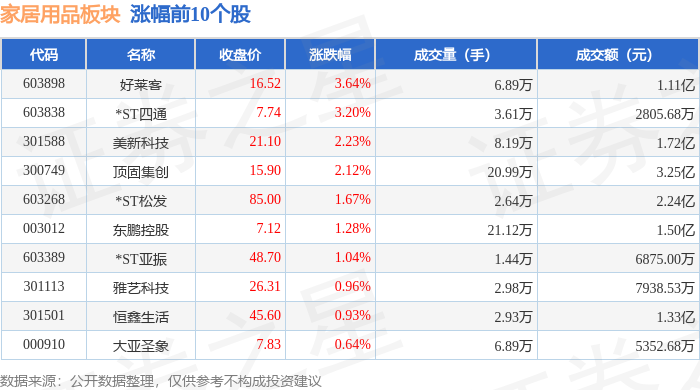
Group 1 - The home goods sector experienced a decline of 1.72% on January 26, with Songlin Technology leading the drop [1] - The Shanghai Composite Index closed at 4132.61, down 0.09%, while the Shenzhen Component Index closed at 14316.64, down 0.85% [1] - Notable gainers in the home goods sector included Haolaike, which rose by 3.64% to a closing price of 16.52, and ST Sitong, which increased by 3.20% to 7.74 [1] Group 2 - The home goods sector saw a net outflow of 476 million yuan from major funds, while retail investors contributed a net inflow of 274 million yuan [2] - Major stocks like Dinggu Jichuang and Meixin Technology had significant net inflows from retail investors, with Dinggu Jichuang seeing a net inflow of 27.63 million yuan [3] - The overall trading volume in the home goods sector was substantial, with stocks like Taili Technology and Filinger experiencing notable declines of 6.86% and 6.15%, respectively [2][3]

高端家居第一股,出事了
商业洞察· 2026-01-26 09:24
Core Viewpoint - The article discusses the severe financial and operational crisis faced by Meike Home, highlighting its transition from a leading high-end furniture brand to a company on the brink of collapse due to unpaid wages, production halts, and significant financial losses [5][7][12]. Group 1: Crisis Overview - Meike Home's controlling shareholder, Meike Investment Group, had 488 million shares frozen by the court, representing 100% of its stake in the company [9]. - The company announced the suspension of operations at two wholly-owned subsidiaries due to low capacity utilization, averaging less than 20% [10]. - Employees reported unpaid wages for several months, leading to a controversial "salary offset" scheme where employees must sell furniture to earn their wages [10][11]. Group 2: Market and Operational Decline - The company has been closing stores rapidly since 2024, with significant locations in major cities like Nanjing and Beijing shutting down or reducing size [11]. - High rental costs and large workforce expenses have created a financial strain, exacerbated by declining customer traffic [12]. - Meike Home attempted to acquire a tech company to boost its stock price, indicating desperation amid its operational struggles [12]. Group 3: Historical Context and Strategic Missteps - Founded by an artist, Meike Home initially thrived by capitalizing on unique design and high-quality materials, becoming a major player in the furniture industry [14]. - The company failed to adapt to significant market changes, missing opportunities in the custom furniture trend and the shift in consumer preferences towards minimalism [15][16]. - Meike Home's reliance on a heavy asset model and direct retailing became a liability as market conditions shifted, leading to unsustainable operational costs [17]. Group 4: Financial Performance - Meike Home reported a cumulative loss of nearly 1.6 billion yuan over three years, with net losses of 298 million yuan in 2022 and 464 million yuan in 2023, and projections indicating losses could exceed 800 million yuan in 2024 [19][20]. - The company's gross margin, previously between 40%-50%, has declined significantly due to discounting efforts to clear inventory [20]. - The sales expense ratio remains alarmingly high at 30%-40%, leading to unsustainable financial practices compared to competitors [21][22]. - As of Q3 2025, the company's cash reserves were critically low, with a cash-to-short-term debt ratio below 0.1, indicating severe liquidity issues [22][23].


轻工制造、纺织服饰行业周报:头部纸企白卡纸提价,去年国内消费市场稳增长-20260126
BOHAI SECURITIES· 2026-01-26 09:10
Investment Rating - The report maintains a "Neutral" rating for the light industry and textile apparel sectors [53] - Specific companies such as Oppein Home (603833), Sophia (002572), Explorer (300005), Semir Apparel (002563), Guai Bao Pet (301498), and Zhongchong Co. (002891) are rated as "Buy" [53] Core Insights - Major paper companies are set to increase white card paper prices by 200 yuan/ton after the Spring Festival, driven by rising operational costs and a reduction in supply due to maintenance shutdowns [16][9] - The domestic consumption market is projected to exceed 4 trillion yuan, with retail sales of consumer goods expected to grow by 3.7% in 2025, supported by policies promoting consumption [10][52] - The report highlights a positive trend in the light industry, with the sector outperforming the CSI 300 index by 5.10 percentage points from January 19 to January 23 [46][49] Industry News - White card paper prices are currently stable at 4,560 yuan/ton, with expectations for an increase due to upcoming maintenance periods in major paper companies [9][52] - Bubble Mart has repurchased shares totaling nearly 350 million Hong Kong dollars, indicating strong market confidence [16] Important Company Announcements - Zhihong Home expects a decline in net profit attributable to shareholders by 42.92%-55.89% in 2025 [4][46] - Lutai A anticipates a net profit increase of 38.92%-53.54% in 2025 [5][46]




建筑材料行业跟踪周报:继续看好地产链估值修复
Soochow Securities· 2026-01-26 05:24
Investment Rating - The report maintains an "Overweight" rating for the construction materials sector [1]. Core Views - The real estate chain is expected to see a valuation recovery in 2026, with a potential rebound driven by policy expectations and market dynamics. Key stocks to watch include high-dividend companies and those in the export sector [2]. - The technology sector is highlighted as a priority, with domestic semiconductor development expected to accelerate, benefiting cleanroom engineering and related companies [2]. - Consumer performance remains subdued, but cost-cutting measures are showing positive effects, indicating that the clearing phase in the real estate chain is nearing completion [2]. - The report emphasizes the importance of global trade stability and the potential for fiscal expansion in major economies, which could positively impact sectors like AI and innovative pharmaceuticals [2]. Summary by Sections 1. Construction Materials Fundamentals and High-Frequency Data - Cement prices remain stable at 347.7 CNY/ton, unchanged from the previous week but down 52.2 CNY/ton year-on-year. The average cement inventory ratio is 59.4%, up 0.5 percentage points week-on-week [6][15]. - The average daily cement shipment rate is 29.5%, down 10.4 percentage points from the previous week but up 16.1 percentage points year-on-year [23][25]. - Glass prices are slightly up at 1138.8 CNY/ton, but down 257.2 CNY/ton compared to the same period last year. Inventory levels are at 4,977 million weight boxes, down 9,000 from last week but up 1,188,000 from last year [49][46]. 2. Industry Dynamics Tracking - The report notes that the cement industry is undergoing supply-side adjustments, with a focus on eliminating outdated capacity. This is expected to improve the utilization rate of clinker capacity [10]. - The glass industry is facing a supply contraction, which may provide price elasticity in 2026. However, the current demand is weak, and inventory levels remain high [10]. - The fiberglass sector is projected to see stable growth in demand, particularly in wind power and new applications, despite a general decline in profitability [10]. 3. Weekly Market Review and Sector Valuation - The construction materials sector saw a weekly increase of 9.23%, outperforming the Shanghai and Shenzhen 300 index, which decreased by 0.62% [6]. - The report suggests that the valuation of leading companies in the sector is at historical lows, indicating potential for recovery as industry policies take effect [10].
建筑材料行业跟踪周报:继续看好地产链估值修复-20260126
Soochow Securities· 2026-01-26 04:52
Investment Rating - The report maintains an "Overweight" rating for the construction materials industry [1]. Core Views - The real estate chain is expected to see a valuation recovery in 2026, with a potential rebound driven by policy expectations and market dynamics [2]. - The report highlights several sectors for investment focus, including high-dividend stocks, export-oriented industries, and home improvement consumption [2]. - The technology sector is emphasized, particularly in domestic semiconductor development and AI applications, which are projected to grow rapidly [2]. - The report indicates that the performance of the real estate chain remains subdued, but cost-cutting measures are showing positive effects [2]. - The global trade environment is expected to stabilize, with fiscal expansion in major economies supporting sectors like AI and innovative pharmaceuticals [2]. Summary by Sections 1. Construction Materials Fundamentals and High-Frequency Data - Cement prices remain stable at 347.7 CNY/ton, unchanged from the previous week but down 52.2 CNY/ton year-on-year [6][15]. - The average cement inventory ratio is 59.4%, up 0.5 percentage points from last week and up 3.1 percentage points from the same period last year [23]. - The average cement shipment rate is 29.5%, down 10.4 percentage points from last week but up 16.1 percentage points year-on-year [23]. 2. Industry Dynamics Tracking - The report notes that the cement industry is undergoing supply-side adjustments, with a focus on eliminating outdated capacity [10]. - The glass market is experiencing price stability, with average prices for float glass at 1138.8 CNY/ton, reflecting a slight increase from the previous week but a significant decrease from last year [46]. - The fiberglass sector is expected to see stable demand growth, particularly in wind power and new applications, with effective capacity projected to increase by 6.9% in 2026 [10]. 3. Weekly Market Review and Sector Valuation - The construction materials sector saw a weekly increase of 9.23%, outperforming the Shanghai and Shenzhen 300 index [6]. - The report suggests that the valuation of leading companies in the construction materials sector is at historical lows, indicating potential for recovery as industry policies take effect [10]. - Recommendations include companies like China National Building Material and Conch Cement, which are expected to benefit from improved industry dynamics and overseas market expansion [10].
地产预期改善,关注家居估值修复弹性
Huafu Securities· 2026-01-25 11:15
Investment Rating - The report maintains an "Outperform" rating for the industry [4] Core Insights - The home furnishing sector is currently at a historical low in valuation, with expectations for recovery driven by improving real estate sentiment and policy expectations [3][5] - The report highlights specific companies for investment, including Gujia Home, Oppein Home, and Sophia, while also suggesting attention to undervalued stocks like Minda Holdings and Zhibang Home [3] - The report anticipates profit growth for Minda Holdings with projected net profits of HKD 2.07 billion, HKD 2.12 billion, and HKD 2.21 billion for FY2026 to FY2028, corresponding to PE ratios of 9X and 8X [3] - For Goodbaby International, projected net profits for 2025 to 2027 are HKD 150 million, HKD 344 million, and HKD 385 million, with a current valuation suggesting a potential for recovery [3] Summary by Sections Home Furnishing - The report notes a 14.6% year-on-year increase in retail sales of furniture for 2025, with a 2.2% decline in December [5] - Residential construction area decreased by 20.2% year-on-year for 2025, with a 20.6% decline in December [5] - The report emphasizes the low valuation and institutional holdings in the home furnishing sector, suggesting a potential for valuation recovery [5] Paper and Packaging - As of January 23, 2026, prices for various paper products have shown a decline, with white cardboard down by 5 CNY/ton and boxboard down by 52.8 CNY/ton [8] - The report indicates that major paper companies are planning to increase prices by 200 CNY/ton in late February to early March [8] - The report recommends companies with strong domestic production capabilities, such as Nine Dragons Paper and Sun Paper, for investment [8] Consumer Goods - The report highlights a 9.0% year-on-year increase in retail sales for sports and entertainment products in December [5] - The consumer goods sector is expected to benefit from expanding channels and product price increases, particularly in oral care and medical products [5] - The report suggests investment opportunities in companies like Anta, Li Ning, and 361 Degrees, which are expected to perform well in the current market [5]
未来10年,这18个赛道将带来48万亿美元收入
创业家· 2026-01-25 09:33
Core Insights - McKinsey's report identifies 18 industry sectors likely to reshape the global business landscape, predicting revenues of $29 trillion to $48 trillion by 2040, contributing 18-34% to global GDP growth [2] E-commerce - By 2040, e-commerce's share of global retail revenue is expected to rise to 27%-38%, up from approximately 20% currently [3] - Growth drivers include market expansion in developing countries and new product categories in developed nations, such as healthcare and emotionally valuable products [4] - Significant investments are anticipated in customer acquisition and last-mile delivery across e-commerce platforms [5] Electric Vehicles - Electric vehicles (EVs) are projected to exceed 50% of global passenger car sales by 2040 [6] - Breakthroughs in battery technology and smart algorithms will significantly influence this sector, prompting increased R&D investments from both EV manufacturers and traditional automakers [7] Cloud Services - The demand for higher storage and computing capabilities is driven by a more interconnected world and the need for AI products requiring substantial computational power [9] - The cloud services industry experienced a 17% compound annual growth rate (CAGR) from 2005 to 2020, with similar growth expected in the coming decades [10] Semiconductors - The semiconductor industry is essential for the digital world, with demand from computing, data storage, automotive, communication, and industrial electronics driving growth [11] - A sustained CAGR of 6%-8% is forecasted for the semiconductor sector over the next decade [11] AI Software Services - The rapid development of AI has led to its classification as a distinct sector, with increasing usage of AI assistants [12] - Companies in the AI space are engaged in a competitive race to develop advanced foundational models and applications [13] Digital Advertising - Digital advertising, through search, social media, and media services, is expanding in value as internet usage among the middle class increases [14] - Continuous algorithm improvements enhance platforms' abilities to target customers and track advertising costs, although competition for user attention necessitates increased investment in engaging content [15] Streaming Video - Investment in customer acquisition and content production is rising, prompting streaming platforms to seek new revenue models [17] - Developing countries may provide incremental growth in subscription and advertising revenue for streaming services, with projections indicating over 1 billion households subscribing to long-form video services by 2040 [18] Shared Autonomous Vehicles - The advent of autonomous driving technology may reduce the necessity for personal vehicle ownership [19] - By 2040, shared autonomous vehicles could account for 25%-51% of shared mobility revenue [20] Space Economy - The world is on the brink of entering a space economy era, with advancements in reusable rocket technology changing the aerospace industry [21][22] Cybersecurity - Cybercrime caused approximately $950 billion in direct economic losses in 2020, with indirect losses potentially reaching $4-6 trillion [24] - Increasing awareness of cybersecurity has led companies to enhance their investments in this area [25] Batteries - Significant advancements in battery technology have tripled energy density over the past few decades [26] - The global energy transition is driving demand for batteries, particularly from electric vehicles, energy storage, and consumer electronics, with EVs expected to comprise over 80% of the battery market by 2040 [28] Video Games - By 2030, an estimated 40% of the global population may become video game players [30] - New gaming models, such as mobile and cloud gaming, are accelerating market growth, with free-to-play games generating substantial revenue [32] Robotics - The integration of AI with robotics is creating significant expectations for humanoid robots as "ultimate intelligent agents" [33] Industrial and Consumer Biotechnology - Breakthroughs in gene editing and other technologies are accelerating the application of biotechnology in agriculture, alternative proteins, consumer products, and bio-materials [37] Modular Construction - Modular construction methods, which involve prefabricating building components for on-site assembly, can significantly enhance construction efficiency [38] Nuclear Fission Power - The development of safer, smaller modular reactors presents opportunities to supplement renewable energy sources [39] Air Traffic - Electric vertical takeoff and landing vehicles and delivery drones are expected to drive significant technological changes in air traffic [41] Obesity Treatment Drugs - The prevalence of obesity is projected to rise from 15% in 2020 to 24% by 2035, indicating a potential market for effective weight loss products [43]