Blue Owl

Search documents
难怪拒投甲骨文!Blue Owl麻烦缠身:遭疯狂挤兑,赎回上限飙至17%
Hua Er Jie Jian Wen· 2026-01-08 10:20
Core Viewpoint - Blue Owl is significantly increasing the redemption limit for one of its private credit funds to address a surge in withdrawal requests from investors, highlighting the growing pressures faced by the once-popular private credit market [1] Group 1: Company Actions and Responses - Blue Owl plans to allow investors to withdraw up to 17% of net assets, approximately $685 million, exceeding the previous 5% quarterly limit [1] - The deadline for investor redemptions has been extended from December 31 to January 8 [1] - Craig Packer, co-founder of Blue Owl, stated that the fund has $2.4 billion in liquidity, including $1.2 billion in liquid loans, allowing the company to meet investor liquidity demands [3] Group 2: Industry Trends - The situation with Blue Owl reflects a broader trend in the industry, with non-listed Business Development Companies (BDCs) experiencing significant redemption levels that exceed historical averages [2] - Data from Goldman Sachs indicates that the average redemption amount for non-listed BDCs in Q4 was 5% of net assets, compared to a historical average of around 2% [4] - Robert A Stanger & Co. reported a 200% increase in redemption amounts for funds over $1 billion in assets during the last three months of 2025 [4] Group 3: Market Conditions and Challenges - The current market environment is intensifying structural pressures on non-listed BDCs, which typically set quarterly redemption limits to balance liquidity needs with the illiquid nature of fund investments [5] - Non-listed BDC investors can redeem at full book value, while publicly traded BDCs have recently underperformed, leading to significant discounts in trading prices [6] - Blue Owl previously faced scrutiny when it canceled merger plans for two private credit funds, which could have forced investors to incur losses of about 20% [6]
OWL DEADLINE: Faruqi & Faruqi Reminds Blue Owl Investors of the Pending Class Action Lawsuit with a Lead Plaintiff Deadline of February 2, 2026
Prnewswire· 2025-12-31 17:40
Core Viewpoint - The complaint against Blue Owl alleges violations of federal securities laws due to misleading statements and undisclosed liquidity issues, particularly related to BDC redemptions and the impact of a merger on investor redemptions [2][3][4]. Group 1: Allegations and Issues - Blue Owl is accused of experiencing significant pressure on its asset base from BDC redemptions, leading to undisclosed liquidity issues [2]. - The company is likely to limit or halt redemptions of certain BDCs, which contradicts previous positive statements made by the defendants regarding the company's business and prospects [2]. - A report indicates that Blue Owl has blocked redemptions in one of its private credit funds due to a merger, potentially resulting in large losses for investors [3]. Group 2: Financial Impact - Following the announcement of the merger, investors in Blue Owl Capital Corporation II will lose the ability to redeem cash at the fund's Net Asset Value (NAV), with shares trading approximately 20% below NAV [4]. - On November 17, 2025, Blue Owl's stock price fell by $0.85, or 5.8%, closing at $13.77 per share, indicating a negative market reaction and potential injury to investors [4]. Group 3: Legal Proceedings - The lead plaintiff in the class action is the investor with the largest financial interest, who will oversee the litigation on behalf of the class [5]. - The law firm Faruqi & Faruqi encourages individuals with information regarding Blue Owl's conduct to come forward, including whistleblowers and former employees [6].



超额回报光环褪色、银行业“反击”,私募信贷热潮正在降温
Zhi Tong Cai Jing· 2025-12-30 11:43
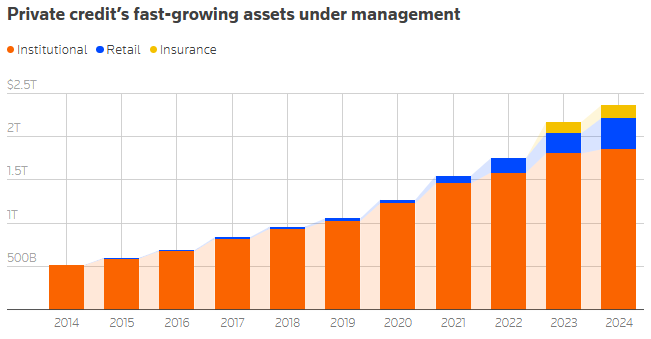
Core Viewpoint - The private credit industry, once distinct for its unique advantages, is increasingly resembling the public credit market, leading to a decline in return rates as banks recover and direct lending institutions invest heavily in retail tools [1][9]. Group 1: Industry Growth and Trends - The private credit industry's asset size has steadily grown to $2.4 trillion by 2024, with traditional closed-end funds raising $113 billion in the first half of 2025 [2]. - New funding sources, such as perpetual funds like Blackstone's BCRED, are rapidly gaining popularity, raising $48 billion in the first half of 2025, accounting for 40% of inflows into traditional institutional funds [2]. - The pursuit of retail funds is expected to continue, with estimates suggesting that individual wealth allocated to private credit could grow nearly fourfold to $1.5 trillion by 2029 [2]. Group 2: Challenges and Market Dynamics - A significant amount of raised capital, amounting to $543 billion, remains uninvested as of the end of 2024, indicating challenges in finding suitable investment opportunities [5]. - The additional premium that direct lending institutions charge over publicly issued bonds is under pressure, having halved in Europe to just over 1 percentage point, and sometimes even lower in the U.S. [8]. - Private credit is becoming a common financing tool in traditional acquisition markets, with borrowers increasingly leveraging competition between markets and lenders [9]. Group 3: Evolving Financing Structures - Direct lending institutions are adapting by offering more flexible loan structures, such as installment loans, to attract borrowers like private equity firms [8]. - Private credit managers are exploring new growth areas, with firms like Blue Owl becoming key players in financing AI assets, while Apollo utilizes its insurance arm to provide tailored financing to higher-rated companies [8]. - The lines between private and traditional credit are blurring, with retail fund growth potentially narrowing the gap and leading to a world of lower returns and higher liquidity [9].

巴菲特谢幕、OpenAI搅动万亿市值、谷歌强势崛起......2025全球十大商业事件盘点
华尔街见闻· 2025-12-28 12:49
Core Insights - The article highlights significant business events in 2025, emphasizing the rise of AI competition and the reshaping of the technology landscape [4] - Key players like OpenAI, Nvidia, and Google are at the forefront of this transformation, with substantial investments and strategic partnerships [1][3] AI Competition and Investments - The U.S. government announced a $500 billion investment in AI infrastructure, dubbed "Stargate," aiming to build 20 large-scale AI data centers [5] - OpenAI's partnership with SoftBank and Oracle faced challenges, leading to a reduction in project scope and delays in execution [6] - CoreWeave, a company specializing in GPU cloud services, went public with a valuation of approximately $230 billion, marking a significant moment for AI computing rental services [7][12] Major Corporate Developments - Nvidia became the first company to reach a market capitalization of $5 trillion, driven by the demand for AI-related hardware [24][26] - The company invested $50 billion in Intel, marking a strategic alliance to enhance their competitive positions in the PC and data center markets [13][15] - OpenAI's influence on the market was profound, with its valuation and orders significantly impacting the AI industry narrative throughout the year [17][21] Market Dynamics and Trends - The article discusses the shift in the automotive industry, particularly Germany's decision to amend its 2035 ban on internal combustion engines, reflecting the tension between aggressive transformation and market realities [2][40] - Google's advancements in AI, particularly through its TPU and Gemini models, are positioned to challenge Nvidia's dominance in the AI infrastructure market [43][44] Conclusion - The events of 2025 illustrate a complex interplay of alliances, competition, and market adjustments, with companies navigating the evolving landscape of AI and technology [3][21]

ETO Markets 出入金:2万亿泡沫裂缝里的散户血亏与AI融资断链
Sou Hu Cai Jing· 2025-12-22 09:48
Group 1 - The U.S. private credit market, once marketed as a "high-dividend safe haven," is now facing severe challenges due to high interest rates, a wave of defaults, and liquidity issues [2] - Blue Owl Capital, managing $180 billion in assets, abruptly withdrew from a $10 billion financing negotiation with Oracle, citing execution risks and Oracle's high leverage, which led to a spike in Oracle's five-year CDS to the highest level since 2009 [2] - The confidence in the "off-balance-sheet financing" model for AI infrastructure has plummeted, jeopardizing the capital expenditure chain of tech giants [2] Group 2 - Business Development Companies (BDCs) targeting retail investors have experienced a "double whammy" this year, with FS KKR Capital's stock price dropping by 33% and BlackRock BDC's default rate rising to 7% [2] - The VanEck BDC ETF has underperformed the S&P 500 by over 20 percentage points this year, indicating significant distress in the sector [2] - BDCs, which once promised monthly dividends, now derive 14% of their income from "payment-in-kind" (PIK), suggesting borrowers are unable to pay cash interest [2] Group 3 - A liquidity trap has emerged, as Blue Owl's attempt to merge private BDCs with public BDCs to alleviate redemption pressure was rejected by shareholders due to a 14% discount to net asset value, resulting in the deal's failure [2] - There is a significant disconnect between public market prices and private valuations, leaving retail investors unable to exit their positions and witnessing the evaporation of their principal [3] - Jamie Dimon's earlier warning about seeing "a cockroach" now appears to be just a glimpse of a larger issue within the $2 trillion private credit market, where retail investors are the last to join but the first to bear the losses [3]



美股周五收盘点评(下)人工智能板块继续大举募资,股价疲软
Xin Lang Cai Jing· 2025-12-19 22:31
来源:宏观对冲陈凯丰Kevin 这再次让人联想到 20 世纪 90 年代互联网早期光纤网络过度建设的情况 人工智能正在演变成一个资本密集型基础设施业务 特别声明:以上内容仅代表作者本人的观点或立场,不代表新浪财经头条的观点或立场。如因作品内 容、版权或其他问题需要与新浪财经头条联系的,请于上述内容发布后的30天内进行。 估值现在取决于长期的生产力提升,而不是短期利润 此前,本周有消息称,Blue Owl 退出了与甲骨文合作的价值 100 亿美元的数据中心项目,该项目原本 是为 OpenAI 服务的 从一些迹象来看,一些投资者似乎开始质疑投资该行业的长期可行性 ...
预警、撤资、腰斩…真要崩了?
Ge Long Hui· 2025-12-18 09:26
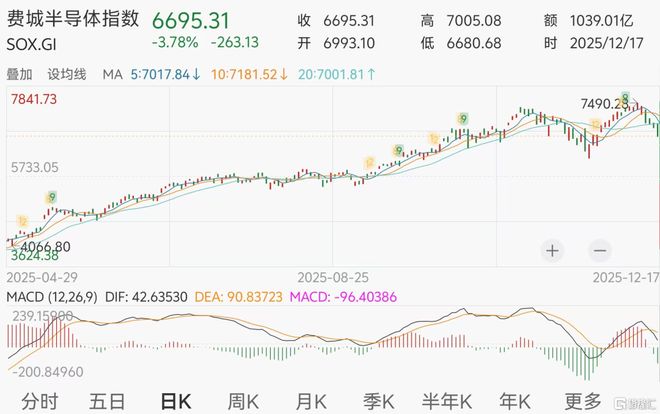
Group 1 - The global market is experiencing unprecedented fragmentation as the year-end approaches, with the AI narrative losing its previous momentum while precious metals like gold and silver remain strong [2][3] - Gold prices surged over 1%, nearing October highs, while silver prices broke through significant thresholds, achieving a year-to-date increase of approximately 130% [2] - Oracle's stock price has plummeted nearly 45% due to project delays and withdrawal of funding from its major partner, Blue Owl, which has significantly impacted the entire AI sector [4][5] Group 2 - The decline in Oracle's stock has dragged down other tech stocks, with Nvidia, Broadcom, and Tesla all experiencing significant losses, and the Philadelphia Semiconductor Index falling below its 50-day moving average [5] - BCA Research warns that the AI-driven bull market in U.S. stocks may fade by 2026, with excessive spending on AI raising concerns about investment returns [7] - Despite the downturn in stock prices, demand for AI remains strong, with companies like Micron and OpenAI continuing to seek substantial funding [8][10] Group 3 - The market is entering a new phase of AI investment, where high capital expenditures are not yet yielding expected returns, leading to concerns about declining return on invested capital (ROIC) [10][11] - The recent surge in A-share market activity is attributed to significant inflows into ETFs, particularly the CSI A500 ETF, which saw a net inflow of 164 billion yuan in a single day [13][19] - Institutional investors, particularly insurance funds, are likely behind the recent buying spree in the CSI A500 ETF, indicating a strategic year-end repositioning [19]


金融期货早评-20251218
Nan Hua Qi Huo· 2025-12-18 02:13
1. Report Industry Investment Ratings No relevant content provided. 2. Core Views of the Report - Short - term, the RMB is likely to be moderately strong against the US dollar, mostly in a low - volatility range with limited trading value. Key factors include clear policy support, enhanced independent exchange - rate fluctuations, and a resonance of internal and external environments. However, potential risks such as high long - position inventories of USD/HKD and the impact of the Bank of Japan's interest - rate hikes should be noted [3]. - The entry of the national team only boosts the market sentiment in the short term. The stock index is expected to stabilize and fluctuate in the short term, and the small and medium - cap stock indexes may face pressure [4]. - For the bond market, it is not pessimistic in the medium term. Mid - term long positions can be held, while short - term long positions can consider taking profits [5]. - In the container shipping European route, there is a bull - bear mix. The price is expected to be supported in January due to shipping companies' price - holding intentions, but factors such as weak economic data, sufficient shipping capacity, and the expected resumption of Red Sea routes may bring pressure [6]. - For platinum and palladium, the long - term bullish foundation for platinum remains. In the short term, attention should be paid to the risk of adjustment due to the widening price difference between domestic and foreign markets. For gold and silver, be cautious about short - term callbacks, and maintain a long - term bullish view. For copper, the market sentiment is high, but the price increase did not meet expectations. For aluminum, it is expected to fluctuate strongly in the medium term; alumina is expected to be weak; and cast aluminum alloy is expected to fluctuate strongly. For zinc, it is expected to maintain a wide - range shock in the short term. For nickel and stainless steel, they had a short - term correction, and attention should be paid to the supply and demand situation. For tin, it is expected to be strong in the short term, and it is recommended to enter the market on dips. For lithium carbonate, the short - term price may fluctuate more widely, and there are opportunities for long positions in the long term. For industrial silicon, it is in a supply - demand weak situation, and for polysilicon, the trading logic is mainly technical [9][11][13][16][19][20][22][23][24][26]. - For steel products, the price is expected to fluctuate. The price range of the rebar main contract 2605 is likely between 2900 - 3300, and that of the hot - rolled coil main contract 2605 is likely between 3000 - 3400. For iron ore, the downward space is expected to be limited. For coking coal and coke, if the upward trend continues, it may drive a new round of terminal restocking. For ferrosilicon and ferromanganese, the market is in a situation of weak reality and strong expectation, and there may be a short - term rebound [30][31][32][33][34][36]. - For pulp and offset paper, the short - term strategy is mainly to wait and see. For crude oil, the escalation of the US - Venezuela situation may drive up short - term oil prices. For LPG, the near - term is still supported. For PTA - PX, there is no obvious driver, and it will fluctuate with the cost side. For MEG - bottle chips, the short - term downward driving force is weakened, but the medium - and long - term situation is still under pressure. For methanol, it is recommended to maintain a reverse spread. For PP, the cost side provides strong support, and there may be a short - term rebound. For PE, the spot side is weak, and the supply - demand pressure is large. For pure benzene - styrene, pure benzene shows a near - weak and far - strong pattern, while styrene shows a near - strong and far - weak pattern. For asphalt, if the US does not directly declare war on Venezuela, the upward space is limited. For rubber, both natural and synthetic rubber are expected to maintain a wide - range shock. For urea, the 01 contract is expected to continue to fluctuate. For soda ash, it is waiting for unexpected supply changes. For glass, the near - month 01 will follow the delivery logic, and the far - month is affected by production line cold repairs. For caustic soda, the price is expected to fluctuate weakly. For logs, the current price has limited trading value. For propylene, it is expected to maintain a shock pattern [38][40][42][44][45][46][47][49][50][52][53][54][55][57][58][60][61][62][63][65][67][68][70][71][72][75][76][78][79][80]. - For oilseeds, the external soybean market will focus on demand in the short term and is expected to fluctuate around the cost line in the medium term. The domestic soybean meal will continue the long - spread trend in the short term, and the medium - term supply depends on reserve releases. For oils, the short - term trend is wide - range shock, and attention should be paid to production and biodiesel information. For cotton, it is recommended to build long positions on dips, paying attention to downstream orders and hedging pressure. For sugar, the price will remain weak. For apples, the strategy is mainly to buy on dips. For red dates, the short - term downward space may be limited, and attention should be paid to pre - holiday procurement [81][82][83][84][85][86][87][88][89]. 3. Summary by Relevant Catalogs Financial Futures - **Macro**: Overseas, the Fed cut interest rates in December, the US employment market cooled, and the UK's CPI decline increased the expectation of an interest - rate cut. Domestically, policies are "seeking progress while maintaining stability," and in November, industrial production was resilient but domestic demand was weak [1]. - **RMB Exchange Rate**: The previous trading day, the on - shore RMB depreciated slightly against the US dollar. Key information includes China's fiscal revenue growth, the Fed's potential interest - rate cuts, and the UK's CPI decline. The RMB is expected to be moderately strong in the short term, with potential risks [2][3]. - **Stock Index**: The stock index rose collectively in the previous trading day. The entry of the national team boosted market sentiment, but the index is expected to fluctuate in the short term, and small and medium - cap indexes may face pressure [4]. - **Treasury Bonds**: The bond market rose on Wednesday. The market sentiment improved, and it is not pessimistic in the medium term. Mid - term long positions can be held, and short - term long positions can consider taking profits [4][5]. Commodities Non - ferrous Metals - **Platinum and Palladium**: The night - session prices of platinum and palladium rose to new highs this year. The price is affected by factors such as the Fed's policy, supply - demand fundamentals, and EU policies. In the long term, the bullish foundation for platinum remains, and short - term adjustment risks should be noted [9][10]. - **Gold and Silver**: Gold and silver prices rose. Silver shows a long - squeeze phenomenon. The short - term focus is on callback risks, and the long - term view is bullish [11][12]. - **Copper**: The copper price rebounded. The market sentiment was high, but the increase did not meet expectations. It is recommended to pay attention to the pressure around 93500 - 94000, and downstream enterprises can consider buying futures on dips for hedging [13][14][15]. - **Aluminum Industry Chain**: Aluminum is expected to fluctuate strongly in the medium term; alumina is expected to be weak; and cast aluminum alloy is expected to fluctuate strongly. The fundamentals of aluminum are relatively stable, alumina is in a supply - surplus situation, and cast aluminum alloy has strong support [16][17][18]. - **Zinc**: Zinc prices had support at the bottom and rebounded slightly at night. In the short term, it is expected to maintain a wide - range shock, and there may be entry opportunities [19][20]. - **Nickel and Stainless Steel**: They had a short - term correction. The nickel ore market is expected to be stable and strong, and the stainless - steel market is affected by export regulations. Attention should be paid to the supply and demand situation [20][21]. - **Tin**: Tin prices were strong. It is recommended to enter the market on dips, and the short - term view is not to short [22]. - **Lithium Carbonate**: The price rose sharply. The short - term price may fluctuate more widely, and there are opportunities for long positions in the long term. Attention should be paid to supply shocks and demand declines [22][23]. - **Industrial Silicon and Polysilicon**: Industrial silicon is in a supply - demand weak situation, and polysilicon's trading logic is mainly technical. The long - term price of industrial silicon has limited downward space, and polysilicon's fundamentals are ineffective [24][26]. - **Lead**: Lead prices were weakly volatile. In the short term, it is expected to fluctuate between 16700 - 17500, with strong support around 16500 [27]. Black Metals - **Rebar and Hot - Rolled Coil**: The prices rebounded slightly but faced pressure above. After the central economic work conference, the pricing of the steel market returned to fundamentals. Supply may slow down the reduction, demand is seasonally weak, and inventory is in a de - stocking trend. The price is expected to fluctuate [28][30][31]. - **Iron Ore**: The price rebounded. After macro events, the trading logic returned to fundamentals. Supply is relatively restrained, demand is in a bottom - grinding stage, and the price is supported by coking coal [32]. - **Coking Coal and Coke**: The coking coal price may be affected by winter restocking, and the coke price may continue to decline. If the upward trend continues, it may drive a new round of terminal restocking [33][34]. - **Ferrosilicon and Ferromanganese**: The market is in a situation of weak reality and strong expectation. Supply is likely to continue to decline, demand is expected to decrease, and inventory is at a high level. There may be a short - term rebound [35][36]. Energy and Chemicals - **Pulp - Offset Paper**: Pulp prices fluctuated, and offset paper prices were weakly volatile. The Crofton pulp mill's shutdown was postponed, and the pulp port inventory is still high. The short - term strategy for both is to wait and see [38][40][41]. - **Crude Oil**: Oil prices stopped falling and rebounded. The US - Venezuela tension may drive up short - term oil prices, and attention should be paid to the development of the situation [42][43][44]. - **LPG**: The near - term is still supported. The supply increased slightly, demand remained stable, and attention should be paid to marginal changes [45][46]. - **PTA - PX**: There is no obvious driver, and it will fluctuate with the cost side. PX supply is expected to be high, PTA supply and demand are in a tight - balance situation in December, and the polyester demand is expected to decline seasonally in December [47][49]. - **MEG - Bottle Chips**: The short - term downward driving force is weakened, but the medium - and long - term situation is still under pressure. Supply has shown initial signs of support, and demand is expected to decline seasonally in December [50][52]. - **Methanol**: It is recommended to maintain a reverse spread. Factors such as commodity trends and unloading problems have affected the price, and the unloading problem will be resolved in the future [53][54]. - **PP**: The cost side provides strong support, and there may be a short - term rebound. Supply may be relieved in January, and demand has some support [55][57]. - **PE**: The spot side is weak, and the supply - demand pressure is large. Supply is increasing, and demand is decreasing, especially in the agricultural film sector [58][60]. - **Pure Benzene - Styrene**: Pure benzene shows a near - weak and far - strong pattern, while styrene shows a near - strong and far - weak pattern. The supply of pure benzene is slightly decreasing, and the demand is weak. The supply of styrene has increased, and the demand is stable [60][61]. - **Asphalt**: If the US does not directly declare war on Venezuela, the upward space is limited. The supply and demand have changed slightly, and the US - Venezuela situation may affect the supply of heavy oil [62]. - **Rubber**: Both natural and synthetic rubber are expected to maintain a wide - range shock. Natural rubber is affected by supply - side disturbances and weak demand. Synthetic rubber has limited fundamental improvement, and the upward space is restricted [63][65][67]. - **Urea**: The 01 contract is expected to continue to fluctuate. High supply pressures the price, but export policies relieve the pressure, and the inventory is in a de - stocking trend [68][70]. - **Soda Ash, Glass, and Caustic Soda**: Soda ash is waiting for unexpected supply changes, glass's near - month 01 will follow the delivery logic, and the far - month is affected by production line cold repairs. Caustic soda prices are expected to fluctuate weakly due to supply pressure and weakening demand [71][72][75]. - **Logs**: The current price has limited trading value. It is in a position - shifting market, with the inventory decreasing and the spot price falling [76][78]. - **Propylene**: It is expected to maintain a shock pattern. The supply is relatively loose, demand is stable, and it is affected by the "anti - involution" policy [79][80]. Agricultural Products - **Oilseeds**: The external soybean market will focus on demand in the short term and is expected to fluctuate around the cost line in the medium term. The domestic soybean meal will continue the long - spread trend in the short term, and the medium - term supply depends on reserve releases. The rapeseed meal is in a supply - demand weak situation [81][82]. - **Oils**: The short - term trend is wide - range shock. Palm oil is affected by supply pressure, soybean oil is affected by soybean auctions, and rapeseed oil is affected by global supply. Attention should be paid to production and biodiesel information [82][83]. - **Cotton**: It is recommended to build long positions on dips. The downstream shows resilience, but short - term pressure exists. Attention should be paid to downstream orders and hedging pressure [84]. - **Sugar**: The price will remain weak. Global sugar production and trade data affect the price, such as India's high production and Brazil's high exports [85][86]. - **Apples**: The strategy is mainly to buy on dips. Consumption is sluggish, and inventory is slowly decreasing [87][88]. - **Red Dates**: The short - term downward space may be limited. New - season production is slightly reduced, and new - product supply is sufficient. Attention should be paid to pre - holiday procurement [89].
ASX Market Open: Aimless day for Aussie bourse again; Wall Street tech falls | Dec 18
The Market Online· 2025-12-17 21:29
Market Overview - Australian shares are expected to open flat, with minimal changes in futures [1] - The tech sector in the U.S. has experienced a significant sell-off, with the S&P 500 down nearly -1.2% and the Nasdaq composite down -1.8% [3] - European and Asian markets are not providing direction for Australia, with London's FTSE up +0.9% and Japan's Nikkei up +0.5% [3] Company News - ANZ Group (ASX:ANZ) is facing shareholder dissatisfaction over a board pay plan and responses to compliance failures, leading to a second investor strike [4] - Santos (ASX:STO) is preparing financing for a large LNG project in Papua New Guinea, with total costs projected to reach $27 billion [5] - Elders (ASX:ELD) is holding an AGM where investors will inquire about succession plans for long-time chief Mark Allison [5] - Netwealth (ASX:NWL) has reached a settlement with ASIC, agreeing to pay over $100 million to those affected by First Guardian's fund collapse [6] - Treasury Wines (ASX:TWE) has seen a -10% decline this week due to sales misses [6] Commodities and Forex - The Australian dollar is trading at 66 U.S. cents [7] - Iron Ore prices have increased by +1% to $103.60 per tonne [7] - Brent Crude oil has risen by +2.8% to $60.57 per barrel [7] - Gold is priced at $4,350 per ounce [7] - U.S. natural gas futures have surged by +5% to $4.10 per gigajoule [7]


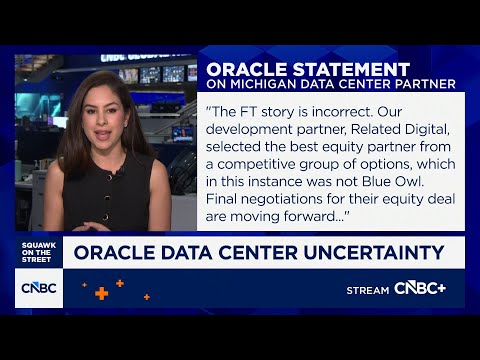
Blue Owl decided not to pursue Oracle’s $10 billion Michigan data center, source familiar
CNBC Television· 2025-12-17 16:13
on Oracle's AI ambitions on the heels of this new report now on the fate of a data center in Michigan. For that, we'll turn to Sema Modi. Uh, important story, Sema.>> It is, Carl. There have been these questions surrounding Oracle's 1 gigawatt data center in Michigan and who will finance this 10 billion dollar project following an FT report that suggests talks are breaking down. Oracle telling CBC that the FD story is incorrect and that its developments partner, Related Digital, selected the best equity par ...