京东

Search documents
透视顺丰同城(09699)半年报:“第三方+全场景”稀缺性加持,收入利润持续双高增
智通财经网· 2025-09-01 03:32
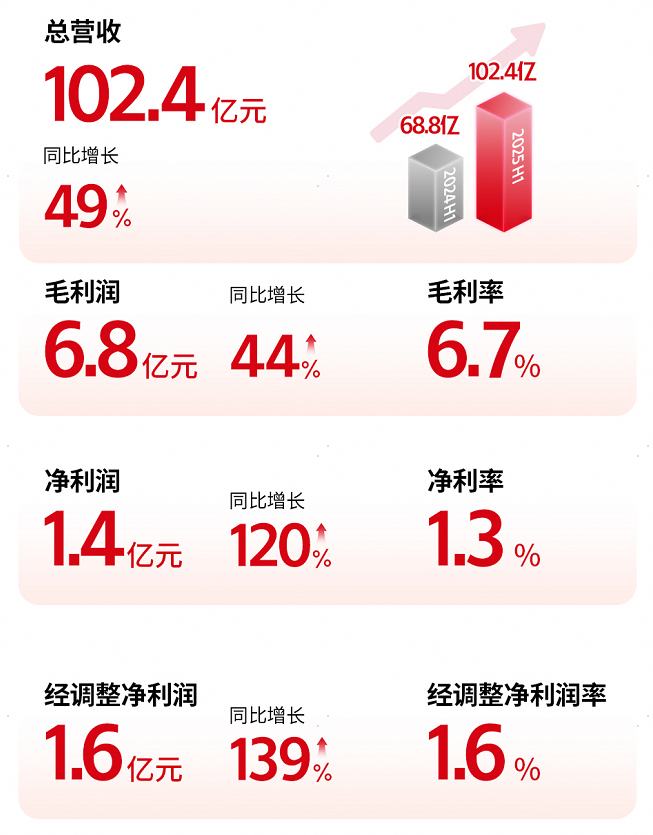
Core Viewpoint - SF Express City (顺丰同城) has demonstrated significant growth in the instant delivery industry, achieving a revenue of 10.24 billion yuan in the first half of 2025, representing a 49% year-on-year increase, and a net profit of 140 million yuan, up 120% year-on-year, indicating a strong performance amidst industry competition [1][4][12] Group 1: Financial Performance - The company reported a revenue of 10.24 billion yuan for the first half of 2025, with a year-on-year growth of 49% [1] - Net profit reached 140 million yuan, marking a 120% increase year-on-year, while adjusted net profit was 160 million yuan, up 139% [1] - The company has achieved continuous profitability for five consecutive periods since the first half of 2023, with net profit doubling [12] Group 2: Business Segments and Growth Drivers - The company’s revenue from merchant-oriented same-city delivery services was 4.467 billion yuan, a 55.4% increase year-on-year, while consumer-oriented same-city delivery revenue was 1.312 billion yuan, up 12.7% [4] - Last-mile delivery revenue surged to 4.457 billion yuan, reflecting a 56.9% year-on-year increase [4] - The number of active merchants on the platform grew by 55% year-on-year, reaching 850,000 [6] Group 3: Competitive Landscape - The instant delivery industry is experiencing significant differentiation, with competitors like Meituan and JD.com intensifying their efforts in the food delivery sector [3] - SF Express City has established long-term partnerships with major clients across various industries, enhancing its service capabilities [4] - The company has adapted to the multi-polarization of traffic trends, leveraging its independent third-party platform to improve order management and delivery efficiency [4] Group 4: Operational Efficiency and Technology - The company has implemented digital and AI-driven solutions across its operations, enhancing efficiency and optimizing logistics [10] - SF Express City has integrated a network of riders and autonomous delivery vehicles, with over 300 autonomous vehicles in operation, achieving an average of 20,000 trips per month [10] - The company’s focus on operational excellence and technology has led to a reduction in unit costs and an improvement in gross margins [12] Group 5: Market Recognition and Future Outlook - The stock price of SF Express City has seen a maximum increase of nearly 150% in the first half of 2025, reflecting market recognition of its growth potential [12] - The company’s comprehensive advantages in scale, cost, customer breadth, and risk resilience position it as a foundational player in the instant delivery sector [12]

中国互联网行业-闪购行业专家电话会议纪要
2025-09-01 03:21
Summary of the Conference Call on China's Internet Industry and Flash Purchase Market Industry Overview - The conference call focused on the competitive landscape and future prospects of China's food delivery and flash purchase markets, which are experiencing intense competition and significant growth [1][2]. Key Points and Arguments 1. **Market Growth**: By August 2025, the average daily order volume in China's food delivery and flash purchase market is expected to reach approximately 180 million orders, representing over 80% growth compared to around 100 million orders in the same period last year [2][3]. 2. **Market Share Distribution**: - Meituan leads with approximately 85 million daily orders, capturing 47% of the market. - Alibaba follows closely with about 80 million daily orders, holding a 45% market share. - JD.com accounts for around 14 million daily orders, translating to an 8% market share [2][3]. 3. **Meituan's Strategy**: Meituan aims to maintain its market share through operational efficiency and leveraging its existing user and merchant base. Its market share has remained stable at 47% over the past three months [2][3][13]. 4. **Alibaba's Focus**: Alibaba is shifting its strategy to enhance its flash purchase business, targeting a market share of 50% and increasing traffic to its e-commerce platform. The company plans to consolidate its food delivery and flash purchase operations under the Taobao app [2][14]. 5. **JD.com's Approach**: JD.com is focusing on increasing user engagement and cross-selling to drive growth in its core e-commerce business, with a target of capturing 10-15% of the food delivery and flash purchase market [2][14]. 6. **Profitability Comparison**: - Meituan's average loss per order in the food delivery segment is estimated at 1.2 yuan, while Alibaba and JD.com incur losses of approximately 4.4 yuan and 5.5 yuan per order, respectively [7][12]. - In the flash purchase segment, Meituan's average loss is about 1.5 yuan per order, compared to Alibaba's 4.5 yuan [7][12]. 7. **Strategic Shifts Since 2018**: The current competition is more focused on flash purchases, which are expected to grow at a double-digit rate, compared to the previous emphasis on food delivery. Alibaba's organizational restructuring aims to enhance synergy across its various business units [14][15]. 8. **Emerging Competitors**: Pinduoduo has recently entered the flash purchase market, establishing self-operated warehouses and focusing on fresh produce. This new entrant is expected to compete more with local grocery stores than with the major internet platforms [16][17]. Additional Important Insights - The competitive dynamics have shifted significantly since 2018, with a greater emphasis on flash purchases and a more integrated approach within Alibaba's business units [14][15]. - The anticipated market trends suggest that the flash purchase segment will become increasingly critical for all players involved, with significant investment expected in the second half of 2025 [17]. This summary encapsulates the key insights from the conference call regarding the competitive landscape and strategic directions of major players in China's food delivery and flash purchase markets.

刚刚!A股,大面积异动!发生了什么?
券商中国· 2025-09-01 02:58
Core Viewpoint - The article highlights the significant surge in Alibaba-related stocks, driven by the company's advancements in artificial intelligence and strong performance in cloud services, leading to a bullish sentiment in the market [2][5][6]. Group 1: Market Performance - Alibaba's concept stocks experienced a notable increase, with the sector rising over 2% and 12 stocks hitting the daily limit [2][5]. - The Hong Kong stock market opened significantly higher, with the Hang Seng Index up 430 points (1.7%) and the Hang Seng Tech Index up 117 points (2.1%) [4]. Group 2: Company Developments - Alibaba's CEO emphasized a focus on consumer and AI + cloud strategies, achieving strong growth and significant synergies through platform integration [6]. - The company announced plans to develop AI chips, contributing to a stock price increase of 18% [4]. Group 3: Financial Insights - In the second quarter, Alibaba's capital expenditure reached approximately 387 billion yuan, exceeding Bloomberg's expectation of 292 billion yuan [7]. - The company plans to invest 3.8 trillion yuan in AI over the next three years, with over 100 billion yuan already invested in AI infrastructure and product development over the past four quarters [7][8]. Group 4: Analyst Recommendations - Analysts suggest that Alibaba's increased investment in AI is creating a positive feedback loop, leading to higher AI-related revenues [7][8]. - There is a recommendation to focus on Alibaba's supply chain, including GPU, IDC, and networking equipment, as domestic cloud providers are expected to return to high growth driven by AI demand [8].

阿里引爆港股 我坚决“南下”的三个理由
Mei Ri Jing Ji Xin Wen· 2025-09-01 02:57
Group 1 - Alibaba's stock surged by 18%, indicating a vibrant market for Hong Kong stocks [1] - The investment strategy focuses on identifying companies with clear business logic and high quality, which increases the likelihood of long-term profitability in the Hong Kong market [1] - The experience with Tencent's stock highlights the volatility of the Hong Kong market, emphasizing the importance of patience and long-term holding [1] Group 2 - The Hong Kong market offers access to companies that are not available in the A-share market, such as Alibaba, Tencent, Meituan, JD.com, and HSBC [2] - Unique investment opportunities in the Hong Kong market include consumer stocks like Nongfu Spring and Pop Mart, as well as gaming stocks like Galaxy Entertainment and Sands [2] - The internationalization and market-oriented characteristics of the Hong Kong market create a dynamic financial ecosystem that fosters compelling business stories and wealth growth potential [2]
内地经济景气边际回升
citic securities· 2025-09-01 02:48
Market Overview - A-shares continued to rise, with the Shanghai Composite Index up 0.37% to 3,857 points, while the Shenzhen Component Index increased by 0.99% and the ChiNext Index rose by 2.23%[14] - The U.S. PCE index for July showed a larger-than-expected increase, leading to a decrease in rate cut expectations and a drop in U.S. stock indices, with the Dow Jones down 0.2% and the Nasdaq down 1.2%[8][25] - European markets declined due to geopolitical tensions and political uncertainties in France, with the Stoxx 600 index falling by 0.64%[8][10] Economic Indicators - China's manufacturing PMI for August was 49.4, a slight increase of 0.1 from the previous month, while the non-manufacturing PMI rose to 50.3, up 0.2[4] - The U.S. core PCE inflation rate increased from 2.8% in June to 2.9% in July, indicating persistent inflationary pressures[8][25] - India's GDP growth for Q1 2026 was reported at 7.8%, exceeding expectations, driven by investment and fiscal spending[21] Sector Performance - In the U.S. market, six out of eleven sectors in the S&P 500 saw gains, with the healthcare sector leading at a 0.73% increase, while the information technology sector fell by 1.63%[8] - In Hong Kong, the Hang Seng Index rose by 0.32%, with significant gains in healthcare and materials sectors, while semiconductor stocks faced declines[10] - The semiconductor sector in A-shares experienced a pullback, with stocks like Hengxuan Technology dropping by 7.8%[14] Commodity and Currency Trends - Gold prices increased, nearing historical highs, amid rising geopolitical tensions and legal disputes surrounding the Federal Reserve[25] - International oil prices fell, with WTI crude down 0.9% to $64.01 per barrel, and Brent crude down 0.7% to $68.12 per barrel[25] - The U.S. dollar index remained stable at 97.77, with the dollar appreciating against the yuan and the euro[23]


科技周报|电商成小红书一级入口,美团二季度财报受外卖战影响
Di Yi Cai Jing· 2025-08-31 04:47
Group 1: E-commerce Developments - Xiaohongshu has made e-commerce a primary entry point in its app, launching a "million commission-free plan" to attract merchants, with 50% of its 350 million monthly active users being post-95s [2] - Meituan's second-quarter revenue reached 91.84 billion yuan, a year-on-year increase of 11.7%, but adjusted net profit fell by 89% due to intensified competition in the food delivery sector [4] - JD.com and Meituan have entered the "hard discount" market, with JD's discount supermarket opening four stores and Meituan launching its self-operated supermarket, indicating a shift in retail focus towards discount offerings [5] Group 2: Financial Performance and Strategic Moves - Ying Shi Innovation reported a 51.17% year-on-year revenue growth to 3.671 billion yuan in the first half of 2025, but net profit growth has slowed due to increased strategic investments [8] - Alibaba's second-quarter revenue was 247.65 billion yuan, a 2% increase, with operating profit declining by 3% due to significant investments in the Taobao flash purchase strategy [6][7] - Midea Group's revenue for the first half of 2025 reached 252.3 billion yuan, a 15.7% increase, with net profit growing by 25% to 26 billion yuan, marking record highs [11] Group 3: Technological Innovations - Tax Friend Co. launched the first Agentic platform in the tax industry, aiming to address common issues such as low efficiency and high costs, with AI products achieving a hallucination rate below 10% [9] - Kuaishou's AI tool, Keling, has seen significant growth, with over 1 billion yuan in monthly revenue since April and a 321% increase in content playback volume compared to six months ago [10] Group 4: Aerospace Developments - SpaceX's Starship successfully completed its tenth test flight after two previous failures, marking a significant milestone in its development and paving the way for future iterations [3]


趋势研判!2025年中国智能手机行业发展全景分析:产品更新换代速度加快,市场换机需求提升,随着技术的不断创新,Al手机成为主要创新方向[图]
Chan Ye Xin Xi Wang· 2025-08-31 00:00
Core Insights - China has become the world's largest mobile phone producer and consumer, with a projected smartphone production of 1.25 billion units in 2024, maintaining over 70% of total mobile phone production for several years [1][4] - The smartphone industry is now in a mature phase, with a continuous decline in shipment volumes observed in recent years. The expected smartphone shipment for 2024 is 294 million units, a year-on-year increase of 6.5%, accounting for 63% of total mobile phone shipments [1][6] - The rapid pace of product updates has shortened the average usage cycle of smartphones, leading to increased market demand for replacements. AI smartphones are emerging as a key innovation direction [1][11] Industry Overview - The smartphone industry is defined as mobile devices with independent operating systems that allow users to install third-party applications and access wireless networks [2] - The industry has evolved from personal digital assistants (PDAs) to smartphones, which have become essential in daily life, driven by the growth of mobile internet [4] Current Market Situation - In 2024, the total mobile phone production in China is expected to reach 1.67 billion units, with a year-on-year growth of 7.26%. The smartphone production is projected at 1.25 billion units, consistently representing over 70% of total production [4] - The smartphone shipment volume in 2023 was 276 million units, with a 4.8% year-on-year increase, while the 2024 projection is 294 million units, reflecting a 6.5% growth [6] Industry Chain - The smartphone industry chain includes upstream components such as chips, PCBs, memory, operating systems, displays, power supplies, and cameras. The midstream involves manufacturing (ODM, OEM/EMS, brand owners), while the downstream includes operators, service providers, and end-users [6] Competitive Landscape - The Chinese smartphone market is characterized by high concentration and significant competition among domestic brands. In 2024, domestic brands are expected to ship 269 million units, a 16.3% increase, capturing 85.6% of the market [9] - Major players include Vivo, Huawei, Apple, Honor, and OPPO, with Vivo leading the market share at 17.2% and Huawei regaining its position among the top five brands [9] Future Trends - The smartphone market in China is expected to see a shift in consumer demand due to the early release of national subsidy policies, increasing the number of new models and enhancing consumer choices [10] - The competition for young consumers is intensifying, with brands increasing marketing investments and focusing on AI innovations [11]


外卖大战与AI芯片:变轨中的阿里巴巴
36氪未来消费· 2025-08-30 08:17
Core Viewpoint - Alibaba has emerged as the biggest winner in the first quarter of the instant retail war, with Q2 revenue and profit exceeding market expectations, driven by improvements in various business segments [4][8]. Financial Performance - Alibaba's Q2 revenue grew by 10% year-on-year, surpassing the market expectation of 6%, while operating profit reached 35 billion yuan, only down 3% year-on-year [4]. - The net profit under non-standard accounting fell by 18%, but this was significantly better than JD's -49% and Meituan's -89% [4]. - The new Chinese e-commerce group reported an EBITA of 38.4 billion yuan, a year-on-year decline of 21%, indicating a significant investment in the instant retail segment [11]. Strategic Developments - The "user-first, AI-driven" strategy implemented over the past two years has shown significant results, with Taobao Flash Purchase achieving a monthly transaction user base of 300 million, a 200% increase compared to before April [4][15]. - Alibaba Cloud's AI revenue accounted for 20% of its overall revenue, with AI-related product revenue growing for eight consecutive quarters at triple-digit rates, leading to a 26% year-on-year revenue increase [4][18]. Market Reactions - Following the impressive Q2 results, Alibaba's stock price surged, with a pre-market increase of nearly 7% and a post-market rise of 13%, adding 260 billion yuan to its market capitalization [8][12]. - The market's positive feedback was attributed to the strong performance of Alibaba's cloud and AI segments, which alleviated concerns about the company's ability to sustain technological investments [18]. Competitive Landscape - The intense competition in the instant retail sector has led to significant losses for major players, with Alibaba spending 15.6 billion yuan in Q2, the highest among its competitors [12][13]. - Despite the high costs associated with entering the instant retail market, Alibaba's management remains confident in the long-term potential of this investment, viewing it as a strategic opportunity to enhance its e-commerce platform [16][20]. Future Outlook - Alibaba plans to continue investing heavily in its instant retail segment, with an additional 50 billion yuan allocated to support growth [13][20]. - The company is also focusing on AI and cloud computing, with significant capital expenditures expected to drive future growth and maintain its competitive edge in the market [18][19].
城市发展与AI战略顶层设计出炉,“外卖大战”影响初显丨一周热点回顾
Di Yi Cai Jing· 2025-08-30 03:24
Group 1: Urban Development Policies - The central government has released guidelines for promoting high-quality urban development, aiming for significant progress by 2030 and basic completion by 2035 [1][2] - Key measures include enhancing urban competitiveness, fostering new development drivers, and improving urban living quality through better infrastructure and public services [1][2] Group 2: Artificial Intelligence Initiatives - The State Council has issued a roadmap for the "Artificial Intelligence+" initiative, focusing on six key actions, including technology, industry development, and global cooperation [3][4] - By 2030, the goal is for AI applications to exceed 90% penetration, establishing AI as a crucial growth driver for the economy [3][4] Group 3: Carbon Market Development - A new policy has been introduced to accelerate the construction of a national carbon market, with plans to cover major industrial sectors by 2027 [5][6] - The market will transition from intensity control to total control, combining free and paid allocation methods for carbon emissions [5][6] Group 4: Real Estate Market Adjustments - Shanghai has announced adjustments to its real estate policies, including lifting purchase limits for certain residents outside the city’s outer ring [7] - The changes aim to stimulate the housing market and improve buyer sentiment, following similar moves in other major cities [7] Group 5: Industrial Profit Trends - Industrial profits for large enterprises fell by 1.5% year-on-year in July, but the decline rate has narrowed for two consecutive months, indicating a potential recovery [8][9] - Notably, profits for medium and small enterprises improved, suggesting the effectiveness of policies aimed at supporting these businesses [8][9] Group 6: Stock Market Developments - Cambrian Technology's stock surged by 15.73%, surpassing Kweichow Moutai to become the new stock king in A-shares, with a total increase of 133.86% since late July [10][11] - The company reported significant revenue growth of 4347.82% year-on-year, indicating a strong performance despite potential risks related to stock price volatility [10][11] Group 7: Food Delivery Industry Financials - Major players in the food delivery sector, including Meituan and JD, reported significant profit declines due to intense competition, with Meituan's net profit down 89% [12][13] - Alibaba's financial results also showed a decrease in operating profit, attributed to increased investments in user experience and technology [13]

深夜狂飙!阿里巴巴暴涨13%,市值一夜飙升2600亿元!特朗普与美联储的大战,正进入白热化...
雪球· 2025-08-30 03:05
↑点击上面图片 加雪球核心交流群 ↑ 深夜,美股回调,阿里巴巴却带领中国资产大涨,其中阿里巴巴股价大涨近13%, 一夜之间,阿里巴巴市值上涨369亿美元,约合人民币2628亿 元。 盘面上大型科技股多数下跌,拖累了整体走势。个股方面,特斯拉跌超3%,英伟达跌逾3%,Meta跌超1%,亚马逊跌逾1%,微软跌0.58%,苹 果跌0.18%,谷歌涨0.6%。 芯片股同样普遍下跌,费城半导体指数大跌3.15%。个股方面,迈威尔科技跌超18%,博通、超威半导体、台积电等跌超3%。 01 美股三大指数收跌 大型科技股多数下跌 当地时间周五,美股三大股指全线收跌,道指跌0.2%报45544点,标普500指数跌0.64%报6460点,纳指跌1.15%报21455点。 其中,迈威尔科技在最新披露的财报中给出的业绩指引不及市场预期,引发了投资者对其未来业绩增长放缓的担忧。财报显示,该公司预计第三季 度的营收为20.6亿美元,低于分析师一致预期。 | 迈威尔科技 | | | --- | --- | | MRVL 已收盘08-29 16:00:00 美东 | | | 62.86 -14.36 -18.60% | 1.59万人加自选 ...