上美股份

Search documents
商贸零售行业点评报告:2025年社零同比+3.7%,海南封关首月表现亮眼
KAIYUAN SECURITIES· 2026-01-19 14:14
Investment Rating - The industry investment rating is "Positive" (maintained) [1] Core Insights - The overall performance of social retail in 2025 was steady, with a total retail sales of 501,202 billion yuan, reflecting a year-on-year growth of 3.7%. December's retail sales reached 45,136 billion yuan, with a growth of 0.9% [4] - Essential categories like grain, oil, and food maintained resilience, while optional categories like cosmetics performed relatively well. The overall Consumer Price Index (CPI) in December increased by 0.8%, with food prices rising by 1.1% [5] - Online retail channels showed a continuous recovery, with total online retail sales reaching 159,722 billion yuan in 2025, marking an 8.6% increase. The share of physical goods in online retail was 130,923 billion yuan, growing by 5.2% [6] Summary by Sections Retail Performance - In 2025, the retail sales of essential goods such as grain and oil increased by 3.9%, while optional goods like cosmetics saw an increase of 8.8% in December [5] - The online retail sector showed significant growth, with a year-on-year increase in online sales of food, clothing, and daily necessities [6] Investment Recommendations - The report suggests focusing on high-quality companies in the "emotional consumption" theme, particularly in four investment lines: 1. Gold and jewelry brands with differentiated product offerings [7] 2. Offline retail companies adapting to market changes [7] 3. Domestic cosmetics brands that emphasize emotional value and innovative ingredients [7] 4. Medical beauty firms with unique products and expansion strategies [7]
韩束经历考验,上美谋求战略转型
3 6 Ke· 2026-01-19 13:05
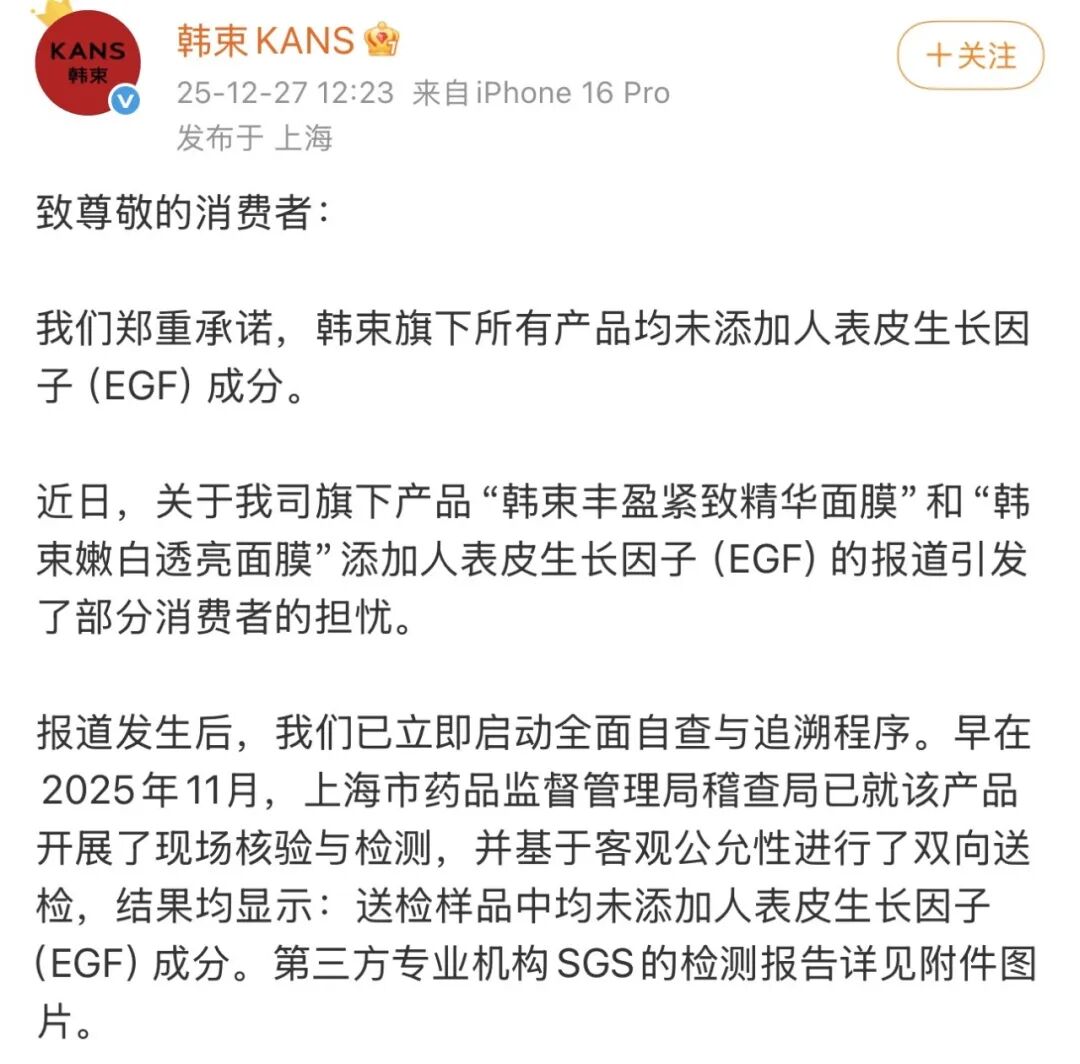
Core Insights - The domestic beauty brand Han Shu is currently facing challenges, including a controversy over product ingredients and executive turnover, which reflects broader scrutiny in the beauty industry [1][3][4] Group 1: Ingredient Controversy - Han Shu's two facial mask products were reported by CCTV to contain epidermal growth factor (EGF), leading to public concern despite the company's claims of compliance [4][6] - EGF is primarily used in medical applications, and its use in cosmetics is prohibited in China due to safety concerns, prompting Han Shu to withdraw the affected products and issue a statement asserting no EGF was added [6][9] - The discrepancy between testing results from CCTV and Han Shu's own tests raises questions about the detection methods used, highlighting the lack of standardized testing for EGF in cosmetics [7][8] Group 2: Business Performance and Strategy - Han Shu has experienced significant growth, with revenue reaching 5.591 billion yuan in 2024, marking over a threefold increase in two years, making it a key driver for its parent company, Shangmei [10][11] - The brand's strategy of focusing on single products and leveraging platforms like Douyin has led to its dominance in the beauty sector, achieving a GMV of 33.4 billion yuan in 2023 [11][13] - However, the company's reliance on Han Shu, which accounted for 82.3% of revenue in 2024, poses risks, as any issues with the brand could directly impact overall performance [15][16] Group 3: Market Challenges and Future Directions - The growth rate of Han Shu has begun to slow, with a 14.3% increase in revenue for the first half of 2025, indicating a need for transformation and diversification [17][18] - To reduce dependency on Han Shu, Shangmei is accelerating the development of multiple brands, with new brand Newpage achieving a revenue of 397 million yuan in the first half of 2025, growing by 146.5% [18][20] - The company is also pursuing globalization, entering Southeast Asian markets with tailored products, but faces challenges in brand recognition and local market adaptation [20][21] Group 4: Innovation and Long-term Goals - The shift from a marketing-driven approach to a technology-driven strategy is crucial for Han Shu to enhance its product offerings and address consumer skepticism regarding domestic brands [21][22] - The company aims to achieve a revenue target of 10 billion yuan by 2025, with ongoing investments in research and development to support this goal [21][22]

深度 | 美妆科学传播的下一个浪潮是什么?
FBeauty未来迹· 2026-01-19 12:34
Core Insights - The beauty science communication has shifted from a "one-way output of scientific strength" to a "temperature dialogue with consumers" over the past 25 years, focusing on social emotional insights rather than just scientific data [2][4] - The NUTE model (Need-Unique-Technology-Evidence) is introduced as a methodology for scientific communication, emphasizing the importance of translating hard science into relatable solutions for consumers [3][5] Evolution of Beauty Science Communication - The initial phase focused on creating market buzz through ingredient efficacy and scientific concepts [4] - The explosion of scientific content saw many beauty companies entering the field, but it lacked consumer focus [4] - The communication evolved to a consumer-centric approach, aiming for empathy and understanding [4] - The current phase emphasizes co-creation of brand trust, where consumers focus less on scientific data and more on brand reliability [4] Case Studies in Effective Communication - Natural Hall's "anti-fatigue" marketing effectively resonated with consumers by translating abstract concepts into relatable experiences, such as "post-overtime fatigue" [6] - Zhanmiya utilized cinematic storytelling to connect with the emotional expectations of consumers regarding "China's technological rise," showcasing the journey of artificial skin [8] - Brands like Zhenyan addressed information gaps in post-surgery care by prioritizing knowledge dissemination over direct product promotion [10] The Role of Social Emotion - Social emotion acts as a "translator" in scientific communication, transforming deep research into consumer-friendly language and practical solutions [12] - The understanding of consumer needs is crucial, as effective communication is not about what brands research but what consumers need to know [12] Unique Research Frameworks - Establishing a unique research framework is essential for brands to create an irreplaceable competitive edge, allowing them to transition from "ingredient followers" to "category definers" [13] - Brands must avoid merely showcasing single-point technologies and instead build comprehensive frameworks or focus on specialized breakthroughs [13][14] Challenges in Consumer Acceptance - Concepts like ECM (extracellular matrix) are difficult for consumers to grasp; thus, brands must create relatable scenarios to make advanced theories accessible [16][18] - Shiseido's innovative approach to anti-aging through "memory T cells" represents a reverse strategy in a market focused on collagen supplementation [19][22] Evidence-Based Communication - The beauty industry is adopting a structured evidence chain similar to that in clinical research, categorizing evidence into various levels to enhance credibility [34][36] - Brands like HBN are leading the way in establishing standardized guidelines for efficacy evidence, promoting transparency and scientific rigor [41] Visualizing Scientific Evidence - OLAY's use of 3D technology to visualize the effects of their products represents a shift towards making scientific evidence more comprehensible and relatable to consumers [42][44] - The focus is on reducing the complexity of scientific data to enhance consumer trust and understanding [45] Future Directions - The industry is moving towards a model where storytelling is used to explain science, fostering a two-way relationship between brands and consumers [47] - The expectation is for brands to create relatable narratives that connect scientific advancements with everyday consumer experiences, enhancing trust and engagement [47]

化妆品“唯成分论”乱象 检测屡陷“罗生门”
经济观察报· 2026-01-19 07:22
Core Viewpoint - The ongoing disputes regarding cosmetic ingredient content reflect a marketing battle driven by single-ingredient concept marketing [5] Group 1: Disputes and Detection Challenges - Recent controversies have arisen over the ingredient content in cosmetics, with brands like Han Shu and Ke Fu Mei facing scrutiny in 2025 due to differing detection results from various institutions [2] - The complexity of cosmetic formulations leads to varying detection results, influenced by the matrix of ingredients and the methods used for testing [6] - The lack of standardized testing methods contributes to discrepancies in results, with some institutions using inappropriate methods that amplify result deviations [6] Group 2: Consumer Trust and Understanding - Consumers are left confused by conflicting information, raising questions about the precision of ingredient content detection and the significance of small variations in ingredient amounts [3][11] - The rise of ingredient-conscious consumers has prompted brands to disclose more product information, making detection results a key factor in assessing product value [12][13] Group 3: Scientific and Regulatory Insights - The detection of active ingredients like peptides and proteins faces challenges due to their low concentrations and susceptibility to degradation during testing [7] - Current effective detection technologies, such as LC-MS/MS, provide high sensitivity and specificity, enabling accurate measurement of active ingredients [9] - The establishment of credible group standards requires a diverse range of stakeholders, including hospitals, research institutions, and regulatory bodies, to ensure transparency and inclusivity [16] Group 4: Recommendations for Industry Development - The industry should shift towards a foundation of skin science and evidence-based medicine, moving away from a focus solely on ingredient content [17] - Collaboration among regulatory bodies, research institutions, and companies is essential to integrate evidence-based logic into industry standards and practices [17]

化妆品“唯成分论”乱象 检测屡陷“罗生门”
Jing Ji Guan Cha Wang· 2026-01-19 05:52
Core Viewpoint - The ongoing disputes regarding cosmetic ingredient content highlight the complexities of ingredient testing and the challenges consumers face in discerning accurate information [1][2][3] Group 1: Disputes and Testing Challenges - Different testing institutions yield varying results for the same cosmetic ingredient, leading to consumer confusion and mistrust [2][4] - The complexity of cosmetic formulations, which often contain numerous ingredients, complicates the accuracy of testing results [4][5] - The lack of standardized testing methods contributes to discrepancies in results, as different institutions may use varying techniques and protocols [4][5][6] Group 2: Consumer Guidance and Industry Practices - Consumers are advised to prioritize testing institutions with recognized qualifications, such as CMA and CNAS, and to be cautious of unqualified third-party tests [7] - The impact of ingredient content variations can be significant, especially for active ingredients present in low concentrations, where small differences can affect efficacy [8][9] - The rise of ingredient-focused consumers has prompted brands to disclose more product information, making testing results a critical factor in product valuation [9][10] Group 3: Industry Development and Recommendations - The cosmetic industry is encouraged to adopt a foundation based on skin science and evidence-based practices to address the ongoing disputes and improve consumer communication [11][12][13] - Establishing a unified standard for ingredient testing that incorporates evidence-based data and involves diverse stakeholders is essential for enhancing credibility [12][13] - The industry must shift focus from mere ingredient content to the actual effects of ingredients on skin, ensuring that product efficacy and safety are prioritized [13]
行业周报:赤子城科技Dramabite成短剧黑马,关注AKK菌布局企业-20260118
KAIYUAN SECURITIES· 2026-01-18 14:44
Investment Rating - Investment rating: Positive (maintained) [1] Core Insights - The luxury goods retail revenue in China is showing signs of recovery, with high-end brands like LVMH, Hermès, and Prada experiencing positive growth since Q2 2025 [15][16] - The global network literature market is witnessing rapid growth, particularly in Latin America, with WebNovel reaching nearly 400 million cumulative users by October 2025 [34][35] - The micro-drama and comic-drama market in China is projected to exceed 100 billion yuan in 2025, significantly surpassing the film box office revenue [37][38] - The probiotic market is expanding, with a focus on next-generation probiotics (NGPs) like AKK bacteria, which show significant potential in health applications [55][63] Summary by Sections 1. Duty-Free Shopping - Post-New Year duty-free shopping in Hainan shows strong growth, with sales reaching 3.89 billion yuan and a 49.6% year-on-year increase in shopping amount [31][33] - The high net worth individuals are expected to drive luxury consumption, with a notable increase in spending on preservation-type luxury goods [15][16] 2. Network Literature - The Chinese network literature market reached 49.55 billion yuan in 2024, with a 29.37% year-on-year growth, while the overseas market grew by 10.68% [34] - WebNovel has cultivated nearly 530,000 authors and over 820,000 original works, with a significant increase in user engagement [34][35] 3. Micro-Drama - The micro-drama and comic-drama market in China is expected to reach 100 billion yuan in 2025, with a 98% year-on-year growth [37][38] - The user base for micro-dramas is approaching 700 million, with a strong preference among female viewers [40][42] 4. Probiotics - The global probiotic market is projected to grow at a CAGR of 8.7%, reaching 93.49 billion USD by 2028, with China's market expected to reach 134.89 billion yuan by 2024 [55][63] - Next-generation probiotics like AKK bacteria are gaining traction, with significant potential in health management and consumer interest [55][63]




大消费行业周报:细分赛道出现分化-20260118
Ping An Securities· 2026-01-18 12:06
Investment Rating - The industry investment rating is "stronger than the market," indicating an expected performance that exceeds the market by more than 5% within the next six months [25]. Core Insights - The report highlights a divergence in the performance of various segments within the consumer sector, with a stable overall market performance but most sub-sectors underperforming compared to the broader market [4][6]. - There is an expectation for consumer demand to improve ahead of the Lunar New Year, driven by sufficient market liquidity [4]. - The tourism sector is showing potential for growth, with leading companies responding effectively to changing consumer demands [4]. - The beauty industry is experiencing steady growth, with a focus on companies that adapt quickly to market dynamics [4]. - The food and beverage sector is seeing a recovery in supply-demand relationships, particularly in dairy products, while the restaurant supply chain is stabilizing [4]. - In the liquor segment, leading companies are expected to maintain market share despite recent profit adjustments [4]. Market Performance Review - The Shanghai Composite Index fell by 0.57% during the week of January 12-16, with the media sector rising by 3.34% while other sectors like food and beverage and agriculture saw declines of 2.03% and 3.49% respectively [6][8]. Social Services - The report emphasizes the importance of companies that actively respond to changes in consumer demand, particularly in tourism and beauty sectors [4]. Industry Dynamics - The People's Bank of China has introduced measures to enhance structural monetary policy support, which may positively impact consumer spending and economic recovery [10]. - The Philippines has announced visa-free entry for Chinese citizens, which could boost tourism [11]. Company Announcements - Companies like Giant Biological and Proya are making strategic moves, such as product approvals and share buybacks, indicating proactive management in response to market conditions [13][19]. - The report notes significant developments in the liquor industry, including the launch of premium products and partnerships for promotional events [20].

行业周报:钱大妈递表港交所,“折扣日清”打造模式特色-20260118
KAIYUAN SECURITIES· 2026-01-18 08:43
Investment Rating - The industry investment rating is "Positive" (maintained) [1] Core Views - The report highlights the competitive advantage of Qian Dama through its "community small store + daily clearance mechanism + warehouse and cold chain" model, which enhances supply stability and operational efficiency [3][24][35] - The report emphasizes the importance of emotional consumption themes and identifies high-quality companies in high-growth sectors, recommending specific companies across various segments [6][37] Summary by Sections Industry Overview - The retail and social service indices reported a decline of 1.47% and an increase of 1.53% respectively during the week of January 12-16, 2026 [5][13] - The internet e-commerce sector showed the highest growth, with a year-to-date increase of 11.18% [16][19] Company Highlights - Qian Dama has submitted its IPO application to the Hong Kong Stock Exchange, focusing on fresh food retail in the South China market, with a GMV of 9.8 billion yuan in 2024, significantly outperforming its competitors [24][25] - The company operates 2,983 stores, with 2,898 being franchise stores, contributing over 90% of its revenue [25][31] - The report recommends several companies based on their performance and market positioning, including: - Chaohongji, expected to achieve a net profit of 436-533 million yuan in 2025, driven by brand upgrades and channel expansion [39][43] - Meilitiantian Medical Health, projected to see a revenue increase of 28.2% in FY2025H1 [39] - Zhou Dafu, focusing on product structure optimization and store upgrades [39] Investment Themes - Investment Theme 1: Focus on high-end gold and fashion jewelry brands, recommending Chaohongji and Laopu Gold [6][37] - Investment Theme 2: Emphasize retail companies adapting to trends and AI-enabled cross-border e-commerce leaders, recommending Yonghui Supermarket and Aiyingshi [6][37] - Investment Theme 3: Highlight domestic beauty brands that meet emotional value and safety innovation, recommending Maogeping and Pola [6][37] - Investment Theme 4: Focus on differentiated medical beauty product manufacturers and leading medical beauty institutions, recommending Meilitiantian Medical Health and Aimeike [6][37]


半亩花田冲击IPO 林清轩创始人“潜伏”
Zhong Guo Ji Jin Bao· 2026-01-18 05:14
Core Viewpoint - The company "Banmu Huatian" is accelerating its IPO process in Hong Kong, aiming to become the first domestic personal care stock listed in Hong Kong, with significant attention from industry insiders due to its Pre-IPO financing involving the founder of Lin Qingxuan [1][4]. Company Overview - Banmu Huatian, officially known as Shandong Huawutang Cosmetics Co., Ltd., submitted its IPO application to the Hong Kong Stock Exchange on January 16, 2026, with CITIC Securities as the sole sponsor [1]. - The company reported a revenue of 1.895 billion RMB for the first nine months of 2025, marking a 76.7% increase compared to the same period in 2024 [4]. Revenue Breakdown - The company's revenue is primarily driven by three main business segments: body care, hair care, and facial care. Body care products contribute over 40% of total revenue, while hair care has emerged as a significant growth driver, increasing from 43 million RMB in 2023 to 482 million RMB in the first nine months of 2025 [5][6]. - The facial care segment's revenue share decreased from 50.1% in 2023 to 24.4% in the first nine months of 2025 [5]. Sales Channels - Online channels accounted for over 75% of revenue in 2023 and 2024, with 76.3% in the first nine months of 2025, amounting to 1.445 billion RMB [6][8]. - The company is also expanding its offline presence, increasing the number of distributors from 187 at the end of 2023 to 454 by the end of September 2025, with offline revenue share rising from 13.9% to 23.5% [7]. Marketing Expenses - Marketing expenses have been substantial, with 637 million RMB in 2023 (53.2% of revenue), slightly decreasing to 677 million RMB in 2024 (45.2%), and then rising again to 896 million RMB in the first nine months of 2025 (47.3%) [9][10]. - The marketing budget is primarily allocated to brand and product promotion, e-commerce interactions, KOL collaborations, and outdoor advertising [10]. Industry Context - The personal care market in China is experiencing rapid growth, with the body wash market expected to reach 111 billion RMB in 2024, growing at a compound annual growth rate (CAGR) of 5.6% from 2024 to 2029 [4][13]. - The overall skin and personal care market is projected to grow to 1,022.1 billion RMB by 2029, with a CAGR of 6.5% from 2024 to 2029 [13]. Competitive Landscape - The personal care sector is highly competitive, with major players like L'Oréal, Procter & Gamble, and Unilever holding significant advantages in channels, R&D, and brand positioning. Domestic brands such as Proya and others are also rapidly expanding in the body care segment [13]. - The average price-to-earnings ratio for listed beauty and personal care companies ranges from 25 to 30 times, indicating a shift in investor focus from growth to profitability and sustainability, especially amid rising marketing costs [14].

半亩花田冲击IPO,林清轩创始人“潜伏”
Zhong Guo Ji Jin Bao· 2026-01-18 04:56
Core Viewpoint - The company "Banmu Huatian" is preparing for an IPO in Hong Kong, aiming to become the first domestic personal care stock in the Hong Kong market, with significant interest from investors, including the founder of Lin Qingxuan participating in its Pre-IPO financing [2][4]. Financial Performance - Banmu Huatian reported a revenue of 1.895 billion yuan for the first nine months of 2025, representing a 76.7% increase compared to the same period in 2024 [4]. - The company's revenue grew from 1.199 billion yuan in 2023 to 1.895 billion yuan in the first nine months of 2025 [5][6]. Business Segments - The three main business segments of Banmu Huatian are body care, hair care, and facial care, with body care contributing over 40% of total revenue [6]. - Hair care has emerged as a significant growth driver, increasing from 43.255 million yuan in 2023 to 482.16 million yuan in the first nine months of 2025 [6]. Sales Channels - Online channels accounted for over 75% of revenue in 2023 and 2024, with 76.3% in the first nine months of 2025, amounting to 1.445 billion yuan [7][8]. - The number of offline distributors increased from 187 at the end of 2023 to 454 by the end of September 2025, with offline revenue share rising from 13.9% to 23.5% [8]. Marketing Expenses - Marketing expenses have been substantial, reaching 637.176 million yuan in 2023, 677.410 million yuan in 2024, and increasing to 896.222 million yuan in the first nine months of 2025 [10]. - The marketing budget is primarily allocated to brand promotion, e-commerce interactions, KOL collaborations, and outdoor advertising [10]. Industry Context - The personal care market in China is rapidly growing, with the body wash market expected to reach 111 billion yuan in 2024, growing at a compound annual growth rate (CAGR) of 5.6% from 2024 to 2029 [5]. - The overall skin and personal care market in China is projected to grow to 1,022.1 billion yuan by 2029, with a CAGR of 6.5% from 2024 to 2029 [14]. Competitive Landscape - The personal care sector is highly competitive, with major players like L'Oréal, Procter & Gamble, and Unilever holding significant advantages in channels, R&D, and brand positioning [14]. - Emerging brands are also capturing niche markets through differentiated positioning, intensifying competition [14].