乐鑫科技

Search documents
英伟达Rubin平台正式发布,台积电2025全年营收创新高

Zhong Guo Neng Yuan Wang· 2026-01-13 01:47
以下为研究报告摘要: 投资要点: 电子板块观点:英伟达于CES2026全面展示Rubin平台,通过六款芯片组件的极致协同,其生成token的 成本将降低至上一代Blackwell的约1/10,目前该平台已全面量产。台积电12月合并营收约3350.03亿元 新台币,同比增长20.4%,超市场预期,全年营收同比增长31.6%创历史新高,体现出半导体行业需求 端的全面复苏。当前电子行业需求持续复苏,供给有效出清,存储芯片价格上涨,我国国产化力度超预 期。建议关注AI算力、AIOT、半导体设备、关键零部件和存储涨价等结构性机会。 英伟达于CES2026全面展示Rubin平台,通过六款芯片的极致协同,其生成token的成本将降低至上一代 的约1/10,目前该平台已全面量产。1月6日至9日,2026年美国拉斯维加斯消费电子展举办,英伟达 CEO黄仁勋发布了英伟达首个采用极致协同设计、集成六款芯片的AI平台Rubin,并首次公开了六款芯 片的详细性能参数。凭借Rubin平台,生成token的成本将降低至上一代的约1/10,可降低大规模AI部署 成本。Rubin平台组件涵盖Rubin GPU、Vera CPU、NVLink6 ...
乐鑫科技股价涨5.01%,永赢基金旗下1只基金重仓,持有4.02万股浮盈赚取35.39万元
Xin Lang Cai Jing· 2026-01-12 03:07
Group 1 - The core point of the news is that Lexin Technology's stock price increased by 5.01%, reaching 184.50 CNY per share, with a trading volume of 716 million CNY and a turnover rate of 2.54%, resulting in a total market capitalization of 30.838 billion CNY [1] - Lexin Technology, established on April 29, 2008, and listed on July 22, 2019, is primarily engaged in the research, design, and sales of integrated circuit products [1] - The main revenue composition of Lexin Technology includes modules and development kits at 60.47%, chips at 38.89%, and others at 0.64% [1] Group 2 - From the perspective of fund holdings, Yongying Fund has one fund heavily invested in Lexin Technology, specifically the Yongying SSE Sci-Tech Innovation Board Artificial Intelligence Index Fund A (024774), which held 40,200 shares, accounting for 3.15% of the fund's net value, ranking as the tenth largest holding [2] - The Yongying SSE Sci-Tech Innovation Board Artificial Intelligence Index Fund A (024774) was established on August 12, 2025, with a latest scale of 63.0089 million CNY and a year-to-date return of 10.78%, ranking 345 out of 5,579 in its category [2] - The fund manager, Zhang Lu, has a tenure of 6 years and 166 days, with total assets under management of 22.921 billion CNY, achieving the best fund return of 163.04% and the worst return of -60.31% during the tenure [2]

端侧AI近况如何-有哪些投资机会
2026-01-12 01:41
Summary of Key Points from the Conference Call Industry Overview: Edge AI Market - **Increased Attention on Edge AI**: Since Apple introduced the Apple Intelligence project in 2024, the market's focus on edge AI has been rising, with advancements in large models and computing power laying the groundwork for AI applications by 2026 [1][2]. - **Maturity of AI Hardware**: Edge AI hardware forms, such as AI glasses and toys, have matured, with wearable devices increasingly capturing consumer interest. At CES 2026, AI interaction features became standard in consumer electronics and home products [1][2]. - **Policy Support**: National subsidy policies now include wearable devices like smartwatches, expected to drive growth by approximately 20% year-on-year. The inclusion of Rokid glasses in a procurement project for the disabled indicates demand stimulation through targeted promotions [1][4]. Key Drivers of Investment Opportunities - **Computing Power Upgrades**: The maturity of technology and models, alongside a competitive arms race in computing facilities, is making conditions for AI application deployment more favorable by 2026 [2]. - **Hardware Iteration**: The current maturity of edge AI hardware, particularly in wearables, is seen as a catalyst for growth. Despite skepticism about blockbuster products in 2025, devices like Rokid AI glasses are gaining traction among consumers [2]. - **Resilience of Edge AI**: In the face of rising storage costs, wearable devices are less affected compared to traditional consumer electronics, which are more vulnerable to cyclical fluctuations. The edge AI market remains in a high-growth phase with significant supply chain premium potential [1][4]. Product Launch and Shipment Forecasts - **AI Glasses Shipment Projections**: Meta anticipates shipping between 20 to 25 million units of AI glasses by 2027, while other brands like Thunder and Roku expect shipments of 300,000 to 500,000 units. Total shipments across all brands are projected to approach 3 million units by 2027, representing significant growth compared to 2025 [3][7]. - **Product Release Schedule**: Meta plans to launch three new products in 2026 and a new brand of AI glasses in 2027. Samsung and Huawei are expected to release new products by the end of Q1 or early Q2 2026, while Xiaomi may iterate its first-generation product this year [5][6]. Investment Recommendations - **Top Investment Picks**: GoerTek is highlighted as a leading company in the AI glasses market, expected to benefit significantly from market growth. Other recommended companies include Luxshare Precision, Lianyi Manufacturing, Lens Technology, Yutong Optical, Changying Precision, and Longqi Technology, all of which have promising market prospects [8]. SOC Sector Insights - **Investment Value of SOC Sector**: The SOC sector is viewed as having high potential due to the anticipated shift from cloud to edge computing over the next two to three years. SOC components represent the highest cost proportion in edge devices, with Chinese A-share SOC companies showing strong market share potential [9]. - **Volume-Price Dynamics**: The SOC sector is driven by new product cycles and flagship product releases, which are expected to enhance average selling prices (ASP). For instance, AI-enabled chips are projected to increase in price from $2 to $4 [10][11]. - **Inventory Adjustments**: Following a chip shortage in late 2021, inventory levels have normalized by early 2024, positively impacting earnings per share (EPS) for companies like Rockchip and Hengxuan, which saw stock prices rise by 30-40% during high inventory periods [12]. Future Outlook for SOC Industry - **Growth Projections**: The period from 2026 to 2027 is expected to see rapid growth in flagship products from leading companies, driven by national subsidy policies and the explosion of new AI products. The current low market expectations for the SOC sector suggest significant upside potential once market conditions improve [13].




CES2026:英伟达六大芯片协同升级,算力+存力迈入新纪元
Xinda Securities· 2026-01-11 15:04
Investment Rating - The industry investment rating is "Positive" [2] Core Viewpoints - The release of the Nvidia Rubin platform marks a new era in AI computing power, with a complete transformation of global computing facilities towards the "AI factory" paradigm [3][39] - The Rubin platform features six new chips designed for AI supercomputers, significantly enhancing inference performance and reducing training costs [3][7] - The introduction of open-source models expands Nvidia's ecosystem, covering various fields including biomedical AI, physical AI, and autonomous driving [3][29] Summary by Sections Chip Performance - The Rubin GPU introduces a Transformer engine, achieving inference performance of 50 PFLOPS, which is five times that of the Blackwell GPU, while training performance reaches 35 PFLOPS, 3.5 times that of Blackwell [3][13] - The Vera CPU is designed for data movement and intelligent processing, featuring 88 custom Nvidia cores and a system memory of 1.5 TB, which is three times that of the Grace CPU [3][12] Storage Solutions - The Rubin platform addresses KV Cache issues with a new inference context memory storage platform, significantly enhancing memory performance and efficiency [3][18] - Each Rubin GPU can be equipped with up to 288 GB of HBM4, with total memory bandwidth increased to 22 TB/s, 2.8 times that of Blackwell [3][14] PCB and Rack Innovations - The transition to a cableless interconnect architecture in the Rubin NVL72 PCB significantly reduces assembly time by 18 times and lowers operational costs [3][22] - The system's collaborative design enhances efficiency, allowing for a reduction in the number of GPUs needed for training large models by 75% compared to the previous generation [3][25] Open Source Models - The expansion of Nvidia's open-source model ecosystem includes updates across six major areas, with a focus on the Nemotron series for various applications [3][32] - The Nemotron series includes models for inference, retrieval-augmented generation, safety, and speech processing [3][32] Physical AI Developments - The Cosmos model is designed for understanding and generating physical world videos, while Alpamayo serves as an open-source toolchain for autonomous driving, introducing reasoning capabilities [3][33][34]
存储“超级周期”下终端消费电子领域提价:笔本、国产手机等集体调价
Xin Lang Cai Jing· 2026-01-10 08:11
Core Viewpoint - The storage chip price surge continues into 2026, affecting downstream sectors such as consumer electronics, AI hardware, and AIoT terminals, leading to price increases and downward adjustments in shipment volumes [1][3]. Price Increases in Storage Chips - In Q1 2026, general DRAM contract prices are expected to rise by 55% to 60%, while NAND flash prices will increase by 33% to 38%, with consumer-grade QLC products seeing a rise of at least 40% [3]. - Samsung and SK Hynix plan to raise server DRAM prices by 60% to 70% in Q1 2026 compared to Q4 2025 [3]. - The current cycle is driven by demand mismatch, capital expenditure, and technology migration, likely lasting until late 2026 or even 2027 [3]. Impact on Consumer Electronics - Major PC manufacturers like Lenovo, Dell, and HP are planning price increases of up to 20% due to rising storage costs, which have increased by 3 to 4 times [4]. - The average price of laptops over 5000 yuan has increased by 500 to 1500 yuan since the end of 2025 [4]. - TrendForce has revised down global smartphone shipment forecasts for 2026 from a 0.1% increase to a 2% decrease, and laptop shipments are expected to decline by 5.4%, potentially reaching a 10.1% decrease [6]. Smartphone Price Trends - The smartphone industry is experiencing a price increase due to rising storage costs, with IDC predicting the average smartphone price will reach $465 in 2026, generating $578.9 billion in revenue [7]. - Storage costs in smartphones have risen from 10%-15% to over 20%, with mid-range phones seeing storage costs close to 30% [7]. - Recent models from brands like Redmi and iQOO have seen price increases of 100 to 600 yuan [7]. AIoT Chip Manufacturers - AIoT chip manufacturers are experiencing varied impacts from storage price increases, with some transitioning from DDR4 to DDR5 due to price hikes [10]. - Companies like Rockchip report that while storage shortages and price increases affect demand, the growth in AIoT products mitigates these impacts [10]. - Other AIoT firms, such as Espressif, indicate that their use of NOR Flash means that price increases will not significantly affect demand [11]. Opportunities for Storage Industry Chain - Companies in the storage industry chain are benefiting from rising prices, with increased demand for chip testing services leading to higher utilization rates [12]. - The semiconductor testing equipment market is experiencing growth, with companies like Changchuan Technology reporting strong order volumes [12]. - The storage industry is expected to remain in a high-growth phase driven by price increases, technological advancements, and domestic replacements over the next 2-3 years [12].




东海证券:存储涨价势头不减 AI仍为主线叙事
Zhi Tong Cai Jing· 2026-01-08 03:41
Core Viewpoint - The semiconductor industry is experiencing a continuous recovery in December, with prices on an upward trend, highlighting structural opportunities in AI computing power, AIOT, semiconductor equipment, key components, and storage price increases [1][2][3] Group 1: Industry Demand and Supply - Global semiconductor demand showed improvement in December, with slight growth in PC and smartphone sales, and rapid growth in TWS headphones, wearable devices, and smart home products, while AI servers and new energy vehicles maintained high growth [2][4] - Despite high inventory levels, demand in certain segments driven by AI is leading to price increases from upstream wafer foundries, although memory price hikes may slow down shipments of consumer electronics like smartphones and PCs [2][3] - The overall semiconductor supply-demand balance is expected to remain favorable in January, with global semiconductor sales in October showing a year-on-year increase of 27.23% and a cumulative increase of 21.19% from January to October [3] Group 2: Price Trends and Market Dynamics - In December, the price of storage modules increased significantly, with ranges from 10.42% to 68.42%, and DRAM and NAND flash prices also saw increases between 1.73% and 57.42% [3] - The global semiconductor equipment shipment value increased by 10.80% year-on-year in Q3 2025, indicating a stronger procurement trend [3] Group 3: Key Players and Market Developments - New domestic GPU companies like Moore Threads and Muxi have recently gone public, while established firms like Broadcom and Micron reported significant growth in Q4 driven by AI [2][5] - The approval of NVIDIA's H200 for export to China is expected to enhance domestic large model training efficiency, indicating a shift in U.S. export policies for AI chips [5][6] Group 4: Investment Recommendations - The industry is advised to focus on key players benefiting from strong domestic and international demand in the AIOT sector, as well as those in the AI innovation-driven segment, semiconductor equipment, and storage sectors [7] - Specific companies to watch include Lexin Technology, Cambrian, and various semiconductor equipment manufacturers, as well as those in the power and CIS sectors [7]
中证1000成长ETF(562520)开盘跌0.15%
Xin Lang Cai Jing· 2026-01-07 01:39
Core Viewpoint - The China Securities 1000 Growth ETF (562520) opened with a slight decline of 0.15%, priced at 1.376 yuan, while its constituent stocks showed mixed performance on January 7 [1] Group 1: ETF Performance - The China Securities 1000 Growth ETF (562520) has a performance benchmark based on the China Securities Intelligent Selection 1000 Growth Innovation Strategy Index [1] - Since its inception on March 8, 2022, the fund has achieved a return of 37.50%, with a one-month return of 8.71% [1] Group 2: Constituent Stocks Performance - Among the top holdings, Jucheng Co. saw a significant increase of 13.14%, while other stocks like Gylon Electronics and SourceJet Technology also experienced slight gains of 0.22% and 2.94% respectively [1] - Conversely, stocks such as Gigabit and Lexin Technology faced declines of 0.60% and 0.49% respectively, indicating a mixed performance across the ETF's holdings [1]





非银助力开门红,缓涨更健康
Orient Securities· 2026-01-07 01:12
Core Insights - The report indicates that the A-share market welcomed a strong start in 2026, with trading volume exceeding 2.5 trillion yuan over two consecutive trading days, driven significantly by the non-bank financial sector [7][3] - The current market is characterized by a healthy upward trend, with a focus on mid-cap blue chips in cyclical and manufacturing sectors, particularly in chemicals and non-ferrous metals, as well as smart vehicles and robotics [7][3] - The upcoming CES event is expected to showcase significant innovations in AI glasses, robotics, and other smart consumer hardware, indicating a strong pipeline of new products [7][4] Industry Strategy - The home appliance sector is witnessing price increases from leading companies, with CES acting as a catalyst for upcoming innovations [4] - In the consumer electronics space, there is a focus on the integration of AI at the edge, with expectations for accelerated adoption and breakthroughs in hardware products [5][7] - The report highlights potential uncertainties regarding the sustainability of trade-in subsidies, tariff fluctuations, and the pace of AI implementation, which could impact downstream demand and upstream raw material prices [6] Investment Focus - Key investment themes include mid-cap blue chips in cyclical industries and technology growth, with specific ETFs recommended for sectors such as chemicals, non-ferrous metals, robotics, and smart vehicles [7][3] - The report emphasizes the potential for AI to enhance traditional consumer electronics, with innovations in AI glasses and headphones expected to improve user interaction experiences [7][5] - Notable companies mentioned for potential investment include Stone Technology and various semiconductor firms, indicating a focus on innovative hardware solutions [7][5]
【前瞻分析】2025年全球通信芯片行业细分市场及产业链分析
Sou Hu Cai Jing· 2026-01-06 10:27
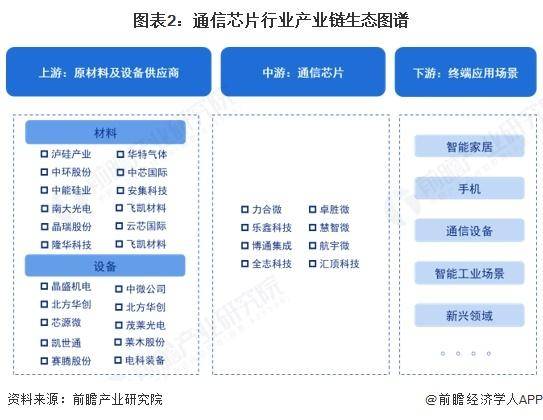
Core Insights - The communication chip industry is experiencing significant investment and development, with major companies actively expanding their production capabilities and focusing on advanced technologies [4][6][8]. Industry Overview - Key listed companies in the communication chip sector include Lihe Micro (力合微), Lexin Technology (乐鑫科技), Broadcom Integration (博通集成), and Allwinner Technology (全志科技) [1]. - The communication chip supply chain consists of upstream raw material suppliers like SMIC and North Huachuang, midstream chip manufacturers such as Lihe Micro and Lexin Technology, and downstream application service providers including Alibaba Cloud and Xiaomi [2]. Investment Trends - Lihe Micro is investing 5 billion yuan in the second phase of its Haining base, aiming to become the largest microwave RF chip production base in China, with a planned annual capacity of 360,000 6-inch chips by 2025 [4][6]. - Guangxun Technology is investing 6.75 billion yuan in a high-end optoelectronic and silicon photonic chip project, focusing on the development of high-speed optical modules for AI computing centers [4][6]. - Lemon Photon is initiating a semiconductor laser chip manufacturing project with an investment of 100 million yuan, expecting cumulative sales of over 340 million yuan in five years [4][6]. - Xincheng Semiconductor is investing 800 million yuan in an IDM production line in Suzhou, which is set to start mass production by December 2024, filling a gap in high-end optical chip manufacturing in China [4][6]. Market Dynamics - The global RF chip market is projected to reach approximately 23.7 billion USD in 2024, driven by technological advancements and the increasing importance of multi-band compatibility [8]. - Filters are becoming the most critical component in RF front-end modules, with their value share increasing from 33% in 3G devices to 57% in LTE devices, and expected to reach 66% in 2024 [7][8]. - The industry is witnessing a trend towards regional supply chain layouts due to geopolitical factors, with companies enhancing competitiveness through technology development and local production [8].
最强赛道“吊车尾”:前海开源人工智能基金为何逆市折戟?
经济观察报· 2026-01-06 09:57
Core Viewpoint - The Qianhai Kaiyuan Artificial Intelligence Fund was the only fund to incur losses in 2025 among 18 AI-themed funds, with a net value growth rate of -4.15%, while others saw gains exceeding 40% [2][5]. Performance Comparison - In 2025, the A-share AI sector experienced strong performance, with the CSI Sci-Tech Innovation AI Index rising by 103.09% and other indices also showing significant increases [4]. - The Qianhai Kaiyuan AI Fund ranked 2242 out of 2274 flexible allocation funds, underperforming its benchmark by 12.55% [5][6]. Fund Management and Strategy - The fund, established in May 2016, focuses on stocks related to AI with at least 80% of its non-cash assets invested in this theme [5]. - The fund was managed by star fund manager Qu Yang until June 2025, when he stepped down due to internal adjustments, with Wei Chun taking over [7]. Investment Strategy Issues - The fund's poor performance was attributed to its focus on end-side AI stocks, while the market was led by AI computing infrastructure stocks [9]. - In Q2 2025, the fund made significant changes to its portfolio, replacing six of its top ten holdings, which subsequently led to substantial losses as these stocks declined [10][11]. Market Trends and Future Outlook - Despite the fund's struggles, the manager Wei Chun anticipates a rapid growth phase for AI hardware in 2026, driven by advancements in AI models and user experience improvements [13].