大成基金

Search documents
铜占比超60%的有色ETF大成(159980)高开涨近3%,连续40日强势“吸金”超46亿元,机构称强基本面或将支撑铜价
Sou Hu Cai Jing· 2026-01-26 02:07
Group 1 - The core viewpoint is that the industrial metal market, particularly copper, is expected to experience a supply shortage due to various constraints, while demand is projected to grow, driven by economic recovery and the energy transition [1][2][3] - The recent performance of the Dazhong Nonferrous ETF (159980) shows a significant increase in both scale and shares, reaching a new high of 79.24 billion yuan and 3.73 billion shares respectively, with a notable net inflow of 46.63 billion yuan over the past 40 days [1] - Copper prices have shown resilience despite multiple negative factors, with recent prices recorded at $13,128 per ton in London and 102,830 yuan per ton in Shanghai, supported by supply constraints and declining ore grades [1][2] Group 2 - Citic Securities highlights that the prices of industrial metals are influenced by both financial and commodity attributes, with expectations of a recovery in demand for copper and aluminum due to low global inventories and economic recovery in China [2] - Huatai Securities forecasts that global electrolytic copper supply will remain limited in 2026, with a year-on-year increase of only 66,000 tons, while demand is expected to grow by 93,000 tons, potentially leading to a shift from surplus to shortage [2] - The Dazhong Nonferrous ETF (159980.SZ) is positioned to capture overall opportunities in the industrial metal sector, with its underlying assets including copper, aluminum, lead, tin, zinc, and nickel futures [3]
供需共振叠加资金涌入 公募发力有色金属赛道
Shang Hai Zheng Quan Bao· 2026-01-25 14:24
Group 1: Institutional Movements - The non-ferrous metal sector is becoming a focal point for both fund companies and investors, with public funds significantly increasing their positions in this industry by Q4 2025 [1][2] - The allocation ratio of non-ferrous metals in actively managed equity funds has notably increased, rising by 2.3 percentage points compared to the end of Q3 2025, driven by strong demand and favorable liquidity conditions [2] - Major funds are concentrating their holdings in strategic metals such as gold, copper, aluminum, tin, and antimony, with specific funds optimizing their stock selections [2] Group 2: ETF Inflows - A substantial amount of capital is flowing into non-ferrous metal ETFs, with a net subscription of nearly 20 billion yuan in Q4 2025 alone [3] - The total scale of non-ferrous metal theme ETFs has surpassed 100 billion yuan, indicating strong investor interest and confidence in this sector [4] Group 3: New Product Launches - There has been a surge in the issuance of new non-ferrous metal-themed ETFs, with four new products currently in the pipeline as of January 23 [4] - The mining companies within the non-ferrous metal sector are expected to benefit significantly from rising metal prices, as their revenues are closely linked to the spot prices of metals like copper, lithium, and zinc [4] Group 4: Long-term Investment Outlook - The long-term investment logic for the non-ferrous metal mining sector is being reinforced due to tightening supply and demand dynamics, alongside a favorable macroeconomic environment [4] - Despite recent price corrections, the overall bullish outlook on resource commodities remains intact, with expectations for long-term investment returns in the non-ferrous sector [5]
今年ETF新品,多点开花
Zhong Guo Ji Jin Bao· 2026-01-25 10:39
Core Insights - The ETF market in 2026 is experiencing robust growth, with 17 new ETFs launched and a total issuance scale nearing 10 billion yuan, representing 22.37% of new fund issuance quantity and 14.69% of scale [1] - The newly established ETFs cover diverse sectors including non-ferrous metals, chips, artificial intelligence, biotechnology, food, batteries, and public utilities [1] Group 1: Market Growth and Demand - Industry experts are optimistic about the growth potential of the ETF market in 2026, driven by long-term capital inflows and upgraded investor demand [3] - Institutional investors, such as insurance companies, are increasingly seeking long-term allocations in the domestic equity market, while individual investors are becoming more accepting of passive index products due to their low fees and high transparency [3][4] - The diversification of ETF products is creating opportunities for innovation, as there are still many gaps in niche sectors, strategies, commodities, bonds, and overseas assets [4] Group 2: Competitive Landscape and Differentiation - The ETF market is characterized by significant concentration among leading firms, posing challenges for smaller fund companies [5] - Smaller firms are encouraged to focus on differentiated product offerings in niche sectors or thematic areas where larger firms have not established a strong presence [5][6] - There is potential for smaller fund managers to explore non-equity asset ETFs to meet the evolving asset allocation needs of investors [6] Group 3: Challenges and Pain Points - Despite growth opportunities, the ETF market faces challenges such as insufficient investor understanding and operational pressures on certain products [7] - Some individual investors lack a deep understanding of ETFs, leading to impulsive trading behaviors, which can negatively impact their investment outcomes [7] - Certain ETFs are experiencing issues with small scale and high operational costs, which can erode investor returns and affect trading efficiency [7]

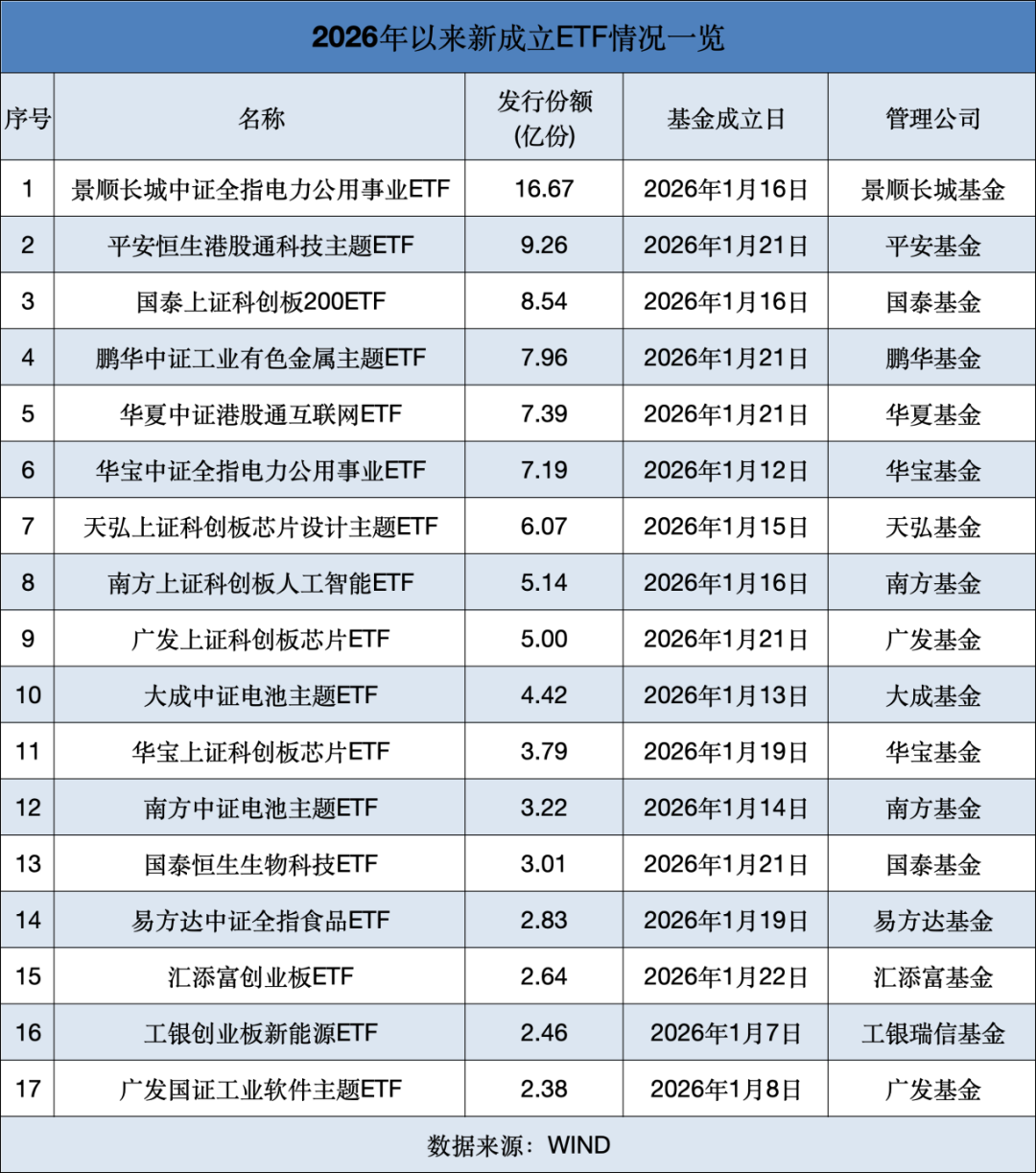
今年ETF新品,多点开花
中国基金报· 2026-01-25 10:28
Core Viewpoint - The ETF market in China is experiencing robust growth in 2026, with a diverse range of new products being launched and a steady increase in scale, indicating a strong market potential and competitive landscape [2][4]. Group 1: New ETF Launches - As of January 24, 2026, a total of 17 new ETFs have been established, with an issuance scale nearing 10 billion yuan, accounting for 22.37% of new fund launches and 14.69% of the total issuance scale [2]. - The newly established ETFs cover various sectors including non-ferrous metals, chips, artificial intelligence, biotechnology, food, batteries, and public utilities [2]. Group 2: Market Growth Drivers - Industry experts are optimistic about the growth potential of the ETF market, driven by long-term capital inflows and evolving investor demands [5]. - Institutional investors, such as insurance companies, are increasingly seeking long-term allocations in the domestic equity market, while individual investors are becoming more accepting of passive index products due to their low fees and high transparency [5]. - There remains significant room for innovation in ETF products, particularly in niche sectors and strategies, as the demand for diversified investment portfolios continues to grow [5]. Group 3: Competitive Landscape - The ETF market is characterized by a concentration of leading firms, posing challenges for smaller fund companies. However, differentiation and refined operations are seen as key strategies for smaller firms to carve out a niche [7]. - Smaller fund companies are encouraged to focus on underrepresented sectors and themes where larger firms have not established a strong presence, thereby building expertise and brand influence [7][8]. - There is a need for smaller firms to innovate in product offerings, such as Smart Beta and ESG-focused ETFs, to meet the diverse asset allocation needs of investors [8]. Group 4: Challenges in the ETF Market - Despite growth opportunities, the ETF market faces challenges such as insufficient investor understanding and operational pressures on certain products [9]. - Some individual investors lack a deep understanding of ETFs, leading to impulsive trading behaviors, which can negatively impact their investment outcomes [9]. - Certain ETFs are experiencing issues with small scale and high operational costs, which can erode investor returns and affect trading efficiency due to low liquidity and high bid-ask spreads [9].

ETF市场跟踪与配置周报-20260124
Xiangcai Securities· 2026-01-24 15:29
1. Report Industry Investment Rating No relevant content provided. 2. Core Viewpoints - The report analyzes the market and ETF performance in the past week, and recommends industries and ETFs to focus on next week based on the PB - ROE framework and the ETF redemption sentiment indicator model [8][36] 3. Summary by Directory 3.1 Recent Market Overview (January 19 - 23, 2026) - Among the 31 Shenwan primary industries, 24 rose and 7 fell. The top three gainers were building materials (up 9.23%), petroleum and petrochemicals (up 7.71%), and steel (up 7.31%); the top three losers were banks (down 2.70%), communications (down 2.12%), and non - bank finance (down 1.45%) [4][11] - The Shanghai Composite Index closed at 4136.16, up 0.84% for the week; the Shenzhen Component Index closed at 14439.66, up 1.11% for the week; the ChiNext Index closed at 3349.50, down 0.34% for the week; the Beixin 50 Index closed at 1588.66, up 2.60% for the week; the Hang Seng Index closed at 26749.51, down 0.36% for the week. The average daily trading volume of the Shanghai and Shenzhen stock markets was 27727.12 billion yuan, and the total trading volume for the week was 13.86 trillion yuan [11] - Main funds had net outflows on 4 trading days and net inflows on 1 trading day, with a total net outflow of 125.207 billion yuan for the week. The industries with more net inflows of main funds were banks, non - bank finance, and non - ferrous metals; the industries with more net outflows were electronics, communications, and computers [4][11] 3.2 Recent ETF Market Performance (January 19 - 23, 2026) 3.2.1 Stock - type ETFs - 8 new stock - type ETFs were listed, including 2 battery ETFs and 6 other stock - type ETFs. 9 new ETFs were established, including 2 Shanghai - STAR Market chip ETFs and 7 other ETFs, with a total issuance scale of 4.416 billion yuan [5][18] - The median weekly increase or decrease of stock - type ETFs was 0.88%. Gold stock ETFs and photovoltaic leading ETFs performed well, with gold stock ETFs rising the most (13.17%); science and innovation semiconductor ETFs and financial real - estate ETFs performed poorly, with science and innovation semiconductor ETFs falling the most (3.86%) [5][21] - The average weekly share change of stock - type ETFs was a decrease of 51.8174 million shares. Chemical ETFs and power grid equipment ETFs had more share increases, with chemical ETFs increasing the most (6.316 billion shares); CSI 300ETF and SSE 50ETF had more share decreases, with Huatai - Ber瑞 CSI 300ETF decreasing the most (15.345 billion shares) [21] 3.2.2 Bond - type ETFs - The median weekly increase or decrease of 53 bond - type ETFs was 0.11%. Convertible bond ETFs had the highest increase (2.94%), and treasury bond ETFs had the lowest increase (0.01%). As of January 23, 2026, the scale of Haifutong CSI Short - term Financing ETF (511360.SH) was the largest, at 70.223 billion yuan [24] 3.2.3 Cross - border ETFs - The median weekly increase or decrease of cross - border ETFs was - 0.66%. The Brazilian ETF and the S&P Biotechnology ETF had high increases or decreases, with the Brazilian ETF rising the most (7.63%); the Hong Kong Stock Connect Innovative Drug ETF and the Hong Kong Innovative Drug ETF had low increases or decreases, with the Hong Kong Stock Connect Innovative Drug ETF falling the most (3.94%) [26] - Since the beginning of the year, the median increase or decrease of cross - border ETFs has been 3.84%. The China - South Korea Semiconductor ETF and the Hong Kong Medical ETF had high increases, with the China - South Korea Semiconductor ETF rising 23.87%; the Nasdaq ETF and the Nasdaq Technology ETF had high decreases, with the Nasdaq Technology ETF falling 2.79% [26] 3.3 PB - ROE Framework - based ETF Rotation Strategy Tracking - The strategy focuses on the communications, agriculture, forestry, animal husbandry, and fishery, and transportation industries, corresponding to their respective industry ETFs. This week, the strategy's cumulative return was 1.29%, the CSI 300 Index's cumulative return was - 0.62%, and the strategy's cumulative excess return relative to the CSI 300 Index was 1.91% [7][31] - Since 2023, the strategy's cumulative return has been 27.65%, the CSI 300's cumulative return has been 21.46%, and the strategy's cumulative excess return relative to the CSI 300 Index has been 6.19% [7][33] - Since 2022, the strategy's cumulative return has been 9.16%, the CSI 300's cumulative return has been - 4.81%, and the strategy's cumulative excess return relative to the CSI 300 Index has been 13.98% [35] 3.4 Investment Recommendations - Based on industry PB - ROE and supplementary indicators, the PB - ROE framework - based ETF rotation strategy recommends focusing on the communications, agriculture, forestry, animal husbandry, and fishery, and transportation industries next week, corresponding to their respective industry ETFs [8][36] - According to the ETF redemption sentiment indicator model, it is recommended to focus on breeding ETFs, satellite ETFs, pharmaceutical ETFs, securities ETFs, and science and innovation AI ETFs next week [8][36]
25Q4主动权益基金季报分析:主动权益四季度加仓周期减持科技,永赢主动权益规模突破千亿
Shenwan Hongyuan Securities· 2026-01-24 09:14
1. Report Industry Investment Rating No relevant content provided. 2. Report's Core View - In Q4 2025, active equity funds decreased their scale, with the scale dropping from about 4 trillion yuan in Q3 to about 3.85 trillion yuan, a decline of 4.14%. Meanwhile, the scale of index funds slightly increased. [10] - The performance of active equity funds in Q4 2025 significantly declined compared to the previous quarter, with about 42.8% of the funds achieving positive returns, and the median return rate was -1.02%. [15] - Active equity funds reduced their holdings in technology and pharmaceutical sectors in Q4 2025 and increased their positions in cyclical sectors. [1] 3. Summary According to Relevant Catalogs 3.1 Fund Four - Quarter Report Investment Outlook Keywords - Technology, consumption, and computing power were the key areas of focus for active equity fund managers in Q4. The trend keywords included "repair", "recovery", and "resilience"; industry - related keywords were "technology", "consumption", and "electronics"; theme - related keywords were "computing power", "robotics", and "new energy"; and event - related keywords were "interest rate cuts", "exports", and "tariffs". [7] 3.2 Performance and Scale Dimension - **Scale Change**: The scale of active equity funds decreased in Q4 2025, while the scale of index funds slightly increased. Fund companies such as Yongying and Guojin saw significant growth in their active equity management scale, with Yongying's active equity scale exceeding 100 billion yuan. [10][14] - **Performance**: The overall performance of active equity funds in Q4 2025 declined significantly. About 42.8% of the funds achieved positive returns, and the median return rate was -1.02%. The top - performing funds in Q4 mainly focused on industries such as military, non - ferrous metals, and communications. [15][17] - **Position and Heavy - Holding Stock Allocation**: The overall position of active equity funds decreased in Q4 2025, with the average stock position dropping to 87.70% (-1.05%), and the Hong Kong stock position also significantly decreasing. The heavy - holding stocks in Hong Kong decreased, while the allocation ratios of heavy - holding stocks in CSI 300, CSI 500, and CSI 1000 increased. [18][19] - **Large - Scale Funds**: The scale of some large - scale active equity funds decreased in Q4 2025, but some funds such as Yongying Ruixin and Yongying Technology Smart Selection saw an increase in their shares. [24] - **New Issuance and Continued Management**: Among active equity products, Yongying Pioneer Semiconductor Smart Selection and Yongying High - end Equipment Smart Selection had the highest estimated net subscription amounts. The new - issue fund Guangfa Quality Selection had the largest issuance scale this quarter. [25] 3.3 Fund Company Dimension - **Performance**: Among active equity fund management companies with a management scale of over 10 billion yuan, Caitong Fund had the best average performance in Q4 2025, with an average return rate of 4.22%. Other companies with good performance included Western Lide, Yongying Fund, and Huashang Fund. [27] - **Scale**: E Fund remained the largest active equity management company in Q4 2025, although its scale decreased slightly compared to the previous quarter. Yongying Fund saw significant growth in its active equity scale in Q4 2025. [30] - **Heavy - Holding Stock Allocation**: Caitong Fund, the top - performing company in Q4, under - allocated non - ferrous metals and other industries and over - allocated electronics, communications, and other industries. Leading fund companies generally over - allocated non - ferrous metals and chemicals and under - allocated pharmaceutical biology. [32] - **Industry Allocation of Leading Fund Companies**: Leading active equity fund management companies' industry over - and under - allocations were mainly concentrated in several popular industries. For example, E Fund significantly over - allocated communications and food and beverages and significantly under - allocated power equipment and pharmaceuticals. [34] - **Market Value and Valuation Style of Heavy - Holding Stocks**: Companies with a relatively large - market - value style in their holdings included Ruiyuan, Morgan, and Huifutianfu; those with a relatively small - market - value style included Yongying, Dacheng, and Nuoyan; companies with relatively high PE in their holdings included Yongying, Huashang, and E Fund; and those with relatively low PE included Ruiyuan, Dacheng, and ABC Fortune. [37]
三七互娱接待111家机构调研,包括淡水泉投资、安信基金、博时基金、创金合信基金等
Jin Rong Jie· 2026-01-23 11:03
2026年1月23日,三七互娱披露接待调研公告,公司于1月22日接待淡水泉投资、安信基金、博时基金、 创金合信基金、财通基金、大成基金等111家机构调研。 调研情况显示,当前游戏市场有三大核心变化和潜力机会:国内小游戏市场高速增长,公司已确立绝对 领先地位,在研多款含IP产品(如《斗破苍穹》IP)并将持续投入以保持领先;SLG赛道战略价值与天 花板突破,公司围绕"轻量化""大题材"布局,多款新产品计划今明年测试,MMO产品《RO 仙境传说: 世界之旅》首发登顶中国港澳台地区榜单并将拓展东南亚、日韩和欧美市场;休闲赛道因碎片化需求增 长,公司海外布局三年处于"种树"阶段,"三消""二合"领域储备产品有望下半年及明年推出。 公司已构建差异化题材立项、工业化管线、研发流程AI应用及人才孵化四大核心研发能力,自研储备 超10款聚焦小游戏和SLG赛道。AI应用深刻改变行业模式,内部AI渗透率超90%,广告投放AI自动比 例超70%,研发美术AI渗透率65%并降低成本,未来AI将深度融合玩法实现"千人千面"。投资重点布局 游戏研发核心资产及AI相关公司(如智谱、月之暗面等)以保障产品供给和业务协同;人才梯队正向 年轻化迈 ...

万物启新,大道骥行——万得基金新年投资策略会成功举办
Wind万得· 2026-01-23 03:30
Core Viewpoint - The investment strategy conference hosted by Wind Fund and Dachen Fund emphasizes the importance of macroeconomic environment, AI themes, and asset allocation for investment planning in 2026, highlighting a pivotal year for value awakening in the Chinese stock market and a dual recovery driven by liquidity and cycles [1][4]. Group 1: Macroeconomic Analysis - The Vice President and Chief Economist of Dachen Fund, Yao Yudong, analyzed the macroeconomic situation for 2026, indicating a transition from "investment in objects" to "investment in people" in China, with a need for consumption structure optimization and facing structural challenges in internal circulation [6]. - The global landscape is characterized by a "flame era" of technological revolution and great power competition, with AI driving industry differentiation and intensifying resource competition [6]. - Investment strategies should focus on "technological innovation + resource autonomy," paying attention to strategic areas such as AI, chips, and copper, while also seizing profit recovery opportunities under anti-involution policies [6]. Group 2: AI and Decision-Making - The head of investment research at Wind Fund, Chen Yidi, discussed how technology is profoundly reshaping the investment research ecosystem, with AI evolving from an efficiency tool to a critical component of decision support [8]. - AI, combined with high-quality structured data, enhances research coverage and reduces "illusion" risks, aiding institutions in building a more stable and consistent decision support system [8]. - The future of decision-making in the industry will shift from experience-driven to data and system-driven, promoting long-term sustainable development [8]. Group 3: Multi-Asset Allocation Insights - A roundtable discussion on multi-asset allocation in a low-interest-rate environment highlighted the rising duration risk in bonds and the normalization of equity market volatility, stressing the need for a well-structured allocation to avoid hidden risks [10]. - Experts suggested reconstructing the "underlying anchor" of multi-asset allocation, focusing on the value of uncorrelated assets, and addressing the mismatch between investor return expectations and risk tolerance through diversified strategies [10]. - The importance of strategy selection over asset selection is increasingly emphasized, particularly in a low-interest-rate environment where the ability to generate Alpha and strategic allocation becomes crucial [10]. Group 4: AI Industry Investment Opportunities - Dachen Fund's stock investment manager, Du Cong, analyzed the core value segments and opportunities within the AI industry chain, noting Google's significant advantages in AI while highlighting relative shortcomings of companies like Amazon and Meta [13]. - Fund manager Guo Weiling focused on the technology sector investment strategy for 2026, asserting that AI remains the main investment theme, with expectations for continued market performance in the first half of the year, albeit with increased investment difficulty compared to 2025 [15]. Group 5: Future Outlook - The conference served as a critical moment for investment layout, gathering industry wisdom to interpret macroeconomic trends and investment research logic, while outlining feasible paths for annual asset allocation [17]. - Wind Fund aims to continue fostering an open, cooperative, and win-win philosophy, collaborating with more industry partners to build a financial ecosystem and leveraging AI to help investors seize development opportunities in the new era of the 14th Five-Year Plan [18]. Group 6: Company Overview - Wind Fund, as an independent sales institution under Wind, ranks among the top 100 sales institutions, with its non-monetary public fund scale among the top 10 independent fund sales institutions as of the second quarter of 2025 [20]. - The company is dedicated to providing off-market fund research and trading management services, creating efficient and convenient one-stop investment research and trading platforms for various financial entities [20].
天禄科技股价涨5.1%,大成基金旗下1只基金位居十大流通股东,持有64.08万股浮盈赚取117.91万元
Xin Lang Cai Jing· 2026-01-23 02:26
Group 1 - Tianlu Technology's stock increased by 5.1%, reaching 37.90 CNY per share, with a trading volume of 55.52 million CNY and a turnover rate of 2.37%, resulting in a total market capitalization of 4.181 billion CNY [1] - Suzhou Tianlu Optical Technology Co., Ltd. was established on November 9, 2010, and went public on August 13, 2021. The company's main business involves the research, production, and sales of light guide plates, with revenue composition being 97.85% from light guide plates and 2.15% from other sources [1] Group 2 - Among Tianlu Technology's top ten circulating shareholders, a fund under Dacheng Fund holds a position. The Dacheng CSI 360 Internet + Index A (002236) reduced its holdings by 13,800 shares in the third quarter, now holding 640,800 shares, which is 1% of the circulating shares. The estimated floating profit today is approximately 1.1791 million CNY [2] - The Dacheng CSI 360 Internet + Index A (002236) was established on February 3, 2016, with a current scale of 754 million CNY. Year-to-date returns are 9.8%, ranking 1497 out of 5546 in its category; the one-year return is 53.39%, ranking 1147 out of 4261; and since inception, the return is 263.13% [2]
激烈!公募基金最新数据出炉!非货万亿俱乐部再添新丁,5家机构规模缩水超百亿元
券商中国· 2026-01-23 01:17
Core Viewpoint - The public fund industry in China is experiencing significant shifts in product scale and investor preferences, with a notable divergence in risk appetite among investors, leading to a mixed environment of opportunities and challenges for the industry [2]. Group 1: Market Trends - Since the fourth quarter of last year, there has been a rapid rotation in market styles, with a clear adjustment in the scale of industry products. Index funds, mixed bond funds, commodity funds, overseas investment funds, and FOFs have all seen growth, while actively managed equity funds and pure bond funds continue to shrink [2]. - As of December 31, 2025, the total net asset value of public funds exceeded 37.64 trillion yuan, marking a historical high, with continued net inflows into the public fund market [3]. - The bond fund sector has rebounded, with a quarterly growth exceeding 300 billion yuan, bringing the total scale close to 11 trillion yuan, also a historical high [4]. Group 2: Fund Performance - Actively managed equity funds faced net redemptions, with investors losing confidence despite improved performance. The overall share of these funds showed a net outflow in the fourth quarter [3]. - In contrast, investors favored index equity funds, particularly the A500 index ETFs, which saw significant inflows, with several funds growing by over 10 billion yuan in the fourth quarter [3]. Group 3: Multi-Asset Growth - 2025 is marked as a year of explosive growth for multi-asset funds, with overseas investment funds, commodity funds, and FOFs experiencing substantial increases in scale. The commodity fund sector saw a quarterly increase of over 45%, with gold and silver products leading the growth [5][6]. - The FOF products regained popularity, with several newly established funds achieving impressive fundraising results in the fourth quarter [6]. Group 4: Competitive Landscape - The public fund industry exhibits a pronounced "Matthew Effect," where leading firms maintain strong competitive positions, while mid-tier firms face intense competition. The top three firms in non-monetary fund scale are E Fund, Huaxia Fund, and GF Fund, with GF Fund recently surpassing the 1 trillion yuan mark for the first time [7][8]. - Smaller firms, some with non-monetary scales below 100 billion yuan, have also shown significant growth, with several achieving over 10 billion yuan in quarterly increases [9].