中国平安

Search documents
东吴证券晨会纪要2026-01-26-20260126
Soochow Securities· 2026-01-25 23:30
Macro Strategy - The report highlights the investment value of the GF CSI Media ETF (512980.SH), which is closely tracking the CSI Media Index (399971.SZ) and has a management fee of 0.5% per year and a custody fee of 0.1% per year. As of January 16, 2026, the ETF has a circulation scale of 10.759 billion yuan and an annualized return of 29.47% with a volatility ratio of 0.89, indicating reasonable risk control capabilities [1][12] - The underlying index focuses on AI applications, with a significant weight of 31.43% in GEO concept stocks, including key companies like BlueFocus, Yanshan Technology, and Kunlun Wanwei. The top ten weighted stocks account for 51.52% of the index, indicating a high concentration of component stocks [1][12] - The report emphasizes that the current media bull market is driven by AI technology transformation and the assetization of data factors, contrasting with the previous bull market driven by mobile internet traffic. The media sector's valuation is at a historical low, providing a high margin of safety for investors [1][12] Non-Bank Financial Industry - The report indicates that the non-bank financial sector is experiencing an upward trend in market conditions, with public fund holdings in the sector increasing to 2.42% by the end of 2025, up 0.82 percentage points from the previous quarter. However, the sector remains underweight compared to the market [5][16] - The report recommends key stocks such as China Life, Ping An, New China Life, China Pacific Insurance, and CITIC Securities, highlighting their potential to benefit from the improving market environment [5][16] - The average daily trading volume of equity funds reached 34.444 trillion yuan, a year-on-year increase of 155%, indicating a significant improvement in market activity [5][16] Real Estate Industry - The report notes that the real estate market is gradually stabilizing, with a narrowing decline in sales and construction metrics compared to 2024. The total development investment in 2025 was 8.3 trillion yuan, down 17.2% year-on-year, while the new construction area was 5.9 million square meters, down 20.4% [6][18][19] - Sales figures show a cumulative sales area of 8.8 million square meters, down 8.7% year-on-year, with a cumulative sales amount of 8.4 trillion yuan, down 12.6%. The decline in sales is narrowing, particularly in first-tier cities [6][18][19] - Investment recommendations include China Resources Land, China Merchants Shekou, and New City Holdings, with a focus on property management companies like China Resources Mixc Life and Greentown Service [6][18][19] Environmental Industry - The report discusses the growth potential of the waste incineration sector, particularly in Southeast Asia and India, where an estimated 500,000 tons per day of waste incineration capacity is expected, corresponding to an investment scale of approximately 250 billion yuan [7][20] - Companies like Weiming Environmental and Sanfeng Environment are highlighted for their overseas expansion and operational stability, with significant revenue increases driven by high electricity prices and processing fees in international markets [7][20] - The report emphasizes the importance of cost control in overseas projects, with potential for significant profit margins compared to domestic projects, particularly in Indonesia where new projects are expected to yield higher returns [7][20]
农险扩面提质结硕果
Jing Ji Ri Bao· 2026-01-25 22:17
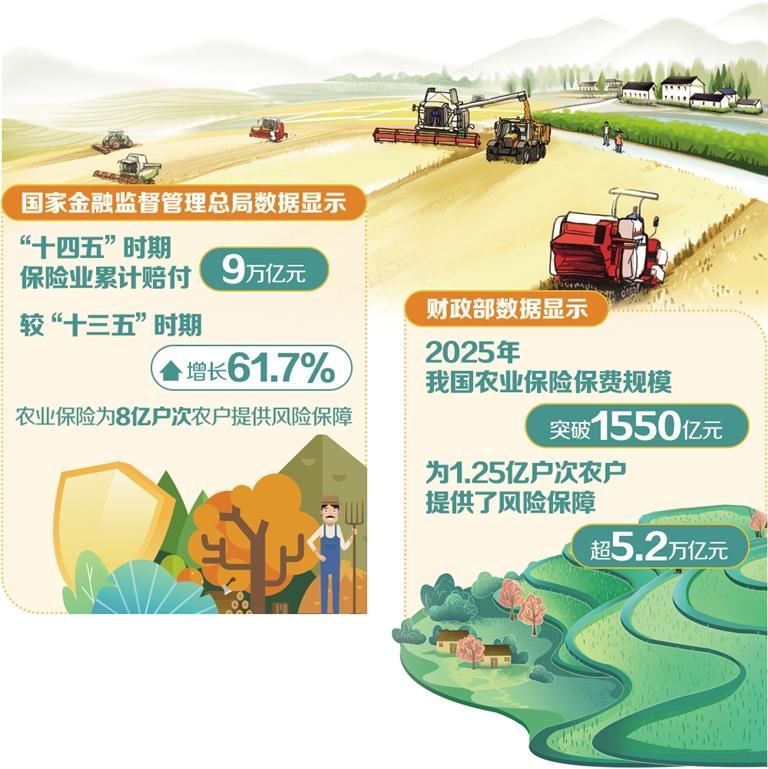
Core Insights - The central economic and rural work meetings in 2025 have systematically deployed strategies for "three rural issues," emphasizing the importance of agricultural insurance in supporting rural revitalization and food security [2] - Agricultural insurance premiums in China have steadily increased, with a total payout of 9 trillion yuan during the 14th Five-Year Plan, marking a 61.7% increase compared to the previous plan [2] - The agricultural insurance sector is evolving from cost coverage to income protection, addressing significant disaster risks associated with agricultural production [4] Agricultural Insurance Development - The planting areas of rice, wheat, and corn account for over 80% of China's total grain area, with these crops being the main focus of agricultural insurance policies [3] - The development of agricultural insurance has progressed in stages every 5 to 6 years, with the introduction of basic insurance in 2007 and the expansion of comprehensive cost and income insurance starting in 2018 [3] - In 2023, agricultural insurance payouts exceeded 2.6 billion yuan due to adverse weather conditions affecting wheat crops, demonstrating the critical role of insurance in mitigating farmers' losses [3] Expansion of Coverage - The scope of comprehensive cost and income insurance is expanding, with new policies for sugarcane and soybeans set to cover more regions by 2026 [4] - The establishment of a disaster model for major crops aims to assess risks from various natural disasters, enhancing the insurance framework [4] Specialized Agricultural Products - Agricultural insurance in China is categorized into central government-subsidized products and local specialty products, with a focus on expanding coverage and improving product offerings [5] - Insurance products tailored for geographical indication agricultural products have been developed, providing significant risk coverage for specific crops [5] Technological Integration - The insurance sector is increasingly adopting digital transformation to enhance efficiency in underwriting and claims processing, with a focus on a comprehensive risk management service model [7] - The use of advanced technologies such as drones and AI is being encouraged to improve the accuracy and timeliness of insurance services [10] Future Outlook - By 2025, agricultural insurance premiums are projected to exceed 155 billion yuan, providing risk coverage for over 1.25 billion farmers [11] - The Ministry of Finance plans to continue enhancing the quality and efficiency of agricultural insurance, with a guiding document expected in 2026 to support high-quality development [11]

手握近2000亿元额度 险资为何对黄金“克制”入场?
Zheng Quan Ri Bao· 2026-01-25 18:00
Core Viewpoint - The rising gold prices have sparked extensive discussions regarding their future trends and investment value, particularly in the context of insurance funds' involvement in gold investments, which has been under trial for nearly a year [1][2]. Group 1: Insurance Funds' Involvement - The National Financial Regulatory Administration has allowed insurance funds to participate in gold investments since February 2025, with ten insurance companies as the first batch of trial participants [2]. - As of March 2025, several major insurance companies, including People’s Insurance Company, China Life, and Ping An Life, have become members of the Shanghai Gold Exchange and completed their first gold transactions [2]. - Despite the opening of investment channels, the actual investment proportion remains low due to the trial's early stage, rapid gold price increases, and the ongoing development of professional investment teams within insurance companies [2][3]. Group 2: Investment Limits and Caution - The trial regulations stipulate that the total investment in gold by insurance companies must not exceed 1% of their total assets from the previous quarter, theoretically allowing for nearly 200 billion yuan in gold asset allocation across the ten trial companies [3]. - Insurance companies are currently maintaining a cautious approach to gold investments, primarily due to the high gold prices and the need to build specialized investment teams [3][4]. - Experts indicate that the current phase is characterized by a defensive investment strategy, with insurance companies gradually accumulating experience in gold investments [3][5]. Group 3: Long-term Strategic Value - The cautious stance of insurance companies does not negate the long-term strategic value of gold, which is seen as a means to optimize asset allocation and reduce overall portfolio volatility [4][5]. - Gold's low correlation with stocks and bonds makes it a valuable asset for insurance funds, particularly in managing long-term liabilities associated with life insurance and annuity products [5][6]. - The potential for gold to serve as a stabilizing asset in the face of inflation and economic fluctuations is recognized, with international practices suggesting that gold can be a long-term holding for insurance companies [6][7]. Group 4: Recommendations for Future Investment - Experts recommend a gradual and cautious approach to gold investment during the trial phase, with a focus on integrating gold allocation with liability duration management to prevent short-term trading behaviors [7]. - Suggestions include optimizing the solvency framework, adjusting risk factors for gold investments, and improving accounting treatment to reflect long-term volatility without significantly impacting current profits [7].
解码公募基金2025年四季报:主动权益基金重仓电子、医药生物等行业
Zheng Quan Ri Bao Zhi Sheng· 2026-01-25 17:07
Group 1 - The core focus of the news is on the performance and trends of actively managed equity funds, highlighting their significant stock positions and preference for value style investments [1][2][4] - As of the end of 2025, the total scale of actively managed equity funds reached 3.91 trillion yuan, with equity mixed funds dominating both in number (2,770 products) and scale (2.41 trillion yuan), accounting for over 61% of the total [1][2] - The number of new actively managed equity fund products launched in Q4 2025 was 112, with a total scale of 570.83 billion yuan, maintaining stability compared to Q3 2025 [2] Group 2 - The top three sectors favored by actively managed equity funds as of the end of 2025 were electronics, pharmaceuticals and biology, and power equipment, with the electronics sector having the highest holding ratio at 23.76% [4] - The top three individual stocks held by actively managed equity funds were Zhongji Xuchuang, Xinyi Sheng, and Ningde Times [4] - The overall performance of actively managed equity funds in Q4 2025 was weaker compared to Q3 2025, although flexible allocation mixed funds outperformed the CSI 300 index with a quarterly return of 0.26% [2][3] Group 3 - The stock positions of actively managed equity funds remained high in Q4 2025, with equity investment funds at 90.54%, equity mixed funds at 87.82%, and flexible allocation mixed funds at 74.20% [3] - The market outlook for 2026 is optimistic, with expectations of a shift from valuation-driven growth to fundamental-driven growth as corporate earnings stabilize [5][6] - The current low interest rate environment enhances the attractiveness of equity assets, with potential for significant capital inflow into A-shares and Hong Kong stocks [6]






春节红包行情蓄力稳行,科技与价值各有亮点
Haitong Securities International· 2026-01-25 13:33
[Table_Title] 研究报告 Research Report 25 Jan 2026 中国策略 China Strategy 春节红包行情蓄力稳行,科技与价值各有亮点 Spring Festival "Red Packet" Rally Builds Momentum Steadily, with Highlights in Both Tech and Value 周林泓 Amber Zhou 黄雨昕 Yuxin Huang 从本周表现看,大盘如期震荡休整,市场整体情绪有所降温之后更健康,半导体走势偏强,航天军工等方向短期 震荡调整之后再次回暖。 我们判断,春节红包行情仍将蓄力稳行。从结构来看依然聚焦"高科技+强周期",具体而言: ——高科技方向的机会:一方面,可继续延着当前年报预告业绩超预期的方向,深挖半导体特别是存储、储能、 电网设备、化工、创新药等方向。另一方面根据十五五规划相关的产业引领,进一步聚焦掘金国防军工、国产算 力/芯片、太空算力、可控核聚变等领域龙头。 ——价值方向的机会:首先,继续持有黄金及相关权益资产。其次,在震荡中择机布局性价比高、基本面改善的 低位价值股机会,关注港股具有业绩 ...
公募去年四季度亏超千亿终结七连盈,科技周期成加仓核心
第一财经· 2026-01-25 13:23
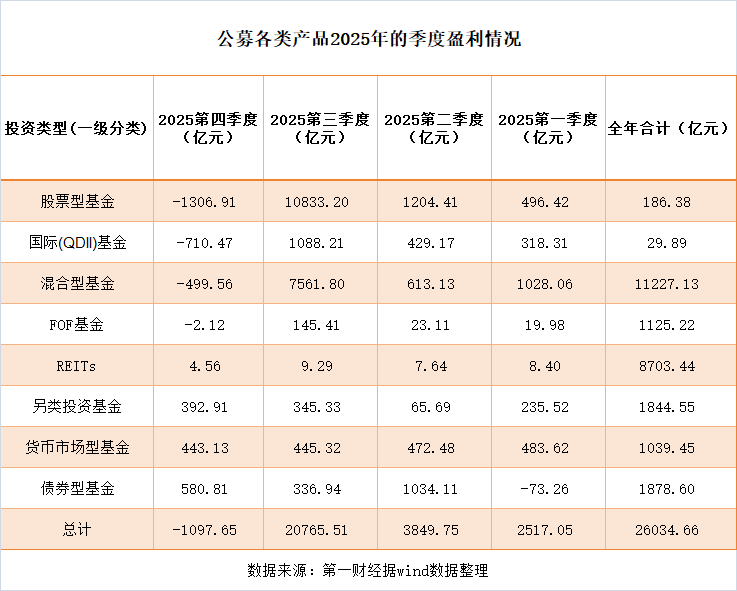
Core Viewpoint - The A-share market experienced significant fluctuations around the 4000-point mark, leading to a loss of profitability for public funds in the fourth quarter of 2025, marking the first loss after seven consecutive profitable quarters. However, the overall annual profit reached a record 2.6 trillion yuan, recovering losses from previous years [3][6]. Fund Performance - In Q4 2025, public funds reported a total loss of approximately 1.1 billion yuan, ending a streak of profitability. Despite this, the annual profit of 2.6 trillion yuan set a historical record, covering cumulative losses of 1.87 trillion yuan from 2022 to 2023 [6][8]. - Equity funds were the hardest hit in Q4, with a combined loss of 1.81 trillion yuan, while mixed funds also faced losses. In contrast, bond and money market funds continued to perform well, contributing significantly to overall profits [6][9]. Fund Adjustments - Public funds actively adjusted their holdings in response to market conditions, increasing their positions in technology and cyclical sectors. Notably, Zhongji Xuchuang replaced Ningde Times as the top holding among active funds [3][11]. - The top ten heavy stocks saw minimal changes in total market value, but individual rankings shifted significantly, with Zhongji Xuchuang and Xinyi Sheng surpassing Guizhou Moutai in holdings [12][13]. Sector Focus - The electronic sector emerged as the largest area of investment for public funds, with a total market value of 741 billion yuan. The power equipment sector followed closely, while the communication sector became the third-largest focus, overtaking the pharmaceutical sector [17]. - Public funds increased their positions in oil, non-bank financials, and metals, with significant additions in stocks like Industrial Bank and China Petroleum [15][16]. Market Outlook - Analysts suggest that while sectors like new consumption and AI show strong fundamentals, valuation concerns may arise due to market liquidity tightening. Dividend investments are expected to perform better in 2026 compared to the previous year [17].

2025Q4非银板块公募持仓点评:非银重仓环比提升,保险获显著增配
HUAXI Securities· 2026-01-25 13:10
[Table_Title2] 保险Ⅱ 行业评级: 推荐 证券研究报告|行业点评报告 [Table_Date] 2026 年 01 月 25 日 [Table_Title] 2025Q4 非银板块公募持仓点评:非银重仓环 比提升,保险获显著增配 ► 保险板块环比显著增配 在主动基金重仓持股口径下,保险板块持仓比例由三季度末的 0.61%显著提升至四季度末的 1.25%,我们预 计主要系 2026 年开门红和资负匹配均预期向好。个股上,四季度末保险板块持仓市值前五大股票分别为:中国 平安 A 持股数量 3.15 亿股(环比+97.6%)、持仓市值 215.44 亿元(环比+145.2%);中国太保 A 持股数量 1.78 亿股(环比+66.3%)、持仓市值 74.68 亿元(环比+98.4%);中国人寿 H 持股 1.48 亿股(环比 +44.2%)、持仓市值 36.61 亿元(环比+76.7%);中国平安 H 持股数量 0.59 亿股(环比+107%)、持仓市值 34.79 亿元(环比+151.5%);新华保险 A 持股数量 0.40 亿股(环比+33.5%)、持仓市值 28.05 亿元(环比 +52.2%)。 ...
24%高息产品被叫停,两大平台业务关停退场
21世纪经济报道· 2026-01-25 12:52
Core Viewpoint - The recent regulatory changes in the small loan sector have led to significant disruptions in the credit guarantee insurance business, with major players like Dadi Insurance and Sunshine Insurance halting their financing guarantee services due to increased compliance pressures and risk management challenges [1][5][13]. Group 1: Regulatory Changes and Business Impact - The annualized interest rate cap for small loans has been set at 24%, leading to the cessation of products exceeding this rate [1][9]. - Dadi Insurance and Sunshine Insurance have announced the closure of their financing guarantee business, with Dadi stopping new business from the end of 2025 and Sunshine closing its related offline outlets and systems [1][4]. - The financing guarantee insurance business, which previously accounted for over 90% of the credit guarantee insurance market, is experiencing a significant contraction due to stricter regulations and the need for strategic focus [5][7][10]. Group 2: Industry Trends and Player Responses - Major players in the credit guarantee insurance sector, including Dadi and Sunshine, are not alone in their exit; other companies like Pacific Insurance have also withdrawn from this business segment [7][8]. - The industry has seen a clear trend of consolidation, with leading firms focusing on lower-risk insurance products such as health and auto insurance, while scaling back on high-risk financing guarantee services [8][12]. - The shift in focus is driven by the need to optimize resources and reduce capital occupation associated with high-risk financing guarantee insurance [8][14]. Group 3: Market Dynamics and Future Outlook - The financing guarantee insurance business is fundamentally linked to credit risk, which has been exacerbated by economic fluctuations and rising default rates among borrowers [8][14]. - The tightening of regulations is expected to reshape the credit landscape, leading to a potential consolidation of smaller players and a focus on high-quality borrowers [15][16]. - The overall impact of these regulatory changes is anticipated to lead to a more sustainable credit environment, aligning with the needs of the real economy [15].


非银金融行业周报:偏股基金新发同比明显增长,公募强化基准约束-20260125
KAIYUAN SECURITIES· 2026-01-25 12:45
Investment Rating - The industry investment rating is "Overweight" (maintained) [1] Core Insights - The report indicates a significant improvement in market trading volume and new fund issuance at the beginning of 2026, which is favorable for the fundamentals of financial IT and brokerage sectors. Brokerage firms are expected to continue rapid growth in their brokerage business, while investment banking, asset management, and overseas expansion are likely to enhance the return on equity (ROE) of leading brokerage firms. The insurance sector has also seen a strong start in both individual and bank-insurance channels, with a continued trend of deposit migration, suggesting a positive outlook for the insurance sector in the spring market [4][6]. Summary by Sections Brokerage Sector - Daily average trading volume for stock funds reached 3.44 trillion, down 16% week-on-week; however, the average trading volume since the beginning of 2026 is 3.64 trillion, a 105% increase compared to Q1 2025 [4] - New stock and mixed fund issuance in January 2026 totaled 44.3 billion, a 56% year-on-year increase [4] - The "Public Fund Performance Benchmark Guidelines" was officially released on January 23, 2026, establishing stricter standards for benchmark selection and changes, enhancing performance evaluation and compensation management systems [4] Insurance Sector - The fourth quarter of 2025 saw a stable research value for ordinary life insurance products at 1.89%, slightly down from 1.90% in the previous quarter, indicating a trend towards stability [6] - The individual insurance channel is under pressure due to various factors, but the strong start in 2026 is expected to improve new policy growth, aided by favorable market conditions [6] - The stabilization of long-term interest rates and a favorable equity market are expected to enhance net assets and profitability for insurance companies, with a potential valuation recovery towards 1x PEV for leading firms [6] Recommended Stocks - Recommended stocks include Guangfa Securities, Guotai Junan, Huatai Securities, and China International Capital Corporation H, as well as China Life, China Pacific Insurance, and Ping An Insurance [7]




公募去年四季度亏超千亿终结七连盈,科技周期成加仓核心
Di Yi Cai Jing· 2026-01-25 12:00
Core Insights - The public fund industry in China achieved a record profit of 2.6 trillion yuan in 2025, recovering from a cumulative loss of 1.87 trillion yuan from 2022 to 2023 [1][2] - Despite a loss of approximately 110 billion yuan in Q4 2025, the overall annual performance marked a significant recovery for the industry [2][3] Fund Performance - In Q4 2025, public funds reported a total loss of 1,097.65 billion yuan, ending a streak of seven consecutive profitable quarters [2][3] - Equity funds were the hardest hit, with a combined loss of 1,306.91 billion yuan in Q4, while mixed funds lost 499.56 billion yuan [3][4] - For the entire year, equity funds still managed to generate a profit of 1.99 trillion yuan, despite the Q4 downturn [4] Product Categories - QDII funds and FOF funds also faced losses in Q4, amounting to 710.47 billion yuan and 2.12 billion yuan respectively, but ended the year with profits of 1,125.22 billion yuan and 186.38 billion yuan [4] - Fixed-income products, including bond and money market funds, contributed significantly to profits, with bond funds earning 580.81 billion yuan and money market funds 443.13 billion yuan [4] Fund Company Performance - Among 167 fund companies, 108 reported positive profits, with over 60% achieving profitability [5] - Notable performers included Guotou Ruijin Fund, which led the industry with a profit of 72.82 billion yuan [5] Stock Holdings Adjustments - Public funds increased their holdings in 83 new stocks by the end of Q4 2025, with a focus on technology and cyclical sectors [7] - Ningde Times remained the top holding stock, despite a reduction of 1,993 million shares, while Zhongji Xuchuang became the most held stock among active funds [10][11] Sector Focus - The communication sector, particularly in optical modules, saw increased institutional investment, with Zhongji Xuchuang and Xinye Technology becoming top holdings [10] - The top three sectors for public fund investments were electronics, power equipment, and communication, with significant capital allocated to these areas [13]